READING FROM THE MARGINS: A STUDY OF EMERGENT BILINGUAL STUDENTS’ WRITTEN RESPONSES TO TEXT
Beverly L. Schieman
A dissertation submitted to the faculty at the University of North Carolina at Chapel Hill in partial fulfillment of the requirements for the degree of Doctor of Philosophy in the School of
Education (Culture, Curriculum, and Change).
Chapel Hill 2017
Approved by:
Madeleine Grumet
Lynda Stone Michael Dominguez
Suzanne Gulledge
©2017
ABSTRACT
Beverly L. Schieman: Reading from the Margins: A study of emergent bilingual students’ written responses to text
(Under the direction of Madeleine Grumet)
There are myriad strategies for teaching literacy to emergent bilingual students that often reduce the amount of English that must be spoken, written, or read by the student so as to facilitate completion of assignments. Such strategies can bar students from meaningful literacy experiences for most if not all of their formal English education. In this study, I explore the use of margin writing in a sheltered middle school English Language Arts
classroom for students identified as SIFE (Students with Interrupted Formal Education). The participants are six Karen students who received their early literacy education in refugee camps in Thailand. Over the course of their eighth grade year, they wrote their responses to the class’s assigned texts in the text margins for the purpose of facilitating in-class discussion about the texts. I use text analysis to investigate the students’ interactions with the books they read, and to gain a greater understanding of their reading processes. I also conducted a focus group interview with the students a year after their middle school experience asking them about their personal histories with literacy learning, from the refugee camp to high school. Applying literary response theory and curriculum theory to the interpretation of the data gleaned in this research, I analyze the ways that margin writing freed emergent bilingual students from the constraints of formal English education and opened up their literacy
ACKNOWLEDGEMENTS
No one works on any great task alone, even when the many hours spent in front of a computer screen at midnight make you feel otherwise. There is no way I could have made it to this point in this process, or even this point in my life, without the support of many others. It takes a village to write a dissertation.
I am grateful to Melissa Miller and to Gregg and Lori Ireland, without whom I would never have been able to begin my journey at UNC.
I am grateful to Madeleine Grumet, my mentor and advisor, without whom I would never have been able to finish. Her faith, encouragement and model of excellence in scholarship continue to be a guiding star for me to follow.
I am grateful to my committee members Lynda Stone, Julie Justice, Suzanne Gulledge and Michael Dominguez, for their patience and flexibility. Together, they form a dream team of everything I hope to be as I follow in their footsteps.
I am grateful to my colleagues at Smith Middle School for their infinite stores of support and patience each day, and for always asking about my progress and congratulating me when I finished.
I am grateful to my dearest friends who cheered for me, loudly, from the sidelines. I am grateful to my family members who stepped in to help clear the obstacles in my path.
“And whoever thinks these are worthy, breathy words I am writing down is kind. Writing is neither vibrant life nor docile artifact but a text that would put all its money on the hope of suggestion. Come with me into the field of sunflowers is a better line than anything you will find here, and the sunflowers themselves far more wonderful than
any words about them.” (Oliver, 2016, p. 4)
Dedicated to my Karen students who raise their heads and continue to turn towards the sun . . .
PREFACE
One of my most prized possessions is a battered paperback copy of Heart of Darkness and The Secret Sharer by Joseph Conrad (1902, 1989), obtained during my freshman year of
high school in my English class. I hold it in my hand delicately, a cooled, compact heart of its own. If you open the book to the middle--the space between the short story and the novella--the binding cracks and exposes a white bone of cardboard between tanning pages. Across those tanning pages are the black bubbly print letters of a teenage girl. Writing hard, but fast . . . with purpose. The writing in that “space between” . . . after the last words on one side, “. . . seemed to lead into a heart of immense darkness” and on top of the centered title “The Secret Sharer” on the next . . . is the second half of a conversation between a fifteen-year-old girl and Joseph Conrad. It is the recorded document of one person waking up to the voice of another, finally realizing, after years of voracious reading that rolled in and out of her brain like pleasant movie reels, that someone REAL was actually talking to her. And she had to talk back . . . because what she was reading awakened her. She was asked to question what she had just heard, to join in the discussion, to add to it her own thoughts and
experiences, which at fifteen, she had had just enough to have something to contribute. I mark this day, which I can still see so clearly in my mind, as a momentous one. I was already a reader, but I hadn’t really become a true responder until that moment.
Secret Sharer? However, as an ESL teacher, that job is sometimes beset with difficulties that
I had not anticipated. A fifteen-year old is ripe to bring his/her lived experience to that of a novelist and have a conversation, if a green one. But what if those fifteen-year olds have never identified themselves as readers, going even so far as to self-describe as
“non-readers”? What if those children grew up in a place where reading books was not a cultural standard? What if those fifteen-year olds bring to the book a world of experience that is rich, but incongruous? How will they respond to the conversation? Will that play a role, or can they start from scratch, a sojourner in a new land?
“I talk to the book like it’s my friend.” This is how a former student of mine recently responded to a casual question about his experience with books. This statement came a year and a half after he was first asked to read a book and annotate it for an enrichment
activity. Recognizing him as an extremely bright and precocious child, I felt it necessary to differentiate his instruction to include more advanced reading to boost his language level to his academic potential. His first assignment was to read a graphic novel and respond in a journal, in which I gave him a list of prescribed vocabulary from the story and asked him to answer pre-written questions about theme and foreshadowing, etc. The vocabulary exercises were done hastily and the answers to the questions short and perfunctory; it was not the enriching experience I had planned. Even my attempts to respond to his answers with my own personal thoughts as models didn’t seem to elicit the deeper connection to the text I was hoping for. I felt immense frustration, as this work did not mirror the verbal responses and creative connections I had heard him share in class. Then I remembered my copy of Heart of Darkness and The Secret Sharer, and decided to try, instead, to have him respond directly to
1981), a novel, based on a true story, about a teacher reenacting mob mentality in the classroom as a lesson about World War II. The book was selected based on my knowledge of the student’s reading level and areas of interest. After a pre-reading session in which I showed him snippets of video about the true story of this experiment, and discussed what the good and bad sides of such an activity might be, I sent him home with instructions to read the first twenty pages of the book, annotating as he went. The next day, he returned to me
distraught and embarrassed, admitting he only made it through sixteen pages after working for an hour. I was shocked and dismayed. Had I misjudged his reading ability? Had I pushed him into text he was not ready for? Then, I opened the book.
I had expected to find the typical annotations taught to every middle-school student: a few underlined vocabulary words defined in the margin (often out of context), an
identification of a metaphor here and there to impress the teacher. There were vocabulary struggles, to be sure, of a student not yet comfortable using context to help with
understanding, but what dominated the margins most were words and phrases of
done the same thing”. Even, at the end of a chapter, a philosophical statement: “Everybody is meant to be different in this world, we are not meant to be the same.”
It was more than I had ever expected from him. He wasn’t annotating by checking off a teacher-provided list of what annotations should look like. He was in the moment, in the text and talking back to the author, judging the characters, siding with them, finding himself. He talked to the book like it was his friend.
A year and a half later, I had provided personal copies of other texts to him and five other students, all of whom were emergent bilingual refugees from Thailand, self-identifying as “non-readers” before their 8th grade year started. Technically, they could read within one or two grade levels of their actual grade, but they didn’t connect being “readers” to their identities. Now there exists 25 paperback novels full of margin writing in which these same students have conducted their own conversations with authors, becoming not just readers, but intimate conversants . . . secret sharers.
that may act as windows into the literacy experiences and intelligences of these individuals, and perhaps clues to designing pedagogy that might better serve them.
In the children’s book Many Moons by James Thurber (1943) a king is dismayed because his daughter is sick. She tells her father what she needs to get better—literally, the moon. The king then calls upon his many advisors, all learned scholars, to figure out how to do this. Citing their own experience, the scholars proclaim that they know everything about the moon’s dimensions, composition and distance (though each has different ideas about what these measurements are), and that the task that she asks is impossible. Distraught, the king turns to his court jester for comfort. The jester suggests that the person who holds the answer to what the princess needs might be the very person who needs it. “They are all wise men,” the jester says of the consultants, “and so they must all be right. If they are all right, then the moon must be just as large and as far away as each person thinks it is. The thing to do is to find out how big the Princess Lenore thinks it is, and how far away.”
The princess describes the moon as “a little smaller than my thumbnail” and “not as high as the tree outside my window” because that is her experience and view of the moon.
Though she has not directly touched the moon, she is convinced it is “made of gold.” The jester has the goldsmith make her a moon the size of her thumbnail that she can wear around her neck, and she gets better. The king worries that his daughter will discover the truth when she sees the moon has returned to the sky the next night, but when she does, she says that many things grow back when cut or are removed for one’s own purpose, “And it is the same way with the moon…I guess it is the same way with everything.”
TABLE OF CONTENTS
LIST OF TABLES ... xvi
LIST OF FIGURES ... xvii
CHAPTER 1: INTRODUCTION ... 1
1.1 The Problem: Emergent Bilingual Students and the Literacy Curriculum ... 1
1.2 Purpose of the Study: Finding a Way In ... 4
1.3 Terminology Used ... 5
CHAPTER 2: REVIEW OF THE LITERATURE ... 6
2.1 Literacy and Agency ... 6
2.2 Reader Response Theory and Emergent Bilinguals ... 9
2.3 Margin Writing ... 12
CHAPTER 3: METHODOLOGY ... 14
3.1 Participants ... 14
3.1a Karen Language, Culture and Literacy Practices ... 14
3.2 Data Set 1: Margin Writing in Class-assigned/Enrichment Texts ... 17
3.3 Data Set 2: Focus Group Interview Transcripts ... 19
3.4 Member Checks ... 20
3.5 Limitations to the Study ... 20
CHAPTER 4: TEXT ANALYSIS ... 22
4.2 Analysis of Themes ... 24
4.2a Feeling ... 24
4.2b Responding ... 25
4.2c Understanding ... 26
4.2d Connecting ... 27
4.2e Predicting ... 27
4.2f Pictures ... 27
4.3 Text Analyses ... 28
4.4 Text Analysis Findings ... 69
CHAPTER 5: FOCUS GROUP FINDINGS ... 73
5.1 Silence, Feeling Like “the Other”, and the Value of Emotions ... 73
5.2 The Emotional Life of the Reader-responder ... 78
5.3 The “Ins” and “Outs” of Text ... 81
5.4 Where There’s a Will… ... 84
5.5 “Respond to Me”: The Role of Culture ... 88
5.6 Readers in Exile ... 97
CHAPTER 6: DISCUSSION ... 102
6.1 The Emancipators ... 102
6.2 Conclusion ... 111
LIST OF TABLES
TABLE PAGE
LIST OF FIGURES
FIGURE PAGE
Figure 1: Thoo Wah Text Analysis ... 32
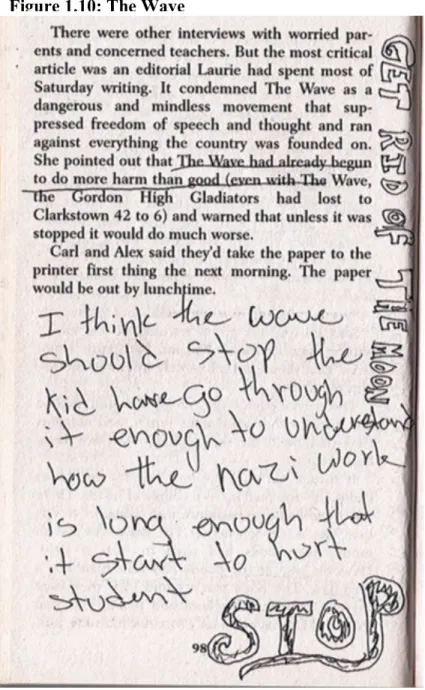
1.1: The Wave ... 33
1.2: The Wave ... 34
1.3: Speak ... 34
1.4: Speak ... 35
1.5: The Wave ... 35
1.6: The Wave ... 35
1.7: The Adventures of Huckleberry Finn ... 36
1.8: The Wave ... 37
1.9: Speak ... 37
1.10: The Wave ... 38
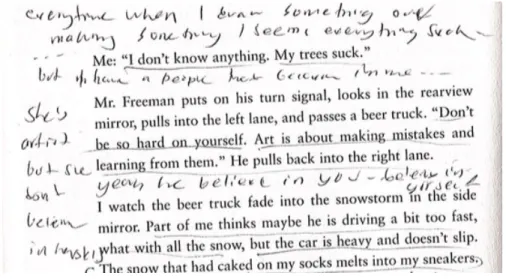
1.11: Speak ... 39
1.12: The Adventures of Huckleberry Finn ... 39
Figure 2: Lah Bwe Text Analysis ... 40
2.1: A Step from Heaven ... 41
2.2: A Step from Heaven ... 41
2.3: Speak ... 41
2.4: Speak ... 42
2.5: Speak ... 43
2.6: Speak ... 43
2.9: Speak ... 45
2.10: Speak ... 45
2.11: Speak ... 45
2.12: Of Beetles and Angels ... 46
2.13: Of Beetles and Angels ... 47
Figure 3: Ter Kwe Paw Text Analysis ... 48
3.1: A Step from Heaven ... 49
3.2: A Step from Heaven ... 50
3.3: Speak ... 51
3.4: Speak ... 52
3.5: Speak ... 52
Figure 4: Poh Let Text Analysis ... 53
4.1: Of Beetles and Angels ... 54
4.2: Speak ... 55
4.3: Speak ... 55
4.4: A Step from Heaven ... 56
Figure 5: Htee Khu Text Analysis ... 57
5.1: A Step from Heaven ... 58
5.2: Of Beetles and Angels ... 58
5.3: A Step from Heaven ... 59
5.4: Speak ... 60
5.5: Of Beetles and Angels ... 60
5.7: A Step from Heaven ... 61
Figure 6: Hsa Mu Htaw Text Analysis ... 63
6.1: Of Beetles and Angels ... 64
6.2: Speak ... 65
6.3: Speak ... 65
6.4: A Step from Heaven ... 66
6.5: Speak ... 67
6.6: Speak ... 68
CHAPTER 1: INTRODUCTION
1.1 The Problem: Emergent Bilingual Students and the Literacy Curriculum
Emergent bilingual students face a myriad of challenges in K-12 education. Often, they are dropped into a system and curriculum that are blind to their cultural resources and practices, leading to feelings of inadequacy, isolation and pessimism regarding their academic potential (Bartlett & Garcia, 2011; Valenzuela, 1999). Language barriers force well-meaning teachers to scaffold learning to the extent that autonomy is sometimes
sacrificed and not developed, and students become “tracked” into remedial classes with less rich linguistic opportunities (Roberge, 2002). In efforts to make the work more accessible or easier to navigate, students are often not provided with opportunities for extensive reading or writing, and this can hinder academic development (Calderon, 2007; Ortmeier-Hooper, 2013; Roberge, 2002).
content-specific literacy demands (Dooley, 2009; Windle & Miller, 2012; Zacarian & Haynes, 2012). SIFE are often tackling high-level academic content with literacy levels that are two years behind or more. (Zacarian & Haynes, 2012) Also, these students often have experienced, or have family members who have experienced, significant trauma and poverty in their home countries, and the majority of them live in poverty in the United States
(Zacarian & Haynes, 2012). SIFE also often experience cultural dissonance (DeCapua & Marshall, 2011) when it comes to literacy experiences and conceptions. Zacarian & Haynes (2012) identify three major “hurdles” to the literacy instruction of SIFE:
1. (SIFE) are collectivist, pragmatic, and oral in their traditions, in direct contrast to mainstream US culture
2. Reading and writing are challenging to (SIFE), as these are often new activities for them
3. The individualist and academic orientation of schools in the United States presents a culture clash
These students are often viewed as deficient literacy learners because of their non-standard literacy backgrounds, and schools “often treat (SIFE) as empty vessels that need knowledge ‘poured in’” (Zacarian & Haynes, 2012). This kind of instruction can be
scaffolded and sometimes watered-down literacy instruction. On the other hand, students may also be pushed too early into “mainstreamed” classes, and provided with little to no support to handle the rigor and pace of the curriculum (Roberge, 2002). Both situations present problems. If students reject tracking and seek out the higher quality literacy
curriculum of “honors” courses, they may be facing a “sink or swim” situation in which they do not receive the proper language support they need to succeed in those classes. On the other hand, if they are placed in long-term remediation classes where ESL support is
provided, they may end up with a watered-down curriculum that does not meet the needs of their cognitive abilities, nor put them on a path for college. “In low track classes, ESL students may find the tasks more manageable. However, linguistic input in low-track classes are generally poorer, tasks are more mechanical, and classroom interaction tends to be minimal . . . ” (Roberge, 2002)
students might be able to navigate more complicated material with proper support and extended time.
As educators, we may “reach out” to emergent bilinguals, especially those with minimal formal literacy instruction, and do for them as if they cannot do for themselves. Though no one can argue that proper support is needed for transitioning, the students and teachers can tend to get stuck in this safe-feeling rut. Even though SIFE enter the literacy “play” already in progress, with its own momentum, stock characters, expectations and conventions, how can we, as educators, open up the literacy curriculum so that these students are encouraged and empowered to reach towards it themselves?
1.2 Purpose of the Study: Finding a Way In
The purpose of the study is to examine the margin writing produced by emergent
bilinguals and see if the blank space around text provides an opportunity for them to exercise greater agency as participants in the literacy curriculum. I seek to find answers to the
following questions: In what ways do emergent bilinguals who are asked to work independently with English language texts interact with the texts? What do the
1.3 Terminology Used
In this paper, I am electing to use the term “emergent bilinguals” (Garcia, 2009) to refer to the participants in the study, rather than “English Language Learners” (ELLs), because the prior term acknowledges the fact that these students are developing skills in two languages, as well as the strengths and benefits this process can provide for the student, not to mention the classroom. In other words, “bilingualism is recognized as a potential resource, both cognitively and socially” (Garcia, 2009, p. 322), and because this is a central tenet of the study, it is appropriate and necessary for me to use language that reflects this. I also believe this term, with its inclusion of the word “emergent”, points to the limitless possibilities for the continued development of the students along their language paths, which is another theme of this work.
CHAPTER 2: REVIEW OF THE LITERATURE 2.1 Literacy and Agency
Bartlett and Holland (2002) describe a “figured world of literacy” in which students are given positional identities based upon their interactions and expectations with and from other “actors” in the space of literacy instruction. These identities can be formed in several ways, and for my students who identified as “non-readers”, this positioning is likely derived from cultural attitudes toward reading and early education in their L1 (in which formal literacy instruction was minimal and extensive reading was not prevalent), the actors and practices in the literacy curriculum which position them as English Language Learners and SIFE when they enter the United States as refugees, and possibly family and friends who are their role models for literacy in their community.
Certain books like Moby Dick, 100 Years of Solitude, or A Tale of Two Cities would be visible on lists of those considered “well-read”. However, these same artifacts can offer “possibilities for becoming” (Urrieta, 2007). Margin writing may provide students who identify as non-readers with opportunities to “become” readers. As responders, they are primarily responsible for authoring the text between the text and the reader, and concurrently they are authoring their own stories of reading.
Figured worlds proponents argue that the field of the figured world is constructed much like a story, play, or “narrative” (Urrieta, 2007) of that world, in which people are assigned roles and have “life paths” (Cain, 1998) through the world. An example of a life path of a reader in the figured world of literacy in the United States might include these examples of interactions with mediating artifacts:
• early childhood interactions with board books and cloth books
• being read to as a young child by a parent or guardian
•preschool interactions with “big books” • early step-level readers
•picture books, early non-fiction books and reference books
• chapter books and more advanced non-fiction, articles and reference
materials such as textbooks
• full-length novels and more advanced non-fiction books and research
materials
positions (Bartlett & Holland, 2002). Emergent bilinguals from countries with limited formal literacy education entering the United States in the middle of their literacy education
“narrative” are positioned as out of step with the literacy path, and must find ways to adapt, catch up, or re-position themselves.
Even though emergent bilinguals may come to the figured world of literacy in the middle of a play already in progress, they bring with them a rich history of experience from their cultural backgrounds. These experiences, however incongruous with the expected practices of the figured world of literacy, must nonetheless be integrated into the meaning-making of the text in front of them. Immigrant children bring with them cultural “funds of knowledge”, experiences and competencies that they will use in their transactions with text (Amanti, 2005). Schema theory (Anderson & Pearson, 1982) posits that students must use their existing knowledge of the world to comprehend what they read. Readers combine what they already know with the information provided by the text in front of them to create a “single schema or message” (Anderson & Pearson, 1984). Teachers of emergent bilinguals can use this theory to provide their students with background knowledge in an effort to create a schema before learning new material. Stott (2011) argues, however, that this artificial creation of schema may not be as beneficial as extensive reading of texts, because the repeated act of reading will create a more natural schema for interactions with texts,
2.2 Reader Response Theory and Emergent Bilinguals
Reading response theory asserts that each reader brings his or her background
knowledge and “schemas” to text to help create a world of meaning. What is important is not the text itself, but what is created between the reader and the text (Iser, 1978). In his
investigations of margin writing throughout history, Jackson (2001) found that this dynamic is not only naturally occurring, but has been so for thousands of years, and is essential for the reading activity to occur:
What that principle entails, as generations of critics have now demonstrated, is an acknowledgement that learning to read and write involves a whole lot more than mastery of the alphabet; it is an initiation into a set of shared codes of
communication. Readers are obliged to recognize and negotiate their way around the conventions of writing, just as writers are obliged to work within the structure of conventions that their readers understand. Although levels of proficiency vary, the basics are indispensable to all readers trained under the same system: they could be scarcely said to be making sense of a text otherwise, let alone talking to one another about it. (p. 257)
reposition themselves in the figured world of literacy. The margin writing in which the students respond could represent the transaction between the reader and the text, and tell the story of reading for each individual.
The research question presented here assumes that when readers are left alone with texts and allowed to respond to them, that this affords the reader the opportunity to exhibit a capacity to interact with that text in a meaningful way specific to that individual. Typically, manuals on ESL instruction emphasize the importance of reading “comprehension” (Lems, 2010; Xu, 2014) rather than reader response, indicating that the text is a puzzle with a single solution to be unlocked. There are studies that eschew this passive reader-text relationship in favor of a more active engagement. Davis (1989) illustrates metacognitive monitoring by asking readers to self-question as they read foreign-language texts. This study, though it engages students more actively, still focuses on the students deriving the already existing meaning of the text, rather than co-creating it. Elliott (1990) took this a step further, showing with his study integrating language, literature and drama, how students can use reader
experience and thought behind it. When language development consistently takes a front seat to thought, then the students are always “working on” this more technical aspect of themselves, seeking to fix, rather than to create, themselves. Hirvela (1996) discusses how literature has been used as a means to an end in English Language Instruction, pointing to instructional textbooks that claim that they include literature as a resource for “stimulating language activities” (128). He advocates for teacher-created reading response questions that activate the readers’ thinking about their reactions to the text, and how they interpret it, as opposed to standardized questions asking about author’s intentions. He also supports Rosenblatt’s (1994) ideas about transactional approaches to reading response, which state that the “evoked work” created between the reader and the text supercedes the text itself, and argues this is the best way to use literature in English language teaching. Though this more closely approaches the tenets of my research question in that it assumes that the reader’s immediate experience is important outside of linguistic aims, its focus is still on questions that the teacher provides the students outside of the reading experience, before or after, and does not look at what is happening during the act of reading itself. “Think alouds” are a strategy supported in ESL manuals (Lems, 2010; Xu, 2010), which is encouraged during the act of reading, but again, this strategy is asking readers to monitor their comprehension of the text’s content and author’s intentions, rather than their own literacy experiences.
2.3 Margin Writing
Though there is little research on margin writing in general, and even less in the field of education and how marginalia pertains to literacy, what has been published is primarily investigatory work into the minds of readers from long ago (Jackson, 2001; Orgel, 2015). Historical researchers and biographers are sleuths hunting for clues about their subjects’ literary subjectivities. For example, though in libraries, annotations in publicly shared volumes are considered acts of vandalism, the discovery of an annotated copy of a book in the library of Thomas Jefferson is akin to finding a rare treasure providing a new insight into the mind of a genius (Scrimgeour, 2014). These books become goldmines of
reader-responder insight, and sometimes simply goldmines when copies of books annotated by well-known individuals fetch high prices at auctions (Scrimgeour, 2014). Rarely, an annotated book can be a record of a community, as in the case of the Robben Island Shakespeare
volume in which prisoners, including Nelson Mandela, marked and signed their names beside inspirational passages (Jackson, 2001).
Orgel (2015) claims that through the years, the reader-responder has breathed life into books through marginalia:
And marginalia are commonplace because even in the hands of a reader the book never adequately expressed itself, always needing something more that could only be supplied by the reader—commentary, explanation, something to help us remember it, or even simply something to make it ours, something to make it not absolutely dead. (p. 8)
He goes on to state that marginalia is at its richest when the reader is not just
the author, narrator, characters, or even the overall theme of the story, a record of the “naturally occurring transaction between text and reader” (Jackson, 2001, p. 242).
CHAPTER 3: METHODOLOGY 3.1 Participants
The participants are six then-eighth, now-ninth grade intermediate emergent bilingual students with 2014-2015 WIDA ACCESS Academic English Literacy Proficiency scores ranging from 2.9-3.8, or “Developing” (on a 1-6 point scale). English proficiency is
considered attained when the student receives a score of 5 or higher. There are two girls and four boys in the study. All students had been participants in the researcher’s sheltered
Language Arts classes for 2-3 years. The novels being analyzed represent the first time the students had been asked to respond to books in the margins. The books were provided as part of the Language Arts class or, in the case of one student, as an enrichment supplement to reading outside of class.
All students arrived in the United States between 2nd and 6th grade (intermediate elementary-middle school) and are considered Generation 1.5 refugee students. All students arrived from refugee camps along the Thailand/Myanmar border, and had very little
schooling in English prior to arrival. Upon arrival, their English reading levels were more than two grades below grade level. Thus, they would also be considered to be SIFE. 3.1a Karen Language, Culture and Literacy Practices
Karen people” (p. 1.) Karen comprise an ethnic subgroup from Southeast Asia, and within this group are several subgroups with differing languages, customs and religious
practices. Karen make up the majority of refugees living in camps along the Thai-Burma border, exiled from their homes and villages in Burma where they were being oppressed, tortured and murdered by the Burmese military regime (Karen Culture and Social Support Foundation Inc., n.d.).
Buddhism, Animism and Christianity are the major religions of Karen, with Christianity being introduced by missionaries. The Karen families I have met have a mix of Christian and Buddhist/Animist religious traditions, while some have converted fully to Christianity, and some refusing to convert. I have also had students who served as Buddhist monks in their villages, donning saffron robes, meditating, and carrying alms bowls (Karen Buddhist Dhamma Dhutta Foundation, 2011).
The two main Karen languages are Skaw Karen and Pwo Karen. All of my students speak Skaw Karen primarily, but several have relatives that speak Pwo Karen. They all are able to recognize Burmese, Skaw Karen, Pwo Karen and Thai when spoken, and most of them know at least a few phrases from each of the other languages. Skaw Karen is the language used to teach reading and writing in the refugee camp schools. Skaw Karen is the most common Karen language, and has a written alphabet developed by Baptist missionaries from Burmese script. (Karen Buddhist Dhamma Dhutta Foundation, 2011). A layman
missionaries who sought to convert the originally Buddhist and Animist Karen to Christians. One of my students says that there was once a pictographic written language for Karen, but much more difficult to learn, and likely disposed of when Christian missionaries took control of education away from the Buddhist monks. Thus, the Karen people have faced
displacement in their homeland, religion and even written language.
Most of my students did not use any Karen writing in their annotations, though they were free to do so. When asked, about half of them (the ones who had come to the United States most recently) answered that they did most of their “thinking” about the book in Karen, but responded in English. Two students said there weren’t the right words for what they wanted to say in Karen, that they thought the Karen language wasn’t “deep” enough for it. Others really wanted to write their thoughts in Karen, but had not received enough instruction in Karen reading and writing to do so. One student who had attended American schools since Kindergarten said he used only English throughout, even when thinking about the book, because that was the first academic language he had learned.
remembered his educational experience as more stable than those closer to the border. The teaching practices in refugee camp schools have historically been teacher-centered and based on rote learning, though this is changing (Karen Buddhist Dhamma Dhutta Foundation, 2011).
In his study of Karen people, Marshall (1922) insisted that though an early written language was not apparent, the Karen were not “without a literature”, referring to the
tradition of oral storytelling passed down through generations, “taught by certain elders to the youths . . . in order that they might transmit it in turn without change to those coming after them” (p. 34). He states that most of these stories were tales, legends and myths, as well as short sayings of “wise instruction” in the form of proverbs or riddles. Recollections of these oral literacy practices emerge later in this study in the focus group findings.
3.2 Data Set 1: Margin Writing in Class-assigned/Enrichment Texts
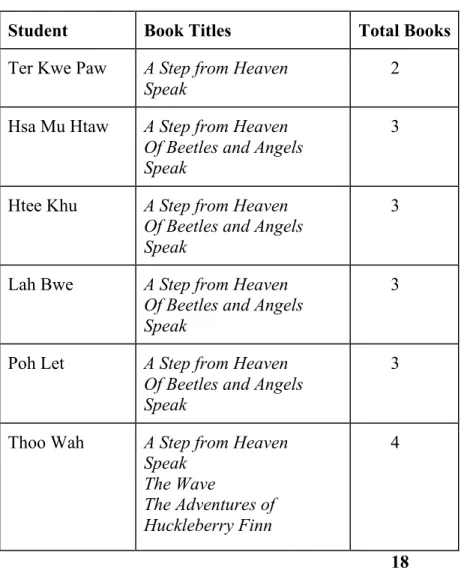
Table 1: Students and Text Titles
Student Book Titles Total Books
Ter Kwe Paw A Step from Heaven Speak
2
Hsa Mu Htaw A Step from Heaven Of Beetles and Angels Speak
3
Htee Khu A Step from Heaven Of Beetles and Angels Speak
3
Lah Bwe A Step from Heaven Of Beetles and Angels Speak
3
Poh Let A Step from Heaven Of Beetles and Angels Speak
3
Thoo Wah A Step from Heaven Speak
The Wave
The Adventures of Huckleberry Finn
4
18
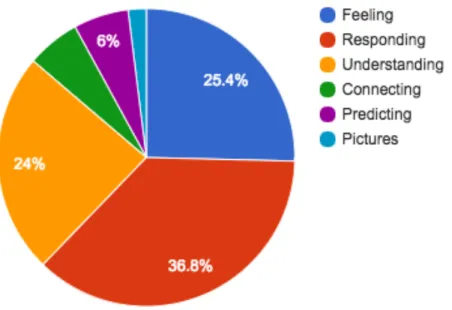
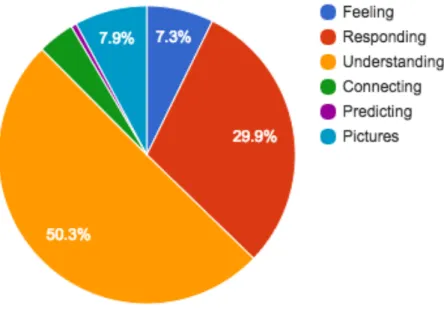
I then analyzed each text looking at the margin writing for common themes. Each entry was categorized into one of six groups, according to discovery. The annotations were then put into a chart showing the patterns of thought for each individual, and an overall picture was developed of the annotating experience for each. I looked for patterns across
3.3 Data Set 2: Focus Group Interview Transcripts
When meeting with the students to conduct interviews, the goal of data collection was to ask students about their literacy experiences, including:
a) Their memories of their experiences reading and annotating the books b) Their memories of their literacy learning experiences, past and present,
including
a. Earliest experiences with literacy b. Refugee camp literacy instruction
c. Past experiences with literacy instruction in the US, including 8th grade
d. Current experiences with literacy instruction one year later, in high school
From the interviews, I hoped to get a better picture of the arc of the students’ literacy self-perceptions—how they view their overall story of reading. Also, I hoped to get a sense of how they feel they are perceived as readers in the literacy classroom. Finally, how does margin writing add to that picture?
participants. Also, any other identifying information has been omitted or changed. The focus group interview took place before the text analysis was performed.
3.4 Member Checks
After the text analysis, I contacted each student to arrange a time to meet with them and share their individual results. If the students had anything they wanted to add to their
analysis, I included their statements in that section of the paper. 3.5 Limitations to the Study
There is an understandable concern that the teacher conducting the research would also be the one who conducted the class and provided the students with the text. There might be questions about the reliability of the truth of the students’ answers, that they might be less likely to answer honestly in my presence as opposed to a disinterested third party. It is true that I have built strong relationships with my students over the past four years, but I argue that it is because of that relationship that I am more likely to get an honest response than a stranger might. In fact, when our school conducted a focus group of exiting 8th graders asking about their overall middle school experience, I was asked to remain in the room with my emergent bilingual students so that they felt comfortable and were more likely to give honest responses, or feel comfortable giving responses at all. It is not uncommon for emergent bilinguals to be shy speaking in English or perhaps be overly polite around those they don’t know well, and my experience teaching Karen students has shown me that they are more likely to be relaxed around adults they know well, letting the veil of respect slip and speaking frankly. I feel quite certain that the students provided honest responses to the
CHAPTER 4: TEXT ANALYSIS 4.1 Overview
When looking over marginalia, it is natural to want to sort them into categories, asking, “What was the reader thinking here?” Like I did with my own copy of The Secret Sharer, we may peer into the books from our past and look for commonalities and patterns among the scribblings, a story of our own journey as a reader, the ways we left our marks on the adventures. Billy Collins, in his poem titled “Marginalia” (1996) writes:
We have all seized the white perimeter as our own and reached for a pen if only to show
we did not just laze in an armchair turning pages; we pressed a thought into the wayside,
planted an impression along the verge.
Jackson categorizes marginalia in categories defined by length: ownership marks (names and/or initials), signs of attention (underlining, brackets, highlighting), brief words or phrases (short comments like “don’t agree” or “good idea”), long notes (running along the space of the margins and sometimes to other pages, or at the ends of chapters) and indices (lists of page numbers to help the reader return to parts of the text) (2001). To Jackson, length is an indicator of depth of engagement. He asserts that there is an “obvious correlation between the level of interest and absorption in the reader and the length of the reader’s notes” (p. 30). On the other hand, he also states that the number of annotations in a book may also be “an indicator of the degree of the . . . reader’s interest” (p. 38). Though my own analysis does not factor in the relative length of each annotation, it does recognize the amount of
me an indicator of their interest and engagement in the text, as well as a means by which they remained engaged in the text.
What I was looking for, primarily, in the margin writing of the students, was the nature of the students’ intentionality. In what ways, and for what, where they reaching in the text? This kind of analysis cannot be done without also asking from what subjectivities were they reaching? This last part is a little trickier, in that at any given moment, we may react to situations from myriad subjectivities, or even a combination of such. However, since my students, prior to my reading their texts, claimed that their feelings and opinions were the things that they wished were more “valued” in the classroom, Bleich’s spectrum of emotional response to text helped to frame my approach (1975). He describes the basic components of emotional response as being either “affect” or “association”, in which the former involves one’s basic gut reaction to the text, and the latter involves forming analogous relationships between what is being read and either an imagined experience (metaphor) or an actual lived experience (memory). However, there is a flow between the “affect’s” base reaction and the “association’s” identification--one precedes the other. To me, both indicate an engaged intentionality at work, because in order to experience this spectrum at any range indicates a reach toward the experience of feeling.
Jackson asserts that the study of marginalia in books raises questions that must be “addressed case by case, with as much knowledge of the historical and personal context as we can muster” (2001, p. 43). Each text and its marginalia is a record of a highly
way is the analysis done “case by case”. The focus group data is an attempt for me to gain as much knowledge as I can “muster” from the “historical and personal context” of the readers. My hope is that together, these snapshots will paint pictures of the individual readers in their approach and their experience with the text.
4.2 Analysis of Themes
The data consists of the margin writing produced by six eighth-grade participants in a sheltered Language Arts class. One student, Thoo Wah, did not participate in the class, because he was moved to a standard Language Arts class after 7th grade. However, he read the books as an enrichment activity, and wrote in the margins as part of this assignment. What follows are the categories of annotations, as I saw them, in the texts. The first three categories represent the most prevalent annotations in the texts overall.
4.2a Feeling
Sometimes the notes are ferocious, skirmishes against the author
raging along the borders of every page in tiny black script.
if I could just get my hands on you, Kierkegaard, or Conor Cruise O’Brien they seem to say,
I would bolt the door and beat some logic into your head. (Collins, 1996)
Students wrote in the margins evidence of their feelings about the text. I considered these statements to be ones of “affective involvement” (Bleich, 1975), in which the students’ basic emotions were evoked and represented on the page:
• Empathizing/identifying with characters (“me too”, “I feel you”) • Words of emotion (sad, happy, relief...etc.)
• Emotional interjections (“ugh”, “ew”, “yay”, “wow”)
• Sensory statements (“I see”, “feel”, “taste”) 4.2b Responding
Or, they are fans who cheer from the empty bleachers, hands cupped around their mouths.
‘absolutely,’ they shout
to Duns Scotus, and James Baldwin. ‘Yes.’ ‘Bull’s-eye.’ ‘My man!’
check marks, asterisks, and exclamation points rain down along the sidelines. (Collins, 1996)
In these statements, the students are active participants, talking back to the characters or author directly, or considering and offering ways to solve the problems presented in the text. These kinds of responses follow affective (emotional) responses as a matter of course, and most closely resemble what Bleich terms “associative” responses. To Bleich, this means that the responses reflect the reader’s “aggregate self-image, and the self-image at the time of reading” (p. 48, 1975). To me, this means that the reader has recognized herself as a participant in the text, essential for the dialogue to continue. Though this is a more active response than the purely affective one, the emotional response is the spark that lights the active pursuit present in these responses. I have sorted these responses into separate categories, but to me they are on a continuum, and are inextricably linked. When I look at the overall data for each student, I consider the Feelings/Response data as one entity. Evidence included:
• Talking back to the text (often using 2nd person…”you”)
• Asking questions directly to the characters
• Answering questions directly posed by characters or narrator
• Judging the characters and/or narrator
• Sharing ideas or solving problems in text 4.2c Understanding
Students are more modest
needing to leave only their splayed footprints along the shore of the page.
One scrawls ‘Metaphor’ next to a stanza of Eliot’s. another notes the presence of ‘Irony’
fifty times outside the paragraphs of A Modest Proposal. (Collins, 1996)
This category most resembles what one would expect to see a student do when asked to annotate a text for class. When annotating for Understanding, students use their learned terminology to identify literary devices, author’s craft, etc. However, I’ve also included here their statements about their own comprehension monitoring in the text, such as “I’m
confused,” or “I don’t know what is going on.” These statements act as supports to keep them in the text so they can make it to the next station of clarity or identification.
These pieces of evidence, though they may seem to be smaller, more surface-level
responses, are no less products of a students’ subjectivity. Bleich (1975) calls the retelling of a piece of writing a “subjective perception” of the text, and that the “simple act of reading produces a subjective change in the text” (p. 21).
Pieces of evidence included:
• Statements of confusion
• Identification of literary devices (simile, metaphor, onomatopoeia)
• Paraphrasing
• Guessing about what is happening
• Defining unfamiliar terms
• Author’s purpose statements
• Author’s craft statements
• Inferring 4.2d Connecting
In this category, I placed statements in which the readers connected events or characters in the books to other books, movies, TV shows or people that they know. I did not count their own personal experiences here, as I counted those kinds of connections as statements of empathy, and since empathy is an aspect of emotional response, I placed them in the
“feelings” category. Pieces of evidence in the Connecting category included “Reminds me of” statements about other texts, media, people, and events.
4.2e Predicting
This category includes instances where the student makes guesses about the outcome of events in the story. These do not include inferences about character’s motives or feelings, but are strictly limited to cause and effect relationships between actions in the plot. Though this could be arguably categorized with Understanding, I feel it is a separate skill, apart from comprehension monitoring and identifying literary elements. It involves looking into the future, from an almost scientific viewpoint, serving as its own way to stay engaged with the text. Pieces of evidence in this category include what the reader thinks will happen to the characters or in the story.
4.2f Pictures
A few greasy looking smears
and next to them, written in soft pencil- by a beautiful girl, I could tell,
whom I would never meet-
This category contains any images drawn in the text. An image can be as simple as a smiley-face to an intricate drawing of a metaphorical analogy. These arguably could have been included in the category of Feeling, since the majority of them were drawn in response to the readers’ emotional reactions, or in the Responding category, as a few were images in which the students were trying to carry their own ideas to completion, or even in
Understanding, as some pictures were drawn to create representational images of what they perceived they were reading (visual paraphrasing). However, because they are distinct from the other responses in that they are outside of language, I gave them their own category. 4.3 Text Analyses
Though the above description helps to provide an overall image of the kinds of
Grumet states that “Meaning is something we make out of what we find when we look at texts. It is not in the text” (1988, p. 143). To me, the reader of the marginalia, the text fades into the background when the students step up to the margins. Under their pens, new characters are added, storylines are reconfigured, and possibilities emerge—not just for the remaking of the reader, but for the text as well. It becomes “the text as performed by Thoo Wah” or “Lah Bwe”, etc. The sides are swimming with intentional activity.
As educators, we may fear this generation of new text, because we are instructed to help students to view the text in the “correct” way. But when we fall in line with a way of thinking that assumes and requires homogeneity of thought, we remove the life that exists between the reader and the text, and the text becomes nothing but a “dead sign” (Grumet, 1988, pg. 116). In the margins, the students are free and encouraged to step into the text and fashion a new one from their own intentionality and the material of the text. When asked about how he is able to respond when faced with an unfamiliar text, Thoo Wah said “When your experience is blank, you just fill it in with the experience in front of you”—thus, a new world born of his subjectivity and the text is generated between the lines.
Grumet says this is the sign of a truly active reader, using intentionality and subjectivity to shape the texts in front of him/her:
There are no sacred texts. Let the cursor unravel the binding of the text as readers erase what they do not believe, or add whatever it is that the author left out. Why not invite them to weave their questions, responses and arguments into the texts
themselves and so acknowledge the wisdom of graffiti? (1988, p. 146)
and resymbolizations” (Grumet, 1988, p. 149). What is depicted in the next pages are the students’ graffiti—their ruminations and resymbolizations of the text. They become “actors” of the text, reshaping it with their own subjectivities and taking an active role in its
exploration and interpretation:
Constructed from their experience and dreams, this liminal space cannot be reduced to the specifications of either the author’s or the reader’s world. It is a space for negotiation. It is the middle place of curriculum. Theater places action in this middle time and space. Literally, the action takes place….Performance
simultaneously confirms and undermines the text. (1988, p. 149)
A script provides a multitude of “blank spaces” for each actor to fill in with his/her own experiences, interpretations and emotional responses. A new text is thus created, which is why we will go see different performances of King Lear. In a similar way, these texts act as scripts for the students to perform in the margins.
I selected and provided all of the texts for the students as part of their English Language Arts classes, with the exception of Thoo Wah, for whom I gave the texts as an enrichment activity. I chose the texts for different reasons. Speak (Anderson, 1999) was chosen because all eighth graders were required to read a text on bullying, and this was one of the options provided to the teachers. I had read Speak before, and found it inspiring, rife with imagery, and powerful. A Step from Heaven (An, 2001) was the first book we annotated in class, chosen for its sparse but poetic language and connection to the immigrant experience. Finally, we read a memoir/autobiography, a task required by the literacy curriculum
Thoo Wah, the texts The Wave (Strasser, 1981) and The Adventures of Huckleberry Finn (Twain, 1884) were chosen to connect to topics he was learning or had recently learned about in Social Studies class--WWII and slavery—in hopes that his recent exposure might help provide a timely entrance into those texts. Drawing on the background knowledge and experiences of students is a technique used by ESL teachers (and really any teachers) who practice culturally relevant pedagogy, and this training impacted my choices at the time.
Thoo Wah: “As a human, we need a mirror.” (Ann., endcover in The Wave). Figure 1: Thoo Wah Text Analysis
Thoo Wah is a prolific annotator. The total annotations over his four books are 2,032, averaging to 508 annotations per book. The average page length per book is 167 pages.
Thoo Wah is a very “present” reader, emotionally responding to the situation in front of him, and participating loudly. He talks to the characters a lot, asking them questions,
offering advice and admonishing them when they do things with which he disagrees.
Thoo Wah almost never passes up an opportunity to answer a question that a
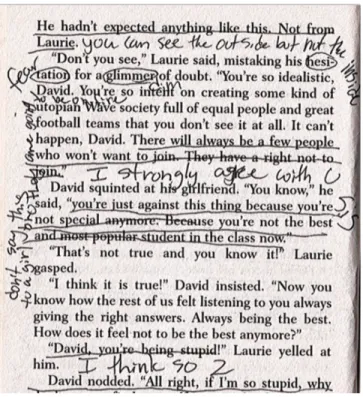
character asks, as if he is in the room with the characters or in the characters’ minds. In times of intensity, he will even step in and speak FOR characters. Figure 1.1 comes from the text, The Wave, in which a teacher
facilitates a mob mentality exercise in his classroom to teach about the Nazi regime during WWII. In the text, friends turn against friends out of loyalty to the group.
In his annotations, Thoo Wah responds loudly (in all caps) to the statement made by one of the characters, and then proceeds to angrily judge the
kind of friend she is. He talks directly to the character at one point, “Don’t hate her, follow her footsteps.” Then he uses reverse writing to show how the character, Amy, is the
antithesis of a friend. The page rings of judgment from top to bottom. Figure 1.2: The Wave
In Figure 1.2, Thoo Wah has stepped completely into the text and is talking directly to the characters in a very informal way, calling them “sis” and “bro,” appropriate since the
characters are teenagers as well. He has settled in and made himself comfortable in the world.
In Figure 1.3, during a point in the book Speak when the protagonist is being questioned by her friend about being raped, Thoo Wah responds for and to the
character at a time of heightened emotion, clearly frustrated with her unwillingness to speak up about the incident.
Judging the characters’ actions becomes a big activity for Thoo Wah when he
reads. Characters are either morally black or white for him, and he wants to categorize them as either people to be loved or people to be killed. His responses to characters that have done things wrong is often a violent wish (as shown in Figure 1.4) while at the same time, he deeply yearns for good fortune for the heroes and underdogs in the story.
Thoo Wah also offers advice and wisdom to the characters, telling them what to do, and following his directions with a nugget of personal philosophy, as shown in Figures 1.5 and 1.6. In The Wave, he offers consolation to those characters who feel they must stand outside of the oppressive movement of the mob, encouraging them to stay strong.
Figure 1.6: The Wave
Figure 1.4: Speak
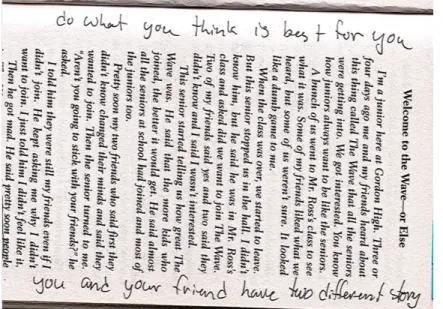
The environment of a novel affects Thoo Wah, and can make him scared or contented and push him to either reject or embrace the setting as if he were there. His attitude towards a book before reading is often formed by the kind of “journey” he predicts it will make him take. Also, he has said that he talks to a book like it is his friend. The book becomes a person in a conversation. In Figure 1.7, culled from The Adventures of Huckleberry Finn, Thoo Wah responds as if he is in the perilous situation along with the Huck and Jim, facing immoral criminals, and he even expresses fear:
In Figure 1.8, Thoo Wah relates the persuasive speaking tactics of the teacher to that of a legend that claims a magic liquid placed on the lips of a speaker could cause entire armies to succumb to his will. When asked from what culture this tale derived, he claimed that he didn’t remember if it was Burmese or Thai or both. It was simply a story from his childhood. As observers outside of his culture, we might be quick to attach a label to this story, but he is not. It is a tale from his experience growing up and hearing stories…an early literacy experience, but from his perspective not consciously culturally bound.
In Figure 1.9, Thoo Wah takes personally the racist statements made by the teacher and students in Speak, and also confirms a predictive statement he had made earlier in the argument. It is as if he is a student in the room with the characters,
participating in the debate, pushing for peace.
Thoo Wah is adept at creating metaphors for characters and
Figure 1.11: Speak Figure 1.12: The Adventures of Huckleberry Finn
Lah Bwe: “Ask yourself, you are the one who sees the world different.” (Ann., p. 199 in Speak)
Figure 2: Lah Bwe Text Analysis
Figure 2.1: A Step from Heaven
Lah Bwe was the quietest member of our class, and admitted that his shyness was one of his biggest obstacles. He rarely raised his hand in class, even though he said he wanted to. This frustration surfaced when he empathized with characters going through similar struggles, as evidenced in Figures 2.2 and 2.3, admitting that he has “lots to say in school, but it can’t come.”
Figure 2.2: A Step From Heaven
Figure 2.3: Speak
Though Lah Bwe was hesitant to annotate, his emotional response is still present. He uses the space and the textual situations to express his frustration with his reticence. The two protagonists in A Step from Heaven and Speak are overwhelmed by their respective
Lah Bwe is able to empathize and respond. Even when thinking about his own situation, he is able to take a role in the text and ask characters direct questions, for example, asking Melinda in Figure 2.3 why she ignores her teacher. Though he understands her plight, he is able to step outside his own to try to change her actions.
Lah Bwe continues to empathize and identify with Melinda in the novel Speak, but is able to step outside his own emotions to become a counselor for her (Figure 2.4), telling her that “he (your teacher) believes in you—believe in yourself.”
Figure 2.4: Speak
Figure 2.5: Speak
Figure 2.6: Speak
The majority of Lah Bwe’s annotations are Understanding, meaning that he wrote a lot of comments about being confused, asked many questions, and paraphrased quite a bit. Also in this category, however, are literary devices; Lah Bwe was not only adept and prolific at identifying similes, metaphors, symbolism and personification in the novels, he often developed his own to represent the characters and their situations. Gallagher, in Deeper Reading (2004), states that this is an important tool for understanding text at its deepest level.
Figure 2.7: Speak
Lah Bwe will also utilize figurative language in his associative connections to the text, as evidenced in Figure 2.8, where he recounts a painful childhood memory evoked by the text. In the story, the protagonist and her brother try to rehabilitate an orphaned baby bird, but fail. The bird dies, and this reminds Lah Bwe of a similar situation from his childhood. Figure 2.8: A Step From Heaven
A Step From Heaven is a text rich with
metaphor, one if which is an extended metaphor about waves and water. Lah Bwe builds on this metaphor in the book by adding his own, in which his tears are “falling like rain all the way down to the bottom,” his own metaphorical
Lah Bwe, shy and reticent, is not one to ask for help in class. However, in the books, he has no trouble stating where he is confused, and repeatedly does so after passages or
sentences he does not understand. He is also the only one who actually wrote Karen
translations in his texts (Figures 2.9 and 2.10), and made a reference to a Karen phrase “big blood” (Figure 2.11) to help him describe a character who acts like he is superior to everyone around him (which is what “big blood” means in Karen). In this case, he is describing a security guard at the mall. Lah Bwe’s culture and language not only become a support for him in the text, they also help him claim it as his own.
Figure 2.9: Speak Figure 2.10: Speak
Figure 2.11: Speak
an opportunity to do so. His images are rich ones, often metaphorically representing characters, themes and situations in the book.
Figure 2.12: Of Beetles and Angels
In Figure 2.12, Lah Bwe drew a text-image to represent the pain of a refugee leaving his country and people behind, and the guilt that goes along with that transition. This is in response to a chapter in Of Beetles and Angels, the autobiography of a Sudanese refugee. As a refugee himself, Lah Bwe can speak to the
experience from a personal place. He said some of the words he used in the drawing were lyrics from a song, but others, like the references to sea turtles finding their way home, are all his. Here, Lah Bwe has modified the text, extending it into a collage of poetry and image. He is resymbolizing the pain of the author, and his own as well.
Figure 2.13: Of Beetles and Angels Lah Bwe writes an inscription that forms part of the angel’s wing: “An (angel) can give you what you’ve already had before.” He is writing in response to the death of a loved one in the book Of Beetles and Angels, and the author’s own
expressed feelings about the loss in the last sentences of the chapter. Lah Bwe has erected a monument to that loss, almost a gravestone, which can stand for Charlene and any angel who has left her mark on a life and then suddenly flown away. He ruminates on this idea with his winged text, considering how those that leave us never really do, but in fact become a permanent part of who we are, reminding ourselves who we are.
Ter Kwe Paw: “bitch...didn’t mean to say it, when I read it, I get a little mad.” (Ann., p. 193 in Speak)
Figure 3: Ter Kwe Paw Text Analysis
a book, I’m more interested and I’ll write more and tell more. If I don’t, I’ll just leave it and write a little bit.”
Ter Kwe Paw spends almost all her margin space paraphrasing, making inferences and asking questions, so much it sounds like a conversation where she is clarifying what is happening. Many of her long paraphrases that conclude chapters start with “I think”, and “maybe” and “Oh” or “Oh, nvm”..and end with statements that begin “And by the
way…” For example, “I think Apa don’t really like Young Ju because Young Ju is a girl.” And “Oh, Harry is a bird. Wait . . . how did the bird die?” She often asks a question and then immediately or soon after, answers her own question (Figure 3.1)
In this way, Ter Kew Paw is performing her own identity as reader, stumbling through the text loudly, asking help from the author, or perhaps even herself, much as Alice in Wonderland does, talking herself through unfamiliar situations in an unknown world and using her own logic to try to figure them out. At points like the ones shown in Figure 3.2, Ter Kwe Paw doesn’t so much respond to the book as much as she responds to herself asking questions in the book . . . helping to clear up her own confusion.
Figure 3.2: A Step from Heaven
book, “screams” epithets at her attacker, and then apologizes (to the reader) for her anger (Figure 3.3).
Figure 3.3: Speak
Here, Ter Kwe Paw ceases being the vocal wanderer and becomes the champion. She aggressively steps in to try to change the situation and protect the protagonist. Her responses are touching in that it appears as if she almost believes she can change the outcome of the text. In Ter Kwe Paw’s responses of this nature, more so perhaps than any of the other annotations I read, does her new “character” change the way I read the book. She infuses hope and strength into the text. I find myself rooting for her as well. For
Figure 3.4: Speak Figure 3.5: Speak
This is a sharp contrast to Ter Kwe Paw’s behavior in class . . . she and the other female student did not respond in class or often share what they felt. She is a quiet student and if ever seems upset, will always respond with, “I’m fine” or “Everything’s ok.” However, in the books A Step from Heaven and Speak, both of which feature women being beaten or abused, she is a champion and a mother figure, speaking up loudly and firmly. She is not afraid to share how she feels and connect her own emotions and experiences to the
characters. From these interactions, she derives meaning. Her heart is her way in, it is what binds her to a text, and the annotations become the expressions of her heart.
Poh Let: “Some books can inspire you.” (Ann., p. 87 in Of Beetles and Angels) Figure 4: Poh Let Text Analysis
Poh Let’s total annotations over his three books are 1,357, averaging to 452 annotations per book. The average page length per book is 163 pages.
Figure 4.1: Of Beetles and Angels
Figure 4.2: Speak
This practice of filling in the gaps revealed to me that Poh Let is skilled at inferencing and remains active when reading. He also talks back to the book, not just at times of heightened emotion, but at quieter moments as well. His ability to sum up the theme of a story is captured in Figure 4.3, with just two words of foreshadowing hope for Melinda, the rape victim protagonist of Speak:
Poh Let is also a skilled illustrator, and below, he resymbolizes not just a part of the story, but a part of himself. (Figure 4.4)
Figure 4.4: A Step From Heaven
Htee Khu: “Just like my Karen people.” (Ann., p. 48 in Of Beetles and Angels) Figure 5: Htee Khu Text Analysis
Htee Khu’s total annotations over her three books are 1,624, averaging to 541 annotations per book. The average page length per book is 163 pages.
Unlike the other students, whose remarks are largely in the Understanding category in the beginning pages of their books before they begin to connect the text to themselves, Htee Khu’s first remarks are usually personal connections or emotions. She empathizes
Figure 5.1: A Step from Heaven
Htee Khu is also quick to start talking back to the characters or narrator, offering advice and words of consolation, finding places of connection between herself and the
“speaker”. She connects much of the story back to her own life, understandably more with the autobiography of the refugee, Of Beetles and Angels, and shares her own stories that are similar to what is happening. In the margins, there are a lot of references to her family, and she once mentions “my Karen people” (Figure 5.2).
Figure 5.2: Of Beetles and Angels