Cigarette smoking is among the most prominent, prevent-able causes of cardiovascular disease1 and smoking cessa-tion is related to reduccessa-tion in cardiovascular disease risk.2 Smoking is associated with factors that adversely affect arterial elastic properties, such as systemic and vascu-lar inflammation,1 endothelial function,3 tissue uptake of smoke particles,4 and damage to the extracellular matrix5 that are putatively related to arterial stiffness. Arterial stiff-ening is a progressive arteriosclerotic process that occurs during the course of aging and exposure to cardiovascular disease risk factors. Arterial stiffness and associated prop-erties can be measured noninvasively and reproducibly by pulse wave velocity (PWV), with higher values signifying stiffer arteries.
Cigarette smoking causes arteries to become less disten-sible acutely.6–11 Reported long-term effects of smoking on arterial stiffness, however, are inconsistent, and whether long-term smoking cessation is associated with a reduction in arterial stiffness has not been well established.12–14 Also, the effects of intensity and duration of smoking on arte-rial stiffness are unknown. The findings of the association of smoking behaviors with carotid-femoral PWV (cfPWV), the reference standard measure of aortic stiffness, have been inconsistent.6,14–18 Previous studies that included brachial-ankle PWV (baPWV), a composite measure of central and peripheral arterial stiffness,10,13 are difficult to interpret given the structural and hemodynamic differences of the arterial territories subsumed in baPWV.19,20 The relationship
Smoking Behaviors and Arterial Stiffness Measured by Pulse
Wave Velocity in Older Adults: The Atherosclerosis Risk in
Communities (ARIC) Study
Ricky Camplain,
1Michelle L. Meyer,
1Hirofumi Tanaka,
2Priya Palta,
1Sunil K. Agarwal,
3David Aguilar,
4Kenneth R. Butler,
5and Gerardo Heiss
1BACKGROUND
Though smoking is strongly associated with peripheral vascular dis-ease and arteriosclerosis, smoking’s association with arterial stiffness has been inconsistent and mostly limited to a single arterial segment. We examined the relationship between smoking behaviors with arte-rial stiffness in multiple artearte-rial segments among community dwelling older adults.
METHODS
The cross-sectional relationship between smoking behavior with carotid-femoral (cfPWV) and femoral-ankle pulse wave velocity (faPWV) was examined in 5,002 men and women, separately, of the Atherosclerosis Risk in Communities (ARIC) cohort study. Brachial-ankle PWV was also assessed and presented in Supplementary Material. Heckman selection models were used to control for selective attrition and death in the ARIC cohort.
RESULTS
In women, faPWV was lower in current smokers compared to never smokers (−66.0 cm/s; 95% confidence interval (95% CI): −94.6, −37.4), and was 1.0 cm/s lower (95% CI: −1.8, −0.2) for every
additional year a woman smoked, after adjustment for confound-ers. Among women, cfPWV was not associated with smoking status or cigarette pack-years. Additionally, no associations of smoking status and cigarette pack-years with PWV were observed among men. Years since smoking cessation was not associated with PWV in either gender.
CONCLUSION
Both smoking status and cumulative smoking exposure were associ-ated with lower peripheral arterial stiffness among women, but not among men. We did not observe an association between central arte-rial stiffness and smoking status in either gender. The profound and well-documented adverse effects of cigarette smoking on the vascu-lature may not include a sustained stiffening of the arteries measured at older age.
Keywords: arterial stiffness; arteriosclerosis; blood pressure; central and peripheral arterial stiffness; health behavior; hypertension; smoking; smoking cessation; subclinical cardiovascular disease.
doi:10.1093/ajh/hpv189
Correspondence: Ricky Camplain ([email protected]). Initially submitted August 26, 2015; date of first revision October 12, 2015; accepted for publication November 11, 2015; online publication December 10, 2015.
© American Journal of Hypertension, Ltd 2015. All rights reserved. For Permissions, please email: [email protected]
1University of North Carolina at Chapel Hill, Chapel Hill, North Carolina,
USA; 2University of Texas at Austin, Austin, Texas, USA; 3Johns Hopkins
University, Baltimore, Maryland, USA; 4Baylor College of Medicine,
Houston, Texas, USA; 5University of Mississippi Medical Center, Jackson,
between smoking behaviors and femoral-ankle PWV (faPWV), a measure of peripheral arterial stiffness, has not been explored.
The aim of this study was to examine the association of smoking behaviors, including smoking status, intensity, and duration of smoking over the lifetime, and years since smok-ing cessation with segment specific arterial stiffness meas-ured by cfPWV and faPWV in older adults.
METHODS Study population
The Atherosclerosis Risk in Communities (ARIC) Study is an ongoing prospective cohort study of cardiovascular disease and atherosclerosis.21 Recruitment occurred dur-ing 1987–1989 and included 15,792 Caucasian and African American participants aged 45–64 years from 4 US commu-nities: Forsyth County, North Carolina; Jackson, Mississippi; Washington County, Maryland; and Minneapolis, Minnesota. Standardized physical examinations and inter-viewer-administered questionnaires were conducted at baseline. Follow-up examinations occurred approximately 3 years apart until visit 4 (1996–1998). The visit 5 exami-nation was conducted from 2011 to 2013. Participants were asked to fast (no food or drink, with the exception of water) beginning 8 hours prior to their visit and to abstain from tobacco products, vigorous physical activity, and caffeine in the morning of the exam. Participants were followed-up annually through telephone interviews and review of hos-pitalization and vital status records. Institutional Review Boards at each participating institution approved the study and all participants provided written informed consent at each examination.
Smoking behaviors
Primary exposures included cigarette smoking status at ARIC visit 5, cumulative cigarette pack-years, and years since smoking cessation. Smoking behavior was obtained by interview at each of the 5 study visits and by annual tel-ephone interviews beginning the 11th year from baseline. Participants were categorized into current, former, and never smokers. For ever smokers, age at smoking initiation and cigarettes per day were determined at baseline. Additionally, age when a participant stopped smoking cigarettes was col-lected for former smokers. To calculate pack-years of smok-ing, average cigarettes per day were collected at ARIC visits 1–4 and years of cigarette smoking were calculated using age at initiation of smoking subtracted from the partici-pant’s age at the visit or as the time between the previous and current visit. At each visit, pack-years were calculated as the average number of reported cigarettes smoked per day multiplied by the years of smoking divided by 20 (the number of cigarettes in a standard pack). The area under the continuous pack-year curve was calculated using the trapezoid rule. Pack-years were classified into 5 categories (<10, 10–19, 20–29, 30–39, and ≥40 pack-years). In the lung cancer and smoking literature, duration of cigarette smok-ing has a stronger effect on disease outcomes compared to
intensity of smoking; therefore, we assessed the association of total number of years smoked and average cigarettes per day of cigarette smoking separately with PWV.22 Years since smoking cessation were determined for former smokers. Current smokers at baseline with inconsistent smoking sta-tus during follow-up were classified as continuous smokers (e.g., former smoker at visit 2 but current smoker at later visits). Participants who reported never smoking and those with missing date of smoking initiation were not included in smoking cessation analyses.
Pulse wave velocity
Technicians measured cfPWV, baPWV, and faPWV fol-lowing a standardized protocol with the automated wave-form analyzer VP-1000 Plus (Omron, Kyoto, Japan) after participants were supine for 5–10 minutes at study visit 5.23 Carotid and femoral arterial pressure waveforms were acquired for 30 seconds by application tonometry sensors attached on the left common carotid artery (via neck col-lar) and left common femoral artery (via elastic tape around the hip). Bilateral brachial and posterior-tibial arterial pres-sure waveforms were detected over 10 seconds by extremity cuffs connected to a plethysmographic and an oscillometric pressure sensor wrapped on both arms and ankles. PWV measures were simultaneously measured twice; the aver-age of the 2 was used for analyses. PWV was calculated as the path length between 2 arterial sites divided by the time delay between the foot of the respective waveforms. Distance for cfPWV was measured with a segmometer (Rosscraft, Surray, Canada), and calculated as the distance between the suprasternal notch to carotid minus the carotid to femoral distance. Distances for baPWV and faPWV were automati-cally calculated by the VP-1000 Plus using height-based formulas. Repeat visits were conducted for a subset of par-ticipants at each field center (n = 79; mean age 75.7 years; 46 females) approximately 4–8 weeks later.24 The intra-class cor-relations and 95% confidence intervals (95% CI) were 0.70 (0.59, 0.81) for cfPWV, 0.84 (0.78, 0.90) for baPWV, and 0.69 (0.59, 0.79) for faPWV.
Results for baPWV were presented in Supplementary Material due to the nature of baPWV as a composite meas-ure of PWV.
Covariates
blood pressure was calculated as [2/3(DBP) ± 1/3(SBP)]. Height was measured to the nearest centimeter and body weight to the nearest 0.1 kg. Body mass index was calcu-lated as weight in kilograms divided by the square of height in meters. Blood was drawn after an 8-hour fasting period with both glucose and plasma total cholesterol measured centrally by standard enzymatic methods. Diabetes was defined as a hemoglobin A1c value ≥6.5%, using medication for diabetes, or self-reported diabetes at visit 5. Peripheral artery disease was defined as a hospitalization with one of the following International Classification of Disease, 9th Edition Clinical Modification codes present in the claim: 440.21–440.24, 443.9, 707.10–707.19, 785.4, 84.10–84.19, 84.91, 39.25, 39.29, 38.08, 38.16, 38.18, 38.38, 38.48–38.49, 39.50, 39.56–39.58, and 39.90 or a right or left ankle brachial index value of <0.9. Ankle brachial index was measured con-currently with cfPWV, faPWV, and baPWV and calculated as the average of ankle systolic blood pressure divided by the higher of the left or right arm systolic blood pressure.
Overall, 5,683 ARIC participants with PWV measured at visit 5 were considered for the present study. Because of numbers insufficient for stratified analyses, partici-pants were excluded if they reported ethnicity other than African American or Caucasian. PWV measurements 3 SDs from the mean, participants with a body mass index >40 kg/m2, a major arrhythmia on the 12-led
electrocar-diogram (Minnesota code 8-1-2, 8-1-3, 8-3-1, and 8-3-2), self-reported aortic revascularization surgery, abdominal aortic aneurysm (maximal diameter ≥5 cm), aortic stenosis, moderate or greater aortic regurgitation, and missing values of respective PWV or exposure variables (N = 681) were excluded. We also excluded participants with peripheral revascularization when assessing the associations between smoking behaviors and faPWV. Associations were evaluated in 5,002 individuals.
Statistical analysis
Continuous data were expressed as mean ± SD and cat-egorical data as percentages for descriptive characteristics. Multivariable linear regression was used to estimate asso-ciations between smoking status, smoking intensity and duration, and years since smoking cessation with PWV. Covariates were assessed for inclusion by directed acyclic graph evaluation and from the literature. Models were strati-fied by gender (P < 0.1 for interaction) and adjusted for age, body mass index, a quadratic term for body mass index, heart rate, race, hypertension, diabetes, physical activity, peripheral artery disease, and mean arterial blood pressure.
At the time of the visit 5 examination, 33% (n = 5,275) of participants had died and 38% (n = 3,979) of those alive did not attend the examination. Thus, attrition and selection biases are of concern when using ARIC data since healthier participants would have the greatest influence on associations when analyses are restricted to visit 5. We used Heckman selection models to account for this informative missing-ness.26,27 The Heckman selection model is a joint model that allows for a 2-stage estimation of the following submodels: the probability of nonattendance at visit 5 due to either death or dropout and the exposure–outcome association accounting
for probability of nonattendance. We first examined the asso-ciation of several sociodemographic, clinical, and social risk factors with nonattendance to identify predictors of both death and dropout. Age, education, race-center, self-rated health, income, and functional status were identified as sig-nificant predictors of nonattendance and used to estimate the probability of not attending visit 5. This estimated probability of nonattendance at visit 5 was subsequently included as an explanatory variable for the exposure–outcome association. All results presented are adjusted for selective attrition due to death or dropout. Similar Heckman-type selection models have been used and validated in other epidemiologic studies to account for selection biases.28
Estimates are presented as the predicted mean difference in PWV (β) and their associated 95% CI. Statistical analyses were performed with SAS version 9.3 (SAS Institute, Cary, NC) with 2-sided P < 0.05.
RESULTS
Participant characteristics
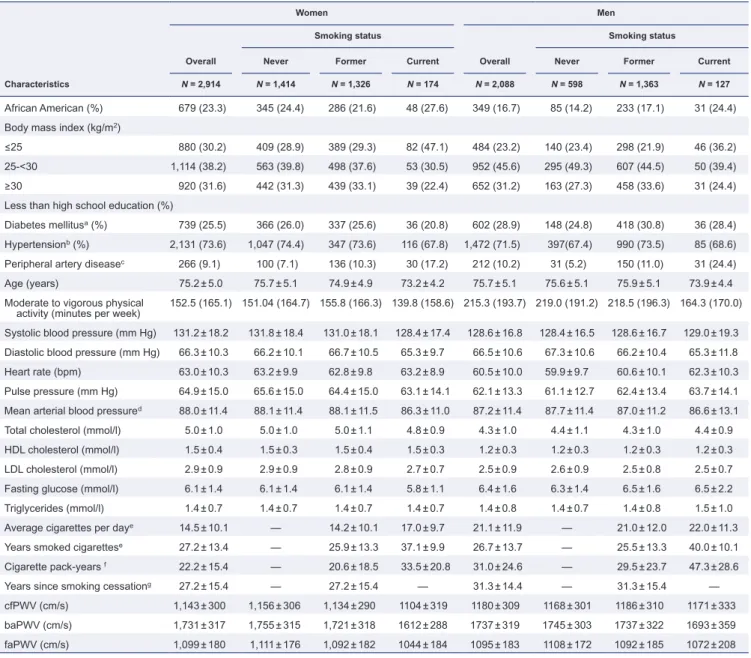
Current smokers at visit 5 were younger and a higher pro-portion of African Americans were current smokers compared to never and former smokers (Table 1). Current smokers were more likely to be normal weight and have peripheral artery disease compared to never and former smokers. Current smokers had a higher average of cigarette pack-years and total years smoked compared to former smokers.
Smoking status and pulse wave velocity
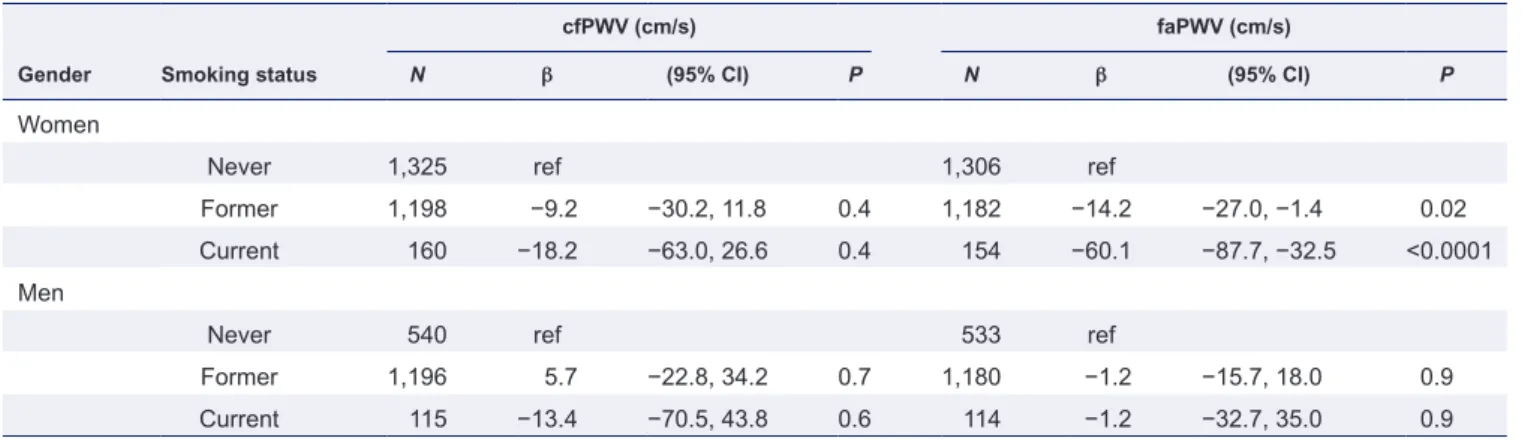
In women, compared to never smokers, faPWV was 14.2 cm/s (95% CI: −27.0, −1.4) lower in former smokers and 60.1 cm/s (95% CI: −87.7, −32.5) lower in current smokers (Table 2). Smoking status at visit 5 was not associated with cfPWV in women and there were no associations between smoking status and PWV in men.
Cigarette pack-years and pulse wave velocity
Because there did not appear to be a linear association between cigarette pack-years and PWV, cigarette pack-years were categorized and disjoint indicator terms were used. Linear regression models yielded no association between cig-arette pack-years and cfPWV (Table 3). For women, faPWV was lower in former and current smokers who smoked 10 pack-years or greater compared to never smokers. Cigarette pack-years were not associated with PWV in men.
Cigarettes per day, cigarette smoke-years and pulse wave velocity
Years since smoking cessation and pulse wave velocity
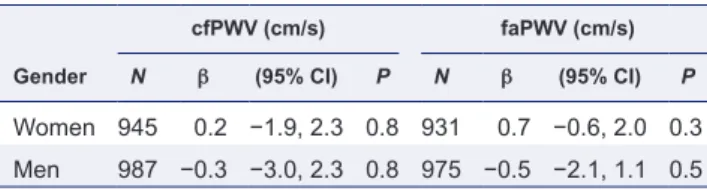
In addition to covariates and attrition, years since smoking cessation and PWV models were adjusted for total cigarette smoke-years. No associations were detected between years since smoking cessation and PWV (Table 4, Supplementary Table 5).
DISCUSSION
Chronic smoking is inversely associated with peripheral arterial stiffness measured by faPWV in older women, but not in men. Similarly, cigarette pack-years were inversely associated with faPWV in women. When the components of Table 1. Descriptive characteristics of ARIC participants by gender and smoking status (N = 5,002)
Characteristics
Women Men
Smoking status Smoking status
Overall Never Former Current Overall Never Former Current
N = 2,914 N = 1,414 N = 1,326 N = 174 N = 2,088 N = 598 N = 1,363 N = 127
African American (%) 679 (23.3) 345 (24.4) 286 (21.6) 48 (27.6) 349 (16.7) 85 (14.2) 233 (17.1) 31 (24.4)
Body mass index (kg/m2)
≤25 880 (30.2) 409 (28.9) 389 (29.3) 82 (47.1) 484 (23.2) 140 (23.4) 298 (21.9) 46 (36.2)
25-<30 1,114 (38.2) 563 (39.8) 498 (37.6) 53 (30.5) 952 (45.6) 295 (49.3) 607 (44.5) 50 (39.4)
≥30 920 (31.6) 442 (31.3) 439 (33.1) 39 (22.4) 652 (31.2) 163 (27.3) 458 (33.6) 31 (24.4)
Less than high school education (%)
Diabetes mellitusa (%) 739 (25.5) 366 (26.0) 337 (25.6) 36 (20.8) 602 (28.9) 148 (24.8) 418 (30.8) 36 (28.4)
Hypertensionb (%) 2,131 (73.6) 1,047 (74.4) 347 (73.6) 116 (67.8) 1,472 (71.5) 397(67.4) 990 (73.5) 85 (68.6)
Peripheral artery diseasec 266 (9.1) 100 (7.1) 136 (10.3) 30 (17.2) 212 (10.2) 31 (5.2) 150 (11.0) 31 (24.4)
Age (years) 75.2 ± 5.0 75.7 ± 5.1 74.9 ± 4.9 73.2 ± 4.2 75.7 ± 5.1 75.6 ± 5.1 75.9 ± 5.1 73.9 ± 4.4
Moderate to vigorous physical
activity (minutes per week) 152.5 (165.1) 151.04 (164.7) 155.8 (166.3) 139.8 (158.6) 215.3 (193.7) 219.0 (191.2) 218.5 (196.3) 164.3 (170.0) Systolic blood pressure (mm Hg) 131.2 ± 18.2 131.8 ± 18.4 131.0 ± 18.1 128.4 ± 17.4 128.6 ± 16.8 128.4 ± 16.5 128.6 ± 16.7 129.0 ± 19.3
Diastolic blood pressure (mm Hg) 66.3 ± 10.3 66.2 ± 10.1 66.7 ± 10.5 65.3 ± 9.7 66.5 ± 10.6 67.3 ± 10.6 66.2 ± 10.4 65.3 ± 11.8
Heart rate (bpm) 63.0 ± 10.3 63.2 ± 9.9 62.8 ± 9.8 63.2 ± 8.9 60.5 ± 10.0 59.9 ± 9.7 60.6 ± 10.1 62.3 ± 10.3
Pulse pressure (mm Hg) 64.9 ± 15.0 65.6 ± 15.0 64.4 ± 15.0 63.1 ± 14.1 62.1 ± 13.3 61.1 ± 12.7 62.4 ± 13.4 63.7 ± 14.1
Mean arterial blood pressured 88.0 ± 11.4 88.1 ± 11.4 88.1 ± 11.5 86.3 ± 11.0 87.2 ± 11.4 87.7 ± 11.4 87.0 ± 11.2 86.6 ± 13.1
Total cholesterol (mmol/l) 5.0 ± 1.0 5.0 ± 1.0 5.0 ± 1.1 4.8 ± 0.9 4.3 ± 1.0 4.4 ± 1.1 4.3 ± 1.0 4.4 ± 0.9
HDL cholesterol (mmol/l) 1.5 ± 0.4 1.5 ± 0.3 1.5 ± 0.4 1.5 ± 0.3 1.2 ± 0.3 1.2 ± 0.3 1.2 ± 0.3 1.2 ± 0.3
LDL cholesterol (mmol/l) 2.9 ± 0.9 2.9 ± 0.9 2.8 ± 0.9 2.7 ± 0.7 2.5 ± 0.9 2.6 ± 0.9 2.5 ± 0.8 2.5 ± 0.7
Fasting glucose (mmol/l) 6.1 ± 1.4 6.1 ± 1.4 6.1 ± 1.4 5.8 ± 1.1 6.4 ± 1.6 6.3 ± 1.4 6.5 ± 1.6 6.5 ± 2.2
Triglycerides (mmol/l) 1.4 ± 0.7 1.4 ± 0.7 1.4 ± 0.7 1.4 ± 0.7 1.4 ± 0.8 1.4 ± 0.7 1.4 ± 0.8 1.5 ± 1.0
Average cigarettes per daye 14.5 ± 10.1 — 14.2 ± 10.1 17.0 ± 9.7 21.1 ± 11.9 — 21.0 ± 12.0 22.0 ± 11.3
Years smoked cigarettese 27.2 ± 13.4 — 25.9 ± 13.3 37.1 ± 9.9 26.7 ± 13.7 — 25.5 ± 13.3 40.0 ± 10.1
Cigarette pack-years f 22.2 ± 15.4 — 20.6 ± 18.5 33.5 ± 20.8 31.0 ± 24.6 — 29.5 ± 23.7 47.3 ± 28.6
Years since smoking cessationg 27.2 ± 15.4 — 27.2 ± 15.4 — 31.3 ± 14.4 — 31.3 ± 15.4 —
cfPWV (cm/s) 1,143 ± 300 1,156 ± 306 1,134 ± 290 1104 ± 319 1180 ± 309 1168 ± 301 1186 ± 310 1171 ± 333
baPWV (cm/s) 1,731 ± 317 1,755 ± 315 1,721 ± 318 1612 ± 288 1737 ± 319 1745 ± 303 1737 ± 322 1693 ± 359
faPWV (cm/s) 1,099 ± 180 1,111 ± 176 1,092 ± 182 1044 ± 184 1095 ± 183 1108 ± 172 1092 ± 185 1072 ± 208
Data are percentages or mean ± SD.
Abbreviations: ARIC, Atherosclerosis Risk in Communities Study; HDL, high-density lipoprotein; LDL, low-density lipoprotein; cfPWV, carotid-femoral pulse wave velocity; baPWV, brachial-ankle pulse wave velocity; faPWV, carotid-femoral-ankle pulse wave velocity.
aDiabetes was defined as hemoglobin A1c value ≥6.5%, using medication for diabetes, or self-report diagnosis of diabetes at visit 5.
bHypertension was defined as systolic blood pressure ≥140, diastolic blood pressure ≥90, or on medication for high blood pressure at study visit 5.
cPeripheral artery disease was defined as a hospitalization with one of the following International Classification of Disease, 9th Edition Clinical
Modification codes: 440.21–440.24, 443.9, 707.10–707.19, 785.4, 84.10–84.19, 84.91, 39.25, 39.29, 38.08, 38.16, 38.18, 38.38, 38.48–38.49, 39.50, 39.56–39.58, and 39.90 or a right or left ankle brachial index value of <0.9.
dMean arterial blood pressure calculated as 2/3(diastolic blood pressure) + 1/3(systolic blood pressure).
eAverage cigarettes per day and years smoked cigarettes evaluated in current and former smokers.
fPack-years calculated as the product of the average number of cigarettes smoked per day and years smoked, divided by 20.
pack-years (intensity and duration of smoking) were evalu-ated separately, cigarette smoke-years, not cigarettes per day, were associated with faPWV in women. When considering an individual’s cigarette smoking experience over their life-time, no associations between years since smoking cessation and PWV measures were observed.
The effect of chronic smoking on endothelial function is detrimental.29 Reports on the effect of smoking on arterial stiffening in older populations is limited and inconsistent in healthy, young, and middle-aged populations.30 In younger populations, smokers have higher central stiffness and lower
central distensibility compared to nonsmokers,4,6,11,14–16,31,32 whereas there is support for greater distensibility among those who smoke,9,33 and others report little difference in aortic stiffness by smoking status,7,15 consistent with our findings.
Little evidence exists on the association between intensity and duration of cigarette smoking with arterial stiffening. To our knowledge, the present study is the first to assess the association of pack-years of cigarette smoking and periph-eral arterial stiffness measured by faPWV. Cigarette pack-years is positively related to carotid stiffness measured by Table 2. Adjusted regression coefficients and 95% confidence intervals for the associations between smoking status and pulse wave velocity by gender
cfPWV (cm/s) faPWV (cm/s)
Gender Smoking status N β (95% CI) P N β (95% CI) P
Women
Never 1,325 ref 1,306 ref
Former 1,198 −9.2 −30.2, 11.8 0.4 1,182 −14.2 −27.0, −1.4 0.02
Current 160 −18.2 −63.0, 26.6 0.4 154 −60.1 −87.7, −32.5 <0.0001
Men
Never 540 ref 533 ref
Former 1,196 5.7 −22.8, 34.2 0.7 1,180 −1.2 −15.7, 18.0 0.9
Current 115 −13.4 −70.5, 43.8 0.6 114 −1.2 −32.7, 35.0 0.9
Models adjusted for age, body mass index, quadratic term for body mass index, heart rate, race, hypertension, diabetes status, physical activity, peripheral artery disease, mean arterial blood pressure, and attrition.
Abbreviations: ARIC, Atherosclerosis Risk in Communities Study; 95% CI, 95% confidence interval; cfPWV, carotid-femoral pulse wave velocity; faPWV, femoral-ankle pulse wave velocity.
Table 3. Adjusted regression coefficients and 95% confidence intervals for the associations between cigarette pack-years of smoking and pulse wave velocity by gender
Gender pack-years
cfPWV (cm/s) faPWV (cm/s)
N β (95% CI) P N β (95% CI) P
Women
Never smokers 1,325 ref 1,306 ref
<10 383 −17.6 −47.9, 12.6 0.3 375 −6.4 −24.9, 12.2 0.5
10–19 252 16.6 −16.5, 52.7 0.4 247 −28.6 −50.7, −6.5 0.01
20–29 163 −4.3 −47.6, 39.1 0.8 161 −40.1 −66.6, −13.6 0.01
30–39 143 −47.2 −93.6, −0.9 0.04 139 −19.1 −47.6, −13.6 0.003
≥40 178 −40.3 −83.0, 2.5 0.07 177 −53.9 −80.0, −27.9 <0.0001
Men
Never smokers 540 ref 533 ref
<10 236 −18.7 −61.4, 24.0 0.4 234 5.5 −19.9, 30.8 0.7
10–19 252 −18.7 −60.4, 23.0 0.4 251 1.8 −22.9, 26.6 0.9
20–29 186 21.0 −25.3, 67.2 0.4 182 −17.4 −45.1, 10.2 0.2
30–39 165 44.1 −4.4, 92.6 0.07 162 −6.9 −35.8, 22.0 0.6
≥40 312 17.1 −22.7, 56.9 0.4 308 3.6 −20.1, 27.3 0.6
Models adjusted for age, body mass index, quadratic term for body mass index, heart rate, race, hypertension, diabetes status, physical activity, peripheral artery disease, mean arterial blood pressure, and attrition.
augmentation and stiffness indices.34,35 Smoking history quantified by pack-years is not sufficient because effects of smoking cigarettes is modest for the first decade, but sub-stantial after several decades, leading to sharp increases in the effect estimates with age in continuous smokers.22 Therefore, we assessed the association of smoking duration and smok-ing intensity with PWV measures separately, i.e., the time exposed to cigarettes regardless of the amount smoked, and the average number of cigarettes consumed per day, to evalu-ate the drivers of a relationship between cigarette pack-years and PWV. Although there was an association between dura-tion of smoking and PWV, but no associadura-tion of cigarette pack-years with PWV in women, substantial missingness of average cigarettes per day and years smoked cigarettes data for ARIC participants may have biased estimates. However, women and men with missing data were similar to those who reported cigarettes per day and years smoked (data not shown).
The lack of an association between years since smoking cessation and PWV is consistent with other observations.12,14 However, never and former smokers had more similar PWV measures compared to never and current smokers, suggest-ing a possible association. We did not observe a difference in arterial stiffness between never and former smokers, con-sistent with other studies that have shown improvements in endothelial function following smoking cessation.14,18,36 These observations, coupled with previous work, are consist-ent with improvemconsist-ent in endothelial function in the first few months after smoking cessation.3,37
We found no relationship between smoking status and cfPWV, although power constraints might have limited our ability to detect small PWV differences between former and never smokers. Given our study size and measurement properties, our study had 80% power to detect a difference of 32 cm/s in cfPWV between never smokers and those who ever smoked. Additionally, attrition of the ARIC cohort is associated with cigarette smoking. For example, 42% of women and 56% of men who identified as current smokers compared to 23% of women and 29% of men who identi-fied as never smokers at ARIC visit 1 were deceased by 2011. Thus, it is plausible that cohort members who attended ARIC visit 5 represent a healthier population that could be more resilient to the effects of cigarette smoking. However,
Heckman selection modeling accounts for this informative missingness. A limitation of the Heckman selection model is that it relies on model specification; thus, we may not have controlled for attrition appropriately if relevant predictors were excluded from our model. Lastly, although smoking behavior was assessed repeatedly during the 25–27 years of follow-up predating the PWV measurement at visit 5, the cross-sectional nature of these analyses prevented us from relating temporal changes in smoking behavior to changes in arterial stiffness over time.
Among the documented mechanisms at the tissue level, smoking compromises vessel wall structure and its mechani-cal properties through activation of matrix metalloprotein-ases (MMPs).38 MMPs digest components of the extracellular matrix and basement membrane during development, tis-sue maintenance and repair, and remodeling. Activation of MMPs has major structural and physiological conse-quences since dysregulation of the MMP system contributes to a broad spectrum of diseases, including atherosclerosis. Tobacco smoke extract induces damage to the extracellu-lar matrix. Macrophages exposed to tobacco smoke extract experience a sequence of events that culminates in apoptosis of macrophages and the release of small membrane-bound vesicles, specifically MMP-14, that break down collagen and gelatin, degrading the local matrix and thus the hemody-namic properties of the arterial wall.
Chronic smoking also causes sustained activation of the sympathetic nervous system that induces sympa-thetically mediated vasoconstriction, promoting arterial wall remodeling that more likely affects the peripheral, muscular vasculature.39 It is remarkable that the associa-tion between smoking and peripheral arterial stiffness has attracted little attention, judging by the paucity of published reports, beyond an indication that smoking may not affect peripheral vascular stiffness as measured by the peripheral augmentation index.40 In contrast, our study suggests that peripheral arteries of women who smoke are more distensible than those of never smokers, suggesting that the effects of smoking on large arteries should be assessed with consideration of specific arterial segments.
Because most research on PWV was conducted in younger populations, we have little basis for the interpreta-tion of our results on smoking cessainterpreta-tion and PWV in older adults. It is conceivable that PWV measured in older adults is not sensitive to the functional and structural changes that occur following smoking cessation in middle adulthood. Alternatively, although smoking cessation interrupts the repeated acute effects of cigarette smoking on the vascula-ture, our results in older adults suggest that damage accrued to the arterial extracellular matrix may not be reversible.
The present study among older adults revealed that women who smoked have lower peripheral arterial stiffness measured by faPWV compared to never smokers. In partic-ular, women who reported higher intensity and duration of smoking, notably if greater than 20 pack-years, have lower faPWV compared to never smokers. The profound and well-documented adverse effects of cigarette smoking on the vas-culature may not include a sustained stiffening of the arteries measured at older age.
Table 4. Adjusted regression coefficients and 95% confidence intervals for the association between years since smoking cessation and pulse wave velocity by gender
Gender
cfPWV (cm/s) faPWV (cm/s)
N β (95% CI) P N β (95% CI) P
Women 945 0.2 −1.9, 2.3 0.8 931 0.7 −0.6, 2.0 0.3
Men 987 −0.3 −3.0, 2.3 0.8 975 −0.5 −2.1, 1.1 0.5
Models adjusted for age, body mass index, quadratic term for body mass index, heart rate, race, hypertension, diabetes status, physical activity, peripheral artery disease, mean arterial blood pres-sure, cigarette pack-years of smoking, and attrition.
SUPPLEMENTARY MATERIAL
Supplementary materials are available at American Journal of Hypertension (http://ajh.oxfordjournals.org).
ACKNOWLEDGMENTS
The Atherosclerosis Risk in Communities Study is carried out as a collaborative study supported by National Heart, Lung, and Blood Institute contracts (HHSN268201100005C,
HHSN268201100006C, HHSN268201100007C, HHSN268201100008C, HHSN268201100009C, HHSN268201100010C, HHSN268201100011C, and HHSN268201100012C) with the ARIC carotid MRI exami-nation funded by U01HL075572-01. The authors thank the staff and participants of the ARIC study for their impor-tant contributions. R.C. was supported by the National Heart, Lung, and Blood Institute GRS Diversity Supplement (HHSN268201100007C).
DISCLOSURE
The authors declared no conflict of interest.
REFERENCES
1. Howard G, Wagenknecht LE, Burke GL, Diez-Roux A, Evans GW, McGovern P, Nieto FJ, Tell GS. Cigarette smoking and progression of atherosclerosis: the Atherosclerosis Risk in Communities (ARIC) Study. JAMA 1998; 279:119–124.
2. Critchley JA, Capewell S. Mortality risk reduction associated with smoking cessation in patients with coronary heart disease: a systematic review. JAMA 2003; 290:86–97.
3. Celermajer DS, Sorensen KE, Georgakopoulos D, Bull C, Thomas O, Robinson J, Deanfield JE. Cigarette smoking is associated with dose-related and potentially reversible impairment of endothelium-depend-ent dilation in healthy young adults. Circulation 1993; 88:2149–2155. 4. Zhang JY, Cao YX, Xu CB, Edvinsson L. Lipid-soluble smoke particles
damage endothelial cells and reduce endothelium-dependent dilatation in rat and man. BMC Cardiovasc Disord 2006; 6:3.
5. Li CJ, Liu Y, Chen Y, Yu D, Williams KJ, Liu ML. Novel proteolytic microvesicles released from human macrophages after exposure to tobacco smoke. Am J Pathol 2013; 182:1552–1562.
6. Lemogoum D, Van Bortel L, Leeman M, Degaute JP, van de Borne P. Ethnic differences in arterial stiffness and wave reflections after ciga-rette smoking. J Hypertens 2006; 24:683–689.
7. Kool MJ, Hoeks AP, Struijker Boudier HA, Reneman RS, Van Bortel LM. Short- and long-term effects of smoking on arterial wall properties in habitual smokers. J Am Coll Cardiol 1993; 22:1881–1886.
8. Failla M, Grappiolo A, Carugo S, Calchera I, Giannattasio C, Mancia G. Effects of cigarette smoking on carotid and radial artery distensibility. J Hypertens 1997; 15(12 Pt 2):1659–1664.
9. Sassalos K, Vlachopoulos C, Alexopoulos N, Gialernios T, Aznaouridis K, Stefanadis C. The acute and chronic effect of cigarette smoking on the elastic properties of the ascending aorta in healthy male subjects.
Hellenic J Cardiol 2006; 47:263–268.
10. Kim JW, Park CG, Hong SJ, Park SM, Rha SW, Seo HS, Oh DJ, Rho YM. Acute and chronic effects of cigarette smoking on arterial stiffness.
Blood Press 2005; 14:80–85.
11. Stefanadis C, Tsiamis E, Vlachopoulos C, Stratos C, Toutouzas K, Pitsavos C, Marakas S, Boudoulas H, Toutouzas P. Unfavorable effect of smoking on the elastic properties of the human aorta. Circulation 1997; 95:31–38.
12. van den Berkmortel FW, Wollersheim H, van Langen H, Smilde TJ, den Arend J, Thien T. Two years of smoking cessation does not reduce arte-rial wall thickness and stiffness. Neth J Med 2004; 62:235–241. 13. Yu-Jie W, Hui-Liang L, Bing L, Lu Z, Zhi-Geng J. Impact of smoking
and smoking cessation on arterial stiffness in healthy participants.
Angiology 2013; 64:273–280.
14. Rehill N, Beck CR, Yeo KR, Yeo WW. The effect of chronic tobacco smoking on arterial stiffness. Br J Clin Pharmacol 2006; 61:767–773. 15. Filipovsky J, Ticha M, Cifkova R, Lanska V, Stastna V, Roucka P. Large
artery stiffness and pulse wave reflection: results of a population-based study. Blood Press 2005; 14:45–52.
16. Jatoi NA, Jerrard-Dunne P, Feely J, Mahmud A. Impact of smoking and smoking cessation on arterial stiffness and aortic wave reflection in hypertension. Hypertension 2007; 49:981–985.
17. Jang SY, Ju EY, Huh EH, Kim JH, Kim DK. Determinants of brachial-ankle pulse wave velocity and carotid-femoral pulse wave velocity in healthy Koreans. J Korean Med Sci 2014; 29:798–804.
18. Polonia J, Barbosa L, Silva JA, Rosas M. Improvement of aortic reflec-tion wave responses 6 months after stopping smoking: a prospective study. Blood Press Monit 2009; 14:69–75.
19. Boutouyrie P, Laurent S, Benetos A, Girerd XJ, Hoeks AP, Safar ME. Opposing effects of ageing on distal and proximal large arteries in hypertensives. J Hypertens Suppl 1992; 10:S87–S91.
20. Kawasaki T, Sasayama S, Yagi S, Asakawa T, Hirai T. Non-invasive assessment of the age related changes in stiffness of major branches of the human arteries. Cardiovasc Res 1987; 21: 678–687.
21. The ARIC Investigators. The Atherosclerosis Risk in Communities (ARIC) Study: design and objectives. The ARIC investigators. Am J Epidemiol 1989;129:687–702.
22. Peto J. That the effects of smoking should be measured in pack-years: misconceptions 4. Br J Cancer 2012; 107:406–407.
23. Meyer ML, Tanaka H, Palta P, Cheng S, Gouskova N, Aguilar D, Heiss G. Correlates of segmental pulse wave velocity in older adults: the Atherosclerosis Risk in Communities (ARIC) Study. Am J Hypertens
2015. pii: hpv079.
24. Meyer ML, Tanaka H, Palta P, Patel MD, Camplain R, Couper D, Cheng S, Al Qunaibet A, Poon AK, Heiss G. Repeatability of central and peripheral pulse wave velocity measures: the Atherosclerosis Risk in Communities (ARIC) Study. Am J Hypertens 2015. pii: hpv127. 25. Baecke JA, Burema J, Frijters JE. A short questionnaire for the
measure-ment of habitual physical activity in epidemiological studies. Am J Clin Nutr 1982; 36: 936–942.
26. Heckman J. The common structure of statistical models of truncation, sample selection and limited dependent variables and a simpler estima-tor for such models. Ann Econ Soc Meas 1976; 5:475–492.
27. Heckman J. Sample selection bias as a specification error. Econometrica
1979; 47:153–161.
28. Clark SJ, Houle B. Validation, replication, and sensitivity testing of Heckman-type selection models to adjust estimates of HIV prevalence.
PLoS One 2014; 9:e112563.
29. Cacciola RR, Guarino F, Polosa R. Relevance of endothelial-hae-mostatic dysfunction in cigarette smoking. Curr Med Chem 2007; 14:1887–1892.
30. Doonan RJ, Hausvater A, Scallan C, Mikhailidis DP, Pilote L, Daskalopoulou SS. The effect of smoking on arterial stiffness. Hypertens Res 2010; 33:398–410.
31. Liang YL, Shiel LM, Teede H, Kotsopoulos D, McNeil J, Cameron JD, McGrath BP. Effects of blood pressure, smoking, and their interaction on carotid artery structure and function. Hypertension 2001; 37:6–11. 32. Malayeri AA, Natori S, Bahrami H, Bertoni AG, Kronmal R, Lima JA,
Bluemke DA. Relation of aortic wall thickness and distensibility to car-diovascular risk factors (from the Multi-Ethnic Study of Atherosclerosis [MESA]). Am J Cardiol 2008; 102:491–496.
33. Sharrett AR, Ding J, Criqui MH, Saad MF, Liu K, Polak JF, Folsom AR, Tsai MY, Burke GL, Szklo M. Smoking, diabetes, and blood cholesterol differ in their associations with subclinical atherosclerosis: the Multiethnic Study of Atherosclerosis (MESA). Atherosclerosis 2006; 186:441–447. 34. van Trijp MJ, Bos WJ, Uiterwaal CS, Oren A, Vos LE, Grobbee DE, Bots
ML. Determinants of augmentation index in young men: the ARYA study. Eur J Clin Invest 2004; 34:825–830.
35. Jonason T, Henrikssen E, Kangro T, Nilsson H, Vessby B, Ringqvist I. Stiffness of the common carotid artery in healthy 50-year-old subjects.
36. Oren S, Isakov I, Golzman B, Kogan J, Turkot S, Peled R, Yosefy C. The influence of smoking cessation on hemodynamics and arterial compli-ance. Angiology 2006; 57:564–568.
37. Node K, Kitakaze M, Yoshikawa H, Kosaka H, Hori M. Reversible reduction in plasma concentration of nitric oxide induced by cigarette smoking in young adults. Am J Cardiol 1997; 79:1538–1541.
38. Furmanski P. Revealing the mechanism of tissue damage due to tobacco use: finally, a smoking gun? Am J Pathol 2013; 182:1489–1493.
39. Grassi G, Seravalle G, Calhoun DA, Bolla GB, Giannattasio C, Marabini M, Del Bo A, Mancia G. Mechanisms responsible for sympathetic acti-vation by cigarette smoking in humans. Circulation 1994; 90:248–253. 40. Recio-Rodriguez JI, Gomez-Marcos MA, Patino Alonso MC,