Scholarship@Western
Scholarship@Western
Electronic Thesis and Dissertation Repository
12-16-2013 12:00 AM
Disaster Data Management in Cloud Environments
Disaster Data Management in Cloud Environments
Katarina Grolinger
The University of Western Ontario
Supervisor
Miriam A.M. Capretz
The University of Western Ontario
Graduate Program in Electrical and Computer Engineering
A thesis submitted in partial fulfillment of the requirements for the degree in Doctor of Philosophy
© Katarina Grolinger 2013
Follow this and additional works at: https://ir.lib.uwo.ca/etd
Part of the Databases and Information Systems Commons, and the Data Storage Systems Commons
Recommended Citation Recommended Citation
Grolinger, Katarina, "Disaster Data Management in Cloud Environments" (2013). Electronic Thesis and Dissertation Repository. 1774.
https://ir.lib.uwo.ca/etd/1774
This Dissertation/Thesis is brought to you for free and open access by Scholarship@Western. It has been accepted for inclusion in Electronic Thesis and Dissertation Repository by an authorized administrator of
Disaster Data Management in Cloud Environments
(Thesis format: Monograph)
by
Katarina Grolinger
Graduate Program in Engineering Science Department of Electrical and Computer Engineering
A thesis submitted in partial fulfillment of the requirements for the degree of
Doctor of Philosophy
The School of Graduate and Postdoctoral Studies Western University
London, Ontario, Canada
ii
Abstract
Facilitating decision-making in a vital discipline such as disaster management requires information gathering, sharing, and integration on a global scale and across governments, industries, communities, and academia. A large quantity of immensely heterogeneous disaster-related data is available; however, current data management solutions offer few or no integration capabilities and limited potential for collaboration. Moreover, recent advances in cloud computing, Big Data, and NoSQL have opened the door for new solutions in disaster data management.
In this thesis, a Knowledge as a Service (KaaS) framework is proposed for disaster cloud data management (Disaster-CDM) with the objectives of 1) facilitating information gathering and sharing, 2) storing large amounts of disaster-related data from diverse sources, and 3) facilitating search and supporting interoperability and integration. Data are stored in a cloud environment taking advantage of NoSQL data stores. The proposed framework is generic, but this thesis focuses on the disaster management domain and data formats commonly present in that domain, i.e., file-style formats such as PDF, text, MS Office files, and images. The framework component responsible for addressing simulation models is SIMONTO. SIMONTO,as proposed in this work, transforms domain simulation models into an ontology-based representation with the goal of facilitating integration with other data sources, supporting simulation model querying, and enabling rule and constraint validation.
Two case studies presented in this thesis illustrate the use of Disaster-CDM on the data collected during the Disaster Response Network Enabled Platform (DR-NEP) project. The first case study demonstrates Disaster-CDM integration capabilities by full-text search and querying services. In contrast to direct full-text search, Disaster-CDM full-text search also includes simulation model files as well as text contained in image files. Moreover, Disaster-CDM provides querying capabilities and this case study demonstrates how file-style data can be queried by taking advantage of a NoSQL document data store.
iii
models can be queried and how model compliance with rules and constraints can be validated.
Keywords
Disaster Data Management, Big Data, NoSQL, Cloud Computing, Knowledge as a Service, Document Data Stores, Graph Databases, Data Model Design, Ontologies, Ontology-based Simulation Models
iv
Acknowledgments
First and foremost, I would like to thank my supervisor, Dr. Miriam Capretz, for her invaluable guidance, encouragement, and support. Dr. Capretz always valued my opinion, trusted in my abilities, and made me feel that we were partners, which encouraged me to reach for higher goals. I truly appreciate the freedom and flexibility I was given in my research pursuit.
I would like to thank my husband Vladimir for supporting and encouraging me to pursue this degree and my kids, Monica and Dominic, for their patience and understanding. I hope that from my journey the kids learned about believing in yourself, being dedicated, and pursuing dreams. In addition, I am grateful to my parents for their quiet but steady encouragement.
Furthermore, I am grateful for the opportunity to work with a number of professors, including Dr. Said Tazi, Dr. Ernesto Exposito, Dr. Jose Marti, Dr. Krishan Srivastava, and Dr. Americo Cunha. I have learned greatly from each one of them.
v
Table of Contents
Abstract ... ii
Acknowledgments... iv
Table of Contents ... v
List of Tables ... ix
List of Figures ... x
Listings ... xi
List of Acronyms ... xii
Chapter 1 ... 1
1 Introduction ... 1
1.1 Motivation ... 1
1.2 Goals and Scope ... 4
1.3 Thesis Organization ... 7
Chapter 2 ... 10
2 Background ... 10
2.1 Big Data ... 10
2.2 Cloud Computing ... 11
2.3 NoSQL Data Stores... 15
2.4 Summary ... 20
Chapter 3 ... 21
3 Related Work ... 21
3.1 Disaster Data Management ... 21
3.2 Knowledge as a Service (KaaS) ... 23
3.3 Related Simulation Work ... 24
vi
3.3.2 Ontologies in Simulation Modelling ... 26
3.4 Summary ... 28
Chapter 4 ... 29
4 Disaster Cloud Data Management ... 29
4.1 Disaster-CDM Framework... 29
4.2 Knowledge Acquisition ... 31
4.2.1 Heterogeneous Data Sources ... 31
4.2.2 Data Processing Services ... 31
4.2.3 Data Storage in the Cloud Environment ... 33
4.3 Knowledge Delivery ... 35
4.4 Summary ... 35
Chapter 5 ... 37
5 Disaster-CDM for File-style Data ... 37
5.1 Data Processing Services ... 38
5.2 Data Processing Rules... 39
5.3 Data Storage in the Cloud Environment ... 41
5.4 Summary ... 43
Chapter 6 ... 45
6 Ontology-Based Representation of Simulation Models ... 45
6.1 Simulation Model Graph... 45
6.2 SIMONTO Architecture ... 49
6.2.1 SIMONTO Ontologies ... 49
6.2.2 The SIMONTO Engine ... 56
6.2.3 Storage for Ontology-Based Simulation Models ... 60
6.2.4 Simulation Services ... 61
vii
Chapter 7 ... 64
7 Evaluation: Case Study 1 ... 64
7.1 Data Set ... 64
7.2 Disaster-CDM Implementation ... 66
7.2.1 Implementation: Data Processing Services ... 66
7.2.2 Implementation: Data Storage ... 67
7.3 Knowledge Acquisition Services ... 68
7.4 Knowledge Delivery Services ... 70
7.4.1 Full-text Search ... 70
7.4.2 Querying File-Style Data ... 74
7.5 Discussion ... 76
7.6 Summary ... 78
8 Evaluation: Case Study 2 ... 79
8.1 SIMONTO Implementation ... 79
8.1.1 SIMONTO Ontologies ... 80
8.1.2 SIMONTO Engine ... 81
8.2 Ontology-Based Simulation Models ... 82
8.2.1 The EPANET Model... 82
8.2.2 The I2Sim Model ... 83
8.3 Knowledge Acquisition Services ... 85
8.4 Knowledge Delivery Services ... 86
8.4.1 Simulation Model Querying ... 86
8.4.2 Rule and Constraint Validation ... 87
8.5 Discussion ... 89
8.6 Summary ... 90
viii
9 Conclusions and Future Work ... 91
9.1 Contributions... 92
9.2 Future Work ... 95
References ... 98
ix
List of Tables
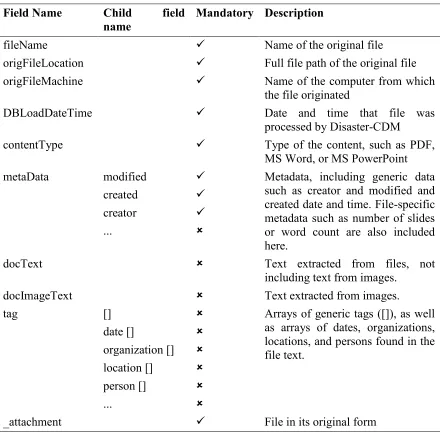
Table 5.1: File storage data model – document data store ... 43
Table 7.1: Loaded file types ... 69
Table 7.2: Search strategies ... 73
Table 7.3: Query results for ―power plant‖ ... 76
Table 8.1: SPARQL query output ... 87
Table 8.2: Watermain design recommendation [86] ... 88
x
List of Figures
Figure 1.1: Disaster management phases ... 3
Figure 4.1: Disaster-CDM framework ... 30
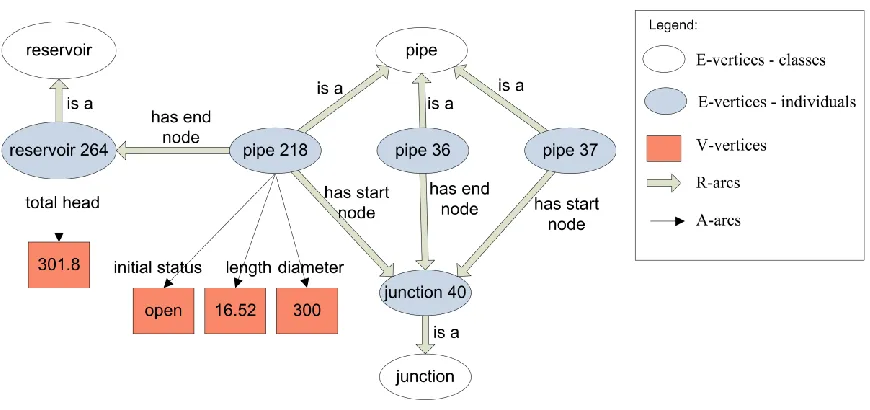
Figure 6.1 A SIMONTO graph-structured EPANET simulation model ... 48
Figure 6.2: Overall SIMONTO architecture ... 49
Figure 6.3: SIMONTO ontologies ... 50
Figure 6.4: Upper ontology classes ... 51
Figure 6.5: EPANET ontology with relations to the upper ontology ... 53
Figure 6.6: The SIMONTO Engine ... 56
Figure 7.1: Full-text search ... 72
Figure 8.1: I2Sim ontology with relation to the upper ontology ... 81
Figure 8.2: Ontology-based representation of the EPANET model ... 83
Figure 8.3: Simulation model hierarchy ... 84
xi
Listings
Listing 5.1: Data processing rule for MS Office files ... 39
Listing 5.2: Data processing rule for PDF files ... 40
Listing 5.3: Data processing rule for images ... 40
Listing 5.4: Data processing rule for simulation models ... 41
xii
List of Acronyms
ACID - Atomicity, Consistency, Isolation, Durability ANNIE - A Nearly-New IE system
BASE - Basically Available, Soft state, Eventually consistent BSON - Binary JSON
CI - Critical Infrastructures
COSMO - COmponent Simulation and Modelling Ontology DeMO - Discrete-event Modelling Ontology
DES - Discrete Event Simulation DESO - DES Ontology
Disaster-CDM – Disaster Cloud Data Management DOM - Document Object Model
DR-NEP - Disaster Response Network Enabled Platform GATE - General Architecture for Text Engineering IaaS - Infrastructure as a Service
I2Sim - Infrastructures Interdependencies Simulation IE – Information Extraction
JSIM - Java-based SIMulation JSON - JavaScript Object Notation KaaS – Knowledge as a Service LOD - Linked Open Data
MVCC - With Multi-Version Concurrency Control NIST - National Institute of Standards and Technology NLP - Natural Language Processing
NoSQL – Not only SQL
OCR - Optical Character Recognition OWL - Web Ontology Language PaaS - Platform as a Service
PIModel - Process Interaction Model
xiii PSL - Property Specification Language
RDB - Relational database
RDBMS - Relational Database Management System RDF - Resource Description Framework
RDFS - RDF Schema
REST - Representational State Transfer SaaS - Software as a Service
SQWRL - Semantic Query-Enhanced Web Rule Language SWRL - Semantic Web Rule Language
UFO - Unified Foundational Ontology W3C - World Wide Web Consortium
Chapter 1
1
Introduction
Each year, a number of natural disasters strike across the globe, killing hundreds and causing billions of dollars in property and infrastructure damage. Extreme weather events have been predicted by climate scientists and have been attributed to global warming. As the number of such events increases, minimizing the impact of disasters becomes imperative in today‘s society.
The role of information and communication technology in disaster management has been evolving. Large quantities of disaster-related data are being generated. Behaviour of critical infrastructures is being explored through simulation, response plans are being created by government agencies and individual organizations, sensory systems are providing potentially relevant information, and social media (Twitter, Facebook) have been flooded with disaster information [1]. Traditional storage and data processing system are facing challenges in meeting the performance, scalability, and availability needs of Big Data. In the context of disaster data management, Big Data refers to the massive collection of data sets generated by various participants and composed of diverse data structures, including structured, semi-structured, and unstructured data [1]. Current disaster data storage systems are disparate, providing few or no integration capabilities and limited potential for collaboration. To meet the needs of Big Data and make the most of available information, a reliable and scalable storage system provided by cloud infrastructure and supported by information sharing, reuse, integration, and analysis is needed.
1.1 Motivation
citizens as collaborators in disaster decision-making since they can provide relevant information [3]. Such diverse disaster participants generate large quantities of heterogeneous disaster-related data, making information gathering, storage, and integration especially challenging.
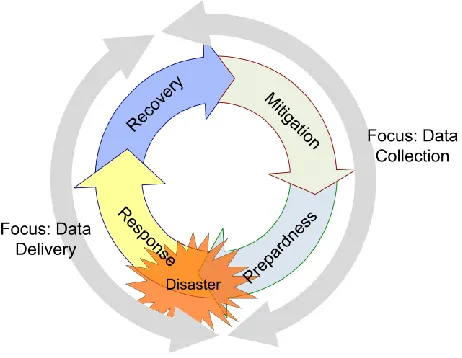
Figure 1.1: Disaster management phases
Recent advances in cloud computing, Big Data, and NoSQL have been changing how data are captured, stored, and analyzed. NoSQL solutions have been especially popular in Web applications [5], including Facebook, Twitter, and Google. However, the use of cloud technologies and NoSQL solutions in disaster management has been sparse.
A solution which stores disaster-related data in a cloud environment can provide the following benefits to disaster management [6]:
High availability. Within the cloud environment, data are automatically replicated, often across large geographic distances. If a region is affected by a disaster and a local data centre fails, the system remains available because it can switch to another data centre.
Scalability and elasticity. The amount of disaster-related data is massive, and a cloud solution can adapt storage resources based on real-time needs and priorities. Data can be automatically redistributed to take advantage of heterogeneous servers.
Moreover, NoSQL data stores have a number of characteristics that can benefit disaster data management, including [7]:
Flexible data structure. Disaster data are extremely diverse, and therefore it would be almost impossible to store them in a predetermined data structure. Horizontal scalability. NoSQL data stores were designed for a cloud environment,
and therefore they scale easily over a large number of commodity servers.
Performance. For simple read/write operations, NoSQL data stores can provide better performance than relational databases.
Another crucial element of disaster management is simulation because it provides a means of studying the behaviour of critical infrastructures, as well as a way of exploring disaster response ―what-if‖ scenarios. Therefore, simulation-related information must be an integral part of any disaster knowledge system.
Although the act of simulation is not domain-specific, simulation packages are usually application-oriented (designed for simulation experiments in a specific domain) and use different modelling approaches, diverse technologies and a wide variety of domain-specific vocabularies. This heterogeneity in the simulation domain, representation, and semantics presents an obstacle to simulation model querying and rule and constraint validation and hinders the integration of simulation data with other information sources. To be able to provide comprehensive knowledge services, a disaster knowledge system needs to take advantage of simulation-related information and integrate it with other sources. Moreover, to enable better exploration of simulation models, the solution needs to provide querying within simulation models and rule and constraint validation capabilities.
1.2 Goals and Scope
allows data collection and delivery through all four disaster phases. This research will facilitate disaster preparedness, response, and recovery efforts by providing a flexible and expandable storage solution for diverse disaster data. Supporting global information sharing, reuse, and integration, the proposed solution will provide improved and informed decision-making and will therefore reduce the impact of disasters on human lives and property.
Consequently, this research proposes a Knowledge as a Service (KaaS) framework for disaster cloud data management (Disaster-CDM). KaaS [8] aims to generate, from data stored in a cloud environment, knowledge such as advice or responses to meet organizational needs. Therefore, Disaster-CDM has the objectives of:
1. Facilitating information gathering and sharing through collaboration. Knowledge acquisition is responsible for acquiring knowledge from diverse sources and from various collaboration partners. Knowledge delivery is responsible for integrating information and delivering it to consumers as a service.
2. Storing large amounts of disaster-related data from diverse sources. The storage of massive quantities of immensely diverse disaster-related data is achieved by using a combination of various data stores in a cloud environment.
3. Facilitating search and supporting interoperability and integration. Knowledge delivery services are the primarily components responsible for this task. Data stored in diverse data stores are provided to consumers as a service.
The proposed framework is not disaster-specific and could potentially be applied for data management in other domains. However, Disaster-CDM was motivated by disaster scenarios and it was designed for the management of disaster-related data; consequently, this work applies it on disaster-related data.
ontology-based representation. Such ontology-based simulation models are stored in the NoSQL data store with the goal of:
Facilitating integration with other information sources, Providing querying capabilities,
Enabling rule and constraint validation.
The proposed Disaster-CDM provides a flexible and customizable disaster data management solution which can be expanded and altered according to the needs of the organizations using it: Disaster-CDM accommodates new data sources by adding new data processing services and by taking advantage of various NoSQL data stores. The solution is based on cloud computing, NoSQL data stores, and the KaaS approach; however, it takes advantage of a large number of other technologies, such as Web services, full-text search, optical character recognition (OCR), ontologies, and various querying approaches.
The contributions of this thesis can be summarized as follows:
Disaster-CDM framework, a Knowledge as a Service (KaaS) framework for disaster cloud data management, is proposed. It supports disaster management and other disaster-related activities by providing disaster-disaster-related knowledge as a service. Disaster-CDM achieves the following objectives:
Information gathering and sharing is facilitated by means of knowledge acquisition and knowledge delivery services.
Storing large amounts of disaster-related data from diverse sources is achieved by taking advantage of cloud computing and NoSQL data stores.
Search, interoperability and integration are supported primarily by means of knowledge delivery services.
Moreover, the research presented in this thesis defines a process for introducing a new data source into the proposed Disaster-CDM framework. The process consists of:
defining data processing rules for new data sources;
determining suitable data storage, including choosing the type of data store and designing a storage data model.
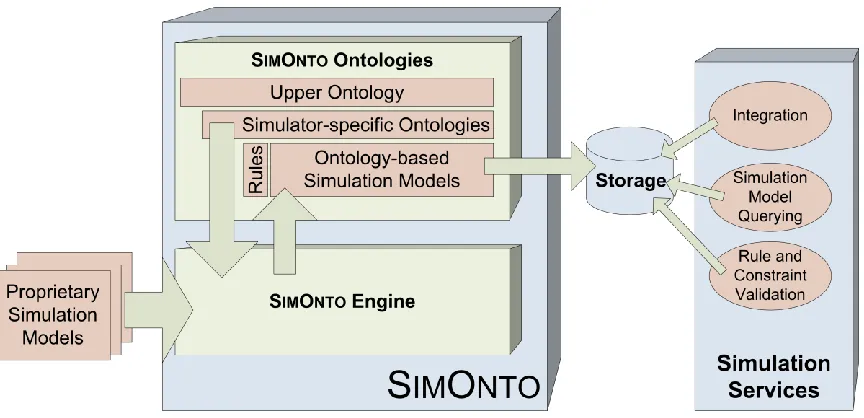
SIMONTO is the part of the proposed Disaster-CDM framework responsible for
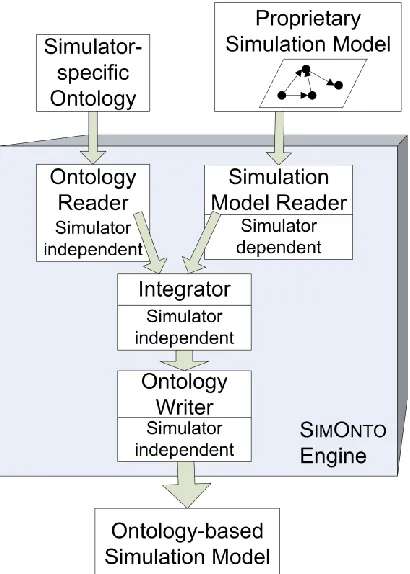
processing simulation models. Existing simulation models expressed in simulator-specific model files are transformed to their corresponding ontology-based representations which are better suited for integration with other data source and for providing simulation model querying capabilities, and rule and constraint validation. The ontology-based simulation models are stored according to their intended use:
For integration with other sources, simulation models are stored in a document database alongside other data.
For querying within simulation models, and for enabling rule and constraint validation, ontology-based simulation models are stored in a graph database.
1.3 Thesis Organization
This thesis is organized into chapters as follows:
Chapter 2 presents the main concepts and technologies relevant to this study: Big Data, cloud computing, and NoSQL data stores. The term ―Big Data‖ in the context of disaster data management is defined. Because the disaster data management solution proposed in this work is cloud-based, the main characteristics, goals, and challenges of cloud computing are discussed. Next, since the Disaster-CDM storage model incorporates NoSQL solutions, NoSQL data stores are introduced and their characteristics described. Furthermore, the four NoSQL data models are discussed with an emphasis on characteristics relevant in the Disaster-CDM context.
approach are examined. Next, work related to simulation model querying and rule and constraint validation is reviewed, and finally, the use of ontologies in simulation modelling is presented.
Chapter 4 proposes Disaster-CDM, a Knowledge as a Service (KaaS) framework for disaster cloud data management. The two main parts of the Disaster-CDM framework are discussed: knowledge acquisition and knowledge delivery. Knowledge acquisition is responsible for acquiring knowledge from diverse sources, processing it to add structure to unstructured or semi-structured data, and storing it in data stores. Knowledge delivery is responsible for integrating information from different data stores and delivering knowledge to consumers as a service.
Chapter 5 focuses on Disaster-CDM for file-style data, which are common in the disaster management domain. The generic process of adding a new data source to the proposed framework is introduced and then applied for file-style data sources. Details of applying each of the three steps to file-style data sources are discussed: establishing required data processing services, defining data processing rules, and data storage in the cloud environment.
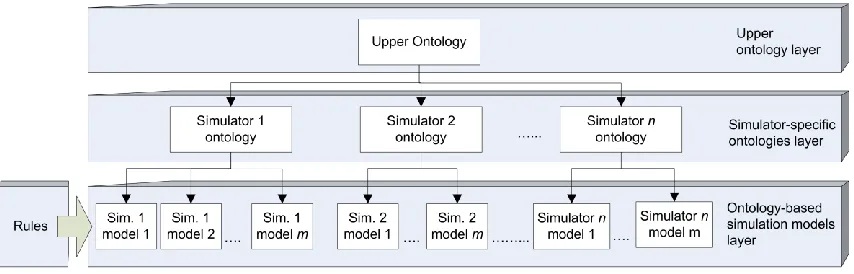
Chapter 6 proposes SIMONTO, an ontology-based representation of simulation models, which represents proprietary simulation models as interconnected instances of simulator-specific ontologies. In the context of Disaster-CDM, SIMONTO is responsible for simulation model processing. Integration with other file-style data is achieved by storing simulation models in a document data store along with other data sources. On the other hand, simulation model querying and rule and constraint validation are achieved by storing the ontology-based simulation models in a graph database.
Disaster-related knowledge is acquired from the DR-NEP data set and stored in a document data store. Finally, the benefits of Disaster-CDM are demonstrated on two knowledge delivery services: full-text search and querying.
Chapter 8, like Chapter 7, presents an evaluation of the proposed Disaster-CDM framework; however, in contrast to Chapter 7 which addresses file-style data sources, this chapter is concerned with simulation models. The SIMONTO implementation and the ontology-based models created by SIMONTO are discussed first. In the presented case study knowledge acquisition service, specifically SIMONTO, transforms simulation models to their corresponding ontology-based representations and stores them in a graph database. Finally, the benefits of Disaster-CDM are demonstrated on two simulation-specific knowledge delivery services: simulation model querying and rule and constraint validation.
Chapter 2
2
Background
This chapter introduces the main concepts and technologies relevant to this work: Section 2.1 introduces Big Data, Section 2.2 portrays cloud computing, and Section 2.3 presents the background on NoSQL data stores.
2.1 Big Data
In recent years, advances in Web technology and the proliferation of sensors and mobile devices connected to the Internet have resulted in the generation of massive data sets that must be processed and stored. For example, Facebook today has more than one billion users, with over 618 million active users on a daily basis generating more than 500 terabytes of new data each day [9].
Traditional relational database management systems (RDBMS) as well as data processing approaches were designed in an era when available hardware, as well as storage and processing requirements, were very different than they are today [10]. Therefore, traditional approaches are facing many challenges in meeting the requirements of Big Data, including storage, processing, management, search, transfer among devices or storage locations, analysis, and visualisation.
The term ―Big Data‖ refers to large and complex data sets made up of a variety of structured and unstructured data which are too big to be managed by traditional techniques. According to Beyer and Laney [11], Big Data is characterized by the 3Vs: volume, velocity and variety. Volume refers to the quantity of data, variety refers to the diversity of data types, and velocity refers both to how fast data are generated and how fast they must be processed. Occasionally, a fourth V is added [12]: veracity is the ability to trust the data to be accurate and to use them to make crucial decisions.
support for disaster management. In addition to volume, the variety of disaster-related data is a major challenge that Disaster-CDM must overcome to be able to provide integrated disaster knowledge as a service. Moreover, the veracity of disaster data is also significant as the makers must be able to trust the data to use it in decision-making.
Enterprises are aware that Big Data has the potential to impact core business processes, provide competitive advantage, and increase revenues [12,13]. Therefore, organizations are exploring ways to make better use of Big Data by analyzing them to find meaningful insights which would lead to better business decisions and add value to their business. In the disaster management domain, better use of available information has the potential to improve decision-making, thus reducing the impact of disasters on human lives and property.
A trend in the Big Data world of special interest to this research is collaboration. This refers to data sharing as well as treating data as a commodity which considers data as a product and even offers it as a service [13]. In the disaster management domain, collaboration among large numbers of participants is essential for successful response and recovery operations. Specifically, in the proposed Disaster-CDM approach, data sharing is achieved through knowledge acquisition from a variety of data sources owned by different collaborators. The integrated data are provided to consumers as a knowledge service.
2.2 Cloud Computing
Various cloud computing definitions have been proposed [14,15]; however, the definition proposed by the National Institute of Standards and Technology (NIST) has been gaining acceptance [5,15]. According to NIST, cloud computing is [16]
It is important to point out the synergy between Big Data and cloud computing. Big Data, due to its size, volume and velocity, imposes continuously increasing computing demands on traditional computing techniques. Cloud computing promises to meet these demands by using a large number of networked resources. Therefore, cloud computing is one of the key enabling techniques for handling Big Data; hence, this work uses it for management of disaster-related Big Data.
In cloud computing, service providers offer computer-based services, and service consumers use these services over the network. A large number of IT companies, including Amazon, Google, Microsoft, Rackspace, and IBM are now providing cloud computing services. According to the NIST definition, the main characteristics of cloud computing include [5,14,15]:
On-demand self-service. Services are consumed as needed, without the need for human interaction.
Broad, ubiquitous network access. Services are provided over the network through standard mechanisms.
Resource pooling. Computing resources are pooled to serve multiple consumers in a multi-tenant environment.
Rapid elasticity. Dynamic resource provisioning is achieved by obtaining and releasing resources on the fly.
Utility-based pricing (a pay-per-use pricing model). The consumer pays only for resources used.
Consequently, the goal of cloud computing systems is to provide the following benefits [5]:
Availability. The system needs to remain operational and accessible in case of server, network, or even data centre failure.
Scalability. This refers to the ability to handle growing demands.
Performance: In a pay-per-use pricing model, performance is directly correlated with cost.
Multi-tenancy. Many tenants (services, applications) reside on the same hardware and software infrastructure.
Fault tolerance. This refers to the ability of a system to continue operating in the presence of failures.
Load balancing. Loads are automatically moved among servers to achieve effective resource utilization.
Ability to run on heterogeneous commodity servers. In infrastructures involving a large number of nodes, heterogeneity is almost unavoidable.
In this research, all mentioned attributes contribute to the choice of a cloud environment for management of disaster data; however, it is important to highlight scalability and availability attributes. Scalability makes it possible to start the system small and expand as needs grow by adding heterogeneous nodes. High availability ensures system operation in the presence of failures, which in the disaster management domain is particularly important as it can be expected that disasters will cause a variety of failures.
From the delivery perspective, the three common cloud computing models are Infrastructure as a Service (IaaS), Platform as a Service (PaaS), and Software as a Service (SaaS). The IaaS model provides resources such as servers (physical or virtual), networks, storage, and operating systems. The PaaS model offers a higher-level environment and delivers a computing platform including data storage, programming languages, and Web application servers. Finally, the SaaS model provides on-demand software by offering access to software applications through the Internet.
answered by knowledge providers through knowledge services [17]. In other words, the proposed Disaster-CDM provides disaster-related knowledge as a service.
Even though cloud computing is gaining popularity in industry and academia, further adoption is facing a number of challenges. Because the approach proposed in this thesis draws on cloud computing, it is exposed to the same challenges:
Security and privacy. In a public cloud, data are stored and processed on third-party premises and in a shared multi-tenant environment; therefore, security and privacy vulnerabilities are increased. Providing an adequate solution is difficult as it needs to include both the service provider and the service consumer.
Customer lock-in. Due to lack of standardization within the cloud computing industry, it is challenging to move from one cloud provider to another. Customer lock-in makes cloud consumers vulnerable to price increases.
Data transfer challenges. The physical locations of provider and consumer may result in significant network traffic which must be considered when evaluating performance and cost.
Legal issues. Public cloud resources may reside in a geographical region with different security and privacy regulations than those in the cloud consumer region. For example, European companies storing data in the United States expose their data to easier access by government agencies due to the U.S. Patriot Act [15]. Application parallelization. In the cloud computing environment, additional
resources are typically acquired by allocating additional servers; however, only applications with parallelizable workload can take advantages of such resources.
Even though the cloud computing challenges just described are generic and are outside the scope of this work, they have a major impact on possible adoption of this work in practice. Moreover, these challenges need to be taken into consideration when implementing the proposed approach in practice.
2.3 NoSQL Data Stores
Relational databases (RDBs) are traditional data storage systems designed for structured data. They have been used for decades due to their reliability, consistency, ACID (Atomicity, Consistency, Isolation, Durability) transactions and query capabilities through SQL. However, RDBs exhibit horizontal scalability challenges, Big Data inefficiencies, and limited availability [18]. In an attempt to address the challenges encountered by RDBs in handling Big Data and in satisfying cloud requirements, new storage solutions, namely NoSQL data stores [6], have emerged. Because this work aims to provide a storage solution for disaster-related Big Data, the proposed solution takes advantage of NoSQL data stores.
Today, the term ―NoSQL‖ refers to ―Not only SQL‖, which emphasizes that SQL-style querying is not the crucial objective of these data stores. Therefore, the term encompasses a large number of immensely diverse data stores that are not based on the relational model, including some solutions designed for highly specific applications such as graph storage. Even though there is no agreement on what exactly constitutes a NoSQL solution, the following set of characteristics is often attributed to them [7,15,19]:
Simple and flexible non-relational data models. NoSQL data stores offer flexible schemas or are sometimes completely schema-free and are designed to handle a wide variety of data structures [7,20].
Ability to scale horizontally over many commodity servers. Some data stores provide data storage scaling, while others are more concerned with read and/or write scaling.
High availability. Many NoSQL data stores are meant to be used in highly distributed scenarios and consider partition tolerance as unavoidable. Therefore, to provide high availability, these solutions choose to compromise consistency in favour of availability, resulting in AP (Available / Partition-tolerant) data stores, whereas most RDBMSs are CA (Consistent / Available).
(Basically Available, Soft state, Eventually consistent) [21]. In this acronym, Basically Available means that the data store is available whenever accessed, even if certain parts are unavailable; Soft state highlights the fact that it can tolerate inconsistency for a certain time period; and Eventually consistent emphasizes that after a certain time period, the data store will arrive at a consistent state.
Lesser emphasis on normalization. Denormalized schema can provide simpler data access, reduce use of resource-intensive operations such as joins, and can more easily scale horizontally. However, this approach will result in larger storage size than for data stored in normalized schema [15].
Distributed and cloud computing are the key enabling technologies for NoSQL data stores. At the time when relational databases emerged, available storage space was restricted and thus normalization was highly desired and redundancy unwanted. Today, distributed and cloud computing provide massive storage space, but the immense quantity of operations imposes strict performance requirements. Therefore, focus has shifted from minimizing redundancy and storage space to improving performance [15]. Consequently, NoSQL schemas are often denormalized resulting in large storage size, but providing a number of advantages including:
Better horizontal scalability as denormalized schema can be partitioned easier, Because data can be redundant, it can be repeated in order to simplify data access, Resource-intensive operation such as joins can be avoided,
Schema can closer resemble application object model and therefore reduce impedance mismatch.
NoSQL data stores are typically further classified according to their data model. As there is no agreement on what exactly constitutes a NoSQL data store, various categorizations have been proposed [19,20]. This study adopts the categorization into four categories: key-value data stores, column-family stores, document stores, and graph databases [7,19,22]. The following discussion introduces the four NoSQL data store categories and highlights the main characteristics relevant for their use in the Disaster-CDM framework.
Key-Value Data Stores have the simplest data model: they provide a simple mapping from each key to its corresponding value. They are primarily used for simple operations in which all access to the store is through a primary key. Client applications can set the value for a key, get the value corresponding to a specified key, or delete a key. The value can be just about anything, and the client application is responsible for interpreting what is stored. Therefore, when using a key-value data store, relations between data are handled at the application level. Although such a simple data model is somewhat restrictive, accessing data only through the primary key provides for good performance and easy scalability. Examples of key-value data stores include Redis, Riak, and Berkeley [19].
In spite of their flexibility, scalability, and performance characteristics, key-value stores have major drawbacks with respect to Disaster-CDM. Relations between data are handled by the application, and data are accessed only through the primary key. Since the relations among data are not expressed in the data store‘s data model, integration possibilities are limited. Moreover, accessing data only through the primary key greatly restricts querying capabilities. In the context of Disaster-CDM, limited querying capabilities and integration possibilities present a major drawback.
structures, which provide storage flexibility. At the same time, the document structure enables querying capabilities as fields within documents can be used as query criteria. Example data stores from this category include CouchDB, MongoDB, and Couchbase Server [19].
In the context of Disaster-CDM, document data stores provide two advantages: querying capabilities and flexible storage. Querying capabilities are made possible by the structure of the documents within the data store, while storage flexibility is achieved by allowing documents within the store to have different structures. However, querying capabilities and storage flexibility are competing attributes: a certain structural consistency among documents is needed to support querying, while excessive structural consistency decreases storage flexibility.
Column-Family Data Stores, like key-value stores, map keys to their corresponding values; however, each value consists of a name-value pair. Key-value pairs can be perceived as rows in a relational database, while name-value pairs relate to column names and their corresponding values. Thus, column-family stores are on the surface similar to relational databases; however, in the relational database, columns are predefined, and each row contains the same fixed set of columns, whereas in the column-family data store, the columns that form a row are determined by the client application, and each row can have a different set of columns. Column-family data stores provide query capabilities. Cassandra, HBase, and Amazon SimpleDB belong to this category [19].
In the context of Disaster-CDM, column-family data stores provide the same advantages as document data stores: querying capabilities and flexible storage. Querying capabilities are supported by name-value pairs within rows, while storage flexibility is achieved by allowing each row to have a different set of columns. Similarly to document databases, a certain level of consistency among rows is needed to support querying capabilities.
for graph databases because the cost of intensive operations like recursive joins can be replaced by efficient graph traversals [7]. Neo4J and Allegro Graph are example stores from this category [19].
In the context of Disaster-CDM, graph databases are suitable for storage of heavily linked data and for data with a graph-like data model. For example, ontology-based simulation models are based on simulation model graphs and therefore are suitable for storage in a graph database. In the Disaster-CDM framework, graph databases have the advantage of advanced querying capabilities: graph database implementations often provide powerful and diverse querying capabilities. For example, a Neo4j graph database can be queried using Cypher, a property graph query language developed by Neo4j; using Gremlin, a graph traversal language; or even using the RDF query language, SPARQL.
In addition to differences in their data models, data store implementations differ greatly in other aspects, such as scalability, fault tolerance, consistency, and concurrency control. These characteristics, in addition to the data model, are influential factors in determining the most suitable data store for the task at hand. Disaster-CDM offers a choice of storage solutions according to the characteristics of the data to be stored. Specifically, the data store category is chosen according to the data to be stored, and a specific data store implementation is then selected by matching the desired storage attributes with the characteristics of various data store implementations.
Because one of the main characteristics of NoSQL data stores is their ability to scale horizontally and effectively by adding more servers to the resource pool, scaling aspects are discussed further here. With regard to what is being scaled, three scaling dimensions can be distinguished: scaling read requests, scaling write requests, and scaling data storage. The partitioning, replication, consistency, and concurrency control strategies used by NoSQL data stores have significant impact on their scalability. For example, partitioning determines the distribution of data among multiple servers and is therefore a means of achieving all three scaling dimensions.
them. Replication also has an important role in providing fault tolerance because data availability can withstand the failure of one or more servers. Furthermore, the choice of replication model is also strongly related to the consistency level provided by the data store. For example, the master-slave asynchronous replication model itself cannot provide consistent read requests from slaves. In the context of Disaster-CDM, the replication model is relevant when choosing the best data store implementation for the task at hand.
2.4 Summary
Chapter 3
3
Related Work
This chapter surveys three categories of related work: disaster data management, Knowledge as a Service (KaaS) and related simulation work.
3.1 Disaster Data Management
Research in disaster management involves many fields, including health science, environmental science, computer science, and a number of engineering disciplines. Crisis informatics [23,24], the area of research concerned with the role of information and technology in disaster management, has been attracting increased research attention recently.
Hristidis et al. [1] surveyed data management and analysis in the disaster domain. The main focus of their survey was on data analysis techniques without the storage aspect. In contrast, in Disaster-CDM, storage and analysis are considered as integral parts. Hristidis et al. identified the following data analysis technologies as relevant in disaster data management: information extraction, information retrieval, information filtering, data mining, and decision support. Similarly, Disaster-CDM uses a number of technologies from information extraction and retrieval. The survey reveals that the majority of research has focused on a very narrow area of disaster management, for example, a specific disaster event such as an earthquake or a flood, or specific disaster-related activities such as communication among actors, estimating disaster damage, and use of mobile devices. Hristidis et al. recognized the need for flexible and customizable disaster management solutions that could be applied in different disaster situations. Disaster-CDM aims to provide such a solution using cloud computing and NoSQL data stores.
This metamodel was instantiated twice: for an earthquake, and for a nuclear meltdown disaster situation. Although they highlighted the large amount of information generated in the disaster domain, their study does not consider disaster data storage. Disaster-CDM provides a scalable and flexible data storage solution in a cloud environment, accommodates both structured and unstructured data, and supports data sharing.
Silva et al. [26] aimed to integrate diverse, distributed information sources by bringing them into a standardized and exchangeable common data format. Their approach focused on data available on public Web sites. Data were first extracted from different source Web sites and stored in a relational database. Next, the data were transformed into Linked Open Data (LOD) and published. In contrast to their work which addressed data available on public Web sites, the proposed Disaster-CDM can accommodate various information sources. In addition, Disaster-CDM is designed for high availability and large amounts of data.
Palen et al. [23] presented a vision of technology-supported public participation during disaster events. They focused on the role of the public in disasters and how information and communication technology can transform that role. Similarly to Hristidis et al. [1], they recognized information integration as a core concern in crisis informatics.
Chou et al. [28] proposed an ontology for developing Web sites for natural disaster management. Web elements contained in the ontology were identified using a ground theory approach with an inventory of disaster management Web sites. To represent the Web page elements, they adopted a combination of XML, XML schemas, and document object model (DOM). The proposed ontology provides support for designing dynamic emergency response management Web sites. Like Chou et al. [28], Disaster-CDM also uses ontologies, but their purpose is data integration in the knowledge delivery stage. Moreover, while Chou et al. addressed disaster Web sites, Disaster-CDM is concerned with a variety of diverse data sources.
3.2 Knowledge as a Service (KaaS)
Disaster-CDM incorporates the KaaS approach to make disaster-related knowledge available as services. Within KaaS, a knowledge provider answers requests presented by knowledge consumers through knowledge services [17]. In Disaster-CDM, the main goal is to acquire knowledge from the diverse data sources and expose it as service to knowledge consumers. Generally, KaaS publishes knowledge models that represent a collection of learned lessons, best practices, and case studies as services that help consumers get knowledge from a distributed computing environment.
The KaaS approach has been used in various domains [29-31]. Lai et al. [29] presented a KaaS model for business network collaboration in the medical context. The main objective of this KaaS is to facilitate the interoperation and the collaboration among members in a knowledge network. In contrast to Disaster-CDM, their work did not tackle the data management layer from which the knowledge is provided nor did it address the storage aspect.
knowledge assists in attracting users to buy other products of the same enterprise. In contrast to the approach proposed by Qirui [30] which stores data exclusively in relational database and that of Kannimuthu et al. [31] which stores data in XML database, the KaaS in Disaster-CDM accommodates both structured and unstructured data by taking advantage of relational databases and NoSQL data stores.
3.3 Related Simulation Work
Simulation is an established way of observing the behavior of a real-world system by developing models that represent the structure and behavior of the system of interest [32]. One of the main factors contributing to the increasing use of simulation involves its non-confinement to a specific discipline [33] as simulation is employed in a variety of domains, such as military operations, critical infrastructures, medical and life sciences, learning, and chemical and biochemical engineering.
Computer simulation, where computer models are developed to represent real-world scenarios, is supported by a variety of software simulation packages or simulation engines [34]. Although the act of simulation is not domain-specific, simulation packages are usually application-oriented, designed for simulation experiments in a specific domain. These packages use different modelling approaches, diverse technologies and a wide variety of domain-specific vocabularies. Moreover, simulation models are saved in simulators‘ engine-specific proprietary file formats. This heterogeneity presents an obstacle to querying, rule and constraint validation, as well as data integration.
Related work in simulation model querying and rule and constraint validation is presented first. It is followed by the review of ontology use in simulation modelling highlighting different roles of ontologies in the reviewed work and the research presented in this thesis.
3.3.1
Simulation Model Querying, Rule and Constraint Validation
Furthermore, semantic heterogeneity has been addressed by creating simulation ontologies [38,39].
Moreover, extensive research has been done on simulation model verification and validations [40,41]. Here, verification is the process of confirming that the model is implemented correctly while the validation checks that the model is accurate representation of the real system. In contrast, this work is concerned with how can simulation models be queried, and how can rules and constraints be written and model compliance with those rules and constraints validated. Nevertheless, research on the topic of simulation model querying, rule and constraints validation has been sparse.
Querying simulation mesh data has been addressed by Lee et al. [42]; however, their AQSim system is intended for querying mesh data and cannot be used with other non-mesh simulation models such as infrastructure networks or logistic systems. In contrast, the proposed SIMONTO focuses on infrastructure-like simulation models, transforms them into ontology-based representations and, as a result, enables simulation model querying and rule and constraint validation.
Querying from the perspective of model discovery and selection in component-based simulation model development has been addressed in the work of Szabo and Teo [43]. In their approach, the COSMO (COmponent Simulation and Modelling Ontology), ontology is applied as a terminology for describing the attributes and behavior of components. Consequently, ontology-based description is queried for the purpose of component discovery and selection. In contrast, SIMONTO represents simulation models as instances of an ontology and Disaster-CDM queries those ontology-based models after storing them in a NoSQL data store.
3.3.2
Ontologies in Simulation Modelling
Although ontologies have been used in a variety of domains [45], their application to the field of simulation has been limited and primarily constrained within the research community. The potential of ontologies in simulation and modelling was explored by Lacy and Gerber [46]. From the perspective of these authors, ontologies are beneficial in simulation and modelling because they formalize semantics and allow querying, inference, sharing, and reuse of developed models.
The studies that are particularly relevant to our research are related to the use of ontologies to represent real-world scenarios for simulation purposes such as Tofani et al. [36], Miller et al. [38] and Silver et al. [47].
Tofani et al. [36] proposed an ontology framework to model the interdependencies among Critical Infrastructures (CI). Like our SIMONTO, the approach of Tofani et al. represents infrastructures as instances of an ontology and uses proprietary simulation packages for the simulation execution. However, this study creates ontology-based representations from existing simulation models, while Tofani et al. model CIs directly as instances of ontologies and then map them manually onto the proprietary simulation models. Therefore there are two main drawbacks to the work of Tofani et al: firstly, the CI network has to be modelled twice, as instances of an ontology and in the domain simulation language; and secondly, the mappings between ontology representations and simulation models must be established manually.
therefore, it facilitates domain experts‘ understanding of ontologies and enables automated creation of the ontological representation from the proprietary simulation models.
Silver et al. [47] represented real-world scenarios as instances of the extended DeMO PIModel (Process Interaction Model). Subsequently, these instances are transformed to XPIM (Extensible Process Interaction Markup) instances, which are then translated to a JSIM (Java-based SIMulation) model. This approach models real-world scenarios in terms of an ontology, which may represent a challenge for domain experts that are accustomed to domain-specific simulation engines. Moreover, DeMO makes use of generic, domain-independent terminology that may differ significantly from specific domain terminology. Depending on the domain modelled, the majority of DeMO entities may be irrelevant and hence may obscure the modelling efforts. In contrast, the SIMONTO approach does not require modelling in an ontology form; it draws on existing proprietary simulation models to automatically generate its ontology-based representation. When new simulation models are needed, experts create them in the domain-specific simulation packages they are accustomed to using, and SIMONTO generates their corresponding ontology-based representation. Moreover, SIMONTO uses existing domain simulators for the simulation execution, while Silver et al. transform the ontology-model to JSIM for the simulation execution.
Like Miller et al. [38], Guizzardi and Wagner [39] also proposed a DES ontology. Their DES Ontology (DESO), a foundational ontology for discrete event system modelling, is derived from the Unified Foundational Ontology (UFO). In contrast to SIMONTO, whose objective is the representation of simulation models for querying and rule and constraint validation, or DeMO, whose aim is the representation of the real world for simulation purposes, the objective of DESO is to provide a basis for evaluating DES languages.
describe different simulation domains, while in this research ontologies represent actual simulation models.
3.4 Summary
Chapter 4
4
Disaster Cloud Data Management
A successful disaster management relies on the collaboration among participants; however, the diversity of the involved participants and their activities results in massive data heterogeneity. This heterogeneity of data, together with their volume, is one of the main challenges in providing a comprehensive solution that could be used by various stakeholders in diverse disaster situations. Disaster-CDM addresses those Big Data challenges by integrating storage in the cloud environment with the KaaS approach which provides disaster-related knowledge as a service.
This Chapter first introduces the overall Disaster-CDM framework in Section 4.1. Next, the two main parts of Disaster-CDM, knowledge acquisition and knowledge delivery are discussed in Sections 4.2 and 4.3.
4.1 Disaster-CDM Framework
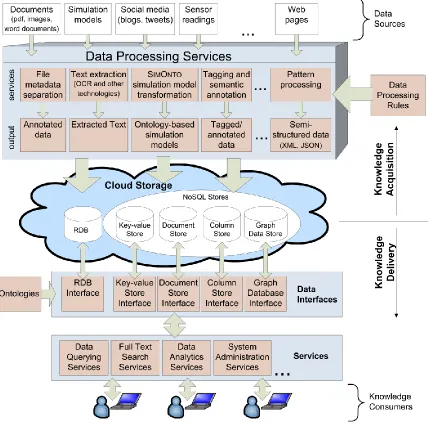
Figure 4.1: Disaster-CDM framework
4.2 Knowledge Acquisition
The knowledge acquisition services obtain data from heterogeneous data sources, process them, and store them in the cloud environment. It was decided to process the information and to store the processed, enriched data because this will allow shorter query response time than performing the processing ―on the fly‖. For example tagging large text content, transforming simulation models and OCR on files with a large number of images may take time and storing already processed files will reduce query response time.
4.2.1
Heterogeneous Data Sources
A few examples of information related to disasters are disaster plans, incident reports, situation reports, social media, simulation models including infrastructure and health-care simulation. As for representation formats, examples include MS Word, PDF, XML, a variety of image formats (jpeg, png, tiff), and simulation model formats specific to simulation packages. Data representation is important because it determines the methods that can be used to add structure to unstructured or semi-structured data.
From our experience working with local disaster management agencies, the majority of information is stored in unformatted documents, primarily MS Word and PDF files. This agrees with the work of Hristidis et al. [1], who reported that most information is in MS Word and PDF files.
4.2.2
Data Processing Services
File Metadata Separation Service makes use of file and directory attributes, including file name, creation date, last modified date, and owner. File names themselves carry important information about content because they are typically chosen with the aim of describing the content. They are processed to separate the words contained in the file name. The creation date and last modified date can assist in distinguishing newer and potentially more relevant information from older and possibly outdated information. The file directory structure contains additional information about file content since directories are used to organize files. Directories can be seen as a categorization and therefore are included in metadata separation.
Text Extraction Service recognizes the text in a file and separates it [51]. An example of such process is optical character recognition (OCR) which Disaster-CDM uses to extract text from images. This step prepares images, MS Office and PDF files for other processing steps such as tagging. Text extraction is especially important in the case of diagrams such as flowcharts or event-driven process chains because these documents contain large amounts of text that can be used for tagging. In the case of MS office files, text is extracted from document body as well as from the images embedded in the document as they may also contain relevant information.
Pattern Processing Service makes use of existing patterns within documents to extract the desired structure. Hristidis et al. [1] observed that most of available disaster-related information is stored in unstructured documents, but that ―typically the same organization follows a similar format for all its reports‖ [1]. Therefore, it is feasible to use patterns for information extraction. However, the number of organizations involved in disaster management is large, which may result in a large number of patterns. This represents a challenge because the patterns need to be identified before pattern processing can be applied. Another challenge is with new data sources where patterns need to be indentified manually.
SIMONTO Simulation Model Transformation Service is responsible for converting
model files, an ontology-based representation of simulation models has been used [52,53]. Unlike text-processing approaches, an ontology-based representation makes it possible to:
address simulator-specific terminology,
remain schema-independent because ontologies do not have predefined schema, focus on entities and their relations.
SIMONTO transforms existing models in the simulator-specific file formats to their corresponding ontology-based representations. Those ontology-based simulation models are then stored in a NoSQL data store which facilitates integration with other data, querying, and rule and constraint validation.
Tagging and Semantic Annotation Services. Tagging is the process of attaching keywords or terms to a piece of information with the objective of assisting in classification, identification, or search [54]. Semantic annotations additionally specify how entities are related. In disaster management data tagging, both manual and automated tagging are needed. Automated tagging applies various natural language processing (NLP) and soft computing techniques to add tags automatically to pieces of information. Because disaster data are immensely diverse, it might not be feasible to tag all content automatically. Images are examples of data which may require computationally expensive tagging. Therefore, manual tagging is used to supplement the automated approach. Tagging will be explored in this study, while semantic annotations will be addressed in future work.
The presented data processing services are common processes for addressing file-style data; nevertheless, Disaster-CDM can be easily expanded to include new data processing services.
4.2.3
Data Storage in the Cloud Environment
and availability. In disaster data management, availability is greatly affected by replication strategy. Data should be replicated across data centers placed on geographically distant locations; therefore, if the region is affected by a disaster and a local data center fails, the system continues to be operational as a remote data center remains unaffected.
As illustrated in Figure 4.1, for data storage Disaster-CDM uses both relational database and NoSQL data stores. As discussed in Section 2.3, NoSQL data stores were designed to address Big Data challenges while taking advantage of cloud computing environments. Moreover, NoSQL data stores have a number of characteristics making them an adequate solution for disaster data management including horizontal scalability and flexible data model. Horizontal scalability enables NoSQL stores to take advantage of the cloud environment by scaling over a number of nodes. Flexible data model is crucial for storage of disaster data due to an immense variety of data that needs to be stored. On the other hand, NoSQL data stores are designed for different purposes and therefore not all problems can be gracefully solved using the same data store. Consequently, Disaster-CDM does not restrict storage to a specific NoSQL data model, but allows for the choice of storage according to the characteristics of the data to be stored.
Despite the advantages of NoSQL data stores, Disaster-CDM also accommodates relational databases. RDBs are still an appropriate solution for many applications because of their characteristics such as ACID (Atomicity, Consistency, Isolation, Durability) transactions, their status as an established technology, and their advanced query capabilities. Moreover, existing data in relational databases do not need to be migrated.
relational databases and NoSQL data stores is a challenge. Part of this challenge is the fact that NoSQL data stores do not support a standard query language.
4.3 Knowledge Delivery
The Disaster-CDM knowledge delivery services answer information requests submitted by service consumers by integrating data stored in the cloud environment. In this stage, the collaboration is achieved by providing the integrated knowledge as a service to collaboration participants. As presented in Figure 4.1, the data access is mainly composed of three parts:
Ontologies: These provide an overall view of the local ontologies representing each data store independently of its category. Ontologies represent the mapping between heterogeneous sources which is needed to unify query capabilities. Data interfaces: After querying the ontology, it is necessary to access the data.
Data interfaces enable translation of the generic query into a specific language that corresponds to the underlying data store system. Thus, the data stored in heterogeneous sources can be accessed, analyzed, and administered. An attempt to unify access to NoSQL systems is proposed in the work of Atzeni et al.[57] where NoSQL models and their programming tactics are reconciled within a single framework.
Services: This is the access layer for users. It provides services independently of how the data are stored. Thus, users are unaware of the storage architecture and are provided with a unified view of the data. Examples of provided services are full-text search, data querying, data analytics, and system administration services.
The application of the proposed Disaster-CDM approach on data formats commonly present in the disaster management domain, i.e. file-style data formats, is further detailed in Chapter 5.
4.4 Summary
Chapter 5
5
Disaster-CDM for File-style Data
The Disaster-CDM framework is designed to accommodate heterogeneous data sources, including PDF files, MS Word documents, simulation models, Web pages, and social media data. The introduction of a new data source to the framework requires:
1. Adding new processing services to existing data processing capabilities. For example, video processing would require a new service which would attach textual context to videos. Such a textual context is essential for effective search and querying of video sources.
2. Defining data processing rules for the new data source. For instance, a video processing rule might specify that video files first undergo metadata extraction followed by a new video-specific service.
3. Determining the data storage appropriate for the new data source. Disaster-CDM does not define storage data structure or even the type of data store; in this step, the data store type suitable for the new data source is determined and the storage data model is designed.
From our experience working with local disaster agencies, which agrees with the work of Hristidis et al. [1], the majority of information is stored in unformatted documents, primarily MS Word and PDF files. Another crucial element of disaster management is simulation because it provides a means of studying the behaviour of critical infrastructures, as well as a way of exploring disaster response ―what-if‖ scenarios. Consequently, this chapter focuses on processing information stored in files, including:
plain text, image files,
MS Office documents including Word, PowerPoint, Excel, and Visio, PDF files, and