SRJIS/BIMONTHLY/ JASPAL SINGH, KIRPAL SINGH, YOGESH SHARMA (2649-2656)
JULY-AUG, 2015, VOL. 2/10 www.srjis.com Page 2649 VITAL CAPACITY: ANALYSIS OF THE EFFECTS OF AEROBIC DANCE AND
PRANAYAMA
Jaspal Singh 1Ph.D, Kirpal Singh2, Yogesh Sharma3Ph.D 1
Lyallpur Khalsa College, Jalandhar, Punjab, India
2
Indian Institute of Science Education and Research, Mohali, Punjab, India
3
Ramgarhia College of Education, Phagwara, Punjab, India
This paper aims to analyse the effects of aerobic dance and pranayama on vital capacity of
college students. Total Ninety (N=90) students were selected will from Ramgarhia College of
Engineering and Technology, Phagwara; Guru Nanak College, Phagwara and Lyallpur
Khalsa College, Jalandhar as subjects for this study. Further, they were divided into equal
group of thirty (N=30) students. The Group-1 known as Aerobic Dance group, Group-II
known as pranayama group and Group-III considered as control group for experiment. Mean
and S.D. are calculated and analysis of co-variance was applied to find out the significantly
better group through S.P.S.S. Further Scheffee,s test was applied to find out the difference
between the adjusted post-test mean among three groups. The significant level was chosen at
0.05. The findings of study concluded that aerobic dance training and pranayama are very
effective exercises which significantly improve the vital capacity of experiment groups. On
the other hand control groups did not report any type of changes on vital capacity. Aerobic
dance training and paranyama can be used as vital capacity enhancing tool by students. Both
aerobic dance training and pranayama are useful methods which can be helpful to improve
the health of the college students and the society in general.
Keyword: vital capacity, aerobic dance, pranayama, physiological variables.
c
Scholarly Research Journal's is licensed Based on a work at www.srjis.comSRJIS/BIMONTHLY/ JASPAL SINGH, KIRPAL SINGH, YOGESH SHARMA (2649-2656)
JULY-AUG, 2015, VOL. 2/10 www.srjis.com Page 2650 Introduction
The vital capacity is an important ability which is interlinked with individual’s respiratory
health. Kent (2006) defined that, “vital capacity is maximum volume of air forcefully expired after maximal inspiration.” Vital capacity is influenced by many types of physical trainings
i.e. running, swimming, weight training, cycling, dancing and yogic practices. The above
given physical training process helps to improve physical and physiological variables to
attain good health. Nowadays, aerobic dance and pranayama are commonly used to maintain
good health by individuals. Wiggins et al. (2005) stated that, “aerobic capacity is the ability
of the cardiovascular system to take in and transport oxygen to the working muscles where it
can be utilized and aerobic performance maintained”. Aerobic fitness involves many
important organs and tells much about the health in general. When aerobic fitness improves,
physical and mental health enhances. Physical fitness prepares the body to perform strenuous
activity without getting fatigue. Mental fitness prepares the mind to face tough tasks and
challenges. Karageorghis & Terry (2001) argued that aerobic dance exercise is one of the
most common exercise practices in the world. Many experts emphasised that exercising to
music, did not require any costly equipment or space, which made dance aerobics very
popular in urban areas. Aerobics is a form of physical exercise that combines rhythmic
aerobic exercise with stretching and strength. Aerobic dance is a type of exercise that
overloads the heart and lungs and causes them to work harder. When appropriately performed
on a regular basis, aerobic exercise helps to increase maximal oxygen uptake (Roitman et al.,
2001). Aerobic fitness can be defined as the ability to transport and utilize oxygen. Moreover,
aerobic dance demands a group organization of the exercise and accompanying music of a
certain tempo and rhythm and to develop cardiovascular fitness (Kostić, et al. 2006).
According to Shaw & Tomar (2000) aerobic dance is to move rhythmically in a series of
steps along with a partner or group music. Sunder (2009) stated that aerobic activities include
walking, jogging, bicycling, dancing and swimming where large muscle group involves and
sustains for thirty minutes or longer. It should be done a minimum of five days a week for at
least thirty minutes of each session. While doing step aerobic exercises, heart plays a key role
to circulate the blood which contains nutrients and oxygen. Above given literature shows that
aerobic dance is a kind of rhythmic exercise that involves music and develops cardiovascular
fitness. The increased capacity and adaptability associated with aerobic fitness can add life to
years, not just years to your life. Length of life has meaning not only in calendar years but
SRJIS/BIMONTHLY/ JASPAL SINGH, KIRPAL SINGH, YOGESH SHARMA (2649-2656)
JULY-AUG, 2015, VOL. 2/10 www.srjis.com Page 2651 to fitness, fulfilment and satisfaction. Experts have introduced a set of rhythm exercises or
activities which are termed as aerobics. These activities vary from simple movements like
free hand exercise to slightly complex and co-ordinated movements like twisting, jumping
and dancing. There are various forms of aerobics exercises used by people to attain and
maintain good health.
Pranayama is an important and essential part of yoga. Kamlesh (2013) defined that, “Yoga is
the process which indicates the effect of the individual self to achieve union or communion
with supreme self.” Yogic breathing techniques are termed as pranayama. The Pranayama is
the process by which the internal pranic store is increased. Some people split the word
Pranayama into prana and yama and define it as breath control. Subbalakshmi et al. (2005)
explained that panayama literally means control of prana and refers to all forms of energy in
the universe. Sovik (2000) mentioned that the ancient science of breath is called pranayama
which meaning both control of energy and expansion of energy. Generally we state that
pranayama is the regulation of the breath through certain techniques and exercises and
closely associated with health of individuals. Keeping in view the importance of aerobic
dance and pranayama that study in hand taken to check the effects of aerobic dance training
and pranayama practices on vital capacity of college students.
Methodology
Sample: Total Ninety (N=90) students selected from Ramgarhia College of Engineering and Technology, Phagwara; Guru Nanak College, Phagwara and Lyallpur Khalsa College,
Jalandhar as subjects for this study. Further, they were divided into equal group of thirty
(N=30) students. The Group-1 known as Aerobic Dance group, Group-II known as
pranayama group and Group-III considered as control group.
Procedure: The experiment programmes of aerobic dance training and pranayama was implemented for 8 weeks. Aerobic dance includes Dance on Music, Step Up, Jumping Jack,
Over the Top & A-Step for 5 Minutes on each station with 2 minutes rest in between each
station. Pranayama experiment includes Kapalbhati, Bharmari, Palvini & Sheetli for 8
Minutes for each type of Pranayama with 2 minutes rest in between each type of Pranayama.
First 5 days of week was chosen for 60 minutes of experiments. Further, sixty minutes
divided into 10 minutes for warming up, 40 minutes for main experiments and 10 minutes for
cooling down.
SRJIS/BIMONTHLY/ JASPAL SINGH, KIRPAL SINGH, YOGESH SHARMA (2649-2656)
JULY-AUG, 2015, VOL. 2/10 www.srjis.com Page 2652 applied to find out the difference between the adjusted post-test mean among three groups.
The significant level was chosen at 0.05.
Rusults And Discussion
The results of experiment group-I, experiment group-II and control groups are presented and
[image:4.595.72.528.222.377.2]graphical representation of mean scores given accordingly.
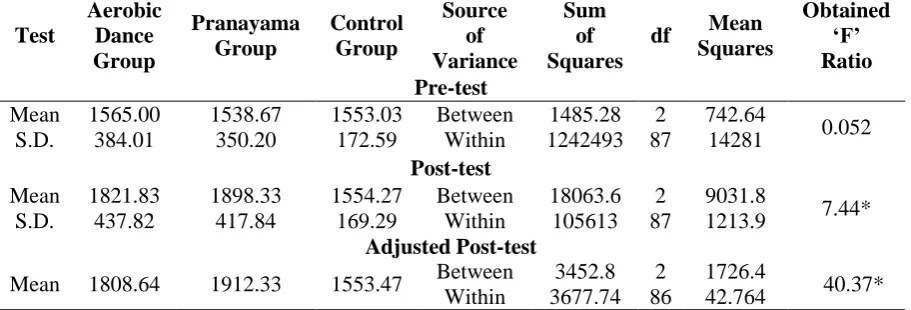
Table-1: Analysis Of Covariance On Vital Capacity Of Aerobic Dance, Pranayama And Control Groups Test Aerobic Dance Group Pranayama Group Control Group Source of Variance Sum of Squares
df Mean
Squares
Obtained ‘F’ Ratio Pre-test
Mean 1565.00 1538.67 1553.03 Between 1485.28 2 742.64
0.052
S.D. 384.01 350.20 172.59 Within 1242493 87 14281
Post-test
Mean 1821.83 1898.33 1554.27 Between 18063.6 2 9031.8
7.44*
S.D. 437.82 417.84 169.29 Within 105613 87 1213.9
Adjusted Post-test
Mean 1808.64 1912.33 1553.47 Between 3452.8 2 1726.4 40.37*
Within 3677.74 86 42.764
* Significant at 0.05 level of confidence.(The table values required for significance at 0.05
level of confidence for 2 and 87 & 2 and 86 are 3.114 and 3.115 respectively).
Table-1 showed that the pre-test mean and S.D. values on vital capacity for aerobic dance,
pranayama and control groups were 1565.00, 384.01; 1538.67, 350.20; and 1553.03, 172.59
respectively. The obtained ‘F’ ratio value of 0.052 for pre-test score of aerobic dance,
pranayama and control groups on vital capacity was less than the required table value of 3.114
for significance with df 2 and 87 at .05 level of confidence. The post-test mean and S.D. values
of vital capacity for aerobic dance, pranayama and control groups were 1821.83, 437.82;
1898.33, 417.84 and 1554.27, 169.29 respectively. The obtained ‘F’ ratio value of 7.44 for
post-test scores of aerobic dance, pranayama and control groups was more than the required
table value of 3.114 for significance with df 2 and 87 at .05 level of confidence. The adjusted
post-test mean values of vital capacity for aerobic dance, pranayama and control groups were
1808.64, 1912.33 and 1553.47 respectively. The obtained ‘F’ ratio value of 40.37 for adjusted
post-test scores of aerobic dance, pranayama and control groups were more than the required
SRJIS/BIMONTHLY/ JASPAL SINGH, KIRPAL SINGH, YOGESH SHARMA (2649-2656)
JULY-AUG, 2015, VOL. 2/10 www.srjis.com Page 2653 The result of this study showed that there was a significant difference between aerobic dance,
pranayama and control groups on vital capacity. Further to determine which of the paired
means had a significant difference that Schefee’s test was applied and the results are
[image:5.595.98.501.221.365.2]presented in Table-2.
Table-2: Schefee’s Test For The Difference Between The Adjusted Post-Test Mean Of Vital Capacity
Adjusted Post
Test Means Mean Difference
Aerobic Dance
Group
Pranayama
Group Control Group
1808.64 1912.33 103.69
1912.33 1553.47 358.86*
1808.64 1553.47 255.17*
* Significant at .05 level of confidence.
Table-2 shows that the adjusted post-test mean difference on vital capacity between aerobic
dance, pranayama and control group were 103.69, 358.86 and 255.17 respectively. Since the
adjusted post-test mean difference between aerobic dance and pranayama were not found
significant. The adjusted post-test mean difference between aerobic dance and control group;
[image:5.595.180.420.485.619.2]pranayama and control group was higher than the confidence interval at 0.05 level.
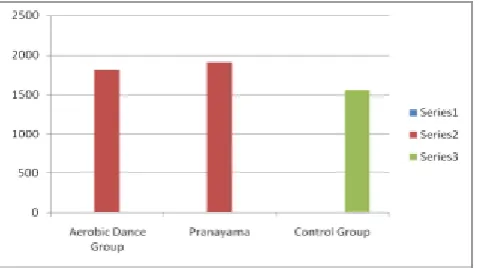
Figure – 1: Comparison Of Mean Values Of Aerobic Dance, Pranayama And Control Groups On Vital Capacity
Discussion
The findings of the study reveals that aerobic dance training and pranayama training
significantly help to improve vital capacity of college level students. The aerobic dance,
alveoli-SRJIS/BIMONTHLY/ JASPAL SINGH, KIRPAL SINGH, YOGESH SHARMA (2649-2656)
JULY-AUG, 2015, VOL. 2/10 www.srjis.com Page 2654 capillary exchange surface. There would have to be concomitant increase in pulmonary
capillarisation in under to make increased lung area effective as a gas exchange area of
increased breath holding time. Basal metabolic rate (B.M.R.) is the number of calories used
by the body when it is at rest. B.M.R. can remain increased after 30 minutes of moderate
physical activity. For aerobic dance, more blood must be supplied to the working tissues.
This means the heart will have to pump more blood and also more oxygen should reach the
muscles by increased rate of respiration. Oxygen helps to burn the calories more efficiently.
The aerobic dance training helps the persons to achieve better oxygen-carbon dioxide
exchange, resulting in better oxygen utilization, slower rate of breathing and vital capacity. If
body weight reduces, we can easily do the aerobic dance or any other activity without any
breathing problems. Chakraborty (1983) reported that dance training helps to improve
physiological aspects of individuals. The concept of pranayama is often mistaken for deep
breathing. In the later situation, movement of breath is fast and forceful. There is no time for
the cells to get soaked in the inhaled oxygen. In pranayama, the movements are so slow that
there is adequate time for every alveolus to soak in oxygen. The venous return is much better
due to phase’s changes in breathing. Elasticity of the lungs and the entire respiratory tract is
maintained to a ripe old age. Gautam and Diwedi (2008) concluded that yogic exercises are
definitely beneficial for increasing vital strength of the lungs. Kocher (1974) emphasised that
yoga exercise improve physiological variables of human body. The haemoglobin/oxygen
saturation is enhanced during kumbhaka, as there is enough time for saturation. The vital
capacity and inspiratory volumes are increased and residual lung volume decreased as more
complete exhalation is performed. The alveoli are exercised, which promotes excellent
excretion of toxins and gases. The healthy movement of diaphragm massages the abdominal
organs, improving their blood supply and aiding the venous drainage to the thoracic cavity. So,
SRJIS/BIMONTHLY/ JASPAL SINGH, KIRPAL SINGH, YOGESH SHARMA (2649-2656)
JULY-AUG, 2015, VOL. 2/10 www.srjis.com Page 2655 results of previous studies conducted by Kumar & Elangovan (2011) & Auvai (2013)
reported that yoga helpful to improve physiological parameters and health of participants.
The results support that aerobic dance training and pranayama needs to practice for good
physiological health of students.
Conclusion
The findings of study concluded that aerobic dance training and pranayama are very effective
exercises which significantly improved the vital capacity of experiment groups. On the other
hand control groups did not report any changes on vital capacity. Aerobic dance training and
paranyama can be used as vital capacity enhancing tool by students. Both aerobic dance
training and pranayama are useful methods which can be helpful in improving the health of
college students and society in general.
Reference
Auvai, R. (2013). Effect of Selected Yogasanas on Physiological and Psychological Traits of
College Girls. Sports Research, 2(1), 39-45.
Chakeraborty, T.M. (1983). Folk Dance: It’s Place in Physical Education. SNIPES, 6(4),
36-38.
Gautam, S.K. & Diwedi, A.K. (2008). An Experimental Study: Effect of Yoga Education on
Student. Journal of Sports and Sports Sciences, 31(2), 47-59.
Kamlesh,M.L. (2013). Foundations of Physical Education. Sport Publication, New Delhi,
349.
Karageorghis, C. I. & Terry P.C. (2001). The Magic of Music in Movement. Sport Medicine,
Today, 5, 38-41.
Kent, M. (2006). Oxford Dictionary of Sports Science and Mechanic. Oxford University
Press, New York, 480.
Kocher, H.C. (1974). Yoga Practices as a Variables Neuroticism, Anxiety and Hostility. Yoga
Mimamsa, 15, (2), 37-46.
Kostić, R., Đurašković, R., Miletić, D., & Mikalački, M. (2006). Changes in the
Cardiovascular Fitness and Body Composition of Women under the Influence of the
SRJIS/BIMONTHLY/ JASPAL SINGH, KIRPAL SINGH, YOGESH SHARMA (2649-2656)
JULY-AUG, 2015, VOL. 2/10 www.srjis.com Page 2656 Kumar, L.M. and Elongovan, R. (2011). Effect of Yogic Practices on Selected Motor Ability
Components of Deaf and Dumb Students, Journal of Sports and Sports Sciences,
34(1),42-51.
Roitman, J. L., Herridge, M., Kelsey, M., Lafontaine, T. P., Miller, L. & Wegner, M. (2001).
ACSM’s Resource Manual for Guidelines for Exercise Testing and Prescription.
Philadelphia, PA: Lippincott Williams & Wilkins.
Shaw, D. & Tomar, R. (2000). Doctoral Research in Physical Education and Its Sciences in
Developed Countries. Vivek Thani Publications, New Delhi.
Sovik, R. (2000). The Science of Breathing: The Yogic View. Brain Research, 22, 491-505.
Subbalakshmi, N. K., Saxena, S. K., Urmimala, N. & D’Souza, J. A. (2005). Immediate Effect of ‘nadi -shodhana pranayama’ on Some Selected Parameters of
Cardiovascular, Pulmonary, and Higher Functions of Brain. The Journal of
Physiological Sciences, 18(2),10-16. Retrieved fromhttp://www.j-pbs.org/
pdf/182/subbalakshmi.pdf
Sunder, P. (2009). Yoga for Fitness. Khel Sahitya Kendra Published, New Delhi.
Wiggins, N., James, R. & Thompson, G. (2005). As PE for AQA: Heinemann Educational