Screening of Trichoderma and antagonistic analysis of a
Potential Strain of
Trichoderma
for Production of a
Bioformulation.
Dr. Ramanuj Patel
*and Deepika Patel
***
Department of Biological Sciences R. D. University, Jabalpur Madhya Pradesh **
Department of Zoology & Biotechnology research lab, Govt. (Auto) Science College Jabalpur Madhya Pradesh
Abstract- Seven different strains of Trichoderma are isolated from wilt infected leguminous crops of a Madhya Pradesh state and tested for their antagonistic activity against Fusarium (soil borne pathogen) which is expressed as a zone of inhibition in the culture plates. The seven strains are identified as Trichoderma viride, T. harzianum, T. asperellum,T. koningii, T. atroviride, T. longibrachiatum, and T. virens. Upon successful identification, morphological description of the isolated strains. This study aims at selecting the best strain of Trichoderma species (Trichoderma viride) and then preparing a simple bioformulation that is cheap, easy to apply and readily accessible to the farmers. Shelf life of the prepared bioformulation is even checked for 180 days and it is concluded that the number of prop gules start declining from 30th day onwards when the bioformulation is prepared in talc as a carrier material.
Index Terms- Antagonism; Biocontrol agent; Trichoderma.
I. INTRODUCTION
he genus Trichoderma has its own significance in the agricultural industry due to its varied activities ranging from being a valuable antagonist against the soil-borne pathogens to acting as a provider of nutrition to the soil as well. Several scientists have worked on how this genus acts as a potential biocontrol agent against a range of pathogenic fungi. Harman et al. [1] have even reported Trichoderma as opportunistic, avirulent plant symbionts. They have explained the features of
Trichoderma as to how it colonizes the roots that eventually proves beneficial to the soil in terms of nutrition and plant growth increasing crop productivity simultaneously. The biocontrol activity of Trichoderma is of immense importance not only to agriculture and its crops but also the environment as it does not accumulate in the food chain and thus does no harm to the plants, animals and humans [2]. The genes and gene products involved in the biocontrol mechanism of Trichoderma provide a vast array of research to the scientists in Biotechnology and Bioinformatics as well. The infrageneric classification by Bisset [3] shows significant morphological similarities between
Trichoderma and Hypocrea and have defined genus Trichoderma
to include the anamorphs of Hypocrea. The morphology of
Trichoderma spp. is very interesting to study as there are a finite number of morphological descriptors to study and disseminate the genus and its features [4,5]. It is believed that the identification of any microorganism becomes quite easy by a
careful morphological observation; hence, a detailed morphological description of some of the commercially important strains of Trichoderma has been carried out in this study. Samuels [6] described the systematics, the sexual stage and the ecology of Trichoderma and mentioned in his study that the morphology of Trichoderma is not only limited to a few characters but many species may be included in this genus due to their geographical distribution.
Druzhinina and Kubicek [7] studied and brought forth the species concepts and biodiversity in Trichoderma and Hypocrea
by aggregating the morphological, studies and presented an update on the taxonomy and phylogeny of a number of taxa. This helped us in understanding that the identification of Trichoderma
only on the basis of morphology of high precision. The study now focuses upon developing a strain-specific morphological for the identification of Trichoderma species.The study also includes the behavior of these BCAs against fungal wilt pathogens affecting leguminous crops. Fusarium wilt causes huge loss to the leguminous crops in India every year ranging from 15 to 20% thereby reducing the production of important legumes. Various management strategies such as use of resistant cultivars are been undertaken to prevent the crops and soils as well from the wilt caused by Fusarium as it may last for several years. Thus, it becomes necessary to derive a cheap and better way to fight against the pathogen and increase the crop production. Bioformulation containing Trichoderma has emerged as an effective alternative to this problem and thus has been disseminated in this report. But, before preparing a bioformulation with Trichoderma, the effect of media, temperature and pH on the growth and sporulation of
Trichoderma species should be known [12, 13]. Trichoderma species, when grown either in PDA within a pH range of 7-7.5 and at an optimum temperature range of 25-30˚C gives the best growth and sporulation rates both. Talc-based bioformulation of
Trichoderma [14] has proven beneficial to the wilt infected leguminous crops but an important aspect to be taken into prior consideration is the shelf life of spores that are present in talc. Various methods and measures are still to be taken that can result in the longevity, competitiveness and survival of Trichoderma on fields.
II. MATERIALS AND METHODS
Isolation and selection of strains
Trichoderma strains were isolated from the soil of pulse fields of various districts of Uttar Pradesh (India) and were tested against phythopathogenesis. The most promising isolates were selected for biochemical, molecular and disease suppressiveness tests. Initially, a total of seven strains were identified and were selected for further study. Based on the descriptions of Bissett [3], we classified these fungi as: Trichoderma anamorph and
Hypocrea teleomorph. The isolates were screened for
antagonistic activity towards the major soil borne fungi such as
Fusarium solani, Rhizoctonia solani, Pythium ultimum,
Macrophomina phaseolina, Sclerotinia sclerotiorum,
Phytophthora, Fusarium oxysporum and Sclerotium cepivorum
that were previously isolated and identified in the Fungal Germplzam Culture Collection Center Mycological research Laboratory, Department of Biological Sciences Rani Durgawati University Jabalpur Madhya Pradesh, India.
In vitro bioassay
In vitro bioassay was conducted between the Trichoderma
isolates and the phytopathogenic fungi in petridishes containing PDA. Isolates which showed a marked effect towards pathogens were selected and used for further study. Each Trichoderma
isolate was separately inoculated into 100 ml Potato Dextrose Broth and incubated at 20˚C for 10 days. After incubation, the cultures were filtered through 0.22 mm Millipore filters and the aliquots (2 ml) of these filtrates were placed in sterile petridishes and 25 ml of 1/4 strength PDA at 45ºC was added. Once the agar solidified, mycelial discs of the pathogens (7 mm in diameter) obtained from actively growing colonies were placed gently on the centre of the agar plates. The petridishes were incubated at 20°C for 6 days. There were three replicates for each experiment and the growth reduction of the pathogens was recorded. Morphological descriptors such as colony morphology, colony color, colony edge and others of each strain were studied. Electrophoresis
The amplification products were analyzed by electrophoresis according to Sambrook and Russell [15] in 2% agarose in TAE buffer (for a litre of 50X TAE Stock solution, we used: 242 g Tris Base, 57.1 ml Glacial Acetic Acid and 100 ml 0.5 M EDTA), stained with 0.2 μg/ml ethidium bromide. Nucleic acid
bands were photographed and detected by BioRad Gel Doc system.
Preparation of bioformulation
Talc powder was evaluated as carrier material to produce bioformulation of Trichoderma sp. The carrier was dried under sun, powdered (sieve pore, 1mm) and sterilized at 1.05 kg/cm2 pressure for 30 min. The substrate was mixed with 7 days old culture of respective Trichoderma spp. which were previously grown on potato dextrose agar in 2:1 (solid culture) w/v and CMC 5 gm/kg was added as adjuvant. Fifty grams of such mixture was then filled in polypropylene bags (25x30 cm) tied and stored at 25 ± 2°C. Observations on colony forming units (cfu) of Trichoderma spp. was recorded initially and at monthly interval up to 6 months for shelf life study.
Seed treatment
Required quantity of fungicide (Vitavax @ 2 gm/kg seed), insecticide (Chloropyriphos 20 EC @ 8ml/kg seed), biocontrol agent (Trichoderma viride @ 4 gm/kg seed) and biofertilizer
Rhizobium culture @ 1 packet/ acre or 30 gm/kg seeds) along with different combination with 100 seeds of lentil and Chickpea taken from the healthy fields and 100 seeds of lentil and chickpea taken from the infected fields were used for studies.
III. RESULTS AND DISCUSSION
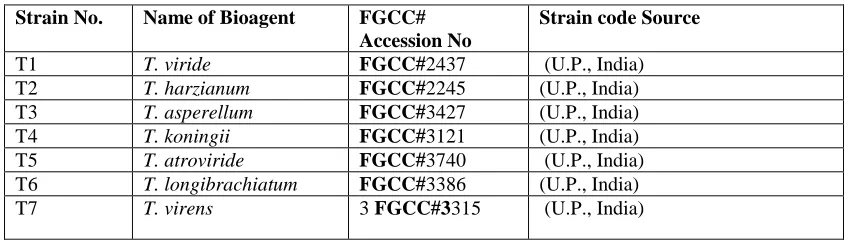
A total of seven isolates of Trichoderma species were isolated from the soil of pulse fields of various districts of Uttar Pradesh, India. These include Trichoderma viride, T. harzianum, T. asperellum, T. koningii, T. atroviride, T. longibrachiatum and T. virens.
All tested strains in genus Trichoderma had high or moderate antagonistic activity towards pathogens expressed as a zone of inhibition and fungal growth reduction by using culture filtrate. Among all isolated strains, T. harzianum and T. viride
were found to be the most effective species against all pathogens.
Trichoderma strains that were isolated and taken into
[image:2.612.94.519.543.664.2]consideration in this study have been validated and submitted to the Indian Typ
Table 1: Details of Trichoderma strains.
Strain No. Name of Bioagent FGCC#
Accession No
Strain code Source
T1 T. viride FGCC#2437 (U.P., India)
T2 T. harzianum FGCC#2245 (U.P., India)
T3 T. asperellum FGCC#3427 (U.P., India)
T4 T. koningii FGCC#3121 (U.P., India)
T5 T. atroviride FGCC#3740 (U.P., India)
T6 T. longibrachiatum FGCC#3386 (U.P., India)
ISSN 2250-3153
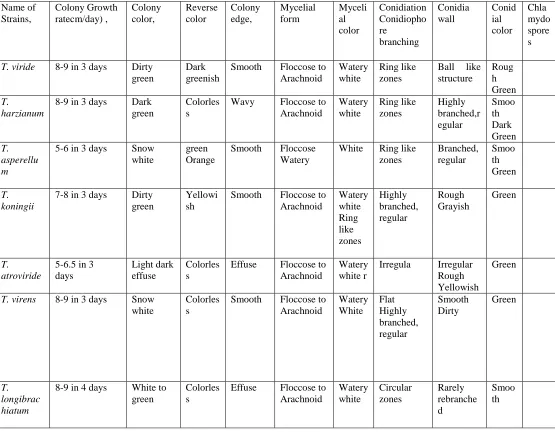
Table 2: Morphological descriptors used for the characterization of native isolates of Trichoderma spp.
Name of Strains, Colony Growth ratecm/day) , Colony color, Reverse color Colony edge, Mycelial form Myceli al color Conidiation Conidiopho re branching Conidia wall Conid ial color Chla mydo spore s
T. viride 8-9 in 3 days Dirty
green
Dark greenish
Smooth Floccose to Arachnoid
Watery white
Ring like zones
Ball like structure Roug h Green T. harzianum
8-9 in 3 days Dark green
Colorles s
Wavy Floccose to Arachnoid Watery white Ring like zones Highly branched,r egular Smoo th Dark Green T. asperellu m
5-6 in 3 days Snow white
green Orange
Smooth Floccose Watery
White Ring like zones Branched, regular Smoo th Green T. koningii
7-8 in 3 days Dirty green
Yellowi sh
Smooth Floccose to Arachnoid Watery white Ring like zones Highly branched, regular Rough Grayish Green T. atroviride
5-6.5 in 3 days
Light dark effuse
Colorles s
Effuse Floccose to Arachnoid
Watery white r
Irregula Irregular Rough Yellowish
Green
T. virens 8-9 in 3 days Snow
white
Colorles s
Smooth Floccose to Arachnoid Watery White Flat Highly branched, regular Smooth Dirty Green T. longibrac hiatum
8-9 in 4 days White to green
Colorles s
Effuse Floccose to Arachnoid Watery white Circular zones Rarely rebranche d Smoo th Morphological description
Morphological study of the Trichoderma strains has been done and the characteristics include various parameters such as colony growth rate, colony color, colony edge, mycelial form, growth pattern and speed Along with morphology of conidia and phialids, conidia color, shape and size etc. were studied for the identification of each strain of the genus Trichoderma (Table 2).
Bioformulation and its validation under in vitro conditions Talc-based bioformulation of Trichoderma is prepared as it is relatively cheap and easily accessible to farmers for use on fields. It can be stored in plastic bags for long as it has been observed that storing the talc-based bioformulation in plastic bags increases the shelf-life of Trichoderma preserving its bioefficiency simultaneously. The shelf life of all the seven isolates was also ascertained at ambient environment prevailing
during a period of 6 months on the basis of spore load per gram. The talc based powder of the bioagent was prepared (Trichoderma viride (FGCC#2437) (spore+mycelium) 1.0% w/ w+Talc 98.5% w/w+0.5% carboxyl methyl cellulose) and used for shelf life, bioefficacy etc. studies. The talc based bioformulation was stored in LDPE pouches. The powder was dull white in color, pH 7.0, moisture 8% and cfu of 29.7×10⁶. It was found that the bioformulation has good shelf life up to six months and then the spores started declining. Shelf life of
retain their viability up to 120 days in all the cases (Figure 3). Under natural conditions, application of talc-based
BCAs, which begins with a safe characterization of biocontrol strains in the new taxonomic schemes of
Trichoderma, is equally important since the exact identification of strains at the species level is the first step in utilizing the full potential of fungi in specific applications. that Vitavax followed by treatment with Trichoderma viride were found superiorsolidformulation of Trichoderma in soil provides protection against wilt disease in leguminous crops. Higher reduction in wilt was obtained in lentil and pigeon pea crops. As compared with the control and other strains, application of
Trichoderma viride (FGCC#2437) was more effective in
reducing the wilt disease caused by Fusarium in Pigeonpea. Trichoderma species can act as biocontrol agents through different synergistic mechanisms. However, it is difficult to predict the degree of synergism and the behavior of a BCA in natural system. Considering that the environmental conditions are important, the right selection of Strains of Trichoderma can produce extracellular enzymes and antifungal antibiotics, they may also be competitors to fungal pathogens, promote plant growth, and induce resistance in plants. The different pre-sowing seed Trichoderma species play an important role in controlling fungal plant pathogens, especially soil borne fungal pathogens.
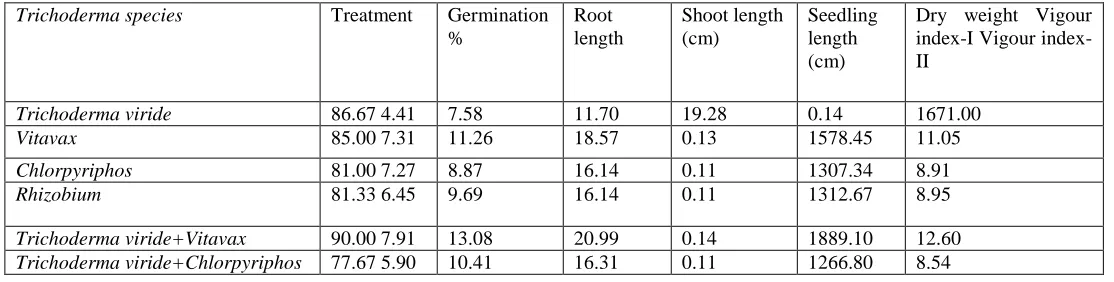
treatments when taken from healthy fields showed different response for all seven seed quality attributes i.e. germination, root length, shoot length, seedling length, dry weight, vigour index I and vigour index II. The data revealed
The commercial use of Trichoderma BCAs must be preceded by precise identification, adequate Formulation and studies about the synergistic effects of their mechanisms of biocontrol. T. viride have been reported as the most important BCAs against plant pathogenic fungi. The strain distribution in several genotypes could also support the idea of developing antifungal formulations in which different Trichoderma BCAs could be combined. The use of Trichoderma-based products is not only safe for the farmers and consumers but it also proves friendly to the environment. The morphological characters of the fungus under study agree very closely with the description given by Vasudeva and Srinivasan [16] and Booth [17]. Cornea et al.
[image:4.612.20.577.597.738.2][18] found that the allow the confirmation of previous taxonomic determination of Trichoderma harzianum (FGCC#2245) and T. viride. (FGCC#2437) However, also reported that germination and seedling length along with seedling dry weight are important attributes, which determine the quality of seed of any seed lot. Besides these quality seed parameters seed vigour index also plays very crucial role in predicting the fate of any seed lot under biotic and abiotic stress conditions
Figure 3: Effect of Talc as a carrier on the population of Trichoderma spp.
Table3: Evaluation with special reference to the use of pesticides in seed treatment in combination with bioagents.
Trichoderma species Treatment Germination
%
Root length
Shoot length (cm)
Seedling length (cm)
Dry weight Vigour I Vigour index-II
Trichoderma viride 86.67 4.41 7.58 11.70 19.28 0.14 1671.00
Vitavax 85.00 7.31 11.26 18.57 0.13 1578.45 11.05
Chlorpyriphos 81.00 7.27 8.87 16.14 0.11 1307.34 8.91
Rhizobium 81.33 6.45 9.69 16.14 0.11 1312.67 8.95
Trichoderma viride+Vitavax 90.00 7.91 13.08 20.99 0.14 1889.10 12.60
ISSN 2250-3153
Trichoderma viride+Rhizobium 84.33 6.59 9.35 15.94 0.11 1344.22 9.28
Vitavax+Chlorpyriphos 67.67 5.51 9.35 14.86 0.12 1005.58 8.12
Vitavax+Rhizobium 9. 73.67 12.75 0.11 939.29 8.10 10.00
Chlorpyriphos+Rhizobium 84.67 3.95 7.16 11.11 0.11 940.68 9.31
Trichoderma viride+
Vitavax+Chlorpyriphos
8.34 77.33 6.57 10.85 0.12 1347.09 9.28
Trichoderma viride+
Vitavax+Rhizobium
78.33 5.84 8.92 14.76 0.12 1156.15 9.40
Trichoderma viride+
Chlorpyriphos+ Rhizobium
80.00 5.57 9.74 15.31 0.11 1224.80 8.80
Vitavax+Chlorpyriphos+Rhizobium 79.33 5.70 8.83 14.53 0.10 1152.66 7.93
Vitavax+Chlorpyriphos+Vitavax+R hizobium
74.00 5.45 9.05 14.5 1073.00 7.40 0.10
Control 66.33 3.87 7.10 10.97 0.10 727.64 6.63
CD= 5% 5.69 1.22 0.63 1. 72 0.02 321.60 1.81
S.D. 2.79 0.60 0.31 0.86 0.01 157.88 2.03
IV. CONCLUSION
It is concluded from this study that Trichoderma has been successfully isolated, identified, characterized and used as an effective biocontrol agent against wilt caused by other pathogenic fungi. The seven strains of Trichoderma have been isolated from wilt infected leguminous crops and tested in the laboratory for the identification of pathogens infecting the crops. The strains have been examined morphologically level as well. The effect of enzyme activities during interaction with the pathogen is also counted and the data reveals the best carbon source for the enzyme for its induction. In the end, a talc based bioformulation is prepared that showed beneficial effects when applied on wilt infected crops on pulse fields
ACKNOWLEDGEMENT
The authors are grateful to Head Department of Biological Sciences Rani Durgawati University Jabalpur Madhya Pradesh India
REFERENCES
[1] Harman GE, Howell CR, Viterbo A, Chet I, Lorito M (2004) Trichoderma species—opportunistic, avirulent plant symbionts. Nat Rev Microbiol 2: 43-56. Monte E, Llobell A (2003) Trichoderma in organic agriculture. V Congreso Mundial del Aguacate 725-733.
[2] Bissett J (1991) A revision of the genus Trichoderma . II. Infrageneric classification. Canadian Journal of Botany 69: 2357-2372. 4.
[3] Gams W, Meyer W (1998) What exactly is Trichoderma harzianum? Mycologia 90: 904-915.
[4] Samuels GJ (2006) Trichoderma: systematics, the sexual state, and ecology. Phytopathology 96: 195-206.
[5] Druzhinina I, Kubicek CP (2005) Species concepts and biodiversity in Trichoderma and Hypocrea: from aggregate species to species clusters? J Zhejiang Univ Sci B 6: 100-112.
[6] Kumar V, Shahid M, Singh A, Srivastava M, Biswas SK (2011) RAPD Analysis of Trichoderma longibrachiatum isolated from Pigeonpea Fields of Uttar Pradesh. Indian J Agric Biochem 24: 80-82.
[7] Shahid M (2012) Evaluation of Antagonistic activity and Shelf life study of Trichoderma viride (01 PP-8315/11). Advances in Life Sciences 1: 138-140.
[8] Sagar MSI, Meah MB, Rahman MM, Ghose AK (2011) Determination of genetic variations among different Trichoderma isolates using RAPD marker in Bangladesh. J Bangladesh Agril Univ 9: 9-20.
[9] Shahid M (2013) Sequencing of 28SrNA Gene for Identification of Trichoderma longibrachiatum 28 CP/ 74444 Species in Soil Sample. International Journal of Biotechnology for Wellness Industries 2: 84-90. [10] Singh A, Shahid M, Pandey NK, Kumar S, Srivastava M, Biswas SK (2011)
Influence of temperature, pH and media for growth and sporulation of Trichoderma atroviride and its Shelf life study in different carrier based formulation. J Pl Dis Sci 6: 32-34.
[11] Shahid M, Singh A, Srivastava M, Sachan CP, Biswas SK (2011) Effect of seed treatment on Germination and Vigour in Chickpea. Trend in Biosciences 4: 205- 207.
[12] Shahid M (2012) Molecular characterization and variability of Trichoderma longibrachiatum based on antagonistic and RAPD analysis in legume crops of Uttar Pradesh. J Botan Soc Bengal 66: 105-110.
[13] Sambrook J, Russell DW (2001) Agarose Gel Electrophoresis. CSH Protocols.
[14] Vasudeva RS, Srinivasan KV (1952) Studies on the wilt disease of lentil (Lens esculenta Moench), Indian Phytopath 5: 23-32.
[15] Booth C (1971) the genus Fusarium. CMI, Kew, Surrey, England. [16] Cornea CP, Pop A, Matei S, Ciuca M, Voaides C, et al. (2009) Antifungal
action of new Trichoderma species Romanian isolates on different plant pathogens. Biotechnol and Biotechnol 23: 766-770.
[17] Shahid M, Singh A, Srivastava M, Mishra RP, Biswas SK (2011) Effect of temperature, pH and media for growth and sporulation of Trichoderma and self life study in carrier based formulations. Ann Pl Protec Sci 19: 147-149. [18] Singh A, Shahid M, Sachan CP, Srivastava M, Biswas SK (2013) Effect of
AUTHORS
First Author – Ramanuj Patel Assistant Peofessor, Department of Biological Sciences,Rani Durgawati University Jabalpur M.P. Jabalpur - [email protected]
Second Author – Deepika Patel Ph.D, Department of Zoology & Biotechnology research lab, Govt. (Auto) Science College Jabalpur Madhya Pradesh