http://dx.doi.org/10.4236/abb.2014.57079
How to cite this paper: Girault, G., Thierry, S., Cherchame, E. and Derzelle, S. (2014) Application of High-Throughput Se- quencing: Discovery of Informative SNPs to Subtype Bacillus anthracis. Advances in Bioscience and Biotechnology, 5, 669- 677. http://dx.doi.org/10.4236/abb.2014.57079
Application of High-Throughput Sequencing:
Discovery of Informative SNPs to Subtype
Bacillus anthracis
Guillaume Girault
*, Simon Thierry, Emeline Cherchame, Sylviane Derzelle
University Paris-Est, ANSES, Animal Health Laboratory, Bacterial Zoonoses Unit, Maisons-Alfort, France Email: *[email protected], [email protected], [email protected],
Received 17 April 2014; revised 29 May 2014; accepted 17 June 2014
Copyright © 2014 by authors and Scientific Research Publishing Inc.
This work is licensed under the Creative Commons Attribution International License (CC BY). http://creativecommons.org/licenses/by/4.0/
Abstract
Single Nucleotide Polymorphisms (SNPs) are the most common and abundant genetic variation found in the genome of any living species, from bacteria to humans. In bacterial genotyping, these evolutionarily stable point mutations represent important DNA markers that can be used to elu- cidate deep phylogenetic relationships among worldwide strains, but also to discriminate closely related strains. With the advent of next generation sequencing (NGS) technologies, affordable so- lutions are now available to get access to the complete genome sequence of an organism. Se- quencing efforts of an increasing number of strains provide an unprecedented opportunity to create comprehensive species phylogenies. In this study, a comparative analysis of 161 genomes of Bacillus anthracis has being conducted to discover new informative SNPs that further resolves B. anthracis SNP-based phylogenetic tree. Nine previously unpublished SNPs that define major groups or sub-groups within the B. anthracis species were selected and developed into SNP discriminative assays. We report here a cost-effective high-resolution melting-based genotyping method for the screening of 27 canonical SNPs that includes these new diagnostic markers. The present assays are useful to rapidly assign an isolate to one sub-lineages or sub-groups and determine its phylo- genetic placement on the B. anthracis substructure population.
Keywords
SNPs, Bacillus anthracis, Genotyping, HRM, Phylogeny
1. Introduction
bioterrorism. This Gram-positive endospore-forming bacterium is the causative agent of anthrax, an infectious and life threatening diseases in all mammals, including humans. B. anthracis evolved as a highly fit clonal pathogen that has spread throughout the world and became ecologically established as local, genetically distinct populations [1].
In both microbiological forensics and epidemiological investigations, obtaining reliable information regarding the identification and source of a suspicious strain is often essential to set up effective responses, as highlighted by the Amerithrax investigations following the so-called 2001 “anthrax letter attacks” in the United States [2]. The principal genomic markers used for genotyping a highly monomorphic bacterium such as B. anthracis are variable number tandem repeats (VNTRs) [3]-[5], single nucleotide repeats (SNRs) [6]-[8] and SNPs [9]. Since 2007, the genotyping of a set of 13 canonical SNPs has emerged as the gold standard method to be used for de- termining phylogenetic relationships within this bacterium [10]-[13]. SNPs are generated by nucleotide substitu- tions, probably associated to errors during DNA replication that are not repaired. These rare events occur at an estimated rate of approximately 10−10 changes per nucleotide per generation in the B. anthracis species [14]. Because of their low mutation rates, SNPs represent ideal targets for phylogenetic analyses. SNPs are evolutio- narily stable markers that are unlikely to mutate back to their ancestral state [9]. This stability can be used for defining canonical markers representative of groups of related strains, such as phylogenetic sub-groups [9].
The substructure of the B. anthracis population is divided into three major clades (A, B and C), with further subdivisions into 13 major lineages or groups [10] [12] [13]. The A-radiation has known the most dramatic dis- persal and clonal expansion. It represents nowadays the majority of anthrax cases reported around the world [3] [15] [16]. The eight A-lineages or groups exhibit distinct geographical patterns across the five continents. Most basal of the A-clade is the African A.Br.005/006 group, consistent with an “out of Africa” hypothesis for B. anthracis. Soon after this divergence, the Vollum-clade appeared, with isolates currently ecologically estab- lished in Iran, Pakistan and Afghanistan, for instance. The highly successful TransEurasian (TEA) group (A.Br.008/009) is slightly more recent and spread across Europe and Asia from which a derived lineage (A.Br. WNA) was introduced into North America. Another recent bifurcation led to the A.Br.003/004, A.Br. Australia- 94 and Ames/Sterne (A.Br.001/002) groups which contain isolates found, respectively, in South America (A.Br.003/004), Asia and part of Europe (A.Br.Aust94 and A.Br.001/002) [1] [10]. Collections from western and south-central Asia (Turkey, India) and western China are dominated by genotypes belonging to the A.Br.Aust94 lineage. Further into central and eastern China the genotypes are dominated by isolates belonging to the A.Br.001/002 group and its derived A.Br.Ames lineage. The B clade is divided into two genetically distinct li- neages with geographical restricted repartition. The B.Br.001/002 group (including the derived B.Br.Kruger li- neage) is ecologically established in Southern Africa, in particular in the Kruger National Park (South Africa), where it co-exists with other strains from the A-clade [10] [17]. The B.Br.CNEVA lineage is exclusively found in continental Europe [10] [18]-[21]. The C-clade is composed of an uncommon lineage, C.Br.A1055, clustering only three collection’s isolates of unknown origin [10] [22].
Whole genome sequencing is the ultimate genotyping tool, giving the highest possible resolution, with com- parison information spanning from distant phylogenetic relationships to the highest level of subtyping. Identifi- cation of thousands of SNPs retrieved from compiled NGS sequences facilitates high-resolution strain tracking and provides the level of discrimination required for microbial forensics. Canonical SNP typing and whole ge- nome comparisons of multiple strains will soon become the method of choice in B. anthracis genotyping [23]. We have recently reported the high throughput sequencing and phylogeographical analysis of 122 strains of B. anthracis isolated in France [24]. The resulting whole-genome SNPs analysis determined relationships existing between French strains at a level of discrimination never reached before and reconstructed the French population substructure in details. Eight new canonical SNPs have been identified that allow classifying French B. anthracis isolates at a higher resolution [24]. In this study, we compared the chromosomal sequences of 161 globally di- verse strains, focusing on identifying additional informative SNPs, to provide further resolution into current SNP-based typing of B. anthracis. Twenty-seven SNP discrimination assays, including nine newly described markers, are reported. The PCR-HRM-based method presented here is a cost-effective tool to genotype the highly clonal B. anthracis species.
2. Materials and Methods
2.1. Extraction of Whole-Genome SNPs among
B. anthracis
Strains
strains (n = 123) belonging to 3 groups or lineages (A.Br.001/002, A.Br.011/009 (A.Br.008/009 sub-group), and B.Br.CNEVA) [24] were whole-genome compared to thirty-seven globally diverse genomes publically available in database [25] (Table 1). Ames Ancestor [GenBank: AE017334.2] was used as reference genome. Sequences alignment and whole-genome SNPs discovery were carried out using the BioNumerics version 7.0 software (Applied Maths, Belgium) and its Chromosome Comparisons module. SNPs were next filtered to avoid errone- ous and biased data. Missing sequences, ribosomal operons, VNTR loci and contiguous SNPs in a 10 pb win- dow were eliminated from the analysis.
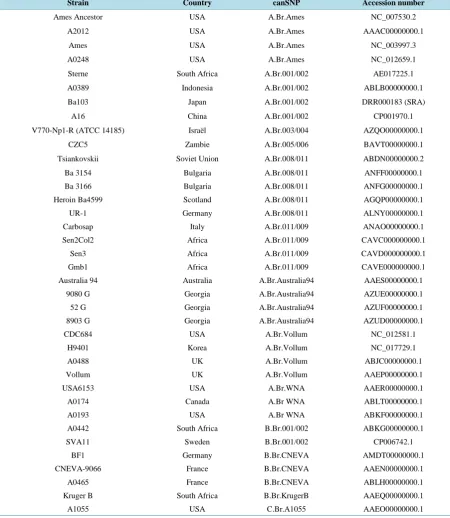
Table 1. Whole genome sequences available in public database used in this study.
Strain Country canSNP Accession number
Ames Ancestor USA A.Br.Ames NC_007530.2
A2012 USA A.Br.Ames AAAC00000000.1
Ames USA A.Br.Ames NC_003997.3
A0248 USA A.Br.Ames NC_012659.1
Sterne South Africa A.Br.001/002 AE017225.1
A0389 Indonesia A.Br.001/002 ABLB00000000.1
Ba103 Japan A.Br.001/002 DRR000183 (SRA)
A16 China A.Br.001/002 CP001970.1
V770-Np1-R (ATCC 14185) Israël A.Br.003/004 AZQO00000000.1
CZC5 Zambie A.Br.005/006 BAVT00000000.1
Tsiankovskii Soviet Union A.Br.008/011 ABDN00000000.2
Ba 3154 Bulgaria A.Br.008/011 ANFF00000000.1
Ba 3166 Bulgaria A.Br.008/011 ANFG00000000.1
Heroin Ba4599 Scotland A.Br.008/011 AGQP00000000.1
UR-1 Germany A.Br.008/011 ALNY00000000.1
Carbosap Italy A.Br.011/009 ANAO00000000.1
Sen2Col2 Africa A.Br.011/009 CAVC000000000.1
Sen3 Africa A.Br.011/009 CAVD000000000.1
Gmb1 Africa A.Br.011/009 CAVE000000000.1
Australia 94 Australia A.Br.Australia94 AAES00000000.1
9080 G Georgia A.Br.Australia94 AZUE00000000.1
52 G Georgia A.Br.Australia94 AZUF00000000.1
8903 G Georgia A.Br.Australia94 AZUD00000000.1
CDC684 USA A.Br.Vollum NC_012581.1
H9401 Korea A.Br.Vollum NC_017729.1
A0488 UK A.Br.Vollum ABJC00000000.1
Vollum UK A.Br.Vollum AAEP00000000.1
USA6153 USA A.Br.WNA AAER00000000.1
A0174 Canada A.Br WNA ABLT00000000.1
A0193 USA A.Br WNA ABKF00000000.1
A0442 South Africa B.Br.001/002 ABKG00000000.1
SVA11 Sweden B.Br.001/002 CP006742.1
BF1 Germany B.Br.CNEVA AMDT00000000.1
CNEVA-9066 France B.Br.CNEVA AAEN00000000.1
A0465 France B.Br.CNEVA ABLH00000000.1
Kruger B South Africa B.Br.KrugerB AAEQ00000000.1
2.2. Phylogenetic Analysis
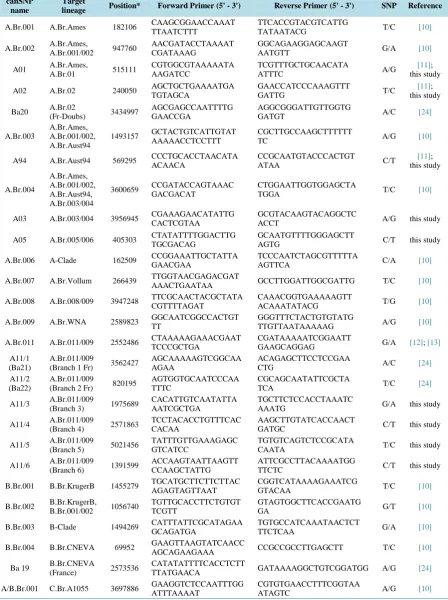
A minimum spanning tree was drawn in BioNumerics by using the filtered whole genome sequencing SNP data as input. Nodes were automatically numbered by the software. Canonical SNPs that defining major group, sub-groups or clusters of strains along the SNP tree were identified by searching for key signatures with allelic states shared only by these selected subgroups.
2.3. SNP Discrimination Assays by HRM
After identification, primer sequences suitable for HRM analysis were designed for each SNP marker using the Primer 3+ software (http://www.bioinformatics.nl/cgi-bin/primer3plus/primer3plus.cgi/) (Table 2). Short am- plicons (<100 pb) were selected. High-resolution melting (HRM) is a post-PCR technique that determines with high precision the melt profile of PCR products. A new generation dye is incorporated into a double-stranded DNA. Using a slow constant increase in temperature, fluorescence acquisition allows the distinction between two different populations of amplicons.
Amplification was performed on the ViiA7™ Real-Time PCR System (Life Technologies) using the Light- Cycler® 480 High Resolution Melting Master Mix (Roche Diagnostics). The reaction mixture consisted of 0.2 μM of each primer, 1 × LightCycler® 480 HRM master mix and 2.5 mM MgCl
2 in a 10 μl final volume. The
following parameters were used: 10 min at 95˚C were followed by 40 cycles consisting of 10 s at 95˚C, 10 s at 58˚C and 20 s at 72˚C. Samples were next heated to 95˚C for 30 s, cooled down to 65˚C for 1 min and heated from 65˚C to 88˚C at a rate of 1˚C/s with 25 acquisitions/˚C. HRM data were analyzed by the ViiA7™ Software (version 1.2.1).
3. Results
3.1.
In Silico
SNP Typing
Thirty-seven B. anthracis genomes available in public NCBI database or Sequence Read Archive (SRA) were used for this study [25] (Table 1). These globally diverse genomes were first subjected to in silico canSNP typ- ing using the 14 canSNPs references set previously published [10] [12] to determine their phylogenetic place- ment on the B. anthracis canSNP tree (Table 1). French strains were previously shown to belong to A.Br.011/009 (a sub-group of the TEA population) (n = 32), A.Br.001/002 (n = 24) and B.Br.CNEVA (n = 67) lineages or groups. The African IEMVT 89 strain is affiliated to A.Br.005/006 [24].
3.2. Phylogenetic Analysis
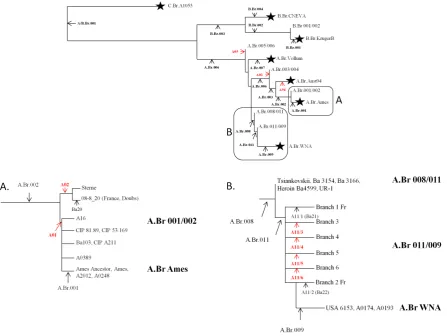
A total of 161 genomes of B. anthracis were aligned to the Ames ancestor reference sequence and whole-geno- me compared with a focus on SNPs discovery. SNPs that define the major A.Br.Aust94 lineage (four genomes), A.Br.003/004 group (one genome) and A.Br.005/006 group (two genomes) were identified and one canonical marker selected for each subpopulation (Table 2, Figure 1). Interestingly, the whole-genome SNP analysis fur-ther resolved the A.Br.001/002 subpopulation (32 genomes) into two distinct phylogenetic sub-groups which were named A01 and A02 (Figure 1, inset A). The A01 sub-group (also termed “Ames sub-group”) radiates very shortly after the A01-A02 divergence (1 SNP at position 515111) into at least 5 sub-branches. The first one contains the A.Br.Ames lineage (strains Ames Ancestor, Ames, A2012 and A0248). The second one is com- posed by the A0389 strain. The third one includes the Japanese strain Ba103 and one old French strain (CIP A211). The two last branches are composed of, respectively, two old French isolates (CIP 81.89 and CIP 53.169), and the A16 Chinese strain. The A02 sub-group (also termed “Sterne sub-group”) clusters the Sterne vaccine strain and all recent strains isolated in France from the Doubs department, including the 08-8_20 ge- nome [24]. Noteworthy to mention, the Carbosap vaccine was found to be phylogenetically related to five French genomes positioned within the third branch of the six sub-branches previously discovered within the A.Br.011/009 sub-groups. SNPs specific to these A.Br.011/009 branches were also selected (Table 2, Figure 1, inset B).
3.3. canSNP Discrimination Assays Using HRM
Table 2. canSNPs and primer sequences used for HRM analysis.
canSNP name
Target
lineage Position* Forward Primer (5' - 3') Reverse Primer (5' - 3') SNP Reference
A.Br.001 A.Br.Ames 182106 CAAGCGGAACCAAAT TTAATCTTT
TTCACCGTACGTCATTG
TATAATACG T/C [10]
A.Br.002 A.Br.Ames, A.Br.001/002 947760 AACGATACCTAAAAT CGATAAAG GGCAGAAGGAGCAAGT AATGTT G/A [10]
A01 A.Br.Ames, A.Br.01 515111 CGTGGCGTAAAAATA AAGATCC TCGTTTGCTGCAACATA ATTTC A/G this study [11];
A02 A.Br.02 240050 AGCTGCTGAAAATGA TGTAGCA
GAACCATCCCAAAGTTT
GATTG T/C
[11]; this study
Ba20 A.Br.02
(Fr-Doubs) 3434997
AGCGAGCCAATTTTG GAACCGA
AGGCGGGATTGTTGGTG
GATGT A/C [24]
A.Br.003
A.Br.Ames, A.Br.001/002, A.Br.Aust94
1493157 GCTACTGTCATTGTAT AAAAACCTCCTTT
CGCTTGCCAAGCTTTTTT
TC A/G [10]
A94 A.Br.Aust94 569295 CCCTGCACCTAACATA ACAACA
CCGCAATGTACCCACTGT
ATAA C/T
[11]; this study A.Br.004 A.Br.Ames, A.Br.001/002, A.Br.Aust94, A.Br.003/004
3600659 CCGATACCAGTAAAC GACGACAT
CTGGAATTGGTGGAGCTA
TGGA T/C [10]
A03 A.Br.003/004 3956945 CGAAAGAACATATTG CACTCGTAA GCGTACAAGTACAGGCTC ACCT A/G this study
A05 A.Br.005/006 405303 CTATATTTTGGACTTG TGCGACAG
GCAATGTTTTGGGAGCTT
AGTG C/T this study
A.Br.006 A-Clade 162509 CCGGAAATTGCTATTA GAACGAA
TCCCAATCTAGCGTTTTTA
AGTTCA C/A [10]
A.Br.007 A.Br.Vollum 266439 TTGGTAACGAGACGAT
AAACTGAATAA GCCTTGGATTGGCGATTG T/C [10]
A.Br.008 A.Br.008/009 3947248 TTCGCAACTACGCTATA CGTTTTAGAT
CAAACGGTGAAAAAGTT
ACAAATATACG T/G [10]
A.Br.009 A.Br.WNA 2589823 GGCAATCGGCCACTGT TT
GGGTTTCTACTGTGTATG
TTGTTAATAAAAAG A/G [10]
A.Br.011 A.Br.011/009 2552486 CTAAAAAGAAACGAAT TCCCGCTGA CGATAAAAATCGGAATT GAAGCAGGAG G/A [12]; [13]
A11/1 (Ba21)
A.Br.011/009
(Branch 1 Fr) 3562427
AGCAAAAAGTCGGCAA AGAA
ACAGAGCTTCCTCCGAA
CTG A/C [24]
A11/2 (Ba22)
A.Br.011/009
(Branch 2 Fr) 820195
AGTGGTGCAATCCCAA TTTC
CGCAGCAATATTCGCTA
TCA T/C [24]
A11/3 A.Br.011/009
(Branch 3) 1975689
CACATTGTCAATATTA AATCGCTGA
TGCTTCTCCACCTAAATC
AAATG G/A this study
A11/4 A.Br.011/009
(Branch 4) 2571863
TCCTACACCTGTTTCAC CACAA
AAGCTTGTATCACCAACT
GATGC C/T this study
A11/5 A.Br.011/009
(Branch 5) 5021456
TATTTGTTGAAAGAGC GTCATCC
TGTGTCAGTCTCCGCATA
CAATA T/C this study
A11/6 A.Br.011/009
(Branch 6) 1391599
ACCAAGTAATTAAGTT CCAAGCTATTG
ATTCGCCTTACAAAATGG
TTCTC C/T this study
B.Br.001 B.Br.KrugerB 1455279 TGCATGCTTCTTCTTAC AGAGTAGTTAAT
CGGTCATAAAAGAAATCG
GTACAA T/C [10]
B.Br.002 B.Br.KrugerB,
B.Br.001/002 1056740
TGTTGCACCTTCTGTGT TCGTT
GTAGTGGCTTCACCGAATG
GA G/T [10]
B.Br.003 B-Clade 1494269 CATTTATTCGCATAGAA GCAGATGA
TGTGCCATCAAATAACTCT
TTCTCAA G/A [10]
B.Br.004 B.Br.CNEVA 69952 GAAGTTAAGTATCAACC
AGCAGAAGAAA CCGCCGCCTTGAGCTT T/C [10]
Ba 19 B.Br.CNEVA
(France) 2573536
CATATATTTTCACCTCTT
TTATGAACA GATAAAAGGCTGTCGGATGG A/G [24]
A/B.Br.001 C.Br.A1055 3697886 GAAGGTCTCCAATTTGG ATTTAAAAT
CGTGTGAACCTTTCGGTAA
ATAGTC A/G [10]
Figure 1.Phylogeny of the major canSNP groups of B. anthracis. Dendrogram of 14 canSNP analysis of Bacillus anthracis
isolates after Van Ert et al. (2007) and Marston et al. (2011). Canonical SNP positions and names that define lineages, groups or sub-groups are indicated in black arrows (previously published canSNP) and red arrows (newly discovered canSNPs). The A.Br.001/002 group is now subdivided into two sub-groups: A.Br.01 and A.Br.02 (inset A). The A.Br.011/009 sub-group is further resolved into six branches as previously described for the French TEA subpopulation (inset B). These new groups are named after the canSNP marker and assay that define their position.
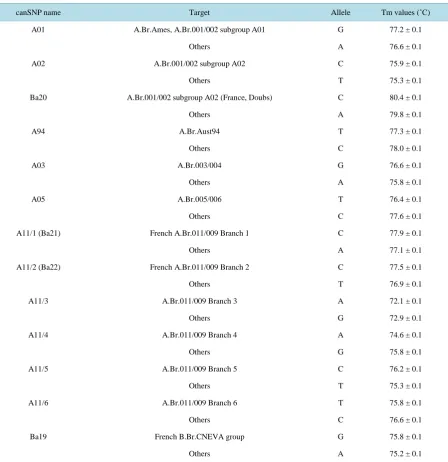
HRM-PCR technology (Table 2). Novel assays targeted four canSNPs specific to the A.Br.011/009 sub- branches 3 to 6 (A11/3, A11/4, A11/5, A11/6), two canSNPs specific to the new A01 and A02 sub-groups with- in A.Br.001/002 (A01, A02) and three canSNPs specific to the main A.Br.Aust94, A.Br.003/004 and A.Br. 005/006 subdivisions (A94, A03 and A05, respectively). These diagnostic assays were successfully validated against all DNA samples of our B. anthracis collection (about 250), including a hundred of non-French B. anth- racis DNAs of diverse origins (described by 10 canSNP typing). Average melting temperatures calculated for each bi-allelic assay are reported in Table 3. All non-sequenced genomes fell on the correct group (data not shown), confirming HRM-based assays’ specificity.
4. Discussion
Table 3. Melting temperature of new canonical SNPs.
canSNP name Target Allele Tm values (˚C)
A01 A.Br.Ames, A.Br.001/002 subgroup A01 G 77.2 ± 0.1
Others A 76.6 ± 0.1
A02 A.Br.001/002 subgroup A02 C 75.9 ± 0.1
Others T 75.3 ± 0.1
Ba20 A.Br.001/002 subgroup A02 (France, Doubs) C 80.4 ± 0.1
Others A 79.8 ± 0.1
A94 A.Br.Aust94 T 77.3 ± 0.1
Others C 78.0 ± 0.1
A03 A.Br.003/004 G 76.6 ± 0.1
Others A 75.8 ± 0.1
A05 A.Br.005/006 T 76.4 ± 0.1
Others C 77.6 ± 0.1
A11/1 (Ba21) French A.Br.011/009 Branch 1 C 77.9 ± 0.1
Others A 77.1 ± 0.1
A11/2 (Ba22) French A.Br.011/009 Branch 2 C 77.5 ± 0.1
Others T 76.9 ± 0.1
A11/3 A.Br.011/009 Branch 3 A 72.1 ± 0.1
Others G 72.9 ± 0.1
A11/4 A.Br.011/009 Branch 4 A 74.6 ± 0.1
Others G 75.8 ± 0.1
A11/5 A.Br.011/009 Branch 5 C 76.2 ± 0.1
Others T 75.3 ± 0.1
A11/6 A.Br.011/009 Branch 6 T 75.8 ± 0.1
Others C 76.6 ± 0.1
Ba19 French B.Br.CNEVA group G 75.8 ± 0.1
Others A 75.2 ± 0.1
PCR-based methods such as Dual Probe TaqMan PCR assays [27] and Mismatch Amplification Mutation As- says (MAMA) [28] [29]. HRM is an ideal format for scoring a small number of SNPs. PCR-HRM assays can be rapidly designed around SNPs to determine the extent to which each marker varies in the B. anthracis popula- tion.
in nature [11] [24] [30]-[32]. In this study, a same but large-scale approach, comparing 161 B. anthracis ge- nomes of diverse origins, were conducted to discover novel informative SNPs that can further discriminate within lineages or groups of strains. Nine novel DNA signatures were selected and developed into SNP discri- mination assays. Combined with previously established canSNPs [10]-[12] [24], the set of 27 markers described here allows a more precise and reliable phylogenetically assignment of any B. anthracis strain into 20 sub-lin- eages or sub-groups. The present method will contribute to improve our ability to characterize B. anthracis strains and to react rapidly when the identity and origin of a suspicious strain need to be established.
Acknowledgements
This work was supported by the French National Research Agency (ANR) and Direction Générale de l’Arme- ment (DGA) (project number ANR11ASTR0007). GG is a PhD student co-supported by ANSES and DGA grants.
This work has benefited from the facilities and expertise of the high throughput sequencing platform of IMAGIF (Centre de Recherche de Gif, http://www.imagif.cnrs.fr).
References
[1] Keim, P., Okinaka, R. and Pearson, T. (2013) The Evolution and Global Dissemination of Bacillus anthracis. The In- ternational Conference on Bacillus anthracis, B. cereus, and B. thuringiensis, Victoria, 1-5 September 2013.
[2] Rasko, D.A., Worsham, P.L., Abshire, T.G., Stanley, S.T., Bannan, J.D., Wilson, M.R., Langham, R.J., Decker, R.S., Jiang, L., Read, T.D., et al. (2011) Bacillus anthracis Comparative Genome Analysis in Support of the Amerithrax In- vestigation. Proceedings of the National Academy of Sciences of the United States of America, 108, 5027-5032. http://dx.doi.org/10.1073/pnas.1016657108
[3] Keim, P., Price, L.B., Klevytska, A.M., Smith, K.L., Shupp, J.M., Okinaka, R., Jackson, P.J. and Hugh-Jones, M.E. (2000) Multiple-Locus Variable-Number Tandem Repeat Analysis Reveals Genetic Relationships within Bacillus anthracis. Journal of Bacteriology, 182, 2928-2936. http://dx.doi.org/10.1128/JB.182.10.2928-2936.2000
[4] Lista, F., Faggioni, G., Valjevac, S., Ciammaruconi, A., Vaissaire, J., le Doujet, C., Gorge, O., De Santis, R., Carattoli, A., Ciervo, A., et al. (2006) Genotyping of Bacillus anthracis Strains Based on Automated Capillary 25-Loci Multiple Locus Variable-Number Tandem Repeats Analysis. BMC Microbiology, 6, 1-15.
[5] Le Flèche, P., Hauck, Y., Onteniente, L., Prieur, A., Denoeud, F., Ramisse, V., Sylvestre, P., Benson, G., Ramisse, F. and Vergnaud, G. (2001) A Tandem Repeats Database for Bacterial Genomes: Application to the Genotyping of Yersi-nia pestis and Bacillus anthracis. BMC Microbiology, 1, 2.
[6] Stratilo, C.W., Lewis, C.T., Bryden, L., Mulvey, M.R. and Bader, D. (2006) Single-Nucleotide Repeat Analysis for Subtyping Bacillus anthracis Isolates. Journal of Clinical Microbiology, 44, 777-782.
http://dx.doi.org/10.1128/JCM.44.3.777-782.2006
[7] Kenefic, L.J., Beaudry, J., Trim, C., Daly, R., Parmar, R., Zanecki, S., Huynh, L., Van Ert, M.N., Wagner, D.M., Gra- ham, T., et al. (2008) High Resolution Genotyping of Bacillus anthracis Outbreak Strains Using Four Highly Mutable Single Nucleotide Repeat Markers. Letters in Applied Microbiology, 46, 600-603.
http://dx.doi.org/10.1111/j.1472-765X.2008.02353.x
[8] Garofolo, G., Ciammaruconi, A., Fasanella, A., Scasciamacchia, S., Adone, R., Pittiglio, V. and Lista, F. (2010) SNR Analysis: Molecular Investigation of an Anthrax Epidemic. BMC Veterinary Research, 6, 11.
http://dx.doi.org/10.1186/1746-6148-6-11
[9] Keim, P., Van Ert, M.N., Pearson, T., Vogler, A.J., Huynh, L.Y. and Wagner, D.M. (2004) Anthrax Molecular Epide-miology and Forensics: Using the Appropriate Marker for Different Evolutionary Scales. Infection, Genetics and Evo-lution: Journal of Molecular Epidemiology and Evolutionary Genetics in Infectious Diseases, 4, 205-213.
[10] Van Ert, M.N., Easterday, W.R., Huynh, L.Y., Okinaka, R.T., Hugh-Jones, M.E., Ravel, J., Zanecki, S.R., Pearson, T., Simonson, T.S., U’Ren, J.M., et al. (2007) Global Genetic Population Structure of Bacillus anthracis. PLoS One, 2, Article ID: e461.
[11] Kuroda, M., Serizawa, M., Okutani, A., Sekizuka, T., Banno, S. and Inoue, S. (2010) Genome-Wide Single Nucleotide Polymorphism Typing Method for Identification of Bacillus anthracis Species and Strains among B. cereus Group Species. Journal of Clinical Microbiology, 48, 2821-2829. http://dx.doi.org/10.1128/JCM.00137-10
[13] Price, E.P., Seymour, M.L., Sarovich, D.S., Latham, J., Wolken, S.R., Mason, J., Vincent, G., Drees, K.P., Beck- strom-Sternberg, S.M., Phillippy, A.M., et al. (2012) Molecular Epidemiologic Investigation of an Anthrax Outbreak among Heroin Users, Europe. Emerging Infectious Diseases, 18, 1307-1313. http://dx.doi.org/10.3201/eid1808.111343 [14] Vogler, A.J., Busch, J.D., Percy-Fine, S., Tipton-Hunton, C., Smith, K.L. and Keim, P. (2012) Molecular Analysis of Rifampicin Resistance in Bacillus anthracis and Bacillus cereus. Antimicrobial Agents and Chemotherapy, 46, 511- 513. http://dx.doi.org/10.1128/AAC.46.2.511-513.2002
[15] Keim, P., Kalif, A., Shupp, J., Hill, K., Travis, S.E., Richmond, K., Adair, D.M., Hugh-Jones, M., Kuske, C.R. and Jackson, P. (1997) Molecular Evolution and Diversity in Bacillus anthracis as Detected by Amplified Fragment Length Polymorphism Markers. Journal of Bacteriology, 179, 818-824.
[16] Keim, P., Gruendike, J.M., Klevytska, A.M., Schupp, J.M., Challacombe, J. and Okinaka, R. (2009) The Genome and Variation of Bacillus anthracis. Molecular Aspects of Medicine, 30, 397-405.
http://dx.doi.org/10.1016/j.mam.2009.08.005
[17] Smith, K.L., DeVos, V., Bryden, H., Price, L.B., Hugh-Jones, M.E. and Keim, P. (2000) Bacillus anthracis Diversity in Kruger National Park. Journal of Clinical Microbiology, 38, 3780-3784.
[18] Derzelle, S., Laroche, S., Le Fleche, P., Hauck, Y., Thierry, S., Vergnaud, G. and Madani, N. (2011) Characterization of Genetic Diversity of Bacillus anthracis in France by Using High-Resolution Melting Assays and Multilocus Varia- ble-Number Tandem-Repeat Analysis. Journal of Clinical Microbiology, 49, 4286-4292.
http://dx.doi.org/10.1128/JCM.05439-11
[19] Garofolo, G., Serrecchia, L., Corro, M. and Fasanella, A. (2011) Anthrax Phylogenetic Structure in Northern Italy.
BMC Research Notes, 4, 273. http://dx.doi.org/10.1186/1756-0500-4-273
[20] Pilo, P., Perreten, V. and Frey, J. (2008) Molecular Epidemiology of Bacillus anthracis: Determining the Correct Ori-gin. Applied and Environmental Microbiology, 74, 2928-2931. http://dx.doi.org/10.1128/AEM.02574-07
[21] Gierczyński, R., Kałuzewski, S., Rakin, A., Jagielski, M., Zasada, A., Jakubczak, A., Borkowska-Opacka, B. and Ras-tawicki, W. (2004) Intriguing Diversity of Bacillus anthracis in Eastern Poland—The Molecular Echoes of the Past Outbreaks. FEMS Microbiology Letters, 239, 235-240.
[22] Sue, D., Marston, C.K., Hoffmaster, A.R. and Wilkins, P.P. (2007) Genetic Diversity in a Bacillus anthracis Historical Collection (1954 to 1988). Journal of Clinical Microbiology, 45, 1777-1782.
[23] Derzelle, S. and Thierry, S. (2013) Genetic Diversity of Bacillus anthracis in Europe: Genotyping Methods in Forensic and Epidemiologic Investigations. Biosecurity and Bioterrorism: Biodefense Strategy, Practice, and Science, 11, S166-S176.
[24] Girault, G., Blouin, Y., Vergnaud, G. and Derzelle, S. (2014) High-Throughput Sequencing of Bacillus anthracis in France: Investigating Genome Diversity and Population Structure Using Whole-Genome SNP Discovery. BMC Ge-nomics, 15, 288.
[25] NCBI. http://www.ncbi.nlm.nih.gov/
[26] Erali, M., Voelkerding, K.V. and Wittwer, C.T. (2008) High Resolution Melting Applications for Clinical Laboratory Medicine. Experimental and Molecular Pathology, 85, 50-58.
[27] Hurtle, W., Bode, E., Kulesh, D.A., Kaplan, R.S., Garrison, J., Bridge, D., House, M., Frye, M.S., Loveless, B. and Nordwood, D. (2004) Detection of the Bacillus anthracis gyrA Gene by Using a Minor Groove Binder Probe. Journal of Clinical Microbiology, 42, 179-185.
[28] Easterday, W.R., Van Ert, M.N., Zanecki, S. and Keim, P. (2005) Specific Detection of Bacillus anthracis Using a TaqMan Mismatch Amplification Mutation Assay. Biotechniques, 38, 731-735.
[29] Birdsell, D.N., Pearson, T., Price, E.P., Hornstra, H.M., Nera, R.D., Stone, N., Gruendike, J., Kaufman, E.L., Pettus, A.H., Hurbon, A.N., et al. (2012) Melt Analysis of Mismatch Amplification Mutation Assays (Melt-MAMA): A Func-tional Study of a Cost-Effective SNP Genotyping Assay in Bacterial Models. PLoS One, 7, Article ID: e32866. [30] Kenefic, L.J., Pearson, T., Okinaka, R.T., Schupp, J.M., Wagner, D.M., Hoffmaster, A.R., Trim, C.B., Chung, W.K.,
Beaudry, J.A., Jiang, L., et al. (2009) Pre-Columbian Origins for North American Anthrax. PLoS One, 4, Article ID: e4813.
[31] Simonson, T.S., Okinaka, R.T., Wang, B., Easterday, W.R., Huynh, L., U’Ren, J.M., Dukerich, M., Zanecki, S.R., Kenefic, L.J., Beaudry, J., et al. (2009) Bacillus anthracis in China and Its Relationship to Worldwide Lineages. BMC Microbiology, 9, 71.
[32] Okinaka, R.T., Henrie, M., Hill, K.K., Lowery, K.S., Van Ert, M., Pearson, T., Shupp, J., Kenefic, L., Beaudry, J., Hofstadler, S.A., et al. (2008) Single Nucleotide Polymorphism Typing of Bacillus anthracis from Sverdlovsk Tissue.
currently publishing more than 200 open access, online, peer-reviewed journals covering a wide range of academic disciplines. SCIRP serves the worldwide academic communities and contributes to the progress and application of science with its publication.