Cooperation Aware Layer Three Multi Path Routing
using QoS Approach for MANET
V. B. Kute
Department of Computer Engineering, St Vincent Pallotti College of Engg & Tech, Nagpur
M. U. Kharat
Department of Computer Engineering, MET Institute of Engg., Bhujbal Knowledge City, Nashik,
Maharashtra (India)
ABSTRACT
Routing protocols in Mobile Ad-Hoc Networks need to accommodate its dynamic characteristics such as node mobility, non-availability of central control etc. Node mobility increase challenges to the routing protocols with respect to attainment of the desired level of Quality of services. Apart from own communication, MANET nodes have to participate in packets forwarding to other nodes. Node cooperation is a crucial characteristic for smooth performance in Mobile Ad Hoc Network (MANET). During the network run, the node run of resources in turn brought down the network. It is therefore, a safer policy to preserve its resources for further communications. Resource preservation of a node will not be the best choice of other nodes seeking the node cooperation for communication.
While nodes refuse to collaborate, delivery of local, alternate (backup) routes to achieve proper communication becomes a better choice.
This paper proposes a novel, alternate routing protocol that is an extension of AOMDV. This protocol ventures to explore supplementary back up routes, which are more helpful in the situations of non-cooperation of nodes by exploiting subsequently received RREP packets.
The novel protocol performance evaluated and analyzed by means of simulations across a wide range of probabilities of non-cooperative nodes. The outcomes indicate that the novel routing protocol outperforms the best (or at least is comparable) with respect to the widely adopted MANET routing protocols in all considered scenarios.
In this paper, we describe the formatting guidelines for IJCA Journal Submission.
General Terms
Quality of Services, Mobile Ad Hoc Network
Keywords
Optimization of AOMDV, Node cooperation, QoS, MANET, Multi-path Routing, Backup route, AOMDV variation
1.
INTRODUCTION
Maintaining perceived quality of services is becoming a challenging task in mobile ad hoc network (MANET). Node mobility is one of the major factor that affects the quality of services (QoS) in MANET. Throughput, average delay and packet loss defines MANET performance measures. Node mobility that mainly affects the MANET performance disturbs active data sessions and upset received QoS.
MANET routing protocols discover routes reactively or proactively. Regardless of the requirement, proactive routing
discovers routes periodically. From this periodic exchange of information, network topology is constructed with mobile nodes that add up more control overheads. Reactive routing is a solution to the problem of massive information exchange that takes place due to proactive routing. The multi-path routing protocols significantly attend the active session failure problem. Availability of backup routes reduces the route discovery frequency by a considerable measure. Apart from this route discovery, frequency and routing overheads are additional QoS improvements addressed by Multi-path routing.
Ad-Hoc on-demand multi-path distance vector (AOMDV) routing protocol is a multi-path extension of Ad-Hoc on-demand distance vector (AODV) routing protocol. AOMDV makes alternate paths available with nominal overheads. AOMDV route discovery does not discard to duplicate RREQ packets instead define alternate (backup) route using. In the situation of a link or a route failure the alternate routes help in continuing the communication. It has a link and node disjointness and no inter-nodal coordination overheads. Marina et al in [1] had discussed disjoint characteristics in detail [1, 2].
Cooperation between MANET nodes makes communication possible. Each MANET node plays two roles. In accession to its own communication, the nodes have to forward the control as easily as data packets of other clients. Node co-operation is crucial to the smooth operation of the network. To preserve its resources sometimes nodes stops cooperating. Singling out the non-cooperative node becomes highly difficult.
In AOMDV alternate reverse routes are discovered by flooding to request packets. This is an attempt to look into the functioning of our proposed system. Intermediate nodes of the proposed AOMDV extension contribute to alternate route discovery. Alternate routes found to be beneficial to the network.
Any node cannot be cooperative always. It becomes uncooperative when it runs out of its resources. Node energy is an indispensable resource for a node to decide in favor of cooperation. The probe is based on node cooperation. The novel protocol along is examined with AOMDV through extensive simulation for both cooperative and non-cooperative state of affairs.
2.
AOMDV OVERVIEW
a valid, fresh route entry to the destination in its routing table, then it sends a reply (RREP) back to the source else it rebroadcasts the RREQ. The nodes on a reverse route towards source update their routing information. Duplicate RREP on reverse path is only forwarded either if it carries a larger destination sequence number or if a shorter route found. In AOMDV each RREQ (respective RREP) arriving at a node potentially define an alternate route. Accepting such duplicate RREQs may lead to formation of routing loops [3]. AOMDV route update rules, applied locally to each node, play a central part in maintaining loop freedom and disjoint properties. There are two types of disjoint paths: node-disjoint and link-disjoint. Node disjoint paths do not have any nodes in common except the source and the destination. In contrast, link-disjoint paths do not possess any common connection. Note that link-disjoint paths can have common nodes. To ward off any possibility of looping the “advertised hop count” are ushered in. A node update routing table if the advertised hop count show hop count less than or equal to previously generated route [1, 2, 3].
3.
PROBLEM DEFINITION AND
NETWORK MODEL
A single path routing protocols like AODV cannot afford non-cooperation extended to nodes in the network. Normally they opt for available backup routes those help multipath routing protocols. Back up routes can lead up the responsibility of forwarding packet further, if a node runs out of its resources (primarily energy). It is important to rule out the non-cooperative nodes.
Nature of any node can become non-cooperative in the network run. Determination of non-cooperative node’s nature turns out to be hard. Every node maintains a list of non-cooperative nodes based on their status and related parameters. The list is made by verifying sent and received packet data. AOMDV is modified for creating the list of non-cooperative nodes and detection of such clients. Nodes create a list of non-cooperative nodes by checking the packets sent and received to neighbors. If the drop count is half of sending a packet, it updates the node information in non-cooperative nodes.
Energy is one of the important parameters that affect node cooperation primarily. The node discontinues forwarding packets when it is low on energy. This phenomenon has a great impact on determination of alternate routes in muti-path for forwarding packets effectively and efficiently. An attempt is made for getting solutions to such cases that determine nature of the nodes with respect to their cooperation.
3.1
Energy and Power Model
Table.1 List of notations defined and used
Parameter /Definition
Meaning /Definition of Parameter
Paramete r/Definiti on
Meaning /Definition of Parameter
Ə(n) Single Node
Energy
Statistical Power consumption
Network path energy
Channel utilization Δt opt Total time
output
Packet
transmission pt total Total power Ptra Packet
consume transmission
avg Tminimum
Average time during transmission
Summation of active, inactive participation
Pd Packet
duration
T Time
consumption
two path integration
Consider a network composed of n nodes moving over a square region. Single node energy is defined by Ə Ə Ə . Total path energy Ə Ə Ə Ə Ə Ə . For
some that is
Ə Ə Ə Ə Ə Ə . Communication route energy for MANET change dynamically. If then
Ə Ə Ə Ə Ə
Ə Ə
Ə
Ə Ə
This defines network energy increases in node addition on communication route.
We define the packet transmission of two nodes as line integral equation defined . The line integral equation for two paths of integration: Nodes P and Q form a line segment. The line segment of P (0,0) to Q(1,1). Using the line equation y = x and formula
the line integral L is
As can be seen, the vector field is conservative. This explains the result that the line integral is a path independent. The time output and the power consumption is expressed as
For the proposed method power consumption calculations are as follows,
Route Discovery Frequency, Routing Overheads and Drop packet Ratio.
4.
NOVEL AOMDV SCHEME
The novel AOMDV protocol is based on the principle of alternate route formation of intermediate nodes. AOMDV proposed by Marina et al use first RREP packet for forming reverse route. Intermediate nodes only forward the first received RREP packet. RREP packets received subsequently are discarded, irrespective of its disjoint nature. The intermediate node of the novel AOMDV protocol exploits subsequently received RREP packets, without compromising its disjoint characteristics. Analogous to AOMDV when an intermediate node (not the intended destination of RREP) in novel scheme receives first RREP; it will merely forward. In the novel scheme when an intermediate node receives another RREP packet, instead merely discarding the packet, it checks for its disjoint nature. If the new RREP contains a potential alternate disjoint route, the node forwards it.
AOMDV protocol is restructured in the novel scheme. Receive REEQ and RREP method updates are as per the following algorithms.
4.1
Procedure Receive Request
#RECV_RREQ {
Fwrd_path NULL
Ptr R rt_path_first # get first path for RREQ destination While (R) {
If (Fwrd_path(nexthop,lasthop)== NULL ){ Fwrd_path R
}End if }End While
If (Fwrd_path == TRUE )&&( Recv_path(nexthop,lasthop) == NULL ){
Fwrd_path RREQ_Fwrd_path Recv_path RREQ_Recv_path If (Advertised_hop_count==INFINITY){ Advertised_hop_countMAX_HOP_COUNT }End If
}End If
Call SEND_RREP. }
Algorthm1.First path searched to RREQ destination at the intermediate node to avoid multiple responses for same forward path. If unused forward path (not responded so far) found then send Reply.
4.2
Procedure Receive Reply
#Recv_RREP {
If (rt_path==NULL || rt_path == down || RREQ == not received so far){
DROP packet }End If
Recv_path NULL Ptr R rt_path_first While (R){
If (Recv_path(nexthop,lasthop)== NULL ){ Recv_path = R
}End If }End While
If (Recv_path == true )&&( Fwrd_path(nexthop,lasthop) == NULL ){
#setRREP source as forward path next hop Fwrd_path_nexthop RREP_src
Fwrd_path_lasthop RREP_first_hop Recv_path RREP_Recv_path
Fwrd_path RREP_Fwrd_path
If (Advertised_hop_count=INFINITY){ Advertised_hop_count=max_hop_count RREP_hop_count = rt_Advertised_hops }End If
}End If
Call Forward Reply. }
Algorthm2. If a node receives RREP and does not have a path to RREQ source or the route is down or original RREQ is never received then drop the packet. The nodes do not respond to the same path twice in response to certain RREQ, Instead it finds an unused path to forward RREP.
5.
IMPLEMENTATION PLAN
The system had been setup and created with the help of Network simulator (ns-2) [4]. The novel routing protocol implemented with new route reply procedure. The protocol makes up nodes inclusive of a routine to check nature of the node with respect to cooperation. Simulator tools such as cbrgen.tcl and ./setdest are used for traffic scenarios and mobility models generation respectively. Nearest neighbor algorithm used to reduce total power consumption.
Network nodes stop cooperation to other nodes when it runs out of resources. Nodes detect non-cooperative neighbors in one simulation run and in other, it continues without detection. When a non-cooperative neighbor found, the node chooses alternate route from routing table if available. If alternate route not present in the routing table, forwards an error packet to source. The source update its routing table with erroneous route information and choose backup route if available. If no route to the destination in routing table, it initiates new route discovery.
Network nodes become non-cooperative, depending on its resources. Network performance with non-cooperative nodes is calculated with different probability of non-cooperative nodes.
QoS parameters such as routing overheads and route discovery frequency considered in view the multipath routing protocols along with throughput, average delay and dropping ratio.
QoS Parameter
Formula Meaning of
symbol Throughput
Σ_
8
1000
received sizestop start
n N P
T
T
ò
N – Set of Active nodes Preceived-size– Packet Received size
Tstop –Stop time
Tstart – Start Time. Average_d
elay
n N
α
Σ
receive time sent time
n N received
P
P
P
òò
N – Set of Active nodes Preceived-time– Packet Receive time
Psent-time – Packet send time Preceived – Received Packets Dropping_r
atio dropped
sent
P DPR
P
Pdropped– Dropped Packets Psent – Sent Packets Routing_ov
erhead Ψ routing
received P P
Prouting – Routing Packets Preceived – Received Packets Route_Disc
overy_Freq
Φ
n Ns
request
P
T
òNs – Set of Active source
uency nodes
Prequest – Request Packet Ttotal – Simulation run time
6.
PARAMETER SELECTION SCHEME
FOR QOS
The traditional best effort delivery network cannot guarantee today’s QoS requirements. Networks are expected to provide guaranteed QoS. Providing better QoS in MANET is challenging due on pursuing results. MANET topology has a limited lifespan and its information needs to be updated often to allow data packets to be expelled from their addresses. This update means more routing overheads. The mobility also increases packet loss and end to end delay. This builds it hard to have any centralized command. Hence, the controlling activities will be disseminated among the nodes, which need lots of data interchange. This too adds up into the routing overheads [5]. Best effort routing does not furnish any form of QoS supports during routing.
A network processing is defined in terms of byte delivering capacity of the nodes. Throughput shows the actual bytes received against sent. Node mobility increases the end-to-end delay of packet. Average delay demonstrates the overall average of end-to-end delay. Routing overheads and route discovery frequency demonstrate the control information flow. Dropping ratio is evidence for packet losses.
6.1
QoS Parameter monitoring function
for (each flow between sender and receiver ) { Send = 0
Sent_Time = 0 Sent_Time[] = 0 Receive = 0 Received_Time =0 Received_Time[] = 0 Control_Overheads = 0 Routing_Overheads = 0 Bytes_received = 0 Throughput = 0 Delay = 0
Average_Delay = 0
Route_Discovery_Frequency = 0 Dropping_Ratio = 0
// Compute Sent and Recd packets If(data_packet){
Sent_Time = Packet_Sent_Time }End If
Received_Time = Packet_Sent_Time Sent_Time[node_id] = Packet_Sent_Time Send = Send + 1
}End If
// Calculations for Average Delay
Else If((event_type == receive){ If(Receive == 0){
Last_Packet_Received = Packet_Sent_Time }End If
Receive = Receive + 1 Receive_Time[node_id] = Packet_Sent_Time
Bytes_received = Bytes_received + packet_size
Delay = Delay +
(Received_Time[node_id]-Sent_Time[node_id] }Else If End
}Else If // Routing Overheads calculated
Else {
Control_overhas = Control_overheads + 1 If (Packet_type == Request){
Route_Discovery_Frequency = Route_Discovery_Frequency + 1
}End If }End Else
// Classificationof the throughput and average delay Throughput = Bytes_Rceived*8/ (Receive_Time-Sent_Time) Average_Delay = Delay/Receive
//Classification of the routing overhead and control overhead Dropping_Ratio = (Send-Receive)/Send*100
Routing_Overheads = Control_Overheads/Receive }
7.
SIMULATION EXPERIMENT
The simulation applied to five types of mobility model monitors with respect to Quality of Services (Qos), namely: Throughput, Average Delay, Drop Packet Ratio, Route Discovery Frequency, and Routing Overheads (with Cooperative nodes, and Non Cooperative nodes). The parameters of the simulations identified depending on the features and the capabilities of MANET and Assumptions. Node transmission interval is set to 0.1; Initial node energy 100. IEEE802.11 used as the medium access control (MAC) layer protocol used. 50 nodes placed randomly in a 1000m X
1000m grid. Multiple sources and destinations used. Constant Bit Rate (CBR) traffic analyzed with a random walk mobility model. As suggested in each simulation run is set to 200s and the data packet size is set to 512 bytes. Table2 summarizes the simulation parameters.
Table.2 Simulation Parameters
Parameters Values
Topology size 1000 X 1000
No of Nodes 50
No of Sources Multiple No of Destinations Multiple
Packet size 512 bytes
MAC protocol IEEE 802.11 Simulation time 200s
Traffic Types CBR
Transmit period 200s for each packet rate
8.
SIMULATION RESULTS AND
ANALYSIS
Table.3
Fig.1 Probability Vs Throughput
Average delay is manifest with more non-cooperative nodes in the network. It is evident from the graph in Fig.2. The extended AOMDV shows noticeable improvement in average delay over existing AOMDV. It shows clear improvement with detection of non-cooperation of nodes. With the extended protocol, network performances not affect for more non-cooperative nodes. Simulation results of average delay are shown in Table.4.
With increasing probability, the average delay of base AOMDV protocol increases by 97% for the non-cooperative node detection is on however the increase in average delay for the novel routing protocol is 39%. The novel routing protocol shows large improvement in average delay for non-cooperative node detection whereas its performance drops while non-cooperative node detection is off.
Table.4
Pr
o
b
a
b
il
it
y
Avg Delay
AODV
AOMDV-without detection
AOMDV-with detection
AODVM-without detection
AODVM- with detection
0.1 0.337003 0.0385778 0.0386127 0.0359806 0.0347962 0.3 0.337003 0.0360969 0.0374815 0.0364993 0.0347962 0.5 0.266196 0.0353186 0.0384769 0.233882 0.135935 0.7 0.0952641 0.39379 0.12615 0.494889 0.0345697 0.9 1.11049 0.0662919 1.25862 2.21964 0.0567424
Fig. 2 Probability Vs Avg_Delay
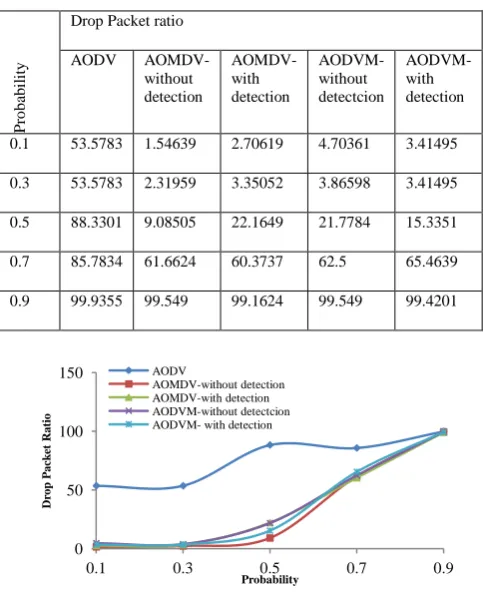
[image:6.595.324.536.83.194.2]Packet loss is evident when nodes refuse support. For the packet loss simulation, dropping ratio is preferred. The novel protocol shows improvement in the dropping ratio. The improvement is evident from the graph in Fig.3 and the simulation results of dropping packet ratio shown in Table.5. When a node rejects to forward a packet, the packet will be lost and increases the dropping ratio. The impact of the novel protocols idea of generating backup routes during the reply process will be useful here. The increase in packet dropping ratio of the novel routing protocol is 96% with non-cooperative node detection and 95% without non-non-cooperative node detection. AOMDV shows increase of 97% and 98% with and without detection respectively. The additional alternate route discovered in the novel routing protocol facilitates the reduced dropping ratio.
Table.5
P
ro
b
ab
il
it
y
Drop Packet ratio
AODV AOMDV-without detection
AOMDV-with detection
AODVM-without detectcion
AODVM- with detection
0.1 53.5783 1.54639 2.70619 4.70361 3.41495
0.3 53.5783 2.31959 3.35052 3.86598 3.41495
0.5 88.3301 9.08505 22.1649 21.7784 15.3351 0.7 85.7834 61.6624 60.3737 62.5 65.4639
0.9 99.9355 99.549 99.1624 99.549 99.4201
Fig. 3 Probability Vs Dropping Ratio
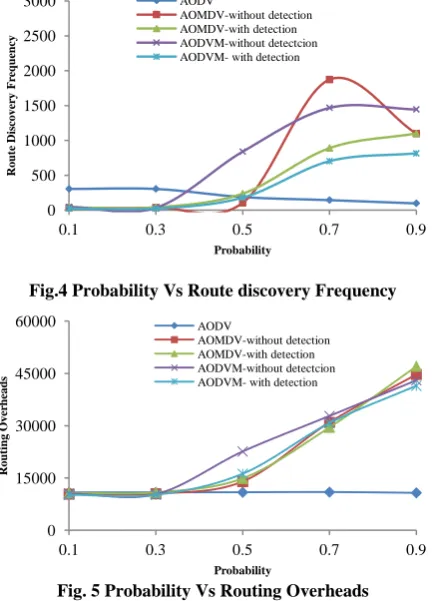
The other two qualities of service parameters considered are route discovery frequency and routing overheads. The novel protocol idea mainly targets reduction in the route discovery frequency along with routing overheads. Following two graphs shows that novel protocol performance compared to its
0 50000 100000 150000
0.1 0.3 0.5 0.7 0.9
T
h
ro
u
gh
p
u
t
Probability
AODV
AOMDV-without detection
AOMDV-with detection
AODVM-without detectcion
AODVM- with detection
-0.1 0.1 0.3 0.5
0.1 0.3 0.5 0.7 0.9
A
v
er
a
g
e
D
el
a
y
Probability
AODV
AOMDV-without detection AOMDV-with detection AODVM-without detection AODVM- with detection
0 50 100 150
0.1 0.3 0.5 0.7 0.9
Dr
op
P
ac
k
et
Rat
io
Probability
AODV
AOMDV-without detection AOMDV-with detection AODVM-without detectcion AODVM- with detection
Pro
b
a
b
il
ity
Throughput
AODV AOMDV
-without detection
AOMD V-with detectio n
AODVM -without detectcio n
[image:6.595.308.550.390.690.2]original counterpart is an improved one. Route discovery frequency in the novel routing protocol with non-cooperative nodes shows significant improvement. Simulation results for route discovery frequency are demonstrated in graph of Fig.7. Routing overheads increased with the idea of detection of non-cooperative nodes. Each node has to build and maintain the list of such nodes. On the flow, each node has to check the list and take the decision of forwarding the packet. Fig. 4 and Fig. 5 exhibits the simulation results for route discovery frequency and routing overheads respectively. In fact, the route discovery frequency and routing overheads for multipath routing is less compared to single path routing. The simulation experiment is applied to AODV also to represent single path routing.
Fig.4 Probability Vs Route discovery Frequency
Fig. 5 Probability Vs Routing Overheads
9.
CONCLUSION
The node cooperation anticipated by nodes of Mobile Ad Hoc Network is vital to network operations. Nodes refuse to forward packets for other nodes if it runs out of its resources. Energy backup is the key resource the MANET nodes have to preserve and it’s availability to nodes is limited. In this paper the focus is on the ‘cooperation aspects’ of MANET node and
Improved Method of Multi Path Routing using QoS Approach in ad hoc networks.
The novel routing protocol performance is evaluated with AOMDV and AODV. The protocol performance is analyzed against the non-cooperative nature of nodes. Probability of non-cooperative nodes in the network is raised from 0.1 to 0.9. Drop in throughput is definite but the drop rate for the novel protocol is 99%. Increase in average delay and dropping ratio is apparent. Experiment show raise of 39 % and 96% in average delay and dropping ratio for novel protocol respectively. Compare to AOMDV the novel protocols throughput dropping - rates, average delay and dropping ratio - raising rate is on lower side. From this extensive simulation, it is expressed that the new routing protocol shows significant improvement in throughput, average delay, and packet loss and route discovery frequency. Routing overheads for the novel protocol is more and it outperforms the single path routing protocol.
It concludes that while maintaining the AOMDV performance of outperforming single path routing protocol, the novel protocol proved to be an improved version of AOMDV. The proposed system is reliable and simple computing technique and can well fit for practical use in application such as emergency services, rescue operations, military operations.
10.
REFERENCES
[1] Mahesh K. Marina and Samir R. Das 2006. Ad hoc on-demand multipath distance vector routing. WIRELESS COMMUNICATIONS AND MOBILE COMUTING, (Jun.2006),969-988.
[2] Marina MK, Das SR 2001. On-demand multipath distance vector routing in ad hoc networks. in Proc.IEEE International Conference on Network Protocols (ICNP). [3] Prof. Arvind S & Guru Prasad 2013. Enhancement of
Network Life Time using Binary Tree Based Multicast Routing Protocol for Mobile Ad Hoc Network. Global Journal of Computer Science and Technology Network, Web & Security Volume 13 Issue 10 Version 1.0 (2013). [4] Kevin Fall, Kannan Varadhan, Jan 6, 2009. The Ns
Manual,[online] http://www.isi.edu/nsnam/ns/ns-documentation.html
[5] Jungkeun Yoon, Mingyan Liu, Brian Noble 2003. Random Waypoint Considered Harmful. In Proc. of IEEE Infocom (2003)
[6] Lajos Hanzo II and Rahim Tafazolli 2007. A Survey of QoS Routing Solutions for Mobile Ad Hoc Networks. IEEE Communications Surveys ,(2nd Quarter 2007), Vol-9, No-2
0 500 1000 1500 2000 2500 3000
0.1 0.3 0.5 0.7 0.9
Rout
e
Dis
cove
ry
F
re
q
u
en
cy
Probability
AODV
AOMDV-without detection AOMDV-with detection AODVM-without detectcion AODVM- with detection
0 15000 30000 45000 60000
0.1 0.3 0.5 0.7 0.9
Rout
in
g
Over
h
ead
s
Probability
AODV
[image:7.595.60.277.231.532.2]