http://dx.doi.org/10.4236/ojpsych.2014.43033
How to cite this paper: Nadkarni, P., Jayaram, M., Nadkarni, S., Rattehalli, R. and Adams, C. (2014) Rapid Tranquillisation: An AGREEable Ground? Open Journal of Psychiatry, 4, 269-274. http://dx.doi.org/10.4236/ojpsych.2014.43033
Rapid Tranquillisation: An AGREEable
Ground?
Pallavi Nadkarni
1*, Mahesh Jayaram
2, Shailesh Nadkarni
3, Ranga Rattehalli
4,
Clive Adams
51Department of Psychiatry, Queen’s University, Kingston, Canada
2Department of Psychiatry, The University of Melbourne, Level 1 North, Main Block, Royal Melbourne Hospital VIC 3050 Australia
3National Research Corporation Canada, Markham, Canada 4Newsam Centre, Seacroft Hospital, Leeds, UK
5The University of Nottingham, Jubliee Campus, Nottingham, UK
Email: *[email protected], [email protected], [email protected],
[email protected], [email protected]
Received 1 May 2014; revised 30 May 2014; accepted 26 June 2014
Copyright © 2014 by authors and Scientific Research Publishing Inc.
This work is licensed under the Creative Commons Attribution International License (CC BY).
http://creativecommons.org/licenses/by/4.0/
Abstract
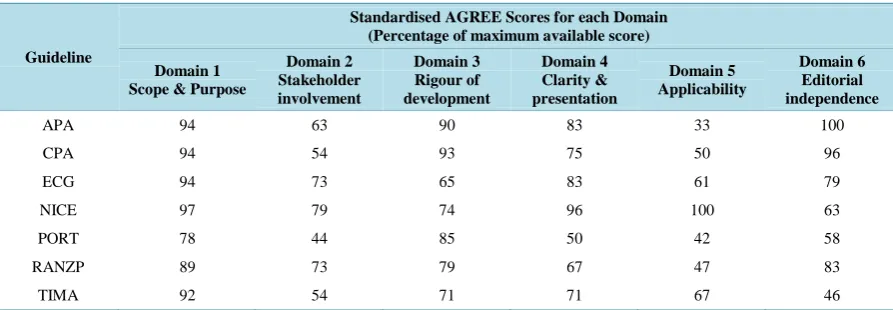
Objective: Evidence base for rapid tranquillisation is an under researched area. Guidelines on rapid tranquilisation from English speaking countries were appraised using AGREE (Appraisal of Guidelines Research and Evaluation) and differences in their recommendations were analysed. Methods: Four independent psychiatrists appraised the guidelines using the AGREE tool. AGREE is a validated instrument used to assess the quality of guideline and recommendations using six do-mains of which each domain captures a specific aspect of the guideline development. The content was analysed manually. Results: Seven guidelines from five English speaking countries met the in-clusion criteria. All the guidelines scored well on the domain of “scope and purpose”. NICE guide-lines from the UK consistently scored well on all domains with the maximum possible score of 100 on the “applicability” domain. APA from the USA did well on the domain of “editorial independ-ence”. AGREE could only examine the guideline development process and not the content. The guidelines differed in their recommendations of choice of drug for rapid tranquillisation. Discus-sion: All guidelines scored reasonably well on AGREE. National Institute of Clinical Excellence (NICE) has used robust strategies in developing the guidelines. Guidelines failed to achieve con-sensus in recommendations despite using a common pool of evidence. Haloperidol-promethazine combination is not recommended by any with the exception of NICE. This suggests data is selec-tively interpreted depending on locally prevalent customs.
Keywords
Tranquillisation, Guidelines, Anti-Psychotics, Psychiatric Emergencies
1. Introduction
Violent or aggressive behaviour is a psychiatric emergency that necessitates swift mobilisation of staff and re-sources. Commonly it is secondary to psychotic symptoms, physical illness (e.g. delirium) and substance abuse
[1]. Violent behaviour in an emergency room setting elicits varied responses and inexperienced staff may be re-quired to handle such situations. This can have an impact on care of other patients with acute medical problems. On psychiatric wards, violent behaviour is likely to provoke aggression amongst other inpatients thereby stretch- ing staff resources. Effective management of these volatile situations can reduce risks to the patient, other ser-vice users, staff and family members who are often victims of aggression [2].
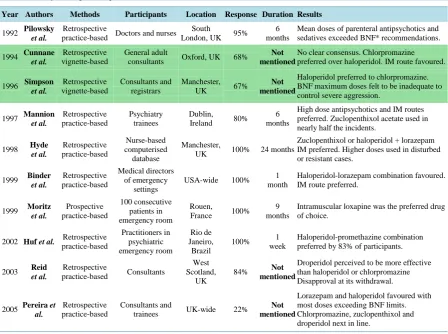
[image:2.595.90.539.378.712.2]Rapid tranquillisation is the use of medication to manage agitated or aggressive behaviour [3] and is used when other psychological and behavioural approaches have failed to calm the patient. A literature search of rap-id tranquillisation revealed eight surveys of clinical practice and two surveys of clinician preferences (Table 1). There was failure of consensus on choice of medication for rapid tranquillisation—probably reflecting local cultural influences on prescription practices. All but one survey were from the western world. Appraisal of var-ious guidelines around the world for schizophrenia suggests that recommendations are not uniform and quality of guideline may vary [4]. We have not come across any similar appraisal of guidelines on rapid tranquillisation and this is one important piece of the puzzle that we felt needs to be solved.
Table 1. Surveys on rapid tranquillisation.
Year Authors Methods Participants Location Response Duration Results
1992 Pilowsky et al.
Retrospective
practice-based Doctors and nurses
South
London, UK 95% 6 months
Mean doses of parenteral antipsychotics and sedatives exceeded BNF* recommendations.
1994 Cunnane et al.
Retrospective vignette-based
General adult
consultants Oxford, UK 68%
Not mentioned
No clear consensus. Chlorpromazine preferred over haloperidol. IM route favoured.
1996 Simpson et al. Retrospective vignette-based Consultants and registrars Manchester,
UK 67%
Not mentioned
Haloperidol preferred to chlorpromazine. BNF maximum doses felt to be inadequate to control severe aggression.
1997 Mannion et al. Retrospective practice-based Psychiatry trainees Dublin, Ireland 80%
6 months
High dose antipsychotics and IM routes preferred. Zuclopenthixol acetate used in nearly half the incidents.
1998 Hyde et al. Retrospective practice-based Nurse-based computerised database Manchester,
UK 100% 24 months
Zuclopenthixol or haloperidol + lorazepam IM preferred. Higher doses used in disturbed or resistant cases.
1999 Binder et al. Retrospective practice-based Medical directors of emergency settings
USA-wide 100% 1 month
Haloperidol-lorazepam combination favoured. IM route preferred.
1999 Moritz et al. Prospective practice-based 100 consecutive patients in emergency room Rouen,
France 100% 9 months
Intramuscular loxapine was the preferred drug of choice.
2002 Huf et al. Retrospective
practice-based Practitioners in psychiatric emergency room Rio de Janeiro, Brazil
100% 1
week
Haloperidol-promethazine combination preferred by 83% of participants.
2003 Reid et al.
Retrospective
practice-based Consultants
West Scotland,
UK
84% Not
mentioned
Droperidol perceived to be more effective than haloperidol or chlorpromazine Disapproval at its withdrawal.
2005 Pereira et al.
Retrospective practice-based
Consultants and
trainees UK-wide 22%
Not mentioned
Lorazepam and haloperidol favoured with most doses exceeding BNF limits. Chlorpromazine, zuclopenthixol and droperidol next in line.
2. The Instrument and Its Scope
The Appraisal of Guidelines Research and Evaluation (AGREE) is an instrument used to assess the methodo-logical rigour and potential biases involved in guideline development. It also checks for the internal and external validity of the recommendations [5]. It can assess any new, existing or updated guideline. It consists of 23 key items organised in six domains each of which rates a separate dimension of guideline. Domain 1 is “Scope and Purpose” which captures the overall aim of the guideline and its target group. Domain 2 is “Stakeholder In-volvement” which captures the extent to which appropriate stakeholders were involved in developing the guide-line and also represents the views of its intended users. Domain 3 is “Rigour of Development” which looks at the process of gathering and summarizing the evidence used and the methods used to develop its recommenda-tions. Domain 4 is “Clarity of Presentation” capturing the language, structure and format of the guideline. Do-main 5 is “Applicability” looking at the potential barriers and facilitators to implementation, strategies to im-prove uptake and resources needed to implement the guideline. Domain 6 is “Editorial Independence” which captures biases caused by any other competing interests.
Four independent raters rate the guidelines on these domains using a four point scale. The scores on the six domains are independent and cannot be aggregated. These scores help to compare the different guidelines and to decide whether or not to recommend a particular guideline over others. However it is not possible to set thre-sholds for the domain scores to demarcate a good guideline from a bad one.
3. Method
Guidelines on rapid tranquillisation from all English speaking countries were appraised using AGREE, with special emphasis on the NICE guidelines [6]. An English-speaking country was defined as a country with Eng-lish as one of the official languages and with more than 50% residents speaking EngEng-lish. The 50% mark was ar-bitrarily chosen as a cut off figure. This was because countries where the majority of the population spoke a language other than English as first language were likely to have guidelines in local languages. This meant that there would be innumerable guidelines to assess, which would have been difficult to achieve given the language barrier.
Major databases were searched through the electronic database OVID. The databases included EMBASE (1980 to October week 3 2008), CINAHL (1982 to October week 3 2008), MEDLINE (1950 to October week 3 2008) and PsycINFO (1806 to October week 3 2008).The search terms used were “rapid tranquillisation” “tran-quillisation” “behavioural emergencies”, “aggression”, “psychiatry emergencies”, ”guidelines in psychiatry” and “expert consensus guidelines”. After dropping the duplicates and hand searching the abstracts seven guidelines in English language were obtained from five countries: UK, USA, Canada, Australia and New Zealand which met our inclusion criteria. The eighth guideline from Singapore was excluded as it did not meet the criterion of an English-speaking country.
Four raters used the AGREE tool to objectively assess potential biases of guidelines. The assessors were trai-nee psychiatrists at different levels of their training. Two of them were senior house officers: one in his first year of training and the second in his second year of training. A specialist registrar (one of the authors) and a staff grade psychiatrist both in their fourth year of training formed the team of assessors. The raters had received prior instructions regarding the scoring process. The guidelines were scored on six domains mentioned above. The scores were then standardised according to validated recommendations which could range from 0 to 100%. The content of the guidelines was analysed separately as it was not rated by the AGREE tool.
4. Results
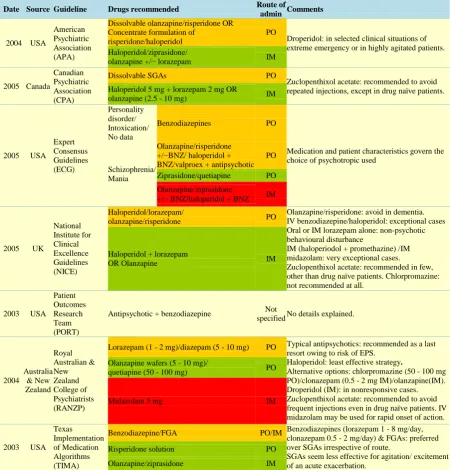
Table 2. Guideline recommendations for rapid tranquillisation.
Date Source Guideline Drugs recommended Route of
admin Comments
2004 USA
American Psychiatric Association (APA)
Dissolvable olanzapine/risperidone OR Concentrate formulation of
risperidone/haloperidol
PO
Droperidol: in selected clinical situations of extreme emergency or in highly agitated patients. Haloperidol/ziprasidone/
olanzapine +/− lorazepam IM
2005 Canada
Canadian Psychiatric Association (CPA)
Dissolvable SGAs PO
Zuclopenthixol acetate: recommended to avoid repeated injections, except in drug naïve patients. Haloperidol 5 mg + lorazepam 2 mg OR
olanzapine (2.5 - 10 mg) IM
2005 USA Expert Consensus Guidelines (ECG) Personality disorder/ Intoxication/ No data
Benzodiazepines PO
Medication and patient characteristics govern the choice of psychotropic used
Schizophrenia/ Mania
Olanzapine/risperidone +/−BNZ/ haloperidol + BNZ/valproex + antipsychotic
PO
Ziprasidone/quetiapine PO
Olanzapine/ziprasidone
+/− BNZ/haloperidol + BNZ IM
2005 UK
National Institute for Clinical Excellence Guidelines (NICE) Haloperidol/lorazepam/
olanzapine/risperidone PO
Olanzapine/risperidone: avoid in dementia. IV benzodiazepine/haloperidol: exceptional cases Oral or IM lorazepam alone: non-psychotic behavioural disturbance
IM (haloperiodol + promethazine) /IM midazolam: very exceptional cases.
Zuclopenthixol acetate: recommended in few, other than drug naïve patients. Chlorpromazine: not recommended at all.
Haloperidol + lorazepam
OR Olanzapine IM
2003 USA Patient Outcomes Research Team (PORT)
Antipsychotic + benzodiazepine Not
specified No details explained.
2004 Australia & New Zealand Royal Australian & New Zealand College of Psychiatrists (RANZP)
Lorazepam (1 - 2 mg)/diazepam (5 - 10 mg) PO Typical antipsychotics: recommended as a last resort owing to risk of EPS.
Haloperidol: least effective strategy.
Alternative options: chlorpromazine (50 - 100 mg PO)/clonazepam (0.5 - 2 mg IM)/olanzapine(IM). Droperidol (IM): in nonresponsive cases. Zuclopenthixol acetate: recommended to avoid frequent injections even in drug naïve patients. IV midazolam may be used for rapid onset of action. Olanzapine wafers (5 - 10 mg)/
quetiapine (50 - 100 mg) PO
Midazolam 5 mg IM
2003 USA Texas Implementation of Medication Algorithms (TIMA)
Benzodiazepine/FGA PO/IM Benzodiazepines (lorazepam 1 - 8 mg/day, clonazepam 0.5 - 2 mg/day) & FGAs: preferred over SGAs irrespective of route.
SGAs seem less effective for agitation/ excitement of an acute exacerbation.
Risperidone solution PO
Olanzapine/ziprasidone IM
FGA = first generation antipsychotic; SGA = second generation antipsychotic; BNZ = benzodiazepine. Colour code: Yellow = 1st choice, Green = 2nd choice, Red = 3rd choice.
5. Discussion
Common themes in clinical practice can be identified. For instance, benzodiazepines are chosen when little background information about the patient is available. This is in keeping with the Expert Consensus Guidelines
Table 3. Methodological quality of guidelines.
Guideline
Standardised AGREE Scores for each Domain (Percentage of maximum available score)
Domain 1 Scope & Purpose
Domain 2 Stakeholder involvement
Domain 3 Rigour of development
Domain 4 Clarity & presentation
Domain 5 Applicability
Domain 6 Editorial independence
APA 94 63 90 83 33 100
CPA 94 54 93 75 50 96
ECG 94 73 65 83 61 79
NICE 97 79 74 96 100 63
PORT 78 44 85 50 42 58
RANZP 89 73 79 67 47 83
TIMA 92 54 71 71 67 46
lack of good quality evidence necessitates those drawing up guidance to draw conclusions that are not founded on best possible evidence. For instance the only existing trial of zuclopenthixol acetate has a sample size of 40 patients [11] yet Australian and New Zealand guidelines [12] recommend it for rapid tranquillisation unlike the NICE and Canadian guidelines [13]. However even the NICE and Canadian guidelines have used equally thin evidence base for their recommendations. They differ on their inclusion of first and second generation anti psy-chotics thereby suggesting that guidelines are a combination of personal preferences and evidence base that is in turn influenced by selective interpretation of data.
Consensus on rapid tranquillisation guidelines is the need of the hour. Whether better quality clinical trials can help us reach an AGREEment remains to be seen.
Declaration of Interest
None.
References
[1] Atakan, Z.D. (1997) ABC of Mental Health. Mental Health Emergencies. BMJ, 314, 1740-1742.
http://dx.doi.org/10.1136/bmj.314.7096.1740
[2] Macpherson, R., Dix, R. and Morgan, S. (2005) A Growing Evidence Base for Management Guidelines. Advances in Psychiatric Treatment, 11, 404-415. http://dx.doi.org/10.1192/apt.11.6.404
[3] Pereira, S., Paton, C., Walkert, L., et al. (2005) Treatment of Acute Behavioural Disturbance: A UK National Survey of Rapid Tranquillisation. Journal of Psychiatric Intensive Care, 1, 84-88.
http://dx.doi.org/10.1017/S1742646406000148
[4] Gaebel, W., Weinmann, S., Sartorius, N., Rutz, W. and McIntyre, J.S. (2005) Schizophrenia Practice Guidelines: In-ternational Survey and Comparison. The British Journal of Psychiatry, 187, 248-255.
http://dx.doi.org/10.1192/bjp.187.3.248
[5] The AGREE Collaboration. Appraisal of Guidelines for Research and Evaluation (AGREE) Instrument (Accessed 21 March 2008). http://www.agreecollaboration.org
[6] National Institute for Clinical Excellence: Clinical Guideline 25. Violence: The Short-Term Management of Dis-turbed/Violent Behaviour in In-Patient Psychiatric Settings and Emergency Departments. London: NICE 2005.
[7] Expert Consensus Panel for Behavioural Emergencies: Expert Consensus Guideline Series. Treatment of Behavioural Emergencies. Journal of Psychiatric Practice,2005, 11, 5-108.
[8] Macpherson, R., Dix, R. and Morgan, S. (2005) A Growing Evidence Base for Management Guidelines. Advances in Psychiatric Treatment, 11, 404-415. http://dx.doi.org/10.1192/apt.11.6.404
[9] Huf, G., Coutinho, E., Fagundes Jr., H., Oliveira, E., Lopez, J., Gewandszajder, M., Carvalho, A., Keusen, A. and Adams, C. (2002) Current Practices in Managing Acutely Disturbed Patients at Three Hospitals in Rio de Janeiro-Bra- zil: A Prevalence Study. BMC Psychiatry, 2, 4. http://dx.doi.org/10.1186/1471-244X-2-4
http://dx.doi.org/10.1136/bmj.327.7417.708
[11] Gibson, R., Fenton, M., Coutinho, E. and Campbell, C. (2005) Zuclopenthixol Acetate in the Treatment of Acute Schizophrenia and Similar Serious Mental Illnesses. Cochrane Database of Systematic Reviews, Article No: CD000525. http://dx.doi.org/10.1002/14651858.CD000525.pub2
[12] McGorry, P. (2004) Royal Australian and New Zealand College of Psychiatrists: Clinical Practice Guidelines for the Treatment of Schizophrenia and Related Disorders. Australian and New Zealand Journal of Psychiatry, 39, 1-30
currently publishing more than 200 open access, online, peer-reviewed journals covering a wide range of academic disciplines. SCIRP serves the worldwide academic communities and contributes to the progress and application of science with its publication.
Other selected journals from SCIRP are listed as below. Submit your manuscript to us via either