ISBN 978-93-84422-51-6 Proceedings of 2016 International Conference on IT, Mechanical & Communication Engineering
(ICIMCE 2016) Pattaya, January 2-3,2016
Sentiment Analysis Technique: A Look into Support Vector Machine
and Naive Bayes
Wandeep Kaur, Vimala Balakrishnan
Department of Information Systems, Faculty of Computer Science and Information Technology University of Malaya, Malaysia
Abstract:
Sentiment Analysis and opinion mining aims to analyze sentiments, opinions, emotions etc. towardsproducts, services or current topics. There are various approaches applied to mine the sentiments portrayed. Supervised machine learning is one such approach that is generally applied. The aim of this paper is to investigate the current methods used to perform sentiment analysis by reviewing and comparing recently published research. The findings are discussed in hope that it would help future researchers to gain an understanding of a possible method they could adopt or even come up with a new approach to better mine sentiments from big data that is tailored to suit the need of their data source.
Keywords:
sentiment analysis, Naive Bayes, support vector machine, supervised machine learning1.
Introduction
The boom of social networking system has resulted in a vast amount of textual data availability in the last few years. Realizing the opportunity that comes with studying large data, the attention has now diverted from data storage and retrieval to refining methodologies to extract and process information from raw sources [7]. Sentiment analysis (SA) is a combination of data mining and Natural Language Processing (NLP) techniques in order to computationally treat subjectivity in textual documents. Itis considered a challenging NLP problem specifically for Twitter and transcribed text [9]. The primary focus of textual information retrieval technique is to mine fact from opinions. Facts consist of an objective component expressed within subjective characters. These subjective elements comprise of opinions, sentiments and emotions, which are the core of SA [18]. SA aims to classify texts as positive, negative or neutral at different levels: document-level sentiment analysis, sentence-level sentiment analysis, aspect-based sentiment analysis, comparative sentiment analysis and, sentiment lexicon acquisition. [6]. Nevertheless, SA is commonly employed on three levels: sentence level, document level and aspect level [20].
2. Literature Review
Sentiment classification can approximately be divided into two key areas: lexical based approach and
machine learning approach [3]. Predefined dictionaries of terms annotated with positive or negative scores are
essentially used for the lexical method [14]. If lexicon matches a word marked positive in the dictionary, then
the total polarity score of a text increases. A text in whole will be classified as positive given that the general
polarity score is positive, else it is categorized as negative.
The machine learning approach uses a series of chosen feature vectors and a collection of tagged corpora to
prepare a model which will then be used to categorize untagged corpus of text [11]. The feature selection in this
approach is vital to ensure the classification success rate. A wide range of unigrams (i.e. single words from a
document) or n-grams (i.e. two or more words from a document in sequential order) are essentially chosen as
feature vectors. The primary asset of machine learning approach lies within the capability of its algorithm to
analyse text of any sphere and produce classification models that are customized to the issue at hand [17].
Furthermore, they are not only language independent and can be successfully applied to multiple languages but
can also be adapted to incorporate additional information in their decision process [9]. Machine learning
approach can be further sub divided into two main classes: supervised and unsupervised methods (see Fig. I).
However,
[1]discovered that most of the approaches used for document level sentiment analysis focused on
supervised learning due to its strong predictive power.
Inparticular, the Support Vector Machine (SVM), Nai've
Bayes
(NB)and Maximum Entropy algorithm are the preferred techniques [3]. Lastly, the hybrid approach
marries the above discussed approaches in order to achieve higher accuracy as sentiment lexicons play an
imperative role in majority of the methods[I],[5],[7],[15].
Fig 1: Sentiment classification techniques (Medhat et. ai, 2014)
3. Supervised Machine Learning
A supervised machine learning approach hinges on the existence of labelled training documents. With regard
to the literature study done, there are various kinds of supervised classifiers. In the following subsection, a
concise description of the two most endorsed classifiers in SA will be presented [3] namely Naive Bayes and
Support Vector Machine.
3.1.
Naive Bayes
instead of the complete covariance matrix. Based on Bayes theorem, the probability for each class review can be calculated using the equation (1)
c
(1)(Tripathy, Agrawal&Rath, 2015)
Where P(dJc) P(c) P(d)
=prior probability of a label
=prior probability that given feature set is being classified as a label =prior probability that a given feature set is occurred.
3.2.
Support Vector Machine (SVM)
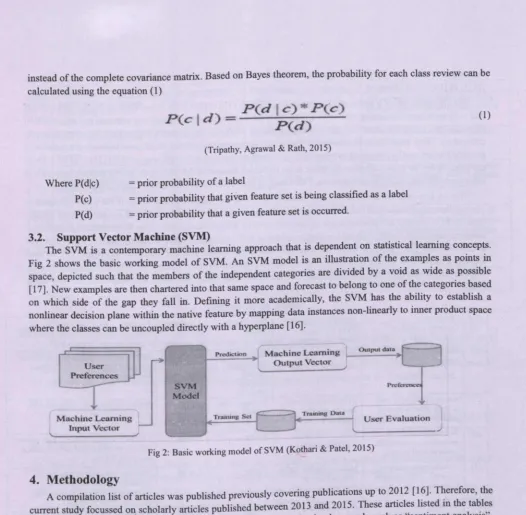
[image:3.545.11.537.19.534.2]The SVM is a contemporary machine learning approach that is dependent on statistical learning concepts. Fig 2 shows the basic working model of SVM. An SVM model is an illustration of the examples as points in space, depicted such that the members of the independent categories are divided by a void as wide as possible [17]. New examples are then chartered into that same space and forecast to belong to one of the categories based on which side of the gap they fall in. Defining it more academically, the SVM has the ability to establish a nonlinear decision plane within the native feature by mapping data instances non-linearly to inner product space where the classes can be uncoupled directly with a hyperplane [16].
Machine Learning input Vector
SVM
Model
Machine Learning ...--_Ou__:.lllU_t_da_l__,a
.r--""'"
Output Vector
Pn:diction
T.,.iruog Data
User Evaluation
~---~
Fig 2: Basic working model ofSVM (Kothari&Patel, 2015)4. Methodology
A compilation list of articles was published previously covering publications up to 2012 [16]. Therefore, the current study focussed on scholarly articles published between 2013 and 2015. These articles listed in the tables were found through Google Scholar and Science Direct; searched using keywords such as "sentiment analysis", "multilingual sentiment analysis", "sentiment classification", "sentiment polarity", "Naive Bayes", "support vector machine", "machine learning algorithms", "supervised machine learning" and "classifier ensembles". A basic filtering was utilized whereby only those research that used NB and SVM as their base techniques were analysed resulting in these seventeen articles. Itneeds to be noted that the papers listed in this tables are merely a fraction of the research done on SA and opinion mining. The articles and results of our review are presented next.
5. Results
and
Discussion
languages
such
as
German,
Spanish,
Chinese,
French,
Arabic
and
Kannada
is
catching
on
([2],[ 12],[14],[15],[21]).
NB algorithm yields a better score compared to SVM ([12],[14],[21]) for a non-English corpus. Articles [8]
and [11] were examined using two sets of data; cleaned data (noise removal, hashtag removal and abbreviation
clean-up) and uncleaned data. The performance accuracy produced significantly high results for when data was
cleaned up. Table I and Table
IIalso shows that a hybrid approach (combination of more than one SA approach)
produced better results compared to when only one machine learning technique was used ([1],[5],[7],[15]). From
the table, it can be seen that although there is an increased interest in SA of corpus whose domain language is
other than English, yet a gap still persists. This could be due to the lack of a lexicon source that is non English.
The SA approach chosen is dependent on the data source and purpose of the study. If the study is related to
content that requires some form of human translation and language lexicons, then NB produces better results.
This could
berelated to the abundance of lexicons created within the database. The SVM method is statistical
learning dependent hence it produces higher accuracy and precision when calculating polarity.
Animproved
accuracy reading is recorded when the asset of both these approaches are manipulated. Hence SA method
applied is dependent on the data source. If the study relates to polarity using data source consisting of
non-English corpus that may require some form of translation, then using the hybrid approach may produce better
results.
TABLE I:
ArticleSummary
Ref Obiective Technique Annlied Data Source Lanauaze Ffndinas
[1] Semantic analysis of SVM&Particle Twitter English SVM-PSO performed better than SVM
movie review Swarm Optimization alone
[2] Multilingual semantic SVM NTCIR8 English, SVM results using English data set and
analysis Multilingual German, translated dataset showcased almost
Opinion French and similar results Analysis Task Spanish
(MOAT)
[3] Aspect classification and SVM combined with Training corpus English SVM combined with domain specific polarity identification of domain specific of 1940 reviews lexicons produced 78% accuracy product review lexicons
[4] Detect high tension in SVM, NB&Linear Twitter English Classifier unable to detect "high tension" online communities using logistic regression but able to detect some form of tension
computational analysis using NB&SVM
[5] Classify tweet sentiment Multinomial NB, SVM, Twitter English Classifier ensemble formed by using ensemble classifier random forest& diversified compnents provide &lexicons logistic regression exceptional results Feature hashing
results good for tweet SA
[7] Ensemble learning to Bayesian ensemble Twitter English Ensemble technique discussed is efficient
reduce noise sensitivity learning &effective
related to language ambiguity
[8] Investigate role of pre- SVM&chi square Online movie English Pre-processing data / data clean up can
processing data method reviews significantly increase accuracy
[9] Context based approach ConSent - novel Twitter, English Performs well in data that has some for SA approach TripAdvisor & context in it. Twitter results not
Internet Movie convincing Database
[II] Suggested use of standard SVM TripAdvisor English Integration ofSVM with pre-processed
SVM in dealing with data produced results of higher accuracy
contextual and non contexual data
[12] SA for Kannada web SVM, NB Kannada review Kannada, Text corpus was translated NB
documents text corpus English performed best
TABLE II: Article Summary
Ref Objective Technique Applied Data Source Language Findinas
(14] Arabic sentiment lexicon SVM, NB Arabic English, NB accuracy scored higher than SVM. tested using semi WordNet Arabic Accuracy performance recorded at 97%
supervised method using the Arabic lexicons
(15] Meta classifier to develop SVM, NB, Bayesian Spanish corpus English, Ensemble technique improves polarity polarity classification Logistic Regression, of film movie Spanish classification
system C4.S
(17] Propose advanced Multi Improved SVM Medical English Proposed method showed an increase in Class Instance Selection disorder dataset classification accuracy, ratio of selected
based SVM to increase fromVCI instances and time consumption
efficiency of SVM repository
(19] Investigate big data SVM TWItter English Framework proposed to cope with the
reduction technique problem of reducing size and dimension
in big data supervised learning settings
(20] SA movie reviews using NB,SVM Movie dataset English SVM produced higher accuracy results
machine learning compared to NB
technique
(21] SA of application reviews NB,SVM WeChat, iTunes English, Bayesian produced better results
from mobile users Chinese compared to SVM
6. Conclusion
This paper depicts an overview on the recent updates in machine learning techniques specifically NB and
SVM. Seventeen recently published articles were read and summarized.
Itis hoped that from this work,
researchers may gain some information on the possible results that could be expected when analysing sentiments
for different data source as well as language and to decide the most appropriate one to fit hislher interest.
7. Acknowledgement
The author wishes to extend their gratitude to University Malaya for supporting this study (RP028A-14AET)
8. References
[IJ Basari, A. S. H., Hussin, B., Ananta, I.G. P., & Zeniarja, 1.(2013). Opinion mining of movie review using hybrid method of support vector machine and particle swarm optimization. Procedia Engineering, 53, 453-462.
[2J Balahur, A., & Turchi, M. (2014). Comparative experiments using supervised learning and machine translation for multilingual sentiment analysis. Computer Speech &Language, 28(1), 56-75.
[3] Bhadane, C., Dalal, H.,&Doshi, H.(2015). Sentiment Analysis: Measuring Opinions. Procedia Computer Science, 45, 808-814.
[4] Burnap, P., Rana, O. F., Avis, N., Williams, M., Housley, W., Edwards, A., Morgan, J. &Sloan, L.(2013). Detecting tension in online communities with computational Twitter analysis. Technological Forecasting and Social Change.
[5] da Silva, N. F., Hruschka, E. R., & Hruschka, E. R. (2014). Tweet sentiment analysis with classifier ensembles. Decision Support Systems, 66, 170-179.
[6] Feldman, R.(2013).Techniques and applications for sentiment analysis. Communications of the ACM, 56(4), 82-89. [7] Fersini, E., Messina, E., & Pozzi, F. A. (2014). Sentiment analysis: Bayesian Ensemble Learning. Decision Support
Systems, 68, 26-38.
[8] Haddi, E., Liu, X., &Shi, Y.(2013).The role of text pre-processing in sentiment analysis. Procedia Computer Science, 17,26-32.
[10] Khan, K., Baharudin, B., Khan, A., & UlIah, A. (2014). Mining opinion components from unstructured reviews: A
review. Journal of King Saud University-Computer and Information Sciences, 26(3), 258-275.
[11] Kothari, A. A., &Patel, W. D. (2015). A Novel Approach Towards Context Based Recommendations Using Support
Vector Machine Methodology.Procedia Computer Science, 57, 1171-1178.
[12] Kumar, K. A., Rajasimha, N., Reddy, M., Rajanarayana, A., &Nadgir, K. (2015). Analysis of users' Sentiments from
Kannada Web Documents.Procedia Computer Science, 54, 247-256.
[13] Luke, J. (2015). Data Mining of Automatically Promotion Tweet for Products and Services Using Naive Bayes
Algorithm to Increase Twitter Engagement Followers atPT. Bobobobo. Procedia Computer Science, 59, 254-261.
[14] Mahyoub, F. H., Siddiqui, M. A., & Dahab, M. Y. (2014). Building an Arabic Sentiment Lexicon Using
Semi-Supervised Learning. Journal of King Saud University-Computer and Information Sciences, 26(4), 417-424.
[15] Martin-Valdivia, M. T., Martinez-Camara, E., Perea-Ortega, J. M., & Urena-Lopez, L. A. (2013). Sentiment polarity detection in Spanish reviews combining supervised and unsupervised approaches. Expert Systems with
Applications, 40( I 0), 3934-3942.
[16] Medhat, W., Hassan, A., &Korashy, H. (2014). Sentiment analysis algorithms and applications: A survey. Ain Shams
Engineering Journal, 5(4), 1093-1113.
[17] Ramesh, B., & Sathiaseelan, J. G. R. (2015). An Advanced Multi Class Instance Selection based Support Vector
Machine for Text Classification.Procedia Computer Science, 57, 1124-1130.
[18] Serrano-Guerrero, J., Olivas, J. A., Romero, F. P., &Herrera-Viedma, E. (2015). Sentiment analysis: A review and
comparative analysis of web services. Information Sciences, 311, 18-38.
[19] Silva, C., Antunes, M., Costa, J., & Ribeiro, B. (2015). Active Manifold Learning with Twitter Big Data. Procedia
Computer Science, 53, 208-215.
[20] Tripathy, A., Agrawal, A., & Rath, S. K. (2015). Classification of Sentimental Reviews Using Machine Learning
Techniques. Procedia Computer Science,57, 821-829.