Technology (IJRASET)
Ant Colony Optimization Based Delay Aware
Routing Protocol (ACO-DARP)
For Wireless Sensor Network
G.Sathishkumar1, K.Vignesh2
1
Research scholar, Dept.of.comp.sci, 2Asst.professor, Dept.of.Info and Comp.Tech, Sri Krishna arts and Science College, Coimbatore, Tamilnadu, India.
Abstract - Today’s wireless networks urge to provide communication in most delay reduced manner. This research work aims to propose a routing protocol ACO-DARP, which is more aware about the delay. Route optimization is performed using the ant colony optimization approach. ACO-DARP inherits the features of AOMDV routing protocol. Performance metrics such as throughput, packet drop, delay time, and memory are taken into account for comparing the proposed routing protocol ACO-DARP with Fast Time-Dependent Shortest Path protocol (FTSP). Simulations are carried out using NS2 simulator and the results shows that the proposed routing protocol ACO-DARP achieves better performance.
Keywords- Sensor networks, wireless channel, delay, routing and protocol
I. INTRODUCTION
Wireless sensor networks (WSNs) are one among the thrust research areas in the field of computer science. It has certain pros over conventional communications in today’s applications, such as environmental monitoring, homeland security, and health care. Wireless sensor networks are used for many applications such as military surveillance [8], infrastructure protection [9] and scientific exploration [10]. Most of the existing routing protocols in WSNs designed based on the single-path routing algorithm, where each source node selects a single path towards the sink node without (adequate) consideration of reliability, energy or traffic load. Although the route discovery in these approaches performed with minimum computational complexity and resource utilization, the limited capacity of a single path highly reduces the achievable network throughput [11]–[14]. In WSN scenario, sensor nodes monitor the atmosphere, gather sensed data, and send the collected data to the destination sensor node. In certain application areas, harsh and complex environments create great challenges in the scheduled and reliable WSN communications. In the literatures [15]– [17], it is mentioned that wireless links in real environments can be extremely unreliable and not tolerant to delay. In addition to that, if the sensor nodes are not within the transmission range of the destination sensor node, then the other sensor nodes act as relay nodes and deliver sensed data from the source node to the sink node through a single path or multiple paths. Hence, to attain reliable and delay tolerant wireless communications within WSNs, which are deployed in an ad hoc fashion, it is necessary to have a reliable, delay aware routing protocol that also has scheduling ability.
II. LITERATURE REVIEW
QoS provision in wireless sensor networks is an emerging field of research and various literatures are available on this field. In this section, we are briefly reviewing some of the QoS aware routing protocols for wireless sensor networks. Our survey mainly deals with delay and energy aware reliable routing protocols in wireless sensor networks. T. He et. al proposed stateless real-time communication protocol called SPEED [1] in WSNs. It meets the end-to-end delay by enforcing uniform communication speed in every hop in the network through feedback control mechanism and non-deterministic QoS aware geographic forwarding.
E.Felemban et al. proposed MMSPEED [3], which was designed as an extension of the SPEED to support multiple communication speeds over multi path and provides differentiated reliability. Chenyang Lu et al. proposed a Real-time Architecture and Protocols (RAP) based on velocity [4]. RAP was designed to provide service differentiation by velocity monotonic classification of packets in timeliness domain. The required velocity is calculated based on destination and packet deadline. Packets priority is assigned in the velocity-monotonic order so that a high velocity packet can be forwarded earlier than a lower velocity one.
Technology (IJRASET)
different priority queues. The delay requirement is converted into bandwidth requirement. The use of class based priority queuing is complicated mechanism and costly for resource constraint sensors. Chipara et al. proposed a Real time Power-aware Routing (RPAR) in [5]. This protocol was designed to achieve application specific communication delay with low energy cost by dynamic adjustment of transmission power routing decisions. The network topology changes frequently in this protocol due to dynamic adjustment of transmission power.
X.Hunag and Y.Fang have proposed Multi Constrained QoS Multi Path (MCMP) routing protocol [6] based on certain QoS requirements such as delay and reliability. In this protocol, the authors have formulated an optimization problem for end-to-end delay and then, linear programming solves this problem. The protocol utilizes multiple paths to transfer packets with moderate energy expenditure. To fulfill the QoS requirement the protocol prefers to route information through paths having minimum number of hops, which leads to more energy consumption. Z.Lei et al. proposed FT-SPEED [7], which is an extension of SPEED protocol. This protocol takes care of routing voids while transmitting packets to its destination. Due to routing voids, path length becomes longer and because of this data, packets may not be delivered to its sink node before its deadline.
III. PROPOSED WORK
It is important to estimate delay in wireless sensor networks in order to perform path optimization. This part of research initially evaluates delay in more appropriate way. Each node in the sensor network has buffer. The data packets or RREQ packets arrive the buffer with poisson distribution and it is referred by
. Hence, the delay of the node can be computed by the following equation.2 1
2(1
)
T
Delay
T
---- (1)
is the arriving rate of data packets to the buffer.T1 is the mean service time required to transfer a data packet with success (which also includes retransmission delays).
is the rate occupation which is equal to
T1.T2 is the second moment of service time distribution.
Ant colony metaheuristic is a concurrent algorithm in which a colony of artificial ants cooperates to find optimized solutions of a given problem. Ant algorithm was first proposed by Dorigo et al. as a multi-agent approach to solve traveling salesman problem (TSP) and since then, it has been successfully applied to a wide range of difficult discrete optimization problems such as quadratic assignment problem (QAP) [11], job shop scheduling (JSP) [12], vehicle routing [13], graph coloring [14], sequential ordering [15], network routing [16], to mention a few.
Leaving the nest, ants have a completely random behavior. As soon as they find a food, while walking from the food to the nest, they deposit on the ground a chemical substance called pheromone, forming in this manner a pheromone trail. Ants smell pheromone. Other ants are attracted by environment pheromone, and subsequently they will find the food source too. More pheromone is deposited, more ants are attracted, and more ants will find the food. It is a kind of autocatalytic behavior. In this way (by pheromone trails), ants have an indirect communication which are locally accessible by the ants so-called Stigmergy, a powerful tool enabling them to be very fast and efficient. Pheromone is evaporated by sunshine and environment heat time by time destroying undesirable pheromone paths. If an obstacle, of which one side is longer than the other side cuts the pheromone trail. At first, ants have random motions to circle round the obstacle. Nevertheless, the pheromone of the longer side is evaporated faster, little by little, ants will convergence to the shorter side, and hereby, they always find the shortest path from food to the nest vice versa.
Technology (IJRASET)
One of the most advantages of ant colony optimization as compared to the Genetic algorithm is, as said before, indirect communication between ants using the pheromone variables. In contrast to the Genetic algorithm in which decisions are often random and based on the mutation and cross over (many experiences will be also eliminated by throwing the weaker chromosomes away), in ant colony optimization, all decisions are purposeful, and based on the experiments of all the previous ants. This indirect communication enables ant colony optimization to be more preciously and more quickly.
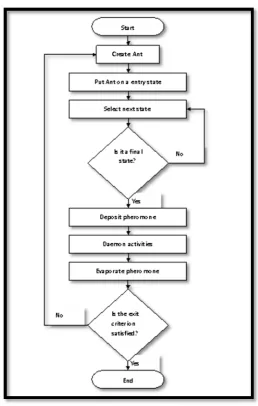
At first, a n×n matrix named is considered as pheromone variables, where n is the number of tasks in the given task graph. Actually, ij is the desirability of selecting task nj just after task ni. All the elements of the matrix initiate with a same and very small value. Then, the iterative ant colony algorithm is executed. Each iteration has the following steps:
Generate ant (or ants) and estimate the delay.
Loop for each ant (until the complete scheduling of the all tasks in the task-graph).
- Select the next task according to the pheromone variables of the ready-tasks using a probabilistic decision-making. Deposit pheromone on the visited states.
[image:4.612.174.432.271.677.2]Daemon activities (if applicable) Evaporate pheromone.
Figure 1. Flow chart of (ACO_DARP)
Technology (IJRASET)
iteration, the ant must select a task from the ready-list using a probabilistic decision-making based on the values of the pheromone variables and heuristic values (priorities) of the tasks. The desirability of selecting task nj just after selecting task ni at time instant t is obtained by the composition of the local-pheromone-trail values with the local-heuristic values as follows:
) ( ] [ )] ( [ ] [ )] ( [ ) ( ) ( t j t t t a t l l il j ij
ij
(2)where ij(t) is the amount of pheromone on the edge (ni, nj) at time instant t, j is the heuristic value (priority measurement) of task nj, (t) is the current set of ready-tasks (ready-list), and and are two parameters that control the relative weight of pheromone-trail and heuristic-value (Note that different priority measurements such as TLevel, BLevel, SLevel, ALAP, and NOO can be used as heuristic values, and the best one should be selected experimentally). For ant k at time instant t, the probability of selecting task nj just after selecting task ni is computed by using (8).
) ( ) ( ) ( t l il ij k ij a t a tp (3)
Then a random number is generated, and the next task will be selected according to the generated number (for each ready-task, the bigger pheromone-value and the bigger priority, the bigger chance to be selected). The selected task is appended to the ant's list, removed from the ready-list, and its children ready-to-execute now will be augmented to the ready-list. These operations are repeated, until the complete scheduling of all the tasks, which means the completion of the ant's list.
In the third stage, tasks are extracted one by one from the ant's list, and mapped to the processors that supply the earliest-start-time. Then, the maximum finish-time is calculated as makespan that is also the desirability of the obtained scheduling for this ant. According to this desirability, the quantity of pheromone, which should be deposited on the visited states, is calculated:
k j i k
k
ij if n n T
L
1 ( , ) (4)
Where Lk is the overall-finish-time or makespan obtained by ant k and Tk is the executed tour of this ant. Accordingly, ijk should be deposited on every ij if and only if the (ni, nj) exists in the Tk (task nj has been selected just after task ni). Otherwise, ij will remain unchanged.
In the fourth stage (daemon activity), to intensify and to avoid removing the good solutions, the best-ant-until-now (Antmin), is selected (as the best solution), and some extra pheromone is deposited on the states visited by this ant using
min min min
)
,
(
1
T
n
n
if
L
i jij
(5)In the last stage, by using (6), pheromone variables are decreased simulating pheromone evaporation in the real environments. It should be taken to avoid premature convergence and stagnation because of the local minima.
ij
ij
(1 ) (6)
Where, is the evaporation rate in the range of [0, 1] should be determined experimentally.
IV. SIMULATION SETTINGS AND PERFORMANCE METRICS
Technology (IJRASET)
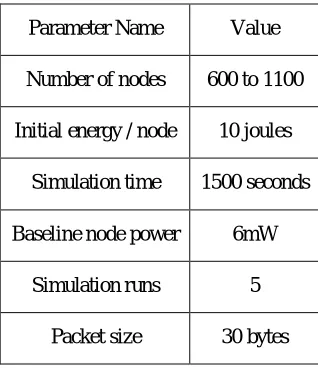
Table 1. Simulation SettingsParameter Name Value
Number of nodes 600 to 1100
Initial energy / node 10 joules
Simulation time 1500 seconds
Baseline node power 6mW
Simulation runs 5
Packet size 30 bytes
[image:6.612.226.385.94.286.2]V. RESULTS AND DISCUSSIONS
Figure 2 shows the comparative analysis of the protocols FTSP and ACO-DARP in terms of throughput. Simulation results prove that the proposed ACO-DARP outperforms than that of FTSP.
Figure 2. Number of Nodes Vs Throughput
[image:6.612.200.415.341.486.2]Figure 3 projects the comparative analysis of the protocols FTSP and ACO-DARP in terms of packets drop. Simulation results emphasize that the proposed ACO-DARP outperforms than that of FTSP.
Figure 3. Number of Nodes Vs Packets Drop
[image:6.612.199.414.539.690.2]Technology (IJRASET)
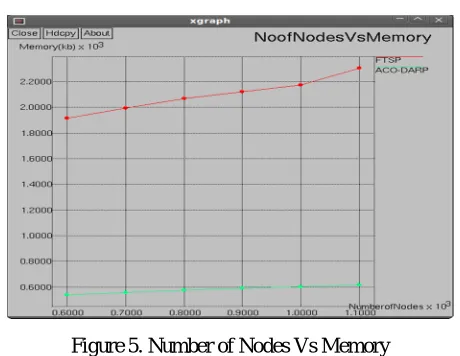
[image:7.612.195.418.106.250.2]proposed DARP outperforms than that of FTSP. Figure 5 shows the comparative analysis of the protocols FTSP and ACO-DARP in terms of memory utilization. A simulation result shows that the proposed ACO-ACO-DARP outperforms than that of FTSP.
Figure 4. Number of Nodes Vs Delay
Figure 5. Number of Nodes Vs Memory
VI. CONCLUSION AND FUTURE SCOPE OF RESEARCH
The emergence of wireless networks tends to offer communication with reduced delay. This research work aims to propose a routing protocol ACO-DARP, which is more aware about the delay. Route optimization carried out by making use of ant colony optimization approach. ACO-DARP inherits the features of AOMDV routing protocol. Performance metrics such as throughput, packet drop, delay time, and memory are taken into account for comparing the proposed routing protocol ACO-DARP with Fast Time-Dependent Shortest Path protocol (FTSP). Simulations are carried out using NS2 simulator and the results shows that the proposed routing protocol ACO-DARP achieves better performance.
REFERENCES
[1] T. He et al., SPEED:A stateless protocol for real-time communication in sensor networks, in: Proceedings of International Conference on Distributed Computing Systems, Providence, RI, May 2003.
[2] K. Akkaya and M. Younis, An energy-aware QoS routing protocol for wireless sensor networks, in: Proceedings of the IEEE Workshop on Mobile and Wireless Networks (MWN 2003), Providence, RI, May 2003.
[3] Emad Felemban, Chang-Gun Lee, and EylemEkici,” MMSPEED: Multipath Multi-SPEED Protocol for QoS Guarantee of Reliability and Timeliness in Wireless Sensor Networks”, IEEE Transaction on mobile computing, Vol. 5, No. 6,pp 736-754 June 2006.
[4] C. Lu, B.M.Blum, T. F. Abdelzaher,J.A. Stankovic and T.He , “RAP: a real-time communication architecture for largescale wireless sensor networks”, In Proc. Real-Time and Embedded Technology and Applications Symposium, IEEE conference, 2002.
[5] O. Chipara, Z. He, G.Ging, Q. Chen and X. Wang, “RPAR: Real-time power-aware routing in sensor networks”, In Proc. IWQoS. June 2006, pp. 83-92. [6] X. Huang and Y.Fang, “Multi constrained QoS multipath routing protocol in wireless sensor networks” Wireless Networks, Vol. 14, No 4, August2008. [7] L. Zhao,B.Kan, Y.Xu and X.Li, “FT-SPEED: A faulttolerant, real-time routing protocol for wireless sensor networks”, In Proc.of International Conference on
Wireless Communications, Networking and Mobile Computing, Shanghai, China, September 21–23, 2007.
[image:7.612.191.421.266.444.2]Technology (IJRASET)
[9] N. Xu, S. Rangwala, K. K. Chintalapudi, D. Ganesan, A. Broad, R. Govindan, and D. Estrin, “A Wireless Sensor Network for Structural Monitoring,” Proc. SenSys’04, 2004, pp. 1-12.
[10] L. Selavo, A. Wood, Q. Cao, T. Sookoor, H. Liu, A. Srinivasan, Y. Wu, W. Kang, J. Stankovic, D. Young, and J. Porter, “LUSTER: Wireless Sensor Network for Environmental Research,” Proc. SenSys ’07, 2007, pp. 1-14.
[11] J. N. Al-Karaki and A. E. Kamal, “Routing techniques in wireless sensor networks: A survey,” IEEE Wireless Commun., vol. 11, no. 6, pp. 6–28, Dec. 2004. [12] K. Akkaya and M. Younis, “A survey on routing protocols for wireless sensor networks,” Ad Hoc Netw., vol. 3, no. 3, pp. 325–349, 2005.
[13] D. Son, B. Krishnamachari, and J. Heidemann, “Experimental study of concurrent transmission in wireless sensor networks,” in Proc. 4th Int. Conf. Embedded Netw. Sensor Syst. (SenSys), 2006, pp. 237–250.
[14] J. Kang, Y. Zhang, and B. Nath, “End-to-end channel capacity measurement for congestion control in sensor networks,” in Proc. 2nd Int. Workshop Sensor Actor Netw. Protocols Appl. (SANPA), Boston, MA, USA, pp. 1–9, Aug. 2004.
[15] F. Akyildiz , W. Su , Y. Sankarasubramaniam, and E. Cayirci, “Wireless sensor networks: A survey,” Comput. Netw., Int. J. Comput. Telecommun. Netw., vol. 38, no. 4, pp. 393–422, Mar. 2002.