Sexton, N.J. and Cooper, Richard P. (2014) An architecturally constrained
model of random number generation and its application to modeling the effect
of generation rate. Frontiers in Psychology 5 , ISSN 1664-1078.
Downloaded from:
Usage Guidelines:
Please refer to usage guidelines at
or alternatively
An architecturally constrained model of random number
generation and its application to modeling the effect of
generation rate
Nicholas J. Sexton * and Richard P. Cooper
Department of Psychological Sciences, Centre for Cognition, Computation and Modelling, Birkbeck, University of London, London, UK
Edited by:
Gary Jones, Nottingham Trent University, UK
Reviewed by:
Mark Andrews, Nottingham Trent University, UK
Gary Jones, Nottingham Trent University, UK
*Correspondence: Nicholas J. Sexton, MERLiN, Department of Psychological Sciences, Birkbeck, University of London, Malet Street, London WC1E 7HX, UK
e-mail: [email protected]
Random number generation (RNG) is a complex cognitive task for human subjects, requiring deliberative control to avoid production of habitual, stereotyped sequences. Under various manipulations (e.g., speeded responding, transcranial magnetic stimulation, or neurological damage) the performance of human subjects deteriorates, as reflected in a number of qualitatively distinct, dissociable biases. For example, the intrusion of stereotyped behavior (e.g., counting) increases at faster rates of generation. Theoretical accounts of the task postulate that it requires the integrated operation of multiple, computationally heterogeneous cognitive control (“executive”) processes. We present a computational model of RNG, within the framework of a novel, neuropsychologically-inspired cognitive architecture, ESPro. Manipulating the rate of sequence generation in the model reproduced a number of key effects observed in empirical studies, including increasing sequence stereotypy at faster rates. Within the model, this was due to time limitations on the interaction of supervisory control processes, namely, task setting, proposal of responses, monitoring, and response inhibition. The model thus supports the fractionation of executive function into multiple, computationally heterogeneous processes.
Keywords: random number generation, executive function, cognitive control, cognitive architecture, computational model, supervisory system
INTRODUCTION
In a random number generation (RNG) task, subjects are instructed to randomly produce items from a given response set (e.g., single-digits 0–9), as if selecting and replacing items from a hat. The task typically requires subjects to produce a sequence of arbitrary length (e.g., 100 digits). Despite its apparent simplicity, the task is surprisingly complex, and appears to require the co-ordination of a diverse set of cognitive processes in order to generate an apparently random sequence.
When human-generated sequences are analyzed according to information-theoretic criteria for randomness, performance is typically poor, with such sequences exhibiting a number of sub-stantial biases. Perhaps surprisingly, however, such biases show considerable regularity and robustness across subjects and modal-ities. For example, subjects strongly avoid consecutive repetitions
(e.g., Baddeley et al., 1998; Towse, 1998), even though in
ide-ally random sequences of sufficient length, such repetitions occur with a non-negligible expected frequency—for a response set of 10 items, approximately one-tenth of responses should be consecutive repeats.
One possibility is that participants are poor at generating random sequences because they have an erroneous concept of
randomness1, an inability to perceive whether one’s own sequence
1We take an erroneous concept of randomness to include both biases
reflecting lay-beliefs about randomness (e.g., the gambler’s fallacy), or due to ill-specified instructions (seeNickerson, 2002for a review of both issues).
is sufficiently random, or both (see Bar-Hillel and Wagenaar,
1991, for a review, but seeNickerson, 2002 for a critical
treat-ment). This may well contribute to a normative, base-level bias, but the biases shown by participants are reliably modulated by experimental manipulations (e.g., concerning the rate of produc-tion, the concurrent performance of different secondary tasks, or the response modality). Additional factors therefore appear to underlie the biases shown across experimental conditions. In fact, an analysis of the production mechanisms involved in RNG suggests the involvement of multiple, functionally separable but
interdependent processes. For example, Baddeley et al. (1998)
propose that RNG involves, minimally: maintaining and updating a representation of previous responses; the selection of responses from an internal representation of the response set; and the sup-pression of habitual sequences such as counting. The involvement of multiple heterogeneous processes is supported by evidence
from behavioral experiments (e.g.,Baddeley et al., 1998; Towse,
1998; Cooper et al., 2012), TMS (e.g., Jahanshahi et al., 1998),
neuroimaging (Jahanshahi et al., 2000), and individual differences
studies (e.g., Miyake et al., 2000) and there is an apparent
consensus that these processes correspond with putative executive functions, including working memory monitoring/updating, task setting, and response inhibition.
While such executive functions have been extensively studied in numerous experimental paradigms, and specified in
com-putational terms (e.g., Gilbert and Shallice, 2002; O’Reilly and
has tended to focus on simple experimental tasks intended to isolate or decompose single executive functions. Computational accounts of more complex tasks which seek to show how more complex behavior is regulated as a synthesis of a number of such executive functions operating in concert have been infrequent
(although, seeSood and Cooper, 2013).
The present article presents a model of the RNG task within a theoretically motivated executive function architecture, and evaluates the model against existing empirical data sets. Of the remainder of this paper, the Measures of Randomness and Behavioral Effects section reviews how biases in random sequences have been assessed and how they have variously been manipulated in behavioral experiments. The Existing Models of RNG and their Limitations section discusses cognitive theories of RNG. In An Architecturally Grounded Model of RNG, we present a computational model of the task, grounding the model within the specification of a complete, task-general executive architec-ture. The Simulations section presents four simulations in which the model performs RNG at various rates. Together, the simula-tions demonstrate how some of the characteristic effects of mod-ulating generation rate in human subjects might be accounted for in terms of an automatic contention-scheduling system which produces habitual behavior, regulated by rate-limited supervisory processes. The Results section presents simulation results. The Discussion section presents a general theoretical discussion of the simulations and the presented architecture. The Supplementary Material contains implementational details and parameters for
the model2.
MEASURES OF RANDOMNESS AND BEHAVIORAL EFFECTS
The randomness of a sequence may be assessed in a number of ways. In an ideally random sequence of infinite length, the overall frequency of responses should be equal. Biases away from such equality are commonly assessed using R, an information theo-retic index of redundancy which is derived from the number of
occurrences of each response (Baddeley et al., 1998). However,
a sequence that simply cycles repetitively through the response set would achieve minimal redundancy whilst being entirely pre-dictable, suggesting that additional criteria are required. One
alternative is the RNG score (Evans, 1978), which measures
the relative usage of all consecutive two-response combinations (digrams), which should also be equal in an infinitely long, ideally random sequence. Hence, a higher RNG score can be thought of as reflecting overall overuse of certain digrams. While the RNG score gives an overall assessment of sequential bias, other indices are sensitive to specific stereotyped sequences. For example, when using a familiar response domain such as
let-ters (e.g.,Baddeley, 1966) or digits (e.g.,Jahanshahi et al., 1998)
it appears that subjects must inhibit overlearned continuations, such as cycling responses in alphabetical order, or counting, and a number of metrics have been used to specifically assess such
2The simulations described in this paper were written in C, using the GTK+
graphical toolkit for interface functions. All model code and simulated data are available from the authors. To compile and run the simulations GCC ver-sion 3.0 and GTK+version 2 or similar are required. Both are freely available with any modern GNU/Linux distribution.
habitual sequence biases. Adjacency (A), is simply the proportion of responses that reflect adding or subtracting one to the
previ-ous response (±1 associates), while count scores (CS1, CS2) are
weighted to the length of a subsequence, and defined respectively as the summed square of the length of each sequence that
con-sists of±1 or±2 associates (Spatt and Goldenberg, 1993). Such
measures do not assess the regularity with which responses are re-used. The distribution of the gaps between successive instances of the same response may be calculated, and the average (usually, the median) repetition gap (RG) assesses the tendency of subjects to cycle through the response set with a greater predictability than
ideally random sequences (Towse and Neil, 1998). Thus, no single
metric provides a complete assessment of randomness.
A large number of indices may be calculated from an arbi-trary sequence, and compared with the expected values associated with true randomness (generally, calculated empirically through repeated computer generation of pseudorandom sequences or random number tables) for an assessment of bias. A crucial ques-tion is the extent to which indices of randomness dissociate. When such varied metrics are obtained from written sequences generated by human subjects, a factor structure is found that shows individual differences in human biases different to that
from ideally random sequences of the same length. Ginsburg
and Karpiuk (1994) suggested a three-factor model of subject biases, including factors they named Cycling (loading primarily on median RG), Seriation (with strong factor loadings on indices of adjacent responses, similar to CS1 and A, and unequal digram usage, similar to RNG), and Repetition (with strongest factor loading on the number of consecutive repetitions). This sug-gested that underlying the biases evident in randomness indices is a consistent structure, relating to the operation of various underlying cognitive processes, the efficacy of which differs across individuals.
Subsequent factor analyses of verbal responses to an RNG
task (e.g.,Towse and Neil, 1998; Miyake et al., 2000) confirmed
these findings, although with an additional factor, Equality of Response Usage, which loaded primarily on redundancy (R). Miyake et al. hypothesized that the suppression of prepotent
responses (identified as Seriation byGinsburg and Karpiuk, 1994)
requires response inhibition, while equality of response usage requires the updating of memory representations of previous responses. Indeed, relating variation on the Equality of Response Usage factor to differences in working memory updating is
con-sistent with the absence of such a factor in the analysis ofGinsburg
and Karpiuk (1994)which, being based on a written version of the task, obviated the need for subjects to use memory to reg-ulate response equality. Miyake and colleagues found the best fitting structural equation model indeed linked the two factors to latent variables which putatively indexed the respective executive functions, as derived from a selection of simple executive tasks.
ability to perceive randomness. Additionally, the study suggests plausible candidate functions underlying two of the main dimen-sions of bias in random generation performance. However, it has a number of limitations: the data are purely correlational; the fit of the authors’ favored model (with single path from each latent variable to randomness factors) is only marginally better than the fit of several alternative models; and the model does not provide a mechanistic account of task performance in terms of cognitive
processes (seeCooper et al., 2012, for a more detailed discussion).
Consistent with these findings from individual differences methodologies, experimental studies have found that various indices of randomness are differentially sensitive to behavioral manipulations. One commonly reported finding is the effect of varying the rate of response generation, with an increase in generation rate producing an increase in the tendency to use counting as a stereotyped strategy (indexed by CS1 or A scores). It appears that at faster rates, subjects have difficulty
suppress-ing overlearned, habitual sequences (Towse, 1998; Jahanshahi
et al., 2000). In a PET study, the left dorso-lateral prefrontal cortex (LDLPFC) appeared to be critical for such suppression of habitual sequences, with the region more active when
sub-jects performed RNG compared to counting (Jahanshahi et al.,
2000). Furthermore, activation in the region appeared to be
related to a behavioral measure of stereotypy, with the faster rates of generation producing an increase in CS1 scores and a decrease in LDLPFC activation. Jahanshahi and colleagues inter-preted this as reflecting the breakdown of this region’s ability to suppress habitual responses at fast rates of generation. This con-clusion was supported by findings from a second study using Transcranial Magnetic Stimulation (TMS) over the region, which produced a similar increase in CS1 without having a significant effect on other randomness indices for equality of response usage
(R) or cycle length (RG) (Jahanshahi et al., 1998). These results
are paralleled by neuroimaging findings from another genera-tion task—verbal fluency—in which the same region was active
for word production, but not word comprehension (Frith et al.,
1991). Taken together, these findings suggest that the role of the
LDLPFC in generation tasks is not specific to random sequences, but instead related more generally to response selection and the suppression of bias. This evidence appears incompatible with an explanation of random generation bias purely in terms of an erroneous conception of randomness, and again points to a control-process account of random generation.
Varying other task parameters has tended to modulate alter-native indices of randomness. Varying the size of the response set, for example, appears to affect the subject’s ability to achieve equal use of each element of the response set, although this effect disap-pears in modalities where the responses are represented visually, or when a visible representation of the response set is provided (Towse, 1998). From this evidence, it appears as though equal use of the response set is dependent on the subject representing the response set, either externally, or internally, where the ability to keep track of previous responses appears limited by memory constraints.
An alternative approach to the investigation of the cognitive processes underlying random generation has been to use a dual-task methodology, based on the assumption that the performance
of a simple task should lead to performance impairments on a concurrent complex task through a reduction in the capac-ity of cognitive processes which are shared between the tasks.
Specifically, the findings of Miyake et al. (2000) suggest that
concurrent performance of a simple response inhibition task should increase prepotent associates bias, while a concurrent memory monitoring/updating task would increase equality of response usage bias. Inconsistent with this prediction, however,
in a visual/spatial version of the task,Cooper et al. (2012)found
prepotent associates indices (including RNG and A) were most biased when RNG was paired with a 2-back task (held to primarily involve working memory monitoring/updating), while equality of response usage (R) was affected both by concurrent performance of a 2-back task and a digit-switching task (held to require task switching).
In summary, while an erroneous conception of randomness might explain the existence of normative bias, such limitations are inadequate to explain findings from three main strands of evidence. Firstly, individual differences studies suggest that biases are regular across subjects, and appear to correlate with putative executive functions. Secondly, neuroimaging and TMS data sug-gests that the degree of bias in a sequence is modulated by activity in a specific region of prefrontal cortex, which is also linked to response production, but not perception, in a generation task which does not involve randomness. Thus, the control processes involved in controlling bias appear more general than would be suggested by specific limitations in a concept of randomness. Thirdly, a limited concept of randomness cannot explain why biases are modulated by behavioral manipulations (e.g., gen-eration rate, concurrent performance of a secondary tasks) or procedural variations (e.g., response modality, response set size), in such a way as to produce qualitatively different patterns of
behavior3. While the evidence reviewed thus far is consistent with
the hypothesis that random generation performance requires multiple co-ordinated executive functions, it does do not yet present a coherent picture of how the cognitive processes interact during task performance, or which biases reflect which execu-tive functions. One aim of the present work is to present such a theoretically-motivated account.
EXISTING MODELS OF RNG AND THEIR LIMITATIONS
Baddeley et al. (1998) suggested that the process of random generation can be understood by analogy with other genera-tion tasks, such as category generagenera-tion. In such a task, subjects typically make use of strategies or schemas to generate a clus-ter of related items (e.g., for the category “animals,” typical schemas might include “household pets” or “farmyard animals”), switching schemas when they cease to produce novel responses. Random generation is held to involve similar use of retrieval schemas. In the case of digit generation, schemas might include habitual schemas such as counting or reciting telephone num-bers; or deliberate strategies such as iteratively subtracting two.
3It is plausible, however, that limitations in applying a concept of randomness
However, in contrast to category generation, to comply with the requirement that the sequence appear random, subjects are required to frequently switch between different generation schemas. According to this model, distinct cognitive processes are responsible for monitoring responses before they are generated, inhibiting conspicuously non-random responses, and switching between alternative generation schemas. The schema switching process must be capacity limited, or ideal random generation could be achieved by deliberate switching of schemas on every response. Impairment in performance could result from three possible sources: the availability and capacity to switch between retrieval schemas, the capacity to monitor and inhibit prior plans or responses if they would produce an insufficiently random out-put, and the capacity to maintain a mental representation of previously used schemas. The processes of monitoring, inhibi-tion, and schema switching were ascribed to the central executive
of the multicomponent working memory model (Baddeley, 1986,
2000).
Jahanshahi et al. (2000)proposed a similar model, also based on extrapolating the processes thought to be involved in category fluency. In this model, an associative network represents response alternatives as a series of nodes, with node activation spreading through mutual, variably weighted excitatory connections. The
strongest weights are between neighbor pairs (representing±1
associates) with the next strongest between alternate pairs, such that the unrestrained output of the network resembles counting. An active controller comprises multiple control processes, includ-ing inhibitory modulation of response alternatives, monitorinclud-ing output to detect violations of task rules, and access to informa-tion in long term memory (e.g., task rules, a subjective concepinforma-tion of randomness, etc.). The authors propose that the mechanism for the control of responses is the active inhibition of a prior response’s neighbor nodes (or strongest connections), to suppress inappropriate, habitual responses. Inability to produce a random
sequence is, as inBaddeley et al. (1998), due to capacity
limita-tions of the active controller, in particular at the fastest rates of generation.
One limitation of the models of Baddeley et al. and Jahanshahi et al. is that neither is fully specified in computational terms. The main aim of the present article is therefore to present a compu-tationally explicit account of the contribution of specific control functions to the generation of random numbers by human sub-jects. This approach offers advantages beyond the above verbal models. It makes explicit how varied randomness indices are dependent on the interaction of specific control processes; and it shows how the interaction of such control processes might be affected by task factors such as generation rate.
AN ARCHITECTURALLY GROUNDED MODEL OF RNG
While it would be possible to develop a computationally com-plete model of RNG based on the above verbal description, there is much to be gained by developing the model within the more constrained theoretical framework of a cognitive architecture. A cognitive architecture specifies at a gross level a theory of the organization of the processing subcomponents that make up a cognitive system (in this case, the human cognitive system). By developing a model within an architecture, the model inherits
constraints from the architecture (Newell, 1990) and when
mod-els of a range of tasks are developed within a single architecture, constraints from the full range of tasks can help to further specify elements of the architecture, thereby effectively resulting in
addi-tional constraints on each specific model (but seeCooper and
Shallice, 1995).
At the time of writing, the most well-developed cognitive architecture is the ACT-R (Adaptive Control of Thought— Rational) architecture of Anderson and colleagues (e.g., Anderson, 2007), though there are a range of proposals in
the literature (including most notably Soar, e.g.,Newell, 1990;
Laird, 2012; and EPIC, Meyer and Kieras, 1997). Here we present a novel architecture—the Executive Subprocess (ESPro) architecture—which is based on theories of the organization of
the “central executive” (Baddeley, 1996) and the break-down
of executive functioning following neurological damage (e.g., Norman and Shallice, 1986; Shallice et al., 2008). We return to the relation between the ESPro architecture and other extant cognitive architectures in the general discussion.
THE EXECUTIVE SUBPROCESS (ESPro) ARCHITECTURE (VERSION 1.0)
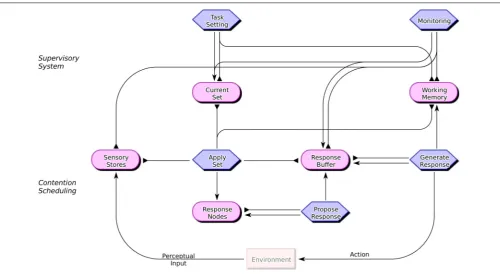
Figure 1 shows the components of the proposed ESPro archi-tecture (version 1.0) and their potential interactions. The figure adopts the conventions of the COGENT modeling environment (Cooper and Fox, 1998; Cooper, 2002), whereby a cognitive system is decomposed into interacting components (generally buffers, shown as rounded rectangles, and processes, shown as hexagonal boxes), with interactions shown by different types of arrow (for sending messages to processes or querying the content of buffers). In order to develop a fully operational computa-tional model from a COGENT diagram it is necessary to specify the properties of the component buffers (e.g., whether and how capacity limitations and decay might operate) and the rules of operation of the component processes.
ESPro assumes a basic distinction between routine or
over-learned behavior and non-routine behavior (see Norman and
Shallice, 1986). The former is assumed to be the product of a
schema-based system (referred to as contention scheduling and
shown in the lower portion ofFigure 1) while the latter arises
from the modulation of that schema-based system by higher
cog-nitive processes (referred to collectively as thesupervisory system
and shown in the upper portion ofFigure 1). Many of the
FIGURE 1 | Components of the Executive Subprocess (ESPro) architecture.Hexagonal boxes represent processes that generate output while rounded rectangles represent buffers that store representations
(possibly with associated activations). Pointed arrows between boxes show message passing. Arrows with flat heads represent the reading of information from buffers by processes.
articulating the word or pressing the corresponding response key) and stores the response thus generated in Working Memory. These components thus implement a system for the generation of habitual or schema-driven behavior.
The operation of Apply Set is based on the contention
schedul-ing system described byNorman and Shallice (1986), see also
Cooper and Shallice (2000). It assumes that routine behavior involves application of behavioral routines (schemas) to per-ceptual input (i.e., the contents of Sensory Stores). Responses generated in this way must be stored in Working Memory (or some short-term buffer) as many routine sequential tasks con-sist of actions that are dependent on previous actions, even when those previous actions have no persistent sensory consequences. For example, when adding sugar to a hot beverage it is necessary to record in some way when sugar has been added as once the sugar has dissolved it cannot serve as a perceptual cue. Similarly in the case of RNG it is necessary to record, at least temporar-ily, each response, as schemas such as counting need to know the previous response in order to generate the next putative response. Empirical and neuroimaging studies involving tasks such as
the stop signal and Go/NoGo tasks (e.g., Verbruggen et al.,
2006, 2008; Swick et al., 2011) and the task switching paradigm
(e.g., Philipp et al., 2007) imply that response selection and
response generation are separate processes. This is reflected within the ESPro architecture by the distinction between the Propose Response and the Generate Response processes. Once a response is proposed, it is temporarily stored in the Response Buffer prior to being generated. A putative response can then be
withdrawn or withheld prior to generation if supervisory pro-cesses (specifically Monitoring) determine that the response is inappropriate in the current context.
The remaining components of the architecture allow for the modulation of routine behavior in non-routine situations. Monitoring detects when a proposed behavior fails to meet task
requirements4. In the case of random generation this process
must detect when a putative response is “insufficiently random,” as described below. When Monitoring detects such a failure, it inhibits production of the proposed response and triggers gen-eration of a more appropriate response. It does the latter by inhibiting the current schema (i.e., the contents of Current Set). This in turn triggers Task Setting to generate and install an alter-native schema in Current Set. Routine operation (via contention scheduling) may then resume, with the alternative schema (hope-fully) leading to the proposal of a more appropriate or acceptable response.
A MODEL OF RNG WITHIN THE ESPro ARCHITECTURE
Applying the ESPro architecture to a specific task such as ran-dom generation requires specifying the operation of the two key task-specific components of the architecture: Task Setting and
4More generally, Monitoring may also make use of a forward model (not
Monitoring. The role of Task Setting is to propose and instate a new schema or task set whenever the process detects that there is no schema currently controlling behavior (i.e., Current Set is empty). The operation of the process depends on the available schemas (which is task specific), and in highly complex tasks the process may involve problem solving and planning. This level of complexity is not required, however, for the random generation task, and in the current model we explore the assumptions that (a) the available schemas may be effectively approximated by a set of schemas that can transform (by addition or subtraction of a fixed quantity) any response into any other response, and (b) Task Setting selects from these schemas stochastically, with “repeat response” having a much smaller probability of selec-tion (e.g., of 0.01, assuming a response set size of 10) than all other schemas, which have equal probability of selection (e.g., of 0.11, given the response set size of 10). Thus, Task Setting imple-ments a bias away from selection of the schema supporting repeat responses, but beyond this it is not biased in its schema selection. Within the general architecture, the Monitoring process is required to detect when a planned response (i.e., a putative response that has been entered into Response Buffer) is inap-propriate, and hence should be inhibited in favor of a more considered response. In the context of the random generation task, Monitoring must determine when a putative response is in some sense insufficiently random. On detection of such a puta-tive response it should be removed from the Response Buffer and the schema that led to its generation should be deselected (i.e., removed from Current Set). Presumably there are individual dif-ferences in what one considers “insufficiently random.” For the purposes of the current simulation we assume that criteria for rejection of a response can be abstractly represented with a sim-ple set of if/then rules. Specifically, the model treats a putative response as insufficiently random in the event of any of three conditions: (a) the model can recall having recently produced the response (i.e., there is a record of it in Working Memory); (b) the response is one more or one less than the previous response; or (c) the response together with the previous two responses forms a sequence with equal intervals between each (e.g., 2, 5, 8 or 9, 5, 1). These three rules can be seen as implementing an avoidance of repeat responses, counting, or repeated use of a single schema, respectively, and are thus consistent with the verbally specified
models ofBaddeley et al. (1998)andJahanshahi et al. (2000).
The only further details required to specify the model of ran-dom generation concern the behavior of the Working Memory
and Response Node buffers5. Working Memory is a short-term
store that must be capable of holding an ordered set of recently generated responses. The information in Working Memory is used by Apply Set to generate a putative response by applying
5The architecture as shown inFigure 1includes three other buffers. Response
Buffer and Current Set are assumed for the purposes of this implementa-tion to be capable of holding exactly one element. It is moreover assumed that decay does not operate on these buffers. Current Set is a proxy for the schema network ofCooper and Shallice (2000)implementation of contention scheduling, with the contents of Current Set corresponding to the selected schema within that implementation. The current simulations do not make use of sensory feedback, so the properties of Sensory Stores are not relevant here.
the current schema (stored in Current Set) to the recollection of the previous response (as recovered from Working Memory), and by Monitoring to check whether a putative response, once gen-erated, is sufficiently random (as above). The model is agnostic about how the short-term storage aspects of Working Memory are achieved. Thus, the buffer might have limited capacity (such that when capacity is exceeded older elements are over-written) or decay might operate on its contents (with the likelihood of an element becoming inaccessible increasing with time or with the number of elements stored in the buffer). In the simula-tions reported below we consider two distinct implementasimula-tions of Working Memory.
The Response Node buffer is an interactive activation net-work with one node for each possible response. Nodes compete for activation according to standard interactive activation princi-ples with lateral inhibition between nodes ensuring that no more than one node is highly active at any time. Apply Set operates by exciting the node corresponding to the favored response, but this is modulated by associative excitation within the network (so if the node for “3” is active it will excite the nodes for its closest associates, “2” and “4”). Propose Response detects when a node’s activity exceeds a threshold. A representation of that response is then placed into Response Buffer and the corresponding node in Response Nodes is inhibited. Activation dynamics is governed by
the interactive activation equations ofCooper and Shallice (2000)
with a threshold of 0.80.
A WORKED EXAMPLE
An example of processing in the model is as follows. Let us assume that Working Memory contains three previous responses, 0, 2,
and 5, while Current Set contains the schema+3. At this stage,
the most active response node is 6, due to the spreading of activa-tion from the previously active node, 5, and the activaactiva-tion of this node laterally inhibits all other response nodes. However, within the contention scheduling system, Apply Set excites the 8 node
on each cycle, as a result of applying the+3 schema to the
pre-vious response in working memory (5). Activation of the 6 and 8 nodes is competitive, and in this example, the 8 node “wins,” crossing an activation threshold first. Propose Response then cre-ates an instance of the “8” response in the Response Buffer and correspondingly inhibits the “8” Response Node.
Once a response has been added to the Response Buffer, the model is ready to produce it at any appropriate time. In the model, this time is given by the number of cycles specified by the Generation Rate parameter. In the interim, however, the contents of the Response Buffer are open to inspection by Monitoring. To continue our example, Monitoring matches the “8” response against the contents of working memory, according to one of its rules specifying an insufficiently random response
(in this instance, reflecting repeated usage of the +3 schema)
and performs two actions: firstly, inhibiting the activation of
the “8” response within the Response Buffer6, secondly,
clear-ing the schema fromCurrent Set. Next, Task Setting sets a new
6Note that while the proposed response is inhibited, it remains in the
schema (−2) which Apply Set uses to excite the “3” response node. Meanwhile, the “6” response has remained relatively active from the earlier stages of processing, and crosses the activation threshold first, and is transferred to the Response Buffer.
This cycle of proposing responses, monitoring, task-setting, and proposing new responses continues until a either a response is found which does not trigger any Monitoring rules, or the model runs out of time and is forced to generate whatever response is in the Response Buffer (i.e., in our example, if the generation period expired here, the next response to be generated would be “6”). Thus, at longer rates of generation, the model may proceed through more iterations, and is more likely to generate a response fully consistent with its concept of randomness.
SIMULATIONS
MODEL IMPLEMENTATION
A consistent finding of empirical studies of RNG is that varying the rate of generation leads to a substantial decrease in ran-domness at the fastest rates of generation, characterized by an increased tendency to employ the simplistic, overlearned strategy of counting. This effect is held to be the result of a breakdown
in control processes underlying random generation (Baddeley,
1996; Towse, 1998). Why might this occur at faster rates of generation? We note two distinct possibilities. Firstly, a break-down may be directly related to rate of generation; for example, if the elimination of stereotyped responses depends on tempo-rally extended supervisory processes, increased bias may be a direct result of limited processing time. Alternatively, the break-down of control processes may be indirectly related to generation rate via an increase in generic cognitive load, or a reduction in the availability of specific cognitive resources, as a result of the increasingly demanding nature of the task at faster rates of gener-ation. Although the present model architecture could be adapted to represent either proposal, the following simulations explore the behavioral implications of the first, more parsimonious, hypothe-sis: that decreased randomness and increased sequence stereotypy is a direct result of time limitations on supervisory processes.
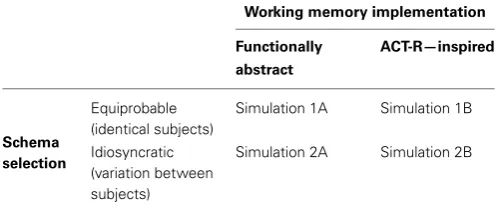
While certain aspects of the model, such as the architecture of the supervisory system, represent core theoretical claims; other components are included only to provide a complete, executable, computational model. We argue that the precise instantiation of working memory is such an implementational detail, and that a range of implementations of working memory would produce a broadly similar qualitative pattern of behavior. To substantiate this argument, two alternative implementations of working memory are presented (simulations 1A, 2A vs. 1B, 2B). Additionally, two alternative implementations explore how the effect of generation period on one specific dependent variable, RNG, may arise from individual differences in schema selection
biases (simulations 1A, 1B vs. 2A, 2B).Table 1shows the four sets
of simulations.
Working memory implementation
While a wide range of theoretically-motivated models of
work-ing memory have been proposed (for a review, seeMiyake and
[image:8.595.302.550.78.184.2]Shah, 1999) the present implementation of the RNG model aims to avoid commitment to any specific implementation. Thus, two
Table 1 | Overview of simulations.
Working memory implementation
Functionally ACT-R—inspired abstract
Schema selection
Equiprobable (identical subjects)
Simulation 1A Simulation 1B
Idiosyncratic (variation between subjects)
Simulation 2A Simulation 2B
alternative implementations of the model are presented, offer-ing a functionally abstract workoffer-ing memory system (Simulations 1A and 2A) and a theoretically-driven implementation adopt-ing a number of the assumptions and features of the ACT-R architecture (Simulations 1B and 2B).
A functionally abstract implementation of working memory. For the purposes of simulations 1A and 2A, working memory is implemented as a buffer which contains a temporally-ordered list of representations of previous responses. This implementation differs from the standard buffers available within the COGENT
framework7, in that it is assumed that the likelihood of a
repre-sentation decaying is a function of its position in the buffer, rather than the elapsed time since it was added.
This assumption is based on empirical findings that repetition suppression appeared to occur as a function of the number of intervening items, orthogonal to generation rate, and not directly related to the amount of time that had elapsed since its
produc-tion (Towse, 1998), in contrast to findings on the recency effect
in typical working memory paradigms (e.g.,Page and Henson,
2001). Indeed, the assumption that the decay of memory for
previous responses is orthogonal to generation rate is critical to model performance. Possible mechanisms for this phenomenon are briefly discussed in the following section.
In implementational terms, working memory implements the assumption that a normalized activation level is distributed across the contents of working memory, with new items in work-ing memory “stealwork-ing” activation from existwork-ing items such that an item’s activation is approximately inversely proportional to its position in the buffer. This intuitive description is formal-ized in Supplementary Material (Working memory activation equations).
An implementation of working memory inspired by ACT-R. While the previous implementation aims to abstract away from the algorithmic detail of working memory as a model-ing convenience, it may be argued that its implementation is overly simplified and lacks theoretical motivation. It implements memory representations as all-or-none—if they are present in the
7The COGENT framework offers a range of off-the-shelf buffer
buffer, their instantaneous retrieval is guaranteed; however on decaying they are irretrievably lost. It might be argued that it is implausible that a monitoring process accesses the most recent and most distant items in working memory equally easily; in demanding working memory tasks requiring continual updating such as the N-back task, for example, cognitive load increases as more items are required to be maintained in working
mem-ory (Fletcher and Henson, 2001). An alternative implementation
of working memory aims to demonstrate that the behavior of the model is not dependent on the simplified working memory assumptions made in simulations 1A and 2A. Here, we assume that retrieval of older items in the buffer should take more time. Hence at faster rates, the monitoring system will be restricted to checking responses against fewer previous responses in working memory.
One available implementation of this idea is that used by ACT-R to model retrieval from declarative memory (e.g., Anderson, 2007). Within the ACT-R architecture, memory rep-resentations are activated portions of long-term memory, with the activation value decaying over time. Thus, in contrast to the previous implementation, items do not decay from working memory—each possible response is represented once. The prob-ability of successfully retrieving memories, and the time required for retrieval, are functions of an item’s activation. Adopting these assumptions offers some independent, theoretically validated, constraints for working memory, while testing the claim that the specific implementation of working memory is incidental to its qualitative behavior.
Our implementation of activation in working memory departs from the ACT-R algorithms in one important respect. We assume, for the purposes of retrieval latency and probability equations, that activations of working memory items are relative to mean activation in the buffer, rather than absolute values, in order to ensure working memory decay is independent of generation rate, and so as to stabilize the capacity of working memory between the start and end of the task. This additional assumption is sim-ilar to that adopted in the functionally abstract implementation of working memory above. However, in the canonical imple-mentation of base-level learning in ACT-R, successful retrieval of chunks in memory increases their level of activation, a mecha-nism not implemented in the present model. If slower rates of generation permit more memory retrievals as a by-product of more thorough monitoring, it seems reasonable that this mech-anism might counterbalance decaying activation to produce WM decay that is orthogonal to generation rate, as has been assumed here. Future experimental and computational work might fruit-fully explore whether working memory decay is indeed orthog-onal to generation rate in the RNG paradigm, and whether this can be accounted for by models which propose active mainte-nance as a by-product of monitoring, or a dedicated process (e.g., verbal rehearsal), although such work is outside the scope of the present study and these points will not be discussed further.
Schema selection
In the model, schemas represent a probability distribution of all potential responses, given a previous response. For sim-plicity, however, simulations 1A and 1B essentially model the
performance of a single subject, where the selection of all non-repeat schemas by Task Setting is equi-probable. In human sub-jects, however, it is plausible that idiosyncratic schema biases are superimposed over shared schemas such as counting, or count-ing in twos. This creates issues for empirical assessment of bias. On one hand, certain indices of randomness, such as associates scores, reflect population averages (rather than biases evident in any single individual) and thus may not be sensitive to such between-subject variability. On the other hand, measures of bias which are calculated individually for each subject, such as the RNG score, may reflect idiosyncratic bias that is not evident in associates scores.
Simulations 2A and 2B therefore model a varied population of subjects. A unique set of biases is created for each mod-eled “subject” by scaling each element of the original schema selection weights matrix with a noise value obtained by sam-pling from a Gaussian distribution. We predicted that this will increase individual-specific biases, indexed by RNG scores, with-out substantial changing mean associate scores (but producing an increase in their variances).
GENERAL SIMULATION METHODS
Simulation procedure
For each of the four simulation studies, 36 virtual subjects produced a sequence of 100 responses from the set 0 to 9 (inclu-sive) for each of six experimental conditions. All sequences were scored on the standard dependent measures described above, namely CS1, CS2, R, RNG, and RG. The model includes sev-eral parameters that are essential to its correct operation (e.g., spreading activation in the response nodes) but are of no theo-retical interest. There are, however, a number of free parameters that do affect the action of the supervisory processes, includ-ing: generation period, controlling the number of cycles between responses; Working Memory decay, which was related to the per-item capacity of Working Memory; and parameters control-ling the likelihood of updating Working Memory and of the Monitoring process firing. Such parameters and their values are given in the Supplementary Material.
In order to establish baseline performance, model parameters were hand-set such that the model fit human performance in a single empirical condition. Simulations then consisted of sys-tematically manipulating only the generation period parameter, which was hypothesized to produce similar modulation of ran-domness indices to varying generation interval in human sub-jects. This procedure was adopted so as to avoid arbitrary model performance produced by atheoretically fitting free parameters. For qualitative examination of model behavior, fine-grained vari-ations of the generation period parameter were used to graph how biases in random sequences varied as a function of gener-ation rate. For quantitative analysis, six regularly-spaced levels of this parameter were assumed to correspond ordinally to the levels of generation interval in the target data (i.e., fastest to slowest) described below. This gives the six experimental conditions for each virtual subject referred to above.
Target data
Specifically, the model aims to capture the qualitative pattern of bias modulation when generation rate is varied, which we argue reflects rate-limitations in executive processes. Unfortunately, while the behavioral effects of varying generation rate are qual-itatively robust, dependent variables have not been reported consistently across published studies, making direct quantitative comparison between studies problematic. However, at least two behavioral studies report sufficient indices of randomness to infer
the modulation of underlying biases. Jahanshahi et al. (2006)
reported 11 varied randomness indices in a behavioral replication
of previous studies (Jahanshahi et al., 1998, 2000). Additionally,
[image:10.595.306.547.230.331.2] [image:10.595.45.551.408.630.2]Towse (1998)reports the results of statistical tests for the indices RNG, R, and A, with findings consistent with the Jahanshahi stud-ies. The qualitative patterns of bias modulation are as follows (see
Table 2). Firstly, both studies report a main effect of generation rate on measures of consecutive associates (CS1, A), with faster rates of generation significantly more biased than slower rates. Secondly, finer-grained analysis of bias in associates usage (e.g., Towse, 1998, reproduced here asFigure 2) illustrates the shape of response biases that contribute to the RNG score. Features of
this data include the typical overproduction of±1 associates at
fastest rates of generation (i.e., 1.33 Hz) and their suppression at intermediate (0.66 Hz) and slower rates (0.33 Hz), to the extent
that +2 associates were more frequently used than +1
asso-ciates at the slowest rate. Unfortunately, formal statistical tests
of these data were not reported. Thirdly, bothTowse (1998)and
Jahanshahi et al. (2006)report significant effects of generation
rate on overall associate bias (RNG), although inJahanshahi et al.
(2006)this was restricted to an increase at only the fastest rate of
generation (2 Hz), whereas inTowse (1998)the increase appeared
gradual. No further effects of generation rate are anticipated.
RESULTS
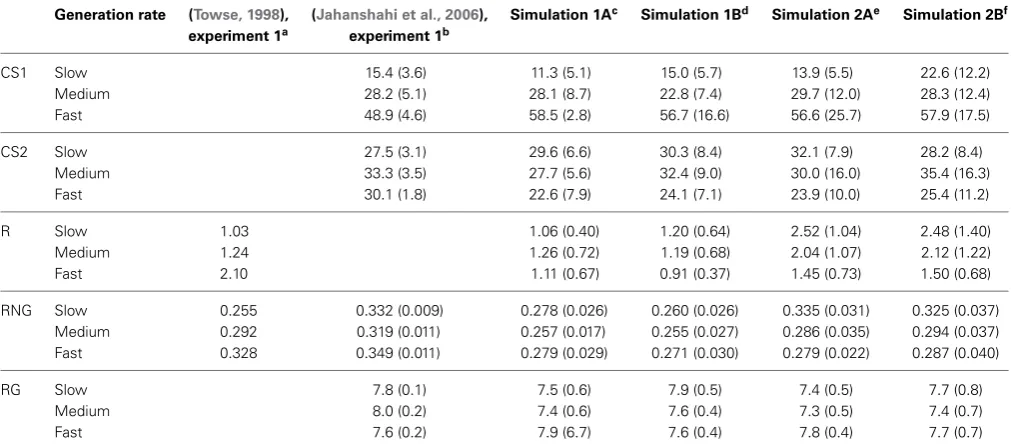
Means of each dependent measure (CS1, CS2, R, RNG, and RG), together with human data from the target studies, are shown in
Table 2. Data for three representative conditions are presented, representing slow, medium, and fast rates of generation.
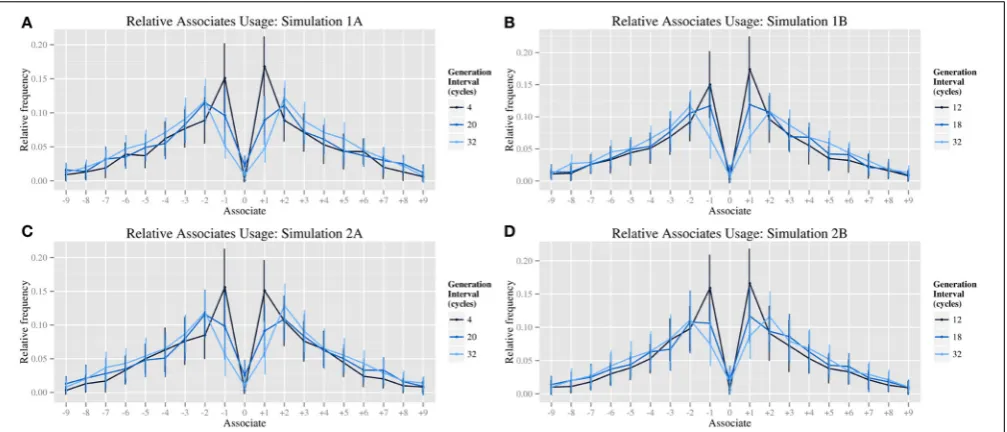
The switch in bias from CS1 to CS2 at slower generates
rates was assessed graphically (cf.Figure 2for human data and
Figure 3for simulation data). All simulations reproduced the key
effect, with±1 associates being more frequent than±2 associates
FIGURE 2 | Distribution of difference scores—the difference between consecutive responses (adapted fromTowse, 1998, Figure 2).
Table 2 | Mean and SD for all randomness indices, target data, and simulations.
Generation rate (Towse, 1998), (Jahanshahi et al., 2006), Simulation 1Ac Simulation 1Bd Simulation 2Ae Simulation 2Bf experiment 1a experiment 1b
CS1 Slow 15.4 (3.6) 11.3 (5.1) 15.0 (5.7) 13.9 (5.5) 22.6 (12.2) Medium 28.2 (5.1) 28.1 (8.7) 22.8 (7.4) 29.7 (12.0) 28.3 (12.4) Fast 48.9 (4.6) 58.5 (2.8) 56.7 (16.6) 56.6 (25.7) 57.9 (17.5)
CS2 Slow 27.5 (3.1) 29.6 (6.6) 30.3 (8.4) 32.1 (7.9) 28.2 (8.4) Medium 33.3 (3.5) 27.7 (5.6) 32.4 (9.0) 30.0 (16.0) 35.4 (16.3) Fast 30.1 (1.8) 22.6 (7.9) 24.1 (7.1) 23.9 (10.0) 25.4 (11.2)
R Slow 1.03 1.06 (0.40) 1.20 (0.64) 2.52 (1.04) 2.48 (1.40)
Medium 1.24 1.26 (0.72) 1.19 (0.68) 2.04 (1.07) 2.12 (1.22)
Fast 2.10 1.11 (0.67) 0.91 (0.37) 1.45 (0.73) 1.50 (0.68)
RNG Slow 0.255 0.332 (0.009) 0.278 (0.026) 0.260 (0.026) 0.335 (0.031) 0.325 (0.037) Medium 0.292 0.319 (0.011) 0.257 (0.017) 0.255 (0.027) 0.286 (0.035) 0.294 (0.037) Fast 0.328 0.349 (0.011) 0.279 (0.029) 0.271 (0.030) 0.279 (0.022) 0.287 (0.040)
RG Slow 7.8 (0.1) 7.5 (0.6) 7.9 (0.5) 7.4 (0.5) 7.7 (0.8)
Medium 8.0 (0.2) 7.4 (0.6) 7.6 (0.4) 7.3 (0.5) 7.4 (0.7)
Fast 7.6 (0.2) 7.9 (6.7) 7.6 (0.4) 7.8 (0.4) 7.7 (0.7)
aGeneration intervals: 3, 1.5, 0.75 s. Raw scores obtained from standardized scores presented inTable 1by scaling against expected values obtained from a
pseudorandom algorithm.
bGeneration intervals: 3, 1.5, 0.5 s. Data extracted from Figure 1 ofJahanshahi et al. (2006), corrected for set-size to facilitate direct comparison with other data
sets.
FIGURE 3 | Graphs of specific biases at varied generation rates; relative associates usage for simulations 1A (A), 1B (B), 2A (C), 2B (D).
at fast generation rates andvice versaat slower generation rates.
For the remaining dependent measures, one-way independent measures ANOVAs were performed to test the effect of generation period across the six generation rates. Minor effects of skew were
disregarded as the sample size was generous (N =36). In cases of
nonhomogeneous variances, the test reported is Welch’sF.
Consistent with the target data, the effect of generation rate on CS1 was highly significant in all four simulations, with a very
large effect size [Simulation 1A:F(5,94.47)=82.43,p<0.0001,
η2=0.64; Simulation 1B:F
(5,96.54)=65.16,p<0.0001,η2=
0.71; Simulation 2A:F(5,95.53)=74.62,p<0.0001,η2=0.65;
Simulation 2B:F(5,97.278)=29.85,p<0.0001,η2=0.54]. Also
consistent with the target data, the effect of generation rate on CS2 was significant, but with a much smaller effect size reflect-ing a more modest increase at intermediate rates [Simulation
1A: F(5,210)=5.42, p<0.0005, η2=0.11; Simulation 1B:
F(5,210)=4.59,p<0.001,η2=0.10; Simulation 2A:F(5,210)=
3.60,p<0.005,η2=0.08; Simulation 2B:F(5,210)=2.68,p<
0.05,η2=0.06]. Thus, the effect of generation rate on CS1 and
CS2 appears robust across all four simulations, suggesting it is independent both of the specific working memory implementa-tion (i.e., simulaimplementa-tions 1 and 2), and to whether the distribuimplementa-tion of schema selection probabilities is fixed (i.e., simulations 1A and 2A) or subject to individual variation across subjects (i.e., simulations 1B and 2B).
More equivocally, the main effect of generation rate on R and RNG varied between simulations. For R, the main effect of gener-ation rate was significant but with a small effect size in Simulgener-ation
2B [F(5,210)=4.60, p<0.001, η2=0.08] and Simulation 2A
[F(5,210)=6.16,p<0.0001,η2=0.13], but not in Simulation
1A [F(5,97.227)=0.581,p=0.71], or Simulation 1B [F(5,210)=
1.49,p=0.20]. In both simulations in which a significant effect
was shown, the value associated with ideal randomness lies within 1 SD of the mean in nearly every condition, although an overall
trend is evident in simulation 2A, for less equal usage of responses at slower rates of generation. For RNG, the main effect of
gen-eration rate was significant in Simulation 1A [F(5,97.18)=6.01,
p<0.0001, η2=0.11], Simulation 2B [F
(5,210)=14.06, p<
0.0001, η2=0.25] and Simulation 2A [F(5,97.24)=31.64, p<
0.0001, η2=0.45], but not in simulation 1B [F(5,210)=1.69,
p=0.14]. An overall trend toward more biased digram usage at
slower rates of generation is evident in simulations 2A and 2B only. As predicted, between-subjects variability affected the RNG score, however rather than producing a uniform effect, between-subjects variability appeared to interact with generation rate, with a trend toward greater bias at slower rates of generation in B sim-ulations but not A simsim-ulations. Thus, R and RNG both appear somewhat dependent on between-subjects variability in schema selection. For R, a small but statistically significant effect was observed in B simulations only. For RNG, significant effects with a larger effect size were observed in B simulations, and in A simulations the effect was either not significant (2A) or significant but with a smaller size of effect (1A).
Finally, the effect of generation rate on RG was significant, with
large effect size in Simulation 1B [F(5,210)=7.16,p<0.0001,
η2=0.38] and small effect size in Simulation 1A [F
(5,210)=
2.80, p<0.05, η2=0.06], Simulation 2A [F(5,210)=3.56,
p<0.005, η2=0.08] and Simulation 2B [F(5,210)=6.25,
p<0.0001,η2= 0.13].
DISCUSSION
EVALUATION OF MODEL PERFORMANCE
effect sizes for this measure. WhileJahanshahi et al. (2006)did not report such an effect, their data does show a corresponding non-significant trend. As all three studies constituting target data use a relatively small sample size (between 6 and 15 subjects), they may lack sufficient power to detect real but small effects, thus we postulate that this effect would be significant in a behav-ioral replication with a larger sample size. Qualitatively, the model produces a distribution of associates that matches the pattern of
data in human subjects, (Figure 3) including a shift from±1 as
dominant associates at the fastest rates, to a dominance of±2
associates at the slowest rates. This is achieved by manipulat-ing only the equivalent model parameter, which controls the number of cycles of processing between responses. Interestingly, modulation of generation rate in simulations 1B and 2B pro-duces a non-monotonic modulation of CS2—the apparent use
of±2 schemas is greatest at intermediate rates of generation. In
the model, this occurs as a result of a sequential process. A±1
response becomes highly active and is proposed as a putative response. This putative response is inhibited by the monitoring system before it is produced, but meanwhile activation has spread
to the ±1 response’s next neighbor. As spreading activation is
bistable, tending to continue spreading in a single direction (i.e., counting either up or down) the next generated response is
rea-sonably likely to be a±2 response. The time required to complete
such a sequence tends to match the period available at
interme-diate rates of generation, thus making±2 associates (counting
in twos) slightly more likely than other associates. This
explana-tion has a clear analog with the explanaexplana-tion given byJahanshahi
et al. (2000)—given more time for each response, subjects sup-press counting in ones, in favor of counting in twos. The peak in
CS2 score matches a non-significant trend reported inJahanshahi
et al. (2006), and is a prediction that this will reach significance with a larger number of subjects.
Despite the model’s success in simulating a distribution of associates consistent with the target data, simulations 1A and 1B fail to produce RNG scores that are in a characteristically human range. Yet, the RNG score is an overall measure of associate bias, reflecting bias away from uniform digram usage. Such a bias would result from preferred continuations (e.g., a tendency to follow “3” with “8”). It may seem, therefore, that the simulations’ unrealistic RNG scores in simulations 1A and 1B are inconsistent with the good fits of the associates graphs. How can they be reconciled?
The hypothesis explored in simulations 2A and 2B is that such selection biases are indeed substantial, but vary across individuals. Consequently, idiosyncratic biases disappear from specific associates scores when averaged across participants. In the absence of variance statistics in the target data it is impos-sible to ascertain to what extent the qualitative shape of the associates bias is representative of an individual subject or a
group average. Additionally, associates scores (e.g.,+2) are
them-selves a composite of paired responses (e.g., 1–3, 2–4, 3–5), and variance in the relative preference of different continua-tions indexed by the same associate (e.g., a bias for 3–5 but against 5–7) would contribute to a higher RNG index but
not a+2 associate score. Hence, while individual variability in
certain biases may be either invisible in associates scores, or
averaged out across participants in a group mean, bias as mea-sured through RNG scores is neither. If this is the case, it is not appropriate to use a model with fixed associate biases to model such an index of empirical data obtained from a large sample.
Indeed, generation rate has a much larger effect on RNG in simulations 2A and 2B than in simulations 1A (where the effect was significant, but small) and 1B (where the effect was not significant). Thus, simulations 2A and 2B demonstrate that typ-ical human values of RNG imply a greater degree of individual bias than observed in published graphs of sample means (e.g.,
Figure 2). While such graphical representations illustrate com-monalities in biases across a population, such as the habitual use of counting, fully assessing the biases of individuals within a larger sample requires measures such as the RNG index. This finding has methodological implications for how bias is measured in empirical studies using the RNG task.
In these simulations, however, the RNG index was modulated by generation rate in an opposite direction to the human data. Thus, these simulations do not support the suggestion that in human subjects, the modulation of the RNG index is a direct effect of a variable interval in which to propose and evaluate responses for randomness, as tested in these simulations. Instead, we speculate that the modulation of the RNG index may reflect biases in Task Setting which are a result of increased cognitive load, and are thus an indirect, rather than a direct, effect of manipulating the generation rate. Incorporating a task selection bias (e.g., a bias toward more well-rehearsed schemas) mediated by cognitive load would be within the scope of the proposed architecture, but remains a hypothesis to be explored in future empirical and computational modeling research.
For R, similarly to RNG, between-subjects variability in schema selection bias (i.e., simulations 2A and 2B) interacted with generation rate to produce a slight modulation in bias. However,
we recall that whileTowse (1998)found no effect of generation
rate on redundancy, early RNG studies report increased redun-dancy at faster rates, the opposite direction of effect to the
sim-ulations (e.g.,Baddeley, 1966). Given that R reflects preference
for specific responses, it seems likely to reflect idiosyncratic biases similar to those for digram usage. Such biases could be mod-eled by adding noise to individual Response Nodes’ self-excitation weights, so each subject has a preference for the activation of certain response nodes (such an arrangement is suggested by Jahanshahi et al., 1998) however without more robust behav-ioral data to constrain modeling, we have not attempted this simulation in the present study.
MODEL SIGNIFICANCE AND RELATION TO VERBAL MODELS OF RNG To date, we are not aware of other mechanistic computational accounts of cognitive processes underlying RNG, hence we cannot quantitatively evaluate model performance in relation to other models. The operation of the model can be qualitatively compared to verbal models of RNG, however.
Essentially, the model operationalizes the theoretical proposal that the generation of random responses involves the
suppres-sion of the most habitual responses, counting in ones (Jahanshahi
in twos as a result of the proposal, and subsequent suppression,
of±1 responses before production. However, while Jahanshahi
and colleagues implied that selection occurs in parallel, with a shift in CS1/2 bias at fastest rates a consequence of a breakdown of modulatory influence in the DLPFC; in the model reported here the evaluation and selection of responses takes place serially, in a temporally extended sequence. A serial mechanism has the benefit of explaining offset peaks of CS1/CS2 scores at different genera-tion rates. Under faster rates of generagenera-tion, there is no breakdown of modulatory influence—the consequence of faster rates of gen-eration is an increasingly truncated representation of previous responses in working memory due to longer retrieval times of older (less active) items, and thus a progressive impairment in monitoring effectiveness.
The verbal process model of Baddeley et al. (1998)
sug-gested that schema-based generation of responses is modulated by inhibition of immediate responses together with a monitor-ing system that detects and inhibits inappropriate overuse of schemata. This is a reasonable broad description of the model operation. In the model, the operation of the supervisory com-ponents (including the mechanisms of monitoring, inhibition of proposed responses, switching generation schema, and acti-vating and proposing an alternative) is constrained by time available for each generation, which limits the number of pos-sible alternatives at faster rates. While Baddeley and colleagues suggested that the schema switching process was the source of capacity limitations, in the present model the complex behav-ior of inhibiting an inappropriate response and proposing an alternative requires time for the interaction of a number of pro-cesses, including: checking the response against working memory; inhibiting a proposed response; activating an alternative response node; set switching; and generating a response from a novel schema. While it has been suggested that the concept of ran-domness is complex and varies between subjects, the model implements a rudimentary set of rules used by the monitor-ing system (informally, inhibitmonitor-ing recently generated responses, inhibiting responses generated by recently used schemas, and inhibition of counting) supporting the idea that a sophisticated conception of randomness is not necessary to produce qualita-tively human-like behavior. In summary, previous verbal models of the RNG task are consistent with the model, and the favored ESPro architecture, although the latter emphasizes the interac-tive nature of multiple, computationally heterogeneous execuinterac-tive functions.
We make no strong theoretical commitment to how the con-cept of randomness is represented semantically. Nevertheless, the existence of such a concept is assumed by our model: one role of the monitoring system is to implement such a concept over successive digit productions. While such a concept may plausi-bly vary between individuals in sophistication, compared to a normative standard, the model shows that abstracting such a con-cept in terms of simple if/then production rules is sufficient to account for a wide range of observed human biases. One area for future research might be to evaluate various theories of random-ness concepts in the model, by changing the rules implemented by the monitoring system and comparing behavioral predictions. We believe one advantage of architectural approaches in general
is to facilitate such tests of theory by providing a computational framework for generating such predictions.
While the RNG task is of intrinsic interest as an index of exec-utive function, it has been argued here and elsewhere, e.g., that the suppression of stereotyped, habitual behavior in favor of con-trolled, deliberately selected sequences of action is characteristic of a wide range of naturalistic human behavior as well as behav-ior on complex psychological tasks. From this perspective, RNG is paradigmatic of complex, self-directed and non-routine behavior. The model presented here demonstrates that such behavior can be produced by a functionally decomposed, well-specified, set of mechanistic processes without recourse to an “homunculus.”
The model thus demonstrates the viability of modeling com-plex “executive” tasks as the integrated operation of computa-tionally heterogeneous processes. However, we regard the ESPro architecture outlined in this model as preliminary. The model invokes two mechanisms of convenience: setting up and realizing intentional markers (which is the proper role of further super-visory processes, hitherto explored in a somewhat separate line of research), and the role of Monitoring in suppressing inappro-priate, out-of-bounds responses (e.g., responding “25” when the task is to produce random numbers ranging from “0” to “9”). Such responses are occasionally made by normal human subjects. These errors are reminiscent of certain errors of patients with
prefrontal lesions on naturalistic and lab-based tasks (Shallice
and Burgess, 1991). However, such errors in the RNG task have not, to our knowledge, been systematically studied, in either nor-mal human participants or frontal lesion patients. Given the lack of quantitative data on out-of-bounds rule-breaks, this phe-nomenon has not been addressed here, but it may indicate a fruitful paradigm for clarifying the computational functions of the monitoring process.
While the simulations demonstrate that model behavior is largely independent of working memory implementation, both sets of simulations assume that working memory decay is a func-tion of the number of intervening items, rather than time, yet this remains to be explained. A possible mechanism was proposed to be rehearsal as a by-product of memory retrieval by a moni-toring process, however this remains to be demonstrated within the model. Indeed, a complete specification of a supervisory sys-tem architecture should clearly specify working memory rehearsal processes where they integrate with supervisory processes.
THE ESPro COGNITIVE ARCHITECTURE