Performance Analysis of Multiband Impulse Radio UWB
Communication System Based on PSWF
Lili Chen, Zheng Dou
Information and Communication Engineering College, Harbin Engineering University, Harbin, China Email: [email protected]
Received May, 2013
ABSTRACT
To improve the data transmission rate and use spectrum flexibly, a new spectrum allocation method for Multiband Im-pulse Radio UWB (MB-IR-UWB) is proposed in this paper based on the band-limited and orthogonal characteristics of Prolate Spheroidal Wave Function (PSWF). The system model is built and the bit error rate (BER) formula is deprived by binary time hopping pulse position modulation under additive white Gaussian noise. Moreover, the system perform-ance is analyzed via MATLB simulation. The results indicate that MB-IR-UWB system performperform-ance of BER is the same with single-band UWB. However, in the proposed scheme the data can be transmitted in multiple parallel bands, which enjoys much higher transmission rate. In addition, PSWF pulse duration affects the BER performance.
Keywords: IR-UWB; Multiband; PSWF; Performance Analysis
1. Introduction
Ultra-wideband (UWB) is an emerging technology that offers great promises to satisfy the growing demand for low cost and high-speed digital wireless home networks. By using ultra short impulse pulse to convey information [1], Impulse Radio allows remarkable data rates of Gbit/s. However, conventional single-band UWB signal has a wide fixed spectrum, which made the receiver lack the flexibility of spectrum utilization and restricted the im-provement of the system transmission performance. In 2004, Stkphane Paquelet proposed the idea of multiband in [2,3], and proved that the method can effectively im-prove the transmission rate. Later in [4] Martin Mittel-bach modified the model and concluded that extending the basic architecture to a multiband system could allow remarkable data rates in the order of several hundred Mbit/s up to almost a Gbit/s. Multiband Impulse Radio UWB (MB-IR-UWB) scheme divides the allocated UWB frequency range into several subbands and trans-mit information in multiple parallel band, which would not only expand the capacity of the system, but also im-prove the flexibility of spectrum utilization. By using soft-spectrum adaption (SSA) [5], it can avoid some cer-tain narrow-band interference and improve the perform-ance of receiver. Therefore, this scheme will become a new direction of future technologies.
According to preceding researches, we know tradi-tional MB-IR-UWB systems use band-pass filter to ar-range for the spectrum, and use incoherent energy detec-tion in the receiver, but the filter design is more complex.
Based on the band-limited and orthogonal characteristics of PSWF, it can be equivalent to the ideal band-pass fil-ter, and the coherent demodulation can be applied to get better performance.
In this paper, Section II makes a brief introduction of MB-IR-UWB architecture. The detailed description of waveform choice, band allocation, and system model is developed in Section III. The simulation result and analysis of transmission performance based on PSWF is presented and discussed in Section IV. Finally, Section V concludes this paper.
2. MB-IR-UWB System Overview
A block diagram of entire system model is depicted in
Figures 1 and 2. These two diagrams contain the major components of this architecture [6,7].
The basic working method of MB-IR-UWB system is as follows. A mono-band pulse generator is to generate a number of pulses where each pulse occupies a specific frequency band. The relatively narrow-band pulses are referred to as subband or monoband pulses. Each sub-band pulse is modulated with different data according to a specific modulation scheme. Prior to modulation the coded bit stream is convert into a block of MNband bits
that is partitioned into Nband groups of M bits. After
demodulation is considered, ensuring the optimum re-ception. At first, the received multi-band signal is de-composed by multiplying the orthogonal mono-band pulse to its subbands and subsequent operations are per-formed per band. And then, make the received data par-allel to serial conversion and make a soft or hard bit de-cision depending on the type of channel decoder. At last, we can get the original data. Theoretically multi-band technology can improve the system capacity N times (N
is the sub-band number), but it is still far from this limit.
3. MB-IR-UWB System Model Building
3.1. Prolate Spheroidal Wave Function Set
Prolate Spheroidal Wave Function (PSWF) has the ad-vantage of time-limited and band-limited. It was first proposed by D.Slepian and H.O.Pollack of Bell Lab in the late 1950s [8]. It is a complete set of orthogonal func-tion, which is time-limited in [ / and band- limited in . It has the maximum energy concen-tration on the interval [-T, T] as a band limited function. The PSWF pulses are orthogonal both in time and fre-quency domain. We can shift its spectrum and control its bandwidth easily by adjusting the pulse parameters. Therefore it is often applied in UWB communication.
2, / 2
T T
]
] [ ,
As is well-known, it’s difficult to calculate the closed- form solution of PSWF. So the discrete approximation solving method has been used, which can be regarded as follows. The signal ( )t , whose time duration is T, goes through an ideal band-pass filter that the upper cut-off
[image:2.595.57.281.464.575.2]
[image:2.595.310.535.515.714.2]Figure 1. Multi-band pulse generator and MB-IR-UWB transmitter.
Figure 2. MB-IR-UWB receiver block diagram.
frequency is fu and lower cut-off frequency is fl, the
output signal is ( )t . So the N base frequency bands can be regarded as N ideal band-pass filter. The template of N spectrum is as follows.
, , ,
, ,
( ) 2 sin (2 ) 2 sin (2 )
1
( ) (1, )
0
i i u i u i l i
i l i i u
h t f c f t f c f t f f f
H f i N
others
,l
(1)
where fi l, and fi u, respectively means the lower cut-
off frequency and upper cut-off frequency of the ith base frequency band. Using discrete solution respectively in each band, the corresponding PSWF pulses of all orders can be attained. In this paper, we choose the first order PSWF pulses of each band as the base pulses.
For two band-limited PSWF pulses i k, ( )t and j l,( )t ,
in different sub-bands, they don’t overlap each other in the frequency domain. By the Parseval’s theorem, it can be easily proved that
2
, , ,
/ 2
1 ( ) ( )
0
T
i k j l i j
i j
t t dt
i j
(2)So the band pass PSWFs in different sub-bands are orthogonal [9]. Due to the double orthogonal characteris-tic, two PSWF pulses have the same time duration and subbands are orthogonal. Therefore, all the pulses in the set are mutually orthogonal.
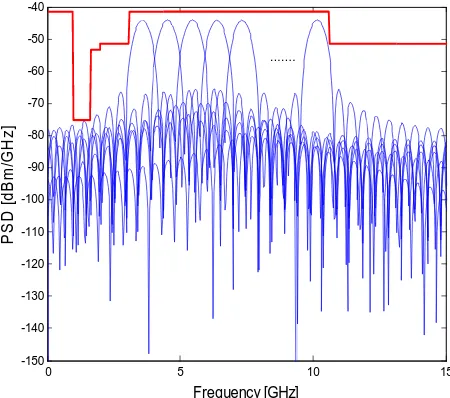
In this paper, we divide the UWB spectrum (from 3.1 GHz to 7.5 GHz) into several subbands, and then use the corresponding PSWF time domain impulse as the infor-mation carrier of MB-IR-UWB. The multiband spectrum allocation is given in Figure 3. In order to meet the re-quirements of ultra-wideband communications, the bandwidth of each band should be greater than or equal to 500 MHz.
0 5 10 15
-150 -140 -130 -120 -110 -100 -90 -80 -70 -60 -50 -40
Frequency [GHz]
PSD
[
d
B
m
/G
H
z
[image:2.595.58.282.618.719.2]]
...
3.2. MB-IR-UWB System Model Building
Consider a single-user MB-IR-UWB, with the binary orthogonal TH-PPM modulation, it is assumed that the pulse repetition time is Ts and every Ns pulses are used to
transmit one bit information. So the binary symbol rate
s bps. The transmitted signal can be
ex-pressed as: 1 /
b
R NTs
j 1 1 0 0 ( ) ( ) ( ) 0,1, 1 N N
i i s j c
i i j
S t s t p t jT c T a
i N
(3)where s ti( ) is transmitted signal of the ith band, is the pulse waveform of the ith band,
( )
i
p t
j c defines the
jitter of the pulse with respect to the timing of the integer,
c T
j
a is the time shift caused by PPM modulation. Trough AWGN channel, the received signal can be written as:
( ) ( ) ( )
r t S t n t (4) Channel gain and channel delay depends on the propagation distance between the transmitter and receiver. is additive white Gaussian noise with zero mean value and variance
( )
n t
0 2
N .
As stated earlier, the pulses between each sub-band are orthogonal, the optimum receiver under the AWGN can be considered, the received signal goes into the correla-tors, multiplying correlation mask of each band , and into the integrator, then into the decision unit for judgment. The correlation mask of the ith band is
( )
i
v t
( ) ( ) ( )
i i j c i j c
v t p t c T p t c T
(5)
For each band is independent, separate judgments can be made in each branch. The detection is a standard hy-pothesis testing problem. While the decision variables
( ) ( ) 0
s T
i i
Z r t v t dt
(6)it will be judged bit ‘0’,othervise bit ‘1’.According to the receive form of binary determinate signal, usually in the case of equal priori probability, we can obtain the aver-age error probability
1 1
Prob( >0 <1)+ Prob( <0 >1)
2 2
= Prob( <0 >1)
Pe Z Z Z Z
Z Z
│ │
│ (7)
Define 0 0 1 1
[ ( ) ( )]
T
bRX
p t p t dt E
is the normalizedcorrelation coefficient of the received signal and
, where , it’s the energy of each
0( )
p t
1( )
p t EbRX=2N Es TX
received bit information. After some calculus operations, yield 2 0 2 (1 ) 0 1 = 2 (1 ) 1
= erfc( )
2 2 bRX u E N bRX
Pe e du
E N
(8)For binary orthogonal PPM signal, we can easily ob-tain that
0 0
0
1
( ) ( ) 0
T bRX
p t p t dt
E
(9)Thus, the average error probability of binary orthogo-nal PPM for MB-IR-UWB system is:
0 1 erfc( ) 2 2 b RX E Pe N
(10)
where erfc( )= 2 + -u2
y
y e du
.4. Simulations and Performance Analysis
4.1. Performance Comparison of Single-band and Multiband IR-UWB
The following parts analyze MB-IR-UWB system per-formance from two views of reliability and validity.
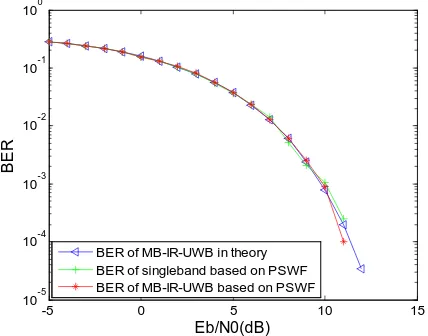
First, for the reliability, Figure 4 shows the perform-ance comparison of the single-band UWB and MB-IR- UWB system, assumed the conditions of the same wave-form, the same data transmission rate.
It can be seen from Figure 4 that the BER curves of MB-IR-UWB and single-band UWB almost completely overlap. This is because that each band can be equivalent to a single-band UWB, and in white Gaussian noise channel bit error rate is only related to signal-to-noise ratio. So in terms of reliability, multiband UWB system did not enjoy the advantage.
-5 0 5 10 15
10-5 10-4 10-3 10-2 10-1 100 Eb/N0(dB) BER
[image:3.595.317.531.540.708.2]BER of MB-IR-UWB in theory BER of singleband based on PSWF BER of MB-IR-UWB based on PSWF
Second, for the validity, the transmission rate of the two systems is compared. When the operating frequency occupied the entire 7.5 GHz band, the single-band PSWF pulse duration 1 , multiband PSWF pulse
dura-tion 2 . Therefore, if other conditions are the
same, the pulse repetition period 1 2 2
4 m
T n ns
s
4 m
T
s s s h m .
Suppose the transmission rate of single-band UWB is
1
b , and the transmission rate of MB-IR-UWB is ,
we can see that
T T N N T
2
b
R R
1 1 / 1, (1 /2 2)
b s s b s s
R N T R N T Nsub
Therefore, theoretically in equal time, compared with single-band UWB, the multi-band scheme can increase the transmission rate by N times. Thus, multi-band UWB communications technology plays an important role in satisfying the increasingly high data transmission rate.
4.2. The Impact of Pulse Duration on System Performance
Due to the advantage of PSWF’s high energy concentra-tion, it is of great significance to increase the transmis-sion rate as much as possible. From the analysis above, we can conclude that the pulse duration affects the data transmission rate indirectly. The following part will fo-cus on the analysis of the effect of different m on
sys-tem performance. In the simulation, the number of pulse per bit , the cardinality of the TH code
T
5 s
N Nh3. The corresponding relation between different values and is shown as Table 1.
m
T
b
It can be seen from Figure 5 that the BER curves are very close when m equals to 8ns, 4ns, 2ns.Under this
circumstance, the system performance is the best. When
m is 1.5ns, the system performance deteriorates
seri-ously, and when Tm is 1ns, the system performance
becomes worst. It is because that the larger m is, the
higher energy concentration of pulse in particular fre-quency band is. So the less energy loss is, the better the system performance is. Thus, the validity and reliability is a pair of mutually contradictory unity. To improve the reliability of the system, it would inevitably lead to a decline in the validity. In our simulation, in order to en-sure the system performance, the pulse duration which corresponds to = 66.7 Mbps is the best, i.e. = 2 ns.
R
T
b
T
T
T
R m
5. Conclusions
[image:4.595.310.537.85.254.2]This paper takes the MB-IR-UWB communication system
Table 1. Corresponding relation between different Tm
val-ues and Rb.
Pulse duration Tm/ns 8 4 2 1.5 1
Bit rate Rb/Mbps 16.7 33.3 66.7 88.9 133.3
0 2 4 6 8 10
10-4 10-3 10-2 10-1 100
Eb/N0(dB)
BE
R
[image:4.595.55.289.697.736.2]Rb=16.7 Mbit/s Rb=33.3 Mbit/s Rb=66.7 Mbit/s Rb=88.9 Mbit/s Rb=133.3 Mbit/s
Figure 5. The performance comparison in different data rate.
based on PSWF pulse as the research object, proposes a new way of multi-band spectrum arrangement and uses coherent demodulation method to achieve the best recep-tion. Through system model building and simulation analysis, we draw the conclusion that MB-IR- UWB system has the same bit error rate performance with sin-gle-band UWB. But in the MB-IR-UWB, the data can be transmitted in parallel, which can improve the transmis-sion rate of information. In addition, PSWF pulse dura-tion affects the BER performance. The simuladura-tion results show that the shorter PSWF pulse duration is, the larger the transmission rate is, but the system performance be-comes worse. Therefore, in actual communication, we should make a tradeoff between the validity and reliabil-ity to a best choice.
REFERENCES
[1] L. Yang, Ultra-wideband Communications: An Idea Whose Time Has Come, Signal Processing Magazine, IEEE, Vol. 3, 2004, pp. 26-54.
doi:10.1109/MSP.2004.1359140
[2] A. Batra et al., “Design of a Multiband OFDM System for Realistic UWB Channel Environments,” IEEE Trans-actions Microwave Theory and Techniqu, Vol. 52, No. 9, 2004, pp. 2123-2138.doi:10.1109/TMTT.2004.834184
[3] S. Paquelet, L.-M. Aubert and B. Uguen, “An Impulse Radio Asynchronous Transceiver for High Data Rates,” International Workshop on Wideband Systems joint with Conference on Ultrawideband Systems and Technologies, Joint UWBST & IWUWBS., pp. 18-21, 2004.
[4] Martin Mittelbach Rainer Moorfeld Adolf finger. Per-formance of a Multiband Impulse Radio UWB Achitec-ture. The 3rd Conference on mobile Technology, Appli-cations and Systems 2006.
doi:10.1109/LCOMM.2003.812167
[6] Aamish Hasan Asim Anwar Hasan Mahmood, On the Perfomance of Multiband DS-UWB System for IEEE 802.15 a Channel with Hydrid PIC Rake Receiver. Pro-ceedings-International Conference on Computer Net-works and Information Technology, 2001, pp. 65-69.
[7] A. Hasan, A. Anwar and H. Machael, “on the Perfomance of Multiband DS-UWB System for IEEE 802.15a Chan-nel with Hydrid PIC Rake Receiver. Proceed-ings-International Conference on Computer Networks and Information Technology, 2011, pp. 65-69.
doi:10.1109/ICCNIT.2011.6020909
[8] D. Slepian and H. O. Pollak, “Prolate Spheroidal Wave Functions, Fourier analysis, and Uncertainty-I,” Bell Syst. Tech. J., Vol. 40, No. 1, 1961, pp. 43-46. doi:10.1002/j.1538-7305.1961.tb03976.x