Munich Personal RePEc Archive
Portfolio risk evaluation: An approach
based on dynamic conditional
correlations models and wavelet
multiresolution analysis
Khalfaoui, R and Boutahar, M
GREQAM d’Aix-Marseille, IML université de la méditerranée
24 September 2012
Online at
https://mpra.ub.uni-muenchen.de/41624/
Portfolio risk evaluation: An approach based on dynamic conditional
correlations models and wavelet multiresolution analysis
R. Khalfaoui∗,a,, M. Boutahar,b,,
aGREQAM, 2 rue de la charite, 13236, Marseille cedex 02, FRANCE. bIML , Campus de Luminy, Case 907, 13288, Marseille cedex 09 FRANCE.
Abstract
We analyzed the volatility dynamics of three developed markets (U.K., U.S. and Japan), during the period 2003-2011,
by comparing the performance of several multivariate volatility models, namely Constant Conditional Correlation
(CCC), Dynamic Conditional Correlation (DCC) andconsistentDCC (cDCC) models. To evaluate the performance
of models we used four statistical loss functions on the daily Value-at-Risk (VaR) estimates of a diversified portfolio in
three stock indices: FTSE 100, S&P 500 and Nikkei 225. We based on one-day ahead conditional variance forecasts.
To assess the performance of the abovementioned models and to measure risks over different time-scales, we proposed
a wavelet-based approach which decomposes a given time series on different time horizons. Wavelet multiresolution
analysis and multivariate conditional volatility models are combined for volatility forecasting to measure the
comove-ment between stock market returns and to estimate daily VaR in the time-frequency space. Empirical results shows
that the asymmetriccDCC model ofAielli(2008) is the most preferable according to statistical loss functions under
raw data. The results also suggest that wavelet-based models increase predictive performance of financial forecasting
in low scales according to number of violations and failure probabilities for VaR models.
Key words: Dynamic conditional correlations, Value-at-Risk, wavelet decomposition, Stock prices
1. Introduction
Measuring market risk is the most interest of financial managers and traders. The most widely used measure of
risk managment is the Value-at-Risk (VaR), which was introduced by Jorion (1996). Forecasting VaR is based on
the volatility models. The well-known volatility model is the generalized autoregressive conditional
heteroskedas-ticity (GARCH) model ofEngle(1982) andBollerslev(1986). The success of this model has subsequently led to a
family of univariate and multivariate GARCH models which can capture different behavior in financial returns. The
development of this family of models has led to the development of conditional VaR forecasts.
∗Corresponding author
Email addresses:[email protected](R. Khalfaoui),[email protected](M. Boutahar)
The literature on multivariate GARCH models is large and expanding.Engle and Kroner(1995) defined a general
class of multivariate GARCH (MGARCH) models. The popular ones arediagonalVECH model ofBollerslev et al.
(1988), the BEKK model ofEngle and Kroner(1995). While, popular, these models have limitations.1 In particular,
diagonalVECH lacks correlation between the variance terms, BEKK can have poorly behaved likelihood function
(making estimation difficult, especially for models with more than two variables), and VECH has a large number of
free parameters (which makes it impractical for models with more than two variables). To deal with the curse of
the dimensionalityEngle(2002) proposed the dynamic conditional correlations (DCC) model which generalizes the
specification ofBollerslev(1990) by assuming a time variation of correlation matrix. Tse and Tsui(2002) defined a
multivariate GARCH model which includes time-varying correlations and yet satisfies the positive-definite condition.
Ling and McAleer(2003),McAleer et al.(2009) andCaporin and McAleer(2009,2010) proposed another family of
multivariate GARCH models which assume constant conditional correlations, and do not suffer from the problem of
dimensionality, by comparison with the VECH and BEKK models. The convenient of these models is that modeling
conditional variances allows large shocks to one variable to affect the variances of the other variables.
Another important topic in the financial econometrics is the asymmetric behavior of conditional variances. The
basic idea is that negative shocks have a different impact on the conditional variance evolution than do positive shocks
of similar magnitude. Cappiello et al.(2006),Aielli(2008) andPalandri(2009) extended the DCC model ofEngle
(2002) to an asymmetric DCC model which is a generalization of the DCC model (authors develop a model
capa-ble of allowing for conditional asymmetries not only in volatilities but also in correlations). Authors used several
asymmetric versions of the DCC model. In our article, we based on version which allows asymmetry in conditional
variance. This phenomenon was raised byNelson(1991) in introducing the Exponential GARCH (EGARCH) model,
and was also considered byGlosten et al.(1993) (GJR-GARCH models), Rabemananjara and Zakoian(1993) and
Zakoian(1994) (Threshold GARCH models) for the univariate case. More recently, in the area of finance, several
em-pirical studies based on symmetric and asymmetric multivariate GARCH models have been employed. For instance,
Cappiello et al.(2006) used the asymmetric generalized-DCC (AG-DCC) specification to investigate asymmetries in
conditional variances and correlation dynamics of three groups of countries (Europe, Australia and North America).
They provide evidence that equity returns show strong evidence of asymmetries in conditional volatility, while little
is found for bond returns.Chiang et al.(2007) applied a DCC model to nine Asian stocks and confirm a contagian
ef-fect during the Asian crisis.Ho et al.(2009) applied various multivariate GARCH models to investigate the evidence
of asymmetry and time-varying conditional correlations between five sectors of Industrial Production of the United
States. They provide also, strong evidence of asymmetric conditional volatility in all sectors and some support of
time-varying correlations in various sectoral pairs. Büttner and Hayo(2011) used a bivariate DCC model to extract
dynamic conditional correlations between European stock markets.Chang et al.(2011) employed several multivariate
GARCH models (CCC, DCC, VARMA-GARCH and VARMA-AGARCH) to model conditional volatility in the
re-turns of rubber spot and futures in major rubber futures and rubber spot Asian markets, in order to investigate volatility
transmissions across these markets. Their results provide presence of volatility spillovers and asymmetric effects of
positive and negative return shocks on conditional volatility.Kenourgios et al.(2011) applied the AG-DCC model and
a multivariate regime-switching Gaussian copula model to capture non-linear correlation dynamics in four emerging
equity markets (Brazil, Russia, India and China) and two developed markets (U.S. and U.K.). Arouri et al.(2011)
employed a VAR-GARCH approach to investigate the return linkage and volatility transmission between oil and stock
markets in Gulf Cooperation Council countries.Lahrech and Sylwester(2011) used DCC multivariate GARCH
mod-els to examine the dynamic linkage between U.S. and Latin American stock markets. Their results show an increase
in the degree of co-movement between Latin American equity markets and U.S. equity ones.
In this study, we employ three multivariate GARCH models, such as the CCC model ofBollerslev(1990), the
DCC model ofEngle(2002) and thecDCC model ofAielli(2008). These models impose a useful structure on the
many possible model parameters. However, parameters of the model can easily be estimated and the model can be
evaluated and used in straightforward way. Our empirical methodology follows a two-step approach. The first step
applies these dynamic conditional correlation models to model conditional volatility in the returns of three developed
stock markets (U.K., U.S. and Japan stock markets), in order to examine the evidence of time-varying conditional
variances and correlations between stock markets. Moreover, in order to show the asymmetric effects of positive
and negative return shocks on conditional volatility the EGARCH and GJR-GARCH models ofNelson(1991) and
Glosten et al.(1993), respectively, were employed for modeling univariate conditional volatility. In the second step,
we re-examine the dynamic conditional correlation analysis among the three major developed stock markets through
a novel approach, wavelet analysis. This technique is a very promising tool as it is possible to capture the time and
frequency varying features of co-movement within an unified framework which represents a refinement to previous
approaches. This wavelet-based analysis takes account the distinction between the short and long-term investor. From
a portfolio diversification view, there exist a kind of investors whose are more interested in the co-movement of stock
returns at higher frequencies (lower scales), that is, short-term fluctuations, and also, there exist a kind of investors
whose focuse on the relationship at lower frequencies (higher scales), that is, long-term fluctuations. The study of
the co-movement of stock market returns, i.e. dynamics of variances and correlations, across scales is crucial for risk
assessment of a portfolio. In terms of risk management, a higher co-movement (higher covariances) among assets of
a given portfolio implies lower gains. According to investors or traders, evaluating the co-movement of assets is a
great importance to best assess the risk of a portfolio. Several applications of wavelet studying the co-movement of
stock indices have been recently applied bySharkasi et al.(2005),Rua and Nunes(2009),Rua(2010) andMasih et al.
(2010).
In this paper, we investigate also the selection of the multivariate GARCH models used in the two approaches
(with and without wavelet analysis) to identify which model has the best out-of-sample forecasting performance. The
assessment of the forecast performance of these models is based on out-of-sample one-day ahead conditional matrix
forecasts. However, to measure model performance we used four statistical loss functions.2
The empirical evidence showed that the conditional variances and correlations of U.K., U.S. and Japan stock
market returns were dynamic and the three markets were highly correlated. We showed also, that thecDCC model
ofAielli(2008) is preferable than the CCC and DCC models based on one-day ahead out-of-sample forecasts. With
regard to wavelet-based multivariate conditional volatility approach, our findings suggested a multi-scale behavior
of the three markets under study, which decomposes the total spillover into three sub-spillovers and decomposes the
market risk measured by VaR into wavelet VaR (WVaR) estimates. In addition, this new approach help traders and
investors to reduce risk management on their investing time horizons.
The purpose of the paper is four-fold. First, we estimate multivariate conditional volatility for stock market
returns using several recent models of multivariate conditional volatility. Second, we investigate the importance of
volatility spillovers on the conditional variance across the three developed markets. Third, we focuse on the forecasting
performance of the multivariate conditional volatility models under study for the last 250 days of the data set. Forecast
comparison is based on four different loss functions including the mean squared error, the mean absolute error, the
mean absolute percentage error and the logarithm loss error. Fourth, we propose a wavelet-based multi-resolution
analysis in order to combine between traditional multivariate conditional volatility models and wavelet decomposition.
The combination of wavelet decomposition and dynamic conditional correlation models was introduced to analyze the
comovements and volatility spillovers between three developed markets on multi-scale framework, based on behavior
of investors. Finally, we compare the performance of wavelet-based multivariate conditional volatility model against
the traditional one for one-day ahead forecast.
The structure of the paper is organized as follows: Section2presents the data used for the empirical analysis and
the multivariate conditional volatility methodology. Section3reports the empirical results under raw data. Wavelet
analysis is discussed in section4. Finally, concluding remarks are stated in section5.
2. Methodology and empirical specifications
2.1. Data
Our data on stock market prices consist of the S&P 500, FTSE 100 and NIKKEI 225 composite indices for U.S.,
U.K. and Japan. We collect daily data over the period from January 01, 2003 to February 04, 2011. Indices are
obtained from DataStream. We use daily data in order to retain a high number of observations to adequately capture
the rapidity and intensity of the dynamic interactions between markets.
Returns of marketi(indexi) at timet are computed asri,t=log(Pi,t/Pi,t−1)×100, wherePi,t andPi,t−1are the
closing prices for daytandt−1, respectively.
2.2. Descriptive statistics
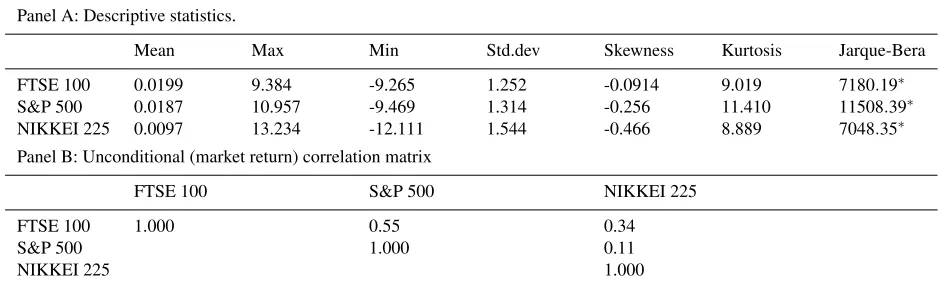
The summary statistics of the data are given in Table1. In panel A (Table1), for each return series, the mean value
is close to zero. For each return series the standard deviation is larger than the mean value. Each return series displays
a small amount of skewness and large amount of kurtosis and the returns are not normally distributed.
In panel B (Table1), unconditional correlation coefficients in stock market index returns indicate strong pairwise
correlations. The correlation between S&P 500 and FTSE 100 is positive and larger than the correlation between
[image:6.595.62.532.475.617.2]NIKKEI 225 and FTSE 100. This could be due to the high trade share between the two markets.
Table 1
Descriptive statistics of stock market returns.
Panel A: Descriptive statistics.
Mean Max Min Std.dev Skewness Kurtosis Jarque-Bera FTSE 100 0.0199 9.384 -9.265 1.252 -0.0914 9.019 7180.19∗ S&P 500 0.0187 10.957 -9.469 1.314 -0.256 11.410 11508.39∗ NIKKEI 225 0.0097 13.234 -12.111 1.544 -0.466 8.889 7048.35∗ Panel B: Unconditional (market return) correlation matrix
FTSE 100 S&P 500 NIKKEI 225 FTSE 100 1.000 0.55 0.34 S&P 500 1.000 0.11
NIKKEI 225 1.000
Notes: ∗denotes the rejection of the null hypothesis of normality at the 1% level of the Jarque-Bera test. The data frequency is daily and covers the period from 01 January 2003 to 04 February 2011.
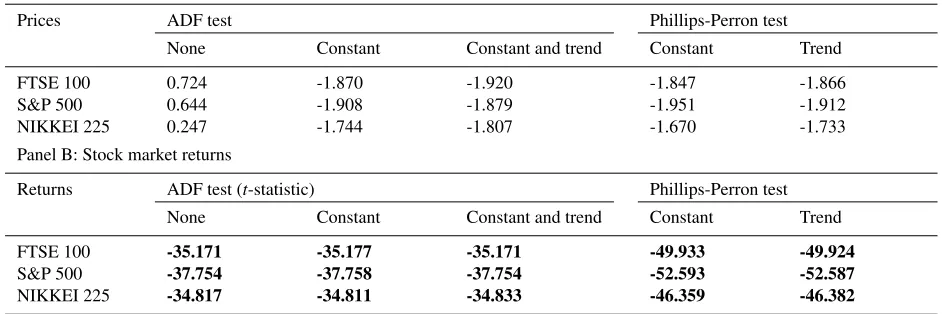
The results of the unit root tests for all sample of level prices (in logs) and returns in each market are summarized
in Table2. The Augmented Dickey-Fuller (ADF) and Phillips-Perron (PP) tests are used to explore the existence of
unit roots in individual series. The results show that all returns are stationary.
Table 2
Unit root tests.
Panel A: Stock market level prices (in log)
Prices ADF test Phillips-Perron test None Constant Constant and trend Constant Trend FTSE 100 0.724 -1.870 -1.920 -1.847 -1.866 S&P 500 0.644 -1.908 -1.879 -1.951 -1.912 NIKKEI 225 0.247 -1.744 -1.807 -1.670 -1.733 Panel B: Stock market returns
Returns ADF test (t-statistic) Phillips-Perron test None Constant Constant and trend Constant Trend FTSE 100 -35.171 -35.177 -35.171 -49.933 -49.924
S&P 500 -37.754 -37.758 -37.754 -52.593 -52.587
NIKKEI 225 -34.817 -34.811 -34.833 -46.359 -46.382
Notes: Entries in bold indicate that the null hypothesis is rejected at 1% level.
2.3. Model specifications
The econometric specification used in our study has two components. To model the stock market return we used
a vector autoregression (VAR). To model the conditional variance we used a multivariate GARCH model.
A VAR of orderp, where the orderprepresents the number of lags, that includesNvariables can be written as the
following form:
Yt=Φ0+
p
∑
i=1ΦiYt−i+εt, t=1, . . . ,T (1)
whereYt = (Y1t, . . . ,YNt) ′
is a column of observations on current values of all variables in the model,ΦiisN×N
matrix of unknown coefficients,Φ0is a column vector of deterministic constant terms,εt= (ε1t, . . . ,εNt) ′
is a column
vector of errors.3 Our basic VAR will have the three stationary variables, first log differences of FTSE 100, S&P
500 and NIKKEI 225 stock market prices (will be defined in empirical section). We focused on the modelling of
multivariate time-varying volatilities. The most widely used model is DCC one ofEngle(2002) which captures the
dynamic of time-varying conditional correlations, contrary to the benchmark CCC model (Bollerslev(1990)) which
retains the conditional correlation constant.4
3FollowingBrooks(2002), the main advantage of the VAR is that there is no need to specify which variables are the endogenous variables and which are the explanatory variables because in the VAR, all selected variables are treated as endogenous variables. That is, each variable depends on the lagged values of all selected variables and helps in capturing the complex dynamic properties of the data. Note that selection of appropriate lag length is crucial. If the chosen lag length is too large relative to the sample size, the degrees of freedom will be reduced and the standard errors of estimated coefficients will be large. If the chosen lag length is too small, then the selected lags in the VAR analysis may not be able to capture the dynamic properties of the data. The chosen lag length should be free of the problem of serial correlation in the residuals.
4The CCC specification can be presented as:
Ht=DtRDt, where,Dt=diagp
2003 2004 2005 2006 2007 2008 2009 2010 2011 3500 4000 4500 5000 5500 6000 6500
(a) FTSE 100 price
2003 2004 2005 2006 2007 2008 2009 2010 2011 -0.075 -0.050 -0.025 0.000 0.025 0.050 0.075
(b) FTSE 100 returns
2003 2004 2005 2006 2007 2008 2009 2010 2011 700 800 900 1000 1100 1200 1300 1400 1500
(c) S&P 500 price
2003 2004 2005 2006 2007 2008 2009 2010 2011 -0.075 -0.050 -0.025 0.000 0.025 0.050 0.075 0.100
(d) S&P 500 returns
2003 2004 2005 2006 2007 2008 2009 2010 2011 8000 10000 12000 14000 16000 18000
(e) NIKKEI 225 price
2003 2004 2005 2006 2007 2008 2009 2010 2011 -0.10
-0.05 0.00 0.05 0.10
[image:8.595.92.497.112.410.2](f) NIKKEI 225 returns
Figure 1 Time series plots of FTSE 100, S&P 500 and NIKKEI 225 stock market indices. We plot the daily level stock market indices (left panel) and corresponding returns (right panel) in the period January 01, 2003 to February 04, 2011.
The specification of the DCC model is as follows:
rt=µ+ p
∑
s=1Φsrt−s+εt, t=1, . . . ,T, εt|Ωt−1∼N (0,Ht), (2)
εt= (εU K,t,εU S,t,εJP,t) ′
=Ht1/2zt, zt∼N (0,I3), (3)
Ht=E(εtε ′
t |Ωt−1), (4)
where,rt is a 3×1 vector of the stock market index return,εt is the error term from the mean equations of stock
market indices (Equation2),ztis a 3×1 vector ofi.i.derrors andHt is the conditional covariance matrix. Equation2
the time-invariant symmetric matrix of the correlation returns withρii=1.
In CCC model, the conditional correlation coefficients are constant, but conditional variances are allowed to vary in time.
can be re-written as follows:
rU K,t
rU S,t
rJP,t
= µU K µU S µJP + p
∑
s=1 φs
11 φ12s φ13s
φs
21 φ22s φ23s
φs
31 φ32s φ33s
rU K,t−s
rU S,t−s
rJP,t−s
+
εU K,t εU S,t εJP,t
To represent the Engle’s (2002) DCC-GARCH model for the purpose of this study, letrt= (rU K,t,rU S,t,rJP,t) ′
be
a 3×1 vector of stock market returns, such that,rU K,rU SandrJPare the returns of FTSE 100, S&P 500 and NIKKEI
225 indices, respectively:rt|Ωt−1∼N (0,Ht).
The DCC-GARCH specification of the covariance matrix,Ht, can be written as:
Ht=DtRtDt (5)
whereDt=diag phU K,t,phU S,t,phJP,tis 3×3 diagonal matrix of time-varying standard deviation from
uni-variate GARCH models; i.e. hi,t =ωi+αiεi2,t−1+βihi,t−1, i=UK, US, JP, andRt=
ρi j is the time-varying
condi-tional correlation matrix.
The estimation procedure of DCC-GARCH model is based on two stages. In the first stage, a univariate GARCH
model is estimated. In the second step, the vector of standardized residualsηi,t =ri,t/
p
hi,t is employed to develop
the DCC correlation specification as follows:
Rt=diag
q11−1,/t2, . . . ,q33−1,/t2Qtdiag
q−111,t/2, . . . ,q−331,/t2 (6)
where Qt = (qi jt)is a symmetric positive define matrix. Qt is assumed to vary according to a GARCH-type
process:
Qt= (1−θ1−θ2)Q¯+θ1ηt−1η
′
t−1+θ2Qt−1 (7)
The parametersθ1andθ2are scalar parameters to capture the effects of previous shocks and previous dynamic
conditional correlation on current dynamic conditional correlation. The parametersθ1andθ2are positive andθ1+
θ2<1. ¯Qis 3×3 unconditional variance matrix of standardized residualsηi,t. The correlation estimators of equation
7are of the form:
ρi j,t=
qi j,t
√q
ii,tqj j,t
In the DCC model the choice of ¯Qis not obvious asQtis neither a conditional variance nor correlation. Although
E(ηt−1η
′
t−1)is inconsistent for the target since the recursion inQtdoes not have a martingale representation.5Aielli
(2008) proposed thecorrectedDynamic Conditional Correlation (cDCC) to evaluate the impact of both the lack of
consistency and the existence of bias in the estimated parameters of the DCC model ofEngle(2002). He showed that
the bias depends on the persistence of the DCC dynamic parameters.6
In order to resolve this issue,Aielli(2008) introduces thecDCC model, which have the same specification as the
DCC model ofEngle(2002), except of the correlation processQtis reformulated as follows:
Qt= (1−θ1−θ2)Q¯+θ1ηt∗−1η∗
′
t−1+θ2Qt−1 (8)
whereηt∗=diag{Qt}1/2ηt.
To investigate the asymmetric properties of stock market returns we introduce the conditional asymmetries in
variance.Cappiello et al.(2006) estimate several asymmetric versions of the dynamic conditional correlation models.
The version which we use is based on the following specification:
rt=µ+∑sp=1Φsrt−s+εt, t=1, . . . ,T, εt|Ωt−1∼N(0,Ht)
Ht=DtRtDt where Dt=diag
p h1,t,
p h2,t,
p h3,t
hit=ωi+αiεi2,t−1+γi1{εi,t−1<0}ε 2
i,t−1+βihi,t−1 for i=U K,U S,JP
Rt=Qt∗−1QtQ∗−t 1 where Qt∗=diag
√
q11,t,√q22,t,√q33,t
Qt= (1−θ1−θ2)Q¯+θ1ηt−1η
′
t−1+θ2Qt−1.
3. Empirical results
In this section we initially employed a vector autoregressive (VAR) model to examine the relationship among
stock market returns of the three developped countries. Our model is estimated on set of stationary variable. These
variables are returns in stock market prices for the United Kingdom (U.K), United States (U.S) and Japan.
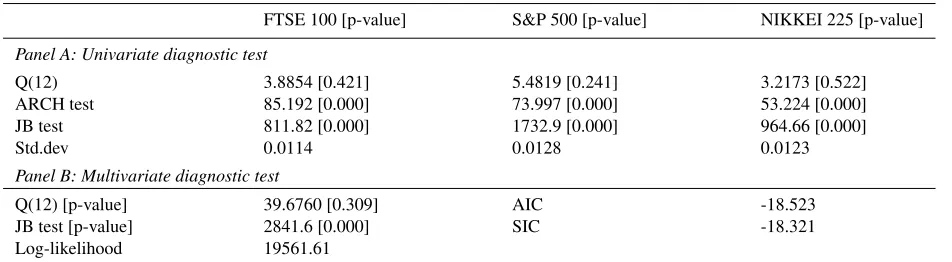
Table3reports the findings of the VAR(8) model (lags is selected by AIC criterion).
5seeAielli(2008) for further details.
6Aielli(2008) showed that the lack of consistency of the three-step DCC estimator depends strictly on the persistence of the parameters driving the correlation dynamics and on the relevance of the innovations. The bias is an increasing function of bothθ1andθ1+θ2. The parameter estimates obtained from fitting DCC models are small, and close to zero forθ1and close to unit forθ1+θ2.
3.1. Conditional variance and volatility analysis
This subsection presents the empirical results from symmetric and asymmetric multivariate models. In the first
step the univariate GARCH(1,1) model for each stock market is fitted. We model the conditional variance as a
GARCH(1,1), EGARCH(1,1) and TGARCH(1,1). In the second step the symmetric multivariate GARCH(1,1)
mod-els, such as; Constant Conditional Correlation (CCC), the Dynamic Conditional Correlation (DCC), thecorrected
Dynamic Conditional Correlation (cDCC) and the asymmetric multivariate GARCH(1,1) models, such as; aCCC,
aDCC and a-cDCC are fitted.
Symmetric and asymmetric univariate GARCH analysis. Table4reports the model estimates (panel A) and related
diagnostic tests (panel B) for the three models and for the three stock markets. Firstly, panel A of Table4shows
that the parameters in the conditional variance equations are all statistically significant, except for theα’s in the
EGARCH model for the three markets. The estimated value ofβ (GARCH effect) is close to unity (in all models the
estimated values are greater than 0.90) and is significant at the 1% level for each model. This indicates a high degree
of volatility persistence in the U.K, U.S and Japan stock market returns. Secondly, results given by the GARCH(1,1)
model assume that positive and negative shocks will have the same influence in conditional volatilities forecasts. In
order to identify the asymmetry in conditional volatilities, we fitted the univariate EGARCH(1,1) and TGARCH(1,1)
models. This asymmetry is generally reffered to as a "leverage" and a "Threshold" effects. The EGARCH(1,1) model
captures this "leverage" asymmetry and the TGARCH(1,1) captures this "threshold" asymmetry.7
The results showed that the asymmetric parameterγ orδ is positive and significantly different from zero at the
5% level in the EGARCH(1,1) model, indicating that U.K, U.S and Japan stock markets exhibit a leverage effect with
positive shocks (good news) and significantly different from zero at 1% level in the TGARCH(1,1) model, identifying
that the U.K, U.S and Japan stock markets exhibit a threshold effect with positive effect.
To select the adequate model for our data, we compare between the three models using three criteria; such as the
Log-likelihood, Akaike Information Criterion (AIC) and Schwarz Information Criterion (SIC). We showed that the
asymmetric GARCH model; TGARCH(1,1) has a superior goodness of fit for the data employed. For instance, AIC
in the TGARCH(1,1) is lower than in GARCH(1,1) and EGARCH(1,1) models.
7The EGARCH (Exponential GARCH) model ofNelson(1991) is formulated in terms of the logarithm of the conditional variance, as in the EGARCH(1,1) model,
log(ht) =ω+α√|εt−1|
ht−1 +γ√εt−1
ht−1
+βlog(ht−1).
The parametrization in terms of logarithms has the obvious advantage of avoiding non-negativity constraints on the parameters.
The TGARCH (Threshold) GARCH model or GJR-GARCH model defined byGlosten et al.(1993) andZakoian(1994) augments the GARCH model by including an additional ARCH term conditional on the sign of the past innovation,
ht=ω+αε2
t−1+δ1{εt−1<0}ε 2
Table 3
VAR diagnostic test.
FTSE 100 [p-value] S&P 500 [p-value] NIKKEI 225 [p-value]
Panel A: Univariate diagnostic test
Q(12) 3.8854 [0.421] 5.4819 [0.241] 3.2173 [0.522] ARCH test 85.192 [0.000] 73.997 [0.000] 53.224 [0.000] JB test 811.82 [0.000] 1732.9 [0.000] 964.66 [0.000] Std.dev 0.0114 0.0128 0.0123
Panel B: Multivariate diagnostic test
Q(12) [p-value] 39.6760 [0.309] AIC -18.523 JB test [p-value] 2841.6 [0.000] SIC -18.321 Log-likelihood 19561.61
The VAR was estimated using eight lags (the lag was selected using the AIC criterion). p-values show the statistical significance of the results.
Table 4
GARCH parameter estimates stock market indices for raw data.
United Kingdom United States Japan
GARCH EGARCH TGARCH GARCH EGARCH TGARCH GARCH EGARCH TGARCH
Panel A: model estimates.
ω 0.0078∗∗ −9.2720∗ 0.0101∗ 0.0112∗∗ −9.0095∗ 0.0114∗∗ 0.0218∗∗ −8.9373∗ 0.0244∗∗
α 0.0894∗ 1.0788 0.0080 0.0707∗ 2.3070 −0.0078 0.0753∗ 0.1645 0.0449∗
β 0.9055∗ 0.9594∗ 0.9267∗ 0.9190∗ 0.9616∗ 0.9416∗ 0.9101∗ 0.9306∗ 0.9091∗
γorδ 0.1266∗ 0.1064∗ 0.0651 0.1055∗ 0.2179∗ 0.0562∗∗
Log-likelihood 6875.8 6848.3 6900.5 6764.4 6734.5 6797.5 6497.1 6468.2 6504.5 AIC -6.5331 -6.5050 -6.5556 -6.4272 -6.3969 -6.4577 -6.1731 -6.1437 -6.1792 SIC -6.5250 -6.4916 -6.5449 -6.4191 -6.3834 -6.4469 -6.1650 -6.1303 -6.1685
Panel B: diagnostic test for standardized residuals.
Q(24) 21.1221 18.6651 19.0830 39.6830 34.7351 40.3153 22.6904 18.6922 25.6935
p-value 0.6315 0.7696 0.7475 0.0231 0.0724 0.0197 0.5381 0.7681 0.3688
Qs(24) 34.6176 37.0246 33.1795 37.9826 45.9568 31.3504 19.1083 35.0669 14.5893 p-value 0.0424 0.0235 0.0593 0.0184 0.0020 0.0891 0.6386 0.0381 0.8792 Notes: The estimates are produced by the univariate GARCH(1,1), univariate EGARCH(1,1) and TGARCH(1,1) models. The univariate variance estimates are introduced as inputs in the estimation of the CCC, DCC andcDCC models. The estimated coefficientωdenotes the constant of the variance equation,αrepresents the ARCH term,βis the GARCH coefficient,γandδare the asymmetric effects.
∗∗∗,∗∗and∗indicate significance at 10%, 5% and 1%, respectively.Q(24)andQs(24)respectively represent the Ljung-Box Q statistics of order 24 computed on the
standardized residuals and squared standardized residuals. Value of the estimated coefficientωis multiplied by 104for the EGARCH model. Values in bold indicate the selected model.
Panel B of Table4depicts the Ljung-Box statistics computed on the standardized residuals and squared
standard-ized residuals. We showed that all theQ(24)andQs(24)values don’t reject the null hypothesis of no serial correlation
in the standardized residuals and squared standardized residuals at 1% level.
Symmetric and asymmetric dynamic conditional correlation analysis. In the second step the symmetric and
asym-metric multivariate GARCH(1,1) models were estimated in order to investigate the constant and time-varying
condi-tional correlation in the stock markets under study. To fit these models, the standardized residuals of the univariate
GARCH(1,1) models specification (discussed in the first step of our study) was employed for the estimation of the
symmetric models; CCC, DCC,cDCC and asymmetric models; aCCC, aDCC, a-cDCC. The DCC andcDCC
[image:12.595.65.535.338.485.2]Table 5
CCC diagnostic under raw data
Log-likelihood: -7233.3 AIC: 6.8872 SIC: 6.9194 Diagnostic test for standardized residuals.
FTSE 100 S&P 500 NIKKEI 225
Q(12) 25.9838 17.2378 13.8918
p-value 0.0107 0.14086 0.3076
Qs(12) 26.1324 17.1204 13.3307
p-value 0.0102 0.1451 0.3454
The Constant Conditional Correlation (CCC) model ofBollerslev(1990) assumes that the conditional variance for each return,hit,
i=UK, US, JP, follows a univariate GARCH process. The specification is as
rt=Φ0+∑sp=1Φsrt−s+εt, εt|Ωt−1∼N(0,Ht) εt=Ht1/2zt, zt∼N(0,I3)
Ht=E(εtε
′
t|Ωt−1),
where,rt= rU K,t,rU S,t,rJP,t ′
is the vector of stock market index returns,εt= εU K,t,εU S,t,εJP,t ′
is the error term from the mean equation of stock market indices (Equation2),ztis a 3×1 vector ofi.i.derrors andHtis the conditional covariance matrix, which
satisfies the following equation:
Ht=DtRDt
whereDt=diag
hU K1/2,t,h1/2U S,t,h1/2JP,t, andR=
ρi j , for i,j=U K,U S,JP, is the unconditional (time-invariant) correlation
matrix. The off-diagonal elements of the conditional covariance matrix are given by
Hi j=h1/2it h
1/2
jt ρi j,i6=j
∗∗∗,∗∗and∗indicate significance at 10%, 5% and 1%, respectively. Q(12)andQs(12)respectively represent the Ljung-Box Q
statistics of order 12 computed on the standardized residuals and squared standardized residuals.
Table 6
Constant conditional correlation estimates under raw data.
Stock market returns FTSE 100 S&P 500 NIKKEI 225
FTSE 100 1 0.5692∗(0.0149) 0.2583∗(0.0212)
S&P 500 1 0.1751∗(0.0222)
NIKKEI 225 1
[image:13.595.65.530.612.671.2]given in tables7and8. Results showed that all coefficients are statistically significant at 1% and 5% levels.
For the CCC model (Table5and6), the correlation between FTSE 100 and S&P 500, FTSE 100 and NIKKEI 225
and S&P 500 and NIKKEI 225 are each positive and statistically significant at 1% level, and the highest correlation
is between FTSE 100 and S&P 500 followed by the correlation between FTSE 100 and NIKKEI 225. This indicates
the positive comovement between the three markets. For instance, we found that the co-movements between U.K
and U.S are higher than the co-movements between U.S and Japan. However, we remarked that estimated constant
conditional correlation coefficients of the sample stock markets do not seem to be informative on dynamic linkages
and co-movements between the abovementioned markets. To evaluate the dynamic (pairwise) correlation structure of
U.K., U.S. and Japan stock markets, we employed the DCC andcDCC models in trivariate framework.
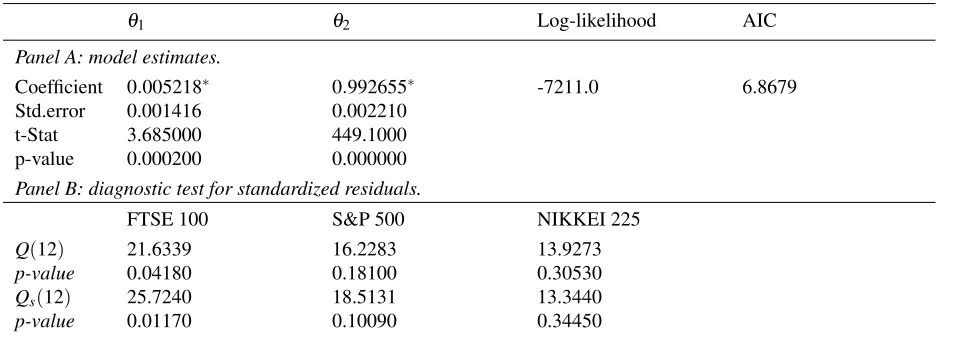
For the DCC andcDCC models (Tables7and8), the estimated parametersθ1andθ2capture the effect of lagged
standardized shocks; ηt−1ηt′−1, andηt∗−1η∗
′
t−1 and lagged dynamic conditional correlations; Qt−1, on current
dy-namic conditional correlations, respectively. We remarked that these parameters are significant, and this statistical
significance in each market indicates the presence of time-varying stock market correlations. Following the dynamic
conditional variance, the three markets under study produce similar behavior and the estimated conditional variance
shows a sharp spikes in the period between 2007 and 2008 (The maximum value of estimated conditional variance is
in October 21, 2008 for FTSE 100 returns, in October 16, 2008 for the S&P 500 returns and in November 03, 2008
for NIKKEI 225 returns). This period is related to the U.Ssubprimefinancial crisis. This financial crisis led U.K, U.S
and Japan capital markets to abrupt downturns, dramatically increasing systematic volatility.
We conclude that the estimates of the conditional variances based on DCC andcDCC models suggest the presence
of volatility spillovers in the U.K, U.S and Japan stock market returns.
As shown in Figure2, we remarked also that the dynamic conditional correlations of the three markets under study
show considerable variation, and can vary from the constant conditional correlations (ρU K−U S,ρU K−JP andρU S−JP)
indicating that the assumption of constant conditional correlation for all shocks to returns is not supported empirically.
We stated that during the period 2003-2006, correlations between U.K. and U.S. decreased (58% to 38%), as indicated
in Figure2. Whereas, after 2006 we remarked a substantial increase of correlations between U.K. and U.S., it might
be due to the Afghanistan, Iraq and Liban wars and the americansubprimefinancial crisis.
The diagnostic tests for standardized residuals of CCC model are shown in Table5and those of DCC andcDCC
models are shown in panel B of Tables7 and8. Ljung-Box Q(12)andQs(12)statistics for the residuals models
indicate no serial correlation in either the standardized residualsQ(12)or the squared standardized residualsQs(12),
inferring that the fitted models are appropriate for the data employed.
To investigate the asymmetry in the conditional volatility we fitted the aCCC, aDCC and a-cDCC models. The
Table 7
DCC estimates under raw data
θ1 θ2 Log-likelihood AIC
Panel A: model estimates.
Coefficient 0.005218∗ 0.992655∗ -7211.0 6.8679
Std.error 0.001416 0.002210
t-Stat 3.685000 449.1000
p-value 0.000200 0.000000
Panel B: diagnostic test for standardized residuals.
FTSE 100 S&P 500 NIKKEI 225
Q(12) 21.6339 16.2283 13.9273
p-value 0.04180 0.18100 0.30530
Qs(12) 25.7240 18.5131 13.3440
p-value 0.01170 0.10090 0.34450
Estimates of a symmetric version ofEngle(2002) dynamic conditional correlation model are computed. The specification is as
rt=Φ0+∑sp=1Φsrt−s+εt εt|Ωt−1∼N(0,Ht) εt=
εU K,t
εU S,t
εJP,t
=H
1/2
t zt, zt∼N(0,I3)
Ht=DtRtDt where Dt=diag phU K,t,phU S,t,phJP,t
hit=ωi+αiεi2,t−1+βihi,t−1, i=U K,U S,JP
The dynamic conditional correlationRt=
ρi j tis a time-varying matrix defined as
Rt=Qt∗−1QtQt∗−1 where Q∗−t 1=diag √
q11,t,√q22,t,√q33,t Qt= (1−θ1−θ2)Q¯+θ1ηt−1η
′
t−1+θ2Qt−1 where ηt=D−t1εt.
¯
Qis the unconditional covariance matrix ofη. The elements ofHtareHi j t= p
hithjtρi jwhereρii=1.∗∗∗,∗∗and∗indicate
significance at 10%, 5% and 1%, respectively. Q(12)andQs(12 respectively represent the Ljung-Box Q statistics of order 12
computed on the standardized residuals and squared standardized residuals.
results are reported in Table9. In the asymmetric case, we focused on the TGARCH(1,1)-based model to model the
asymmetric behavior in the conditional volatilities.8 The asymmetric dynamic conditional correlation estimates are
all significant at 1% level (as shown in Table9). Based on the log-likelihood values and AIC criterion reported in the
last two columns of Table9, the asymmetriccDCC (a-cDCC) is supperior to the aCCC and aDCC. Moreover, as it
can be seen, the log-likelihood values and AIC criteria of aDCC and a-cDCC are nearly equivalent, hence the choice
of model needs to be made on other grounds (see the following subsection).
Table 8
correctedDCC (cDCC) estimates under raw data.
θ1 θ2 Log-likelihood AIC
Panel A: model estimates.
Coefficient 0.005282∗ 0.992716∗ -7210.5 6.8674
Std.error 0.001430 0.002047
t-Stat 3.692000 484.8000
p-value 0.000200 0.000000
Panel B: diagnostic test for standardized residuals.
FTSE 100 S&P 500 NIKKEI 225
Q(12) 21.6228 16.3030 13.9019
p-value 0.04190 0.17770 0.30700
Qs(12) 25.6085 18.5792 13.3573
p-value 0.01210 0.09920 0.34360
Aielli(2008) proposed a consistent DCC (cDCC) model. He suggested that the DCC correlationQtshould take a slightly different
from than given in DCC model. The specification is similar to DCC one, except ofQtwhich becomes Qt= (1−θ1−θ2)Q¯+θ1ηt∗−1η∗
′
t−1+θ2Qt−1 η∗
t =diag{Qt}1/2ηt
∗∗∗,∗∗and∗indicate significance at 10%, 5% and 1%, respectively. Q(12)andQs(12)respectively represent the Ljung-Box Q
statistics of order 12 computed on the standardized residuals and squared standardized residuals.
Table 9
Asymmetric dynamic conditional correlation model under raw data.
θ1 θ2 Log-likelihood AIC BIC
aCCC -7169.5 6.8293 6.8696
aDCC 0.0055(0.00162)∗ 0.9913(0.00295)∗ -7148.3 6.8111 6.8568 a-cDCC 0.0056(0.00162)∗ 0.9913(0.00273)∗ -7148.0 6.8108 6.8565
This table presents estimates coefficients for the asymmetric CCC [aCCC] the asymmetric DCC [aDCC] model and the asymmetric
cDCC [a-cDCC] model. The specification is similar to those in DCC andcDCC models (given in Tables7and8), except of the conditional variances follow the asymmetric TGARCH model ofGlosten et al.(1993). The value in parentheses are standard errors. ∗indicate significance at 1% level. Log-likelihood is the log-likelihood value; AIC is the Akaike information criterion. Values in bold indicate the selected model.
[image:16.595.66.532.578.633.2]FTSE 100
2003 2004 2005 2006 2007 2008 2009 2010 2011 2 4 6 8 10 FTSE 100 (a)
FTSE 100_S&P 500
2003 2004 2005 2006 2007 2008 2009 2010 2011 0.40 0.45 0.50 0.55 0.60 0.65 0.70
FTSE 100_S&P 500
(b)
S&P 500
2003 2004 2005 2006 2007 2008 2009 2010 2011 2 4 6 8 10 12 14 S&P 500 (c)
FTSE 100_Nikkei 225
2003 2004 2005 2006 2007 2008 2009 2010 2011 0.150 0.175 0.200 0.225 0.250 0.275 0.300 0.325
0.350 FTSE 100_Nikkei 225
(d)
Nikkei 225
2003 2004 2005 2006 2007 2008 2009 2010 2011 2 4 6 8 10 12 Nikkei 225 (e)
S&P 500_Nikkei 225
2003 2004 2005 2006 2007 2008 2009 2010 2011 0.075 0.100 0.125 0.150 0.175 0.200 0.225
0.250 S&P 500_Nikkei 225
[image:17.595.98.499.112.477.2](f)
Figure 2 Time-varying conditional variances (left column) and conditional correlations (right column) from DCC
model. The pictures on the left column:(a), (c) and (e) refer to conditional variances of U.K, U.S and Japan stock market indices and those on the right column:(b), (d) and (f) report conditional correlations among the same group of stock market indices. The blue line (horizontal) is the constant conditional correlation estimate.
3.2. Forecast performance evaluation
To evaluate the volatility forecasting performance of different multivariate GARCH models and to compare
be-tween them, further loss functions can be used. The popular statistical loss functions employed to assess the accuracy
of competing models in the forecasting of volatilities over daily trading horizon are Mean squared Error (MSE),
Mean Absolute Error (MAE), Mean Absolute Percentage Error (MAPE) and Logarithm Loss Error (LLE). These loss
metrics are expressed as follows:
MSEk= 1 M
M
∑
m=1ςm,k−σˆm2
2
MAEk= 1 M
M
∑
m=1
ςm,k−σˆm2
(10)
MAPEk= 1 M
M
∑
m=1
ςm,k−σˆm2 ˆ σ2
m
(11)
LLEk= 1 M
M
∑
m=1
log(ςm,k)−log(σˆm2)
2
(12)
whereMis the number of forecast data points;ςm,k=κ ′
Hmκdenotes the portfolio volatility forecast generated by
modelkfor daym; ˆσm2is the actual volatility on daym.
The assessment of the forecast performance of the various volatility models described in section2.3is based on
out-of-sample one-day ahead prediction conditional variances and correlations. This forecasting study is done by
first removing the last 250 observations from our sample starts from 02 January 2003 and ends 04 February 2011. A
forecast of volatilities and correlations are generated for the periodn+1, wherenis the size of the first sample to be
estimated starts 02 January 2003 and ends 19 February 2010 (the estimation is based on three models: CCC, DCC
andcDCC). The second sample, starting 03 January 2003 and ending onn+1, is used to forecast the volatility and
correlation ofn+2 based on the estimated models (CCC, DCC andcDCC) for the second sample. The procedure of
estimation and forecasting steps is repeated 250 times for the available sample from 02 January 2003 to 04 February
2011.9 More specifically, we produce the 250 one-day ahead forecastsςm, whereςm,m=n+1, . . . ,n+250 is the
forecast of the conditional variance.
The actual volatility ˆσ2
mis unobservable. The use of squared returns as a proxy for actual volatility is used in the
literature (seeKang et al.(2009),Sadorsky(2006) andWei et al.(2010)). In our empirical study, the proxies of actual
volatilities are as follows: for forecasts based on the unfiltered return series (original stock market return series), we
proxied the actual volatility by the squared returns,r2m.
Table10presents the forecast accuracy statistics that consist of the mean of four loss functions: MSE, MAE,
MAPE and LLE. In terms of these criteria and based on symmetric models, we find that DCC model produces smaller
values than those produced by CCC andcDCC. In terms of these statistics and basing in asymmetric models, the
a-cDCC model produces the smallest values. Moreover, we remarked that all loss functions values produced by
asymmetric models are smaller than those calculated by symmetric ones. In summary, we can conclude that, in our
9For instance, forecasting the DCC model is as follows: the initial sample consists of the first 1862 daily observations, i.e. 02 January 2003
to 19 February 2010. The last 250 trading days constitute the sample for which we compute one-day ahead forecasts. We re-estimated the DCC model basing on the initial sample every day using a recursive method (all estimations and forecasts are computed with OxMetrics 6). After that, we computed the conditional variance and conditional correlation forecast values. These forecast values are used to compute the loss functions of the weighted portfolio defined before.
Table 10
Volatility forecasts performance.
Symmetric models Asymmetric models
CCC DCC cDCC aCCC aDCC a-cDCC
MSE 0.16923 0.15971 0.15986 0.09237 0.08652 0.08639
MAE 0.40981 0.39822 0.39844 0.30178 0.29195 0.29170
MAPE 313.908 304.884 304.990 221.732 214.423 214.199
LLE 111.794 111.208 111.220 105.430 104.763 104.744
The table reports the loss functions over the 250 forecasting observations for the symmetric and asymmetric dynamic conditional correlation models. The MSE, MAE, MAPE and LLE of the weighted portfolio are computed as fol-lows: MSEk=M−1∑Mm=1 ςm,k−sˆ2m2, MAEk=M−1∑M
m=1
ςm,k−ˆs2m, MAPEk=M−1∑Mm=1
(ςm,k−sˆ2m)/sˆ2m and LLEk= M−1∑Mm=1log(ςm,k)−log(ˆs2m)2, whereM is the number of forecast data points (M=250); ςm,kdenotes the volatility
fore-cast of the portfolio constituted of three stock market indices and generated by modelkfor daym, it is defined by equation14; ˆs2m
is the actual portfolio volatility on daym.
forecasting study, asymmetric models produce more accurate volatility forecasts as compared to those models with
symmetric conditional volatility.
3.3. Application to Value-at-Risk
In this section, we present a methodology allowing us to compute the VaR of diversified portfolio. A portfolio
with weightκiin stock market indexihas return as
rtp=κ′rt (13)
wherert= (rU K,t,rU S,t,rJP,t) ′
denotes the vector of stock market returns of FTSE 100 (rU K,t), S&P 500 (rU S,t) and
NIKKEI 225 (rJP,t).κ′= (κU K,κU S,κJP) = (0.27,0.40,0.33)is the weight vector of the three given indices.10
The portfolio variances are as follows
ςt=κ′Htκ (14)
whereHtis the conditional covariance defined in section2.
The multivariate GARCH-based VaR estimates forq-day holding periods are computed as follows:
VaRkt+l(n,α) =qκ′µt+l+zα√qςt+l (15)
where the argument (q) of VaR is used to denote the time horizon,zα denotes the corresponding quantile which
depends on the chosen distribution. For instance, when computing a 99% VaR using normal distribution,zα=2.33.
ςt+l= (κ ′
Ht+lκ)1/2is the square root of the daily conditional variance forecast of the portfolio generated from model
k(CCC, DCC,cDCC), made at timet+l.µt+lis the conditional mean forecast at timet+l, generated from VAR(8)
model.
3.3.1. Backtesting VaR measures
In order to analyze our results implied by different time-varying volatilities models, we use the above estimation
to compute one-day ahead out-of-sample VaR. We performed a backtesting analysis based on likelihood ratio test
(Kupiec(1995) andChristoffersen(1998)) and dynamic quantile regression test (Engle and Manganelli(2004)).
Unconditional coverage. Kupiec(1995) developped the likelihood ratio test,LRucas follows:
Letn1=∑nt=011t be the number of days over an0period that the portfolio loss was larger than the VaR estimate,
where
1t+1=
1 if rt+1<VaRt+1|Ωt
0 if rt+1≥VaRt+1|Ωt
n1∼B(n0,π) is a Binomial variable representing the number ofexceedances or exceptions in the sample of
lengthn0. The null hypothesis of the failure probability,π, is tested against the alternative hypothesis that the failure
probability differs fromπ0.11 TheLRucstatistic is
LRuc=−2 ln
(1−π)n0−n1πn1+2 ln
(1−nn1
0 )(n1
n0 )n1
(16)
Asymptotically,LRuc∼χ2(1).
Conditional coverage. Christoffersen(1998) developped a likelihood statistic to test joint assumption of
uncondi-tional coverage and independence of failures. He tests the null hypothesis of independence against the alternative of
first-order Markov structure of{1t+1},12with transition matrix
Π=
π00 1−π11
1−π00 π11
11The null hypothesis forKupiec(1995) test is,H
0: π=n1/n0=π0, whereπis the expected proportion of exceedances, which equals the
desired coverage levelπ0(usually equal to 1% and 5%). 12The null hypothesis forChristoffersen(1998) test is,H
0:π00=π11.
whereπii=p(1t+1=i|1t=i),i=0,1. Letni jbe the number of observations of1t+1assuming valueifollowed
by j, fori,j=0,1; andπi j=ni j/∑jni jis the corresponding probability. Hence, we have ˆπ01=n01/(n00+n01)and
ˆ
π11=n11/(n10+n11). The statistic of the test is given by
LRcc=LRuc+LRind∼χ2(2) (17)
where
LRind=−2 ln
(1−π)n0−n1πn1+2 ln(1−πˆ01)n00πˆn01
01 (1−πˆ11)
n10πˆn11 11
Asymptotically,LRind∼χ2(1).
Dynamic Quantile. Engle and Manganelli(2004) proposed the dynamic quantile (DQ) test to correct for the
inef-ficiency in the conditional coverage test ofChristoffersen (1998). They defined an indicator function Hitt(α) =
1n
rt<VaRt(α)|Ωt−1
o−α to test the VaR of long position as follows:
Hitt+1(α) =
1−α if rt+1<VaRt+1|Ωt
−α, else
(18)
Engle and Manganelli(2004) suggested to test jointly the following hypothesis:
H0:
E(Hitt+1) =0, (1)
Hitt+1 is uncorrelated with variables included in the information set. (2)
These two tests (1) and (2) can be done using artificial regressionHitt+1=Xt+1β+ut+1, whereXt+1is aN×K
matrix whose first column is a column ones and remaining columns are additional explanatory variables.13
UnderH0,Engle and Manganelli(2004) show that the dynamic quantile test statistic is given by
DQ=βˆ
′ OLSX
′ XβOLSˆ
α(1−α) ∼χ
2(7) (19)
The statistical adequacy of VaR forecasts is obtained by the previous tests. It is well-known that these tests have
limited power in distinguishing among various models for VaR. Using these metrics, we cannot conclude whether
an adequate model is more accurate than another one. Loss functions represent an alternative approach that can be
13We include five lags ofHittand the current VaR as explanatory variables. Hence,Hitt=ι,Hitt
Table 11
Daily VaR forecasts.
Model Mean VaRα-level
1% 2.5% 5% 10%
Symmetric models
CCC 1.48782 1.25373 1.05289 0.82008 DCC 1.46673 1.23595 1.03796 0.80845
cDCC 1.46716 1.23632 1.03827 0.80869
Asymmetric models
aCCC 1.27590 1.07515 0.90292 0.70327 aDCC 1.25483 1.05739 0.88801 0.69166
a-cDCC 1.25426 1.05692 0.88761 0.69135
Notes: The table presents the out-of-sample daily VaR of the weighted portfolio consisted of three stock market indices (FTSE 100, S&P 500 and NIKKEI 225). We used quantile for normal distribution. Values in bold show the selected model for better forecasts.
used to compare models.Lopez(1998) suggested a loss function based on regulatory needs. He proposed measuring
the accuracy of VaR forecasts on the basis of distance between observed return,rt, and forecastedVaRt values. He
defined a penalty variable as follows:
LFt+1=
1+rt+1−VaRt+1|Ωt
2
, if rt+1<VaRt+1|Ωt
0, if rt+1≥VaRt+1|Ωt
In our study we computed the loss functionLFas a sum ofLFt+1, witht=0, . . . ,n0.
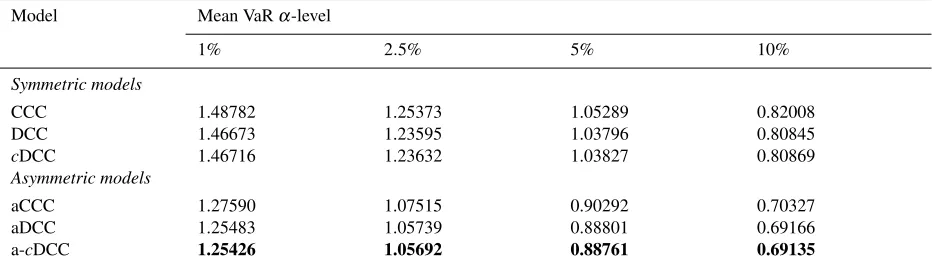
Table11depicts the out-of-sample mean daily VaR of the weighted portfolio consisted of the FTSE 100, S&P
500 and NIKKEI 225 stock market returns. We remarked that the a-cDCC model yields the lowest average daily VaR
estimates at 1%, 2.5%, 5% and 10% levels. The backtesting analysis considers a comparison over the last 250 days
(from February 19, 2010 to February 04, 2011) and focuses mainly on exceptions or violations, i.e. the number of
times in which the portfolio returns underperform the VaR measure, andLRuc,LRccandDQtests statistics. We also
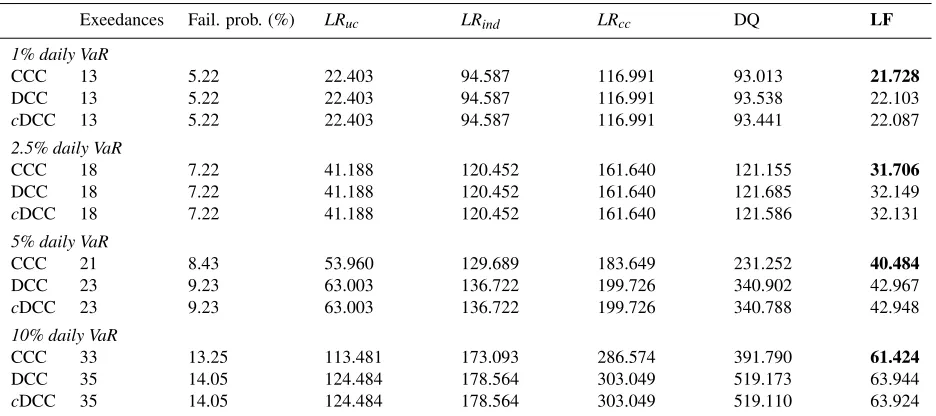
calculated the failure probability and statistic loss functions suggested byLopez(1998). Tables12and13present
unconditional, conditional and dynamic quantile test statistics. The results showed that symmetric and asymmetric
models have been rejected by theLRuc,LRccandDQtests. Hence, these models are slow at updating the VaR values
when market volatility changes rapidly.
For symmetric models, at 1% significance level, CCC, DCC and cDCC models provide the same number of
violations and failure probabilities. The same remark is shown in case of asymmetric models. The results in Tables
12and13showed that all symmetric models produce the lowest number of violations and failure probabilities. For
instance, we identify 13 and 23 violations and 5.22% and 9.23% p-values for the DCC model at 1% and 5% level,
Table 12
Summary results for daily VaR diagnostic tests in symmetric case.
Exeedances Fail. prob. (%) LRuc LRind LRcc DQ LF 1% daily VaR
CCC 13 5.22 22.403 94.587 116.991 93.013 21.728
DCC 13 5.22 22.403 94.587 116.991 93.538 22.103
cDCC 13 5.22 22.403 94.587 116.991 93.441 22.087
2.5% daily VaR
CCC 18 7.22 41.188 120.452 161.640 121.155 31.706
DCC 18 7.22 41.188 120.452 161.640 121.685 32.149
cDCC 18 7.22 41.188 120.452 161.640 121.586 32.131
5% daily VaR
CCC 21 8.43 53.960 129.689 183.649 231.252 40.484
DCC 23 9.23 63.003 136.722 199.726 340.902 42.967
cDCC 23 9.23 63.003 136.722 199.726 340.788 42.948
10% daily VaR
CCC 33 13.25 113.481 173.093 286.574 391.790 61.424
DCC 35 14.05 124.484 178.564 303.049 519.173 63.944
cDCC 35 14.05 124.484 178.564 303.049 519.110 63.924 Notes: The table presents the evaluation of out-of-sample daily VaR for the weighted portfolio (consisted from three stock market indices) generated by symmetric models. it reports test statistics over last 250 days (February 19, 2010 to February 03, 2011). Fail. prob.: The failure probability.LRuc: The LR test of unconditional coverage.LRind: The LR test of independence.LRcc: The
joint test of coverage and independence. DQ: The Dynamic Quantile test.LF: The loss function. Values in bold show the selected model for better forecasts.
1% and 5% level, respectively.
As shown in Tables12and13, we also reported theLFcriterion, which facilitates the selection of optimal VaR
model for risk manager. It is clearly that CCC and aCCC models provide the lowestLFvalues at 1%, 2.5%, 5% and
10% levels. For symmetric volatilty models, the study identifies the CCC model as the best performing model for a
firm, followed bycDCC and DCC models. For the asymmetric volatility models, we identify the aCCC model as the
best performing model, followed by DCC andcDCC models. However, we remarked that DCC andcDCC models
Table 13
Summary results for daily VaR diagnostic tests in asymmetric case.
Exeedances Fail. prob. (%) LRuc LRind LRind DQ LF 1% daily VaR
aCCC 18 7.22 41.188 120.452 161.640 116.833 29.947
aDCC 18 7.22 41.188 120.452 161.640 116.352 30.462 a-cDCC 18 7.22 41.188 120.452 161.640 116.394 30.470
2.5% daily VaR
aCCC 21 8.43 53.960 130.774 184.734 182.956 38.503
aDCC 24 9.63 67.671 142.213 209.884 244.406 42.074 a-cDCC 24 9.63 67.671 142.213 209.884 244.437 42.083
5% daily VaR
aCCC 30 12.04 97.505 162.832 260.338 361.907 53.707
aDCC 31 12.44 102.758 166.311 269.069 375.634 55.327 a-cDCC 31 12.44 102.758 166.311 269.069 375.646 55.338
10% daily VaR
aCCC 37 14.85 135.752 183.844 319.597 576.566 70.127
aDCC 38 15.26 141.483 186.050 327.534 607.452 71.764 a-cDCC 18 15.26 141.483 186.050 327.534 607.448 71.776 Notes: The table presents the evaluation of out-of-sample daily VaR for the weighted portfolio (consisted of three stock market indices) generated by asymmetric models. it reports test statistics over last 250 days (February 19, 2010 to February 03, 2011). Fail. prob.: The failure probability.LRuc: The LR test of unconditional coverage.LRind: The LR test of independence.LRcc: The
joint test of coverage and independence. DQ: The Dynamic Quantile test.LF: The loss function. Values in bold show the selected model for better forecasts.
4. Wavelet-based approach
In this section we employed a new approach, called wavelet transform.14 We used a discrete wavelet
trans-form (DWT), more specifically, we adopt the maximal overlap discrete wavelet transtrans-form (MODWT)15in a
Multi-resolution Analysis (MRA) framework.16
In our study, we sample the daily stock market returns at different scale j as follows: D1(2-4 days), D2
(4-8 days), D3 (8-16 days), D4 (16-32 days),D5 (32-64 days), D6 (64-128 days), D7 (128-256 days), D8 (256-512
days).17 We used Daubechies Least Asymmetric wavelet transformation of lengthL=8 via LA(L) to obtain
multi-scale decomposition of the return series. The MRA yields an additive decomposition through MODWT given by
14The wavelet transform has two types of transform, namely, continuous wavelet transform (CWT) and discrete wavelet transform (DWT). Since
most of the time series have a finite number of observations, the discrete version of wavelet transform is used in finance and economic applications. The wavelet transform decomposes a time series in terms of some elementary functions, called, wavelets;ψu,τ(t) =√1
τψ[(t−u)/τ]. Where√1τ
is a normalization factor,uis the translation parameter andτis the dilation parameter. ψ(t)must fulfill several conditions (see,Gençay et al.
(2002) andPercival and Walden(2000)): it must have zero mean,R+∞
−∞ψ(t)dt=0, its square integrates to unity, R+∞
−∞ψ2(t)dt=1 and it should also
satisfy the admissibility condition, 0<Cψ=R+∞
0 |
Ψ(λ)|2
λ dλ<+∞whereΨ(λ)is the Fourier transform ofψ(t), that isΨ(λ) =R−+∞∞ψ(t)e−iλudt. Following the latter condition we can reconstruct a time seriesx(t).
15We use the MODWT because we can align perfectly the details from the decomposition with the original time series. In comparison with the DWT, no phase shift will result in the MODWT (Gençay et al.(2002)). Fore more information about the MODWT, please refer to
Percival and Walden(2000) andGençay et al.(2002).
16For more details, seeMallat(1989) andPercival and Walden(2000). 17We decompose our time series up to scale 8 (scaleJ≤log
2[(T−1)/(L−1) +1], whereTis the number of observations of stock market returns (T=2112), andLis the length of the wavelet filter LA(8)). We used thewaveletsR package for the MODWT.
X(t) =∑ks˜j,kφj,k(t) +∑j∑kd˜j,kψj,k(t), j=1, . . . ,J
=SJ(t) +DJ(t) +DJ−1(t) +. . .+D1(t)
(20)
where SJ(t)refers to the smooth series and it represent the approximation that captures the long memory term
properties,Dj(t), j=1, . . . ,J.refers to details series, which represent the contribution of frequency jto the original
series.
The wavelet detail,Dj(t), captures local fluctuations over the whole period of time series at each scale, while the
wavelet smooth,SJ(t), gives an approximation of the original series at scaleJ.
After computing the MODWT crystals (details and smooths) for every stock market return, and from the
decom-posed series (D1, . . . ,D8,S8) we classify the short, medium and long term series as follows: Short term=D1+D2+
D3; Medium term=D4+D5+D6; Long term=D7+D8+S8. This choice of time-horizon decomposition is used
to classify three types of investors or traders, such as short, medium and long term ones, i.e. to analyze the behavior
of investors among different time-horizons. Here the highest frequency component Short term,D1+D2+D3
repre-sents the short-term variations due to shocks occurring at a time scale of 2 to 16 days, it provides daily and weekly
spillovers, the next component Medium term,D4+D5+D6represents the mid-term variations at time scale of 32 to
128 days, it defines the monthly and quarterly spillovers, and the third component Long term,D7+D8+S8represents
the long-term variations of 256 days and more, it provides the annual spillovers. The main advantage of this
classi-fication is to decompose the risk and the volatility spillovers into three investment horizons. Therefore, we focus in
three sub-spillovers. All market participants, such as regulators, traders and investors, who trade in stock markets (in
our study, U.K., U.S. and Japan stock markets) make decisions over different time scales. In fact, due to the different
decision-making time scales among investors, the time-varying volatilities and correlations of stock market indices
will vary over the different time scales associated with those horizons (investment strategies).
In order to analyze the comovements in returns and volatilities (the analysis is based on new time series: Short
term, Medium term and Long term) between the three markets defined before and to investigate the dynamics and
spillover effects, we applied a trivariate dynamic conditional correlation (CCC, DCC andcDCC) model. We proceed
the same specifications presented in section2.3to model the conditional mean and the conditional variances, we fitted
a VAR(1)-MGARCH(1,1) to the three new series as follows:
Xt=c0+AXt−1+υt
υt=Dtzt
(21)
whereXt= (FTSE-Shortt,S&P500-Shortt,NIKKEI-Shortt) ′