Change-Point Detection for General Nonparametric
Regression Models
Murray D. Burke*, Gildas Bewa
Department of Mathematics and Statistics, University of Calgary, Calgary, Canada Email: *[email protected]
Received May 1, 2013; revised June 15, 2013; accepted June 22, 2013
Copyright © 2013 Murray D. Burke, Gildas Bewa. This is an open access article distributed under the Creative Commons Attribution License, which permits unrestricted use, distribution, and reproduction in any medium, provided the original work is properly cited.
ABSTRACT
A number of statistical tests are proposed for the purpose of change-point detection in a general nonparametric regres-sion model under mild conditions. New proofs are given to prove the weak convergence of the underlying processes which assume remove the stringent condition of bounded total variation of the regression function and need only second moments. Since many quantities, such as the regression function, the distribution of the covariates and the distribution of the errors, are unspecified, the results are not distribution-free. A weighted bootstrap approach is proposed to ap-proximate the limiting distributions. Results of a simulation study for this paper show good performance for moderate samples sizes.
Keywords: Change-Point Detection; Nonparametric Regression Models; Weighted Bootstrap
1. Introduction
Model building is a very important task. When
consider-ing observations taken over time
we may wish to consider the relationship between the Xi
and the Yi by some regression model, either parametric or
semiparametric, linear or nonlinear. However, if, after some point i = k, there is a change in the relationship between Xi and Yi, then a single regression model will be
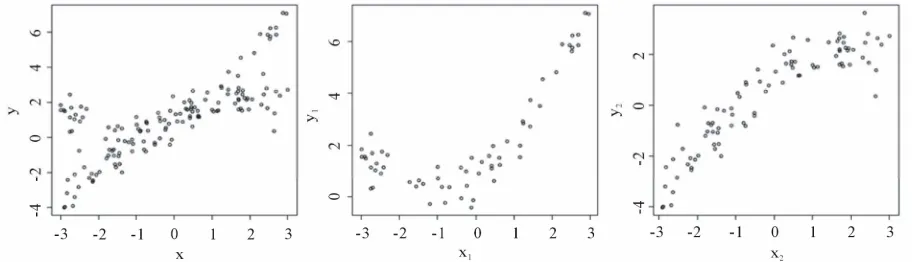
inappropriate and would fit the data poorly. For example, in Figure 1 below, the scatterplot on the left is that of a combined sample of 150 points. The middle scatterplot is that of the first 60 points while the right plot is that of the remaining 90 points. Without realizing that there was a change-point, one might wrongly propose a single re-gression model, perhaps linear, with heteroscedastic er-rors. Thus, it is important to determine whether such a change has occurred before the particular form of the model is postulated. If such a change has occurred, then two regression models should be used, one for the first k
pairs and another for the remaining pairs. We will pro-pose a number of tests designed to detect whether a change has occurred in a general nonparametric model. Change-point problems arise in many areas when obser-vations (Xi, Yi) are taken over time i.
X Yi, i :i1, 2,
For example, the height of (or discharge from) a river as a function of upstream precipitation, or concentrations
of heavy metals in storm-water runoff as a function of suspended sediment size. We refer to the book by Csörgő and Horváth [1] for more applications and important ref-erences and to the papers [2-4] for other change-point problems.
We say that the pair (X, Y) satisfies general regression model M(ϕ, ψ, F, ε) if
, P
,Y X X X x F x
for all x R d, where ε is a mean zero, variance one
random variable, independent of X. We write (X, Y)
M(ϕ, ψ, F, ε).
For a sequence
X Y1, 1
, ,
X Yn, n
, consider the null hypotheses:
X Yi, i
M
, , ,F
,i1,, ,n (1)where ϕ,ψ > 0, and F are unspecified, the Xi are
inde-pendent and the εi are independent and identically
dis-tributed. Model (1) encompasses both linear and nonlin-ear regression models and the case of heteroscedastic errors. We wish to test whether there is a change in the model as the observations are taken, without specifying ϕ,
ψ or F, that is to test the null Hypothesis (1) versus the alternative:
1
, , , , , 1 ,
, , , , , 1
i i
i i
X Y M F i n
,
X Y M F n i n
(2)
Figure 1. Scatterplot of (Xi, Yi).
for some , where [s] denotes the integer part of
s.
0, 1
1 1( ) d ( ) d ; :
d
D x F D x F D x v R v x
,
(3)for some x R d, using the usual partial order in Rd . The alternative Hypothesis (2) includes the case where only ϕ changes, that is, 1,F F1
F F
, for some , and when only F changes
0, 1 1, 1, for
some
0, 1 .We will base our tests on the process
[ ]1
[ ]
1 1
1 ,
1
ns
n D x i D x n
i
ns n
i D x i i D x i
i i
x s Y I X Y I X
n
ns
Y I X Y I X
n n
1 1 1, d
n s n x R ,
and zero otherwise, where ID x
Xi is the indicator ofthe event
i i
X D x X x
and
1
1 n
i i
D x n D x
i
Y I X n Y I X
.βn can also be written as the difference of two means
[ ]
( ) ( )
1 [ ] 1
ns n
i D x i i D x i
i i ns
Y I X Y I X
ns n w
n ns n ns
advantage of βn is that we can use empirical process the-
e next section, we state the main results related to th
2. Main Results
Xi} and {εi}, are in-
de
{Xi} are independent and identically
distrib-ut
(4)
where
1/ 21
w u u u .
Note that
( ) d X D x D x
EY I F
.We are considering the partial sums of the response variables Yi aligned according to the Xi-observations. The
ory which has much better convergence properties, rather than trying to estimate the function ϕ directly with kernel or other curve estimation methods which require a large sample size. As will be demonstrated in the simulation study, our approach works well for moderate sample sizes.
In th
e weak convergence of the above process as well as convergence of various related statistics. These results do not assume the stringent condition of bounded variation for the regression function ϕ and the variance functionψ and strong moment conditions on the error distribution, which were assumed in an earlier paper [5]. Section 3 states the asymptotic results for the weighted bootstrap version of our statistics. This is needed since the asymptotic distributions of our statistics depend on unspecified functions. A new simulation study is con-ducted in Section 4. Proofs of the results (different from those in [5,6]) are sketched in Section 5.
Assume the following:
(A1) The sequences { i1, 2,
pendent. (A2) The
ed random vectors with distribution function F.
(A3) The functions , :Rd R, with 0, satisfy
(A4) The {εi: 1 < 2
d ,F 2dF .
i} are independe t and identically di
n stributed with E({εi) = 0 and E 2 1.
(A5)
0 P t td
.Conditions (A1)-(A5) are much weaker than those in [5] and [6] where ϕ and ψneeded to be of bounded total variation and εi required much higher moment conditions
( Ei p ). While the conclusions in [5] and [6] may
be (weighted approximations), the requirement
Here we dispense with this requirement. For example, we permit the case where the Xi have unbounded support and
the regression relationship is polynomial (unbounded), provided Xi has finite moments of a suitable degree.
For
1, ,
, 1, 2,i i id
x x x i ,
let
1 2 11 21, , 1d 2d
x x x x x x . The first main result is:
umptions (A1)-(A5) and the nu
Theorem 1 Under Ass ll Hypothesis (1),
n D , as n ,
in the space D R
d
0,1
,, equipped with the uniform
norm, where x s is mea
ction
n-zero Gaussian process with covariance fun
,
E x s x
1 1 1 1
1 2 1 2
1 1 2 1 1 1 2 2 1 2
,
,
s
s s s s
H x x G x G x H x x
and where
21 ( ) 1 ( )
2
2 ( )
d ; d ;
d .
D x D x
D x
x F H x F
H x F
GCorollary 2 Under the conditions of Theorem 1 and the null Hypothesis (1),
0 1 1 2 0 2 0 1 supKS sup , ;
, d ;
sup , d ,
d d d n D s x R
n D R
n D R
s
x s
MC x s F ds
KC x s F
(5) where
0 1 1 2 0 2 0 1sup sup , ;
, d d
sup , d .
d d d n n s x R
n R n
n R n
s
KS x s
;
MC x s F s
KC x s
F (6)Corollary 2 follows immediately from Theorem 1. A3) fo
Corollary 3 Under Assumptions (A1)-(A5) and ( r ϕ1 and F1, the test statistics defined by (6) are consis-
tent against the alternative Hypothesis (2). Under the null Hypothesis (1), n
x s,n
has mean
zero for all x and s. The statistic KS ation (6) is a Kolmogorov-Smirnov type statistic expressing the largest deviation between the two means (before [ns] and after [ns]). Both statistics n
in Equ
MC and KCn are Cramér-
von Mises type statistics which meas the squared-
integral distance between the two means. The statistic
n
ures
MC is the mean (integral over s) such distance, while
n KC
Un is the supremum of the squared-integral distance. der the alternative Hypothesis (2), when s < θ, the first part of Expression (4) has mean
d
D x F
,while the term after the minus sign has mean
D x
1dF1
,when s > θ. (see inequality (3)).
3. Weighted Bootstrap Approximations
ll as
,
independent sequences of independ nt and identi- Since the distribution functions of the Xi and εi, as we
the functional forms of ϕ and ψ, are not specified, the limiting distributions of all our test statistics will not be known. A weighted bootstrap is proposed here which will approximate these asymptotic distributions.
Let
1 , 2 , , 1, 2, ,
j j
V V j m
be m e
cally distributed random variables, independent of the {εi}
and {Xi} sequences. We will consider the processes
j
, 1/ 2 j
,
j
nns
xs n x ns x n, ,
n herwise, where for zero ot
1 1 1, d
n s n x R ,
1, 2, ,
j m,and
1 1 1
,
.
j x k
k k k i i
D x
j j
i i D x i
i i
Y I X
YV I X V
k
Theorem 4 Assume Conditions (A1)-(A5) hold and that (A4)-(A5) holds for the
ji
V sequences also. Then,
under the null Hypothesis (1), along almost all sequences
X Y ii, i , 1, 2,
,given (X ,Y ), i i i1, 2, , n , n D in the j
spaceD R
d
0,
, equippe m norm,for eac
1 h j, where
d with the unifor
is a mean-zero Gaussian process. Under the conditions of Theorem 4, the same limiting distributions as found in Corollary 2 for statistics based on βn are obtained for each n j . Moreover, the statisticsbased on βn andn j , j1,2,,m, are asymptotically
independent.
It is also important for the bootstrap process to have a
em 5 If the conditions of Theorem 4 hold for the lim
functio
iting distribution under the alternative hypothesis. We obtain:
Theor
(2), along almost all sequences
X Y i,
, 1, 2,
, given (Xi,Yi), i1, 2, , n, n j
i i 11
D in the space
d 0,1
D R , equippe th , for each
is a mean-zero Gaussian process. d wi the uniform norm
j, where 11
4. Simulations
are omnibus tests in that we do not The proposed tests
specify the form of the regression function ϕ. In order to examine how these tests perform, we conducted simula-tions for two quite different funcsimula-tions, ϕ(x) = 1 + x + βx2
and ϕ(x) = 2 sin(βx). The Xi were generated from the
uniform U(−3, 3) distribution and the errors εi were
standard normals. In each case, 1000 simulations were carried out, each with m = 1000 weighted bootstrap sam-ples. The level of the tests was α = 0.05 throughout. Theorem 3 allows us to choose any mean-zero, vari-ance-one distribution for the bootstrap weights (j)
i
V . We
chose standard normal weights for the simulat since
the limiting processes are Gaussian and normal bootstrap weights have been found to work well in simulations for goodness-of-fit types of statistics [7,8]. We use the per-centile method. If h(βn) is one of the statistics in
Corol-lary 2, we reject the null hypothesis if
ion
n n
h c , where cn(α) is the (1 −α)100-th percenti
j le of the valuesn cn(α)→c
pothe
h , j1, 2, , m. Under the null hypothesis,
(α s the (1 −α)100-th percentile of
) (
h (Theorems 1 and 3). Under the alternative hy-
sis, cn(α)→ c11(α), with c11(α), the (1 − α)100-th
percentile of h
11 and h(βn) →P∞ (Corollary 3 and
Theorem 4). The first po
), where c(α) i
wer study is for the alternative:
,
2
: 1 0.4 , 1 0.4
1
2
1 , 0.4
i i i i
i i i i
H Y X X i n
n
where ψ does not depend on Xi and the change-point is at
e rows correspond to the empirical level of
Y X X n i
0.4n. The statistics KSn, KCn and MCn are defined by
Equation (6). The first thre
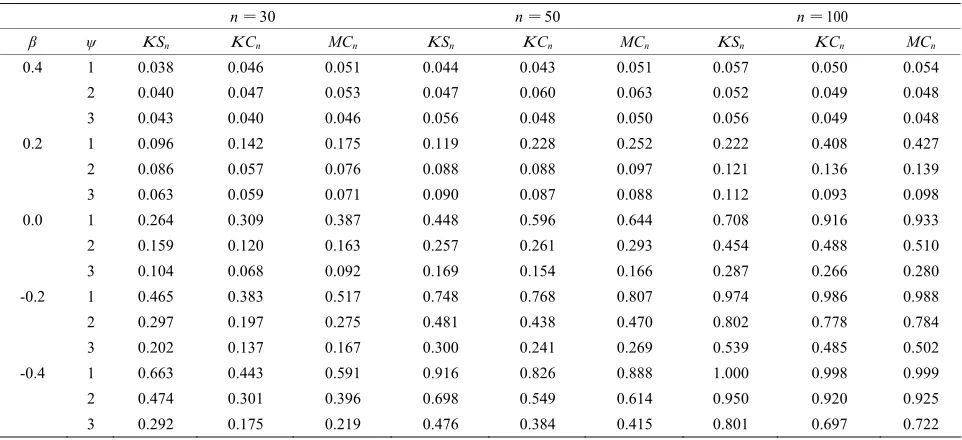
the tests under the null hypothesis (β = 0.4) with dif-ferent choices for ψ, the standard deviation. The break-point θ equals 0.4. The empirical level results are rea-sonably good especially when n > 50, that is they are close to the level of 0.05. The empirical powers of the tests are in the subsequent rows for different β.
As can be seen in Table 1, the power increases as β ge
the second simulation (see Table 2), we consider ϕ to
ts farther from 0.4 (the null Hypothesis). Understanda-bly the power increases in n and decreases in ψ gets lar-ger.
In
be a sine function. We conduct our simulations for sample sizes n = 50, 100, 150. The first row of Table 2 is the empirical level of the test (β= 1, no change-point). Again the empirical level is good when n > 50.
We take ψ = 1, but vary the location of the change- po
us in nature, the po
5. Proofs of the Main Results
intθn. The power increases as β gets farther from 1 (the null hypothesis). The power increases with the sam- ple size n. Except in a few instances, the power is great-est when the change-point occurs in the middle (θ= 0.5) and decreases as θ is farther from 0.5. The exceptional cases are likely due to simulation error.
Considering that our tests are omnib wer results can be seen to be quite good.
Proof of Theorem 1: For x R d, 0s1, let
2n
1
1 1, ,
n i D x i n
i
x s [ ]ns Y I X G x
where
[ ]
1 1
1
, ns ;
n i D x i
i
x s X I X G
xi
[ ] 2
1
, ns .
n i i D x
i
x s X I
XThe collection
D x x R
:
quently,d is a Vapnik-Cervo-
nenkis class of sets. Conse the collection of in-
dicator functions
: d
D x
I x R
is a Donsker class of functions. For (fixed) ϕ and ψ,
: d
D x
I x R
and
: d
D x
I x R
are Donsker classes (Pollard [9]). By Giné and Zinn [10, 11] (see also Corollary 2.9.3 of [12]),
1n ,1 , i 1 i( D x i 2
,n1/ 2 x
n I X G xwhere
2 D x d
G x
F,converges in distribution to a vector of tight independent
ean and covariance (j = 1, 2): Gaussian processes, η1
and η2, each with zero m
1 2
1 2
1 2
j j j j j
E x x H x x G x G x
Consequently,
1/ 2
1n x,1 , 2n x,1
n
converges in distribution to a vector of tight
independ-ent Gaussian processes
0
1, 2
with 0
2 0
E x and
covariance
0 0
2 1 2 2 1 2
Table 1. Power when ϕ(x 1 + x + 0.4x2, ϕ1(x) = 1 + x + ψx2 and breakpoint θ= 0.4.
= 100
) =
n = 30 n = 50 n
β ψ K Sn K Cn MCn K Sn K Cn MCn K Sn K Cn MCn
0.4 1 0.038 0.046 0.051 0.044 0.043 0.051 0.057 0.050 0.054
2 0.040 0.047 0.053 0.047 0.060 0.063 0.052 0.049 0.048
3 0.043 0.040 0.046 0.056 0.048 0.050 0.056 0.049 0.048
0.
0.
-0 1
-0 1
2 1 0.096 0.142 0.175 0.119 0.228 0.252 0.222 0.408 0.427
2 0.086 0.057 0.076 0.088 0.088 0.097 0.121 0.136 0.139
3 0.063 0.059 0.071 0.090 0.087 0.088 0.112 0.093 0.098
0 1 0.264 0.309 0.387 0.448 0.596 0.644 0.708 0.916 0.933
2 0.159 0.120 0.163 0.257 0.261 0.293 0.454 0.488 0.510
3 0.104 0.068 0.092 0.169 0.154 0.166 0.287 0.266 0.280
.2 0.465 0.383 0.517 0.748 0.768 0.807 0.974 0.986 0.988
2 0.297 0.197 0.275 0.481 0.438 0.470 0.802 0.778 0.784
3 0.202 0.137 0.167 0.300 0.241 0.269 0.539 0.485 0.502
.4 0.663 0.443 0.591 0.916 0.826 0.888 1.000 0.998 0.999
2 0.474 0.301 0.396 0.698 0.549 0.614 0.950 0.920 0.925
3 0.292 0.175 0.219 0.476 0.384 0.415 0.801 0.697 0.722
Table 2. Power whenϕ(x) = 2 sin(x), ϕ1(x) = 2 sin(βx), andψ = 1 with different breakpoints θ.
n = 50 n = 100 n = 150
β θ K Sn KCn MCn K Sn K Cn MCn K Sn K Cn MCn
1.0 0.052 0.051 0.048 0.046 0.046 0.056 0.051 0.045 0.051
1.2 0.3
0.
1.
1.
1.
2.
0.050 0.053 0.051 0.068 0.077 0.076 0.078 0.079 0.087
4 0.054 0.063 0.060 0.075 0.087 0.091 0.079 0.089 0.096
0.5 0.057 0.059 0.061 0.075 0.090 0.094 0.081 0.093 0.102
0.6 0.058 0.055 0.054 0.065 0.073 0.071 0.086 0.092 0.098
0.7 0.053 0.054 0.058 0.069 0.073 0.080 0.069 0.066 0.067
4 0.3 0.075 0.104 0.111 0.101 0.182 0.193 0.127 0.254 0.263
0.4 0.088 0.127 0.131 0.130 0.233 0.246 0.188 0.344 0.349
0.5 0.090 0.124 0.131 0.136 0.252 0.255 0.198 0.359 0.361
0.6 0.092 0.131 0.139 0.140 0.246 0.248 0.203 0.368 0.359
0.7 0.062 0.098 0.105 0.108 0.189 0.189 0.139 0.278 0.277
6 0.3 0.109 0.148 0.170 0.174 0.331 0.345 0.259 0.489 0.476
0.4 0.121 0.190 0.215 0.243 0.405 0.425 0.382 0.597 0.598
0.5 0.125 0.219 0.222 0.263 0.448 0.455 0.416 0.640 0.638
0.6 0.115 0.193 0.197 0.254 0.423 0.429 0.383 0.603 0.592
0.7 0.092 0.150 0.159 0.188 0.349 0.340 0.285 0.495 0.484
8 0.3 0.118 0.206 0.208 0.235 0.443 0.464 0.425 0.625 0.626
0.4 0.166 0.262 0.292 0.372 0.549 0.558 0.585 0.745 0.742
0.5 0.169 0.280 0.295 0.396 0.592 0.595 0.636 0.760 0.766
0.6 0.148 0.256 0.260 0.380 0.580 0.583 0.588 0.733 0.729
0.7 0.111 0.207 0.200 0.263 0.461 0.459 0.421 0.648 0.632
0 0.3 0.127 0.225 0.238 0.297 0.484 0.488 0.527 0.695 0.679
0.4 0.181 0.295 0.307 0.437 0.626 0.628 0.692 0.806 0.810
0.5 0.204 0.319 0.327 0.506 0.659 0.661 0.765 0.822 0.815
0.6 0.190 0.284 0.319 0.446 0.622 0.620 0.705 0.802 0.790
[image:5.595.59.538.348.739.2]L stly e [1 eore .1)
s
con of tight Gaussian
processes
an
a , (se 2], Th m 2.12
,n n
n1/ 2
x x
1 2
verges in distribution to a vector
, ,s
0 1 2
( , ) on D R
d
0,1
with zero means
and covariances
1 2
E
x
1 1
1 1 1 2
1 2 1 1 2 1 1 1 2
, ,
x s s s s
H x x G x G x
and
0 0
1 1, 1 1 2, 2 1 2 1 1 2
E x s x s s s H x x
. It follows that 1 2n
n uniform
converges in distribution to Г0
with respect to the metric, where
0 1 0
1 2.
n
Since
, 1/ 2
,
,1 ,n n
x s n x s x n
We obtain βn→DГ, as n→∞, where
1
n
ns
0 , 0 ,
D x s s x
and has covariance given in the statement of Theorem 1. Hence Theorem 1 is proven.
By viewing α2n(x, [ns]) as a strong martingale and us-
ing the functional central limit theorem for strong mar-tingales by Ivan ff [13], one can drop the assumption o (A5) and get convergence in the Shorohod topology. (see [14]).
Proof of Corollary 3: Assume the alternative Hy-pothesis (2). Then,
, 1/ 2 11
, [ ] 11
,1n
ns x s n x s x
, , n n n n x s where, for s <θ,
1 1 1 11 , n , , , n nns n n x s n
n n G x G x
x s x s
and for s,
1
1 1
, ,
n
n n ns
x s n G x G x n n ,
11 , , 1 , 1 ,
n x s n x n x s n x
with
1
[ ]
1( ) 1
1
, ns ,
n i D x i
i
x s Y I X G x
d
1 11 x D xdF1
If Condition (A3) holds for the functions and F1,
then under the alternative Hypothesis (2),
in the space
G
.ϕ1
1/ 2 11 11
n D
n ,
d 0,1
D R with the uniform metric,
w 11
Proof of Theorem 4: Let
here Г is a zero-mean Gaussian process. Strong con-sistency of the statistics nKS,nKC,nMC follows. (See the
proof of Theorem 4.1 in [5]).
i i D x i
Z x Y I X .
By the multivariate CLT, along almost all sequences,
X , ,i
,
1, 2,
i i
1/ 2 [ ] 1, ns
n x s n i V Z xi i
is re
a sum of iid random variables with mean zero and a sulting covariance matrix having entries of the form
1 21 2
1 2
1
,
s s
i D x x i
i
n Y I X
which converge, uniformly in (x1, s1) and (x2, s2),
s1s2
H x1
1x2
H x2
1x2
.Similarly, the corresponding conditional c variance of o
j
,
x ns
converges uniformly to
s1s2
H x1
1x2
G x1
1x2
H x2
1x2
,and the corresponding conditional covariance of
j
x ns,
converges uniformly to that of Г.
ualities ([12], Lemma 3.6.7), By the multiplier ineq
0 0 1/ 2 1/ 2 1 0 22 d max i ,
n
V i i
n
R R
n kn i n
E n V Z
P V t t E k Z
1 3/ 2 1 max i n
n n Z E V
0
1
1 i V i n i
i
where
R1, , Rn
utations of
is uniformly distributed on the set of
all perm
1, 2, , n
and is independent of
Z1, , Zn
. In our case, is the collection offunc-tions
: d
D x
.
E
denotes (uniform) measurable cove with respect to all
variables jointly. Using Theorem e proof
3.6.13 in [12], n(x, 1) is Donsker. It follows
that ([12], Theorem 2.12.2) x, s) is Donsker, and Theorem 4 for (j) follows.
s
rs
1, as in th of
Theorem
n(
Proof of Theorem 5: The proof is similar to that of Theorem 4 but where the limiting covariance of is that of 11 instead of Г.
6. Concluding Remark
In this paper, we have constructed test statistics using
: d
D x
F I x R , the lower orthants. It is clear (see sker classes of functions can be used. E
[12]) that other Don-xamples are: the of half-spaces. The method of proof in
handle such classes. One can also ob ined weak
con-[2] M. Csörgő, L. Horváth and B. Szyszkowicz, “Integral
Tests for Suprema tion,”
Statist, Decisio , pp. 365-377.
collection of the closed balls, or the collection [5,6,15] could
ta
not
vergence of the weighted version of the process where the weight functions satisfy the Chibisov-O’Reilly condi-tions (see [5,6], or [16], p. 462).
The simulations show that our tests have good power considering the omnibus nature of the procedure. By avoiding curve estimation (e.g. using kernel methods to estimate ), we are able to provide practical tests for moderate sample sizes.
REFERENCES
[1] C. Lee,M. Csörgő and L. Horváth, “Limit Theorems in Change-Point Analysis,” Wiley, Chichester, 1997.
of Kiefer Processes with Applica
ns, Vol. 15, No. 4, 1997
[3] M. Csörgő and B. Szyszkowicz, “Weighted Multivariate Empirical Processes and Contiguous Change-Point Ana- lysis,” Change-Point Problems, IMS Lecture Notes Mo-
nograph Series, Vol. 23, 1994, pp. 93-98.
doi:10.1214/lnms/1215463116
[4] M. Csörgő and B. Szyszkowicz, “Applications of Multi- Time Parameter Processes to Change-Point Analysis, In: M. Fisz, Ed., Probability Theory and Mathematical
Sta-tistics, John Wiley & Sons, Inc., New York, 1994, pp.
159-222.
[5] M. D. Burke, “Limit Theorems for Change-Point Detec-tion in Nonparametric Regression Models,” Acta
Mathe-matica (Szeged), Vol. 73, No. 3-4, 2007, pp. 865-882.
10, [6] M. D. Burke, “Approximations for a Multivariate Hybrid Process with Applications to Change-Point Detection,”
Mathematical Methods of Statistics, Vol. 19, No. 2, 20
pp. 121-135.
doi:10.3103/S106653071002002X
[7] M. D. Burke, “A Gaussian Bootstrap Approach to Esti-mation and Te
Methods in Probability and Statiststs,” In: B. Szyszkowicz, Ed., ics, Elsevier, Amster-Asymptotic dam, 1998, pp. 697-706.
doi:10.1016/B978-044450083-0/50045-9
[8] M. D. Burke, “Multivariate Tests-of-Fit and Uniform Confidence Bands Using a
tics and Probability Letters, Vol. 46, N
Weighted Bootstrap,” Statis-
o. 1, 2000, pp. 13-20. doi:10.1016/S0167-7152(99)00082-6
[9] D. Pollard, “A Central Limit Theorem for Empirical Processes,” Journal of the Australian Mathematical Soci-
ety A , Vol. 33, No. 2, 1982, pp. 235-248.
doi:10.1017/S1446788700018371
[10] E. Giné and J. Zinn, “Bootsrapping General Empirical Measures,” Annals of Probability, Vol. 18
pp. 851-869.
, No. 2, 1984,
990862 doi:10.1214/aop/1176
[11] E. Giné and J. Zinn, “Lectures on the Central Limit Theorem for Empirical Processes,” Lecture Notes in Ma-
thematics, Vol. 1221, 1986, pp. 50-113.
doi:10.1007/BFb0099111
[12] A. W. Van der Vaart and J. A. Wellner, “Weak Conver- gence and Empirical Processes: With App
tistics,” Springer, New York, 1996. lications to
Sta-doi:10.1007/978-1-4757-2545-2
[13] B. G. Ivanoff, “Stopping Times and Tightness for Multi-parameter martingales,” Statistics & P
Vol. 28, No. 2, 1996, pp. 111-114. robability Letters,
doi:10.1016/0167-7152(95)00103-4
[14] M. D. Burke, “Testing Regression Models: A Strong Martingale Approach,” Fields Instit
2004. ute Communications.
erence, Vol. 88, No. 1, 2000, pp. 1-18.
[15] L. Horváth, “Approximations for hybrids of empirical and partial sums processes,” Journal of Statistical Planning and Inf
doi:10.1016/S0378-3758(99)00207-4