Journal of Criminal Law and Criminology
Volume 77 | Issue 1
Article 5
1986
Why So Fast, Why So Slow: Explaining Case
Processing Time
Mary Lee Luskin
Robert C. Luskin
Follow this and additional works at:
https://scholarlycommons.law.northwestern.edu/jclc
Part of the
Criminal Law Commons
,
Criminology Commons
, and the
Criminology and Criminal
Justice Commons
This Criminology is brought to you for free and open access by Northwestern University School of Law Scholarly Commons. It has been accepted for inclusion in Journal of Criminal Law and Criminology by an authorized editor of Northwestern University School of Law Scholarly Commons.
Recommended Citation
0091-4169/86/7701 -190
TIlE JOURNAL OF CRIMINAL LAW & CRIMINOLOGY Vol. 77. No. I Copyright 0 1986 by Northwestern University, School of Law Printed in .S.A.
WHY SO FAST, WHY SO SLOW?:
EXPLAINING CASE PROCESSING
TIME*
MARY LEE LUSKIN**
ROBERT C. LUSKIN***
From the time of Shakespeare and before, there have been complaints about "the law's delay," and it is a common perception that cases generally take too long to wind their way through Ameri-can courts.' Normatively, this is a matter of "delay" versus "haste," but the factual question is simply of time: How long does a given case take? The answer is the variable increasingly known as case processing time. The cases involved may be civil or criminal, and if criminal they may be felony or misdemeanor, but here we restrict the discussion to felony cases.
Why should we care about felony case processing time? At the
individual level, the consequences are mostly for the defendant. Longer processing times are costlier in jail time and psychological wear-and-tear, but tend to lower the probability of conviction. Both
* The data for this study were collected under grant (No.78-NI-AX-0076) from the
National Institute of Law Enforcement and Criminal Justice of LEAA. Portions of this article appeared in earlier form in a chapter of the report to the sponsoring agency (Neubauer et al., 1981). Further analysis and writing have been funded by a grant (No. NIJ-82-IJ-CX-004 1) to the present authors from the National Institute of Justice's Performance Measurement Program. We want to thank the senior author's colleagues on the original project, David Neubauer, Marcia Lipetz, andJohn Ryan, for comments at earlier stages, and Richard Fritz, Anthony Ragona, Doug Smith, John McIver, David Kessler, andjo Dixon for their able assistance. Cathy Widom and Richard Lempert have kindly read the paper and contributed helpful comments. The analysis and conclusions are our own and do not necessarily represent the views of the United States Department ofJustice, the American Judicature Society, or any of the individuals aforementioned.
** Assistant Professor of Criminal Justice, Indiana University. Ph.D. (Political
Sci-ence), University of Michigan, 1978; M.A. (Political SciSci-ence), University of Michigan, 1970; B.A., Creighton, 1968.
*** Assistant Professor of Political Science, University of Alabama. Ph.D. (Political
Science), University of Michigan, 1983; B.A., University of Virginia, 1969.
I NATIONAL GICN'rFR FOR STATE CotR's, SrATE CotiRTs: A BLUIFPRINT FOR TIIE
FUR-TURE (1978); Int cf. Church, The 'Old and the New' Conventional Ilisdoni of Con Delay, 7
JusT. Svs. J. 395 (1982) ; Grossman, Kritzer, Bumiller & McDougal, Measuring the Pace of
EXPLAINING CASE PROCESSING TIME
defense and prosecution need at least a certain minimum time to prepare, but the prosecution's case tends to decay as witnesses for-get, lose interest, move away, or die. At the aggregate level, the distribution of felony processing times affects us all. Cutting processing times too short may sacrifice justice. But beyond some justice-providing threshold, the societal implications of lengthier cases are mostly adverse. Lower probabilities of conviction under-mine the incapacitative and deterrent value of criminal sanctions and thus carry a cost in public safety. More directly, lengthier cases consume more jail space and police hours-jail space that could be devoted to convicted criminals and police hours that could be spent on patrol. Consequently, many communities have sought to reduce processing times.
Such efforts naturally raise the problem of explanation. We cannot tell what reforms are likely to succeed or to be worthwhile unless we know what variables affect processing times, under what conditions, and by how much. Despite previous investigation, our understanding of why processing times are as long or as short as they are remains tenuous and partial.2 Many relevant studies are monocausal and lack adequate controls. The studies of Church et al.3 and Flanders,4 the major sources of what Church proclaims to be the "new conventional wisdom," are essentially bivariate (as Church acknowledges).5 The same is true of the studies of
Gross-man et al.,6 Boyum,7 and Nimmer.8 The studies of Neubauer and
Ryan9 and Hausner and Seidel'° are multivariate, but have other shortcomings. Neubauer and Ryan surrender the final selection of variables to the atheoretical whims of stepwise regression.1 1 Hausner and Seidel neglect some obvious case-level variables,
in-2 For an earlier review of the literature stressing the need for a more theoretical approach and better analysis, see Luskin, Building a Theory of Case Processing Time, 62
JUDI-CATURE 114 (1978).
3 T. CHURCH, A. CARLSON, J. LEE & T. TAN, JUSTICE DELAYED: THE PACE OF LITIGA-TION IN URBAN TRIAL COURTS, (1978).
4 S. FLANDERS, CASE MANAGEMENT AND COURT MANAGEMENT IN U.S. FEDERAL Dis-TRICT COURTS (1977).
5 Church, supra note 1.
6 Grossman, Kritzer, Bumiller & McDougal, supra note 1.
7 Boyum, A Perspective on Civil Delay in Trial Courts, 5 JUST. Sys. J. 170 (1979).
8 R. NIMMER, THE NATUrE OF SYSTEM CHANGE: REFORM IMPACT IN THE CRIMINAL
COURTS (1978).
9 Neubauer & Ryan, Criminal Courts and the Delivery of SpeedyJustice: The Influence of Case and Defendant Characteristics, 7 JUST. SYs. J. 213-35 (1982).
10 J. HAUSNER & M. SEIDEL, AN ANALYSIS OF CASE PROCESSING TIME IN THE DISTRICT
OF COLUMBIA SUPERIOR COURT (1979).
LUSKIN AND LUSKIN
cluding pretrial motions and defendant absence. And neither really addresses the effects of court structures and arrangements.
This article presents an attempt at a fuller and more satisfactory explanation. We begin by developing a more theory-informed and fully-specified model. En route, we propose explicit criteria for ex-planatory variables and confront the question of mathematical form, making the model nonlinear and nonadditive as appropriate. We then estimate the model on a two-year sample of cases from De-troit's Recorder's Court. The data (and model) are thus confined to variables that vary in this one setting over this one time period, but the setting and period afford hard-to-come-by glimpses of structural variations and their effects.
I. SETTING AND DATA
Recorder's Court is the municipal criminal court of Detroit. At the time of the study, it had both preliminary and trial jurisdiction, was staffed by an elective bench of 20 judges, augmented by a vary-ing number of visitvary-ing judges, and received approximately 11,000 felony cases a year. Our analysis is based on a random sample of felony complaints filed between April, 1976, and March, 1978, strat-ified by month of filing. With cases that saw no arrest and thus never properly began set aside the sample totaled 2026. All but twenty-six (one percent) of the cases reached disposition by the study's close. For the remaining 2000, the mean processing time was seventy-six days, with a standard deviation of ninety-four. Bro-ken down by month of origin, the mean varied from fifty-two days for cases beginning inJuly, 1977, to 147 days for cases beginning in May, 1976. To supplement and illuminate these quantitative data, we also conducted scattered interviews with court participants.
We chose this court and time for a reason. Recorder's Court at this time was the site of a Law Enforcement Assistance Administra-tion sponsored delay reducAdministra-tion project that altered the calendaring system, temporarily increased judicial manpower, and made other changes in court operations.12 Moreover, these reforms were stag-gered, permitting an empirical separation of effects (no perfect or prohibitive collinearity). Hence the data present an unusually good opportunity to examine structural as well as case-specific effects.
II. A. MATTER OF DEFINITION
How long a case takes is partly a matter of definition-at what
12 Described further in D. NEUBAUER, M. LIPETZ, M. LUSKIN &J. RYAN, MANAGING THE
PACE OFJUSTICE: AN EVALUATION OF LEAA's COURT DELAY REDUCTION PROGRAM (1981).
EXPLAINING CASE PROCESSING TIME
point does it "begin," at what point does it "end?" For this article, processing time is the number of days between arraignment on the arrest warrant (the defendant's initial appearance in court) and dis-position by dismissal, trial verdict, or plea. For comparability's sake, we exclude sentencing; all cases must end in dismissal, trial verdict, or plea, but only convictions need sentencing. With that exception, however, we take an inclusive view. Processing time is the whole time in court.
There is no point in separating upper and lower court time, as recommended by Neubauer,13 because Recorder's Court combined upper and lower court functions-cases stayed there from begin-ning to end. Also at variance with Neubauer, we do not subtract "skip time"-intervals during which the case awaits a defendant who has failed to appear.1 4 Skip time, as Neubauer remarks, is largely beyond the court's control.15 But it is still part of processing time. We shall do better to treat it as an explanatory variable. If, but only if, its coefficient equals 1.0, then the two approaches are equivalent. The same applies to "psych time"-intervals of psychiatric evalua-tion or treatment-and other hiatuses.
III. WHAT AFFECTS PROCESSING TIME?
At a general level, we posit, processing time depends on six fac-tors: three case-level, three court-level.
A. CASE-SPECIFIC INCENTIVES
Defendants, defense attorneys, prosecutors, judges, and other court participants are semi-independent decision makers with insti-tutionally defined options and reinforcement contingencies. They respond to economic, social, intellectual, and professional incen-tives to do some things and not others.' 6 Different variables present
13 Neubauer, Improving the Analysis and Presentation of Data on Case Processing Time, 74 J.
CRIM. L. AND CRIMINOLOGY 1589 (1982); J. HAUSNER & M. SEIDEL, supra note 10.
14 See Neubauer, supra note 13; Neubauer & Ryan, supra note 9.
15 Neubauer, supra note 13.
16 J. EISENSTEIN & H. JACOB, FELONY JUSTICE: AN ORGANIZATIONAL ANALYSIS OF CRIMINAL COURTS (1977); R. FLEMMING, PUNISHMENT BEFORE TRIAL: AN
ORGANIZA-TIONAL PERSPECTIVE OF FELONY BAIL PROCESSES (1982); M. HEUMANN, PLEA BARGAINING: THE EXPERIENCES OF PROSECUTORS,JUDGES AND DEFENSE ATTORNEYS (1978); L. MATHER, PLEA BARGAINING OR TRIAL?: THE PROCESS OF CRIMINAL-CASE DISPOSITION (1979); P. NARDULLI, THE COURTROOM ELITE: AN ORGANIZATIONAL PERSPECTIVE ON
CRIMINALJUS-TICE (1979); Blumberg, The Practice of Law as a Confidence Game: Organizational Cooptation of a Profession, 1 LAW & Soc'Y REV. 15 (1967); Heumann & Loftin, Mandatory Sentencing and the Abolition of Plea Bargaining: The Michigan Felony Firearm Statute, 13 LAw & Soc'Y
REV. 393 (1979); Loftin, Heumann & McDowall, Mandatory Sentencing and Firearms
Vio-lence: Evaluating an Alternative to Gun Control, 17 LAw & Soc'Y REV. 287 (1983).
LUSKIN AND LUSKIN
different mixes of incentives for different participants, but at the case-level, the relevant variables include:
Attorney Type. Because retained attorneys are paid directly by
clients, who generally need time to scrape money together and who may be less eager to pay once the case is resolved, these attorneys may handle cases more slowly than public defenders or court-ap-pointed counsel.1 7
Pretrial Release. Whether the defendant awaits the outcome in
jail affects both his motivation and the motivations of others. A jailed defendant has more incentive to move his case quickly. Less obviously, judges, prosecutors, and defense attorneys may feel pres-sure in the same direction. To the extent that the state imposes shorter time limits for cases involving jailed defendants, 18 judges believe that presumptively innocent defendants should be detained as short a time as possible, or jail space is a scarce commodity,19 the court will give priority to jailed defendants. Indeed, the cost of housing the overflow population from the overcrowded Wayne County Jail was the immediate impetus for the delay reduction pro-ject, and "what kept our feet to the fire," in the words of a delay reduction project manager.20 Interviews revealed that the "jail problem" loomed large in participants' minds.
Seriousness. Defendants charged with more serious crimes risk a
greater penalty and should thus find "strategic delay" more attrac-tive. Prosecutors, too, take serious cases more seriously, both to satisfy their own sense of justice and to forestall police or public complaint. For the same reasons, judges allow fuller exercise of the adversary process in more serious cases.2 1 To gauge seriousness, we used the maximum term of incarceration (in months) on the original charge.2 2 For cases involving more than one charge, we
17 See Blumberg, supra note 16; R. NIMMER, supra note 8; NARDULLI, supra note 16. 18 p. NARDULLI, supra note 16; W. THOMAS, BAIL REFORM IN AMERICA, (1976).
19 R. FLEMMING, supra note 16.
20 Id.; M. NEUBAUER, M. LIPETZ, M. LUSKIN &J. RYAN, supra note 12.
21 See M. HEUMANN, supra note 16; L. MATHER, supra note 16; Forst & Brosi, A
Theoreti-cal and EmpiriTheoreti-cal Analysis of the Prosecutor, 6J. OF LEGAL STUD. 177 (1977).
22 One alternative would be a Sellin & Wolfgang or Sellin & Wolfgang-like measure based on the amount and kind of harm and defendant-victim relationship. See T. SELLIN & M. WOLFGANG, MEASURING DELINQUENCY (1964). See also J. JACOBY, L. MELLON, E.
RATLEDGE & S. TURNER, PROSECUTORIAL DECISION-MAKING: A NATIONAL STUDY (1982); Bernstein, Kick, Leung & Schultz, Charge Reduction: An Intermediary State in the Process of
Labelling Criminal Defendants, 56 Soc. FORCES 362 (1977); Forst & Brosi, supra note 21.
Another measure could be based on penalties actually imposed as in McDavid & Stipak,
Simultaneous Scaling of Offense Seriousness and Sentence Severity Through Canonical Correlation Analysis, 16 LAW AND SoC'Y REV. 147 (1981). We prefer the statutory maximum penalty
for several reasons. First, it has the practical advantage of being readily obtainable from court records. Second, it is, in effect, the legal ordering of seriousness, and as such may
EXPLAINING CASE PROCESSING TIME
counted the highest maximum, and we arbitrarily quantified "life" as 480 months.
Prior Record. Like seriousness, prior record affects the stakes. A
defendant with more numerous prior convictions will probably re-ceive a stiffer sentence if convicted and should thus be more in-clined to bear pretrial incarceration, financial hardship, or extended uncertainty in return for a higher probability of acquittal, dismissal, or favorable plea bargain.
Regular Judge. Visiting judges bear relatively slender
responsi-bility for court operations and outcomes. In Recorder's Court, visi-tors did not really have their own dockets, even under the "individual docket" (see below), and thus escaped the individual docket's incentives to keep caseloads down.
B. CASE COMPLEXITY
In ways admittedly difficult to measure, some cases are simply more complex and almost inherently more time-absorbing than
others. One measureable dimension is:
Number of Defendants. Multiple defendants exacerbate problems
of scheduling and coordination and complicate plea bargaining.23
C. CASE EVENTS
As a case unfolds, the participants take some actions and not others, and what they do may curtail or prolong processing time,
either by design or as a side-effect. Such case events include:
Early Dismissal. An early dismissal (at or before the preliminary
hearing) plainly abbreviates processing time. Again, Recorder's Court had preliminary as well as trial jurisdiction.
Trial. Trials, in contrast, are intrinsically the most
time-con-suming disposition. Counterintuitively, some cross-court compari-sons show courts with proportionally more trials processing cases no more slowly,24 but case-level analyses of more fully-specified
carry normative weight for court personnel. See McCleary, O'Neal, Epperlein, Jones & Gray, Effects of Legal Education and Work Experience on Perceptions of Crime Seriousness, 28 Soc. PROBS. 276 (1981). Third, it probably reflects the central tendency of societal percep-tions of seriousness as Rossi, Waite, Bose and Berk, The Seriousness of Crimes: Normative Structure and Individual Differences, 39 AM. Soc. REV. 227 (1974) suggests. Finally, and perhaps most important, it is a direct measure of the defendant's stakes.
23 The number of witnesses should have a similarly tangling effect on scheduling, but
is unfortunately not in the data.
24 See T.CHURCH, A. CARLSON, J. LEE & T. TAN, supra note 4; S. FLANDERS, supra note
5; R. GILLESPIE, JUDICIAL PRODUCTIVITY AND COURT DELAY: AN EXPLORATORY ANALYSIS
OF THE FEDerAL DISTRICT COURTS (1977); Gillespie, The Production of Court Services: An
Analysis of Scale Effects and Other Factors, 5J. OF LEGAL STUD. 243 (1976).
LUSKIN AND L USKIN
models show the expected effect.2 5 Pleas and later dismissals fall between trials and early dismissals, and form the "omitted cate-gory" in an implicit dummyization of disposition type. We do not distinguish post-preliminary-exam dismissals from pleas, despite the former's correlation with processing time, because dismissals at this stage are either spurious correlate or consequence, not cause. The spuriousness arises when prosecutors have only feeble evidence yet face public or police demand for action, and so prolong the case until the heat is off, then seek a dismissal to avoid wasting resources. The consequentiality is more straightforward. Older cases have often deteriorated and are thus more often dismissed.
Pretrial Motions. Hearing and preparing motions-for discovery,
to supress evidence, and so forth-take time both in and out of court.26 Empirically, it is the fact rather than the number of motions that seems to matter.
Psychiatric Hiatus. Psychiatric evaluation for competency to
stand trial and treatment of those found incompetent take time, but the delay is not tautologically equal to the time spent on evaluation or treatment. The court may either make up for lost time when the defendant returns or incur incidental, second-order delays.
Defendant Absence. Defendants sometimes fail to appear for
scheduled hearings, and an AWOL defendant brings the case to a standstill. As with psychiatric hiatus, though, the translation from waiting time to processing time need not be one-to-one.
Late or Second preliminary hearing. Preliminary hearings originally
waived may later be asked for and held, and preliminary hearings later ruled insufficient may be reheld. Either involves a retracing of steps.
Mistrial. Repetitions of later events have similar effects, most
notably when a trial ends in a mistrial and the case is retried.
Continuances. Some continuances result from defendant
ab-sence, motions, or psychiatric hiatus and are covered separately in those variables. But other continuances also add to processing time.
D. STRUCTURAL INCENTIVES AND STRUCTURAL FACILITATION
At the court level, structural and administrative arrangements provide more general incentives. They affect participants' interest in speeding up or slowing down all or broad classes of cases. More intrinsically, they may accelerate or retard the movement of cases,
25 See J. HAUSNER & M. SEIDEL, supra note 10; Neubauer & Ryan, supra note 9.
26 See Neubauer & Ryan, supra note 9.
EXPLAINING CASE PROCESSING TIME
motivational effects quite aside: they may be more or less efficient. Since most court-level variables involve mixtures of incentives and facilitation, we list the variables under these headings together.
Docket Type. Recorder's Court changed during the study period
from a central to an individual docket (from a master to an individ-ual calendar).27 Having previously been responsible for only an ill-defined share of the work, each judge now had to answer for a spe-cific set of cases. The delay reduction project staff reinforced the effect by publishing bi-monthly reports listing and ranking caseloads. To avoid appearing in a bad light, judges had to move cases rapidly enough to keep their dockets down. Thus, accounta-bility honed incentives. Even Church et al.,28 who are skeptical of docket effects in criminal courts, report "competition among the judges in virtually every individual calendar court visited."29 On the other hand, critics of the individual docket argue that the central docket is more rational and efficient.3 0 The argument, in essence, is that docket type is facilitative rather than incentive-related, and that its impact is not negative but positive. We believe that the effect is negative, but the data will tell.3'
Case-Track. Another innovation was a "case-track" designed to
bring all cases to disposition within ninety days. The case-track re-quired that each of several case events- preliminary hearing, plea negotiations, pretrial motions, and trial-take place by a specified deadline. In part, the track was facilitative. Delay reduction project staff prepared forms showing scheduling dates that would meet a ninety-day track and held case scheduling workshops for judges and their clerks. But the track also added incentives. Although judges could not be forced to adhere to the deadlines, the delay reduction project staff, Special Judicial Administrator (see below), and Chief
27 Recorder's Court has shifted back and forth between central and individual calen-dars. In late 1975, it changed the docket from individual to central; in late 1976 (during
our study) it changed it back. See D. NEUBAUER, M. LIPETZ, M. LusIN &J. RYAN, supra
note 12, for an account of these changes andJ. EISENSTmIN AND H. JACOB, supra note 16, on prior oscillations.
28 T. CHURCH, A. CARLSON, J. LEE & T. TAN, supra note 3. 29 Id. at 73.
30 See M. SOLOMON, CASEFLOW MANAGEMENT IN THE TRIAL COURT (1973).
31 T. CHURCH, A. CARLSON, J. LEE & T. TAN, supra note 3, find little effect, but ex-clude two master calendar courts with particularly high median processing times. With these courts retained, the master calendar courts average twenty-five percent longer me-dian processing times than the individual calendar courts. R. NIMMER, supra note 8, reviews and criticizes a number of other studies showing little effect. None controls for more than a handful of variables. Nimmer's own study includes more adequate controls and still shows little effect but is based on cases involving only three offenses, which may or may not be typical.
LUSKIN AND L USKIN
Judge made considerable efforts to persuade or shame them into compliance. In addition, the plea cut-off date, after which no fur-ther concessions were to be offered, undermined the defendant's incentives to foot-drag.
Decentralized Plea Bargaining. The delay reduction project also
transferred plea bargaining from the central prosecutor's office to individual "docket prosecutors," one for each of five groups of same-floor courtrooms. The rationale was mostly facilitative. Prox-imity would breed familiarity, which would increase efficiency. But the effect may also have been due to incentives. Centralized plea-bargaining was the province of specialists. Processing time and backlog were not their concern. Decentralization, however, made docket prosecutors responsible for the dockets within their domain, and thus gave them reason to keep "their" processing times and dockets within bounds. Finally, decentralization was accompanied by a small increase in the number of prosecutors and may have de-creased processing times by that route as well.
The Crash Program. A final element of the delay reduction
pro-ject was a "crash program" that did several things simultaneously. Under the direction of a SpecialJudicial Administrator appointed by the Michigan Supreme Court, the court added visiting judges, be-gan monitoring judges' bench time, instituted meetings among prosecutors, judges, project staff, police, and sheriffs, and reopened negotiations on stalled older cases. The visiting judges decreased the per-judge caseload; the monitoring of courtrooms rewarded hard-workers and penalized shirkers; the reopened plea negotia-tions upped defendants' incentives to plead; and the efforts at in-creased coordination may have been a facilitating factor. The Special Judicial Administrator cracked the whip throughout. Although the crash program officially ran for only six months, its central elements-reopened plea negotiations, monitoring, in-creased manpower, and the Special Judicial Administrator- re-mained even after its official demise. Operationally, therefore, we consider it as continuing through the remainder of the study.3 2
E. CASELOAD
To the extent that a variable number of cases compete for a relatively fixed quantity of court attention, more cases should mean
32 We experimented with a separate dummy variable to distinguish cases initiated
after the "official" crash period. The coefficients for the "crash" and "post-crash" vari-ables were both statistically and substantively indistinguishable.
EXPLAINING CASE PROCESSING TIME
longer processing times.3 3 Yet caseload is also a criterion of court performance, and concommitantly a source of pressure. Excessive caseloads may bring embarrassment or electoral displeasure,3 4 so that judges and prosecutors may process cases more expeditiously as caseloads rise. Either way, processing time depends on caseload. The only question is one of sign.
Court Caseload. Under the central docket, the relevant caseload
is the number of cases per judge. The effect may be either positive (cases overwhelming resources) or negative (compensatively faster processing as caseload rises).
Individual Caseload. Under the individual docket, the relevant
caseload is that of the judge handling the case, and the effect should be negative. Individual accountability makes caseload a highly visi-ble criterion of performance. Judges who improved their position in the monthly rankings pointed proudly to their achievement-even judges who claimed not to care about caseload. Judges who lost
ground avoided the subject. Operationally, we defined both caseloads as of the beginning of each month.3 5
Constraints of measurement aside, we have selected these vari-ables as a function solely of their ability to serve in the minor prem-ise of an implicit syllogism: variable x reflects one or more of our six generic determinants; therefore variable x affects processing time. We claim three advantages for this self-conscious approach. First, it points us in the direction of comprehensiveness. Within the limits of observation, we have tried to include everything that has to do with caseload, case complexity, case-level or structural incen-tives, case events, or structural facilitation. Second, and at the same time, the list is selective. The major premise indicates not only what to include but what to ignore. We exclude such common variables as the defendant's age, sex and race, which may affect processing time, but only in anterior fashion through the probability of trial and other case events. Finally, the simple deductions involved provide
33 Aggregate results, however, are not particularly supportive. See T.CHURCH, A.
CARLSON,J. LEE & T. TAN, supra note 3, R. NIMMER, supra note 8; Gillespie, supra note 24.
34 SeeJ. EISENSTEIN & H.JACOB, supra note 16; P. NARDULLI, supra note 16; Heumann,
Thinking About Plea Bargaining, in THE STUDY OF CRIMINAL COURTS: POLITICAL PERSPEC-TIVES 210 (P. Nardulli ed. 1979); Nardulli, Organizational Analysis of Criminal Courts: An Overview and Some Speculation, in THE STUDY OF CRIMINAL COURTS: POLICrrAL
PERSPEC-TIVES 101 (P. Nardulli ed. 1979).
35 Current caseload is affected by mean processing time, but the effect is lagged, and
only in the mean: the processing times of contemporaneous cases have no effect, and that of any single case in the past practically none. Consequently, we need not specify and estimate a caseload equation alongside the processing time equation.
LUSKIN AND LUSKIN
clear reasons to believe that these variables, and not others have an effect.
IV. WHAT KINDS OF EFFECTS?
Moving from words to equations requires considering the shapes of these variables' effects (roughly, slopes). An explanatory variable x's effect on a dependent variable y is the expected change in y, for each unit change in x, ceteris paribus. For example, the court
caseload's effect on case processing time is the number of additional days a case can be expected to take for each additional case per judge.
For the most part, we presume constant effects. Yet several ef-fects should be nonconstant. Prior record's effect is probably non-linear (a function of its own value). An additional conviction should make little difference to the likely sentence, and thus to the incentive to procrastinate, if it is merely the latest in a long string. The great-est difference should be between zero and one, the next greatgreat-est between one and two, and so on. To capture this pattern, we write processing time as a linear function of logged prior convictions.36 Other nonconstancies are nonadditivities (effects that are functions of the values of other explanatory variables). Since a judge has more control over trials than other dispositions, the individual docket should shorten trial cases more than others. Since the case-track introduced new deadlines for motions and trials, it should have achieved greater reductions for cases with motions or trials. As we have suggested, the relevant caseload depends on the docket sys-tem: the court's caseload under the central docket and the judge's own caseload under the individual docket. Moreover, since visiting judges do not have their own dockets, the judge's caseload should matter only for regularjudges. And, finally, since cases are not offi-cially part of the caseload until after the preliminary hearing, neither caseload variable should have an effect for early dismissals. We ac-commodate these interactions by adding multiplicative terms.
Abbreviating the variable names, the processing time equation is thus: CPT = 0 + 131 TRIAL + 132 DPE +
13
MOTION + 114 PSYCH + 135 ABS + 136 LPE + 137 MISTR + 18 CONTIN +10
£ DEF + 131o RETAIN +131,
BAIL + 112 SERIOUS + 013ln(PRIOR)
+ 1314 DOCK + 1315 TRACK + 1316 LOCPLEA + 117 CRASH + 018
DOCK*TRIAL + 1319 TRACK*TRIAL + 32o TRACK*MOTION +
1321 AVLOAD* (1-DOCK)* (1 -DPE) + 122
JLOAD*DOCK*(1-36 Since In 0 is undefined, we add .01 to the count of prior convictions, taking In
(PRIOR + .01).
EXPLAINING CASE PROCESSING TIME
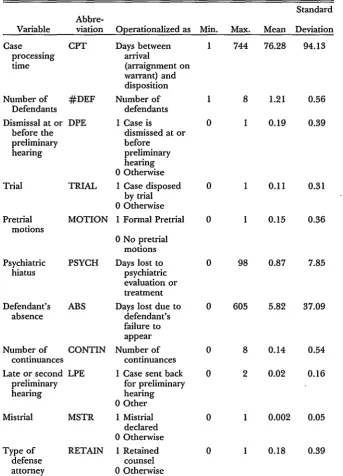
DPE)*REGJ + u, where the 13's are unknown parameters and u is an unmeasured disturbance. Table 1 provides a key to the abbrevia-tions and a reminder of operational definiabbrevia-tions.
TABLE 1
VARIABLES IN THE MODEL
Standard
Abbre-Variable viation Operationalized as Min. Max. Mean Deviation
Case CPT Days between
processing arrival
time (arraignment on
warrant) and disposition
Number of #DEF Number of
Defendants defendants
Dismissal at or DPE 1 Case is
before the dismissed at or
preliminary before
hearing preliminary
hearing
0 Otherwise
Trial TRIAL 1 Case disposed
by trial
0 Otherwise
Pretrial motions Psychiatric hiatus Defendant's absence
MOTION 1 Formal Pretrial
0 No pretrial motions
PSYCH Days lost to psychiatric evaluation or treatment
ABS Days lost due to defendant's failure to
appear
Number of CONTIN Number of
continuances continuances
Late or second LPE 1 Case sent back
preliminary for preliminary
hearing hearing
0 Other
Mistrial
Type of defense attorney
MSTR I Mistrial
declared 0 Otherwise RETAIN I Retained
counsel 0 Otherwise
1 744 76.28 94.13
1 8 1.21 0.56
0 1 0.19 0.39
0 1 0.11 0.31
0 1 0.15 0.36
0 98 0.87 7.85
0 605 5.82 37.09
0 8 0.14 0.54
0 2 0.02 0.16
0 1 0.002 0.05
0 1 0.18 0.39
[image:13.454.46.390.132.609.2]L USKIN AND LUSKIN
[Vol. 77
table continued
Standard
Abbre-Variable viation Operationalized as Min. Max. Mean Deviation
Pretrial release BAIL 1 Defendant free 0 1 0.66 0.47
prior to disposition
Seriousness of charge
0 Otherwise
SERIOUS Statutory maximum of count with highest maximum in
months
Defendant's PRIOR
prior record
Number of prior convictions
REGJ 1 Case heard by
regular judge
0 Visitor
Docket type DOCK 1 Case initiated under individual docket
0 Under central docket
Case-track TRACK 1 Case initiated after case-track in place 0 Before
case-track
0 480 150.47 151.97
0 62 2.02 3.87
0 1 0.77 0.42
0 1 0.73 0.44
0 1 0.53 0.50
Decentralized plea bargaining
LOCPLEA 1 Case initiated after plea bargaining decentralized 0 Before
decentralized plea bargaining
Crash program CRASH and
aftermath
1 Case initiated in crash or post-crash periods 0 Otherwise
0 1 0.18 0.39
0 1 0.24 0.43
JLOAD Number of
defendants on disposition judge's individual docket in month in which case was initiated
0 399 75.215 93.186
EXPLAINING CASE PROCESSING TIME
table continued
Standard
Abbre-Variable viation Operationalized as Min. Max. Mean Deviation
Average AVLOAD Number of 103.10 423.42 224.95 39.07
caseload defendants
before court at beginning of month in which case was initiated, divided by the number of judges available
V. ESTIMATION
At this point, we must address some methodological issues. At-tentive readers may have noticed that these data form an unaggre-gated time-series, with cases implicitly indexed by date of initiation. Averaging within months (for example) would reduce our case-level observations to a monthly time-series. But we should gain nothing and lose much in the process. Case-level analysis yields estimates of structural as well as case-level information effects, but aggregation by time-point wastes case-level information and thus cuts efficiency. Aggregation inflates the R2 but makes the estimates less precise.3 7 These remarks specifically apply to interrupted time-series analysis, which not only wastes information but solves a problem (autocorre-lation of u) that does not exist before aggregation.
Another thing better left undone is separate pre- and post-in-novations estimations, as in Neubauer and Ryan.38 Apart from any-thing else, the structural changes are not nearly coincident enough for clearcut before-after comparison. Even if they were, separate es-timations would effectively respecify the model in theoretically unappealing ways, lumping all of the structural variables together, submerging their combined main effect in differences of intercepts, and indiscriminately conditioning all the nonstructural effects on the combined before-after structurai variable.
Contrary to Neubauer,3 9 we use the full sample. Neubauer's recommendation that modelers discard long cases as "atypical" and "outliers" is wrong on several counts. Long cases are not necessar-ily outliers. (And short ones may be.) Extreme residuals, not
ex-37 Eg.,J. KMENTA, ELEMENTS OF ECONOMETRICS 322-28 (1971).
38 Neubauer & Ryan, supra note 9.
39 Neubauer, supra note 13.
LUSKIN AND LUSKIN
treme values on the dependent variable, define outliers. Further, even true outliers are not generally discarded, but are used as a stimulus and guide to respecification.40 As for typicality, extremely long-and extremely short-cases may be atypical, but why settle for explaining only typical cases? Atypical processing times are the product of atypical values of relevant explanatory variables, and any model worth its salt should be asked and given the chance to explain them.4 1
A more legitimate worry is heteroscedasticity. The precipitous decline in processing times over the period of study raises the possi-bility of a similar decline in their variance, and, more to the point, in the variance of u. Dividing the observations by month of origin and subjecting the hypothesis of equal variances to the usual likelihood
ratio test4 2 produces a X2 of 2006.8, with twenty-three degrees of
freedom. As a result, we have turned to generalized least squares (GLS) as opposed to ordinary least squares (OLS). In effect, this form of GLS weights each observation by the reciprocal of the sam-ple standard deviation of the (OLS) residuals for its month.4 3 The results are displayed in Table 2.4 4
VI. RESULTS
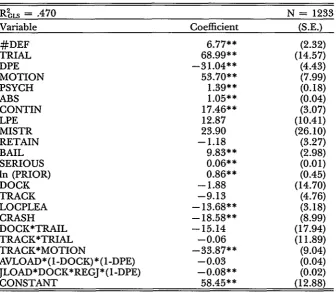
The results generally conform to expectation. Most of the pa-rameter estimates have the signs explicitly or implicitly predicted above, and most attain conventional levels of significance. At .47, the R2 is rewarding by micro-data standards.4 5
Table 2 supplies estimates of most, but not all, of the effects. The constant effects are simply the corresponding parameters, but
40 Bollen & Jackman, Regression Diagnostics: An Expository Treatment of Outliers and
Influ-ential Cases, 13 Soc. METHODS RES. 510 (1985).
41 Neubauer, supra note 13, also deletes cases involving psychiatric hiatus, simply be-cause they take longer. Again, it is better to use psychiatric hiatus as an explanatory variable and give the model a chance to explain.
42 A. MOOD, F. GRAYBILL & D. BOES, INTRODUCTION TO THE THEORY OF STATISTICS 439-40 (1974).
43 T. FOMBY, R. HILL & S. JOHNSON, ADVANCED ECONOMETRIC METHODS 174-76 (1984).
44 We should perhaps mention again that the perennial bugbear collinearity is not a problem here. Only extreme collinearity does much damage, and the only damage it can do is to produce large standard errors, which in turn mean wide confidence intervals and substantively significant but statistically insignificant estimates. Here, a few substan-tively large parameter estimates (for mistrials, late or second preliminary exams and the docket x trial interaction) are statistically insignificant. But the cause is low variance, not
collinearity. See infra note 48.
45 The R2 here is the squared Pearsonian correlation between the actual and GLS-predicted processing time. See Luskin, Looking for R2." Measuring Explanation Outside OLS,
10 POL. METHODOLOGY 513 (1984)..
[Vol. 77
EXPLAINING CASE PROCESSING TIME
TABLE 2
PARAMETER ESTIMATES
RLs = .470 N = 1233
Variable Coefficient (S.E.)
#DEF 6.77** (2.32)
TRIAL 68.99** (14.57)
DPE -31.04** (4.43)
MOTION 53.70** (7.99)
PSYCH 1.39** (0.18)
ABS 1.05** (0.04)
CONTIN 17.46** (3.07)
LPE 12.87 (10.41)
MISTR 23.90 (26.10)
RETAIN -1.18 (3.27)
BAIL 9.83** (2.98)
SERIOUS 0.06** (0.01)
In (PRIOR) 0.86** (0.45)
DOCK -1.88 (14.70)
TRACK -9.13 (4.76)
LOCPLEA -13.68** (3.18)
CRASH -18.58** (8.99)
DOCK*TRAIL -15.14 (17.94) TRACK*TRIAL -0.06 (11.89) TRACK*MOTION -33.87** (9.04) AVLOAD*(1-DOCK)*(1-DPE) -0.03 (0.04) JLOAD*DOCK*REGJ*(1-DPE) -0.08** (0.02) CONSTANT 58.45** (12.88)
" *Significant at the .05 level (by one- or two-tail test as appropriate).
the nonlinear and nonadditive ones are more complicated functions of parameters and variables. Differentiation shows that TRACK's ef-fect is 315 + 1319 TRIAL + 1320 MOTION; that PRIOR's effect is 01js
/PRIOR; and so on. Estimates of these and other nonconstant ef-fects appear in Table 3.
Tables 2 and 3 show that the "how" of disposition has a major effect on the "how long" of disposition. Almost all of the case events make a significant difference. The exceptions are late and second preliminary hearings and mistrials. The point estimates are not small-thirteen and twenty-four days-but the standard errors are large, most likely because of low variance.4 6 Both are infrequent
46 Take any linear equation. Denote the k' explanatory variable by x (k = 1,2 .. K), its coefficient by Bk and the OLS estimate of Bk by Pk- Working from (6-72) in J.
JOHN-sToN, ECONOMETRIC METHODS, 246 (3d ed. 1984) it is easy to show that the variance of
(p2i) is V(1Pi)=--/N*s,(1 - Rk), where oais the disturbance variance, N is the sample size,
[image:17.454.47.384.85.380.2]LUSKIN AND LUSKIN [Vol. 77
0
00 m e -00 q t 0,c : - ( 0 o:
bfl
uE
:a. ?- 0 . 0
_
u
P, 41 t
-c 0 1
z-0~ 0~ 9
~
-I I I
m0Z O 0
m ul)00 0 t-t-06 4 0~ c - ci
to -L - L
0 Gv
1- 0- 0 c
0" 0 0 0,
.U -,-J J
- z 5. 03 S.
L . -cz 0
0.1 U O. tj-,U 1
-z
~
~
U c206
-U -'
~c~5
- ~"N
U
oj4~
z
EXPLAINING CASE PROCESSING TIME
.- 00 C
• Co. c',..
I I
00 0
00 I 00
I.-0 " , -C',C
-0 - M bDs. 0 "o
0 0o .
... 0 CCC..,
u-0 > 0 b
cz 12. 0.2
cz 0
0
+
0
co
co G 006: 00
00 It! O
• . 7
+
Co* 00 Co
+ I +
00 cq
00ts0 -0
ce;j.zcq IR
bo
u r. ol -q0
0- VC w
~
Z.=~0
00
16
10
0 0
o6
S. S.
T 0 0
.- ..
-= C M 0 - , Cz 00
0
0 *0 6 -'
-. 0.- 0
o
:tU) C 0~ c
T- 00c'i
m I T. - U)
"a~ CC C
- 0- JC CZ~
in~.~~
CC 00 'n0
> -q -zU
C4
..0 L *cqC .
1986]
207
LUSKIN AND LUSKIN
events.4 7 Other case events have significant though contingent ef-fects. An early dismissal cuts processing time by thirty-one days under the central docket, and by a slightly larger amount that varies with the judge's caseload (providing the judge is a regular) under the individual docket. The most decelerative case event is trial. Under the central docket and sans case-track, a trial increases processing time by sixty-nine days. As expected, the individual docket reduces this effect, although the reduction falls short of sig-nificance. Low variance in DOCK*TRIAL (which is one only for tri-als, which are rare to begin with, and only under the individual docket) is to blame. Contrary to expectation, the effect does not change under the case-track. The case-track's plea cut-off date ap-parently made little difference. After trials, pretrial motions have the most impact, adding fifty-four days to pre-case-track, but only twenty days to post-case-track.
Each continuance increases processing time by seventeen days, roughly consistent with Hausner and Seidel,48 despite differences in variables, models, and courts. Hausner and Seidel suggest that con-tinuances are a stand-in for other actions by court participants.4 9 But though we have measured and entered several of these actions separately (in motions, psychiatric hiatus, and defendant absence), continuances still have a major effect-slightly larger than in Hausner and Seidel. Hence the court management literature's em-phasis on the importance of a strong continuance policy 50 seems
well-placed.
Psychiatric hiatus and defendant absence also add to processing time, but to different degrees. Every day of psychiatric evaluation or treatment prolongs the case by 1.4 days. Committing a defendant for ninety days of treatment costs 125 days of processing time; a postponement of thirty days for evaluation costs forty-two days. The most likely reason for this slippage is that cases in which the defendant needs psychiatric attention are particularly difficult. Plea
s2 is the sample variance ofxk and R2 is the R2 for the linear regression of x on the other
K - 1 explanatory variables. This formula shows V(13 2 to be an increasing function of
collinearity, measured by Rk. But it also shows V(3 )'s dependence on other factors-most notably on sk. Zero variance (s-- 0) has the same effect on V(k3l) as perfect
col-linearity (R2= 1), and low variance the same effect as high colcol-linearity. The case of GLS, which is simply OLS on appropriately transformed variables, is similar.
47 For binary variables, low frequency (of either category) means low variance. The
variance is maximal for a uniform (fifty-fifty) distribution and 0 when either category is empty.
48 J. HAUSNER & M. SEIDEL, supra note 10.
49 Id.
50 See e.g., L. SIPES, A. CARLSON, T. TAN, A. AIKMAN & R. PAGE, MANAGING TO REDUCE
DELAY 29 (1980).
EXPLAINING CASE PROCESSING TIME
negotiations take longer because the defense attorney has trouble determining what his client wants or is willing to do or because the defense attorney, prosecutor, and judge must grope toward an ap-propriate outcome. In contrast, defendant absence entails neither incidental delay nor compensatory acceleration. The coefficient is almost exactly 1.0.
Judging from the one variable representing the category, case complexity also matters. On average, a case takes almost seven days longer for every additional defendant. If the number of defendants is large, the cost in time is substantial. A case with five defendants can be expected to take twenty-seven days longer than a case with only one defendant.
Case-level incentives have small-to-moderate effects. Surpris-ingly, cases with privately retained attorneys do not take distinguish-ably longer than those with court-appointed counsel. But a free defendant, a stiff maximum sentence, and a lengthy prior record all make for slower processing. Cases conclude ten days sooner when the defendant is in jail. Every additional month of maximum sen-tence adds .06 days of processing, so that the difference between a charge of possessing cocaine, with a maximum of twenty-four months, and one of arson of a dwelling, with a maximum of 240 months, is fourteen days. The first prior conviction adds four days, the next adds another two to three days and the third adds under one-half day.
Again, it is hard to segregate structural incentives from struc-tural facilitation. Many of our strucstruc-tural variables incorporate both. At the least, however, it is clear that structural arrangements can
greatly slow or accelerate processing. The case-track cut processing times dramatically for certain cases. Cases with motions were forty-three days shorter under the case-track. Even for the most stream-lined cases-no trial, no motions-the case-track made a difference
of nine days. The decentralization of plea bargaining reduced processing time by fourteen days. And the crash program
de-creased processing time by nineteen days. Motivational, administra-tive, and manpower contributions cannot be statistically separated, but program veterans considered the increased hours and height-. ened incentives most responsible for the program's effect.
Docket type, as we see it, is primarily an incentive variable, but its effect is somewhat less clear. For early dismissals, the docket change had essentially no effect-hardly surprising since it altered only post-preliminary-exam calendaring. For pleas and dismissals, the inldividual docket brought a modest reduction in processing time. The heavier the judge's caseload, the greater the reduction.
LUSKIN AND L USKIN
The individual docket reduced expected processing time by twelve days for ajudge with 125 cases, but by only six days for ajudge with only fifty cases. For trials, the effect increases to twenty-one days for a judge with fifty cases and twenty-seven days for a judge with 125 cases. Thus, if taken at face value, the estimates suggest that the docket change reduced processing times by two or three weeks. Un-fortunately, however, these figures are statistically insignificant. The estimated effect should be and is largest for trials but remains insignificant even for trials, due to the large standard error for the docket x trial interaction, due in turn to low variance. All we can say with assurance is that the effect varies with the judge's caseload.
Most likely, however, docket type has a substantial effect. Ex-cept for large standard errors, the estimates look right, they are neg-ative and larger in absolute value for trial cases and for judges with larger caseloads. Experiments in other settings show that people expend more effort on a given task when the responsibility is theirs alone; individual accountability increases productivity.5 1 Indeed, many Recorder's Court regulars saw the docket change in precisely this light. As one administrator put it, the central docket's support-ers were motivated by the feeling that "the pressure is getting to me and I don't want to work this hard."5 2 Certainly, it was difficult to get judges to accept cases under the central docket. One employee of the state court administrator's office described the court schedul-ing officer as havschedul-ing to go "around the court on his knees."53 Judges who worked hard grew resentful, and worked less hard. In the words of the same administrator, they became "unhappy about having less productive judges foist cases on them, encroaching on their leisure, trying to harness their productivity for the good of the order against their will. So they ensured that there would be no excess productivity on their part."'54
One of the harder-working judges said much the same thing: "some of the.., more ambitious judges finally adopted the attitude of 'What's the use? It doesn't pay to carry more than your fair share of the load because the others just don't care.' -55 The individual docket made it more difficult for slackers and sluggards to escape attention.
51 See Latan6, Williams & Harkins, Many Hands Make Light the Work: The Causes and
Consequences of Social Loafing, 37J. OF PERSONALITY AND SOC. PSYCHOLOGY 822-32 (1979); Petty, Harkins, Williams & Latan6, The Effects of Group Size on Cognitive Effort and Evalua-tion, 3 PERSONALITY AND SOC. PSYCHOLOGY BULL. 572-82 (1977).
52 Anonymous interviews, in Detroit, Michigan (March 26-29, 1979).
53 Id. 54 Id.
55 Anonymous interviews, in Detoit, Michigan (March 12, 1979 & March 27, 1979).
EXPLAINING CASE PROCESSING TIME
Secondarily, the docket change touched judges' incentives to offer inducements to plead. Under the central docket, the judge su-pervising pre-trial negotiations would not have to try the case him-self if negotiations failed. As one judge put it,
Under a central docket ajudge is not active [in plea bargaining] in that he's not going to be stuck with the case. There's no reason why he should be, you see. One of the most difficult things that a judge does is not in the trial stage, but in the pretrial of cases. The risk that a judge takes on his reputation-his political reputation-and every-thing else is in the pretrial stage. When I decide to take a reduced plea and give a sentence bargain, that's when I lay myself on the line for
criticism.5 6
That again leaves caseload. One of our more interesting find-ings is that under the central docket, the court caseload has no sig-nificant effect, whereas under the individual docket, the judge's caseload has a negative effect.5 7 When a judge's caseload increases
by fifty cases, he compensates by decreasing his average processing
time by four days. Under the individual docket, judges seem to have become more "docket conscious," monitoring their dockets and at-tempting to keep them under control. Of course, the downside of the relationship is that judges whose caseloads diminished tended to relax, moving cases more slowly. One judge had a three-day trial removed from his docket and promptly took a three-day vacation.
VII. DISCUSSION
To sum up: most of the explanatory variables have their antici-pated effects, and together they explain processing time quite well. Only attorney type and court caseload plainly disappoint. Three more effects are arguable: docket type, late or second preliminary hearing, and mistrial, show substantively significant but statistically insignificant effects.
The data also bear out most of the model's interactions. The effect of an early dismissal is a bit greater under the individual docket, where it is an increasing function of the judge's caseload, provided that the judge is a regular. The effect of pretrial motions is much slimmer under the case-track. Symmetrically, the effect of the case-track is greater for cases with motions. For post-prelimi-nary hearing cases, the effect of docket type is an increasing function of the judge's caseload (under the individual docket). And the effect of the docket type seems substantially greater (if "insignificantly")
56 Anonymous interview, in Detroit, Michigan (March 27, 1979).
57 Using aggregate data on U.S. District Courts, where dockets are individual, Gilles-pie, supra note 24, also finds a negative effect.
LUSKIN AND LUSKIN
for trial cases as well. These interactions suggest that reformers should consider how prospective reforms may affect cases differen-tially and that modelers should not automatically assume constant effects.
The variables that clearly have an effect include representatives of all six generic determinants. Precise comparisons between cate-gories are impossible, but the caseload variables seem relatively in-effectual. The impact of average caseload is nil, and that of individual caseload nontrivial but small. On the other side of the scale, case events make a considerable difference. Defendants and their attorneys, prosecutors, and judges make choices-to file mo-tions, dismiss charges, negotiate pleas, etc.-with major conse-quences for processing time. Individual-level incentives have generally smaller effects, but structural variables are powerful, and interview evidence suggests that court-level incentives can lay claim to much of their impact.
In our view, these results should finally put paid to the discour-aging notion that the causes of processing time can be traced no further back than to some nebulous "local legal culture."5 8 Our
model's success shows that more precise explanation is possible. To be fair, Church admits the fuzziness of local legal culture and calls for clarification.5 9 He suggests-and we agree-that for local legal culture to be more than a residual or catch-all variable, it must con-sist of clearly specified norms and expectations.60 To date, the norms and expectations in local legal culture remain largely unspec-ified, but the more fundamental question is how much norms and expectations, however well specified, can matter. The fact that our model explains as well as it does without so much as whispering their names suggests that these norms and expectations are neither so influential nor so exogenous as champions of local legal culture explanations would have us believe. A priori, this is commonsense. Norms and expectations may have some effect on processing times, but the dominant flow is almost certainly in the other direction: court participants form expectations by implicitly averaging the processing times of similar cases. The reverse effect is small and too proximate for interest. To the extent that norms and expectations affect processing time, the interesting question is how they are
deter-58 See Church, supra note 1; Sherwood & Clarke, Toward an Understanding of Local Legal
Culture, 6JusT. SYs.J. at 200 (1981); T. CHURCH, A. CARLSON,J. LEE & T. TAN, supra note
3.
59 Church, supra note I.
60 Id.
EXPLAINING CASE PROCESSING TIME
mined, and that leads back to specific structural and incentive-re-lated variables.
The model's structural variables are of special interest, as they bear on the effectiveness of Detroit's reforms and the potential for
similar efforts elsewhere. At least for certain cases, the reforms all had substantial effects-the decentralization of plea-bargaining and crash program unconditionally, the case-track for cases with mo-tions, and (if rather uncertainly) the individual docket for trial cases. And athough the court caseload has no effect under the central docket, the judge's caseload has a significant effect under the indi-vidual docket, with increasing caseloads resulting in shorter processing times. Evidently, forcing judges to be answerable for their own caseloads makes the system responsive to the length of the queue.
These results have policy implications. The structural innova-tions in Detroit are typical of the ways courts have attempted to re-duce processing times. Courts have commonly tried to achieve tighter and earlier control over the progress of cases (the case-track), to sharpen the incentive structure by increasing individual accountability (the individual docket, decentralized plea-bargaining, and the crash program), to improve coordination (the crash pro-gram), and to increase participants' familiarity with cases (decentral-ized plea bargaining). The success of these reforms in Detroit should be encouraging to those making or proposing similar changes elsewhere.
To be sure, the encouragement depends on the similarity. Su-perficially similar innovations may be sufficiently dissimilar to de-prive them of impact. Case-tracks may have varying deadlines, for varying events, with varying sanctions. Individual dockets may be more or less individual. Judges in some individual docket systems are rotated to other assignments and thereby relieved of their dock-ets periodically. Docket size may be given more or less publicity. Similarly, decentralized plea-bargaining may be more or less decen-tralized. Both local discretion and the ratio of cases to prosecutorial units may vary. And so on, and so on. Details will matter.
Other results also have policy implications. Constrained only by manipulability, every effect suggests a way of reducing (or in-creasing) processing times. And not only structural variables are manipulable, at least in the aggregate. If lengthier prior records slow processing, police or prosecutorial policies that produce a higher proportion of repeat offenders-not charging or diverting more first-timers, for example-will increase average processing time. Similarly, sentencing or plea-bargaining strictures producing
LUSKIN AND LUSKIN
a higher proportion of trials should greatly slow cases. Thus although plea-bargaining is now under attack (in the public, if not in the courts) and may be undesirable in other respects, bringing more cases to trial may have a court-clogging effect. Another example is motions. Any rule or behavior that discourages pretrial motions should result in shorter processing times. Or, again, there is de-fendant absence. Perhaps by being more careful to remind defend-ants of court appearances or more efficient about corralling missing defendants, a court can shorten the period of defendantless limbo and thus the mean processing time.
These observations are non-normative. We are merely indicat-ing some of the possibilities. We do not mean to recommend changes that would reduce processing times or to reject changes that would increase them. In either case, there may be tradeoffs that outweigh the gain or loss in processing time. The point is that non-structural as well as non-structural effects suggest ways in which court policies and behaviors may intentionally or unintentionally affect processing times.
Yet in closing we should also like to underscore "suggest." Our results derive from only one court in only one period. Parame-ters and effects in other courts or in this court at other times may look quite different. Time and further study will tell. Where differ-ences emerge, the task will be to reduce the boundary conditions (implicit interactions) responsible. This model and these results lie nearer to the beginning than the end of investigation.