© 2016, IRJET | Impact Factor value: 4.45 | ISO 9001:2008 Certified Journal
| Page 282
Effect of moderate temperature (100
0C for 5 hours) exposure on
compressive strength and density of Geo-polymer Concrete
K V Vijaya Kumarraju
1, Dr. P Markandeya Raju
2K V Vijaya Kumarraju, Dept. of Civil Engineering, MVGR College of Engineering (A), Vizianagaram-535005,
Andhra Pradesh, India, Email: [email protected]
P Markandeya Raju, Professor, Dept. of Civil Engineering, MVGR College of
Engineering (A), Vizianagaram-535005,
Andhra Pradesh, India, Email: [email protected]
---***---
Abstract -
Emission of carbon dioxide (CO2) into theenvironment is main reason for global warming. To address the environmental effects associated with Portland cement, there is a need to develop an alternative binder for manufacture of concrete. A recent research in this direction is the development of Geo-polymer concrete (GPC). This paper presents results of an experimental study on the compressive strength and density of GPC concrete subjected
to moderate temperature (1000C for 5 hours) exposure. The
GPC used in this study is synthesized by alkali activation of materials of geological origin or industrial by product materials such as Ground Granulated Blast furnace Slag (GGBS) and Silica fume, which are rich in silicon and aluminum. The ratio of Sodium Silicate to Sodium Hydroxide (Alkali activators) is taken as 2.5. Calculations and preparation of mix proportion (1:1.5:3) was confined to various combinations of 9M, 14M and 19M of NaOH Solution
and 20%, 35% and 50% of Na2SiO3 Solution. Alkali Solutions
are prepared separately 1 hour prior to mixing of concrete. The ratio of alkaline liquid to binder was adopted as 0.8. All the samples were air cured for 28 days at room temperature before exposing to temperature. The results indicate that elevated temperature (considered in this study) does not affect the compressive strength of GPC. The average density of GGBS and Silica fume based geopolymer concrete is
similar to that of OPC concrete around 2400 kg/m3. In
summary, GPC more environmental friendly and has the potential to replace ordinary Portland cement concrete in many applications such as precast units subjected to
temperatures up to 1000C.
Keywords: Alkali activator, slag, elevated temperature,
geo-polymer, density
.
1. INTRODUCTION
In today’s environment global warming is increasing day-by-day because of emission of carbon
dioxide and other green house gases by many industries and other man made interventions including constructions. These are not only very harmful to environment but also for mankind. Concrete plays significant role in the development of infrastructure that is taking place all over the world [5].
Cement offers excellent performance as a binder in concrete. The process of producing cement not only consumes significant amount of natural resources but is also highly internal energy intensive. About 3 billion tons of raw materials are needed for cement manufacture every year. It is also responsible for large emission of CO2.On an average, approximately one ton of cement is being produced each year by every human being in the world. The cement industry is the second largest producer of the green house gas [6]. Hence in order to protect the environment, the main concern of minimizing CO2 emission can be realized by reducing the percentage of cement used in making concrete [8].
© 2016, IRJET | Impact Factor value: 4.45 | ISO 9001:2008 Certified Journal
| Page 283
Davidovits proposed that binders could beproduced by a polymeric reaction of alkaline liquids with the silicon (Si) and the Aluminum (Al) as source materials of geological origin or by-product materials such as fly ash and rice husk ash. He termed these binders as geopolymers. Geopolymer concrete can mitigate some environmental problems. It exhibits many excellent properties such as low creep, low shrinkage, good acid resistance and high compressive strength [4]. The theoretical basis of geopolymerization as a major reaction mechanism of cementless concrete was established for the first time by the French researcher Joseph Davidovits in 1978 [9]. Earlier researchers suggested that pozzolans such as Blast Furnace Slag might be activated using alkaline liquids to form a binder and hence totally replace the use of Ordinary Portland Cement in concrete. In this format, the main contents to be activated are silicon and calcium present in the Blast Furnace Slag.
2. EXPERIMENTAL PROGRAM
2.1 Materials
80% of GGBS and 20% of Silica fume were used as binder. Ground Granulated Blast Furnace Slag (GGBS) is a non-metallic by-product of steel production. It consists of limestone, Calcium Silicate and Alumina Silicates that act together as mineral admixtures. A by-product of steel production, it is one of the most sought after replacement of Ordinary Portland Cement in this experimental work. Silica fume (also known as micro-silica) is a byproduct of silicon and Ferro-silicon alloy industries. Because of its extreme fineness and high silica content, silica fume is a very effective pozzolanic material. In this study, Quartz sand is used as a fine aggregate. The Quartz sand is sieved using 4.75 mm sieve to remove all the pebbles. The physical properties of fine aggregate are specific gravity of 2.35 and bulk density of 1201 kg/m3. Coarse aggregates of
20 mm maximum size used. Water conforming to the requirements of potable water was adopted for concreting and curing throughout. Alkaline liquids are used in geo-polymerization. The most common alkaline liquids used in geo-polymerizations is a combination of Sodium Hydroxide (NaOH) or Potassium Hydroxide (KOH) and Sodium Silicate or Potassium Silicate [7]. In the present investigation, a combination of Sodium Hydroxide Solution and Sodium Silicate solutions was used as alkaline solution. Sodium Hydroxide is available commercially in flakes or pellets form. For the present study, Sodium Hydroxide flakes with 98% purity were used for the preparation of alkaline solution. Sodium Silicate is available commercially in solution form and hence it can be used as such.
2.2 Mix design of geopolymer concrete
There is no code of practice developed by any country for design of Geopolymer concrete mix. A nominal mix proportioning of 1:1.5:3 (geopolymer binder, fine and coarse aggregates) was considered in this study that comprises of 82% of aggregate by mass of entire mixture. But in Ordinary Portland Cement (OPC) concrete the percentage of aggregate will be in the range of 75 to 80% of the entire mixture by mass. Assuming the density of concrete as 2400 kg/m3, the combined mass of alkaline liquid and GGBS can be arrived. By assuming the ratios of alkaline liquid to binder as 0.8, mass of binder and mass of alkaline liquid was found out. To obtain mass of Sodium Hydroxide and Sodium Silicate Solutions, the ratio of Sodium Silicate Solutions to Sodium Hydroxide solution was fixed as 2.5. In the present investigation, different concentrations of NaOH solution are taken as 9M, 14M and 19M with different concentrations of Na2SiO3 solution i.e., 20%, 35% and 50%. Using the above procedure the mix was designed and the mix proportions are presented in Table 1 (a) and Table 1 (b).
Table -1 (a): Alkali activator proportions for one cubic meter of GPC (kg)
Mix proportion Code
Mass of NaOH solution Mass of Na2SiO3 solution
Wwater WSHf Wwater Wss
1:1.5:3
Z1 74.7 29.19 207.79 51.95
Z2 74.7 29.19 168.83 90.91
Z3 74.7 29.19 129.87 129.87
Z4 62.34 41.56 207.79 51.95
Z5 62.34 41.56 168.83 90.91
Z6 62.34 41.56 129.87 129.87
Z7 52.46 51.43 207.79 51.95
Z8 52.46 51.43 168.83 90.91
[image:2.612.27.575.553.738.2]© 2016, IRJET | Impact Factor value: 4.45 | ISO 9001:2008 Certified Journal
| Page 284
Table -1 (b): Ingredients of Binder – Aggregate composite for one cubic meter of GPC (kg)
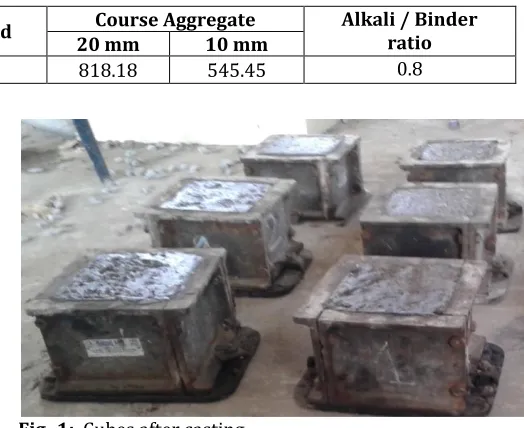
GGBS Silica fume Gypsum Quartz sand Course Aggregate Alkali / Binder ratio 20 mm 10 mm
363.64 90.91 22.73 681.81 818.18 545.45 0.8
2.3 Preparation of geopolymer concrete
In geopolymer concrete, gypsum is used (5% of binder) to achieve the desired setting time in the finished product. 80% of GGBS combined with 20% of silica fume is used as a binder. Quartz sand as fine aggregate and conventional coarse aggregate were used as aggregate. Na2SiO3 and NaOH are used as alkali activators. Although Potassium Hydroxide (KOH) and Potassium silicate (K2SiO3) can also be used as Alkali activators it is expensive compared to Sodium Hydroxide (NaOH) and Sodium Silicate (Na2SiO3). [image:3.612.315.577.114.328.2]
Separate solutions of Sodium Hydroxide (NaOH) and Sodium Silicate (Na2SiO3) of required concentrations were prepared 1 hour prior to concrete mixing. Both these solutions were mixed with the other ingredients at the time of casting. Mixing of all the materials has been done in the laboratory at room temperature. The GGBS, Silica fume and aggregates were mixed together by hand mixing for about 3 minutes. The alkali activated solutions used for synthesis were then added into the blend and mixing is continued for another 2 minutes. After mixing, the fresh concrete is cast into the moulds of size (150 mm x 150 mm x 150 mm) in three layers with each layer compacted by 25 blows using standard tamping rod of 20 mm diameter. These samples were vibrated using vibration table for another 1 minute.
Fig -1: Cubes after casting
2.4 Curing of geopolymer concrete
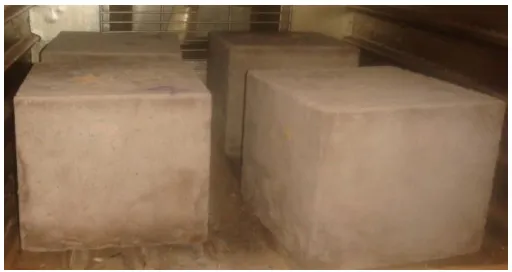
After casting the specimens, they were kept at room temperature for 16 to 24 hours and then were unmoulded. After then, these specimens were kept at room temperature for 28 days for curing under ambient air as shown in Figure 2a. After completion of 28 days, the specimens were kept at 100oC in hot oven for 5 hours as shown in Figure 2b.
[image:3.612.85.529.494.673.2]© 2016, IRJET | Impact Factor value: 4.45 | ISO 9001:2008 Certified Journal
| Page 285
Fig -2b: Cubes in oven.
3. RESULTS AND DISCUSSION
3.1 Density of geopolymer concrete
[image:4.612.34.577.296.448.2]
The density of geopolymer concrete was found approximately equivalent to that of conventional concrete. The affect of Alkali solution is not very significant on density of Geopolymer concrete. From the earlier studies also [3], it is clear that the average density of GGBS-based geopolymer concrete is similar to that of OPC concrete (2400 kg/m3).
Table -2: Densities of Geopolymer concrete
CODE NaOH Na2SiO3
WEIGHT (kg) DENSITY
(kg/m3)
SAMPLE 1 SAMPLE 2 SAMPLE 3 AVERAGE Z1
9M
20% 8.114 8.246 8.18 8.2 2423.70
Z2 35% 8.096 8.058 8.082 8.1 2393.67
Z3 50% 8.066 8.024 8.32 8.1 2410.86
Z4
14M
20% 8.148 8.23 8.204 8.2 2427.85
Z5 35% 8.184 8.142 8.294 8.2 2431.60
Z6 50% 7.68 7.55 7.324 7.5 2227.55
Z7
19M
20% 8.136 8.342 8.212 8.2 2438.51
Z8 35% 8.266 8.308 8.234 8.3 2450.17
Z9 50% 7.392 7.57 7.436 7.5 2212.14
Chart -1:Density of Geopolymer concrete
The difference between the Densities of Geopolymer concrete (GPC) is less in GPC with 20% of Sodium Silicate irrespective of molarity of NaOH. In case of GPC with 35%
of Sodium Silicate, the Density increases by 1.58% and 2.36% in GPC with 14M and 19M NaOH respectively when compared with GPC with 9M NaOH Solution. Whereas in GPC with 50% of Sodium Silicate, the Density decreases by 7.60% and 8.24% in GPC with 14M and 19M NaOH respectively when compared with GPC with 9M NaOH Solution.
3.2 Compressive strength
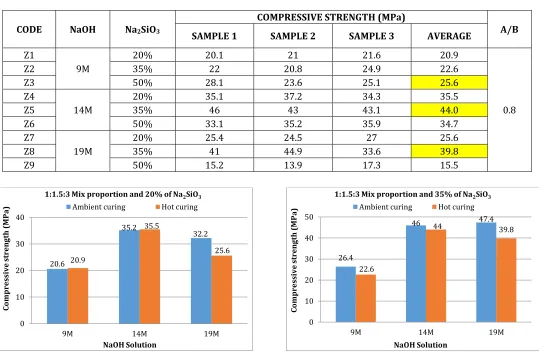
The temperature effect on Geopolymer concrete is also carried out on 150 mm x 150 mm x 150 mm size cube. After 28 days of ambient air curing, cubes are kept in an oven for 5 hours at constant temperature of 100oC. They are tested in compressive testing machine and compressive strengths are recorded. The compressive strengths of cubes exposed to temperature are shown in the Fig 2a.
2423.7 2427.85 2393.67 2431.6 2410.86
2227.55
2438.51 2450.17
2212.14
2000 2100 2200 2300 2400 2500
20% 35% 50%
D
ens
it
y
(kg/m
3)
Percentage of Sodium Silicate
© 2016, IRJET | Impact Factor value: 4.45 | ISO 9001:2008 Certified Journal
| Page 286
Table - 3a: Compressive strength of Geopolymer concrete
CODE NaOH Na2SiO3
COMPRESSIVE STRENGTH (MPa)
A/B SAMPLE 1 SAMPLE 2 SAMPLE 3 AVERAGE
Z1
9M
20% 20.5 21 20.3 20.6
0.8
Z2 35% 30.7 23.4 25.1 26.4
Z3 50% 28.1 26 24.3 26.1
Z4
14M
20% 36.2 34.6 34.9 35.2
Z5 35% 45.1 48.4 44.5 46
Z6 50% 34.5 33.8 36.2 34.8
Z7
19M
20% 29.3 32.5 34.9 32.2
Z8 35% 46.3 51.8 44 47.4
Z9 50% 17.8 17.6 17.1 17.5
Table - 3b: Compressive strength after elevated temperature of Geopolymer concrete
CODE NaOH Na2SiO3
COMPRESSIVE STRENGTH (MPa)
A/B SAMPLE 1 SAMPLE 2 SAMPLE 3 AVERAGE
Z1
9M
20% 20.1 21 21.6 20.9
0.8
Z2 35% 22 20.8 24.9 22.6
Z3 50% 28.1 23.6 25.1 25.6
Z4
14M
20% 35.1 37.2 34.3 35.5
Z5 35% 46 43 43.1 44.0
Z6 50% 33.1 35.2 35.9 34.7
Z7
19M
20% 25.4 24.5 27 25.6
Z8 35% 41 44.9 33.6 39.8
Z9 50% 15.2 13.9 17.3 15.5
Chart -2:20% of Sodium Silicate (Na2SiO3) Chart -3:35% of Sodium Silicate (Na2SiO3)
20.6
35.2
32.2
20.9
35.5
25.6
0 10 20 30 40
9M 14M 19M
Com
pre
ss
iv
e
st
re
n
gt
h
(M
Pa)
NaOH Solution
1:1.5:3 Mix proportion and 20% of Na2SiO3
Ambient curing Hot curing
26.4
46 47.4
22.6
44 39.8
0 10 20 30 40 50
9M 14M 19M
Com
pre
ss
iv
e
st
re
n
gt
h
(M
Pa)
NaOH Solution
1:1.5:3 Mix proportion and 35% of Na2SiO3
[image:5.612.39.578.294.649.2]© 2016, IRJET | Impact Factor value: 4.45 | ISO 9001:2008 Certified Journal
| Page 287
Chart -4:50% of Sodium Silicate (Na2SiO3) From Chart 2 – Chart 4,
The following observations can be made in case of Geopolymer concrete exposed to 1000C.
1. In case of Geopolymer concrete with 20% of Na2SiO3 Solution, the strength increased by 1.45% and 0.85% for temperature exposed GPC with 9M and 14M of NaOH Solution respectively when compared with ambient air exposed GPC. Whereas decrease in strength is 20.49% in temperature exposed GPC when compared to GPC with 19M of NaOH Solution in ambient air curing.
2. In case of Geopolymer concrete with 35% of Na2SiO3 Solution, the strength decreased by 14.39%, 4.34% and 16.03% for temperature exposed GPC with 9M, 14M and 19M of NaOH Solution respectively when compared to ambient air exposed GPC.
3. In case of Geopolymer concrete with 50% of Na2SiO3 Solution, the strength decreased by 1.91%, 0.28% and 11.42% for temperature exposed GPC with 9M, 14M and 19M of NaOH Solution respectively when compared to ambient air exposed GPC.
Chart -5: 9M Sodium Hydroxide (NaOH)
Chart -6: 14M Sodium Hydroxide (NaOH)
Chart -7: 19M Sodium Hydroxide (NaOH) From Chart 5 – Chart 7,
The following observations can be made in case of Geopolymer concrete exposed to 1000C.
1. In case of Geopolymer concrete with 9M of NaOH Solution, the strength increased by 1.45% for temperature exposed GPC with 20% of Na2SiO3 Solution when compared with ambient air exposed GPC. Whereas strength decreased by 14.39% and 1.91% for temperature exposed GPC with 35% and 50% of Na2SiO3 Solution when compared with ambient air GPC. 2. In case of Geopolymer concrete with 14M of NaOH Solution, the strength increased by 0.85% for temperature exposed GPC with 20% of Na2SiO3 Solution when compared with ambient air exposed GPC. Whereas strength decreased by 4.34% and 0.28% for temperature exposed GPC with 35% and 50% of Na2SiO3 Solution when compared with ambient air GPC. 3. In case of Geopolymer concrete with 19M of NaOH Solution, the strength decreased by 20.49%, 16.03% and 11.42% for temperature exposed GPC with 20%,
26.1 34.8 17.5 25.6 34.7 15.5 0 10 20 30 40
9M 14M 19M
Com pre ss iv e st re n gt h (M Pa)
NaOH Solution
1:1.5:3 Mix proportion and 50% of Na2SiO3
Ambient curing Hot curing
20.6
26.4 26.1
20.9 22.6
25.6
0 10 20 30
20% 35% 50%
Com pre ss iv e st re n gt h (M Pa)
Na2SiO3 Solution
1:1.5:3 Mix proportion and 9M of NaOH
Ambient curing Hot curing
35.2 46 34.8 35.5 44 34.7 0 10 20 30 40 50
20% 35% 50%
Com pre ss iv e st re n gt h (M Pa)
Na2SiO3 Solution
1:1.5:3 Mix proportion and 14M of NaOH
Ambient curing Hot curing
32.2 47.4 17.5 25.6 39.8 15.5 0 10 20 30 40 50
20% 35% 50%
Com pre ss iv e st re n gt h (M Pa)
Na2SiO3 Solution
1:1.5:3 Mix proportion and 19M of NaOH
© 2016, IRJET | Impact Factor value: 4.45 | ISO 9001:2008 Certified Journal
| Page 288
35% and 50% of Na2SiO3 Solution when compared withambient air GPC.
4. CONCLUSION
Based on the experimental work reported in this study, the following conclusions are drawn:
1. Geopolymer concrete of grades in the range of 20 MPa to 50 MPa can be made using Alkali activators with GGBS + Silica Fume as binder.
2. GPC with 35% of Na2SiO3 Solution gives the maximum compressive strength when compared to GPC with 20% and 50% Na2SiO3 Solution irrespective of the Molarity of Sodium Hydroxide Solution both in ambient curing and elevated temperature. Although the GPC is expected to give highest compressive strength at 50% Na2SiO3, the strengths are observed to be less. The possible reason could be that the solution becomes harsh and difficult to mix uniformly in case of GPC with 50% Na2SiO3. This also resulted in low relatively low density of GPC with 50% Na2SiO3.
3. Elevated temperature upto 1000C for 5 hours has no significant affect on the Geopolymer concrete after 28 days of curing in ambient air.
4. The average density of GGBS and Silica fume based geopolymer concrete is similar to that of OPC concrete.
In summary, Geopolymer concrete is more environmental friendly and has potential to replace OPC concrete in many applications such as precast units.
ACKNOWLEDGEMENT
I would like to thank Department of Civil Engineering and MVGR College of Engg, for their support in doing this work.
REFERENCES
1) Rajamane N. P. and Jeyalakshmi R. “Quantities of sodium hydroxide solids and water to prepare sodium hydroxide solution of given molarity for geopolymer concrete mixes” The Indian Concrete Journal Aug – Sep. 2014.
2) Anurag Mishra, Deepika, Namrata, Manish, Nidhi and Durga “Effect of concentration of alkaline liquid and Curing time on strength and water absorption Of geopolymer concrete” ARPN journal of engineering and applied science, Vol 3, NO 1, pp.14-18, Feb. 2008. 3) K. Vijai, R.Kumutha and B.G.Vishnuram “Effect of types
of curing on strength of geopolymer concrete” International Journal of the Physical Sciences Vol. 5(9), pp. 1419-1423, 18 August, 2010.
4) J. Temuujin, A. van Riessen, K.J.D. MacKenzie “Preparation and characterisation of fly ash based geopolymer mortars” Elsevier Construction and
Building Materials 24 (2010) 1906–1910, 20 April 2010.
5) Prakash R. Vora and Urmil V. Dave “Parametric Studies on Compressive Strength of Geopolymer Concrete” Elsevier Procedia Engineering 51 ( 2013 ) 210 – 219. 6) Pradip Nath and Prabir Kumar “Effect of GGBFS on
setting, workability and early strength properties of fly ash geopolymer concrete cured in ambient condition” Elsevier Construction and Building Materials 66 (2014) 163–171.
7) Gokhan Gorhan and Gokhan Kurklu “The influence of the NaOH solution on the properties of the fly ash-based geopolymer mortar cured at different temperatures” Elsevier Composites: Part B 58 (2014) 371–377.
8) M.J.A. Mijarsh, M.A. Megat Johari and Zainal Arifin Ahmad “Compressive strength of treated palm oil fuel ash based geopolymer mortar containing calcium hydroxide, aluminum hydroxide and silica fume as mineral additives” Elsevier Cement and Concrete Composites 60 (2015) 65–81.
9) M.J.A. Mijarsh, Megat Johari and Zainal Arifin “Effect of delay time and Na2SiO3 concentrations on compressive strength development of geopolymer mortar synthesized from TPOFA” Elsevier Construction and Building Materials 86 (2015) 64–74.
10)Arie Wardhono, David and Anthony Stranob “The strength of alkali-activated slag/fly ash mortar blends at ambient temperature” Elsevier Procedia Engineering 125 ( 2015 ) 650 – 656.
11)Mohammed, Andreas, Andrew and Steve Meikle “Development of geopolymer mortar under ambient temperature for in situ applications” Elsevier Construction and Building Materials 120 (2016) 198– 211.
12)IS 516: 1959 Methods of tests for strength of concrete, Bureau of Indian Standards, New Delhi, India.
13)IS 12089-1987, Specification for GGBS (Ground Granulated Blast Furnace slag natural sources for Geo-polymer concrete, Bureau of Indian Standards, New Delhi, India.
14)IS 15388-2003, Specification for Silica Fume from natural sources for concrete, Bureau of Indian Standards, New Delhi, India.
15)IS 1727-1967, Specification for Test procedures for pozzolanic materials natural sources for concrete, Bureau of Indian Standards, New Delhi, India.
16)IS 383-1970, Specification for coarse and fine aggregate from natural sources for concrete, Bureau of Indian Standards, New Delhi, India.