Georgia State University Georgia State University
ScholarWorks @ Georgia State University
ScholarWorks @ Georgia State University
Biology Honors Theses Department of Biology
Winter 12-17-2014
The Effects of Visual Color Stimuli on Zebra Finch Behavior and
The Effects of Visual Color Stimuli on Zebra Finch Behavior and
Stress Response
Stress Response
Bao Chau Ly
Follow this and additional works at: https://scholarworks.gsu.edu/biology_hontheses
Recommended Citation Recommended Citation
Ly, Bao Chau, "The Effects of Visual Color Stimuli on Zebra Finch Behavior and Stress Response." Thesis, Georgia State University, 2014.
https://scholarworks.gsu.edu/biology_hontheses/8
i
THE EFFECTS OF VISUAL COLOR STIMULI ON ZEBRA FINCH BEHAVIOR AND
STRESS RESPONSE
An Honors Thesis
Submitted in Partial Fulfillment of the
Requirements for Graduation with
Undergraduate Research Honors
Georgia State University
2014
by
Bao Chau Ly
Committee:
____________ ___________
Dr. Laura L. Carruth, Honors Thesis Director
______________________________ Dr. Sarah Cook, Honors College Associate Dean
ii
THE EFFECTS OF VISUAL COLOR STIMULI ON ZEBRA FINCH BEHAVIOR AND
STRESS RESPONSE
by
BAO CHAU LY
Under the Direction of Laura L. Carruth, Ph.D
ABSTRACT
The Australian Zebra Finch, Taeniopygia guttata, is a common vertebrate model for
understanding behavioral, neurological, and physiological changes across the life span. The goal
of this study was to determine if color in the environment can act as a stimulus and activate the
zebra finch stress response. Zebra finches are diurnal and have color vision. Their plumage
coloration is sexually dimorphic and they show behavioral changes to color; females prefer
males with redder beaks, and both sexes show individual color preferences for materials in nest
building. This experiment was conducted to test whether or not a novel color in the environment
can elicit a stress response. A colored poster board was introduced to the adult zebra finches’
habitat, and behavioral changes were measured immediately and then again after twenty four
hours. In addition, plasma corticosterone (CORT), the main avian stress hormone,
concentrations were measured twenty four hours after introduction of the color stimulus. The
introduction of the color stimuli resulted in immediate behavioral changes in the birds and
increased activity was observed with the addition of green, blue, and red stimuli and decreased
activity with the addition of yellow. However, after twenty four hours there were no changes in
iii
show varied behavioral responses to novel stimuli based on color differences and that these
changes are temporary.
INDEX WORDS: Zebra Finch, Color Stimuli, Visual Stressor, Behavioral Change,
iv
THE EFFECTS OF VISUAL COLOR STIMULI ON ZEBRA FINCH BEHAVIOR AND
STRESS RESPONSE
by
BAO CHAU LY
An Honors Thesis Submitted in Partial Fulfillment of the Requirements for the Degree of
Bachelors of Biological Sciences
in the College of Arts and Sciences
Georgia State University
v
Copyright by Bao Chau Khuong Ly
vi
THE EFFECTS OF VISUAL COLOR STIMULI ON ZEBRA FINCH BEHAVIOR AND
STRESS RESPONSE
by
BAO CHAU LY
Honors Thesis Director: Laura L. Carruth, Ph.D Honors College Associate Dean: Dr. Sarah Cook
Electronic Version Approved:
vii
DEDICATION
I dedicate the thesis to my parents, Man and Linh Ly, for having been an exemplary
support system in my academic career, and as a result, helped me realized my predilection for
viii
ACKNOWLEDGEMENTS
I would like to acknowledge Dr. Laura L. Carruth for her support and mentorship through this
research project. Thank you for believing in my idea.
I would also like to acknowledge Ethan B. Dyer for his generosity and reinforcement through
this process. Finally, I would like to acknowledge Shauna C. Cheesman and several others for
their assistance.
ix
TABLE OF CONTENTS
DEDICATION vii
ACKNOWLEDGEMENTS viii
LIST OF TABLES x
CHAPTER
1. INTRODUCTION 1
2. METHODS 5
Animal Subjects 5
Color Exposure 5
Behavioral Observations 6
Plasma CORT Concentration 6
Radioimmunoassay 6
Statistical Analysis 7
3. RESULTS 8
x
Behavioral data 9
4. DISCUSSION
5. DISCUSSION 10
6. CONCLUSIONS 13
7. FUTURE DIRECTIVES 14
xi
LIST OF TABLES
Table 1. Plasma CORT levels before the addition of colored poster boards and 24 hours after the
addition of colored poster boards………. 8
Table 2. Qualitative descriptions of posture and activity after the addition of color and control
1
INTRODUCTION
Australian zebra finches (Taeniopygia guttata) are highly social birds endemic to the
grasslands of Australia (Zann, 1996). Due to their sociability, accessibility, domestication, and
ease of maintenance, they are a common song bird. As with all birds, color is an important visual
cue for social interactions (Etman et al., 2001). This study was designed to test whether or not a
novel color in the environment can elicit a stress response as measured by changes in behavior
and increase in plasma stress hormone levels.
Zebra finches are commonly used in studies that examine changes in physiological
functioning, such as those associated with acute (short-term as measured in seconds to minutes)
and chronic stress or long-term stress (Griffith and Buchanan, 2010; Perfito, 2010). The two
main adrenal stress hormones, or glucocorticoids, corticosterone (CORT) and cortisol, are
secreted in response to stress. Corticosterone is the main stress hormone in birds and rodents
while cortisol is the primary stress hormone in primates and fishes (Palme et al., 2005). When an
animal is stressed (either by a negative or positive stressor) the
hypothalamic-pituitary-adrenocortical (HPA) feedback system is activated, stimulating the hypothalamus to release
corticotropic releasing hormone (CRH), which acts on the anterior pituitary gland to release
adrenocorticotropic hormone (ATCH), signaling the adrenal cortex to synthesize and secrete
glucocorticoids (Dallman et al., 2004; Malisch et al., 2007). For zebra finches, stressors can
include environmental stimuli, such as predator exposure, food shortage, social isolation, and
physical stressors, such as human handling or temperature changes (Eraud et al., 2007; McGraw
et al., 2011). Circulating CORT increases gluconeogenesis or the availability of circulating
glucose as an energy source, lowers metabolic rate, and increases peripheral blood flow
2
elevated circulating plasma CORT levels may have deleterious chronic effects on the physiology
homeostasis of an organism. These effects include prolonged mobilization of energetic resources
causing growth suppression, continual breakdown of proteins resulting in muscle wastage,
changes in physical features due to immunocompetence, and impaired cognitive and behavioral
functions due to neuronal death (Axelrod and Reisine, 1984; Bremner, 1999; Johnson et al.,
1992).
Zebra finches are a sexually dimorphic species, with the sexes differing in two distinct ways,
behaviorally and in their plumage and bill coloration. Males have redder bills, black and
white-striped collar feathers and orange cheek patches, while female plumage is typically muted brown
and their beaks are orange. In addition, males sing a courtship song that females cannot sing and
they learn this song from a male tutor, usually their father (Deregnaucourt and Gahr, 2013).
Zebra finches have a complex process of mate selection that is driven by female mate choice.
Females prefer males that sing a more complex song and who have redder bills, (Griffith and
Buchanan, 2010). Zebra finches are also a diurnal species and have excellent color vision that
allows them to assess the coloration of their mates as well as the environment (Bowmaker et al.,
1997; Maddocks et al., 2001). They also have been shown to display behavioral changes based
on color (Bolund et al., 2007; Hunt et al., 1997). When male zebra finches are exposed to the
steroid hormone testosterone for short periods, their bills become redder and they exhibit higher
levels of aggression and become more dominant (Ardia et al., 2010).
There are many studies that have examined the influence of color on animal behavior and
physiology and various colors and hues may have significant effects on the growth and
development of vertebrates. For example, yellow light lowers the stress-induced cortisol
3
decreased stress response (Heydarnejad et al., 2013). A different species of fish, the Nile tilapia
was reported to prefer yellow light as well, however after seven days of confinement, stressed
fish demonstrated a decrease in ventilation frequency (the higher the frequency, the more
stressed the fish is) when exposed to blue light (Maia and Volpato, 2013). In humans
environment color also plays a significant role in stress perception. Research by Kutchma and
colleagues (2003) demonstrated that when test subjects were kept in red rooms, they reported a
higher stress perception than subjects in white or green rooms.
As with all vertebrates, the zebra finch HPA axis is highly evolutionarily conserved and can
be experimentally manipulated (Shahbazi et al., 2011). Although there have been no published
studies on how and if environmental colors can act as a stressor for birds, zebra finches are well
documented to show complex color mediated behavior. Females prefer male conspecifics
wearing red leg bands to orange leg bands, and disfavored males with light green leg bands
(Burley et al., 1982); this color preference was found to be inhibited by an ultraviolet light filter
(Hunt et al., 1997). Zebra finches also show color preferences which vary between individuals—
for nest building, Sargent found that birds preferred brown over green (Sargent, 1965) while later
studies showed preferences for green to brown. Individual color preferences for nest building
materials vary; some prefer brown, while others prefer green or blue (Muth et al., 2013).
Since zebra finches have been demonstrated to show robust behavioral changes in response to
color, it is important to understand if the colors can be a stressor. Different environmental
conditions may cause activation of the HPA axis and stress response. Furthermore, the use of
color in housing conditions may also be used to facilitate the stress axis activation, providing a
4
For this study, we recorded changes in behavior and plasma CORT in zebra finches after
exposure to different colors in the environment for 24 hours. We found that there were no
significant changes in behavior or CORT plasma concentrations before or after the introduction
5
MATERIALS and METHODS
Animal Subjects:
For this study, 5 male and 5 female zebra finches were used. Prior to starting the experiment
subjects were housed in large flight cages (60 3/8” W x 30 3/8” D x 78 ¼”H) with multiple
families and mixed age cohorts and then transferred to stackable cages (38 5/16"W x 20 3/8"D x
20"H) and separated upon sex for the duration of the study. All subjects had identifiable color
band that were of no specific designation. Red bands were avoided. All subjects were adults of
12-24 months of age. All of the birds were healthy; however, female Brown 42 had an on-going
eye infection that was continuously treated with veterinarian-grade tropical antibiotic. Birds were
kept under controlled environmental conditions (temperature 21.1–23.8 °C, humidity 50–65%,
constant light schedule of 12L: 12D, lights on at 08:00 with standard fluorescent lighting) at the
Georgia State University animal care facility in the Petit Science Center. All finches received a
mixed seed (Fort-Diet Pro Health Finch, Kaytee Products, Wisconsin) diet, water, grit and
cuttlefish bone (calcium) ad libitum. All animal procedures were approved by the Georgia State
University Institutional Use and Animal Care Committee.
Color Exposure:
The subjects were exposed to five monotone colors (blue, yellow, green, red with white as the
control) during the experimental period. A monotone color board (Roselle Vibrant Art
Construction Paper, Assorted) of 18’’x 24’’ was taped on the back wall and a 9’’x 12’’ color
6
Behavioral Observations:
Acute behaviors were recorded before placement of stimulus, immediately after, and 24 h
post-exposure. Behaviors, such as perch hoping, body positioning relative to stimulus and
beak-opening were qualitatively compared within each trial.
Plasma CORT Concentration:
CORT was analyzed in blood plasma. Baseline blood samples were collected on day 1. After
exposing the subjects to stimulus for 24 h, experimental blood samples were collected. Blood
was collected followed the protocol of Newman et al., 2010. Briefly, blood samples were
collected from the alar wing vein by puncturing the vein using a 26-gauge needle and blood was
then collected into heparinized microhematocrit tubes. The blood collection occurred within 3
min after capture at the same time each day (around 1100 h EST) for each bird to prevent
fluctuation in CORT level due to handling stress. Blood samples were kept on ice until
centrifuged. After centrifuging blood, plasma was collected and stored at -20oC until analysis. A 10 day-rest period was given between each trial to allow sufficient blood replenishment. CORT
level was analyzed with 2 tail-T test.
Radioimmunoassay:
Corticosterone level measurement followed the procedure of Shahbazi et al., 2014. Total
plasma CORT concentrations were measured using a Corticosterone Radioimmunoassay (RIA)
kit (Corticosterone 125I RIA kit, catalog # 07 – 120102; MP Biomedicals LLC, Solon, OH, for
rat plasma). To validate the assay, pooled zebra finch plasma was run with pooled rat and
7
(by adding 6.25ng and 12.5ng through serial dilution of 25ng standard to increase sensitivity).
Once this was established, a dilution series (1:2 98%, 1:4 102%, and 1:6 115%) of zebra finch
plasma was run to get linearity and obtained the overall recovery. In addition to the two (low and
high concentrations of CORT) controls that were provided by the kit, pools of zebra finch, rat
(control for assay), and hamster (in house control) plasma were used as extra controls for each
assay run. Recovery rate was 98% and detection limit was 6.25-1000 ng / ml. Intra-assay &
inter-assay coefficient variations were 4.4% and 14.6%, respectively.
Statistical Analysis:
All data were analyzed using IBM SPSS Statistics for Windows, version 19.0 (SPSS Inc,
Chicago, IL). First, data were examined for assumptions of parametric statistical test but no
assumptions were violated. We used one-tailed test in our statistical analysis because of our
8
RESULTS
CORT Assay:
Baseline CORT was established by assaying blood collected 24 h prior to the addition of
colored poster boards. Experimental plasma CORT levels (24 h CORT) was established by
assaying blood collected from the subjects 24 h after the addition of the colored poster boards.
Due to the small size of the birds, it is not possible to collect two blood samples within 24 hours
of each other. Male and female plasma CORT levels were analyzed after exposure to the colors
yellow, red, blue, and white; male and female plasma CORT levels were combined for green
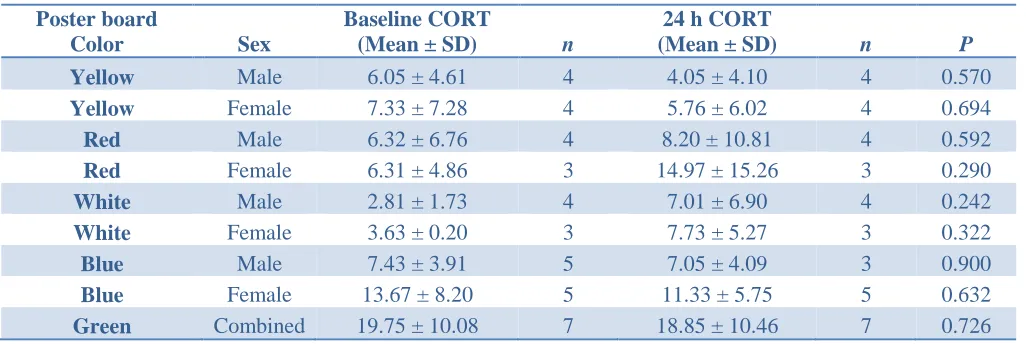
color. There were no significant differences (P <0.025) found in any of the baseline CORT when
[image:20.612.66.579.429.601.2]compared to the 24 h CORT levels.
Table 1. Plasma CORT levels before the addition of colored poster boards and 24 hours after the
addition of colored poster boards.
Poster board
Color Sex
Baseline CORT
(Mean ± SD) n
24 h CORT
(Mean ± SD) n P
Yellow Male 6.05 ± 4.61 4 4.05 ± 4.10 4 0.570
Yellow Female 7.33 ± 7.28 4 5.76 ± 6.02 4 0.694
Red Male 6.32 ± 6.76 4 8.20 ± 10.81 4 0.592
Red Female 6.31 ± 4.86 3 14.97 ± 15.26 3 0.290
White Male 2.81 ± 1.73 4 7.01 ± 6.90 4 0.242
White Female 3.63 ± 0.20 3 7.73 ± 5.27 3 0.322
Blue Male 7.43 ± 3.91 5 7.05 ± 4.09 3 0.900
Blue Female 13.67 ± 8.20 5 11.33 ± 5.75 5 0.632
9
Behavior Data:
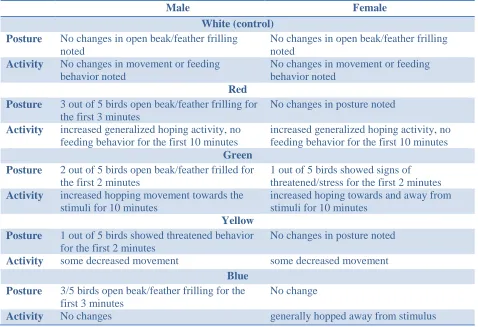
After the color stimulus was added to the cages that contained the experimental birds, we
observed immediate changes in behavior during the 10-min observation period. These changes
will be quantified as part of a future study; qualitative assessment was performed for the current
study. There were no observed differences in behavior of the experimental birds 24 h after
exposure to color stimulus. As predicted, there were no observed behavioral changes after
[image:21.612.66.544.348.675.2]exposure to the control and the color stimuli. These findings are summarized in Table 2.
Table 2. Qualitative descriptions of posture and activity after the addition of color and control
stimuli to each cage.
Male Female
White (control) Posture No changes in open beak/feather frilling
noted
No changes in open beak/feather frilling noted
Activity No changes in movement or feeding behavior noted
No changes in movement or feeding behavior noted
Red Posture 3 out of 5 birds open beak/feather frilling for
the first 3 minutes
No changes in posture noted
Activity increased generalized hoping activity, no feeding behavior for the first 10 minutes
increased generalized hoping activity, no feeding behavior for the first 10 minutes
Green Posture 2 out of 5 birds open beak/feather frilled for
the first 2 minutes
1 out of 5 birds showed signs of threatened/stress for the first 2 minutes
Activity increased hopping movement towards the stimuli for 10 minutes
increased hoping towards and away from stimuli for 10 minutes
Yellow Posture 1 out of 5 birds showed threatened behavior
for the first 2 minutes
No changes in posture noted
Activity some decreased movement some decreased movement
Blue Posture 3/5 birds open beak/feather frilling for the
first 3 minutes
No change
10
DISCUSSION
There were no significant changes in plasma CORT levels after 24 h of exposure to any of the
color stimuli. We were not able to determine if there were any changes in acute plasma CORT
due to physical limitations of the subjects. To perform a second blood sampling without
sufficient recovery time, i.e. 24 h, would place the birds under great health risk. CORT plasma
levels for individual birds were assayed individually and sexes were analyzed separately. We
hypothesized that the HPA axis would be activated (as determined by an elevation in plasma
CORT) after exposure to the color stimuli; however, the results do not support this hypothesis.
There were no major variations in individual bird responses to the colors, and the one outlier (a
sick female bird) was excluded from the analysis.
Behavioral changes were noted immediately after the introduction of each color stimulus that
were not observed with the control (white). However, after 24 h, the zebra finch behavior was
comparable to baseline. This is consistent with the hypothesis that novel colors (stimuli) in the
environment cause temporary behavioral and hormonal changes (we could not verify this).
However, it is possible that the birds may still have been stressed 24 hours after color placement,
and behavioral changes may have been too minor to measure. Chronic exposure to stressors may
engender more long-term physiological changes, such as weigh fluctuations, phenotypic
coloration, and maximal growth size (e.g., Strochlic and Romero, 2008; Rosenthal et al., 2012).
The acute changes in behavior noted for the finches may be typical when novel stimuli are
introduced. However, it is interesting to note that the subjects behaved differently when exposed
to different colors. This suggests that zebra finches have psychophysiological association to
colors of different wavelengths—similar to the way that color has been shown to affect mood
11
It was expected that the addition of the white control would not cause a change in behavior or
plasma CORT concentration. This indicates that color exposure alone was sufficient enough to
affect behavioral change and that observed responses were not only due to the neophobia of
having a novel object placed in their environments.
The most observable changes in behavior were noted during the first 10 min of exposure to
the red color stimulus. Both male and female subjects stopped feeding, became fixated on the
poster boards, and increased movement around their enclosure. Males showed an increase in
stress-associated behaviors, such as opening of beak and feather frilling. This robust response is
consistent with mating selection color preferences seen in the species. Female zebra finches have
a predilection towards male finches with red beaks over other color variations, as the red body
color tone acts as a marker for reproductive fitness. Vivid colors are correlated with high
carotenoid circulation—an indirect measure of physiological health (Endler, 1983). Because
carotenoids are acquired from diet, beak redness may be indicative of foraging ability, health and
nutritional intake (Hill, 1992; Loranzo, 1994). Zebra finches metabolize carotenoids to
keto-carotenoids, an energy-demanding metabolic process, to enrich the color of their beaks (McGraw
and Toomey, 2010). Therefore, conspecifics with the most vibrant colors suggest reproductive
fitness (Hill, 1996). Since strong color preferences for red evolved in the zebra finch, it is
reasonable to expect behavioral expression to be displayed outside of the sexual context.
Further analysis is required to understand the variations in acute behavior to the introduction
of yellow, green, and blue poster boards. Birds show diverse color preferences, which vary
between conspecifics and species; for instance zebra finches show individual variations in color
preference for materials used for nest building (Muth et al., 2013), and the kea (Nestor notabilis),
12
consumes (Weser and Ross, 2013). Currently, there are no published studies that explore the
immediate behavior and physiological changes in zebra finches caused by colors in the
environment. The future the data will be closely analyzed to extrapolate individual differences
13
CONCLUSIONS
This study seeks to create a better understanding of the physiological changes caused by an
environmental stimulus, such as color. The question of “Can a novel color in the environment
elicit a stress response as measured by changes in behavior and increase in plasma stress
hormone levels?” is addressed in this study. The results showed no significant changes in CORT
plasma levels in experimental in comparison to basal levels after 24 h post-exposure to any of the
colors, suggesting that color changes in the environment do not activate the HPA axis. However
it is important to note that the best measurement would have been to assay CORT within 15 min
of the initial color exposure. We were not able to do this because of limitations with taking a
second blood sample from the birds after the baseline sample was taken, and therefore there may
have been an initial elevation in CORT that was missed.
The introduction of the color stimuli resulted in immediate behavioral changes in the birds:
increased activity was observed with green, blue, and red poster boards; decreased activity was
observed with yellow poster board. In addition, male birds consistently showed more aggressive
behavior, i.e. beak opening and feathers frilling. These findings suggest that zebra finches show
temporary sexually dimorphic behavioral responses to novel stimuli based on color differences.
However, consistent with the lack of plasma CORT responses after the exposure of color
stimulus was the lack of change in behavior after 24 h; birds were feeding and behaving as they
14
FUTURE DIRECTIVES
There are many directions this research can take. First, it is important to determine if there
was an increase in plasma CORT that was missed by waiting 24 h before collecting blood. One
possibility is to measure the baseline CORT 24 h before the color exposure instead of 15 min
before the addition of the color stimulus. In addition, in order to further interpret acute
behavioral changes, each individual must be assessed for differences in response to the addition
of a novel colored poster board. Animals generally show differences in behavior and levels of
neophobia when confronted with novel stimuli within a species, ranging from shy to bold
(Verbeek et al., 1994; Wilson et al., 1993). Zebra finches may react differently to novel stimuli
based on their genetic predisposition or personality—in studies of house mice (Mus musculus)
Veenema et al. (2003) found that mice genetically selected for an active coping style are
associated with low HPA reactivity, while those with a passive coping style show high HPA
reactivity. Because of these differences in personalities, it is ideal to measure individual changes
in behavior across specific individuals. Also, it has been shown that individuals consistently
differ in their behavioral responses towards the same stressor in another songbird species great tit
(Parus major) (Carere et al., 2005). Therefore, there is little concern that individual behavior
would drastically change because they had previous experiences of color exposure.
Individual differences in HPA axis response based on personality may also have ramifications
on the way in which data should be analyzed. In addition to assessing immediate behavioral
changes to novel color stimuli, further analysis of physiological changes, such as CORT plasma
levels, will be analyzed on an individual basis. This is done to elucidate any trends in
15
Measuring changes to biologicals markers in addition to CORT could be used to better
understand the acute behavioral changes noted in response to color. The opening of beaks and
frilling of feathers are characteristic signs of aggression in many avian species. Therefore future
studies will not only assay CORT plasma levels but also levels of circulating androgenic
hormones.
More will be done to investigate the differences in acute behavioral response to the addition
of the novel stimuli of colored poster boards. As described above, for future studies, blood
samples will be collected in a shorter period post-exposure. An alternative to venipuncture that
was explored in other studies was observation of physiological markers of stressors, such as
breathing rate or body temperature (Cabanac and Guillemette, 2001; Carere and van Oers).
Another question we will seek to resolve in future studies is: what effect would room color
have on HPA activation and behavior? It is well established that room color can elicit changes in
mood and behavior (e.g. Nelson, 1984; Yildirim K et al., 2011). One concern is that responses
measured in this experiment may be due to stress typical of a novel object being introduced to
the environment; a significant portion (25% of the entire surface area) of the birds’ cage was
covered with the colored poster board. However, housing the birds in a room of a different color
may cause a behavioral response that is contingent on the color, and not on the presence of a
novel subject.
An alternative to changing the color of the walls in the room would be to use colored lighting.
Previous studies have investigated the effects of light colors on fish (Maia and Volpata, 2013;
Heydarnejad et al., 2013) to establish ideal housing conditions. Similar studies could be applied
16
that female zebra finches’ mate preferences change in the absence of UV (Hunt et al., 1997). So,
removing UV may induce behavioral responses that differ from the control.
Finally, if discovered that changing the color or light color of the room leads to changes in
HPA activity, further study will be conducted to evaluate long term effects of being housed in
17
REFERENCES
Ardia, D.R., Broughton, D.R., Gleicher, M.J., 2010. Short-term exposure to testosterone
propionate leads to rapid bill color and dominance changes in zebra finches. Hormones
and behavior 58, 526-532.
Axelrod, J., Reisine, T.D., 1984. Stress hormones: their interaction and regulation. Science 224,
452-459.
Bolund, E., Schielzeth, H., Forstmeier, W., 2007. Intrasexual competition in zebra finches, the
role of beak colour and body size. Animal Behaviour 74, 715-724.
Bowmaker, J.K., Heath, L.A., Wilkie, S.E., Hunt, D.M., 1997. Visual pigments and oil droplets
from six classes of photoreceptor in the retinas of birds. Vision research 37, 2183-2194.
Bremner, J.D., 1999. Does stress damage the brain? Biological psychiatry 45, 797-805.
Burley, N., Krantzberg, G., Radman, P., 1982. Influence of colour-banding on the conspecific
preferences of zebra finches. Animal Behaviour 30, 444-455.
Cabanac, A.J., Guillemette, M., 2001. Temperature and heart rate as stress indicators of handled
common eider. Physiology & behavior 74, 475-479.
Carere, C., Drent, P.J., Privitera, L., Koolhaas, J.M., Groothuis, T.G.G., 2005. Personalities in
great tits, Parus major: Stability and consistency. Animal Behaviour 70, 795-805.
Carere, C., van Oers, K., 2004. Shy and bold great tits (Parus major): Body temperature and
18
Dallman, M.F., Akana, S.F., Strack, A.M., Scribner, K.S., Pecoraro, N., La Fleur, S.E.,
Houshyar, H., Gomez, F., 2004. Chronic stress-induced effects of corticosterone on brain:
direct and indirect. Annals of the New York Academy of Sciences 1018, 141-150.
Delaunay, F., Khan, A., Cintra, A., Davani, B., Ling, Z.C., Andersson, A., Ostenson, C.G.,
Gustafsson, J., Efendic, S., Okret, S., 1997. Pancreatic beta cells are important targets for
the diabetogenic effects of glucocorticoids. The Journal of clinical investigation 100,
2094-2098.
Deregnaucourt, S., Gahr, M., 2013. Horizontal transmission of the father's song in the zebra
finch (Taeniopygia guttata). Biology letters 9, 20130247.
Endler, J.A., 1983. Natural and sexual selection on color patterns in poeciliid fishes.
Environmental biology of fishes 9, 173-190.
Eraud, C., Devevey, G., Gaillard, M., Prost, J., Sorci, G., Faivre, B., 2007. Environmental stress
affects the expression of a carotenoid-based sexual trait in male zebra finches. The
Journal of experimental biology 210, 3571-3578.
Etman, E.J., Lelieveld, H.M., ten Cate, C., 2001. Male bill colour and competition in zebra
finches. Behavioural processes 55, 119-124.
Griffith, S.C., Buchanan, K.L., 2010. The Zebra Finch: the ultimate Australian supermodel. Emu
110, v-xii.
Heydarnejad, M.S., Parto, M., Pilevarian, A.A., 2013. Influence of light colours on growth and
stress response of rainbow trout (Oncorhynchus mykiss) under laboratory conditions.
19
Hill, G.E., 1992. Proximate basis of variation in carotenoid pigmentation in male house finches.
Auk (American Ornithologists Union) 109, 1.
Hill, G. E. 1996. Redness as a measure of the production cost of ornamental coloration. Ethol.
Ecol. Evol. 8: 157/175.
Hunt, S., Cuthill, I.C., Swaddle, J.P., Bennett, A.T.D., 1997. Ultraviolet vision and band-colour
preferences in female zebra finches, Taeniopygia guttata. Anim Behav 54, 1383-1392.
Johnson, E.O., Kamilaris, T.C., Chrousos, G.P., Gold, P.W., 1992. Mechanisms of stress: a
dynamic overview of hormonal and behavioral homeostasis. Neuroscience and
biobehavioral reviews 16, 115-130.
Kutchma, T.M., 2003. The Effects of Room Color on Stress Perception: Red versus Green
Environments. Journal of Undergraduate Research at Minnesota State University;
Mankato 3, 3
Lozano, G.A., 1994. Carotenoids, parasites, and sexual selection. Oikos 70, 309-311.
Maddocks, S.A., Church, S.C., Cuthill, I.C., 2001. The effects of the light environment on prey
choice by zebra finches. The Journal of experimental biology 204, 2509-2515.
Maia, C.M., Volpato, G.L., 2013. Environmental light color affects the stress response of Nile
tilapia. Zoology (Jena, Germany) 116, 64-66.
Malisch, J.L., Saltzman, W., Gomes, F.R., Rezende, E.L., Jeske, D.R., Garland, T., Jr., 2007.
Baseline and stress-induced plasma corticosterone concentrations of mice selectively
bred for high voluntary wheel running. Physiological and biochemical zoology : PBZ 80,
20
McGraw, K.J., Lee, K., Lewin, A., 2011. The effect of capture-and-handling stress on
carotenoid-based beak coloration in zebra finches. Journal of comparative physiology. A,
Neuroethology, sensory, neural, and behavioral physiology 197, 683-691.
McGraw, K.J., Toomey, M.B., 2010. Carotenoid Accumulation in the Tissues of Zebra Finches:
Predictors of Integumentary Pigmentation and Implications for Carotenoid Allocation
Strategies. Physiological & Biochemical Zoology 83, 97-109.
Muth, F., Steele, M., Healy, S.D., 2013. Colour preferences in nest-building zebra finches.
Behavioural processes 99, 106-111.
Nelson, J.G., Pelech, M.T., Foster, S.F., 1984. Color preference and stimulation seeking.
Perceptual & Motor Skills 59, 913-914.
Newman, A.E., MacDougall-Shackleton, S.A., An, Y.S., Kriengwatana, B., Soma, K.K., 2010.
Corticosterone and dehydroepiandrosterone have opposing effects on adult
neuroplasticity in the avian song control system. The Journal of comparative neurology
518, 3662-3678.
Palme, R., Rettenbacher, S., Touma, C., El-Bahr, S.M., MÖStl, E., 2005. Stress Hormones in
Mammals and Birds: Comparative Aspects Regarding Metabolism, Excretion, and
Noninvasive Measurement in Fecal Samples. Annals of the New York Academy of
Sciences 1040, 162-171.
Perfito, N., 2010. The reproductive and stress physiology of Zebra Finches in context:
21
Rosenthal, M.F., Murphy, T.G., Darling, N., Tarvin, K.A., 2012. Ornamental bill color rapidly
signals changing condition. Journal of Avian Biology 43, 553-564.
Sakuragi, S., Sugiyama, Y., 2011. EFFECT OF PARTITION BOARD COLOR ON MOOD
AND AUTONOMIC NERVOUS FUNCTION. Perceptual & Motor Skills 113, 941-956.
Sargent, T., 1965. The role of experience in the nest building of the zebra finch. The Auk 82, 48–
61.
Shahbazi, M., Jimenez, P., Martinez, L.A., Carruth, L.L., 2014. Effects of housing condition and
early corticosterone treatment on learned features of song in adult male zebra finches.
Hormones and behavior 65, 226-237.
Shahbazi, M., Schmidt, M., Carruth, L.L., 2011. Distribution and subcellular localization of
glucocorticoid receptor-immunoreactive neurons in the developing and adult male zebra
finch brain. General and comparative endocrinology 174, 354-361.
Strochlic, D.E., Romero, L.M., 2008. The effects of chronic psychological and physical stress on
feather replacement in European starlings (Sturnus vulgaris). Comparative Biochemistry
and Physiology, Part A 149, 68-79.
Veenema, A.H., Meijer, O.C., de Kloet, E.R., Koolhaas, J.M., Bohus, B.G., 2003. Differences in
basal and stress-induced HPA regulation of wild house mice selected for high and low
aggression. Hormones and behavior 43, 197-204.
Verbeek, M.E.M., Drent, P.J., Wiepkema, P.R., 1994. Consistent individual differences in early
22
Weser, C., Ross, J.G., 2013. The effect of colour on bait consumption of kea ( Nestor notabilis ):
implications for deterring birds from toxic baits. New Zealand Journal of Zoology 40,
137-144.
Wilson, D.S., Coleman, K., Clark, A.B., Biederman, L., 1993. Shy-bold continuum in
pumpkinseed sunfish (Lepomis gibbosus): An ecological study of a psychological trait.
Journal of Comparative Psychology 107, 250-260.
Yildirim, K., Hidayetoglu, M.L., Capanoglu, A., 2011. EFFECTS OF INTERIOR COLORS ON
MOOD AND PREFERENCE: COMPARISONS OF TWO LIVING ROOMS. Perceptual
& Motor Skills 112, 509-524.
Zann, R.A., 1996. The Zebra Finch: A Synthesis of Field and Laboratory Studies
Zimmerman, T., Horber, F., Rodriguez, N., Schwenk, W.F., Haymond, M.W., 1989.
Contribution of insulin resistance to catabolic effect of prednisone on leucine metabolism