A Monthly Double-Blind Peer Reviewed Refereed Open Access International e-Journal - Included in the International Serial Directories
International Research Journal of Human Resources and Social Sciences (IRJHRSS)
Website: www.aarf.asia. Email: [email protected] , [email protected] Page 134
THE CHANGING PATTERN OF AFRICAN MIGRATION: BETWEEN
POLITICALLY FORCED AND ECONOMICALLY INDUCED
MOVEMENT ENGENDERED BY GLOBALIZATION
ADEOLA GABRIEL LANRE (PH.D),
LECTURER, DEPARTMENT OF SOCIAL SCIENCES,
POLITICAL SCIENCE AND INTERNATIONAL RELATIONS’ PROGRAMME, CRAWFORD UNIVERSITY,
FAITH CITY, IGBESA, OGUN STATE, NIGERIA
ABSTRACT
Migration which is as old as world civilization has been a dynamic phenomenon in African
history. Long before colonization, movement of people has been a permanent feature of
development in Africa. However, colonization brought another dimension to the entire
philosophy of migration, now involving international movement of people all over the place.
That period witnessed the movement of Arabs, Indians and Europeans in large numbers to the
continent. Typical destinations were northern Africa, East and Southern Africa. The
independence and more precisely the advent of neocolonialism saw Africans in great numbers
leaving the continent in what economists described as pull factor, a phenomenon induced by
economic reasons of seeking greener pastures abroad. This was the feature until the African
economies nosedived and Structural Adjustment Programmes (SAP) of the World Bank became
continental economic policies. The SAP having failed all over the continent, the new policy also
championed by the western powers was anchored on political imperatives of democratization
and human rights. This new policy better described by push factor has brought untold hardship
to Africans in terms of war, poverty and joblessness causing forced migration all over the
continent with the attendant consequences. While this persists, the economies have not been able
to pick up and so with poverty all over the place, families were being forced through subtle
strategies and campaign to migrate or emigrate to Europe or developed countries on working
Visa and so Africa is at cross roads of forced migration by political reasons and forced
A Monthly Double-Blind Peer Reviewed Refereed Open Access International e-Journal - Included in the International Serial Directories
International Research Journal of Human Resources and Social Sciences (IRJHRSS)
Website: www.aarf.asia. Email: [email protected] , [email protected] Page 135
downturns. Hence, the focus of this paper is this neglected area of research in particular, this
type of forced economic migration or emigration propelled by the advanced countries or their
agencies in dire need of qualified manpower and labour. And the inability of African
governments and policy makers to appraise the consequences of this novel brand of migration or
emigration of active and qualified labour force out of Africa under the guise of seeking greener
pastures from the harsh economic conditions and joblessness in Africa should be a matter of
concern for government and policy makers and be checked before Africa is once again
depopulated for lack of foresight. The paper went further to insist on adequate policy
formulation on population planning and migration by African governments and policy makers.
Key Words: Migration, population, emigration, policy maker, economic policies, labour force, globalization, Africa.
Introduction
Africa is typified by migration, a process which has distinguished the continent before
civilization began making it a continent on the move. In actual fact, movement of people within
the continent, from one country to the other has been a permanent characteristic of development
and cultural exchange before colonization changed the entire philosophy and modality of
movement. First, it introduced intercontinental and international dimension to the whole
phenomena. It began by the penetration of the Arabs, Europeans and Indians to the continent.
They settled in the north, east and southern parts of the continent. The Africans also migrated
abroad essentially for knowledge such that the first generation of leaders mostly travelled abroad
for higher education; such were the Nkrumah’s, the Azikwe’s, Awolowo’s who came back as
nationalist leaders. All through this period, migration has not posed any noticeable problem
internationally except the forceful partition of African continent by the colonization whereby kith
and kin were separated into different countries which continue to affect the geographical
imbalance in intra / international border relations.
Then came independence and the realities of colonization, modernization, industrialization and
the forceful integration of Africa into the world economy totally destroyed traditional forms of
production and social relations and lead to reshaping of nations and states. (Castles: 2009). The
A Monthly Double-Blind Peer Reviewed Refereed Open Access International e-Journal - Included in the International Serial Directories
International Research Journal of Human Resources and Social Sciences (IRJHRSS)
Website: www.aarf.asia. Email: [email protected] , [email protected] Page 136
governance, endemic conflicts and wars. These conditions lead both to economically motivated
and politically forced migration (Castles: 2009; 34)with attendant consequences, while the
African policy makers have not been able to adequately manage these migration flows in terms
of statistical and empirical data between intra national movements and international emigrations
because most studies or publications are based on projections.
In this dilemma, is centered the focus of this research, purportedly to create awareness on the
level and volume of “economically” forced migration of highly skilled professionals moving out
of Africa on masse through subtle but powerful information mechanism, diplomatically pursued
by the developed nations. The unsuspecting strategy is diversity population mix whereby
countries whose nationals are not well represented in their economies are attracted through
diversity visa to fill shortfalls in occupational employment. The target of this policy is the
developing countries while the focal countries are from Africa. As a result, thousands of
Africans, the more intelligent, the highly qualified professional are attracted by this campaign
through visa lottery and working Visas to depopulate Africa of the educated ones who are the
future and the present brains to develop the continent. Hence, the changing pattern of emigration
of brain drain from Africa in the 21st century engendered by globalization is going to cause serious doom to Africa than beneficial. To marshal this position, the paper is divided into four
parts. Following this introduction is the statement of problems entitled: upsurge of skilled
emigration from Africa: the root cause of brain drain: part two will focus on conceptual and
theoretical formulation. Part three: the disruptive effect of forced economic migration on
economic growth and development. Part four will strive to examine strategies to reverse the
trend or a pladoyerfor technological and knowledge transfer to Africa even via diaspora.
Statement of Problems: the Upsurge of Skilled Emigration from Africa
Never in the history of Africa has the continent been faced with a double tragedy, on the one
hand, it is the continent with the greatest population of poverty stricken people on the other, it is
a continent with the greatest number of underdeveloped countries, with the attendant
socio-economic depravity, coupled with internecine conflicts and wars. Despite these, it remained the
A Monthly Double-Blind Peer Reviewed Refereed Open Access International e-Journal - Included in the International Serial Directories
International Research Journal of Human Resources and Social Sciences (IRJHRSS)
Website: www.aarf.asia. Email: [email protected] , [email protected] Page 137
Thus, migration has been an age long preoccupation of Africans but majorly intracontinental
with people crossing borders into neigbouring countries or circulating within the continent. This
has been the case even today (Bakewell and de Haas; 2007: Castles 2009). But since
independence and era of globalization, migration pattern has little been altered. In which case,
movements have shifted beyond neighbouring countries to farther countries through still
intra-continental but also across the Mediterranean to Europe, Asia and America. Despite this
noticeable international migration, but as remarked by Bakewell and de Haas (2007), taking into
consideration West Africa, the region of sub-Saharan Africa with the highest rate of migration to
industrialised countries, regional (internal) migration is at least seven times higher than
movement to the rest of the world. This observation notwithstanding, migration in itself is a
biblically good enterprise. Infact, the process of movement from one place or culture to another
is viewed as a purveyor of innovation, technological development and progress in such a way
that international migration has continuously forged and reforged societies, peoples and states
since the beginning of man’s civilization (Gugler: 1969, Adeolaetal, 2010; Castles etal, 2009).
While the impact of migration is incontestable, since the 1980’s and the increased role of global
capital coupled with the structural Adjustment Programme have not improved average incomes
nor brought the expected stimulus to industry and trade, on the contrary, it has led to decline of
income to many and overall reduced middle class employment in sectors such as Health,
education, administration and industry (Akokpari 2000, Adepoju, 2006). These factors have
impacted harshly on households and even governments which have seen incapacitated to respond
with adequate palliative policies, the result being the motivation to migrate even beyond the
shores of Africa. This is a great dilemma putting the continent at a crossroads of forced
migration or emigration whichever way it is perceived.
The crux of the matter is the pathetic case in which the highly qualified and the middle level
work force are those involved in the current migration trends and gradually but incisively
African continent is being depleted of the best human materials that should transform the
continent from developing to developed. The current globalization induced migration is onlybut
A Monthly Double-Blind Peer Reviewed Refereed Open Access International e-Journal - Included in the International Serial Directories
International Research Journal of Human Resources and Social Sciences (IRJHRSS)
Website: www.aarf.asia. Email: [email protected] , [email protected] Page 138
The most criminal aspect of the migratory process is in the area where it is the developed
countries that have designed strategies or throwing carrots to lure the unsuspecting Africans to
migrate while the African policy makers are watching painfully unconcerned. As a result, and in
the absence of vision, the industrialized world are all over Africa introducing various diversity
visas and working visas to the highly educated and literate African citizens to emigrate with all
the consequences of depleting the educated and professional workforce as well as pragmatic
depopulation of the continent. In this scenario, the issues being raised by this changing pattern of
African migration, induced by world market forces & globalization is: are there theoretical
justifications to stagnateAfrica?
Conceptual and Theoretical Framework
Migration, a phenomenon that has been with humanity since civilization remains both an intra
and international revolution that is shaping and reshaping nations, societies and political
conurbation around the world (Adeola, 2011; Castles etal, 2009). A process which man has
reacted to with natural instinct of movement or wandering from one place to the other for
economic survival as the primary motive, though it has also resulted in fleeing for war, famine,
natural disaster, and settlements. Migration is a permanent flux that is embedded in the nature of
man, but can be influenced by political, economic, social and even geographical factors. In this
age, forced migration has taken various forms. And since the subject matter of this paper is the
changing pattern of African migration, the key word which is “forced” or rather forced
migration, will be clarified. How do we conceive forced migration in this paper? Although some
non-governmental organizations and scholars have defined forced migration as the movement of
refugees, asylees and internally displaced people (FMO, IASM, Castles, 2003) while we may not
have quarrel with this definition, but in this paper we see forced migration as movements
whereby people are constrained to migrate through economic factor induced by wage labour,
including all migrations inspired by diversity visa lottery or work visa. This paper alsoconceived
of all African oversea migration or emigration under any guise, be it economic, political or social
but end up as permanent settlement outside Africa. Popularly referred to as diaspora and the
current type of migration of skilled professionals and educated people out of Africa to countries
or regions such as Europe, United States of America, Canada, Australia, even Asia, motivated by
A Monthly Double-Blind Peer Reviewed Refereed Open Access International e-Journal - Included in the International Serial Directories
International Research Journal of Human Resources and Social Sciences (IRJHRSS)
Website: www.aarf.asia. Email: [email protected] , [email protected] Page 139
Much as migration can be a necessary mechanism for development, in fact, international
migration has been one of the most dynamic forces in the development of contemporary states
and societies, including many of those with a record of economic success (Ezzarqui, 2006;
Global Commission on International Migration, 2005), it can also portend adverse effect on the
socio-economic progress of societies as is currently the case with Africa. As a result, the
conditions that have warranted the exodus of skilled manpower out of Africa should be sought,
while adequate policies are put in place to redress the situation.
In the current African dilemma or situational crossroads of losinghermost qualified personnel to
foreign cultures and societies, are there theoretical justifications?
Fundamentally, migration has been part of African culture. Most scholars have described Africa
as the continent with the world most mobile population while West Africa as the most mobile
region of the continent (Curtin, 1997, Zlotnik, 2004). What today we refer to as international
migration within the continent was nothing but intra African movement. It was colonial
penetration and politics of subjugation that shaped and divided African nations and imposed
arbitrary borders such that kith and kin were scattered into different states making the same
ethnic group to belong to two or more states at the same time (Castles; 2009). Despite this
imposed colonial administrative practice, migration in Africa has been predominantly internal
and intra continental. Thus, preceding colonialism, migration has been spurred by economic
motives for work or better economic conditions within the continent. Other factors did play a
role but in West Africa sub-region, theoretically economic reason remain primordial, (Adeola et
al 2011). Although in the post-colonial Africa in regions such as the Horn of Africa (Ethiopia,
Eritrea, Somalia), East Africa, the great lakes regions and central Africa especially Democratic
Republic of Congo, Rwanda, Burundi driven by forced migration resulting from long, protracted
and recurring wars (Mafukdze, 2006).
Overall, the neo-classical theorists link migration to movement from low to high income area
that is, individuals move to country of residence that maximizes their well-being. In other words,
the mere existence of economic differentials or disparities between various areas should be
sufficient to propel migration. Theseapproaches are known as push-pull theories. (Borjas, 1989;
A Monthly Double-Blind Peer Reviewed Refereed Open Access International e-Journal - Included in the International Serial Directories
International Research Journal of Human Resources and Social Sciences (IRJHRSS)
Website: www.aarf.asia. Email: [email protected] , [email protected] Page 140
freedom among others and “pull factors” demand for labour, good economic opportunities and
political freedom.
The latter form of movement has been typical in African migration tending towards
economically buoyant and prosperous region from weak economic areas. Movements have
tended towards growth poles such as Libya in the North, Cote d’Ivoire, Ghana and Nigeria in the
West, Gabon in central Africa,South Africa and Botswana in the Southern part of the continent.
Butthe largest contemporary movements are from the Northern inland to the Southern coastal
regions in the fast-growing cities like Lagos, Dakar and Accra. In essence, movements within
Africa could be mutually advantageous for both sending and receiving countries within the
neo-classical paradigm.
However when other theoretical parameters are introduced such as segmented labour market
theory in which international migration is caused by structural demand within advanced
economies for both highly skilled workers and lower skilled manual workers (Fiore, 1979) with a
division into primary and secondary labour markets; the workers in the primary labour market
are carefully selected on the basis of human capital while those in the secondary labour market
are disadvantaged for lack of education (Sassen, 1991, Castles 2009). Segmented labour market
theory helps to understand the critical role of employers and governments with particular
reference to developed economies in international migration and the persistence of migration
even when international wage differentials decline (Massez et al, 1998: 28 – 34; Castles, 2009).
This explains the current international migrating trend between Africa and the rest of the world
in which Africa is deprived of its most human capital thus depleting the necessary workforce for
development. According to available statistics by organization for migration (IOM), Africa has
already lost one third of its human capital and continued to lose its skilled personnel at an
alarming rate. Yet, the politics of subtle but forced migration mounted by industrialized countries
to lure qualified professionals and graduates to fill their aging workforce continued unabated.
The strategies of attracting Africans are continually modernized directly through various
diversity visa lottery and work programmes under the guise of diversifying the nationalities of
their population as propounded by USA. Other developed countries are not left out in sourcing
A Monthly Double-Blind Peer Reviewed Refereed Open Access International e-Journal - Included in the International Serial Directories
International Research Journal of Human Resources and Social Sciences (IRJHRSS)
Website: www.aarf.asia. Email: [email protected] , [email protected] Page 141
This segmented labour market theory given fillip by governments of industrialised nations
explains the strategy to depopulate Africa of its qualified manpower, can be complemented by
historical structural theory (Castles 2009). From the perspective of historical structural approach,
rooted in the imperialistic unequal distribution of economic and political power in the world
capitalist economic system, migration was perceived as a way of mobilizing cheap labour,
attracting the qualified manpower and brain from the developing countries. A process of
exploitation that begun during colonization and persisted till now, making the poor countries
poorer and the richer, richer (Castles et al, 2009; Cohen, 1987; Sassen, 1988) of course, this
theory can be understood better when it is laid side by side with the Marxist political economy
approach in particular, the dependency theory or more appropriately, the world systems theory
which focused on the ways the less developed - the peripheral economies were forcefully
incorporated into the capitalist world economy, controlled by the foremost capitalist advanced
countries of Europe and America. The mode of production relation, governance, taste etc. of the
developing countries aremodeled after the dictate of the capitalist hegemony through the
interpolation of the multinational corporations or directly through the influence of information
technology. Consequently, this forced nature had resulted in dislocation of the economies of
developing nations, evidenced by bad governance, corrupt leadership, soaring unemployment,
conflicts, violence and wars etc. As remarked by Adejumobi (2003) that the content and
character of globalization promote social fragmentation, disintegration, disaggregation and
disarticulation; split groups and identities into warring factions; undermines the state by
emptying it of its social content and relevance, and sacrifices the human soul for the
fundamentalism of the market. These imminent tendencies erode the social basis of existence and
warrant the struggle for survival at all costs, including the search for greener pastures outside the
shores of one’s country (Shambhavi and Oloruntoba, 2012). In these societal disorder citizens,
A Monthly Double-Blind Peer Reviewed Refereed Open Access International e-Journal - Included in the International Serial Directories
International Research Journal of Human Resources and Social Sciences (IRJHRSS)
Website: www.aarf.asia. Email: [email protected] , [email protected] Page 142
THE DISRUPTIVE EFFECT OF FORCED MIGRATION ON THE ECONOMIC
GROWTH AND DEVELOPMENT OF AFRICAN ECONOMIES
The emigration of highly qualified professionals and middle level workforce out of the continent
of Africa in accelerated volume in recent times has continued to be a serious threat to the
stability and development of the economies of the constituent nations. Concerned Africans are
worried of the consequences of this mass exodus of brains out of the continent and are beginning
to ask questions whether the governments or those charged with policy formulations are up to the
task of taking steps to reverse the trend, whether Africa can ever catch up with the industrialized
nations technological speaking. Until concrete actions are effected, the reality is challenging; for
example, a study (see Lowell; 2001: 1) has provided a statistical analysis of skilled international
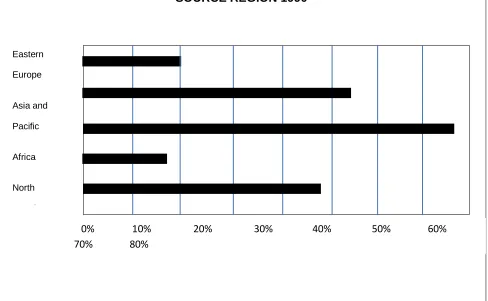
migration from developing to developed countries for the year 1990. The analysis (fig. 1) shows
clearly that emigration of highly educated persons from Africa to developed countries was far
greater to other regions or continents of the world. The study also shows that European countries
including the United Kingdom and North America are the greatest recipients of skilled migrants
from other parts of the world. It particularly noted the upsurge in skilled emigration in the recent
years from Africa in the direction of developed countries. There is thereforeevery reason for
A Monthly Double-Blind Peer Reviewed Refereed Open Access International e-Journal - Included in the International Serial Directories
International Research Journal of Human Resources and Social Sciences (IRJHRSS)
[image:10.612.74.562.137.438.2]Website: www.aarf.asia. Email: [email protected] , [email protected] Page 143
FIGURE 1: TERTIARY EDUCATIONAL SELECTIVITY OF EMIGRANT STOCK BY SOURCE REGION 1990
Eastern
Europe
Asia and
Pacific
Africa
North
America
South
America
A Monthly Double-Blind Peer Reviewed Refereed Open Access International e-Journal - Included in the International Serial Directories
International Research Journal of Human Resources and Social Sciences (IRJHRSS)
Website: www.aarf.asia. Email: [email protected] , [email protected] Page 144
Considering statistics published by Global Commission on International Migration for the year
2005; of the total number of migrants put at 191 million globally, developing countries account
for 75million migrants (Ezzarqui, 2006). Africa records a 16.3million migrant which is 2% of
Africa’s population.On a causal perusal, one is tempted to think that thenumber of Africa’s
international migrants is manageable, but when considers the quality of the migrants (the
educated ones) in relation to the overall population, the figure is outrageous.
International Organization for Migration (IOM) revealed that Africa had already lost one third of
Considering statistics published by Global Commission on International Migration for the year
2005; of the total number of migrants put at 191 million globally, developing countries account
for 75million migrants (Ezzarqui, 2006). Africa records a 16.3million migrant which is 2% of
Africa’s population. On a causal perusal, one is tempted to think that the number of Africa’s
international migrants is manageable, but when considers the quality of the migrants (the
educated ones) in relation to the overall population, the figure is outrageous. In the same vein,
considering Table 2: shows the unacceptable rate of emigration of highly qualified persons from
Nigeria
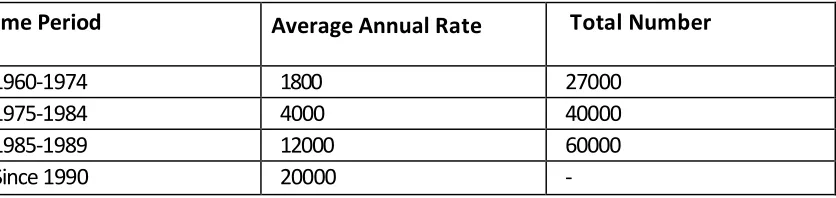
Table 1.Emigration of Skilled Africans to Industrialized Countries (Based on IOM and ECA Estimates)
Time Period Average Annual Rate Total Number
1960-1974 1800 27000
1975-1984 4000 40000
1985-1989 12000 60000
Since 1990 20000
-Source: Brain Drain in Nigeria: Facts and Figures.
International Organisation for Migration (IOM) revealed that Africa had already lost one third of
its human capital. Statistically, about 20,000 medical doctors, University lecturers, engineers and
other professionals have left the continent annually since 1990. Also noteworthy are the over
[image:11.612.85.503.473.572.2]A Monthly Double-Blind Peer Reviewed Refereed Open Access International e-Journal - Included in the International Serial Directories
International Research Journal of Human Resources and Social Sciences (IRJHRSS)
Website: www.aarf.asia. Email: [email protected] , [email protected] Page 145
Within the same period in Nigeria between 1986 and 1990 based on Presidential Committee set
up by Babangida’s administration an estimated 30,000 highly skilled and professionals migrate
out of the country. In the tertiary institutions, over 10,000 lecturers went abroad (Gopalkrishna
and Oloruntoba, 2006). The sordid reality of emigration of professionals and highly skilled
workforce from Nigeria enroute to developed countries of Europe and America is a replica of
forced economic migration all over the continent. Though profound in West Africa which
according to earlier report (Global Commission on International Migration) accounts for 42% of
the continent’s international migrants and East Africa 28%, yet, in other regions where we have
less (12% in North Africa and 9% in Middle & South Africa), it has been recorded that South
Africa loses on average 13% of yearly turn over in professional employment, a situation which
persistently has dampened economic growth (Lowell; 2001). Ethiopia, a country in the horn of
Africa lost approximately 74.6% of its professional and highly qualified person between 1980
and 1991 while for a period of 15 years or more corresponding to the time of war with Eritrea,
half of those who went abroad for higher studies did not return(IOM, 2007). The situation is
lamentable when it is consideredthe amount of resources that the African countries are devoted
to the education of their human capital only for them to leave the countries for greener pastures
without benefitting their home countries by extension Africa. (Gopalkrishna et al, 2006). Some
scholars have tried to quantify roughly in monetary terms the amount involved in education of a
graduate ,Okeke (2008) quoted by (Gopalkrishna et al, 2006) highlighted that it costs about
USD40,000.00 to train a medical doctor, and USD10,000 – USD15,000 to educate a university
student. Before settling down to be useful to the continent, they are lured to forced economic
migration, ending all the expectations of Africa on them. They are thereafter seen contributing
and helping to further the building of foreign economies that have attained exceeding great
heights but abandon their native economy to stagnation, unwarranted struggling and
A Monthly Double-Blind Peer Reviewed Refereed Open Access International e-Journal - Included in the International Serial Directories
International Research Journal of Human Resources and Social Sciences (IRJHRSS)
[image:13.612.71.541.113.458.2]Website: www.aarf.asia. Email: [email protected] , [email protected] Page 146
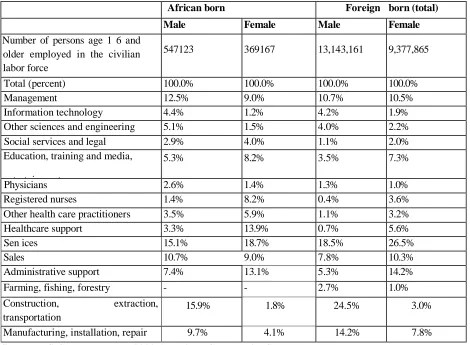
Table 2. Occupations of Employed Workers in the Civilian Labor Force Age 16 and Older by Gender and Origin, 2009.
African born Foreign born (total)
Male Female Male Female
Number of persons age 1 6 and older employed in the civilian labor force
547123 369167 13,143,161 9,377,865
Total (percent) 100.0% 100.0% 100.0% 100.0%
Management 12.5% 9.0% 10.7% 10.5%
Information technology 4.4% 1.2% 4.2% 1.9%
Other sciences and engineering 5.1% 1.5% 4.0% 2.2%
Social services and legal 2.9% 4.0% 1.1% 2.0%
Education, training and media,
entertainment
5.3% 8.2% 3.5% 7.3%
Physicians 2.6% 1.4% 1.3% 1.0%
Registered nurses 1.4% 8.2% 0.4% 3.6%
Other health care practitioners 3.5% 5.9% 1.1% 3.2%
Healthcare support 3.3% 13.9% 0.7% 5.6%
Sen ices 15.1% 18.7% 18.5% 26.5%
Sales 10.7% 9.0% 7.8% 10.3%
Administrative support 7.4% 13.1% 5.3% 14.2%
Farming, fishing, forestry - - 2.7% 1.0%
Construction, extraction,
transportation
15.9% 1.8% 24.5% 3.0%
Manufacturing, installation, repair 9.7% 4.1% 14.2% 7.8%
Source: US Census Bureau. 2009 American Community Survey.
Table 2: looking at Africans in various categories of occupation, the number is very high. It
demonstrates that Africans are an important part of the labour force in America
The brain drain thus continued with calculated intensity disrupting the already fragile African
economy. The consequence is that African have economies increasingly become devastated. As
reasoned by Castles & et al (2009; 5) migration is bound to persist due to the growing
inequalities in wealth between the north and south, a situation which is likely to compel more
people to migrate in search of better opportunities and living conditions elsewhere. As a result,
and except governments do something that will affect the people concretely, Africa may have to
contend with massive emigration of her educated and qualified professionals. This phenomenon
can be compared to Biblical parable which says; from him that had little shall be taken and added
A Monthly Double-Blind Peer Reviewed Refereed Open Access International e-Journal - Included in the International Serial Directories
International Research Journal of Human Resources and Social Sciences (IRJHRSS)
Website: www.aarf.asia. Email: [email protected] , [email protected] Page 147
advancement between Africa and the advanced industrialized nations. Hence, the issue of
international migration taken professionals out of Africa should be confronted with mutually
agreed policies between Africa and receiving countries of the world, especially with the intensity
of competition for skilled labour both highly qualified and middle level workers worldwide. In
the mean time, we shall examine strategies that had been put in place to stem the tide of massive
[image:14.612.68.549.235.472.2]emigration of educated citizens out of Africa.
Table 3: Black Immigrants by Region of Origin, United States, 1980 - 2009
1980 (thousand) 1990 (thousands) % Change 1980 to 1990
2000 (thousands)
% Change 1990 to 2000
2008 – 09 (thousand)
% Change 2000 to 2008 – 09
All
Immigrants 14,079 19,682 40 31,133 58 38,234 23
All Black
Immigrants 816 1,447 77 2,435 68 ,3,267 34
Black African
Immigrants 64 184 188 574 212 1,081 88
Black Caribbean Immigrants
453 897 98 1,428 59 1,701 19
Black Immigrants from Other Regions
299 366 22 433 18 485 12
Source: MPI analysis of data from the 1980, 1990, and 2000 US Census of Population and Housing (census); 2008-09 American Community Surveys (ACS), pooled.
Perusing Table 3, it is clear from the figures that the total numbers of those from Africa is the
highest. And when we consider the total numbers of black to other immigrants to the US, blacks
generally top the chart.
Strategies to Revert Massive Emigration of Qualified Manpower out of Africa
The current trend of uncontrolled massive migration of professionals out of Africa may be
attributed to the death of adequate policies to protect the interests of African nations in their
quest for development and better standard of living. In this age of globalization, where the world
political and economic relations have become more competitive, engineering economic
A Monthly Double-Blind Peer Reviewed Refereed Open Access International e-Journal - Included in the International Serial Directories
International Research Journal of Human Resources and Social Sciences (IRJHRSS)
Website: www.aarf.asia. Email: [email protected] , [email protected] Page 148
technologies, increasing interconnectedness of regions, nations and institutions worldwide,
thereby fostering integration of economies and societies of which the result is borderless world
(Adeola, pg. 1 Awaiting publication) so must be added the integration of global labour market. In
this scenario, any policy or policies no matter how laudable that will not involve or be jointly
acceded to by both parties; that is the sending and the receiving countries, may have limited
impacts. It is inrecognizance of this profound issue that we shall appraise reasoned suggestions
to reverse the trend of depleting Africa of her educated workforce. The urgency has even taken
the form of pladoyer for technological and knowledge transfer to Africa through her nationals in
[image:15.612.65.566.293.601.2]diaspora.
Figure 3 – Shares of High-Skilled US Immigrants Working in Unskilled Jobs, 2009.
Note. * “Unskilled occupations” require no more than modest on-the-job training (for example, construction laborers, drivers, and maids). “High-skilled immigrants” here include only those who earned their college degrees abroad; US-trained immigrants are excluded. “Europe” includes Canada, Australia, and New Zeeland. “Recent” immigrants have been in the United States for ten years or less, while “long-term” immigrants have been in the country for at least ten years. Source: MPI analysis of 2009 ACS.
16% 16% 17%
43%
35%
19% 23%
36%
22%
US Born Europe Latin America Asia Africa
A Monthly Double-Blind Peer Reviewed Refereed Open Access International e-Journal - Included in the International Serial Directories
International Research Journal of Human Resources and Social Sciences (IRJHRSS)
Website: www.aarf.asia. Email: [email protected] , [email protected] Page 149
Figure 2: shows the most pathetic picture or immigration as a larger part of the brains from
Africa are wasted in unskilled jobs
South Africa that could be regarded and of course the most developed country in the
Sub-Saharan Africa, is paradoxically the most terribly affected by emigration of skilled professionals.
Fundamentally, because of her enviable position in the southern part of the continent being
surrounded by far less developed neigbours that look up to her for skilled professionals while on
the contrary there are no reciprocal migrations of skilled workers to South Africa. While this
type of migration is still beneficial to Africa since by our estimation, it is regarded as internal
migration. The other type of migration outside Africa involving a large number of South
Africans in the direction of United Kingdom needs governmental intervention to stem the tide.
As documented by Lowell & Findlay (2001). There are about 800,000 South Africans in
possession of British Passport which is due to historical reason. Coupled with this, is the link
between former British colonies United Kingdom has always been most preferred destinations
for professional emigrations as London is the haven of international finance investment and trade
links of South Africa.
Other countries in the continent that are experiencing serious skilled emigration are Nigeria,
Kenya, Ethiopia, Ghana, among others and for these countries which also apply to the entire
continent, foremost is to design a concerted grand policies of retention. Henceforth sectorial
skilled manpower demand should be made available at the labour and employment bureaus for
employers consumption such that where there are shortages of skilled manpower,embargo would
be totally placed in such occupations for foreign employer or recruitment for overseas
appointments. Closely related to this policy is to encourage skilled migrants from Africa to
return home from developed countries. In this perspective, the strategy would be to design
policies that would make migrants willing to return home. The other strategy is that from now
and where nationals could be employed for overseas jobs, it must be on contracts for few months
and must not be more than a year and return home to contribute his/ her experience, while other
candidates can then be given opportunity. This policy must be within a grand strategy of
temporary placement abroad. What this policy is saying is that government must be more
interested in the movements of skilled citizens outside Africa and ensure that they are sojourning
A Monthly Double-Blind Peer Reviewed Refereed Open Access International e-Journal - Included in the International Serial Directories
International Research Journal of Human Resources and Social Sciences (IRJHRSS)
Website: www.aarf.asia. Email: [email protected] , [email protected] Page 150
industrialized nations, the impact of Diaspora cannot be down played. Gone are the days when
the importance of Diaspora was not fully appreciated. The deepened technological impact of
globalization especially in financial transfers has suddenly brought to the front burner the
contributions of Diaspora to economic virility of Africa.
In situations where official remittances flows to developing countries have doubled the amount
of development assistance received by developing economies, then of course, the issue of
Diaspora cannot be undermined. Available statistics according to Taiwo (2007: 18) showed that
emerging economies received about $251 billion officially in remittances in 2007; while
informal remittances were estimated at $86 billion, totaling $337billion for developing countries
worldwide. Within the same period Nigeria recorded $15billion in 2007 (Taiwo; 2007: 18).
While the remittances are critical to national investment, the Diaspora can be more impactful
when they physically return which according to Lowell and Findlay (2001: 5) can resupply the
highly educated population in the source country and to the degree that returned migrants are
more productive.The factual return of migrants can be more productive when it is backed by
transfer of technology. In other words, there is need for a push factor policy in the direction of
Diaspora and all types of migrants to return to Africa. All said and done, in the current global
economic competition, and beyond the amount of remittances, African countries are grossly at
disadvantage because economically speaking development is not just the money, but the human
capital. It is the human intellectual input that will transform the economy. The negative or
disruptive effect of forced economic migration or emigration of human capital out of Africa is
far greater than financial contribution or the entire foreign assistance combined. Therefore, to
arrest the upsurge and intensification of highly skilled emigration of human capital out of the
shores of Africa, the time has come to go beyond palliative measures and take concrete actions to
A Monthly Double-Blind Peer Reviewed Refereed Open Access International e-Journal - Included in the International Serial Directories
International Research Journal of Human Resources and Social Sciences (IRJHRSS)
Website: www.aarf.asia. Email: [email protected] , [email protected] Page 151
Concluding Remarks
Africa has been described as the most mobile continent globally, an acronym that would have
been exceedingly beneficial as migration is a unique and historically purveyor of development.
Unfortunately, in a highly competitive world where she is struggling to meet up with the other
continents far advanced and prosperous, is mitigating migration especially of her skilled
manpower is a necessary strategy to arrest unrelenting brain drain if she must catch up with the
rest of the world. This position as we can see from the foregoing analysis, needs a dogged
determination of realization because of the impact of globalization on the world political
economy. The concept of globalization is rooted in liberal policies with particular reference to
borderless trade and market integration including internationalization of labour market. Of
course, in the emerging globalization practically, exchange of skilled professional would have
been a healthy and necessary development among nations when there is a sort of equality or
balancing in the development stage but in the present scenario where Africa is the poorest
continent in comparison to the rest of the world, this economic disparity will continue to
engineer migration of the skilled from the continent to other advanced economies, in particular
Western Europe and America. From American Immigration Policy Brief (Elissa, 2005: 1)
showed that contemporary African immigrants to the US are largely professionals with relatively
high level of educational attainment. They number 50,000 annually that enter US mostly through
Diversity Visa. Interestingly, Africans possess the highest average level of education of any
immigrant group: 49 percent of African immigrants hold a bachelor’s degree, 19 per cent have
master’s degree and over 30,000 have Ph.Ds before entry into USA (Castles et al, 2009, 156).
A Monthly Double-Blind Peer Reviewed Refereed Open Access International e-Journal - Included in the International Serial Directories
International Research Journal of Human Resources and Social Sciences (IRJHRSS)
[image:19.612.59.547.84.333.2]Website: www.aarf.asia. Email: [email protected] , [email protected] Page 152
Figure 3. Legal Admissions* by Class for All US Immigrants and Immigrants, FY 2010
Note. * Legal admissions include both immigrants obtaining permanent residency upon arrival in the United States as well as those who apply for and receive LPR status after substantial periods of residency in the country without such status ** Includes African immigrants of all races; the legal admissions data disaggregate admissions by country of origin and not cy race. Source.US Department of Homeland Security (DHS), "Table 10: Persons Obtaining Legal Permanent Resident Status by Broad Class of Admission and Region and Country of Birth: Fiscal Year 2010," in Yearbook of Immigration Statistics (Washington, DC: DHS, 2010, revised March 30, 2011), www.dhs.gov/files/statistics/publications/LPR10.shtm.
Figure 3 shows the influx of African to the US through family connections, diversity visas and refugees which should be a challenge to our governments in providing the dividends of democracy
The effect of this is that Africa is undergoing serious shortages of qualified manpower in critical
areas. Among them is the health sector. The minimum standard for basic health care stipulated
by the World Health Organization is one doctor for every 5,000 people. According to UNDP
(2006), 38 countries in Sub-Saharan Africa fall far below this standard and 13 have one or fewer Refugees and
Asylees
Diversity
Immediate Relatives of Us Citizens
Employment-Based Preferences
Family-Sponsored Preferences
Others
22% 13%
24% 5%
5%
14%
42% 46%
6%
21% 1%
2%
Immigrants from Africa**
A Monthly Double-Blind Peer Reviewed Refereed Open Access International e-Journal - Included in the International Serial Directories
International Research Journal of Human Resources and Social Sciences (IRJHRSS)
Website: www.aarf.asia. Email: [email protected] , [email protected] Page 153
doctors for every 20,000 people. Niger Republic, the nation with the lowest Human
Development Index in 2006, had only three doctors for every 100,000 people, a condition which
has placed the continent in a terribly complicated health problem resulting in a dual brain drain
of emigration and death. While most of the challenges can be seen from forced economically
induced migration, there is the self-inflicted politically forced migration necessitated by
impoverishment, famine, poor governance, endemic conflicts, wars, human rights abuse and
consequences of failed states. This is the most pervasive and devastating to political stability,
good governance, peace, security and development.
The stark reality which no nation can run away from is the continuous interconnectedness of
world economies and migration is a key component of contemporary world development and
innovation. Continents such as Africa lagging behind technologically speaking will have to result
to what she has to get what she wants. And this is the involvement of her own people in Diaspora
in leveraging the shortfall in brain drain through brain exchange, brain circulation, technology
and knowledge transfer – all these within a concerted policy of population planning and
migration of qualified African outside the continent. African governments and policy makers can
no longer play down on the dangers inherent in massive exodus of trained manpower out of
A Monthly Double-Blind Peer Reviewed Refereed Open Access International e-Journal - Included in the International Serial Directories
International Research Journal of Human Resources and Social Sciences (IRJHRSS)
Website: www.aarf.asia. Email: [email protected] , [email protected] Page 154
REFERENCES
1. Adeola, G. L. and Fayomi, O. (2012) The Political and Security Implications of Cross Border Migration between Nigeria and Her Francophone Neighbours International Journal of Social ScienceTomorrow Published by SPIRI www.ijsst.com, May.
2. Adeola, G.L (Awaiting Publication Pg 1) The Impact of Globalization on Political Economy of Nigeria
3. Adepoju, A. (2005) Migration in West Africa Global Commission on International Migration (GCIM) September.
4. Adepoju, A. (2003) Migration in West Africa Development Vol. 46, No.3, Pg. 37 – 41
5. Adejumobi, S. (2005) Identity, Citizenship and Conflict: The African Experience in the Crises of the State and Regionalism in West Africa, edited by A. Fawole and C. Ukeje Dakar, CODESSRIA.
6. Castles, S. (2003) Towards a Sociology of Forced Migration and Social Transformation Sociology Vol.77 (1) 13 – 34.
7. Castles, S and Miller, J. M. (2009).The Age of Migration.4th edition Palgrave Macmillan.
8. Elissa, S.O. (2005) Diversity and Transformation: African Americans and African Immigration to the United States Immigration Policy BriefMarch.
9. Ezzarqui, L. (2006) Research Paper on Migration Alliance of Civilization UNO, New York, 2006.
10. FMO – Forced Migration Online
11.Gopalkrishna, S.V.M. and Oloruntoba, S.O. (2006) The Political Economy of Forced Migration in Nigeria: Prospects and Challenges in the Millennium 12. Hailu, T.E, et al. (2012) Lived Experiences of Diversity Visa Lottery
Immigrations in the USA the Qualitative Report 2012 Vol.17, Article 102, 1 – 17. 13. Hein de Haas, (2007) The Myth of Invasion – Irregular Migration from West Africa to the Maghreb and the European Union. International Migration Institute, James Martin 21st Century School, University of Oxford.
14. IASFM – International Association for the Study of forced Migration.
15. Kohnert, D. (2007) African Migration to Europe: Obscured Responsibilities and Common Misconceptions. German Institute of Global and Area Studies.No.49, May.
16. Lowell, B.L. & Findlay, A.M. (2001) Migration of Highly Skilled Persons from Developing Countries: Impact & Policy Responses – ILO, Geneva.
A Monthly Double-Blind Peer Reviewed Refereed Open Access International e-Journal - Included in the International Serial Directories
International Research Journal of Human Resources and Social Sciences (IRJHRSS)
Website: www.aarf.asia. Email: [email protected] , [email protected] Page 155
18. Min-Harris, E. (2009) Youth Migration and Poverty in Sub-Saharan Africa: Empowering the Rural Youth. Topical Review Digest: Human Rights in Sub-Saharan Africa. Published by University of Denver
19. Munz, R. (2013) Demography and Migration: An Outlook for the 21st Century Migration Policy Institute Brief No. 4, September.
20. Wasem, R.E. (2011) Diversity Immigrant Visa Lottery Issues.Congressional Research Service. April 1.