236
ON THE USE OF OPTIMUM CURVES IN ELLIPTIC CURVE
CRYPTOGRAPHY FOR WIRELESS SENSOR NETWORKS
1
SAEID BAKHTIARI, 1SUBARIAH IBRAHIM, 1MAZLEENA SALLEH, 2MAHDI SHARIFI 1
Dept. of Computer Science,Universiti Teknologi Malaysia, Johor, Malaysia, 2
Department of Computer Engineering, Najafabad Branch, Islamic Azad University, Najafabad, Iran
E-mail: [email protected], {subariah, mazleena}@utm.my, [email protected]
ABSTRACT
Providing security in Wireless Sensor Networks (WSNs) is a considerable challenge due to the concomitant limitations in processing time, power, area and energy consumption in sensor nodes and the nature of wireless links. A variety of cryptographic methods are available for security establishment. Among them, Elliptic Curve Cryptography (ECC) is the best candidate to accomplish this challenge because it provides high security in spite of a smaller key size. In addition, ECC was subject to many recent studies to optimize the time needed for base point selection and point multiplication operations. In this paper, the points on elliptic curves are analyzed, and an efficient implementation of ECC base point selection is proposed. The proposed implementation can be utilized by extremely constrained devices. We prefer to utilize projective coordinate representations of field elements than to utilize affine coordinates over prime finite field Fp, whereas projective coordinates reduce computational complexity by eliminating the multiplicative inverse in point additions and point doubling. This paper further analyzes non-prime order elliptic curves .The analysis results show that the order of the elliptic curve plays a critical role in determining how fast a base point can be selected.
Keywords: Elliptic Curve Cryptography, Wireless Sensor, Prime Order, Adhoc Networks, Base Point
1. INTRODUCTION
A wireless sensor network (WSN) comprises a large number of sensor nodes that are designed for data gathering and propagation in areas that do not lend themselves to ordinary networks due to environmental and/or strategic reasons [1]. A WSN can be applied to a wide spectrum of applications, varying from critical military surveillance applications to evaluating forest fire progress and building security monitoring in the immediate future. To cover such vast fields in which the operational conditions are predominately harsh or even adverse, an abundance of sensors are arranged in these networks. The number of sensors deployed in the aforementioned networks is sufficiently large to enable the network to monitor these vast fields. Deployment in remote places and being left unattended predispose the networks to attacks, including node capture, physical tampering, eavesdropping and denial of service; in this regard, they should correspondingly be provided with highly defensive security mechanisms. Unfortunately, security requirements of resource constricted sensor nodes cannot be assured by classic security mechanisms with high overhead.
WSN researchers have recommended various security schemes that are desirable and practical for such resource-constrained networks.
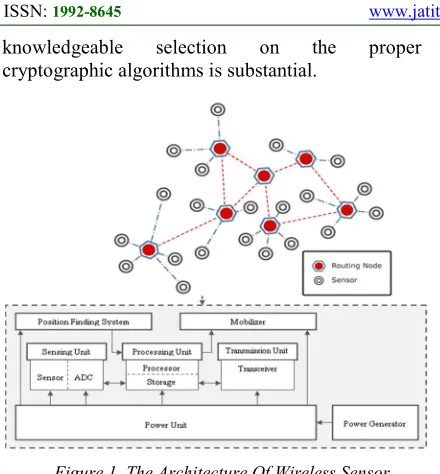
Unlike ad hoc networks, wireless sensor networks exploit a large number of sensor nodes and cover a widespread area, whereas they have inconstant topology due to failure or mobility [2]. Figure 1 demonstrates the architecture of wireless sensor networks and the various constituents of a sensor node. The small circles and red-filled circles are the sensor nodes and the gateways, respectively. Each individual node is qualified to collect data from the environment, execute some computations over its inputs and share the information with other nodes on the network. A network can continue operating by deploying a sensor node just before the battery is depleted of sufficient power. WSNs are surrounded by a diversity of limitations, including energy restrictions, memory limitations, unreliability and high latency in communication.
[image:2.612.89.309.76.313.2]
237 knowledgeable selection on the proper cryptographic algorithms is substantial.
Figure 1. The Architecture Of Wireless Sensor Networks
Elliptic Curve Cryptography (ECC), proposed by Koblitz [3], has been employed in many applications recently because it offers numerous advantages over traditional public key cryptography schemes. Above all (advantages), ECC can provide higher security for equivalent key size in comparison to current asymmetric cryptosystems [4].
The security level in elliptic curve cryptosystems is based on the difficulty of the Elliptic Curve Discrete Logarithm Problem (ECDLP) and secure base point selection. To achieve a time optimization in constrained devices, such as WSNs, radio frequency identification (RFID) and mobiles, researchers have mainly focused on speeding up the following stages:
1) Base point selection
2) Scalar point multiplication
Base point selection is a leading determinant in ECC security level; concomitantly, ECDLP is the other factor to be addressed. Additionally, scalar point multiplication, which is labeled as an underlying operation in ECC, can be performed by finite field arithmetic computations, such as field addition, field multiplication, field squaring, and multiplicative inverse [5-15].
In this paper, we analyze points on elliptic curves considering different features. We also propose an efficient condition to remove the most complicated step of base point selection algorithm known as scalar multiplication; thereby the processing time of ECC base point selection is reduced in WSNs and
extremely constrained secure applications .First, related works and the security requirements in wireless sensor networks are explained in Section 2 and 3. Then, an overview of elliptic curve cryptography with the advantage of projective coordinates is described in Section 4. Section 5 is dedicated to base point selection algorithms description. To achieve low computational complexity for base point selection, in Section 6, orders of points on non-prime order elliptic curves are analyzed, and an ultimate relationship between secure points and orders of elliptic curves is obtained. In Section 7, a mathematical deductive argument is provided to prove the achieved relationship. Following this, the efficiency comparison is presented in Section 8. Finally, the paper is concluded in Section 9.
2. RELATED WORKS
Basically, wireless sensor networks are numerously distributed around the monitored areas which are usually far away from human residential areas, e.g. dense forests. The information transmitted between the sensors can be readily intercepted by an intruder. In order to make the information inaccessible to the intruder, WSNs must deploy a highly secure cryptographic algorithm; this algorithm should be asymmetric to overcome the problem of key exchange as well. A number of publications [16-25] have employed such cryptographic algorithms. However, applicability and optimization of these algorithms are still key issues in WSN security since no efficient implementation of asymmetric algorithms on WSNs exists.
Elliptic curve cryptography is the latest asymmetric cryptographic algorithm providing high security level for authentication and encryption. An explanation as to how this cryptosystem meet the security requirements is given in [26]. It also provided an evaluation of ECC efficiency in discovering wormholes in mobile ad-hoc networks. The speed and security level in ECC cryptosystems primarily depends on selecting an appropriate set of public key parameters.
238 (ATmega128, ATmega256 or ATmega328). This diversity therefore, makes a comparison difficult between those researches.
In 2003, ECC was implemented on sensor networks [18, 19], but the employed hardware was almost strong including 16 bit microcontroller with 16 MHz clock frequency. In this way, the results are confined to hardwares with high computational resources while WSNs do not utilize strong CPUs with high clock frequency to avoid exorbitant cost and energy consumption for the network. Kummar [20] used a microcontroller 8051 with the efficiency of 24 MIPS which was three times as fast as ATmega 128. His implementation was performed on a particular finite field which leads to fast computation of scalar multiplication. However, the protection of this particular finite field is uncertain against the Weil Descent Attack and has not been considered in the proposed work.
Gura et al. [27], in 2004, demonstrated the implementation of ECC on ATmega128 using NIST standardized elliptic curves with sizes of 160, 192 and 224 bits. However, the implementation consumes a considerable time to compute scalar multiplication. For instance, it needs 17.52 million clock cycles on a 224-bit curve. Uhsadel et al. [28] implemented ECC on 8-bit AVR using the same device as Gura's implementation in 2007. Their implementation requires 10 million clock cycles for a 160-bit elliptic curve. The proposed implementation is still unsatisfactory, although it is faster than Gura's work.
ATmega128 chips have limited capabilities causing ECC-signature generation takes more than 70 seconds [22, 23]. Considering these constraints, application of elliptic curves with particular characteristics can lead to a faster signature generation. Recently, Chu et al. [29] utilized a particular group of curves called "Twisted Edward curves" in 2013. It leads to an efficient implementation that requires 5.9 million clock cycles for 160-bit curves on ATmega128. However, they used data-dependent branch conditions which are extremely weak against a group of attacks such as timing analysis, fault analysis, differential power analysis and electromagnetic analysis attacks [30].
3. SECURITY REQUIREMENTS IN WIRELESS SENSOR NETWORKS
A large number of vulnerabilities, which are attributed to wireless sensor networks and other sensor network applications, pose several threats to a WSN protocol and thus make security into a
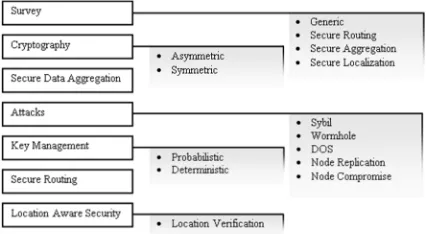
[image:3.612.314.527.272.389.2]critical issue for these networks. Intrusion, interception, modification and fabrication are considered among the most important instances of the aforementioned vulnerabilities [31]. Conceptually, the threats can be listed from diverse aspects. In previous research [28, 32-50], the threats have been listed accordance with the method employed to achieve attacks, the layer of the communication stack on which they are recognized and, finally, whether the malevolent node joins the network whilst the attack is in progress. Security issues in WSNs are categorized as follows: survey, cryptography, secure routing, key management, data aggregation, location aware security and attacks, as demonstrated in Figure 2.
Figure 2. Subcategorized and categorized security areas in WSNs
Different subcategories for security issues in WSNs are illustrated in Figure 2. Security requirements in WSN [51, 52] are divided into the following categories:
1) Data Confidentiality
2) Data Authentication
3) Data integrity
4) Data Freshness
5) Data Availability
6) Time synchronization
7) Secure Group management
8) Secure localization
239 stations or sinks [53]. The number of attacks in WSNs can be considerable, in spite of the security and routing mechanisms.
This paper addresses confidentiality and authentication. To provide these requirements, cryptography is the most common mechanism that has been designed thus far. A variety of cryptographic approaches have been considered, depending on symmetric and asymmetric algorithms. Symmetric cryptographic algorithms efficiently provide (the network with) confidentiality and satisfy the power, space and memory requirements of WSN [54]. However, authenticity and proper key exchange mechanisms are best accomplished by asymmetric algorithms. Asymmetric key algorithms are most commonly used in end devices such as mobile devices, smart cards and servers. There are many asymmetric key algorithms, such as Diffie-Hellman (DH) key exchange, ElGamal Elliptic Curve, ECC, Number Theory Research Unit (NTRU) and Rivest-Shamim-Adleman (RSA).
Elliptic curve cryptography is an approach to public-key cryptography based on the algebraic structure of elliptic curves over finite fields [55]. ECC is a method based on the discrete logarithm problem over the points on an elliptic curve. It is important to consider that ECC is based on Discrete Logarithm Problem (DLP) [56]. Currently, elliptic curve cryptography is used in three different areas in the science of cryptography: key agreement, encryption scheme and digital signature. ECC delivers the highest strength-per-bit of any public-key cryptography [57]. Recently, NIST and many experts have recommended ECC to be used in Secure Socket Layer (SSL) and Transport Layer Security (TLS) protocols [58]. Furthermore, ECC is especially well-suited for constrained environments, such as end devices, because it provides low process time, low storage space, low bandwidth and low power consumption. As part of the effort to promote the widespread use of ECC, Sun Microsystems has donated ECC code to OpenSSL and Network Security Services (NSS) library; this brings ECC to the Apache web server and Mozilla browsers and many other products.
4. OVERVIEW OF ELLIPTIC CURVE CRYPTOGRAPHY
The idea of the deployment of elliptic curves based on finite fields for cryptosystems was first proposed by Kobitz [3]. Occasionally, elliptic curves can be defined on any desirable type of field, for instance, real numbers, rational numbers and
complex numbers. However, elliptic curves used for cryptographic purposes are generally defined over finite fields; these fields include a finite number of elements, as their name implies, and are commonly referred to "Galois fields". In the case of cryptosystems that are implemented by elliptic curves, the feasibility, cost and speed of the system is determined mainly by their finite fieldF , where . Moreover, finite fields proposed for elliptic curves that are used as cryptosystems are further classified as two types:
1) Prime finite field F where p is an odd prime number larger than 3.
2) Binary finite field 2 or F .
An elliptic curve E F consists of elements (x, y) and coefficients that satisfy Equation (1).
→ , ≔ , , , ∈ 1,2,3, … , " 1#; 4 &'
27 )*+ , 0| &' ' / (1)
With constants 0 and 0, it is noticeably easier to solve the DLP for the respective curve. These parameter choices are cryptographically weak, and as a result, are vulnerable to attack. To prevent various attacks, such anomalous curve attacks, Weil and Tate pairing attacks, Weil Descent, invalid curve attacks and small subgroup attacks, parameters selection has been a prolific area of ECC research for the last 25 years [56-58]. For each value of , one needs to prove whether it is a quadratic residue. If it is a quadratic residue, then a couple of values in the elliptic group can be considered for y. Otherwise, the point is not contained in the elliptic group , . The number of points on the elliptic curve , is represented by the order of elliptic curve, which is denoted by #E F . By considering that at least 50% of numbers modulo p are quadratic residues, the number of points is predicted to be approximately ' 1. Additionally, the precise bound for the order of the elliptic curve has been suggested by Helmut Hasse, and it is known as Hassse's theorem [59]. Equation (2) represents that the order of an elliptic curve satisfies #E F 1
' 1 " 2 where |2| 1 2 3 ; 2 is named as the trace of .
' 1 " 2 3 1 # 1 ' 1 ' 2 3 (2)
240 by Schoof's algorithm. This algorithm has methodologies in ECC, especially when it is valuable to judge the difficulty of solving the discrete logarithm problem in the group of points on an elliptic curve, in accordance to the number of points. The total complexity of Schoof's algorithm is 4 5*67 [60].
Conceptually, a finite field is composed of field elements (finite set of objects) and addition and multiplication operations that can be performed on
, field elements. Addition and multiplication operations in elliptic curve cryptography can be considered as equivalent operations to modular multiplication in common public key cryptosystems, and likewise multiple additions are comparable to modular exponentiation. Section 3.1 and 3.2 are dedicated to describing the point addition and scalar multiplication operations and also the arithmetic analysis of proper operations.
4.1 Sections and Subsections
Fundamentally, one of the basic conditions that should be satisfied by any cryptosystem is that the system should be closed. This implies that any operation on any element of the system has a direct effect on another element of the system [61]. In this regard, non-canonical addition and multiplication operations should be created.
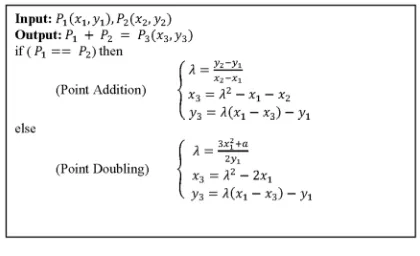
Two types of point representations introduced in elliptic curve cryptography are affine coordinates and projective coordinates. Affine coordinate systems are less complicated because they use the communication between two parties requiring the lowest bandwidth. An affine point on an elliptic curve E can be specified by its respective pair of finite field elements , known as the affine coordinates for the point. No affine representation is allocated to the point at infinity 8[62]. The points located on the curve are represented by upper cases, whereas their lower cases illustrate integers. The addition of two points on the curve generates another point that lies on the curve. This operation is known as point doubling when the points are equivalent. This procedure is explored as pseudo-code in Figure 3.
Affine coordinate prompt division in every addition and every doubling operation requires fewer multiplications in comparison to Jacobian projective coordinates. Briefly, affine coordinates are unfavorable with modular inversion arithmetic operation, whereas Jacobian projective coordinates do not require division in either addition or doubling operations, and merely a single division is
executed in the last stage of the elliptic curve exponentiation computation. Because the ratio of the computation amount of division in to that of multiplication in is generally larger than 9, in this particular case, the computation of the elliptic curve exponentiation can be executed faster in Jacobian projective coordinates than in affine coordinates. Here the so-called addition formula in Jacobian projective coordinates is proposed. Let an elliptic curve over where 9 3 be as below:
[image:5.612.314.524.240.368.2]: &' ' ; , ∈ , 4 &' 27 , 0<
Figure 3. Point addition pseudo-code
For the elliptic curve, the Jacobian coordinate
sets =
>? and >@A, i.e.
: B C&' CDE' DF (3)
the addition formulae in Jacobian coordinates is as follows: Let G CH, BH, DH , I C , B , D and G ' I J C&, B&, D& . For point addition of two points in projective coordinates, let
CH, BH, DH ' C , B , 1 C&, B&, D& then:
C& K – M&' 2CHM ,B& K. CHM – C& – BHM&, D& DHM
where O C DH, P B DH&, M O– CH and
K P – BH. For point doubling in Jacobian
projective coordinates, let 2 CH, BH, DH
C&, B&, D& then:
C& K, B& M O " K – P, D& 2BH. DH
where O 4CH ' BH, P 8BHE, M 3 CH "
DH CH' DH and K "2O ' M .
The scalar multiplication of a point G by a natural integer R is denoted by SRTG. Therefore, RG can be calculated using Equation (4).
I UG G ' G ' ⋯ . 'GWXXXXYXXXXZ
[\]^ _`a
(4)
241 Suppose that b is the order of elliptic curve . Thus, the constant R is an integer that exists in the S1, b " 1T interval. A large number of cryptographic protocols have been designated, in which security relies on the hardness of computing the discrete logarithm over the rational points of an elliptic curve, such as ECDH, ECDSA, ECAES and ECEIGamal. In general, the only algorithms known to solve this problem are exponential-time algorithms, and among various computations of all protocols that are based on elliptic curves, the scalar multiplications are mostly responsible for consuming a lot of CPU time [63]. The scalar multiplication is known as the underlying operation of most of these protocols. Efficient scalar multiplication arithmetic is hence considered as a critical issue in cryptography. Fortunately, some characteristics of elliptic curves allow optimization of scalar multiplication. The interested reader is referred to [64] for a good overview of the question.
The inquiry to discover a scalar multiplication algorithm from point addition and point doubling operations is comparable to computing an exponentiation from multiplications and squares. In the context of elliptic curves, binary exponentiation or binary scalar multiplication should be taken into account as an efficient and straightforward algorithm, which is also called the square-and-multiply algorithm or double-and-add algorithm. The binary algorithm performs the process of a loop that scans the bits of the scalar and then executes a point doubling, and whenever the current scalar equals 1, the aforementioned operations are followed by a point addition.
Let k be an integer with binary expansion R_\H, … , RH, Rc , that is to say, R
∑ Re e2e, where Re∈ 0,1# for every f g b " 1 and
R_\H 1. The binary scalar multiplication of some
point P by R can be perceived as follows. Defining
he S R_\H, … , RH, Rc TG, we get a backward
sequence where h_\H G, hc SRTG and he
2heiH' ReG, which is a binary algorithm. (see
Algorithm 1).
Algorithm 1. Binary Algorithm
Input: G ∈ ; <, R R_\H, … , RH, Rc ∈ o
Output: I SRTG Jc← G; JH← G
For f b " 2 downto 0 do Jc← 2Jc
If Re 1 then Jc← Jc' JH
End for Return Jc
The preceding binary algorithms are efficacious and uncomplicated; however they are not safe in a condition where the scalar is secret and where the implementation is subject to Side-Channel Analysis (SCA) (e.g., a WSN that performs an ECDSA signature). Simple Power Analysis (SPA) can retrieve the secret scalar from a single leakage trace of a binary algorithm computation, even in the existence of data randomization. To oppose SPA successfully, Coron [65] suggested performing a dummy addition in the binary algorithm loop whenever the scalar bit is equal to 0.
Further regular binary algorithms are introduced in the literature and involve attractive features, such as the Montgomery ladder [66]. This algorithm depends on loop invariants and the point registers
Jc and JH. In the Montgomery ladder, the relation
JH" Jc G is fulfilled at the last stage of every
loop iteration (see also [66] for further details).
Algorithm 2. Montgomery Ladder
Input: G ∈ ; <, R R_\H, … , RH, Rc ∈ o
Output: I SRTG set GH← G, G ← 2G
for f 2 " 2 downto 0 do if Re 1 then
set GH← GH' G , G ← 2G ;
else
set G ← GH' G , GH← 2GH;
end End for I GH
Algorithm 3. Montgomery Scalar Multiplication Algorithm using Projective Coordinates
Input: G ∈ ; <, R R_\H, … , RH, Rc ∈ o
Output: I SRTG If R 0 or 0 then Output 0,0 and stop; End
Set CH← , D_1 ← 1, C ← E' , D ← ;
For f 2 " 2 downto 0 do If Re 1 then
€&← H. D ' C . DH , C&← . D&' CH. D . C . DH
DE← D . C , CE← CE' . DE;
DH← D&, CH← C&, D ← DE, C ← CE;
Else
€&← H. D ' C . DH , C&← . D&' CH. D . C . DH
DE← DH. CH, CE← CHE' . DHE;
DH← DE, CH← CE, D ← D&, C ← C&;
End End
As in GF(p), projective coordinates C, B, D are proposed to eliminate costly inversions by =
242
and @
> from affine coordinates , . The
Montgomery scalar multiplication in projective coordinates is listed below in Algorithm 3.
In Section 4.2, elliptic curve cryptography operations are investigated based on their respective arithmetic. Moreover, an analysis of the point operations algorithm was conducted. Finally, a detailed explanation of the Montgomery ladder algorithm based on such arithmetic is presented.
4.2 Arithmetic Analysis
General-form elliptic curves selected arbitrarily from the set of curves that satisfy &' '
, are the only curves considered in this paper. Note that particular forms of elliptic curves (e.g., Koblitz curves and Edwards curves) are also convenient, the performance advantages of which exceed those of general-form elliptic curves.
Point addition formulae such as in Figure 3 rely on different operations over • (e.g., multiplication, inversion, addition, and subtraction), which are characterized by different computational expenses. In the current section, the computational costs of a field inversion, a field multiplication, a field squaring, and a field addition are denoted by I, M,
S, and A, respectively. Furthermore, a field doubling and a field subtraction cost the same as a field addition. In the condition where is a large prime number, it is often supposed that:
1) The inversion cost is I ≈ 100M
2) The squaring cost satisfies S ≈ 0.8M
3) The addition cost is preferred to be ignored.
These assumptions arise from the regular software implementations of the field operations. However, when the second one depends on a hardware coprocessor, for example, in the case of embedded systems, its costs are based on the architecture. Generally, the costs of inversion operations should always total some dozens of multiplications, the squaring should cost the same as one multiplication (possibly a bit cheaper), and the addition should cost substantially loss, but not always negligible [67]. The rest of this section involves the computational cost of different point representations in field operations terms. Furthermore, their memory usage should be taken note of, in terms of field registers, namely memory registers of size log q bits that can storeF elements.
Algorithm 4. Jacobian Doubling Algorithm 5. Jacobian Doubling "3 Input: G ≡ CH, BH, DH
Output: 2G ≡ C&, B&, D&
Input: G ≡ CH, BH, DH Output: 2G ≡ C&, B&, D&
1.hE← hH SCHT 10. hF← hF S DHET 1.hE← h SBHT 10.h&← hH' hH S2 CH" DHE T 2. h…← h SBHT 11. hE← hE'
hF
S3CH' DHET 2.h…← hHhE CHBH O 11.hH← hH' h& S3 CH" DHE T
3. hH← hHh… CHBH O 12. hE←†‡ 3CH' DHE
2 P
3.hE← hE BHE 12.hH←†ˆ CH" DHE
2 P
4. h…← h… BHE 13. hF← hE SP T 4.h ← h h& BHDH D& 13.h&← hH SP T 5. hF← h& DH 14.h ← hH'
hH
S2OT 5.hF← h& DH 14.h&← h&" h… SP " OT
6. hF← hF DHE 15.hF← hF"
h SP " 2OC&T
6.hH← hH' h& SCH' DHT 15.h&← h&" h… SP " 2O C&T
7. h&← h h& BHDH D& 16.hH← hH"
hF
SO " C&T 7.h&← h&'h& S2DHT 16.h…← h…" h& SO " C&T
8. h ← hE'
hE
S2CHT 17. hE← hEhH SP O " C&T 8.h&← hH" h& SCH" DHT 17.hH← hHh… SP O " C& T
9. hE← hE'
h S3CHT 18. h… hH← hE"
P O " C&
" BHE B&
9.hH← hHh& SCH" DHET 18.hH← hH" hE P O " C& " BHE B&
When points are revealed in affine coordinates, the addition of two points includes an expensive field inversion. Fortunately, representing points in projective coordinates is a possible approach to prevent this cost expenditure on the intermediate point additions in scalar multiplication. In projective coordinates, a point P = (x, y) is implied by a triplet (X, Y, Z), where , C/DŠ, B/
D` for some given integers c and d. The Jacobian
243
C& P " 2O, B& P O – C& – BHE b+ D& BHDH, (5)
with O CHBH, P H 3CH ' DHE .
The Jacobian doubling is indicated in Algorithm 4 for the general context and in Algorithm 5 for the case of a = −3. For the latter special case, where a = −3, we have P & CH' DH CH – DH . This equality enables trading 1M+ 2S for 1M+ 1A in the computation of B. The former has a cost of 4M + 6S + 7A and uses 6 field registers, whereas the latter has a cost of 4M + 4S + 9A and uses 5 field registers.
Tetsuya Izu [68] illustrates that a loop iteration of the Montgomery ladder using (X, Z)-coordinates can only be executed in 11Œ ' 4• ' 2Œ '
18O, where Œ denotes the cost of the multiplication by the curve parameter a (which is a small number of additions if is small, e.g., a = −3).
5. BASE POINT SELECTION ALGORITHM
In context of the elliptic curve cryptosystems, the key security correlates with the rationality of the chosen base points [14]. Base point selection implies choosing a point with a large prime order over a given field. This point is in turn termed as a base point. This section of the paper concentrates mostly on the point choosing algorithm over 2_ . In security terms, the author preferred to adopt the non-super singular curve. Commonly, the approach to base point selection is the random point selection on the elliptic curve, the success rate of which is
# 2_ / 2 _ Ž 2\_[14]. During the point
selection procedure, b is assumed as the order of , where b is a large prime number. The order of elliptic curve is denoted by # 2_ . Assume
• •‘ ’ is a large prime factor of # 2_ ,
there is a cofactor which satisfies
“ # 2b / • •‘ ’ , where “
represents a small integer. The optimum base point is achieved when b • •‘ ’ .
Definition: If , U _ , ( F is the subfield of K ), ” ∈ _ , equation (4) is termed the trace of α, denoted by Tr(α ) .
Tr–/— α α ' α ' ⋯ ' α ™šˆ ∑œ\H•žcα › (6)
For ” , when hŸ ” 0, ' ” can be solved, and its solutions are and ' 1, ¡ is the element in K, and hŸ ¡ 1.
Theorem: Let α ,¡ be the elements in field K,
”¡•' ” ' ”• ¡•?
' ⋯ ' ” ' ”•' ⋯ '
¡•’šˆ ¡•’šˆ
, then " • ” hŸ θ " θ "
θ;hŸ α – α< .
The selection of the base point algorithm with the customary method is given in the following succession [69]:
e. Randomly pick up an element θ in the field K
and compute hŸ ¡ . If hŸ ¡ 1, switch to ( ee); else return ( e) to restart;
ee. Randomly choose an element in K as . Let
A= x, &' ' , and the original equation is rewritten as ' O P, let O £. Again, the equation will be transformed to ′ ' ′
P / O .Let ¥ P / O , the equation will be transformed to ′ ' ′ ¥;
eee. ComputinghŸ ¥ , if ¥ 0, switch to
( e¦),otherwise switch to ( ee);
e¦. Then, β and β +1 are the two solutions of the
equation ′ ' ′ ¥, and H O and
O ' 1 , so , H and , are the two points lying on the curve ' & '
' ;
¦. Randomly adopt a point from the points
acquired in ( e¦) as P. If • •‘ ’ G 8 , the point G is one of the base points, otherwise, switch to ( e) to re-choose.
The preceding algorithm is not an optimal algorithm because there might be a point hP that fulfillsp¨ ©— ™ hP 8, if hP ∈ E GF 2« and the point hP is situated on the curve E, and then the point hP is considered as one of the base points of the given curve.
When the base point was selected via the customary method [14], it is apparent that, as the source data seed was chosen at random, there is a substantial number of reiteration calculating ( e), ( eee), and ( ¦), which will in turn provoke an increase in the running costs of the computing time and algorithm complexity.
5.1 YIN Algorithm
244 Initially, a shared area in a system will necessarily be dedicated to save the template outcomes during the interlude of the calculation, before the algorithm begins. For this, three public tables are convenient in this algorithm h -®¯,
h -®° and h -®• which are intended to save ¡,
the random points G and the base points , respectively.
In the remainder of this section, the parallelization of the base point selection algorithm is explained briefly:
To processors, each processor e, do:
e. Scan h -®¯ to perceive if there is data in
h -®¯ , and if so, switch to ee, otherwise, adopt an
element ¡ in the field U, and compute hŸ ¡ . If
hŸ ¡ 1, put ¡ into h -®¯, and messages the other processors that ¡ selection is completed so that the processors in running will not do any operations after this round; otherwise, message the other processors that this element cannot be reselected and return e.
After the above period is finished, all of the s processors are idle, therefore the processors should be divided into two groups, each with ) (p
= 2m) processors. The ) processors of the first
group do as follows:
ee. Randomly choose an element in K as x.
Message the other processors to omit x from the field, then let O ,P & ' ' . The original equation is rewritten as ' O P, let
O ′. Again, the equation is transformed to
′ ' ′ P / O ,let ¥ P / O . The equation is then transformed to ′ ' £ ¥;
eee. Compute hŸ ¥ . If hŸ ¥ 0, switch to e¦, otherwise switch to ee;
e¦. The two solutions of the equation ′ '
′ ¥are β and β +1. Then H O and
O ' 1 , thus , H and , are the two points of the curve ' &' '
,and , H and , are in the public table
h -®°;
As the first groups of processors are performing the above operations, the other groups of
) processors conduct the following operations:
¦. Scan the public table h -®°to discern if it is
vacant. If so, the processor will wait until h -®°is not empty. Select a point G from h -®°. If
• •‘ ’ G 8 , the point G is the base point. Let
G, put into the public table h -®•, then stop the algorithm ,messaging the other processors that
the algorithm has been fulfilled; otherwise, continue on;
¦e. Calculate and ascertain if “G 8. If so
,eliminate the point G from h -®°; if not ,let
G “G, then compute if G is the point lying on the given curve ' &' ' . If so, let
G, put into the public table h -®•,then stop the algorithm, and message the other processors that the algorithm has been finished; if not, return ee.
In [69], ¦ when G is not a an expected base point, the algorithm can still be continued to ¦e in the parallel algorithm, then judge again (the nature of the field computation determines ¦e feasibility). If G is still not the base point of the curve, we go to
ee, but not [69] e. When the point adopted
randomly is not the curve base point, it is not due to inappropriate ¡, but it is due to the . Therefore, the parallel algorithm will go to ee here, rather than e, which will increase the efficiency of the original algorithm by almost twice.
6. ANALYSIS ON NON-PRIME ORDER
ELLIPTIC CURVES
Opting for a cryptographically secure elliptic curve in advance of the deployment of an elliptic curve cryptosystem assures the robustness of the cryptosystem against all recognized attacks which were noted in Section 3, e.g., anomalous curve attack, Weil and Tate pairing attacks, and small subgroup attack. If the order of the underlying elliptic curve possesses certain qualities, the cryptosystem can be protected against all of these attacks. Generating cryptographically secure elliptic curves over prime fields is among the most fundamental and complicated problems in elliptic curve cryptography. The approaches most frequently exploited for the generation of ECs over prime fields are the Complex Multiplication (CM) method [70] and the point counting method [71].
Let E be an elliptic curve over a finite field F and assume that the order of elliptic curve #E F is non-prime n.
# b “Ÿ ,
245 of O is itself). While working over a finite field, this group is inevitably finite (because the existing points are all finite).
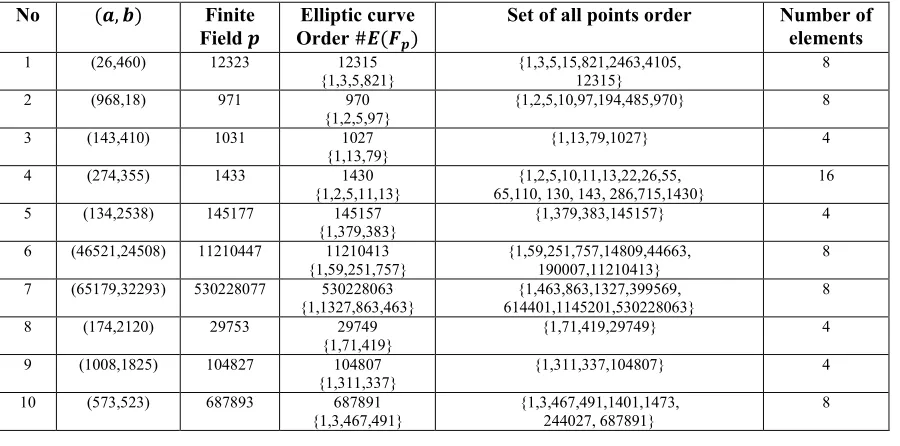
All of the equations included in Table 1 have respective non-prime order ECs. Table 1 shows the factorization of the elliptic curve order # . According to the information derived from Table 1, the set of all points order is generated via prime factorization of the positive elliptic curve order, along with their multiplicities.
Table 1 illustrates the elliptic curve characteristics, such as equation, finite field, elliptic curve order, set of all points order and its number of elements that was subject to analysis. As well, the order of the appropriate elliptic curve accompanied by its factorization is listed in the fourth column. Among the contents of the fifth column, the main divisors of elliptic curve order are bold and thus they can be readily observed. Table 1 shows the order (number of elements) of all points
H, , … , _# of E that divide the order of the
elliptic curve # ; for instance, let ∶
&' ' be elliptic curve defined over finite
field with order # . The factorization of
# is as follows:
ŸH²ˆ³ Ÿ²?³ Ÿ&²A³ … ³ Ÿ´²µ ; ŸHg Ÿ g Ÿ&… g Ÿ´, ¶ ¬
1/.
All points order satisfying # have prime divisors of elliptic curve order ŸH, Ÿ , … , Ÿ´# or together with multiplicities. The number of divisors of # , which are demonstrated in the sixth column of Table 1, can be obtained by Equation (7).
¶H' 1 ¶ ' 1 ¶&' 1 … ¶´' 1 (7)
Suppose that finding a number of divisors of 48 is desired. It is convenient to start with 1 and then continue by working through the set of natural numbers and testing divisibility in each case. Note that divisors can be listed in factor pairs.
48 1 ³ 48 2 ³ 24 3 ³ 16 4 ³ 12 6 ³ 8
It is clear that 48 has exactly ten divisors. It can also be easily perceived that by utilizing this approach (to prove the divisors of a number), it is only ever required to work from 1 up to the square root of the number. This method can be quickly and easily performed with small numbers; however, it is not practical for larger numbers.
Let ¸ b be the number of divisors for the natural number, b. As an initial step the number is written as a product of prime factors: b ŸŠ… and the number of divisors ¸ b ' 1 '
[image:10.612.84.534.455.678.2]1 ‹ ' 1 .
Table 1. Non-prime order ECs and set of all points order.
No ¹, º Finite
Field »
Elliptic curve Order #¼ ½»
Set of all points order Number of elements
1 (26,460) 12323 12315
{1,3,5,821}
{1,3,5,15,821,2463,4105, 12315}
8
2 (968,18) 971 970
{1,2,5,97}
{1,2,5,10,97,194,485,970} 8
3 (143,410) 1031 1027
{1,13,79}
{1,13,79,1027} 4
4 (274,355) 1433 1430
{1,2,5,11,13}
{1,2,5,10,11,13,22,26,55, 65,110, 130, 143, 286,715,1430}
16
5 (134,2538) 145177 145157
{1,379,383}
{1,379,383,145157} 4
6 (46521,24508) 11210447 11210413
{1,59,251,757}
{1,59,251,757,14809,44663, 190007,11210413}
8
7 (65179,32293) 530228077 530228063
{1,1327,863,463}
{1,463,863,1327,399569, 614401,1145201,530228063}
8
8 (174,2120) 29753 29749
{1,71,419}
{1,71,419,29749} 4
9 (1008,1825) 104827 104807
{1,311,337}
{1,311,337,104807} 4
10 (573,523) 687893 687891
{1,3,467,491}
{1,3,467,491,1401,1473, 244027, 687891}
8
To prove this, at first, numbers of the form
b are taken into account. The divisors are 1, , , … , , that is, ¸ ' 1.
b 1, , , … ,WXXXYXXXZ
246 In this step, considerb . The divisors will be as bellow:
1 …
…
⋮ ⋮ ⋮ ⋮ ⋮ … …
Therefore, it is proved that the function ¸ b is multiplicative and in this case, is computed
by¸ ' 1 ' 1 . This can be
[image:11.612.93.297.285.481.2]extended any natural number that is written as a product of prime factors.
Table 2. All possible points order over : &'
26 ' 460
Point G(x, y)
Order of point #G(x, y)
Set of all points order
8 1 {1,3,5,15,821,2463,41
05,12315}
(10829, 5267) 3 {1,3,5,15,821,2463,41
05,12315}
(3272, 3635) 5 {1,3,5,15,821,2463,41
05,12315}
(1118, 5846) 15 {1,3,5,15,821,2463,41
05,12315}
(6, 1154) 821 {1,3,5,15,821,2463,41
05,12315}
(3, 3461) 2463 {1,3,5,15,821,2463,41
05,12315}
(21, 4629) 4105 {1,3,5,15,821,2463,41
05,12315}
(2615, 4332) 12315 {1,3,5,15,821,2463,41
05,12315}
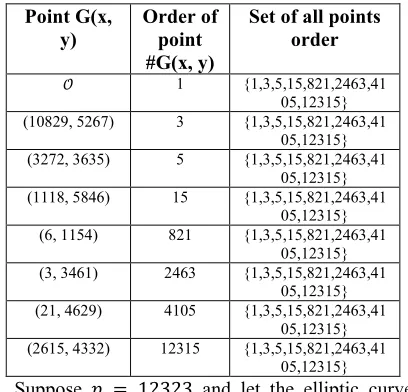
Suppose 12323 and let the elliptic curve be : &' 26 ' 460. The order of E is
# 12315, which is factorized to 12315
3H³ 5H³ 821H. All points order fulfilling E have a
prime factor of elliptic curve order or together with multiplicities. Hence, the feasible order probabilities of each point are only (1+1) (1+1) (1+1)=8={1, 3, 5, 15, 821, 2463, 4105, 12315} values. Table 2 illustrates several points on elliptic curve ∶ &' 26 ' 460 along with their respective order.
7. MATHEMATICAL DEDUCTIVE
ARGUMENT
Definition: If G is a finite group (or subgroup) then the order of is defined as the number of elements of G.
Scientific evidence for the idea will be given by proving that the cosets of a subgroup have the following features:
1) they are disjoint – separate cosets do not have any member in common, and
2) each coset has an exactly identical number of members as the subgroup .
This represents that a subset with belements has
Rcosets and each coset hasb elements; and because these cosets do not overlap and together they include every element in the group, the group must have Rbelements (a multiple of b). Three lemmas will lead to the proof.
Lemma: Suppose that À is one subgroup of a group , and let , ∈ Then
(i) À À ⟺ \H ∈ À.
(ii) If À ∩ À , Ã, then À À.
(iii) | À| |À| for all ∈ .
Proof:
(i) Let À À, then for any “H∈ À there is “ ∈ À with “H “ . This yields
\H “ “
H\H⟹ \H ∈ À,
because “ ∈ À and “H\H∈ À. Let \H∈ À. Put
\H “
c. Then,
À ⊂ À, because if ∈ À, then “ ⟹
\H “ “
c“
Æ
Ç?
“H∈ À,
À ⊂ À, becasue if ∈ À, then “ ⟹
\H \H“ “
c \H“
È
Ç?
“ ∈ À.
so, À ⊂ Àand À ⊂ À, which gives
À À.
(ii) Let À ∩ À , ∅, , then there exists an element x with
∈ À ∩ À ⟹ “H “ ⟹ \H
“ “H\H∈ À,
so À À by (i).
(iii) Consider that if “Hand “ are two distinct elements from H, then “Hand
“ are also distinct, because otherwise
“H “ ⟹ \H “H \H “ ⟹ “H “ ,
247 Suppose that| | 2 and
HÀ, À, … , ÊÀ#
is the family of all cosets of À in . Then
HÀ ∪ À ∪ … ∪ ÊÀ#
As H, , … , Ê# and 1 ∈ À. By
considering part (ii) of the preceding Lemma for any two cosets eÀ and ÌÀ , only two possibilities exist:
eÀ ∪ ÌÀ ∅ or eÀ ÌÀ.
Furthermore, from part (iii) of the Lemma above, it is concluded that all cosets have exactly |À| number of elements. So
| | |À| ' |À| ' ⋯ ' |À| ⟹ | | +|À|, and the result is accomplished.
If H is a subgroup of a finite group G, then the following statement is correct.
|À| divides | |.
Corollary: If is a prime, then every group of order is cyclic.
Proof: Pick up ∈ with , 1, and suspect that
À 〈 〉 is the cyclic subgroup that is generated by . As a result, |À| is a divisor of | | . Because p is a prime and |À| 9 1, it is achieved that
|À| | |,
and therefore À , as demanded.
In conclusion, the orders of elements in a finite group are divisors of the group order. Therefore, if and only if the order of group ; •< is a prime number , then the two feasible orders are 1 and . In this context, the identity (point at infinity 8) has order 1 and no other elements. Therefore, is regarded as the prime order of all remaining elements.
8. EFFICIENCY COMPARISON
This section represents a comparison between the elliptic curves that are generated by respecting the condition that “the order of the curve should be a prime number” and non-prime order elliptic curves, which fail to satisfy the condition, in terms of number of secure base points. According to the principal breakthrough achieved in the investigation and analysis conducted on over 10000 non-prime order elliptic curves ,the number of secure points
#N over non-prime order elliptic curves equals #¨ in the optimum case; however, #N over prime order
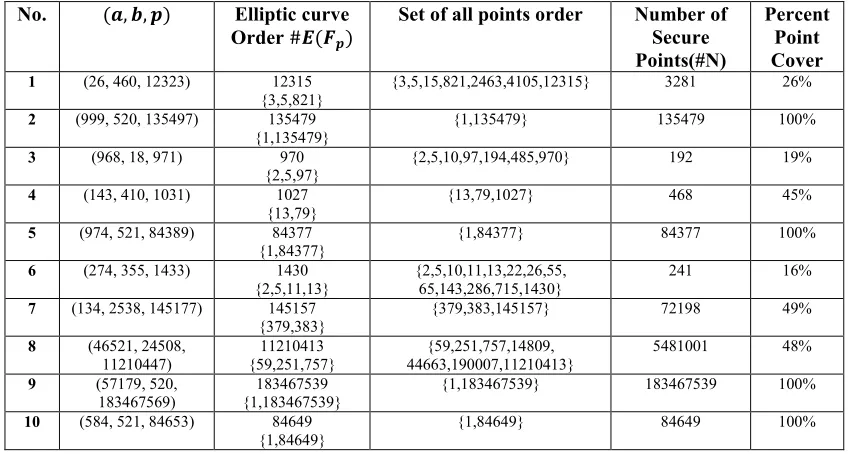
elliptic curves always follows #N= #E. A comparison between some non-prime order ECs and some prime order ECs is conducted by demonstrating information about elliptic curve characteristics, the order of elliptic curves, the set of all points order and the number of secure points over the proper EC in Table 3. All prime order elliptic curves in Table 3 are highlighted in green.
By considering the information illustrated in Table 3, one can conclude that a greater number of secure points is provided by prime order ECs in comparison to non-prime order ECs such as
y x&' 274x ' 355 mod 1433 , with an
identical finite field size. Therefore, those elliptic curves with prime order should be predominantly chosen whenever obtaining an optimal number of secure base points is demanded. Moreover, any point on elliptic curves with prime orders can be readily selected as a secure base point by users; this property of ECs with prime orders justifies their greater efficiency in base point selection in comparison to non-prime order elliptic curves.
Basically, many arithmetic operations are involved in ECC, such as point addition, modular inversion and scalar multiplication. Among these operations, scalar multiplication not only consumes a significant portion of time and energy but also plays an important role in determining the speed of ECC implementation. Whenever scalar R in scalar multiplication R (where denotes base point) has a large value, a crucial step to a fast implementation of ECC is to choose an efficient algorithm for computing the scalar multiplication from the various algorithms proposed. The scalar multiplication is considered as the most complex part of ECC applications irrespective of the algorithm used for scalar multiplication; because it requires a repetition of point additions and point doublings along with necessary inversions over the finite prime field [64]. Table 4 shows time consumed to calculate b-bit scalar multiplication
R (b Ólog Ô) in different standard ECs where is finite prime field and the size of scalar R is equal to b. All computations are performed on a 1.6 GHz Core™ i5-4200U CPU with 4 GB RAM and are implemented by using C# programming language (Visual Studio 2010) with no mathematical library. Moreover, the method used for scalar multiplication is left-to-right binary method.
248 as shown in Table 4. Thus, our study should focus on minimizing this step of the algorithm in order to minimize the time consumption of base point
[image:13.612.94.520.148.375.2]selection algorithms in EC defined in the affine space.
Table 3. Comparison between non-prime order ECs and prime order ECs in terms of secure points number
No. ¹, º, » Elliptic curve Order #¼ ½»
Set of all points order Number of Secure Points(#N)
Percent Point Cover
1 (26, 460, 12323) 12315
{3,5,821}
{3,5,15,821,2463,4105,12315} 3281 26%
2 (999, 520, 135497) 135479
{1,135479}
{1,135479} 135479 100%
3 (968, 18, 971) 970
{2,5,97}
{2,5,10,97,194,485,970} 192 19%
4 (143, 410, 1031) 1027
{13,79}
{13,79,1027} 468 45%
5 (974, 521, 84389) 84377
{1,84377}
{1,84377} 84377 100%
6 (274, 355, 1433) 1430
{2,5,11,13}
{2,5,10,11,13,22,26,55, 65,143,286,715,1430}
241 16%
7 (134, 2538, 145177) 145157
{379,383}
{379,383,145157} 72198 49%
8 (46521, 24508,
11210447)
11210413 {59,251,757}
{59,251,757,14809, 44663,190007,11210413}
5481001 48%
9 (57179, 520,
183467569)
183467539 {1,183467539}
{1,183467539} 183467539 100%
10 (584, 521, 84653) 84649
{1,84649}
{1,84649} 84649 100%
Table 4. The time consumption of scalar multiplication
Size 160 bit
192 bit
224 bit
256 bit
320 bit
384 bit
512 bit Time
(ms)
24.9 35.1 47.1 62.2 99.0 176.
5 272. 1
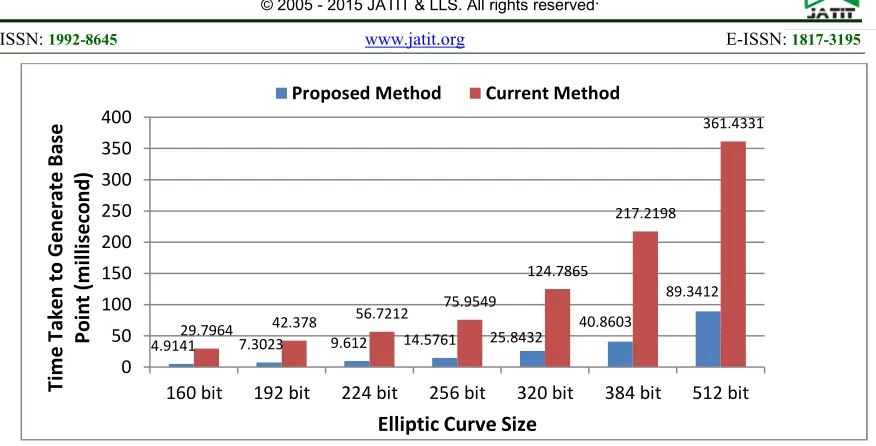
In the last step of the base point selection algorithm, we must ascertain that the selected base point is highly secure by proving whether the order of the point equals to the order of the curve or not; this step is performed by computing scalar multiplication and a point with an order equal to the order of the elliptic curve is confirmed as a secure base point. However, not only the time consumption of these operations is considerably high, but also these operations usually should be repeated in a base point selection process. These repetitions increase the time consumption by several folds. It can be seen from the results of last section that every point on the curve has the same order as EC whenever the order of chosen EC is a prime number. In this case, the second phase of the base point selection algorithm can be readily omitted. Figure 4 demonstrates a comparison
between two base point selection methods; the random base point selection algorithm comprises the second phase, but this step is omitted in the proposed method. As the size of EC increases, the ratio of the time consumption of current method to the time consumption of proposed method decreases. This reduction is from approximately 6 to 4 in 160- to 512-bit EC.
[image:14.612.91.529.62.285.2]
249
Figure 4. Efficiency comparison
9. CONCLUSION
Elliptic curve cryptography has an advantage over the other asymmetric cryptographic systems because it provides a higher security per bit for extremely constrained applications such as wireless sensor networks. This property of elliptic curve cryptography is exploited in portable constrained devices. Moreover, ECC even surpasses other asymmetric cryptosystems in exhibiting enhanced security with shorter bit sizes. Shorter key length in turn results in: 1) saving power and bandwidth, 2) performance improvements, 3) lower space requirements for key storage and 4) quicker arithmetic operations. In summary, by incorporating the ECC-based algorithms into existing protocols, a constant backward compatibility and security is accomplished with smaller resources. However, these above-mentioned positive features of ECC in WSNs are confined to those elliptic curve cryptosystems that have appropriate underlying elliptic curves with proper parameters (e.g., base point with small order is not cryptographically secure). In this regard, choosing a proper elliptic curve has evolved into a critical issue in WSNs use because the recent sensor devices have restricted computational power and are intended to monitor the security of military facilities. In this paper, an efficient type of elliptic curve for WSNs, termed as prime -order elliptic curve, is proposed. Analysis are applied on secure base point numbers of prime- order elliptic curves and then on non-prime order elliptic curves in succession. According to the results of the analyses, any point on prime order ECs can be selected as base point for secure communication.
Thus, the two following reasons are proposed to justify the suitability of elliptic curves with prime order (cofactor = 1) for WSNs. First, prime order elliptic curves provide quick and uncomplicated base point selection in hardware. Furthermore, these elliptic curves bring low area complexity required for secure resource constrained environments; i.e. in certain cases, even nodes, without considering security aspects, can automatically select any point as a base point randomly. On the other hand, non- prime order elliptic curves are recommended by some security agencies, such as NIST. The next attempt in the paper is an explanation for the mathematical deductive argument to provide reliable evidence to confirm the accuracy of the achievements.
Finally, possible directions for future research are discussed. Elliptic curve cryptosystems (e.g., ECDSA) generally entail modular integer arithmetic in addition to elliptic curve operations. This requirement for two types of arithmetic (binary field and modular integer) creates challenges for all systems using binary curves in constrained environments. Recently some high-speed hardware architectures have been proposed [72-74] but none of them is practical for extremely constrained applications due to conversions between integers and ¸-adic representations in Koblitz curves. Extremely constrained applications typically require careful fine-tuning (e.g., by fixing certain parameters) of the cryptosystems that are used in the application, and these aspects should be taken into account when considering different cryptosystems for the application.
4.9141 7.3023 9.612 14.5761 25.8432
40.8603
89.3412
29.7964 42.378
56.7212
75.9549
124.7865
217.2198
361.4331
0 50 100 150 200 250 300 350 400
160 bit 192 bit 224 bit 256 bit 320 bit 384 bit 512 bit
T
im
e
T
a
k
e
n
t
o
G
e
n
e
ra
te
B
a
se
P
o
in
t
(m
il
li
se
co
n
d
)
Elliptic Curve Size
250 ACKNOWLEDGMENT
The authors thank the anonymous reviewers for their valuable comments and to Universiti Teknologi Malaysia (UTM) for the FRGS Grant Vote numbers 4F220, 4L108 and 4L127 that are sponsored by Ministry of Education (MOE) and Research Management Centre, Universiti Teknologi Malaysia, Skudai, Johor.
REFRENCES:
[1] X. Guo and J. Zhu, "Research on security issues in Wireless Sensor Networks," in Electronic and Mechanical Engineering and Information Technology (EMEIT), 2011 International Conference on, 2011, pp. 636-639.
[2] Y. Wang, G. Attebury, and B. Ramamurthy, "A survey of security issues in wireless sensor networks," 2006.
[3] N. Koblitz, "Elliptic curve cryptosystems," Mathematics of computation, vol. 48, pp. 203-209, 1987.
[4] N. Koblitz, A. Menezes, and S. Vanstone, "The state of elliptic curve cryptography," in Towards a Quarter-Century of Public Key Cryptography, ed: Springer, 2000, pp. 103-123.
[5] R. Azarderakhsh and A. Reyhani-Masoleh, "High-Performance Implementation of Point Multiplication on Koblitz Curves," Circuits and Systems II: Express Briefs, IEEE Transactions on, vol. 60, pp. 41-45, 2013.
[6] V. S. Dimitrov, K. U. Jarvinen, M. Jacobson, W. Chan, and Z. Huang, "Provably sublinear point multiplication on Koblitz curves and its hardware implementation," Computers, IEEE
Transactions on, vol. 57, pp. 1469-1481,
2008.
[7] D. Hein, J. Wolkerstorfer, and N. Felber, "ECC is Ready for RFID–A Proof in Silicon,"
in Selected Areas in Cryptography, 2009, pp.
401-413.
[8] Y. Hu, Y.-y. Cui, and T. Li, "An Optimization Base Point Choice Algorithm of ECC on GF (p)," in Computer Modeling and Simulation,
2010. ICCMS'10. Second International
Conference on, 2010, pp. 103-105.
[9] K. Järvinen, "Optimized FPGA-based elliptic curve cryptography processor for high-speed applications," Integration, the VLSI Journal, vol. 44, pp. 270-279, 2011.
[10] U. Kocabas, J. Fan, and I. Verbauwhede, "Implementation of binary Edwards curves for very-constrained devices," in Application-specific Systems Architectures and Processors (ASAP), 2010 21st IEEE International Conference on, 2010, pp. 185-191.
[11] E. S. Kumar and C. Paar, "Are standards compliant elliptic curve cryptosystems feasible on RFID?," in In Proc. of RFIDSec’06, ed Austria, July 2006.
[12] H. Mahdizadeh and M. Masoumi, "Novel Architecture for Efficient FPGA Implementation of Elliptic Curve Cryptographic Processor Over," Very Large Scale Integration (VLSI) Systems, IEEE
Transactions on, vol. 21, pp. 2330-2333,
2013.
[13] G. D. Sutter, J. Deschamps, and J. L. Imana, "Efficient Elliptic Curve Point Multiplication Using Digit-Serial Binary Field Operations," Industrial Electronics, IEEE Transactions on, vol. 60, pp. 217-225, 2013.
[14] X. Yin and J. Zou, "A parallel base point choosing algorithm of ECC on binary field,"
in Systems and Informatics (ICSAI), 2012
International Conference on, 2012, pp. 2425-2428.
[15] L. Yong Ki, K. Sakiyama, L. Batina, and I. Verbauwhede, "Elliptic-Curve-Based Security Processor for RFID," Computers, IEEE
Transactions on, vol. 57, pp. 1514-1527,
2008.
[16] R. Anderson, F. Bergadano, B. Crispo, J.-H. Lee, C. Manifavas, and R. Needham, "A new family of authentication protocols," ACM
SIGOPS Operating Systems Review, vol. 32,
pp. 9-20, 1998.
[17] D. Balfanz, D. K. Smetters, P. Stewart, and H. C. Wong, "Talking to Strangers: Authentication in Ad-Hoc Wireless Networks," in NDSS, 2002.
[18] Q. Huang, J. Cukier, H. Kobayashi, B. Liu, and J. Zhang, "Fast authenticated key establishment protocols for self-organizing sensor networks," in Proceedings of the 2nd ACM international conference on Wireless sensor networks and applications, 2003, pp. 141-150.
251 2003. 14th IEEE Proceedings on, 2003, pp. 2755-2759.
[20] S. Kumar, M. Girimondo, A. Weimerskirch, C. Paar, A. Patel, and A. S. Wander, "Embedded end-to-end wireless security with ECDH key exchange," in Circuits and Systems, 2003 IEEE 46th Midwest Symposium on, 2003, pp. 786-789.
[21] D. Liu, P. Ning, and R. Li, "Establishing pairwise keys in distributed sensor networks," ACM Transactions on Information and System Security (TISSEC), vol. 8, pp. 41-77, 2005.
[22] K. Lorincz, D. J. Malan, T. R. Fulford-Jones, A. Nawoj, A. Clavel, V. Shnayder, et al., "Sensor networks for emergency response: challenges and opportunities," Pervasive Computing, IEEE, vol. 3, pp. 16-23, 2004.
[23] D. J. Malan, M. Welsh, and M. D. Smith, "A public-key infrastructure for key distribution in TinyOS based on elliptic curve cryptography," in Sensor and Ad Hoc Communications and Networks, 2004. IEEE SECON 2004. 2004 First Annual IEEE Communications Society Conference on, 2004, pp. 71-80.
[24] Y. Qiu, J. Zhou, J. Baek, and J. Lopez, "Authentication and key establishment in dynamic wireless sensor networks," Sensors, vol. 10, pp. 3718-3731, 2010.
[25] A. Weimerskirch and D. Westhoff, "Zero common-knowledge authentication for pervasive networks," in Selected Areas in Cryptography, 2004, pp. 73-87.
[26] F. Tellez and J. Ortiz, "Behavior Elliptic Curve Cryptosystem for the Wormhole Intrusion in MANET," ed: IJCSo, 2011.
[27] N. Gura, A. Patel, A. Wander, H. Eberle, and S. C. Shantz, "Comparing elliptic curve cryptography and RSA on 8-bit CPUs," in Cryptographic hardware and embedded systems-CHES 2004, ed: Springer, 2004, pp. 119-132.
[28] L. Uhsadel, A. Poschmann, and C. Paar, "Enabling full-size public-key algorithms on 8-bit sensor nodes," in Security and Privacy in Ad-hoc and Sensor Networks, ed: Springer, 2007, pp. 73-86.
[29] D. Chu, J. Großschädl, Z. Liu, V. Müller, and Y. Zhang, "Twisted Edwards-form elliptic curve cryptography for 8-bit AVR-based sensor nodes," in Proceedings of the first
ACM workshop on Asia public-key
cryptography, 2013, pp. 39-44.
[30] S. Mangard, E. Oswald, and T. Popp, Power analysis attacks: Revealing the secrets of smart cards vol. 31: Springer Science & Business Media, 2008.
[31] U. Sabeel, N. Chandra, and S. Dagadi, "A Novel Scheme for Multiple Spoof Attack Detection and Localization on WSN-based Home Security System," in Computational Intelligence and Communication Networks (CICN), 2013 5th International Conference on, 2013, pp. 360-367.
[32] J. Deng, R. Han, and S. Mishra, "A performance evaluation of intrusion-tolerant routing in wireless sensor networks," in Information Processing in Sensor Networks, 2003, pp. 349-364.
[33] Y.-C. Hu and A. Perrig, "A survey of secure wireless ad hoc routing," IEEE Security & Privacy, vol. 2, pp. 28-39, 2004.
[34] C. Karlof, N. Sastry, and D. Wagner, "TinySec: a link layer security architecture for wireless sensor networks," in Proceedings of
the 2nd international conference on
Embedded networked sensor systems, 2004, pp. 162-175.
[35] B. Parno, A. Perrig, and V. Gligor, "Distributed detection of node replication attacks in sensor networks," in Security and Privacy, 2005 IEEE Symposium on, 2005, pp. 49-63.
[36] Y. Sang, H. Shen, Y. Inoguchi, Y. Tan, and N. Xiong, "Secure data aggregation in wireless sensor networks: A survey," in Parallel and Distributed Computing, Applications and Technologies, 2006. PDCAT'06. Seventh International Conference on, 2006, pp. 315-320.
[37] D. Westhoff, J. Girao, and M. Acharya, "Concealed Data Aggregation for Reverse Multicast Traffic in Sensor Networks: Encryption, Key Distribution, and Routing Adaptation," Mobile Computing, IEEE Transactions on, vol. 5, pp. 1417-1431, 2006.