AT&T
6500 Multifunction
Communication System
In this report: Product Summary
Analysis ... -102 Editor's Note
Release 3.3 of AT&T's controller Characteristics ... -106 software enables the 6544 controller
to support up to four simultaneous Pricing ... -110 SNA host connections. AT&T also
now markets the 6542 tabletop con-troller. The 6578, 6579, 6580, and 6591 IBM plug-compatible displays have been superseded by AT&T's 6591D, 6592D, and 6592F plug.: compatible displays.
Description
AT&T's 6500 Multifunction Com-munication System provides syn-chronous and asynsyn-chronous access to multiple computers and peripherals. AT &T markets a variety of 6500 System-compatible and IBM plug-compatible display terminals and printers. Some system-compatible displays support multitasking.
Strengths
The flexible 6544 controller supports up to four simultaneous synchronous host connections, 32 synchronous peripherals and 32 asynchronous devices or computers, and access to X.25 and token-ring networks. Sup-port for simultaneous access to both synchronous and asynchronous ses-sions is a key feature of both the 6544 and 6542 controllers.
@ 1990 McGraw-Hili, Incorporated. Reproduction Prohibited. Datapro Research. Delran NJ 08075 USA
Limitations
No major limitations.
Competition
IBM, Memorex/Telex, IDEA Cou-rier, Lee Data, and several others.
Vendor AT&T
Data Systems Group 1 Speedwell Avenue Morristown, NJ 07960 (800) 247-1212
In Canada:
AT&T Canada Inc.
3650 Victoria Park Avenue Willowdale, ON M2H 3P7 (416) 499-9400
Price
See pricing section.
C25-046-102 Terminals
Analysis
Product Strategy
In December 1985, AT&T introduced the 6500
Multifunction Communication System, a product
family that provides compatibility with the
syn-chronous IBM 3270 system, as well as
asynchro-nous communications.
By the fourth quarter of 1987, AT&T had
ex-panded the system's functionality with additional
products and enhancements, including three new
plug-compatible displays, an adapter for the 6544
controller to support plug-compatible devices, a
6500 System-compatible color graphics printer, a
local channel-connection option, increased
asyn-chronous access capabilities, and terminal session
capability for IBM-compatible PCs through
adapter cards.
Between April 1988 and March 1989, AT&T
added the 6542 Tabletop Communication
Control-ler, four additional plug-compatible displays, and a
plug-compatible printer and printer controller.
AT &T also provided system enhancements such as
support for up to four simultaneous host
connec-tions, two of which could use SNA/SDLC
proto-cols; 32 ports for synchronous devices; and 32
asynchronous connections. With Release 3.3 of
AT&T's controller software in February 1990, the
6544 controller now supports up to four
simulta-neous SNA hosts and a token ring connection.
AT&T has long been a leader in the IBM
3270-compatible terminal market, with over
300,000 terminals installed. The company's
prod-ucts include the 40 Series, the 4540 family, and the
E4540 line. Each product line provides basic,
func-tional compatibility with corresponding IBM 3270
products.
Components of the 6500 Multifunction
Com-munication System include the 6544 controller; the
6518 Basic Function Display; the 6528 and 6529
Standard Displays; the 6538 and 6539
Multitask-ing Displays; the 6591D, 6592D, and 6592F
Plug-Compatible Displays; the 6571 and 6572 Color
JUNE 1990
AT&T
6500 Multifunction Communication System
Datapro Reports on Data Communications
Graphics Printers; the 6561 and 6562 Printer
Con-trollers; and the 2-N-l and Coax Attachmate
(3-N-1) PC adapters.
The 6544 controller accommodates the older
AT&T 4540 and E4540 displays and the AT&T
4400 family asynchronous displays. The 6500
com-ponents operate over standard twisted-pair
tele-phone wire or previously installed coaxial cable.
The 6544 controller also supports multiple hosts
and devices through 12 expansion slots, which hold
different combinations of the following modules:
• The Synchronous Host Module: provides three
synchronous ports for the access of 3270 hosts
(Bisync or SNA).
• The Synchronous Device Interface Module:
al-lows the attachment of up to 16 synchronous
displays, printers, or PCs via twisted-pair wire.
• The Asynchronous Host/Protocol Conversion
Module: enables connection of up to eight
asyn-chronous hosts or terminals; protocol
conver-sion allows asynchronous terminals to access
synchronous hosts.
• The X.25 Interface Module: provides a
connec-tor for IBM-compatible hosts supporting packet
switched protocols.
• The Local Channel Interface Module: provides
connection for IBM mainframe byte
multi-plexer, block multimulti-plexer, or selector channel
configurations in which the 6544 is within 200
feet of the host.
• The Plug-Compatible Device Interface Module:
provides connection of up to 16 synchronous
devices to the 6544 controller.
• The Token-Ring Logic Module: allows devices
connected to a 6544 controller to access a
re-mote or local SNA host via a token-ring
net-work.
The 6542 Tabletop Controller accommodates one
synchronous host and, with an optional expansion
card, two asynchronous computers (or peripherals).
Standard equipment includes four ports for
plug-compatible devices. With an optional expansion
card, up to eight devices can be supported. Data
transmission speeds of up to 19.2K bps per port
are possible.
The 6500 controllers can communicate with a
variety of host computers, including the IBM S/
360, S/370, 303X, 308X, 43XX, and IBM
plug-compatible mainframes (PCMs) from various
..
AT&T
6500 Multifunction
Communication System
In this report: Product Summary
Analysis ... -102
Editor's Note
Release 3.3 of AT&T's controller
Characteristics ... -105software enables the 6544 controller
to support up to four simultaneous
Pricing ... -110SNA host connections. AT&T also
now markets the 6542 tabletop
con-troller. The 6578, 6579, 6580, and
6591 IBM plug-compatible displays
have been superseded by AT&T's
6591D, 6592D, and 6592F
piug-compatible displays.
Description
AT&T's 6500 Multifunction
Com-munication System provides
syn-chronous and asynsyn-chronous access to
multiple computers and peripherals.
AT&T markets a variety of 6500
System-compatible and IBM
plug-compatible display terminals and
printers. Some system-compatible
displays support multitasking.
Strengths
The flexible 6544 controller supports
up to four simultaneous synchronous
host connections, 32 synchronous
peripherals and 32 asynchronous
devices or computers, and access to
X.25 and token-ring networks.
Sup-port for simultaneous access to both
synchronous and asynchronous
ses-sions is a key feature of both the
6544 and 6542 controllers.
© 1990 McGraw-Hili. Incorporated. Reproduction Prohibited. Datapro Research. Delran NJ 08075 USA
Limitations
No major limitations.
Competition
IBM, Memorex/Telex, IDEA
Cou-rier, Lee Data, and several others.
Vendor
AT&T
Data Systems Group
17760n-the-Green
Morristown, NJ 07960
(201) 898-6000
In Canada:
AT &T Canada Inc.
3650 Victoria Park Avenue
Willowdale, ON M2H 3P7
(416) 499-9400
Price
See pricing section.
C25-046-102 Terminals
Analysis
Product Strategy
In December 1985, AT&T introduced the 6500
Multifunction Communication System, a product
family that provides compatibility with the
syn-chronous IBM 3270 system, as well as
asynchro-nous communications.
By the fourth quarter of 1987, AT&T had
ex-panded the system's functionality with additional
products and enhancements, including three new
plug-compatible displays, an adapter for the 6544
controller to support plug-compatible devices, a
6500 System-compatible color graphics printer, a
local channel-connection option, increased
asyn-chronous access capabilities, and terminal session
capability for IBM-compatible PCs through
adapter cards.
Between April 1988 and March 1989, AT&T
added the 6542 Tabletop Communication
Control-ler, four additional plug-compatible displays, and a
plug-compatible printer and printer controller.
AT&T also provided system enhancements such as
support for up to four simultaneous host
connec-tions, two of which could use SNAlSDLC
proto-cols; 32 ports for synchronous devices; and 32
asynchronous connections. With Release 3.3 of
AT&T's controller software in February 1990, the
6544 controller now supports up to four
simulta-neous SNA hosts and a token ring connection.
AT&T has long been a leader in the IBM
3270-compatible terminal market, with over
300,000 terminals installed. The company's
prod-ucts include the 40 Series, the 4540 family, and the
E4540 line. Each product line provides basic,
func-tional compatibility with corresponding IBM 3270
products.
Components of the 6500 Multifunction
Com-munication System include the 6544 controller; the
6518 Basic Function Display; the 6528 and 6529
Standard Displays; the 6538 and 6539
Multitask-ing Displays; the 6591D, 6592D, and 6592F
Plug-Compatible Displays; the 6571 and 6572 Color
FEBRUARY 1990
AT&T
6500 Multifunction Communication System
Datapro Reports on Data Communications
Graphics Printers; the 6561 and 6562 Printer
Con-trollers; and the 2-N-l and Coax Attachmate
(3-N-1) PC adapters.
The 6544 controller accommodates the older
AT&T 4540 and E4540 displays and the AT&T
4400 family asynchronous displays. The 6500
com-ponents operate over standard twisted-pair
tele-phone wire or previously installed coaxial cable.
The 6544 controller also supports multiple hosts
and devices through 12 expansion slots, which hold
different combinations of the following modules:
• The Synchronous Host Module: provides three
synchronous ports for the access of 3270 hosts
(Bisync or SNA).
• The Synchronous Device Interface Module:
al-lows the attachment of up to 16 synchronous
displays, printers, or PCs via twisted-pair wire.
• The Asynchronous Host/Protocol Conversion
Module: enables connection of up to eight
asyn-chronous hosts or terminals; protocol
conver-sion allows asynchronous terminals to access
synchronous hosts.
• The X.25 Interface Module: provides a
connec-tor for IBM-compatible hosts supporting packet
switched protocols.
• The Local Channel Interface Module: provides
connection for IBM mainframe byte
multi-plexer, block multimulti-plexer, or selector channel
configurations in which the 6544 is within 200
feet of the host.
• The Plug-Compatible Device Interface Module:
provides connection of up to 16 synchronous
devices to the 6544 controller.
• The Token-Ring Logic Module: allows devices
connected to a 6544 controller to access a
re-mote or local SNA host via a token-ring
net-work.
The 6542 Tabletop Controller accommodates one
synchronous host and, with an optional expansion
card, two asynchronous computers (or peripherals).
Standard equipment includes four ports for
plug-compatible devices. With an optional expansion
card, up to eight devices can be supported. Data
transmission speeds of up to 19. 2K bps per port
are possible.
The 6500 controllers can communicate with a
variety of host computers, including the IBM
SfCompany Profile
AT&T
Corporate Headquarters AT&T
550 Madison Avenue New York, NY 10022-3297
(212) 605-5500 In Canada AT&T Canada Inc. 3650 Victoria Park Ave-nue
Willowdale, ON M2H 3P7 (416) 499-9400
Officers
CEO: Robert E. Allen
CFO: Morris Tanenbaum Company Background AT&T's business is mov-ing and managmov-ing infor-mation, domestically and globally. That includes providing long distance telecommunications ser-vices through the compa-ny's Worldwide Intelligent Network, as well as sys-tems, products, and ser-vices that combine communications and computers.
AT&T states its mission is to apply the talents, knowledge, and skills of its people to make the company the global
leader in enabling cus-tomers to reap the bene-fits of information technology.
The company's major customer markets are business and govern-ment, consumers, the telecommunications in-dustry, and electronic equipment manufactur-ers. To business and gov-ernment institutions, AT & T offers a range of voice and data transmis-sion services as well as computer and data net-working products and systems. Communica-tions products sold, rented, and serviced by AT&T include personal computers, midrange computers, software and peripheral eqUipment, PBX equipment, key tele-phone systems, and fac-simile machines. AT&T supplies switching systems, transmission equipment, and opera-tions support services to the telecommunications industry and manufac-tures advanced electronic components for high-technology firms.
360, S/370, 303X, 308X, 43XX, and IBM
plug-compatible mainframes (PCMs) from various
vendors. They can provide access to multiple hosts
from the same display terminal.
© 1990 McGraw-Hili, Incorporated. Reproduction Prohibited. Datapro Research
Delran NJ 08075 USA .
Total Revenues and Expenses
(In millions) 40,000
30,000
20,000
10,000
~ Revenues --0-- Expenses
1985 1986 1987 1988 1989
1988 was a year of strong actions for AT&T: its reve-nues were the highest since divestiture on the strength of growth in product sales as well as growth in service reve-nues; the company shifted more of its people to sales or sales support jobs to further strengthen its market position. To meet a growing demand from its customers, AT&T decided to speed up its conversion to an all-digital long-distance network. Higher costs and ex-penses reflect the deci-sion to accelerate the modernizing of its net-work. It was necessary to
Competitive Position
write down the value of older technology equip-ment, adding $6.7 billion to its costs and expenses. This action reduced AT&T's earnings by $3.66 a share, resulting in a loss for the year. Without this charge the company's earnings would have in-creased to $2.11 per share.
AT&T's actions to in-crease sales, modernize, and reduce expenses en-hanced its earnings po-tential. For the third quarter of 1989, the com-pany reported earnings of $699 million on revenues of $8.9 billion.
Over the years, AT&T's former subsidiary,
Tele-type, built up a large installed base ofIBM
3270-compatible terminals; the company estimates that
there are more than 300,000 terminals now
in-stalled, including the 40, 4540, and E4540 families.
C25-046-104 Terminals
A View of the 6544 Controller
The backplane of the controller contains 12 expansion slots for connecting as many as four synchronous hosts, 32 synchronous devices,
and 32 asynchronous devices.
Prior to AT&T's divestiture, Teletype had what amounted to an exclusive market, selling products primarily to the Bell Operating Companies (BOCs) for their internal use or resale to their customers. As much as 40 percent of Teletype's business at that time was attributed to the company's relation-ship with the BOCs.
In 1985, AT&T Teletype became a wholly owned subsidiary of the Computer Systems Divi-sion of AT&T Information Systems. All sales activ-ities for Teletype-manufactured products were moved to AT&T headquarters in New Jersey, and product management was folded into a DTE divi-sion of the Computer Systems Dividivi-sion. The Tele-type name remains a legal entity for trademark, product brand name, and other purposes; as a com-pany, however, Teletype Corporation has been swallowed up by AT&T.
The 6500 Multifunction Communication Sys-tem is AT&T's most comprehensive (and ambi-tious) foray into the 3270 replacement market. The product line conforms to two important trends in the market:
• Integration of personal computing capabilities into the 3270 cluster; and
FEBRUARY 1990
AT&T
6500 Multifunction Communication System
Datapro Reports on Data Communications
• Access to multiple hosts, including asynchro-nous computers.
The 6500 product line places AT&T in a strong position to compete with IBM, as well as other 3270-compatible vendors, including Telex, ITT Courier, Memorex, Lee Data, and Harris. IBM has taken steps to protect its huge and lucrative 3270 installed base, however.
In the third and fourth quarters of 1989, IBM released a more powerful breed of 3174 controllers which contain more powerful processors, support up to 6M bytes of memory (the former limit was 4M bytes), and run Configuration Support B microcode-new controller software that supports up to 250 physical units. The microcode also works with IBM's new Concurrent Communications Adapter to accommodate up to three synchronous host connections. Previously, only one connection was possible. In September 1989, IBM also an-nounced another generation of display terminals offering higher resolution, greater processing speed, more functions per keystroke, and a more attractive price.
Release 2 of IBM's Configuration Support B microcode, which will be made available in June 1990, will make it possible to perform controller diagnostic procedures from a NetView console rather than through a terminal tied directly to the controller. Towards the end of 1990, IBM will also incorporate into the microcode another feature dubbed the Multi-Host Token-Ring Gateway. Us-ing the Concurrent Communications Adapter, this feature will support communications between any token-ring workstation or device and up to three hosts via the 3174.
Vendors such as AT&T and Lee Data have competed against IBM by adding functionality to their own product lines, incorporating features such as windowing capabilities and simultaneous access to both synchronous and asynchronous hosts. Others, such as Memorex/Telex, strive to provide IBM plug-compatibility at the lowest pos-sible price. A number of vendors have long since withdrawn from this market, unable or unwilling to match IBM's moves. The remaining participants will vie with IBM for what continues to be a grow-ing market segment.
The Future of Display Terminals
According to International Data Corporation (IDC), IBM holds about 50 percent of the market
for 3270 display stations; Memorex/Telex and
AT&T control about 20 and 9 percent respectively.
IDC predicted that annual U.S. display shipments
would grow from 848,900 units in 1988 to 940,400
units by 1992.
Terminals continue to enjoy popularity
be-cause of the large installed base of 3270 systems.
Display terminals also take up less desk space than
personal computers. Therefore, some users who
don't need the disk storage capability and
process-ing power of a standalone PC prefer terminals
in-stead. These displays, however, must now share the
spotlight with a new breed of workstations
de-signed to fill the gap between the PC and the
dis-play terminal: the diskless workstation.
With the proliferation of LANs, users are
moving away from displays controlled completely
by a host to intelligent DOS-based workstations
supported by a file server. Equipped with large
amounts of memory, diskless workstations perform
much of the processing that the host would
per-form for the display terminal, which improves
sys-tem performance. Without disk drives and other
features normally found on a standalone machine,
they offer greater economy, simplicity, and security
than a PC; all information is stored on the file
server. Like a PC, however, the diskless
worksta-tion can run DOS applicaworksta-tions and has the
process-ing power to support advanced capabilities.
The 3270 terminal continues to flourish. But
price wars have taken a toll on vendors, who must
sell more units to make up for lower profits. To
guarantee their financial stability and adjust to the
changing market, more and more vendors are
of-fering diskless workstations in addition to the
tra-ditionalline of display terminals.
Decision Points
The 6500 Multifunction Communication System's
key feature, reflected in its name, is
multifunction-ality. The 6544 controller provides multihost
ac-cess, both to asynchronous and synchronous
computer systems. In addition, it can support color
and monochrome multitasking displays,
plug-compatible displays, personal computers, printers,
adapters, and older AT&T 4540 and E4540
dis-plays.
AT&T's 6500 System-compatible display
ter-minals offer a variety of features and capabilities
not found on previous AT&T displays. Particularly
@ 1990 McGraw-Hili, Incorporated. Reproduction Prohibited. Datapro Research. Delran NJ 08075 USA
interesting are the 6538 monochrome and 6539
color multitasking systems, which can offer up to
four multitasking windows that provide
simulta-neous access to four distinct computer sessions in
any combination of synchronous and
asynchro-nous applications.
The 6544 operates as a standard IBM
3274-type controller; through add-on modules, however,
it can be upgraded to provide support for four
syn-chronous host communications ports (including up
to two local channel connections), as many as 32
synchronous devices, up to 32 peripherals and
computers, one X.25 network connection, and a
token-ring connection. The 6544 controller's 12
expansion slots allow new capabilities to be added
to the system as communications requirements
grow.
A major benefit of the 6544 and 6542
con-trollers is support for simultaneous synchronous
and asynchronous sessions on a single terminal.
This is a benefit currently shared only by Lee
Da-ta's Series 400 products.
The 6500 System puts AT&T on a strong
competitive level in the 3270 market; however,
since the market has been dominated for so long by
IBM, AT&T must still fight for a larger market
share.
Characteristics
Models: Hardware-6544 Multifunction Communication
Controller; 6542 Tabletop Communication Controller; 6518 Basic Function Display; 6528 and 6529 Standard Displays; 6538 and 6539 Multitasking Displays; 6591 D, 6592D, and 6592F Plug-Compatible Displays; 6571 Color Graphics Printer; 6572 Plug-Compatible Printer; 6561 Printer Controller; 6562 Coax Printer Controller; the 2-N-1 Adapter; and the Coax Attachmate (3-N-1) Adapter.
Software-6500 System Controller Software
Re-lease 3,3; Attachmate Control Program.
Date of First Delivery: Hardware-6544 Multifunction
Communication Controller-December 1985; 6542 Ta-bletop Communication Controller-March 1989; 6518
C2S-046-106 Terminals
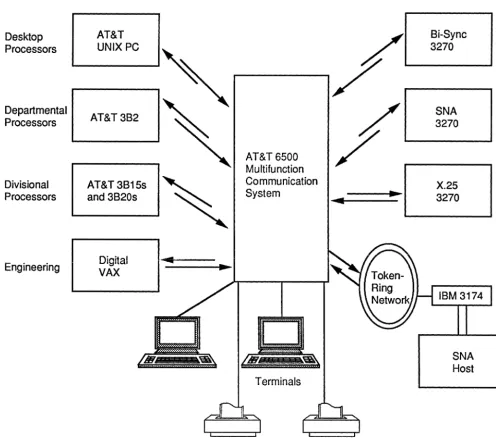
Figure 1.
Connections Supported by the 6544 Controller
Desktop AT&T
Processors UNIX PC
'"
Departmental
AT&T 382
,
Processors
Divisional AT&T 3815s
~
Processors and 3820s
Digital
...
EngineeringVAX
...
AT&T
6500 Multifunction Communication System
Datapro Reports on Data Communications
/
Bi-Sync 3270
/
AT&T 6500Multifunction Communication
System
...
....
Terminals
Printers
SNA 3270
X.25 3270
IBM 3174
SNA Host
AT&T's 6544 Multifunction Communication Controller provides access to a variety of asynchronous and syn-chronous computers.
Basic Function Display-December 1985; 6528 and 6529 Standard Displays-December 1985; 6538 and 6539 Multitasking Displays-December 1985; 6591 D, 6592D, and 6592F Plug-Compatible Displays-March 1989; 6571 Color Graphics Printer-September 1987; 6572 Plug-Compatible Printer-September 1988; 6561 Printer Controller-March 1986; 6562 Coax Printer Controller-March 1989; the 2-N-1 Adapter-November 1987; and the Coax Attachmate (3-N-1) Adapter-November 1987.
Software-6500 System Controller Software
Re-lease 3.3-February 1989; Attachmate Control Program-November 1987.
FEBRUARY 1990
Number Delivered to Date: Vendor did not specify. Serviced by: AT&T.
System Components
The AT&T 6500 Multifunction Communication System currently includes two communications controllers. Model 6544, AT&T's flagship product, has been mar-keted since 1985. Other products in the 6500 System family that work with the 6544 controller include five
The 6572 Printer is a serial, dot matrix color printer that prints at JOO cps in near letter quality or at 400 cps in draft quality. The unit's multicolor ribbons support/our- or seven-color printing.
6500 System display terminals, three IBM plug-compatible display units, a 6500 system-plug-compatible printer and printer controller, an IBM plug-compatible printer and printer controller, and nine expansion mod-ules that extend the connectivity options of the user.
The 6542 controller, made available in March 1989, is a lower-priced, table-top controller that sup-ports coaxial cable connections to up to eight IBM plug-compatible peripheral devices.
The 6500 System supports a variety of host com-puters, including the IBM S/360, S/370, 3031, 3032, 3033, 3081, 3083, 3084, 4321, 4331, and 4341; with the appropriate software, the controllers can also support the IBM 8100, Series/1, System/36, and System/38. In addition to IBM synchronous hosts, the 6500 System supports connections to IBM plug-compatible main-frames (PCMs). The 6500 supports asynchronous con-nections to the AT&T 3B family and UNIX PC, the Digital VAX, and most other popular minicomputer families.
Transmission Specifications
When communicating synchronously, the 6544 control-ler provides maximum data rates of 64K bps for hosts supporting SNA and X.25 protocols and 19.2K bps for hosts supporting Bisync protocols. The 6500 System communicates with asynchronous hosts and peripher-als at a maximum 19.2K bps data transmission rate. De-vices can be connected up to 5,000 feet from the 6544 controller.
The 6542 controller supports data rates of up to 19.2K bps for synchronous and asynchronous devices and hosts.
@ 1990 McGraw-Hili, Incorporated. Reproduction Prohibited. Datapro Research. Delran NJ 08075 USA
Communications Controllers
The 6544 Multifunction Communication Controller
The 6544 controller supports up to four SNA and/or BSC host connections, 32 synchronous devices, and 32 asynchronous devices or processors, depending on how it is configured. Devices can be located up to 5,000 feet from the controller.
AT&T 6500 System-compatible displays and print-ers are connected to the 6544 controller via twisted-pair telephone wire that is compatible with AT&T's SYSTI-MAX PDS. Communications over coaxial cable is also possible through optional adapters.
Standard equipment includes a Main Processor
Module (also referred to as the A Card), dual 51J4-inch diskette drives for loading software, and 14 module slots, 12 of which are available for add-on expansion modules. An optional 20M-byte hard disk drive facili-tates program loading and increases controller software storage capacity.
Self-test diagnostics are standard on the 6544 controller. In addition, the 6544 supports two IBM net-work programs that reside on host computers: Netnet-work Problem Determination Application (NPDA) and Network Logical Data Manager (NLDM).
The 6544 not only supports the 6500 System-compatible and plug-System-compatible displays, but can ac-commodate the older AT&T 4540 and E4540 displays. For asynchronous applications, the 6544 supports the attachment of the AT&T 4400 family of displays and the AT&T 600 line, as well as other asynchronous displays. such as the Digital VT220 and
vn
00.Other printers, including AT&T 4540 and E4540 printer models, may be added to a 6500 System cluster using the 6561 Printer Controller; one printer controller is required for each printer.
Basic 6544 functionality provides access to a sin-gle synchronous host computer through a sinsin-gle 6500 System display. The following nine expansion modules are available to provide additional multifunctional fea-tures:
Synchronous Host Module (8 Card): an expansion module that provides three SNA/BSC ports. Each mod-ule supports an aggregate data transfer rate of 38.4K bps. This allows two ports using the Bisync (or SDLC) protocol to operate at 19.2K bps, for example. Two Syn-chronous Host modules are needed in situations when there are two SNA hosts operating at higher speeds. The 6544 controller supports up to four of these mod-ules for a maximum of four hosts.
The Synchronous Host Module may also support one SNA port operating at either 56K or 64K bps. At either of these higher speeds, only one port is used per card.
Synchronous Device Interface Module (C Card): an expansion module that provides for the attachment of up to 16 synchronous displays, printers, and personal
C2S-046-108 Terminals
computers, including 6500 system-compatible devices, via twisted-pair wire. The 6544 controller accommo-dates two Synchronous Device Interface Modules, pro-viding for a maximum configuration of 32 synchronous devices. This module also permits connections to per-sonal computers using the 2-N-1 product.
Asynchronous Host/Protocol Conversion Module (D Card): an expansion module that provides port connec-tions for up to eight asynchronous host computers or terminals. Protocol conversion allows asynchronous terminals to access synchronous hosts. The ports oper-ate at speeds up to 19.2K bps. Four Asynchronous Hosttprotocol Conversion Modules can be added, pro-viding for a maximum configuration of 32 asynchronous connections.
X.25 Interface Module (H Card): an expansion module that provides one connector for IBM-compatible hosts supporting the Network Control Program Packet Switched Interface (NPSI) protocols. The connector supports either of the following interfaces: RS-232-C at speeds up to 19.2K bps or CCITT V.35 at speeds of 48K, 56K, or 64K bps. Only one H Card may be in-stalled.
Local Channel Interface Module (F Card): an expan-sion module that provides a connection to an IBM main-frame byte multiplexer, block multiplexer, or selector channel in configurations where the 6544 controller is located within 200 cable feet of the host. Users can equip each 6544 with one or two Local Channel mod-ules. The 6544 can support both remote and local hosts concurrently.
Plug-Compatible Device Interface Module (K Card): an expansion module that allows users to establish plug-compatibility for up to 16 synchronous devices or two multiplexers. With Release 3.2 or later of the controller software, any plug-compatible display connected to this module can run up to five concurrent sessions in the same SNA host or different hosts. Users can add a sec-ond module for a total of 32 ports (provided that no C Card is being used). This module also permits connec-tions to personal computers using the Coax Attachmate (3-N-1) product.
Nine-Port PCM Device Logic Module (K"'Card): a smaller, less expensive version of the K Card for users who need to support no more than nine plug-compatible devices or two multiplexers. This module requires Re-lease 3.2 or later of the controller software.
Token-Ring Logic Module (T Card): enables devices connected to a 6544 controller to access a remote or local SNA host via a token-ring network. It also sup-ports communications between token-ring devices to communicate with a local or remote SNA host via a 6544 controller.
FEBRUARY 1990
AT&T
6500 Multifunction Communication System
Datapro Reports on Data Communications
Processor/Memory Logic Module (X Card): expands the memory capacity of the 6544 controller, allowing it to support the enhancements included in controller soft-ware Release 3.0 and later.
6542 Tabletop Controller
The 6542 supports connections to as many as eight IBM plug-compatible devices, one remote host, and up to two asynchronous devices (e.g., minicomputers, PCs, or peripherals). The 6542's ports accommodate coax connections; however, any port can also support twisted pair wire connections using AT&T's Balun Adapter. The 6542 does not support AT&T's 6500 Sys-tem (non-plug-compatible) devices or any of the 6544 expansion modules.
Base 6542 functionality includes one remote syn-chronous host connection, an asynsyn-chronous port for remote diagnostics, a 31/2-inch diskette drive, and sup-port for four directly connected IBM plug-compatible devices.
The 6542 contains three expansion slots to ac-commodate three optional modules:
• A Synchronous Device Interface Module provides four additional ports, making it possible to support a maximum of eight plug-compatible devices.
• An Asynchronous Host/Protocol Conversion Module supports communications with two asynchronous devices.
• A Memory Expansion Module provides the additional memory needed to support the interface and conver-sion modules.
Additionally, one of the 6542's standard ports will allow the multiplexing of eight synchronous plug-compatible peripherals over a single coax cable using an IBM 3299 multiplexer. When the multiplexer is in operation, how-ever, all other ports remain inactive.
Displays
AT&T 6500 System-Compatible Displays AT&T offers five 6500 system-compatible display units which implement the protocols developed for the origi-nal 6500 System. All models support a tilt/swivel capa-bility; both color and monochrome (amber or green) displays are available. The units, developed for use with the 6544 controller, are described in more detail below.
6518 Basic Function Display: This monochrome unit supports single session communications with one syn-chronous host; it does not support access to asynchro-nous hosts. The 6518 includes a 14-inch screen, with a display capacity of 1,920 characters arranged in 24 lines of 80 characters each. The 6518 is functionally compati-ble with IBM's 3178 and 3191 display stations.
6528 Standard Display: The 6528 monochrome display provides a "hot key" for switching between two ses-sions on a single host or different hosts. (Data transfer between sessions is not supported, however.) Either session may be synchronous or asynchronous. The 6528 includes a 15-inch monochrome display screen, with display capacities ranging from 1,920 to 3,564 characters; screen arrangements include 24 lines by 80 characters, 32 lines by 80 characters, 43 lines by 80 characters, and 27 lines by 132 characters. The 6528 is functionally compatible with the IBM 3180 display sta-tion in synchronous mode and with the Digital VT220 display terminal in asynchronous mode.
6529 Standard Display: This 14-inch color display in-cludes the same split-screen capability as the 6528. The 6529 provides a four- or seven-color display, with dis-play capacities ranging from 1,920 to 3,564 characters. Screen arrangements include 24 lines by 80 characters, 32 lines by 80 characters, 43 lines by 80 characters, and 27 lines by 132 characters. The 6529 is functionally compatible with the IBM 3179 display station in syn-chronous mode and with the Digital VT220 display ter-minal in asynchronous mode.
6538 Multitasking Display: This monochrome display provides up to four multitasking windows in any combi-nation of synchronous and asynchronous sessions. Window positioning/browsing/sizing speed is four inches per second horizontal and six inches per second vertical. The 6538 includes a 15-inch display screen, with display capacities ranging from 1,920 to 3,564 characters; screen arrangements include 24 lines by 80 characters, 32 lines by 80 characters, 43 lines by 80 characters, and 27 lines by 132 characters. The 6538 supports four screen formats, including 3270 operation, VT220 operation, full-extended attributing, and input and edit. An auxiliary I/O port and programmed symbol graphics are optionally available. The 6538 is function-ally compatible with the IBM 3180 display station in syn-chronous mode and with the Digital VT220 display terminal in asynchronous mode.
6539 Multitasking Display: This color display provides up to four multitasking windows in any combination of synchronous and asynchronous sessions. Window positioning/browsing/sizing speed is four inches per second horizontal and six inches per second vertical. The 6539 includes a 14-inch display screen, with display capacities ranging from 1,920 to 3,564 characters; screen arrangements include 24 lines by 80 characters, 32 lines by 80 characters, 43 lines by 80 characters, and 27 lines by 132 characters. The 6539 features four- or seven-color display capability and supports four screen formats, including 3270 operation, VT220 operation, full-extended attributing, and input and edit. An auxiliary
1/0 port and programmed symbol graphics are option-ally available. The 6539 is functionoption-ally compatible with the IBM 3279-S3G display station in synchronous mode and with the Digital VT220 display terminal in asynchro-nous mode.
© 1990 McGraw-Hili. Incorporated. Reproduction Prohibited. Datapro Research. Delran NJ 08075 USA
Keyboards for 6500 System-Compatible Displays
The 6518 display comes with a 122-key keyboard con-taining 24 external program function (PF) keys. This de-tachable keyboard has a typewriter-style layout and a low-profile design. Security keylock is a standard fea-ture. A three-year warranty is available with the 6518.
The 6528, 6529, 6538, and 6539 displays are mod-ularly designed and can be upgraded or downgraded by switching logic bases and display monitors. They are all equipped with a 122-key keyboard that includes 24 pro-gram function (PF) keys and a VT220 template. The de-tachable keyboard contains a typewriter-style layout and a low-profile design. Security keylock is a standard feature.
IBM Plug-Compatible Displays
Each of the following three 6500 plug-compatible dis-plays can operate with IBM 3270 controllers, the AT&T 6544 controller, and the AT&T 6542 controller. The units' display screens support tilt/swivel capabilities, and monochrome devices are available with amber or green phosphor characters.
When connected to a 6500 controller running Con-troller Software Release 3.2 or later, these displays sup-port up to five simultaneous sessions with synchronous and asynchronous hosts.
6591D Plug-Compatible Display: This low-cost, mono-chrome display, designed for basic data entry, includes a 14-inch screen and a 122-key keyboard. The 65910 is equivalent to IBM's 3191 display family, supporting screen arrangements of 24 lines by 80 characters and 32 lines by 80 characters.
6592D Plug-Compatible Display: This monochrome display, equivalent to the IBM 3192-0 display, features a 15-inch screen and a 122-key keyboard supporting record keystroke capabilities. The 65920 supports screen arrangements of 24 lines by 80 characters, 32 lines by 80 characters, 43 lines by 80 characters, and 27 lines by 132 characters.
6592F Plug-Compatible Display: This display is the color equivalent of the 95920. It includes a 14-inch, seven-color screen and a 122-key keyboard which pro-vides record keystroke capabilities. The 65920 sup-ports screen arrangements of 24 lines by 80 characters, 32 lines by 80 characters, 43 lines by 80 characters, and 27 lines by 132 characters.
Printers and Printer Controllers
AT&T offers a 6500 system-compatible printer and printer controller as well as an IBM plug-compatible printer and printer controller. The 6500 System printer products are designed for communications with the 6544 controller alone; the plug-compatible printer prod-ucts support connections to both the 6544 and 6542 controllers as well as IBM controllers.C25-046-110 Terminals
6571 Color Matrix Printer: The 6571, a 6500 system-compatible matrix printer, provides color or mono-chrome text and graphics printing. The 6571 operates at speeds up to 400 cps in draft mode and 100 cps in near letter quality mode. The 6571 prints symbol graphics and supports one-, four-, and seven-color printing. The 6571 includes a full-function SNA control panel and LCD display, an operator-replaceable 18-wire printhead with half-dot shift, and a tractor- or friction-feed platen with rear or bottom feed. Paper feed/positioning controls are also included.
6572 Plug-Compatible Printer: The 6572 is a coax (plug-compatible) version of the 6571 printer, offering all the same features.
6561 Printer Controller: The 6561 is a printer controller that enables the use of older AT&T 4540 and E4540 printers as well as AT&T's newer asynchronous printers in a 6500 System cluster. The 6561 adds new functions and applications to the older printers and includes a full-function SNA control panel, LCD display, and the follow-ing interfaces: SSI (twisted pair) in, SSI out, RS-232-C out, and Centronics parallel out.
6562 Coax Printer Controller: The 6562 Printer Control-ler is a plug-compatible version of the 6561 that can connect to IBM 3274 or 3174 controllers. The 6562 sup-ports both parallel and serial asynchronous printers.
Personal Computer Add-On Products
The 2-N-1 Adapter, which runs AT&T's Attachmate Con-trol Program, provides multisession, multiwindowing capability to PCs connected to the 6500 controller via twisted pair wire. Up to seven concurrent windows are possible: four 3270 sessions, two notepads, and one PC session. While the PC cannot access multiple hosts simultaneously, it can access multiple concurrent ses-sions on a single host.
The Coax Attachmate (3-N-1) Card supports a connection from a PC to either the 6544 or 6542 control-ler via an RG62A/U coaxial cable, running AT&T's At-tachmate Control Program and providing the same capabilities.
Pricing
The 6500 Multifunction Communication System compo-nents are available for purchase and lease through AT&T's direct sales force or by calling (800) 247-1212. AT&T provides installation and maintenance service through 1,000 nationwide sites.
The 6500 Multifunction Communication System products carry a warranty from the date of purchase, guaranteeing that AT&T will replace any defective part or software free of charge during the warranty period. The company offers several Equipment Maintenance Agreement Plans, including per-occurrence and con-tract plans.
FEBRUARY 1990
AT&T
6500 Multifunction Communication System
Datapro Reports on Data Communications
Equipment Prices
6544
6544
6542 6542
Multifunction Communication Control-ler
Options:
Synchronous Host Module
Synchronous Device Interface Module Asynchronous Host/protocol
Conver-sion Module X.25 Interlace Module
Local Channel Expansion Module 16-Port, Plug-Compatible Logic
Mod-ule
Nine-Port PCM Device Logic Module Processor/Memory Logic Module Hard Disk Drive
Tabletop Communication Controller Options:
Synchronous Device Interlace Module Asynchronous Host/protocol
Conver-sion Module
Memory Expansion Module Controller Software Release 3.3
Displays
6518 Basic Function Display 6528 Standard Display 6529 Standard Display 6538 Multitasking Display 6539 Multitasking Display 65910 Plug-Compatible Display 6592D Plug-Compatible Display 6592F Plug-Compatible Displays Printers and Printer Controllers
6571 6572 6561 6562
Color Graphics Printer Plug-Compatible Printer Printer Controller Coax Printer Controller Personal Computer Options
The 2-N-l Adapter
The Coax Attachmate (3-N-l) Adapter Attachmate Control Program
Purchase Price
($)
1,418
383 5,179 2,425 1,369 3,668 5,179 4,672 1,600 1,845 3,597 821 887 1,281 27
1,100 1,935 2,085 2,755 2,880 1,300 1,600 1,750
5,037 5,037 1,002 1,643
1,144 1,144 323
•
AT&T
6500 Multifunction
Communication System
In this report: Product Summary
Analysis ... -102 Editor's Note
Release 3.3 of AT&T's controller Characteristics ... -106 software enables the 6544 controller
to support up to four simultaneous Pricing ... -110 SNA host connections. AT&T also
now markets the 6542 tabletop con-troller. The 6578, 6579, 6580, and 6591 IBM plug-compatible displays have been superseded by AT&T's 6591D, 6592D, and 6592F plug-compatible displays.
Description
AT&T's 6500 Multifunction Com-munication System provides syn-chronous and asynsyn-chronous access to multiple computers and peripherals. AT&T markets a variety of 6500 System-compatible and IBM plug-compatible display terminals and printers. Some system-compatible displays support multitasking.
Strengths
The flexible 6544 controller supports up to four simultaneous synchronous host connections, 32 synchronous peripherals and 32 asynchronous devices or computers, and access to X.25 and token-ring networks. Sup-port for simultaneous access to both synchronous and asynchronous ses-sions is a key feature of both the 6544 and 6542 controllers.
@ 1990 McGraw-Hili, Incorporated. Reproduction Prohibited. Datapro Research. Delran NJ 08075 USA
Limitations
No major limitations.
Competition
IBM, Memorex/Telex, IDEA Cou-rier, Lee Data, and several others.
Vendor AT&T
Data Systems Group 77760n-the-Green Morristown, NJ 07960 (201) 898-6000 In Canada:
AT&T Canada Inc.
3650 Victoria Park Avenue Willowdale, ON M2H 3P7 (416) 499-9400
Price
See pricing section.
C25-046-102 Terminals
Analysis
Product Strategy
In December 1985, AT&T introduced the 6500
Multifunction Communication System, a product
family that provides compatibility with the
syn-chronous IBM 3270 system, as well as
asynchro-nous communications.
By the fourth quarter of 1987, AT&T had
ex-panded the system's functionality with additional
products and enhancements, including three new
plug-compatible displays, an adapter for the 6544
controller to support plug-compatible devices, a
6500 System-compatible color graphics printer, a
local channel-connection option, increased
asyn-chronous access capabilities, and terminal session
capability for IBM-compatible PCs through
adapter cards.
Between April 1988 and March 1989, AT&T
added the 6542 Tabletop Communication
Control-ler, four additional plug-compatible displays, and a
plug-compatible printer and printer controller.
AT&T also provided system enhancements such as
support for up to four simultaneous host
connec-tions, two of which could use SNA/SDLC
proto-cols; 32 ports for synchronous devices; and 32
asynchronous connections. With Release 3.3 of
AT&T's controller software in February 1990, the
6544 controller now supports up to four
simulta-neous SNA hosts and a token ring connection.
AT&T has long been a leader in the IBM
3270-compatible terminal market, with over
300,000 terminals installed. The company's
prod-ucts include the 40 Series, the 4540 family, and the
E4540 line. Each product line provides basic,
func-tional compatibility with corresponding IBM 3270
products.
Components of the 6500 Multifunction
Com-munication System include the 6544 controller; the
6518 Basic Function Display; the 6528 and 6529
Standard Displays; the 6538 and 6539
Multitask-ing Displays; the 6591D, 6592D, and 6592F
Plug-Compatible Displays; the 6571 and 6572 Color
APRIL 1990
AT&T
6500 Multifunction Communication System
Datapro Reports on Data Communications
Graphics Printers; the 6561 and 6562 Printer
Con-trollers; and the 2-N-1 and Coax Attachmate
(3-N-1) PC adapters.
The 6544 controller accommodates the older
AT&T 4540 and E4540 displays and the AT&T
4400 family asynchronous displays. The 6500
com-ponents operate over standard twisted-pair
tele-phone wire or previously installed coaxial cable.
The 6544 controller also supports multiple hosts
and devices through 12 expansion slots, which hold
different combinations of the following modules:
• The Synchronous Host Module: provides three
synchronous ports for the access of 3270 hosts
(Bisync or SNA).
• The Synchronous Device Interface Module:
al-lows the attachment of up to 16 synchronous
displays, printers, or PCs via twisted-pair wire.
• The Asynchronous Host/Protocol Conversion
Module: enables connection of up to eight
asyn-chronous hosts or terminals; protocol
conver-sion allows asynchronous terminals to access
synchronous hosts.
• The X.25 Interface Module: provides a
connec-tor for IBM-compatible hosts supporting packet
switched protocols.
• The Local Channel Interface Module: provides
connection for IBM mainframe byte
multi-plexer, block multimulti-plexer, or selector channel
configurations in which the 6544 is within 200
feet of the host.
• The Plug-Compatible Device Interface Module:
provides connection of up to 16 synchronous
devices to the 6544 controller.
• The Token-Ring Logic Module: allows devices
connected to a 6544 controller to access a
re-mote or local SNA host via a token-ring
net-work.
The 6542 Tabletop Controller accommodates one
synchronous host and, with an optional expansion
card, two asynchronous computers (or peripherals).
Standard equipment includes four ports for
plug-compatible devices. With an optional expansion
card, up to eight devices can be supported. Data
transmission speeds of up to 19.2K bps per port
are possible.
The 6500 controllers can communicate with a
variety of host computers, including the IBM S/
360, S/370, 303X, 308X, 43XX, and IBM
piug-compatible mainframes (PCMs) from various
~Company Profile
AT&T
Corporate Headquarters 550 Madison Avenue New York, NY 10022-3297
(212) 605-5500 In Canada AT&T Canada Inc. 3650 Victoria Park Avenue
Willowdale, ON M2H 3P7 (416) 499-9400
Officers
CEO: Robert E. Allen CFO: Morris Tanenbaum
Company Background AT&T's business is mov-ing and managmov-ing infor-mation, domestically and globally. That includes providing long distance telecommunications ser-vices through the compa-ny's Worldwide Intelligent Network, as well as sys-tems, products, and ser-vices that combine communications and computers.
AT&T states its mission is to apply the talents, knowledge, and skills of its people to make the company the global leader in enabling cus-tomers to reap the bene-fits of information technology.
The company's major customer markets are business and govern-ment, consumers, the
telecommunications in-dustry, and electronic equipment manufactur-ers. To business and gov-ernment institutions, AT&T offers a range of voice and data transmis-sion services as well as computer and data net-working products and systems. Communica-tions products sold, rented, and serviced by AT&T include personal computers, midrange computers, software and peripheral equipment, PBX equipment, key tele-phone systems, and fac-simile machines. AT&T supplies switching systems, transmission equipment, and opera-tions support services to the telecommunications industry and manufac-tures advanced electronic components for high-technology firms.
1988 was a year of strong actions for AT&T: its reve-nues were the highest since divestiture on the strength of growth in product sales as well as growth in service reve-nues; the company shifted more of its people to sales or sales support jobs to further strengthen its market position. To meet a growing demand from its customers, AT&T
© 1990 McGraw-Hili, Incorporated. Reproduction Prohibited. Datapro Research. Delran NJ 08075 USA
AT&T
Financial Results 1987-1989
Revenues (in billions)
$40
35.2 36.11 33.8
$30
$20
$10
$0
1987 1988 1989
(in billions) Net Income
$3
$2
$1
$0
$-1
$-2 1988
decided to speed up its conversion to an all-digital long-distance network. Higher costs and ex-penses reflect the deci-sion to accelerate the modernizing of its net-work. It was necessary to write down the value of older technology equip-ment, adding $6.7 billion to its costs and expenses. This action reduced AT&T's earnings by $3.66 a share, resulting in a loss for the year. Without this
2.69
charge the company's earnings would have in-creased to $2.11 per share.
AT&T's actions to in-crease sales, modernize, and reduce expenses en-hanced its earnings po-tential. For the third quarter of 1989, the com-pany reported earnings of $699 million on revenues of $8.9 billion.
C25-046-104 Terminals
A View of the 6544 Controller
The backplane of the controller contains 12 expansion slots for connecting as many as four synchronous hosts, 32 synchronous devices, and 32 asynchronous devices.
~ (Analysis continued)
vendors. They can provide access to multiple hosts
from the same display terminal.
Competitive Position
Over the years, AT&T's former subsidiary,
Tele-type, built up a large installed base of IBM
3270-compatible terminals; the company estimates that
there are more than 300,000 terminals now
in-stalled, including the 40, 4540, and E4540 families.
Prior to AT&T's divestiture, Teletype had what
amounted to an exclusive market, selling products
primarily to the Bell Operating Companies (BOCs)
for their internal use or resale to their customers.
As much as 40 percent of Teletype's business at
that time was attributed to the company's
relation-ship with the BOCs.
In 1985, AT&T Teletype became a wholly
owned subsidiary of the Computer Systems
Divi-sion of AT&T Information Systems. All sales
activ-ities for Teletype-manufactured products were
moved to AT&T headquarters in New Jersey, and
product management was folded into a DTE
divi-sion of the Computer Systems Dividivi-sion. The
Tele-type name remains a legal entity for trademark,
product brand name, and other purposes; as a
com-APRIL 1990
AT&T
6500 Multifunction Communication System
Datapro Reports on Data Communications
pany, however, Teletype Corporation has been
swallowed up by AT&T.
The 6500 Multifunction Communication
Sys-tem is AT&T's most comprehensive (and
ambi-tious) foray into the 3270 replacement market. The
product line conforms to two important trends in
the market:
Integration of personal computing capabilities
into the 3270 cluster; and
• Access to multiple hosts, including
asynchro-nous computers.
The 6500 product line places AT&T in a strong
position to compete with IBM, as well as other
3270-compatible vendors, including
MemorexlTelex, IDEA Courier, Lee Data, and Harris. IBM
has taken steps to protect its huge and lucrative
3270 installed base, however.
In the third and fourth quarters of 1989, IBM
released a more powerful breed of 3174 controllers
which contain more powerful processors, support
up to 6M bytes of memory (the former limit was
4M bytes), and run Configuration Support B
microcode-new controller software that supports
up to 250 physical units. The microcode also works
with IBM's new Concurrent Communications
Adapter to accommodate up to three synchronous
host connections. Previously, only one connection
was possible. In September 1989, IBM also
an-nounced another generation of display terminals
offering higher resolution, greater processing
speed, more functions per keystroke, and a more
attractive price.
Release 2 of IBM's Configuration Support B
microcode, which will be made available in June
1990, will make it possible to perform controller
diagnostic procedures from a NetView console
rather than through a terminal tied directly to the
controller. Towards the end of 1990, IBM will also
incorporate into the microcode another feature
dubbed the Multi-Host Token-Ring Gateway.
Us-ing the Concurrent Communications Adapter, this
feature will support communications between any
token-ring workstation or device and up to three
hosts via the 3174.
Vendors such as AT&T, Lee Data, and
Memorex/Telex have introduced communications
controllers that support access to as many as four
synchronous hosts, with multi windowing on both
synchronous and asynchronous sessions. In the
past, however,
Memorex/Telexhas been most
suc-cessful offering IBM plug-compatible controllers
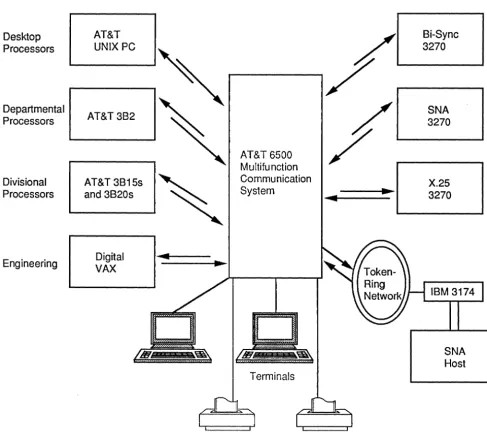
Figure 1.
Connections Supported by the 6544 Controller
Desktop AT&T
Processors UNIX PC
'"
Departmental
AT&T 3B2
,
Processors
Divisional AT&T 3B15s
~
Processors and 3B20s
Digital
...
EngineeringVAX
, /
,/
AT&T 6500 M u Itifu nction Communication
System
...
..
Printers
Bi-Sync 3270
SNA 3270
X.2S 3270
IBM 3174
SNA Host
AT&T's 6544 Multifunction Communication Controller provides access to a variety of asynchronous and
syn-chronous computers.
and peripherals at the lowest possible price. IDEA Courier also offers a line of competitively priced IBM plug-compatible products.
The Future of Display Terminals
According to research performed by Dataquest, IBM holds about 50 percent of the market for 3270 display stations. Memorex/Telex, AT&T, and IDEA Courier follow with about 29, 8, and 5 per-cent of the market respectively. International Data Corporation (IDC) predicted a growth of annual U.S. display shipments from 848,900 units in 1988 to 940,400 units by 1992.
© 1990 McGraw-Hili. Incorporated. Reproduction Prohibited. Datapro Research. Delran NJ 08075 USA
Terminals continue to enjoy popularity be-cause of the large installed base of 3270 systems. Display terminals also take up less desk space than personal computers. Therefore, some users who don't need the disk storage capability and process-ing power of a standalone PC prefer terminals in-stead. These displays, however, must now share the spotlight with a new breed of workstations de-signed to fill the gap between the PC and the dis-play terminal: the diskless workstation.
With the proliferation ofLANs, users are moving away from displays controlled completely
C25-046-106 Terminals
by a host to intelligent DOS-based workstations
supported by a file server. Equipped with large
amounts of memory, diskless workstations perform
much of the processing that the host would
per-form for the display terminal, which
improvessys-tem performance. Without disk drives and other
features normally found on a standalone machine,
they offer greater economy, simplicity, and security
than a PC; all information is stored on the file
server. Like a PC, however, the diskless
worksta-tion can run DOS applicaworksta-tions and has the
process-ing power to support advanced capabilities.
The 3270 terminal continues to flourish. But
price wars have taken a toll on vendors, who must
sell more units to make up for lower profits. To
guarantee their financial stability and adjust to the
changing market, more and more vendors are
of-fering diskless workstations in addition to the
tra-ditionalline of display terminals.
Decision Points
The 6500 Multifunction Communication System's
key feature, reflected in its name, is
multifunction-ality. The 6544 controller provides multihost
ac-cess, both to asynchronous and synchronous
computer systems. In addition, it can support color
and monochrome multitasking displays,
plug-compatible displays, personal computers, printers,
adapters, and older AT&T 4540 and E4540
dis-plays.
AT&T's 6500 System-compatible display
ter-minals offer a variety of features and capabilities
not found on previous AT&T displays. Particularly
interesting are the 6538 monochrome and 6539
color multitasking systems, which can offer up to
four multitasking windows that provide
simulta-neous access to four distinct computer sessions in
any combination of synchronous and
asynchro-nous applications.
The 6544 operates as a standard IBM
3274-type controller; through add-on modules, however,.
it can be upgraded to provide support for four
syn-chronous host communications ports (including up
to two local channel connections), as many as 32
synchronous devices, up to 32 peripherals and
computers, one X.25 network connection, and a
token-ring connection. The 6544 controller's 12
expansion slots allow new capabilities to be added
to the system as communications requirements
grow.
APRIL 1990
AT&T
6500 Multifunction Communication System
Datapro Reports on Data Communications
Major benefits of the 6544 and 6542
control-lers are access to as many as four synchronous
hosts, and support for multiple concurrent
syn-chronous and asynsyn-chronous sessions with
window-ing. These capabilities, however, are also provided
by Memorex's 1174 Network Controller and Lee
Data's Datastar 5000 System.
The 6500 System puts AT&T on a strong
competitive level in the 3270 market; however,
since the market has been dominated for so long by
IBM, AT&T must still fight for a larger market
share.
Characteristics
Models: Hardware-6544 Multifunction Communication
Controller; 6542 Tabletop Communication Controller; 6518 Basic Function Display; 6528 and 6529 Standard Displays; 6538 and 6539 Multitasking Displays; 65910, 65920, and 6592F Plug-Compatible Displays; 6571 Color Graphics Printer; 6572 Plug-Compatible Printer; 6561 Printer Controller; 6562 Coax Printer Controller; the 2-N-1 Adapter; and the Coax Attachmate (3-N-1) Adapter.
Software-6500 System Controller Software
Re-lease 3.3; Attachmate Control Program.
Date of First Delivery: Hardware-6544 Multifunction
Communication Controller-December 1985; 6542 Ta-bletop Communication Controller-March 1989; 6518 Basic Function Display-December 1985; 6528 and 6529 Standard Displays-December 1985; 6538 and 6539 Multitasking Displays-December 1985; 6591 D, 6592D, and 6592F Plug-Compatible Displays-March 1989; 6571 Color Graphics Printer-September 1987; 6572 Plug-Compatible Printer-September 1988; 6561 Printer Controller-March 1986; 6562 Coax Printer Controller-March 1989; the 2-N-1 Adapter-November 1987; and the Coax Attachmate (3-N-1)Adapter-November 1987.
Software-6500 System Controller Software
Re-lease 3.3-February 1989; Attachmate Control Program-November 1987.
Number Delivered to Date: Vendor did not specify.
Serviced by: AT&T.
The 6572 Printer is a serial, dot matrix color printer that prints at 100 cps in near letter quality or at 400 cps in draft quality. The unit's multicolor ribbons support!our- or seven-color printing.
System Components
The AT&T 6500 Multifunction Communication System currently includes two communications controllers. Model 6544, AT&T's flagship product, has been mar-keted since 1985. Other products in the 6500 System family that work with the 6544 controller include five 6500 System display terminals, three IBM plug-compatible display units, a 6500 system-plug-compatible printer and printer controller, an IBM plug-compatible printer and printer controller, and nine expansion mod-ules that extend the connectivity options of the user.
The 6542 controller, made available in March 1989, is a lower-priced, table-top controller that sup-ports coaxial cable connections to up to eight IBM plug-compatible peripheral devices.
The 6500 System supports a variety of host com-puters, including the IBM S/360, S/370, 3031, 3032, 3033, 3081, 3083, 3084, 4321; 4331, and 4341; with the appropriate software, the controllers can also support the IBM 8100, Series/1, System/36, and System/38. In addition to IBM synchronous hosts, the 6500 System supports connections to IBM plug-compatible main-frames (PCMs). The 6500 supports asynchronous con-nections to the AT&T 3B family and UNIX PC, the Digital VAX, and most other popular minicomputer families.
Transmission Specifications
When communicating synchronously, the 6544 control-ler provides maximum data rates of 64K bps for hosts supporting SNA and X.25 protocols and 19.2K bps for hosts supporting Bisync protocols. The 6500 System communicates with asynchronous hosts and peripher-als at a maximum 19.2K bps data transmission rate. De-vices can be connected up to 5,000 feet from the 6544 controller.
© 1990 McGraw·HiII, Incorporated. Reproduction Prohibited. Datapro Research. Delran NJ 08075 USA
The 6542 controller supports data rates of up to 19.2K bps for synchronous and asynchronous devices and hosts.
Communications Controllers
The 6544 Multifunction Communication Controller
The 6544 controller supports up to four SNA and/or BSC host connections, 32 synchronous devices, and 32 asynchronous devices or processors, depending on how it is configured. Devices can be located up to 5,000 feet from the controller.
AT&T 6500 System-compatible displays and print-ers are connected to the 6544 controller via twisted-pair telephone wire that is compatible with AT&T's SYSTI-MAX PDS. Communications over coaxial cable is also possible through optional adapters.
Standard equipment includes a Main Processor
Module (also referred to as the A Card), dual 51f4-inch diskette drives for loading software, and 14 module slots, 12 of which are available for add-on expansion modules. An optional 20M-byte hard disk drive facili-tates program loading and increases controller software storage capacity.
Self-test diagnostics are standard on the 6544 controller. In addition, the 6544 supports two IBM net-work programs that reside on host computers: Netnet-work Problem Determination Application (NPDA) and Network Logical Data Manager (NLDM).
The 6544 not only supports the 6500 System-compatible and plug-System-compatible displays, but can ac-commodate the older AT&T 4540 and E4540 displays. For asynchronous applications, the 6544 supports the attachment of the AT&T 4400 family of displays and the AT&T 600 line, as well as other asynchronous displays such as the Digital VT220 and VT100.
Other printers, including AT&T 4540 and E4540 printer models, may be added to a 6500 System cluster using the 6561 Printer Controller; one printer controller is required for each printer.
Basic 6544 functionality provides access to a sin-gle synchronous host computer through a sinsin-gle 6500 System display. The following nine expansion modules are available to provide additional multifunctional fea-tures:
Synchronous Host Module (8 Card): an expansion module that provides three SNA/BSC ports. Each mod-ule supports an aggregate data transfer rate of 38.4K bps. This allows two ports using the Bisync (or SDLC) protocol to operate at 19.2K bps, for example. Two Syn-chronous Host modules are needed in situations when there are two SNA hosts operating at higher speeds. The 6544 controller supports up to four of these mod-ules for a maximum of four hosts.