Copyright © 2017, Scholarly Research Journal for Interdisciplinary Studies
EXPLOITATION OF IN-MIGRANT CONSTRUCTION WORKERS IN
KERALA: A CASE STUDY
Anish Chandran1 & Chinnu Mariam Chacko2 1
Guest Lecturer, Department of Economics, St. Thomas College, Kozhencherry, Kerala, India
email:[email protected]
2
Assistant Professor, Department of Economics, St. Thomas College, Kozhencherry, Kerala,
India. email:[email protected]
The construction industry forms an integral part of the Indian economy and a conduit for a substantial part of its development investment, is poised for growth on account of industrialization, urbanization, economic development. The sector is labour-intensive and, including indirect jobs, provides employment to millions of people. The construction sector is also the second largest employer in the country following agriculture. The industry comprises of highly specified tasks, and for each task and stage, a different contractor is engaged and under each contractor different labourers are working. All construction labourers are causal workers. Unskilled labour is unaware of his principal employer as there is a chain of contractors between principal employer and unskilled labourers. In-migration with its significant impact on various spheres of life is relatively new experience in the long history of Kerala which was otherwise considered as a region dominating in out-migration Majority of these in-migrant workers in Kerala are employed in the construction sector. The construction work is hard physical labour often under difficult conditions like adverse
weather, low pay and poor living conditions with lack of basic amenities and separation from family.
It is in this context the present study analyzed these issues in details. Keywords: Construction sector, In-migration, working conditions, wages
1. INTRODUCTION
The construction activity is included in the secondary sector. Within the secondary sector,
construction maintained a reasonably high growth rate. In Kerala, with the spectacular
development of service sector, the demand for construction activities, both residential as well
as commercial, have gone up in the recent years. The relatively faster pace of urbanization in
the State also contributes to this. As per 2011 census, the decadal percentage of urban
population has increased from 29.96 in 2001 to 47.72 in 2011 which is higher than the
national average of 31.16. Several areas of the States including the capital city
Thiruvananthapuram are witnessing considerable real estate development, with a spurt in the
Copyright © 2017, Scholarly Research Journal for Interdisciplinary Studies
residential and commercial places would mean more vertical development in the future which
underscores the importance of a technologically advanced, sophisticated and efficient urban
construction sector in the State (P. Nimmi, 2014, Dynamics of urban construction sector.
p.6).
As compared with other parts of the country, reported wage rate of workers in both
agriculture and non-agriculture sector of Kerala are higher. Average daily wage rate of
agriculture and non-agricultural workers in India published by Labour Bureau, Government
of India shows that for males, general agricultural workers in rural Kerala it is 590 rupees (as
on June 2015). The national average is only 232 rupees. Even though people in Kerala are
more illiterate, the Labour Force Participation Rate (LFPR) and Workers Population Ratio
(WPR) for the persons of age group of above 15 are below the national average and this has
been a persistent characteristic of the Kerala Labour Market. (Economic Review, 2015,
Government of Kerala).
Better education and high literacy has prompted Keralites to look for skilled labour and
higher wages abroad which are sometimes considered more respectable. This has led to a
decline in the availability of workforce in Kerala especially in unskilled jobs. This gap is
filled by the migrant workers from other States. Traditionally, the largest number of migrant
workers in Kerala used to come from Tamil Nadu. But as on 2015, 75% of the in-migrant
workers are from five States namely West Bengal, Bihar, Assam, Uttar Pradesh and Odisha
and about 60% of them working in construction sector. There are over 4 million domestic
migrant labourers in Kerala from other States of India, as well as from Bangladesh and Nepal
(Gulati Institute of Finance and Taxation, 2013, “Domestic Migrant Labour”).
2. STATEMENT OF THE PROBLEM
The characteristics of the construction industry and employment of the labour on causal basis
are the important reasons for the absence of collective bargaining in the construction industry.
Migration deals with the exploitation of the in-migrant workers specially the poor, illiterate,
unskilled categories. Kerala state is known for out-migration and at present she is
experiencing large number of in-migration. Kerala’s key attraction as a destination of
domestic migrant workers is the high wage levels in the State as compared to the States of
origin. Globalization breeds competition and sophistication in construction industry. In spite
of all technological advancement workers have to work at less remunerative pay, particularly
when they are unskilled. The profit motive technologies and investment in construction sector
Copyright © 2017, Scholarly Research Journal for Interdisciplinary Studies
dirty and degrading jobs. These are jobs which the local population of the developed State
would not take up. These jobs are invariably associated with more occupational hazards than
other jobs. They commonly suffer from falls, injuries caused by machines, amputations and
crush injuries.The contractors are not concerned about any welfare measures for workers,
health issues and working conditions.No serious studies have been made in this area. The
present study examined these issues related to in-migrant workers in the construction sector
of Kerala.
3. THEORETICAL BACKGROUND AND LITERATURE REVIEW OF THE
STUDY
Human migration is one of the most important aspects of social science. It has maintained a
close relation with mankind from its earlier stage. Although migration phenomena have been
studied by social scientists, thinkers, reformers, and others from the very beginning of human
civilization, the theoretical and empirical knowledge of migration has not developed to a
considerable extent. Even today this study needs migration theories, laws and models,
concerning its spatial and temporal variations. The migration laws, however, cannot be made
rigid like physical laws. Social scientists and scholars have mainly developed hypotheses,
formulated only a few theories and laws, and suggested migration models. Theories
concerning migration flow and other process appeared first of all in the 19th century. Thomas
Robert Malthus (1766-1834), William Farr (1807-83) and Earnest George Ravenstein
(1834-1913)are three prominent scholars of population who made important contribution to
population theory and analysis (Sinha, 1987).
The neo-classical dual models of Lewis (1954) and Fei and Ranis (1961) provide a
comprehensive theoretical explanation of migration. The neo-classical model assumes perfect
market and labour surplus in the traditional agricultural sector that is absorbed by industrial
sector. Workers in the rural areas are pulled by positive wage differential and migrate to the
urban sector. Michael P. Todaro in the late 1960s developed a theory in which migration is
determined more by rural urban differences in expected earnings rather than actual earnings.
Neo-classical models are based on income maximisation strategy; the new economics of
migration seeks to explain it in terms of risk minimizing strategy. The new economics of
migration has emerged to challenge many of the assumptions and conclusions of
neo-classical theory. Strak, Bloom, Katz, Levhari and Taylor are the main exponents of new
migration theory. The new theory states that families or other culturally defined units of
Copyright © 2017, Scholarly Research Journal for Interdisciplinary Studies
the autonomous individual. The new economics of migration also examines the complex
process of migration like living environment, working conditions, exploitation of migrant
workers etc.
The impact of male migration on the family in Kerala is the focus of the study of Gulati
Institute of Finance and Taxation (1983). The major economic impact of this migration at the
family level has been the inflow of remittances and the consequential improvement in living
standards, especially housing and household articles. Zachariah and Rajan (2001) examined
the push factors for migration in Kerala. The study examined the economic and
non-economic factors which pushed for migration. The study found that there was a negative
relationship between migration and economic factors. Nair (2005) made a study on “Migrant
Labourers from Kerala and the Impact on the Household Economy.” It used a systematic,
multi-stage sample of households. The study covered all the States of India. The total number
of households interviewed was 4387. The study revealed that there were more Muslim
migrants (42%) than Hindus (37%) and Christian (21.2%). The study found that migration
helps in raising standard of living of the households. Ramesh (2007) in his study on “Out-Migration of Labour from Rural Area” stated that the main reason behind the out-migration is
the search for employments. The study showed that 60% of the agricultural labourers
interviewed reported that they usually moved to other places as there was not sufficient work
in the local village.
Saikia Dileep (2008) made a study on “Economic conditions of migrant workers in Kerala: A
study in the Trivandrum district.” The purpose of the study was to examine the characteristics
and economic conditions of the migrant workers in Kerala. The study examines the living and
working conditions of migrant workers, reasons for migration, income and wages,
consumption and savings and remittances. Prakash V. (2009) in the study “Inter Regional
Migration of worker: A Study of Migrant Construction Workers in Kerala” focused on the
enquiry into the phenomenon of in-migration to Kerala, a region that was known for
out-migration in the last several decades. The findings of the study suggested that the
phenomenon of large scale in-migration to Kerala was one of the results of the so called
Kerala Model of Development and the out-migration it facilitated. The study revealed that
working and living conditions of in-migrants involved a number of health hazards.
Gulati Institute of Finance and Taxation study “Domestic Migrant Labour in Kerala-
Community health interventions and scope of convergence” (2013) figured migrant labour
Copyright © 2017, Scholarly Research Journal for Interdisciplinary Studies
arriving in the state every year. The study shows that their access to welfare schemes is near
to nil, especially with regard to health care, and even many public care services are
inaccessible to them due to numerous linguistic and social barriers. There were several
studies carried out in India and Kerala State analyzed the rural-urban migration, pull and push
factors in migration. But only few studies analyzed the problems of in-migrants and critical
evaluation of State’s role in protecting in-migrant workers. Keeping in view the research
gaps, the present study examined these issues in details with the specific objectivities
4. OBJECTIVES OF THE STUDY
1. To study the socio-economic background of the in-migrant workers.
2. To analyze the living conditions and working conditions of the in-migrant workers.
5. METHODOLOGY OF THE STUDY
In-migrant workers in the construction sectors of Kerala are facing wide ranges of problems.
The study examined only a few dimensions of vulnerability of in-migrant workers who have
come from different States in India. Both primary and secondary data were used for the
study. Major part of the study was carried out by field survey with the help of structured
interview schedule. Construction work is regularly mentioned as one of the most common
occupations for rural to urban migrants (ILO, 2001). There are difficulties in estimating the
exact number of in-migrant workers in Thiruvananthapuram district. The latest estimate
shows that there are about 4 lakhs migrant workers in Thiruvananthapuram district. It is
impossible to find out the exact number of construction workers among them. The district is
composed of six Taluks. The concentration of in-migrant workers is highest in
Thiruvananthapuram Taluk, so the researcher selected Thiruvananthapuram taluk as the study
area. Samples of 120 workers were selected from six construction site in
Thiruvananthapuram taluk conveniently. Socio-economic background of in-migrant workers,
living conditions and working conditions were the variables used for the study. The
researcher also interviewed officials of State Labour Department, Local workers, contractors,
elected representatives, trade union leaders and representatives of civil society organizations
working among in-migrant workers. The secondary data source includes Government reports,
research papers, survey reports etc. Simple statistical tools were used for the study.
6. SOCIO-ECONOMIC BACKGROUND AND LIVING CONDITIONS OF THE
IN-MIGRANT WORKERS
There are over 2.5 million domestic workers in Kerala from other States as well as from
Copyright © 2017, Scholarly Research Journal for Interdisciplinary Studies
rate of 2.35 lakhs. The number of migrant workers in Kerala is much larger compared to only
1.6 million Keralites working outside India. Besides, within 10 years, the majority of the
local population would have aged above 40 years and this could lead to a further increase of
migration from other States. (Gulati Institute of Finance and Taxation, Op.Cit”)
6.1 In-migrants population estimates in Kerala
According to the census 2011 report, Kerala State’s population is about 33.4 million. Of this
8.7 million are male in the age group 20-64 years. The fact is that only half of them are in the
local work force. Migrants now outnumbered local workers in many professions and have
totally replaced them in manual jobs and the manufacturing sector in the Kerala. Within 10
years the majority of the local population will be in the age group above 40. It would open
doors for more migration. (Ibid)
Table: 6.1 District wise in-migrants population estimates
District In-migrants population (2016)
Ernakulam 800,000
Thiruvananthapuram 400,000
Palakkad 400,000
Kozhikode 400,000
Thrissur 250,000
Kannur 250,000
Malappuram 250,000
Kollam 250,000
Others 150,000
Total (Kerala State) 4,000,000
Source: Gulati Survey Estimates.
A relatively younger bunch of unskilled and semi-skilled in-migrant workers are the main
characteristics of the in-migration in Kerala. About 74% of the in-migrants are in between the
age group 18 to 33. Only 3% of the in-migrants are in the age group above 50. The most
shocking finding is that about 28% of the in-migrants are illiterate.
6.2State of origin of In-migrant workers
The study shows that most of the in-migrant workers are from three States namely West
Bengal (33%), Odisha (19%) and Assam (16%). They together constitute 69% of the sample.
Migrants from Tamil Nadu constitute 9 percent of the total sample migrants and migrants
from UP, Bihar and North East States are only less than 9 percent. About 64% of the
Copyright © 2017, Scholarly Research Journal for Interdisciplinary Studies Table: 6.2 State of origin
Native State No. of In-migrants Percent
West Bengal 40 33.33
Odisha 23 19.17
Assam 19 15.83
Tamil Nadu 11 9.17
Jharkhand 10 8.33
Uttar Pradesh 08 6.67
Bihar 06 5
North East States 3 2.5
Total 120 100
Source: Primary data
6.3Source of information regarding migration to Kerala
The study revealed that 55% of the in-migrants got the information about the employment
opportunities in Kerala through their friends who already migrated to Kerala, 23% from
relatives and only 15 % from contractors and middlemen’s.
Table: 6.3 Source of information regarding in-migration
Source of information No. of In-migrants Percent
Middle men’s/ contractors 18 15
Friends 66 55
Relatives 28 23.33
Others 8 6.67
Total 120 100
Source: Primary data
6.4Social profile of in-migrant workers
The study shows that majority (77%) of the respondents belongs to Hindu religion. Around 16 percent of total respondents are from Islam religion followed by Christian religion (4.16%) and others around 2%. Most of the migrants belong to other backward class. Around 29 per cent belongs to SC/ST category. It is also worth to note that 16 per cent of the migrants come from forward community.
Table: 6.4 Educational level of sample migrant
Schooling level No. of In-migrants Percent
No schooling (illiterate) 34 28.33
Primary schooling 58 48.33
High school 25 20.84
Higher Secondary education 3 2.5
Total 120 100
Copyright © 2017, Scholarly Research Journal for Interdisciplinary Studies
The study revealed a shocking fact that 28 Percent of the migrant workers are illiterate. 48
percent of the workers have only primary education. 21 percent of the migrant workers have
high school education and no one have educational qualification above higher secondary
level
6.5Motivational factors of In-migration
Respondent were asked to identify for the reason for migration, the order of preference were
better employment opportunities (53%), repayment of debt (28%), financing household
expenditure (15%) and for the construction of house/purchase of land (6%).
Table: 6.5 Motivational factors of In-migration
Reasons No. of In-migrants Percent
Employment 63 52.5
Repayment of debt 33 27.5
Construction of house/purchase of land 7 5.83
Financing household expenditure 17 14.16
Total 120 100
Source: Primary data
The study shows that most of the respondents engaged in various occupations in their native
States before migrating to Kerala. Among them 31 percent of workers engaged in agricultural
activities and around 18 percent of workers did casual work. Around 27 percent of the
workers had no employment in their native place. Others include students, petty trader etc.
7 . WAGES AND WORKING CONDITIONS OF IN-MIGRANT WORKERS
Of all the factors which motivate one to migrate, the most important are the economic factors,
because of which one leaves his original residence and migrate to another place. Migration
equalizes economic opportunities. At some place there is availability of employment but lack
of man power. In both condition production is adversely affected. Adverse effect is
minimized by migration. Migration brings adjustments in demand and supply and assists the
creation of national capital. As a result of migration balanced economic growth takes place.
There will be operation of right man, right job, only by migration. Thus, migration acts as
equalizer.
The difference of wages between the local and in-migrant workers has been found to be
ranging between 10 to 40%. The average wages for in-migrant construction mason ranges
from 600-700, but in the case of local mason its ranges from 800 to 1000. The average wages
for in-migrant construction helper ranges from 400 to 500 but in the case of local workers
Copyright © 2017, Scholarly Research Journal for Interdisciplinary Studies
The study has revealed that 12.5% migrant workers have suffered from the problem of
nonpayment of their wages and or dues at the time they were to leave for their homes. The
workers alleged that their employers went on delaying the payments and ultimately they had
to go without payments. The in-migrant workers have to work for longer hours and are
dedicated and sincere; they put in long hours and are ready to do overtime. The normal
working day ranges between 8 to 14 hours depending upon the sector, location and type of
contract. But they are denied social security benefits. Many of the in-migrants, who have
worked outside their States of origin, have been attracted to Kerala by the higher wage level.
7.1 Present occupation of in-migrant workers
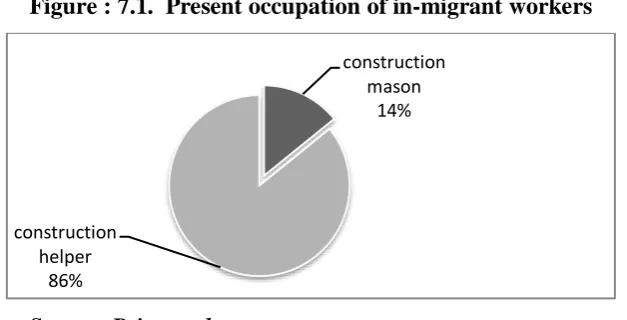
The study shows that 86 percent of the in-migrant workers are working as construction helper
[image:9.595.142.456.322.482.2]and14 percent are contract mason.
Figure : 7.1. Present occupation of in-migrant workers
Source: Primary data
7.2 Working days per week
The study revealed that around 59 percent of the migrant workers work for 6 days. 20 percent
of the respondents work for all days. 15 percent of respondents work for 5 days in a week.
Table: 7.2 Working days per week
Working days No. of In-migrants Percent
Upto 4 days 7 5.83
5 days 18 15
6 days 71 59.17
7 days 24 20
Total 120 100
Source: Primary data
7.3 Working hours per day
The study shows that around 47 percent of the migrant workers works for 8 to 10 hours in a
day. 30 percent of the respondents work for 10 to 12 hours. 16 percent of the workers work
for 8 hours. It is also worth to note that 7.5 percent of the respondents workers for more than
construction mason
14%
construction helper
Copyright © 2017, Scholarly Research Journal for Interdisciplinary Studies 12 hours in a day.
Table: 7.3. Working hours per day
Working Hours No. of In-migrants Percent
8 hours 19 15.83
8-10 hours 56 46.67
10 to 12 hours 36 30
Above 12 hours 09 7.5
Total 120 100
Source: Primary data
7.4 Mode of payment and periodicity of receiving wages
The study revealed that the majority of construction helper’s gets an average daily wages
ranging from 400 to 500 (73%). In the case of construction mason the majority of them are in
the range between 600 rupees to 700 (76.5%). None of the construction helper gets more than
600 rupees and none of the mason gets more than 800 rupees.
Majority of the respondents (43.33%) get wage on weekends. 30 per cent of the respondents
are monthly wage earners. 14 percent of the respondents get wage per day and 12.5 per cent
of the respondents have to wait for finishing work they engaged in to get their full wages.
Most of the in-migrant workers remain an unbanked population. Only 34 percent of the
respondents are having bank accounts. Because of the absence of proof of residence and
identity, in-migrants are unable to open bank accounts. In the absence of bank accounts, they
are depending heavily on informal ways to send money to home. The study shows that
around 33 percent of the respondents remit money through own bank account, 29 percent by
hand during visit and 22.5 percent respondents remit money to their home through friends.
Others includes through post office, money order etc.
Table: 7.4. Periodicity of receiving wages
Category No. of In-migrants Percent
Daily 17 14.17
Weekend 52 43.33
Monthly 36 30
Keeping dues / After finishing work 15 12.5
Total 120 100
Source: Primary data
7.5 In-migrant workers opinion regarding working conditions
It has also come to light during the study that there exists an amount of discrimination with
the in-migrant workers on the issues of job allotments in an establishment. In-migrant
Copyright © 2017, Scholarly Research Journal for Interdisciplinary Studies
of the in-migrant workers opined that there are no safety precautions at the work sites and 64
percent of in-migrants opined that there are no first aid facilities at the work sites. The
majority of the respondents (52%) are not getting fresh drinking water.
Table: 7.5 Working conditions of the respondents
Category No. of In-migrants (out
of total 120 samples)
Percent
Respondents working under extreme condition
101 84.17
Getting safety precautions 53 44.17
Respondents getting first aid 43 35.83
Respondents getting fresh drinking water
58 48.33
Respondents facing discrimination from local workers and local people
79 65.83
Source: Primary data
8. LIVING CONDITIONS OF THE IN-MIGRANT WORKERS
Housing is the biggest problem that the in-migrant workers face in Kerala. Notwithstanding a
reasonably good level of income after migration; most of the respondents are living in
deplorable conditions. The study revealed that the migrant workers prefer to work with an
employer who offers free residence with adequate supply of water even if they are paid a
little less. But such facilities are not offered for the in-migrant workers.
The study found that about 58 percent of in-migrants are living with 6 to 15 workers in a
room, 10% are sharing a room with more than 15 workers. In most of the cases there is no
provision of hygienic sanitation and safe drinking water. The shocking point is that around 53
% of the respondents argued that their residence is of poor quality. Only 15% argued that
there is living in good quality residence.
8.1Type of stay and accommodation of In-migrant workers
The field survey showed that an overwhelming majority, 85 percent of in-migrants are living
with friends and co-workers, 13% with their family, around 2 percent staying alone.
Table: 8.1 Type of stay in Kerala
Type of stay No. of In-migrants Percent
With family 16 13.33
Alone 2 1.67
With co-workers/friends 102 85
Total 120 100
Copyright © 2017, Scholarly Research Journal for Interdisciplinary Studies Table: 8.2 Nature of accommodation
Category No. of In-migrants Percent
Rented house 61 50.83
Work site and Temporary sheds 51 42.5
Lodges and hotels 8 6.67
Total 120 100
Source: Primary data
The study revealed that about 43 percent of the respondents reside at the working sites, 56
percent reside in poor rented houses with single room shared by many. Around 61 percent of
the migrant workers use common toilet. Only 16 percent of the workers use attached toilet.
Others includes open defecation, public toilets etc and it contributes 9 percent of the total
In-migrant workers are working under extreme conditions. The workers are living in crowded
rooms with little space to move. Life is not easy for the in-migrants most living in groups
sharing a single room with little toilet facilities. Because of this, they are vulnerable to
communicable and occupational diseases. In-migrant workers in Kerala are not getting any
benefits from Health insurance scheme. The contractors are not providing any medical care
for the workers. Accidents and deaths at work places are also common in the construction
sector, which is aggravated by the absence of any kind of social protection.
9. CONCLUSION
Construction activities are associated with every phase of development of an economy. The
construction work is a perennial industry and a very crucial one, providing substantial
employment opportunities to unskilled labourers. A high proportion of socially and
economically weaker sections of the society are engaged in the unorganized economic
activities in India and Kerala. Majority of the in-migrant workers are employed in the
informal construction sector in the Kerala. They often work long hours in poor working
conditions, devoid of social security and legal protection Since in-migrants are unaware of
laws and policies, they are exploited in the construction sector of the State.There is a need to
ensure that all migrants and their families have access to services and entitlements as
enshrined in policies and law, while ensuring urban settlements become inclusive spaces as
they expand in size and diversity.
REFERENCES
P. Nimmi, 2014, Dynamics of urban construction sector in Kerala . pp.6
Gulati Institute of Finance and Taxation study , 2013 “Domestic Migrant Labour in Kerala- Community health interventions and scope of convergence” Pp 11, 18.
Copyright © 2017, Scholarly Research Journal for Interdisciplinary Studies
Prakash V, 2009 “Inter Regional Migration: A Study of Migrant Construction Workers In Kerala” Pp 33.
Saikia D, 2008, “Economic Condition of Migrant Workers in Kerala: A Study in Thiruvananthapuram District” Journal of Indian Research (ISSN: 2321-4155) Vol.2, 2014, Pp 45
Zachariah, K.C. and Rajan, S.I. 2008. Kerala Migration Survey 2007. Centre for Development Studies, Trivandrum, Pp 21.