THE STATE OF THE ART INFORMATION SHARING
TECHNOLOGIES FOR SUPPLY CHAIN MANAGEMENT
1MARYAM MOFARRAHI, 2MASOUD RAHIMINEZHAD GALANKASHI, 3MAHDIEH
MOHAMMADI, 4ALI SHAHIDINEJAD
1 Master Student, Faculty of Mechanical Engineering, Department of Manufacturing & Industrial
Engineering (MIE), Universiti Teknologi Malaysia (UTM), 81300 Johor Bahru, Malaysia.
2PhD Student, Faculty of Mechanical Engineering, Department of Manufacturing & Industrial Engineering
(MIE), Universiti Teknologi Malaysia (UTM), 81300 Johor Bahru, Malaysia.
3
Master Student, International Business School (UTM IBS), University teknology Malaysia (UTM), 54100
Kuala Lumpur, Malaysia.
4PhD Student, Communication and Distributed Systems, RWTH Aachen University, Germany.
E-mail: [email protected] , [email protected] , [email protected]
ABSTRACT
Information sharing systems help supply chain management (SCM) by tracking and identifying an object’s or human’s location in real time. However, prior to implement an information system, various technologies and the related advantages and disadvantages must be considered. This paper investigates the state of the art technologies applied in SCM and presents a study about their benefits and drawbacks. RFID, GPS, NFC, ZigBee, ultrasonic, UWB, and infrared systems are discussed and finally Visible Light Communication for different stages of a SCM is proposed.
Keywords: Supply Chain Management, Visible Light Communication, Information sharing.
1.
INTRODUCTIONA supply chain consists of all stages including the manufacturer and suppliers, transporters, warehouses, retailers, and customers to satisfy a customer demand [1]. Supply chain implementation is to manage and coordinate the bi-directional flow of resources, data and funds through the supply chain. Information plays a critical and competitive role during the supply chain stages. However, the importance of the information for supply chain was often overlooked because this concept was not clearly understood by supply chain members [2-4].
Recent advances in technologies support the organization to access information easily in
different parts of their properties. These
technologies manage the supply chain by
organizing the undertakings. Information
technology (IT) offers a many beneficial features for initiative business such as reduction of cycle time, implementation of processes, performing
restructured cross-functional processes. The
importance of information for supply chain
management is due to the fact that satisfying customer has become a bi-directional cooperation and responding the customer in the best way has become essential. Also, information is an important aspect in the managers' capabilities to decrease inventory and human resource demand to a more reasonable level. Moreover, information sharing among different stages of the supply chain is also critical and these incorporations can be realized by different information sharing technologies [5-7].
Such IT initiatives include RFID, GPS, NFC, ZigBee, ultrasonic, UWB, infrared-based systems [8-10]. Each proposed and applied technology in supply chain has specific features (Precision, range, type of electromagnetic spectrum, and etc.), advantages and disadvantages. Therefore, they should be characterized to be utilized properly in each part of the supply chain.
art technologies applied in SCM and a brief introduction of VLC are presented. In section 3, VLC technology is proposed for different stages of the SCM. Finally conclusions are presented in section 4.
2.
THE STATE OF THE ARTINFORMATION SHARING TECHNOLOGIES
Information sharing between partners in the supply chain is crucial and these integration attempts are accompanied by IT initiatives. Such IT initiatives include RFID, NFC, UWB, GPS, ZigBee, ultrasonic, infrared-based systems.
2.1 RFID
Radio Frequency Identification (RFID) is a wireless and automatic identification technology which applies electromagnetic (or inductive) coupling of the radio frequency signal or the reflective transmission features to automatically identify objects (which are RFID tags). After identifying, the object information can be sent or received. The automatically identification of an object is by far easier than manually identification. Moreover, the development of RFID system has caused significant productivity improvements in many operational areas of the overall enterprise supply chain [11-13]. Using RFID in manufacturing process provides the possibility to achieve real-time information about the items involved in the process. The obtained information will be used to advance the production efficiency and decrease the production cost [14, 15].
2.2 NFC
Near Field Communication (NFC) is an emerging wireless short-range technology which supports just a few centimeter distance point to point communication. Operation principle of NFC is based on inductive coupling. NFC enables developing devices, like handheld devices, to access information inside a smart object like RFID tags and NFC tags by holding the handheld device next to the smart object. NFC has lower bit rate and support shorter transmission range compared to other short range technologies such as the Wi-Fi, RFID and Bluetooth. The profits of NFC technology for industrial applications could be; (1) NFC technology provides an easy to use communication between two nodes. (2) Initial latency to set up each communication for NFC is significantly low compared to other technologies such as Bluetooth. (3) NFC provides long lifetime battery for each node because this technology
consumes lower power compared to others. However, the most important limitation of this technology is short communication range between two nodes. Moreover, two phones that benefits from NFC technology can communicate and share news, audio, video files, photos, and etc. Reference
[16] proposed, using NFC mobile device for
solving the existence problems of sales data management System of Chain Enterprises.
2.3 UWB
Ultra wideband (UWB) is a radio frequency based technology which applies a large portion of the radio spectrum and can support high bitrate, short range communication. UWB technology enables high precision positioning and tracking. UWB is utilized for indoor positioning and tracking in [17, 18]. They used active RFID tags to obtain accurate position information. In fact, they calculate the position by estimating the time of arrival (TOA) of received signals. The advantages of using UWB technology is that UWB signals offer accurate TOA measurements in multi path environment. This is due to the high temporal resolution of UWB signals [19].
2.4 GPS
The Global Positioning System (GPS) is based on the satellite communication system provides position (altitude, latitude and longitude) for every system, equipped with a GPS receiver device, in everyplace on or near the Earth. For realizing the GPS, there should be a line of sight among four or more GPS satellites.
In fact, GPS system estimates the propagation duration of a signal between GPS receiver device and satellite by using this information the position of the object can be calculated. GPS is a highly available technology but the drawback of GPS is that it cannot provide indoor positioning and its usage is limited to outdoor [20].
2.5 ZigBee
paths. This is the reason of high reliability of ZigBee system.
ZigBee is an upcoming technology which has attracted lots of attention because of its advantages. One of the most important advantages of ZigBee is being highly energy saving. In fact, ZigBee can save energy considerably better than Bluetooth and WIFI counterparts as discussed in [21]. Also, it is quite cheap. Currently, ZigBee chip costs just about 2 US dollars [22]. However the bit rate of a ZigBee device is low, but it is enough for most of the
industrial usages. ZigBee can support
communication between two nodes with 10 to 100 meters distance. ZigBee applies radio frequency for data transmission.
2.6 Ultrasonic
AT&T Cambridge proposed active bats which applies ultrasonic frequency for positioning and tracking of objects. Active bats provide a better and more accurate indoor positioning. Objects are equipped with ultrasonic tags identified as “bats” [23]. The receivers should be mounted on the wall or ceiling to receive emitted periodic ultrasonic signals by active bats. Actually, active bats
periodically emit position and orientation
information of the object. Other types of ultrasonic positioning systems are Cricket and Dolphin systems which are discussed in [24] and [25] respectively. They offer more accurate indoor positioning system than active bats.
Ultrasonic positioning system provides more accuracy compared to other positioning techniques used in SCM. However, ultrasonic systems require large number of receivers across and also alignment difficulties.
2.7 Infrared
Infrared light is electromagnetic radiation with a wavelength between 740 nanometres (nm) to 300 micrometres (µ m). Infrared system applies active badge for location sensing [26]. In this system, a small infrared beacon is worn by every person or each object. The beacon produces an emitting light every 15 seconds which contains a unique code. All the indoor location should be covered by IR sensors to detect the emissions produces by beacons. The received information will be send to the location server to calculate the location of the object. The advantages of infrared system SCM are; license-free operation, immunity to electromagnetic interference, ease of deployment, low power consumption, high security caused by the high
directionality and narrowness of the beam [27]. However, infrared beams cannot penetrate walls.
Each technology has its advantages and disadvantages, therefore it is highly essential to evaluate available technologies and limitations related to each application before implementation and product selection. This will help you adopt limitations of each application to beneficial features of each technology. GPS, RFID, UWB, ZigBee systems utilize radio frequency as medium. But ultrasonic system uses ultrasound and Infrared system uses Infrared.
3.
APPLYING VLC FOR SCMVisible light communication (VLC) is an
emerging optical wireless communication
technology where information is transferred through emitted light by Light Emitting Diode (LED). VLC is a data communications medium using visible light wavelength between 780 nm and 375 nm. Advantages of LED would be quite energy saving, small size, long life, and low investment and maintenance cost. Due to these beneficial features, LED significantly outweighs traditional lighting systems such as fluorescent and it is expected to play a major role in the future lighting
market. Consequently, these outstanding
advantages lead to apply LED everywhere, replacing traditional light sources. The advantages of VLC system would be no electromagnetic spectrum regulation, immunity to electromagnetic interference, ease of deployment, high bitrate (Gigabit/second), high capacity (many users), low power consumption, high security, and no potential health threatens [27]. Moreover, as discussed later LED will be the future lighting system so it would be energy and cost saving if we use it in supply chain. There are two types of receiver in VLC systems; (1) photodiode: which is common, small and cheap. However, it is susceptible to noises in high bit rates (Giga bit per second) but in most SCM systems such high bitrate is not required. Therefore, photodiode is more appropriate for indoor VLC systems. (2) 2D image sensor, which can receive high bitrate information and it is more unaffected by noises, because it consists of independent receivers, that significantly reduce the effect of existence noises [28].
In the following sections, some applications of VLC Technology in Supply Chain Enterprise are proposed.
3.1 VLC in Retailers
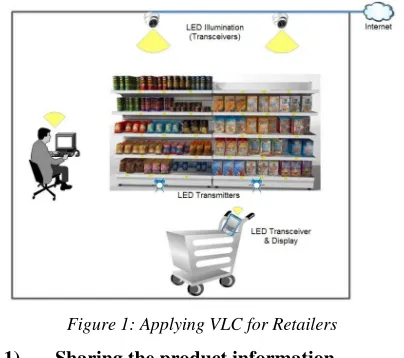
[image:4.612.102.304.278.457.2]Nowadays the retailers should encounter many vendors, because of the increased complexity, it has become challenging to manage the product effectively. To overcome this problem, a cost of more material resources and human resources should be paid. By using IT initiatives, these costs can be significantly decreased. As shown in Fig.1, the retailers can apply following aspects to benefit from the advantages of VLC technology.
Figure 1: Applying VLC for Retailers
1) Sharing the product information
The product information and location are obtained by a visible light transceiver and a display that is installed in a shopping cart. The customer and retailers can search the product information by connecting to the LED transceivers’ network, mounted on the ceiling. Therefore, the customer can find the location of the products graphically. Moreover, the retailers can review the warranty authentication of the products better by checking the retailer database. Recently, Information of products at a supermarket is experimentally obtained by a visible light receiver that is installed in a shopping cart [30]. The mentioned options can be added to the introduced system in [30] to make this system applicable for SCM.
2) Flow planning survey system for a store
Visible light ID from LED transmitters, installed in each passage in the retailer area, is received by the transceiver attached at the shopping cart. Customers’ movement can be studied based on the received ID from LED transmitters. This system is able to analyze how many shoppers passed in each
passage and how fast they walked. This can help to manage product’s location before sale. In fact, the shopping experience can be developed. This system has been recently proposed by Haruyama in 2011 [30]. He practically implemented a system which is able to analyse how many shoppers and how fast they walked in a supermarket [30].
3) Customer feedback to the supply chain
The customers can transmit their demands to retailer by using the VLC transceiver and a display that is installed in a shopping cart. Then the retailer will send the obtained data to the distributer through the internet. The distributer also can share these data to the manufacturer to inform the manufacturer about the customer’s demand. According to received data, the manufacturer manages the quality and quantity of materials which should be ordered by the supplier.
3.2 VLC in Distributers
VLC technology can effectively track the products in transportation for logistics providers. It can reduce the delay time of the products delivery to the destination. Thus the transportation cost will be decreased [5]. SCM not only contains of the manufacture, storage and deliver of the product, but also can include the related requirement of the customer. This is due to the fact that, the information can be feed back in time. VLC delivers timely information to all supply chain stages. In the new SCM era, the information flow is huge and the material flow is small. To satisfy the customer’s order by lowest volumes of storage, having the accuracy and in time information are quite necessary. By doing this, the cost for the relative warehouse and transportation will be decreased.
As shown in Fig. 2, the employee receives the information through the network and send it to forklift and truck drivers. The received information can guide the forklift driver to find the way to take the specific loads and then it sends a feedback to the employee. The employee will transfer the obtain information about the number of boxes which should be distributed to the trucks’ drivers. Afterward, the VLC transceiver, which is installed on the security barrier gate, recognizes the truck and then opens the gate to let the truck to exit.
Moreover, it sends information about the
destination address as well. As mentioned before LED has some significant features. Therefore, it has been using in many applications such as LED
displays, traffic lights, and recently road
illumination [30]. In fact, VLC is able to provide
communication. The advantage is that it is not necessary to install new transmitters and receivers for communication like infrared beacons because road illuminations are mounted everywhere. Compared to radio and infrared communication, VLC uses the large power more efficiency. Using VLC system for roads was first proposed in 2003 in Japan [31]. In fact, using VLC for intelligent transport system delivers real time traffic information and the direction finding information. As can be seen in Fig. 2, the truck, person and forklift are equipped with the VLC transceivers and road illumination and traffic light are transmitters. The VLC transceiver first receives a code from a VLC source such as traffic light or road
illumination and then it obtains location
[image:5.612.331.523.123.262.2]information by accessing to the location server. For managing a port logistics environment the position of each object is needed. However, managing port logistics is influenced by environmental causes that can be the source of problem. In fact, steel objects affect radio frequency signals and they can damage wireless nodes. Therefore, steel objects create places that cannot be reached by radio frequency signals. In such situations, applying VLC can be an interesting alternative. However, visible light cannot penetrate objects. In this case radio frequency technologies should be applied.
Figure 2: Applying VLC for Distributer
3.3 VLC in Manufacturers
It is very important for manufacturers to keep the balance between the customer’s demand and the amount of products which should be sent to the retailers by the manufacturers. As discussed in previous sections, when the retailer and producer use VLC technology, they can achieve the information of the products timely and the consumer’s requirement. By implementing VLC in the manufacturer, they can rapidly respond to the consumer’s demand. Moreover, manufacturer can
[image:5.612.103.299.423.575.2]regulate the ratio of the storage, reduce the products inventory.
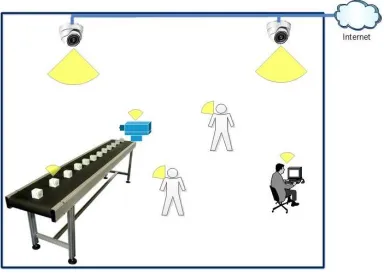
Figure 3: Applying VLC for manufacturer
GPS has generally applied for determining location on the earth. GPS has an inherent problem in measuring the position of objects in places which are inaccessible by radio frequency signals and at
the presence of multipath interference.
Additionally, GPS is not able to deliver precise indoor or underground places. Due to the worse performance of GPS, reference [32] applied VLC, RFID tags and Bluetooth to accurately calculate local position. They implemented fluorescent light to indoor position detection with support of RFID tags and Bluetooth for better positioning. LED is a promising lighting system for future, therefore reference [33] proposed a VLC system in which 3 LEDs in a triangle position are used with broadcasting each space location coordinates. They used 2D image sensor at the receiver part to calculate position more precisely. Moreover, in these systems LED is not only used as a low cost and energy saving lighting method, but also as a communication medium. In fact, VLC is able to provide position information with high quality communication. Reference [34] proposed an indoor optical positioning system using VLC with an accuracy of 6 cm positioning error. However, small size LED and image sensor are proposed in [33], but still VLC positioning needs more future research and deployment. Fig. 3 draws an example of applying VLC for a typical manufacturer.
4.
CONCLUSIONIt can be concluded that each technology has its benefits, drawback and challenges. Thus, according to each application, proper technologies must be chosen. VLC system is emerging as the most promising lighting and communication system and according to the best of our knowledge; this is the first time that VLC is proposed for applying in SCM and more researches are needed. Because of equipment limitations, this work only presented a framework for applying VLC in SCM and it is not a practical implementation. Therefore, one future work could be experimentally implementation of VLC for SCM systems and comparing its function and costs with other technologies.
REFRENCES:
[1] S. Chopra and P. Meindl, "Supply chain
management. Strategy, planning &
operation," Das Summa Summarum des Management, pp. 265-275, 2007.
[2] P. Kelle and A. Akbulut, "The role of ERP
tools in supply chain information sharing,
cooperation, and cost optimization,"
International Journal of Production
Economics, vol. 93, pp. 41-52, 2005.
[3] D. J. Thomas and P. M. Griffin,
"Coordinated supply chain management," European Journal of Operational Research, vol. 94, pp. 1-15, 1996.
[4] P. Fiala, "Information sharing in supply
chains," Omega, vol. 33, pp. 419-423, 2005.
[5] G. C. Stevens, "Integrating the supply
chain," International Journal of Physical Distribution & Logistics Management, vol. 19, pp. 3-8, 1989.
[6] K. A. Patterson, C. M. Grimm, and T. M.
Corsi, "Adopting new technologies for supply chain management," Transportation
Research Part E: Logistics and
Transportation Review, vol. 39, pp. 95-121, 2003.
[7] G. P. Cachon and M. Fisher, "Supply chain
inventory management and the value of shared information," Management science, pp. 1032-1048, 2000.
[8] M. Hazas, J. Scott, and J. Krumm,
"Location-aware computing comes of age," Computer, vol. 37, pp. 95-97, 2004.
[9] P. Bahl and V. N. Padmanabhan, "RADAR:
An in-building RF-based user location and tracking system," 2000, pp. 775-784 vol. 2. [10] H. Cho, H. Choi, W. Lee, Y. Jung, and Y.
Baek, "Design and implementation of a smart tag system for IT-based port logistics,"
Ubiquitous Intelligence and Computing, pp. 32-43, 2006.
[11] R. Angeles, "RFID technologies:
supply-chain applications and implementation
issues," Information Systems Management, vol. 22, pp. 51-65, 2005.
[12] Z. Asif and M. Mandviwalla, "Integrating the supply chain with RFID: A technical and business analysis," Communications of the Association for Information Systems, vol. 15, pp. 393-426, 2005.
[13] K. Michael and L. McCathie, "The pros and cons of RFID in supply chain management," 2005, pp. 623-629.
[14] M. Tajima, "Strategic value of RFID in supply chain management," Journal of Purchasing and Supply Management, vol. 13, pp. 261-273, 2007.
[15] G. Q. Huang, Y. Zhang, and P. Jiang, "RFID-based wireless manufacturing for real-time management of job shop WIP inventories," The International Journal of Advanced Manufacturing Technology, vol. 36, pp. 752-764, 2008.
[16] X. Yiqun, H. Zhenzhen, and W. Longjun, "Sales data management system of chain enterprises based on NFC technology," 2008, pp. 455-458.
[17] L. M. Ni, Y. Liu, Y. C. Lau, and A. P. Patil, "LANDMARC: indoor location sensing using active RFID," Wireless Networks, vol. 10, pp. 701-710, 2004.
[18] D. Harmer, "Ultra Wide-Band Indoor
Positioning," Thales Research and
Technology UK Ltd., ARTES, vol. 4, 2004. [19] R. Merz, F. Chastellain, A. Blatter, C.
Botteron, and P. A. Farine, "An
Experimental Platform for an Indoor Location and Tracking System," 2008. [20] Z. Xiang, S. Song, J. Chen, H. Wang, J.
Huang, and X. Gao, "A wireless LAN-based indoor positioning technology," IBM Journal of Research and Development, vol. 48, pp. 617-626, 2004.
[21] P. V. Nikitin, K. V. S. Rao, S. F. Lam, V. Pillai, R. Martinez, and H. Heinrich, "Power reflection coefficient analysis for complex impedances in RFID tag design," Microwave Theory and Techniques, IEEE Transactions on, vol. 53, pp. 2721-2725, 2005.
chain applications," Communications Magazine, IEEE, vol. 42, pp. 140-151, 2004. [23] M. Hazas and A. Hopper, "Broadband
ultrasonic location systems for improved indoor positioning," Mobile Computing, IEEE Transactions on, vol. 5, pp. 536-547, 2006.
[24] N. B. Priyantha, "The cricket indoor location
system," Massachusetts Institute of
Technology, 2005.
[25] M. Minami, Y. Fukuju, K. Hirasawa, S. Yokoyama, M. Mizumachi, H. Morikawa, and T. Aoyama, "DOLPHIN: a practical
approach for implementing a fully
distributed indoor ultrasonic positioning
system," UbiComp 2004: Ubiquitous
Computing, pp. 347-365, 2004.
[26] R. Want, A. Hopper, V. Falcao, and J. Gibbons, "The active badge location system," ACM Transactions on Information Systems (TOIS), vol. 10, pp. 91-102, 1992. [27] S. Jovkova and M. Kavehard, "Multispot
diffusing configuration for wireless infrared
access," Communications, IEEE
Transactions on, vol. 48, pp. 970-978, 2000. [28] H. B. C. Wook, S. Haruyama, and M.
Nakagawa, "Visible light communication with LED traffic lights using 2-dimensional image sensor," IEICE Transactions on
Fundamentals of Electronics,
Communications and Computer Sciences, vol. 89, pp. 654-659, 2006.
[29] D. O'Brien, "Indoor optical wireless
communications: Recent developments and future challenges," 2009.
[30] S. Haruyama, "Visible Light
Communications: Recent Activities in
Japan," Graduate School of System Design
and Management, Keio University,
Yokohama, Japan, 2011.
[31] S. Kitano, S. Haruyama, and M. Nakagawa, "LED road illumination communications
system," in Vehicular Technology
Conference, 2003. VTC 2003-Fall. 2003 IEEE 58th, 2003, pp. 3346-3350 Vol.5. [32] X. Liu, H. Makino, and Y. Maeda, "Basic
study on indoor location estimation using Visible Light Communication platform," in Engineering in Medicine and Biology Society, 2008. EMBS 2008. 30th Annual International Conference of the IEEE, 2008, pp. 2377-2380.
[33] M. Yoshino, S. Haruyama, and M.
Nakagawa, "High-accuracy positioning
system using visible LED lights and image
sensor," in Radio and Wireless Symposium, 2008 IEEE, 2008, pp. 439-442.