2017 3rd International Conference on Electronic Information Technology and Intellectualization (ICEITI 2017) ISBN: 978-1-60595-512-4
Design of The Tensile Controller Based On
Feed-forward And Feedback Control
Zhiwen Zhou, Xinge Zhang and Tao Wu
ABSTRACT
According to the disturbance of speed changing in the tension, in order to overcome the speed change for the influence of the system tension control, a tension controller based on the PID feedback control additionally the feed-forward compensation is designed. The control principle of system, hardware control system and the program design are introduced, the hardware control circuit is mainly composed of DSP. The controller has the advantages of fast speed response, smooth adjustment, strong disturbance ability, etc. The actual application proved the design is correct and effective.
Tension System Introduction
Coiling coating machine is a vacuum applications equipment that coats the Aluminum steam, SiO2 steam, indium tin oxide steam or other steam material on the
winding materials in vacuum environment. The original film out from unwinding roll through the guide roller, the tension detection roller; the original film is processed on intermediate roll, processed film is rolled by the winding side guide roller, the tension detection roller, it is winded by the winding roller; as shown in figure 1. The film tension range has the strict changes request in the working process, in the process of equipment working the winding roll diameter is more and more big, the unwinding roll diameter is more and more small. The film edge is not neat and it is loose or tight is caused by the stand or fall of tension control. It is possible the film is not wound or have winded to the other roller when the tension is _______________________
too small. Else it can make film fracture or lower quality level when the tension is too much. So the stand or fall of tension control is directly related to the normal use of the machine [1]. Especially in the process of transmission start when the roller accelerates the film may cause the film is fracture in high vacuum coiling coating machine produced by a domestic vacuum equipment production enterprise. Sometimes the machine doesn't work because of the film is winding to other rolls, So the film that need less tension requirement the machine does not work, such as capacitors.
1 Rolling roller 2, 6 guide roller 3, 5 tension testing roller
4 middle roller 7 winding roller 8, 9, 10 dc motor 11, 12, 13 dc motor speed regulator 14, 16 tension
controller
15 speed given 17, 18 tension given
Figure 1. Reel system schematic diagram.
Composition of the Original System
Because of the Dc motor speed control system has a good speed control features of large range of speed regulation ,high precision of speed regulation and smooth speed regulation,the design of coiling coating machine mainly uses Dc motor speed control system in abroad. A type of vacuum winding coating machine system is composed of Dc motor speed control system at home, as shown in figure 1. Rolling motor and winding motor in the control system are Z2-52 7.5KW 220V/1500rpm; Speed motor of rolling and winding is CYT4.5/5.5-15 1500rpm/55V, intermediate roll motor is Z2-52 3KW 220V/750rpm;Speed motor of intermediate roll is CYT4.5/5.5-10 1000rpm/55V.The indicators of winding system as: film runs speed is 60m/min to 300m/min, tension is continuous adjustable, minimum coil diameter is 100mm, maximum diameter is 1000mm, Coil diameter change range is 100 mm to 1000 mm.
directly affects the quality of the film, the film running deviator and the film edge neat, etc.
In the process of equipment work, when the tension is given big and film speed running stability, tension controller basically can guarantee film tension control stable and the transmission part process runs normally, winding film edge is neat. When the tension is too small it is possible that the film is not wind or have winded to the other roller. If speed adjusting is too fast, it can cause tension changed a lot that the film have winded to the other roller or make it fracture, equipment cannot work normally.
Principle of Feed Forward - PID Control
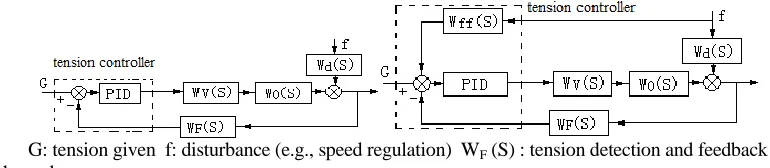
The original system of tension controller is the conventional PID controller, as shown in figure 2. Its working principle is adjustment speed of the whole transmission process through the intermediate roller motor speed control. intermediate roller speed changes (such as speed increases because of given increases), cause winding side tension changes (tension decreases), then the winding side tension detector measured the signal changes, the winding side tension keeps in a given range by winding side tension controller output signal controls winding motor torque change (increase). At the same time cause rolling side tension changes (tension increase), then the rolling side tension detector measured the signal changes, the rolling side tension keeps in a given range by rolling side tension controller output signal controls rolling motor torque change (reduce).
Winding speed change is a major disturbance in tension control system, if adjusting transmission speed will cause the change of the tension, rolling and winding roll tension is stable by means of control the motor torque after detecting the film tension change, so the control action is a kind of control not in time that is always behind the disturbance effect. The result is that system response time is slow. In order to solve this problem, introduced feed forward control to compensate the influence of speed disturbance.[2]
G: tension given f: disturbance (e.g., speed regulation) WF (S) : tension detection and feedback
[image:4.612.102.487.86.170.2]channel
Figure 2. The original feedback tension Figure 3. The improved feedforward - feedback controller principle diagram. tension controller principle diagram.
General the project control system is required can obtain approximate compensation, the simplest form of feed forward control is a proportion link of
ff
ff S K
W ( )
, this form is named as static feed forward compensation. This system adopts the high precision dynamic feed forward control system; it can compensate the disturbance affects timely and greatly improve the dynamic performance of the control process.
In order to avoid excessive dependence of the disturbance channels and control mathematical model, the transfer function of feed forward compensation is
1 1 )
(
2 1
T S T K S
Wff ff
, in the formula Kff is the static feedforward coefficient, T1
is the control channel time constant, T2 is disturbance channel time constant[3].
The Realization of Control System
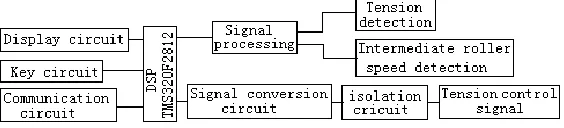
The strain gauge of electrical resistance sensor bridge is chosen conversion tension signal to the proportional voltage signal. This product is produced by Shenzhen Altec Electronic Co., Ltd. The product models is CTS 105-17-500, the maximum output voltage is 20mV, Measuring range is 500N, The principle of tension control is shown in figure 4.
by adjusting the motor torque[4]. The input signal is enter into the DSP chip after the input signal sampling, filtering, conversion processing. Immediately alarm indicator is given if the system detected failure. In serious accidents hardware circuit will be lockout the control signal of the motor driver to realize emergency stop.
Figure 4. Control circuit principle diagram.
Software Design of Control System
Program is divided into different subprogram module according to the function. Such as the initialization subprogram, key input subprogram, display subprogram, data acquisition subprogram, algorithm subprogram, etc.
First DSP is initialized as soon as the system was power on. After the initialization parameter settings can be adjusted through the keys, such as film tension given, taper adjustment. Through data acquisition ports subprogram read external data. LCD monitor displays the setting value and measured value. Based on measured intermediate speed change and compared detecting tension with the given tension the calculation results is realizes by using control principle of feedforward and PID closed-loop feedback control algorithm. Using the calculation results DSP realizes tension control by control DC motor drive input signal to adjust the motor torque.
CONCLUSIONS
The winding coating machine tension control system combines open-loop feed forward control with PID closed-loop feedback control, the system adjustment time is short compared with single feedback control. Control system has the advantages of not only in time feed forward control overcome the intermediate roll speed change influence of tension control but also feedbacks can eliminate the influence of other disturbances. After this improvement the winding coating can produce the small tension requirement film such as capacitor film and tension small disturbance in processing. The performance of machine has improved.
whole system. Through practical operation it shows that tension control system work reliably and the equipment running smoothly.
ACKNOWLEDGMENTS
This work was financially supported by Fundamental Research Funds for the Central Northwest Minzu University (grant 31920140098). The authors also gratefully acknowledge the perceptional comments and suggestions from the reviewers and editors, which have helped to improve the presentation.
REFERENCES
1. Zhi Wen Zhou, Cai Xia Wang and An Ren Ma, 2014, Research on coating devices with applied technology in magnetron sputtering regulated switching power supply design, Source: Applied Mechanics and Materials, v 540, pp. 134-137, Advanced Research on Mechanics, Manufacturing Engineering and Applied Technology II.
2. Meimei Ma and Xisong Cheng, 2008, Feedforward-internal model control application in temperature control process, No.1, pp.6-8, Electrical Automation.
3. Yusen Shao, 2003, in: Engineering control, edited by China Machine Press, Beijing,China. 4. Zhi Wen Zhou, Cai Xia Wang and An Ren Ma, 2014, Design of active power filter based on
DSP, Source: Applied Mechanics and Materials, v 533, p 393-396, Modern Tendencies in