DESIGN AND BUILD PROCUREMENT
METHOD IN PRACTICE: KEY CHALLENGES
AND PRACTICE BASED ENABLERS
Anywhere MURIRO
School of the Built Environment
College of Science & Technology
University of Salford, Salford, UK
Table of Contents
Contents i
List of Tables vii
List of Figures xi Acknowledgement xvi
Abbreviations xvii
Abstract xviii
Preface xix
Chapter 1: Introduction 1
1.1 Introduction 1 1.2 Research background 1 1.3 Research problem 12
1.4 Aim and Objectives 15
1.5 Rationale/Research questions 16
1.6 Research approach 18
1.7 Scope and Limitations of the research 19
1.8 Expected outcome & contribution to knowledge 20
1.9 Key participants of the D&B procurement method 22
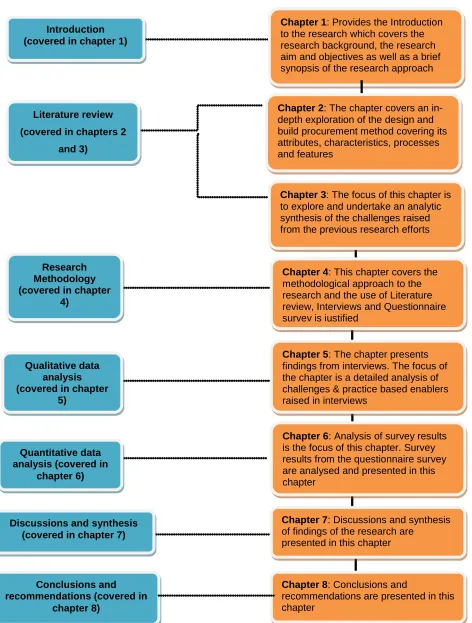
1.10 Contents/Structure of the thesis 26
Chapter 2: D&B characteristics, attributes 30
and processes
2.1 Introduction 30
2.2 D&B procurement method format, trends & evolution 31
2.3 D&B procurement method typical processes 44
2.4 Chapter summary 50
Chapter 3: Underlying challenges associated with 51
D&B procurement method
3.1 Introduction 51
3.2 Single point responsibility 52
3.3 The briefing process 55
3.4 D&B procurement: other process related challenges 65
3.4.1 D&B tender preparation 65
3.4.2 D&B tender evaluation 67
3.4.3 D&B design stage 69
3.4.4 D&B construction stage 71
3.5 D&B procurement: team synergy & process integration
challenges 72
3.6 Chapter summary and key findings 78
Chapter 4: Research methodology 86
4.1 Introduction 86
4.2 Epistemological perspectives 88
4.3 Research approach 91
4.4 Research plan/strategy of inquiry 95
4.5 Research techniques & procedures 100
4.5.2 Interviews 103
4.5.3 Questionnaire survey 105
4.5.4 Questionnaire pilot work 106
4.5.5 Reliability & validity 108
4.5.6 Sequencing of Investigation 113
4.5.7 Interview Design 117
4.5.8 Interview design strategy 119
4.5.9 Aim of the pilot interviews 121
4.5.10 Pilot interviews 122
4.6 Main interviews 122
4.6.1 Aim of the main interviews 122
4.6.2 Surveyed sample of respondents 123
4.7 Survey methodology 129
4.8 Chapter summary 132
Chapter 5: Analysis of Findings: Qualitative data analysis 134
5.1 Introduction 134
5.2 Qualitative analysis of the findings from the
pilot Interviews 134
5.3 Analytical tool used in the process of data analysis 140
5.4 Interview findings and analysis – the challenges 144
5.4.1 Subcontracting arrangements between designers
and D&B contractors 149
5.4.2 Conflict of interest & strained relationships between
the parties – different priorities 152
5.4.3 Conflict of interest & strained relationships between
the parties – liability for design development 159
5.4.4 Cost of the whole process – tendering costs 169
5.4.7 Lack of experience/understanding of the D&B
processes – harnessing buildability 191
5.4.8 Lack of experience/understanding of the D&B
processes – management of design 192
5.4.9 Lack of experience/understanding of the D&B
processes – design iterative process 196
5.4.10 Lack of involvement of key stakeholders 200
5.4.11 Poor administration of change 202
5.4.12 Poor quality of the end product 204
5.4.13 Time allowed in the whole process 208
5.4.14 Unclear Employers’ requirements 213
5.4.15 Unfavourable contracting arrangements 220
5.5 Inter-connectedness of the challenges faced by key
participants 226
5.6 Interview findings and analysis – how the challenges
were dealt with in practice 228
5.6.1 Quality control and assurance process embedment
in all stages of the process 230
5.6.2 Client involvement throughout the process 233
5.6.3 Commercial arrangements that support collaboration &
incentivisation 235
5.6.4 Culture change 237
5.6.5 Early involvement by key stakeholders to the process 239
5.5.6 Integrated designer/contractor organisations 242
5.6.7 Investing time and effort in putting together employers’
requirements 244
5.6.8 Training and development 246
Chapter 6: Analysis of Findings: Quantitative data analysis 254
6.1 Introduction 254
6.2 Questionnaire overview 255
6.3 Questionnaire analysis 257
6.3.1 Respondents profile 257
6.3.2 D&B procurement challenges and their severity as
perceived by key participants – Contractors 261
6.3.3 D&B procurement challenges and their severity as
perceived by key participants – Clients 281
6.3.4 D&B procurement challenges and their severity as
perceived by key participants – Designers 301
6.4 Discussion on survey findings 322
6.4.1 Discussion on findings from the contractor
Respondent category 322
6.4.2 Discussion on findings from the client respondent
category 326
6.4.3 Discussion on findings from the design team
Respondent category 327
6.4.4 Comparison between findings from the three
Respondent categories 328
6.5 Chapter summary and key findings 331
Chapter 7: Discussions and synthesis 335
7.1 Introduction 335
7.2 Discussions 335
7.2.1 Exploration of challenges affecting key participants
of the D&B procurement method 336
7.2.3 Severity of the challenges encountered by key
participants of D&B procurement method 343
7.2.4 Practice based enablers that address D&B
procurement method challenges 344
7.3 Research findings synthesis 345
7.4 Proposed framework 361
7.5 Main findings 371
7.6 Contribution to the body of knowledge 373
7.7 Chapter summary 375
Chapter 8: Conclusions and recommendations 376
8.1 Introduction 376
8.2 Research Findings
8.2.1 Objective 1: To develop an in-depth understanding of the challenges affecting key participants in D&B
procurement 377
8.2.2 Objective 2: To explore the severity of challenges
encountered by key participants 379
8.2.3 Objective 3: To identify practice based enablers that Key participants have used/propose to address the key
challenges identified 382
8.2.4 Objective 4: To propose a framework that will help to Facilitate better integration of design and construction
processes 385
8.3 Recommendations 387
8.4 Limitations of the research 389
References 391
Appendices 413
List of Tables
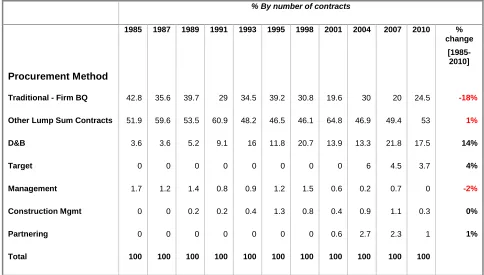
Table 2.1: Trends in procurement methods in the UK by
number of contracts: 1985 - 2010 36
Table 2.2: Trends in procurement methods in the UK by value
of contracts: 1985 - 2010 37
Table 4.1: Alternative research approaches/strategies of inquiry 95
Table 4.2: Research methodology 97
Table 4.3: Research strategies versus characteristics 98
Table 4.4: Reliability statistics ranges and internal consistencies
Per range 110
Table 4.5: Reliability statistics on contractor questionnaire 111
Table 4.6: Reliability statistics on client questionnaire 111
Table 4.7: Reliability statistics on designer questionnaire 111
Table 4.8: Types of triangulation 114
Table 4.9: Respondent coding structure 127
Table 4.10: Respondent experience and project details 128
Table 5.1(a): Key factors underlying the challenge - conflict of
interest and strained relationships between the parties 168
Table 5.1(b): Key factors underlying the challenge - conflict of
interest and strained relationships between the parties 169
Table 5.2: Key factors underlying the challenge - cost of the whole
process 176
Table 5.3: Key factors underlying the challenge - imposition of risks
Table 5.4: Key factors underlying the challenge - lack of control by
clients 190
Table 5.5: Key factors underlying the challenge - lack of
experience/understanding of the D&B Processes 200
Table 5.6: Key factors underlying the challenge - lack of
involvement of key stakeholders 202
Table 5.7: Key factors underlying the challenge - poor
Administration of change 204
Table 5.8: Key factors underlying the challenge - poor quality
of the end product 208
Table 5.9: Key factors underlying the challenge - time allowed
in the whole process 213
Table 5.10: Key factors underlying the challenge - unclear
employers’ requirements 220
Table 5.11: Key factors underlying the challenge - unfavourable
contracting formats/arrangements 224
Table 5.12: Quality control and assurance process 232
Table 5.13: Client involvement in the process 235
Table 5.14: Commercial arrangements that support collaboration
and incentivisation 237
Table 5.15: Culture change 239
Table 5.16: Early involvement by key parties to the process 242
Table 5.17: Integrated designer/contractor organisations 244
Table 5.18: Investing time and effort in putting together
employers’ requirements 245
Table 5.19: Training and development 247
Table 6.1: Participant categorisation 257
Table 6.2: Respondents’ years of experience 258
Table 6.4: Respondents’ organisation’s average annual spend
in property development 259
Table 6.5: Length of time (in years) respondents organisation has been involved in property development/
UK construction sector 260
Table 6.6: Proportion (in value terms) of projects delivered
using design and build as a procurement method over
the last 5-10 years 261
Table 6.7: Challenge 1 - Contractor: Unclear/incomplete client
requirements (UCR) 265
Table 6.8: Challenge 2 - Contractor: Underestimated time needed
for approvals (UTNA) 267
Table 6.9: Challenge 3 - Contractor: Insufficient time allocated to
briefing, tendering and evaluation processes (ITAB) 268
Table 6.10: Challenge 4 - Contractor: Clients interference with the
design process (CIDP) 270
Table 6.11: Challenge 5 - Contractor: Difficulties working, managing and communicating with design professionals
(DWMCDP) 272
Table 6.12: Challenge 6 - Contractor: Difficulties getting specialist
Input into the design (DGSID) 273
Table 6.13: Challenge 7 - Contractor: Difficulties managing the
Design iteration process (DMDIP) 274
Table 6.14: Challenge 8 - Contractor: Costly tender process (CTP) 276
Table 6.15: Challenge 9 - Contractor: Difficulties differentiating scope change from design development change
(DDSCDDC) 278
Table 6.16: Challenge 10 - Contractor: Difficulties managing risks passed on by clients which would have been better
managed by the client (DMRP) 280
Table 6.17: Summary of the observed rankings and their severity
Table 6.18: Challenge 1 - Clients: Lack of/insufficient
Communication with the contractor’s designer (LCCD) 283
Table 6.19: Challenge 2 - Clients: Difficulties in evaluating
D&B tenders (DEDBT) 284
Table 6.20: Challenge 3 - Clients: Loss of benefit of designer’s independent construction oversight and monitoring
(LBDICO) 286
Table 6.21: Challenge 4 - Clients: Contractor’s designer not meeting/
satisfying client’s expectation (CDNMCE) 288
Table 6.22: Challenge 5 - Clients: Quality/design standards sacrificed
to minimum levels by the contractor (QCSSMLC) 290
Table 6.23: Challenge 6 - Clients: Difficult to define requirements clearly & still leave room for contractor’s creativity
(DDRCSLRCC) 292
Table 6.24: Challenge 7 - Clients: Cost savings realised by the
contractor not passed on to the clients (CSRCNPC) 294
Table 6.25: Challenge 8 - Clients: Difficulty in introducing &
evaluating change (DIEC) 296
Table 6.26: Challenge 9 - Clients: The D&B procurement method is more labour intensive & technically demanding than the
traditional procurement method (PMMLIT) 298
Table 6.27: Challenge 10 - Clients: Lack of involvement in technical discussions as the design is developed by the contractor
(LITDDDC) 300
Table 6.28: Summary of the observed rankings and their severity
as perceived by the client respondents 300
Table 6.29: Challenge 1 - Designers: Conflict of interest between professional duty & contractor’s requirements
(CIBPDCR) 303
Table 6.30: Challenge 2 - Designers: Difficulties interpreting
unclear/incomplete client requirements (DIUICR) 305
Table 6.32: Challenge 4 - Designers: Limited recovery of design costs incurred during tender when the tender is not won by the
D&B contractor (LRCDCIT) 309
Table 6.33: Challenge 5 - Designers: Late input of constructability advice from the contractor resulting in delays to design
deliverables (LICAC) 311
Table 6.34: Challenge 6 - Designers: Lack of specialist involvement in the early parts of the design resulting in late changes
& delays to construction (LSIEPD) 312
Table 6.35: Challenge 7 - Designers: Cost saving pressures leading to services procured on lump sum basis which may be
inequitable to the designer (CSPLSPLB) 315
Table 6.36: Challenge 8 - Designers: Lack of transparency in decision processes which underpinned client requirements leading
to requirement misunderstandings (LTDPUCR) 317
Table 6.37: Challenge 9 - Designers: Cost saving pressures leading to claims from the contractor alleging 'errors' in design for
genuine design development matters (CSPLCCAED) 319
Table 6.38: Challenge 10 - Designers: Lack of understanding & appreciation from the contractor on the iterative nature of the design process resulting in insufficient time
allowances in the programme (LUACINDP) 321
Table 6.39: Summary of the observed rankings and their severity as
List of Figures
Figure No Title Page
Figure 1.1: Percentage contribution all in employment by industry
Sector 3
Figure 1.2: Relationship between construction output and GDP 4
Figure 1.3: Input structure of the construction industry 5
Figure 1.4: The relationship between house prices & construction
output 6
Figure 1.5: Procurement systems evolution in the UK construction
Industry 8
Figure 1.6: Number of projects completed on time or better 10
Figure 1.7: Number of projects completed on budget or better 11
Figure 1.8: Research design & schematic diagram of the report 28
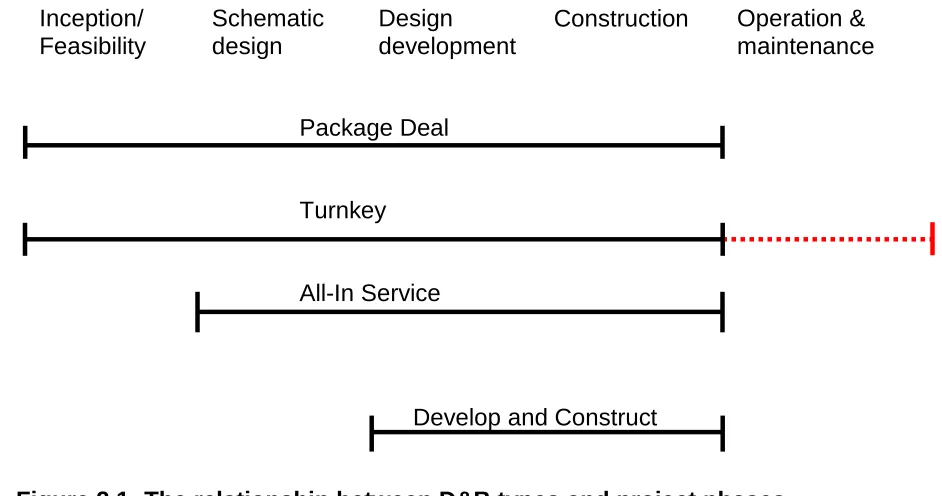
Figure 2.1: The relationship between D&B types and project
phases 31
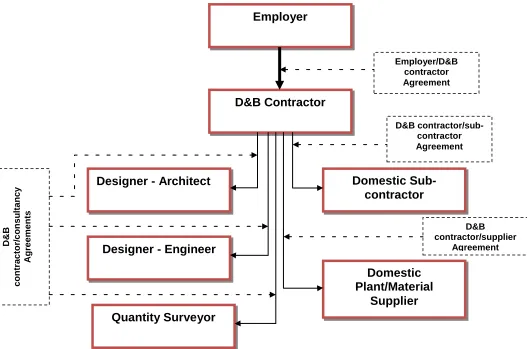
Figure 2.2: D&B procurement method: typical organisational
structure 33
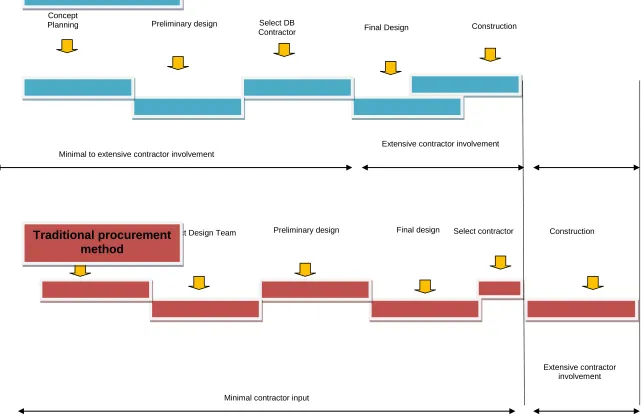
Figure 2.3: Typical sequence of project delivery activities of D&B
compared to traditional procurement method 40
Figure 2.4: Traditional procurement method: typical organisational
Structure 42
Figure 2.5: Conventional D&B procurement: typical processes 47
Figure 2.6: Novated D&B procurement: typical organisational
structure 49
Figure 3.1: A profile of disciplines involved within the project life
cycle 58
Figure 3.2: Key challenges with the D&B procurement method 81
Figure 4.1: Framework for design – the interconnection of
worldviews, strategies & research methods 94
Figure 4.2: The exploratory mixed methods sequential design 100
Figure 4.3: Sequential method & data mining approach to the
research 116
Figure 4.4: Interview design process adopted in the research 118
Figure 4.5: Framework used to explore challenges encountered by
D&B key participants 120
Figure 4.6: Interviewees categorisation 126
Figure 5.1: First stage of interview data analysis – entering data
sources in NVivo 142
Figure 5.2: Second stage of interview data analysis – Organising and
coding data in NVivo 143
Figure 5.3: Third stage of interview data analysis – Analysing and
querying data in NVivo 146
Figure 5.4: Negative experiences encountered by key participants
of the D&B procurement method 225
Figure 5.5: How key participants to the D&B procurement method
dealt with the negative experiences 229
Figure 5.6: NVivo model: How participants dealt with the experiences
encountered 248
Figure 5.7: D&B procurement method: key challenges and practice
Based enablers 250
Figure 5.8: Interconnectedness of key challenges 251
Figure 6.1: Challenge 1-Contractor: Unclear/incomplete client
requirements (UCR) 264
Figure 6.2: Challenge 2-Contractor: Underestimated time needed
Figure 6.3: Challenge 3-Contractor: Insufficient time allocated to
briefing, tendering and evaluation processes (ITAB) 267
Figure 6.4: Challenge 4-Contractor: Clients interference with the
design process (CIDP) 269
Figure 6.5: Challenge 5-Contractor: Difficulties working, managing
& communicating with design professionals (DWMCDP) 271
Figure 6.6: Challenge 6-Contractor: Difficulties getting specialist input
into the design (DGSID) 272
Figure 6.7: Challenge 7-Contractor: Difficulties managing the design
iteration process (DMDIP) 274
Figure 6.8: Challenge 8-Contractor: Costly tender process (CTP) 275
Figure 6.9: Challenge 9-Contractor: Difficulties differentiating scope
change from design development change (DDSCDDC) 277
Figure 6.10: Challenge 10-Contractor: Difficulties managing risks Passed on by clients which would have been better
managed by clients (DMRP) 279
Figure 6.11: Challenge 1-Clients: Insufficient communication with the
contractor’s design (LCCD) 282
Figure 6.12: Challenge 2-Clients: Difficulty in evaluating D&B tenders
(DEDBT) 283
Figure 6.13: Challenge 3-Clients: Loss of benefit of designer’s independent construction oversight and monitoring
(LBDICO) 285
Figure 6.14: Challenge 4-Clients: Contractor’s design not meeting/
satisfying clients’ expectations (CDNMCE) 287
Figure 6.15: Challenge 5-Clients: Quality/design standards sacrificed
to minimum levels by the contractor (QCSSMLC) 289
Figure 6.16: Challenge 6-Clients: Difficulty to define requirements &
still leave room for contractor’s creativity (DDRCSLRCC) 291
Figure 6.17: Challenge 7-Clients: Cost savings realised by the
Figure 6.18: Challenge 8-Clients: Difficulty in introducing & evaluating
change (DIEC) 295
Figure 6.19: Challenge 9-Clients: The D&B procurement method is more labour intensive & technologically demanding than
the traditional procurement method (PMMLIT) 297
Figure 6.20: Challenge 10-Clients: Lack of involvement in technical discussion as the design is developed by the contractor
(LITDDDC) 299
Figure 6.21: Challenge 1-Designers: Conflict of interest between
professional duty & contractor’s requirements (CIBPDCR) 302
Figure 6.22: Challenge 2-Designers: Difficulties interpreting
unclear/incomplete client requirements (DIUICR) 304
Figure 6.23: Challenge 3-Designers: Inadequate/lack of communication
with end users & other stakeholders (ICS) 306
Figure 6.24: Challenge 4-Designers: Limited recovery of design costs incurred during tender when the tender is not won by the
D&B contractor (LRCDCIT) 308
Figure 6.25: Challenge 5-Designers: Late input of constructability advice from the contractor resulting in delays to design
deliverables (LICAC) 310
Figure 6.26: Challenge 6-Designers: Lack of specialist involvement in the early parts of the design resulting in late changes &
delays to construction (LSIEPD) 312
Figure 6.27: Challenge 7-Designers: Cost saving pressures leading to services procured on lump sum basis which may be
inequitable to the designer (CSPLSPLB) 314
Figure 6.28: Challenge 8-Designers: Lack of transparency in decision processes which underpinned client requirements leading
to requirement misunderstandings (LTDPUCR) 316
Figure 6.29: Challenge 9-Designers: Cost saving pressures leading to claims from the contractor alleging ‘errors’ in design for
Figure 6.30: Challenge 10-Designers: Lack of understanding & appreciation from the contractor on the iterative nature of the design process resulting in insufficient time
allowances in the programme (LUACINDP) 320
Figure 7.1: Synthesis of research findings from reviewed literature
and interviews 350
Figure 7.2: Synthesis of research findings from reviewed literature,
interviews and survey phases 353
Figure 7.3: People related challenge synthesis 354
Figure 7.4: D&B process related challenge synthesis 355
Figure 7.5: D&B project risk related challenge synthesis 356
Figure 7.6: D&B contractual related challenge synthesis 356
Figure 7.7: D&B practice based enablers – to address contractual
challenges 358
Figure 7.8: D&B practice based enablers – to address project related
risk challenges 359
Figure 7.9: D&B practice based enablers – to address process
related challenges 359
Figure 7.10: D&B practice based enablers – to address people
related challenges 360
Figure 7.11: Proposed framework for facilitating better integration of design and construction processes within the D&B
procurement method 367
ACKNOWLEDGEMENT
I would like to express my very great appreciation to Dr Gerard Wood, my research supervisor, for his patient guidance, enthusiastic encouragement and valuable and constructive suggestions throughout the course of my research studies at Salford University. I would also like to thank the professional doctorate course Supervisor, Dr Paul Chynoweth, for his relentless valuable support
through my studies at Salford University. My grateful thanks are also extended to all other members of staff at Salford University who offered their help in one way or the other during my research studies in particular research administrators Rachel Liley and Moira Mort.
A very big thank you goes to my Director at work, Alan Cox, for not only providing me with the financial support for my studies but study time during busy periods at work. Without this support I would not have completed this research.
I also acknowledge the contribution that my father, Shadreck Marufu who is now unfortunately late, made to my desire to commence doctoral studies. He is the one who was responsible for sowing the seed in me which ultimately germinated as a burning desire to undertake and complete doctoral studies. This is what he always wanted from me and I hope I have made him proud. For this I am
eternally grateful.
ABBREVIATIONS
BPF British Property Federation
CECA Civil Engineering Construction Association CIRC Construction Industry Review Committee CIT Construct IT centre for Excellence
D&B Design and Build procurement method
DOI Degree of involvement
DoE Department of the Environment
FIEC European Construction Industry Federation
GDP Gross Domestic Product
ICE Institute of Civil Engineers
IT Information Technology
MC Middle level manager role – Client Organisation MCN Middle level manager role – Contractor Organisation MD Middle level manager role – Designer Organisation
NAO National Audit Office
NEC The New Engineering Contract
NEDO National Economic Development Office
RIBA Royal Institute of British Architects RICS Royal Institution of Chartered Surveyors
SC Strategic level manager role – Client Organisation SCN Strategic level manager role – Contractor Organisation SD Strategic level manager role – Designer Organisation SPSS Statistical Package for Social Science
TC Top level manager role – Client Organisation TCN Top level manager role – Contractor Organisation TD Top level manager role – Designer Organisation
ABSTRACT
Over the recent years the UK construction industry has seen an increasing level of interest in the use of design and build (D&B) as a construction procurement method. This appears to be mainly driven by an attempt by the industry to increase the level of integration in what is generally viewed as a fragmented industry. The main advantages associated with this procurement method that have been cited in reviewed literature have been numerous. Key advantages appear to be the following: single point responsibility for the whole project delivery encompassing design and construction, early
contractor involvement resulting in potential cost savings and earlier completion, easy constructability and minimisation of design and construction risk to clients.
Despite its perceived increase in adoption over the last decade as supported by the relatively recent Contracts in use survey in 2010 by the RICS, the construction industry is still experiencing problems associated with D&B procurement. This highlights the need to explore further how this
procurement method is being used in practice. The exploration adopted in this research involves identification and evaluation of challenges
encountered by key participants (clients, contractors and designers). In addition such an exploration is buttressed by the identification and evaluation of practice based enablers that key participants have
used/proposed to use in order to manage better the challenges they have encountered with this procurement method.
used in semi-structured interviews. This approach was adopted in order to gain a holistic insight into this multi-faceted problem.
The research shows that adopting D&B procurement method does not
necessarily result in integration of design and construction processes. Significant time and effort will need to be spent in creating and facilitating integrative
processes and systems to ensure that the gap between the theory and practice of D&B procurement is covered. D&B is not a one size fit all procurement method and each project characteristics and requirements needs to be methodically reviewed and understood to ensure that this fits with the unique features of D&B procurement method.
The research implications mainly relate to the D&B procurement practice. Given the practice based enablers that it generates this has direct implications on how practitioners go about applying the processes and methods that facilitate
integration of design and construction in a D&B procurement method set up. This, therefore, goes a long way to bridge the gap between the theory and practice of D&B procurement method. This potentially leads to unlocking this integrative procurement method’s benefits that were not previously realised.
The output of this research is a framework for facilitating better integration of design and construction processes. Additionally the framework can also be used as a tool kit for effective use and for acting as an enabler for the flow and
PREFACE
Introduction
The research reported in this thesis commenced in October 2008 in the School of the Built Environment at the University of Salford. The researcher was and is still employed in the construction sector when this research was commenced. The research model and methodology developed throughout the period 2008 and 2013. As a practitioner actively involved with the construction sector the
researcher’s interest in construction procurement was perhaps no surprise as the whole project development process hinges upon a procurement strategy and method upon which all the other activities in connection with design and construction of the built environment are based.
Being a chartered quantity surveyor by profession with more than 20 years of experience in both the contracting and cost consultancy sectors of the
construction industry the researcher has been fortunate to have acquired a lot of experience in the field of procurement and contract management. Over the years, in the researcher’s experience, there have been questions asked by clients and other stakeholders if construction projects were not delivered according to the intended plan e.g. if there were cost and/or time overruns; if there were protracted contractual disputes; if there were defects identified during and after the construction phase and a host of other problems emanating from the delivery of construction projects procured through the design and build procurement method (D&B). In most cases project close out meetings that ensued after the event tended to capture the symptoms of the problem without going into the root cause of the problems impacting the D&B procurement method.
problem which is the subject of this research. In addition to the professional practice gained at the work place the researcher was greatly assisted and guided by the professional doctorate cohort of 2008 and gained lots of support through the workshop sessions that were held periodically at the University of Salford over the years from 2008 to 2012. The following sections provides a critical review of the relevant aspects of the researcher’s professional practice with a view of setting out the process by which the researcher’s own reflection has contributed to the researcher’s particular choice of research focus.
Reflective practice
The theory of reflective practice is said to be hinged on such concepts as critical thinking, technical rationality, reflection-in-action, reflection-in-practice, reflective research, action learning and positivist epistemology of practice. It is the intention of the researcher to go through each of these concepts in turn in order to show how these reflective practice concepts have provided the ingredients and focus of this research. Moon (1999) supports this view by stating that reflective practice is a process of looking back in a critical way at what has occurred and using the results of this process together with professional knowledge to tackle new situations.
The concept of critical thinking, with its notion of continual questioning of
assumptions, has aided the researcher in developing the research area. In a way this concept has managed to develop what is generally referred to as reflective scepticism (Brookfield, 1987) enabling the researcher to generate intellectual arguments that underpin and foster the research problem and the associated intellectual puzzles in the form of research questions. This enabled the
the framework to facilitate better integration of design and construction processes within the D&B procurement delivery method.
The role of other professionals in this concept of critical thinking is very relevant to this research. Colleagues at the work place as well as knowledge and
experiences gained from continuous professional development events (CPD) have also helped the researcher not only to mould the research problem but provided the support and critique needed to develop the initial research problem into an intellectual puzzle worthy of a study at doctoral level. This appears to have been at the core of Brookfield (1987)’s thought process when he stated that without the capacity to think and act critically we would never move beyond those assumptions we assimilated uncritically in childhood.
Similarly this concept has further been buttressed by the double-loop learning model cited by Brockbank (2002) in which he states that double-loop learning takes place when assumptions about ways of seeing things are challenged and underlying values are changed thus it is reflective learning for transformation. In another related study by Thompson (2008) this same concept is referred to as technical rationality. This explains the idea that knowledge can be applied directly to practice and that professional knowledge can be seen as a matter of the
knowledge base serving as a resource that needs to be adapted to suit circumstances. In this concept of technical rationality there is recognition that there is a scientific knowledge base that can be drawn upon and also a
realisation that a degree of artistry is needed to make meaningful links between that knowledge base and the actual demands of practice.
Another researcher in this field, Schon (1995), came up with the reflection-in-action concept which he described as ‘thinking on your feet’ or ‘learning by doing’ a process which he says occurs in the midst of a performance. This concept is said to recognise the fact that people sometimes think about what they are doing. This is relevant to the research as the researcher has learnt by doing certain professional practices such as procurement of construction works, cost planning, measurement of construction work, reporting and budgeting for construction work.
The concept of reflecting-in-practice has been described by Schon (1995) as having a bearing on tacit knowledge and is said to have a tendency of becoming spontaneous and automatic thereby conferring upon the practitioner and his/her clients the benefits of specialisation. Through reflection the researcher was able to surface and criticise the tacit understanding that have grown up around the repetitive experiences of a specialised practice.
Reflective research is another concept closely associated with the concept of reflective practice and highlights issues such as frame analysis and repertoire-building research (Schon, 1995). In this concept it is stated that problems and roles are framed and the frame determines their strategy of attention and set the directions which shapes their practice.
Action learning has been described as a process of learning and reflection that happens with the support of a group of a group or ‘set of colleagues’ working with real problems with the intention of getting things done (McGill & Beaty, 1995). This process is further described as a process which adds structure to our experience by allocating particular time to reflection. This is further said to support individuals in reflecting on their past actions in order to learn from
generated. The working environment and the workshop sessions that the researcher attended at the university provided the additional structure to the experience gained in professional practice.
The kolb learning cycle is often associated with this concept as stated by McGill & Beaty (1995). In this learning cycle model the learning process is seen as a cycle of events involving observing and reflecting on experience leading on to making sense of that experience in a new way which in turn leads onto an understanding followed by insights which allow for new plans, new strategies for action and new modes of behaviour. McGill & Beaty (1995) further states that action learning and action research are based on the same learning cycle as they share the focus on learning from experience and they both have an action and a reflective phase.
Critical reflection and review of researcher’s practice
Throughout the years of the researcher’s experience in the construction sector it became evident to the researcher that the construction industry has been
criticised for late delivery of projects, cost overruns and what can be referred to as ‘shoddy workmanship’. In most of these criticisms a common theme that seemed to take centre stage is that traditional procurement methods which were widely used were perhaps not the appropriate and relevant methods used to deliver these projects as they separated design and construction processes. New procurement methods modelled in a way that integrates design and construction processes were adopted over the years such as D&B, management contracts, partnering and construction management.
the validity of some of the widely held conceptions about design and construction integration. This reflection and critical thinking resulted in the researcher noticing gaps between the theory and practice of integration associated with design and construction processes.
It is against this background that issues relating to the research problem began to emerge. Through the process of reflection-on-action and reflection-in-action the researcher had to critically evaluate own experience and contribution as a built environment professional. The problem focus emerged from an ongoing observation of construction projects that the researcher has been directly involved with. The researcher’s immediate aim in embarking on this research is self-development, professional development and generation of knowledge.
This shows that the benefits of self-reflection are countless. All have a commonality to improve competence, practice and to manage complex situations. Schon (1995) combines these perspectives by stating that situations confronted by professionals in practice are unique, individual and complicated and this ‘falls outside the existing knowledge of theory and technique’. In fact Schon (1995) make the role of theory (professional knowledge) as a ‘cloth from which professionals tailor their professional response’ through the use of ‘professional artistry’. Reflection therefore bridges the gap between professional knowledge (high topography) and practice (swampy lowlands) (Thompson, 2008).
CHAPTER 1
INTRODUCTION
1.1 INTRODUCTION
This chapter introduces the background of the research topic. It identifies the research gap and sets out the aims and objectives of the research. It emphasises the research significance, delineates the scope of the research and provides an overview of the structure of the thesis.
1.2 RESEARCH BACKGROUND
The contribution from the construction industry towards the quality of life and the general economy has since been recognised as significant the world over (European Construction Platform, 2005; Fairclough, 2002). This is despite the existence of problems associated with the definition of the term ‘construction industry’ (Ofori, 1990). Some researchers consider the construction industry as involving on-site activities. Others suggest that planning and design functions must be included. Yet others advocate for the inclusion of manufacturing and suppliers of materials and plant, finance of projects and management of construction (Turin, 1975; Hillebrandt, 1985).
will widen the scope of the research making it impossible to complete within the time and cost for this kind of research.
Despite the problem in definition it would appear that there is no dispute regarding the significance and contribution of the construction industry towards the social and economic well-being. The UK construction industry has an output of approximately £100 billion a year and accounts for approximately 6% of the UK’s Gross Domestic Product (Brink and Anagboso, 2010). A 2009 LEK Consulting report for UK contractors Group stated that the industry is a driver in other sectors due to its over reliance on an extended and varied supply chain. The report stated that every £1 spent on construction output generates £2.84 in total economic activity (RICS, 2012). The industry also accounts for 9% of all jobs in the UK (Office of National Statistics, 2012) which is the fifth largest employer in the UK behind the wholesale, manufacturing, health and education sectors. Figure 1.1 (See also Appendix A) depicts this graphically by showing the percentage contribution all in employment by industry sector using data up to the first quarter 2012 from the Office of National Statistics (ONS).
Figure 1.1: Percentage contribution all in employment by industry
sector – 2003 – 2011 yearly average (not seasonally adjusted)
Source: Adapted from Office of National Statistics (2012)
It has since been established that the construction cycle is closely linked with the general business cycle as opined by Tan (1989). His observation has been supported by follow on research work by Hutcheson (1990). He also observed the existence of a relationship between construction demand and growth in Gross Domestic Product (GDP). Both their research efforts observed that the demand for construction work is derived from the demand for consumer goods. This mirrors results from earlier research efforts by Kilian and Suyman (1984). They went further than Tan (1989) and Hutcheson (1990) when they clarified this link. They observed that a period of economic prosperity, which tends to raise consumer demand for goods and services, triggers a rise in the demand for
Agriculture Mining Manufacturing Construction Wholesale Transport Accommodation
Information/Communication Financial
Real Estate
Professional Services Administration/Defence Education
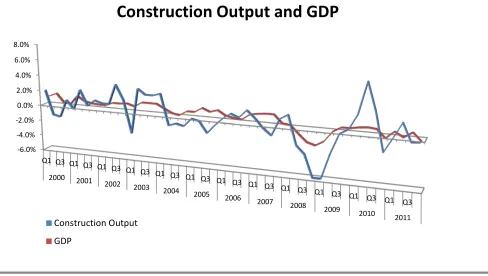
[image:30.612.93.525.69.343.2]These findings of the early 1980’s/1990’s are still being supported by recent research efforts especially studies undertaken by Brink and Anagboso (2010). In an attempt to show the link between construction activity and demand and supply factors, Brink and Anagboso (2010) made additional observations. They observed that the recent contraction in construction activity has (to a large extent) been derived by a fall in demand which inevitably led to reduced supply. This observation is further confirmed by data from ONS (2012), which show the intricate link and relationship over the last 10 years between construction output and GDP as depicted in Figure 1.2 below.
Figure 1.2: Relationship between construction output and GDP
Source: Adapted from ONS (2012)
The sensitivity of GDP to construction activity is attributed to the fact that construction is intricately linked to other sectors of the economy. These sectors
-6.0% -4.0% -2.0% 0.0% 2.0% 4.0% 6.0% 8.0%
Q1 Q3 Q1 Q3 Q1 Q3 Q1 Q3 Q1 Q3 Q1
Q3 Q1 Q3 Q1 Q3
Q1 Q3 Q1 Q3 Q1 Q3 Q1 Q3 2000 2001
2002 2003
2004 2005
2006 2007
2008 2009
2010 2011
Construction Output and GDP
[image:31.612.93.581.282.558.2]are the manufacturing, labour market, business investments and a host of other industries. This is further supported by research efforts undertaken by Cuffe (2003). These researchers identified that although the economy is divided into 123 industrial sectors all these sectors (except a few) contribute directly to the construction sector. Their research efforts observed that the industrial sectors that contribute to the construction sector can be split into 7 broad groups as graphically presented in Figure 1.3.
Construction
Industry
Professional Consultants
Transport & Services
Real Estate
Sub-contractors
Labour Capital
Energy & Supplies Materials & components
Construction output has also been shown to be closely linked to the housing market since this sector makes up over a ⅓ of construction activity (Brink and Anagboso, 2010). Recent data from the ONS appear to support this as shown in Figure 1.4. The Figure also shows that higher prices are likely to lead to an increase in house building and therefore construction output.
Figure 1.4: The relationship between House Prices and Construction
Output
Source: Adapted from ONS (2012)
As depicted graphically above, demand for goods and services produced by the construction industry are affected by numerous factors encompassing the social, political, economical and technological spectrums. Cost of borrowing, demographic factors, government policy, ownership patterns of households, technological developments, changes in taste, business confidence, age and condition of existing built environment are some of the main factors highlighted in previous research efforts (Barter, 1988; Myers, 2004) as impacting on
-8.0% -6.0% -4.0% -2.0% 0.0% 2.0% 4.0% 6.0% 8.0%
Q1 Q3 Q1 Q3 Q1 Q3 Q1 Q3 Q1 Q3 Q1
Q3 Q1 Q3 Q1 Q3 Q1 Q3 Q1 Q3
Q1 Q3 Q1 Q3 2000 2001
2002 2003
2004 2005
2006 2007
2008 2009
2010 2011
House Prices and Construction Output
[image:33.612.90.580.197.444.2]construction demand. Supply within the construction industry, on the other hand, is made up of several interconnected markets. Costs of production, government policy and technology are some of the main factors that affect the supply of goods and services within the construction industry.
The above indicates that the construction industry not only brings social and economic well-being benefits but, creates local and national markets for plant and material suppliers and all the ancillary services that are required. In addition, there are a host of social benefits that the construction industry brings to the users of the built environment. This is because users need to feel safe at work and during social hours. Construction legislation and the Building Regulations that govern construction activity ensure that safety is designed into the built environment. Other social contributions emanating from the construction industry include sustainability. Sustainability of the built environment is a key topical challenge within the construction industry. This is enhanced by getting the local community involved and actively participating in the local built environment projects which gives local construction projects a key sustainability factor.
The construction process is initiated by the client or the sponsoring organisation who determines the requirements of the goods and services that are required to be fulfilled by the built environment. Although there are different categories of clients with different requirements, the Latham Report (1994) suggested client requirements to be principally driven by the need to: obtaining value for money, ensuring projects are delivered on time, having satisfactory durability, incurring reasonable running costs, being fit for its purpose, being free from defects on completion, having an aesthetically pleasing appearance and being supported by meaningful guarantees.
researchers to define a procurement system/method, common themes that come up suggest key aspects of procurement. Such themes defines a procurement system as the strategy, the organisational structure, the responsibilities and relationships and the management of a construction project with the overall objective of satisfying the client’s developmental and operational needs.
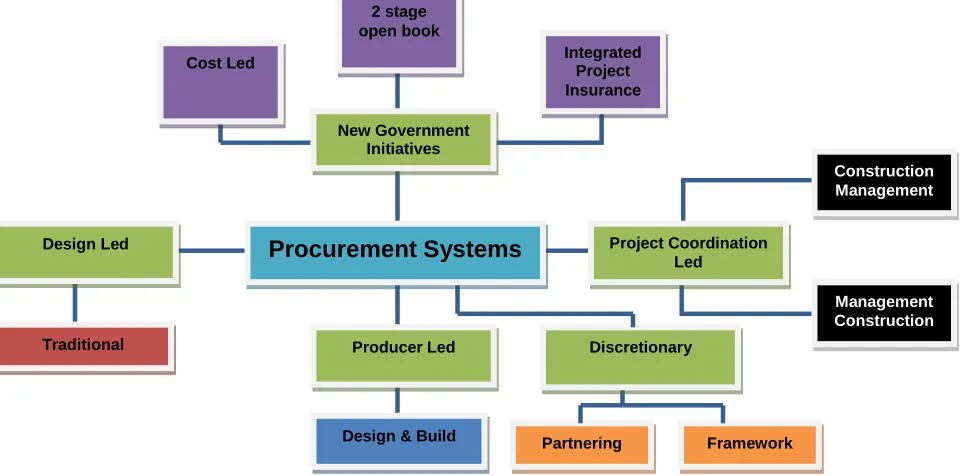
[image:35.612.69.551.393.631.2]As construction procurement has evolved many different types and categories of procurement routes have been developed over the years. Figure 1.5 shows some of the key procurement systems that have evolved in the UK over the last couple of decades (New models of construction procurement, 2012). The drivers for such evolution appear to be the changing nature of the construction market. This is driven by other socio-economic and political factors together with the complexity of construction projects. This is further compounded by the sophistication of the construction clientele which probably influence the proliferation of construction procurement systems in recent years.
Figure 1.5: Procurement systems evolution in the UK Construction
Industry
Discretionary Cost Led
New Government Initiatives
Procurement Systems
Design & Build Traditional
Design Led Project Coordination
Led Integrated
Project Insurance 2 stage
open book
Producer Led
Construction Management
Management Construction
Framework Partnering
The new Government initiatives (Cost led, project insurance and the Two stage open book) (Cabinet Office, 2014) demonstrate that there are challenges with current procurement methods which need to be addressed. Briefly, the cost led approach is where the client selects integrated supply chain teams from an existing pool of partners. The selection is based on their ability to work in a collaborative manner to deliver below the cost ceiling on their first project and to achieve cost reductions on subsequent projects while maintaining the required quality outcomes.
The Two stage open book entails the client inviting suppliers from a pool of suppliers on a framework to bid on the basis of an outline brief and cost benchmark. The team that is successful then develops a fully detailed proposal that meets the client’s stated outcomes and cost benchmark as a second stage. The proposal is developed on an open book basis. Integrated project insurance entail the client appointing, through competition, an integrated project team responsible for delivery. This would have a single insurance policy to cover all delivery risks, packaging up all insurances that would normally be held by the client and supply chain members who will share the cost of project overruns below a certain threshold. The fundamental themes underlying these relatively new procurement initiatives are early supplier engagement, transparency of costs, integrated team working and collaborative working.
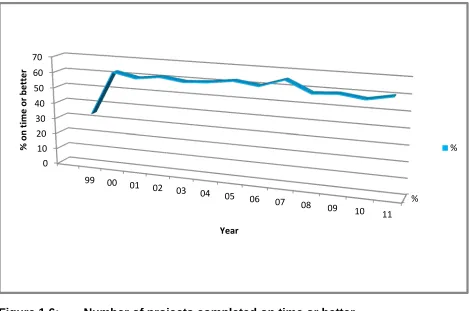
problems. Figure 1.6 shows that over the last 10 years the number of projects completed on time or better has been averaging around the 60% mark while Figure 1.7 show that construction projects completed on budget or better has been largely below 50% over the last 10 years. Similarly Morledge and Sharif (1996) arrived at more or less the same conclusion when they reported that, on a survey of 215 projects surveyed in the UK, 63% were delivered later than expected.
Source: Construction News (2012)
There may well be several reasons for failure to achieve completion on time (or within budget) or better but the bottom line is it is the construction industry that is perceived by the outside world to be underperforming. Apportionment for ‘blame’ as a result of this underperformance may well be fuzzy and varied among and between the parties involved in construction (clients, contractors, designers,
% 0
10 20 30 40 50 60 70
99 00 01 02 03 04
05 06 07
08 09 10
11
%
o
n t
im
e
or
b
et
ter
Year
%
[image:37.612.92.561.236.547.2]supply chain) but the implications brought about by the procurement method adopted must have significant effects to the outcome given that the procurement method sets out the organisational and contractual arrangements for project delivery.
Figure 1.7: Number of Projects completed on budget or better
Source: Construction News (2012)
The poor image of the industry has been widely reported over the last 2 to 3 decades with Smith et al. (2004) observing the construction industry to be complex, responsive and volatile with its essence said to be based on one-off projects and temporary relationships. Love and Li (2000) highlighted another problem related to the poor quality associated with the finished projects which he opined was as a result of lack of adoption of quality assurance programmes.
% 0
10 20 30 40 50 60
99 00 01 02 03 04
05 06 07
08 09 10
11
%
on
b
ud
ge
t o
r b
et
te
r
Year
general lack of commitment from construction companies to effectively implement such programmes.
More recently Mitchell et al (2011, p.47) highlighted that the traditional fragmentation of the construction industry lie at the ‘root of many of the industry problems’ - an observation that had earlier been made by Abi-Karam (2005, p.23) who summed up his observations by stating that the construction of a project is a ‘fragmented process in a fragmented environment’. To support his claim he observed that typically a project is conceived by the owner, designed by architects and engineers, impacted upon by building officials and planning teams, approved by regulatory agencies, constructed by contractors and their supply chain and maintained and operated by end users.
Such problems, almost all centred on challenges pertaining to procurement systems/methods adopted to deliver construction projects, have prompted construction researchers and practitioners across the world to explore procurement related challenges in an effort to identify appropriate systems, models and frameworks that can be adopted to meet challenges posed by such issues in the construction sector. These challenges are explored further in follow on sections/chapters below. Such an exploration would inevitably expose gaps in current research which then forms the foundation for this research study.
1.3 RESEARCH PROBLEM
• Innovation – implying that clients expect to get creative solutions for the project (Beard et al, 2001)
• Costs savings – on the basis that, due to shorter construction durations associated with D&B procurement, there is an expectation for project cost to decrease (Songer and Molenaar, 1997)
• Early cost establishment – on the basis that project costs are secured before the start of the detailed design (Songer and Molenaar, 1997)
• Reduced schedule – as the overall project completion time is expected to be relatively shorter compared to other conventional design led procurement methods (Songer and Molenaar, 1997)
• Single entity responsibility for both design and construction (Beard et al, 2001)
• Builder/contractor involvement in the design process (Gransberg and Lopez del Puerto, 2004)
• Best value selection: the project is awarded to the team that offers the most benefits to the owner; price is not the only factor considered (FAR, 1996)
Despite these perceived benefits of such integrated design and construction processes generally associated with D&B procurement, it is argued in this research that there are still significant disparities between the theory and practice of D&B procurement as a method of delivering construction projects. Significant challenges remain which, if not addressed, may continue to impair the performance of the D&B procurement method and paradoxically undermine the achievement of design and construction integration benefits associated with this procurement method.
construction processes has since been labelled as the root cause of the construction industry problem (Naoum, 2003; Mitchell et al, 2011).
From the review of literature it would appear that there are numerous challenges that have been encountered by participants which hinder better integration. This impacts on the achievement of effective and efficient implementation of the D&B procurement process. Current body of knowledge has identified significant D&B procurement method challenges. These challenges are said to be difficulties in defining requirements clearly and still leaving some room for creativity and ingenuity for the D&B contractor (Fahmy and Jergeas, 2004), perceived inferior quality of D&B projects (Gransberg and Windel, 2008) and clients’ perceived loss of control of the design and construction processes. This may be taken advantage of by the D&B contractor (Garnsberg and Windel, 2008) especially considering that there is no overall design and construction supervision from the owner. The perception by clients is that, although there is room for cost savings emanating from the procurement method, they are unsure if the cost savings realised by the D&B contractor are in fact passed on (Fahmy and Jergeas, 2004).
Similarly, it is also argued in this research that greater understanding of this complex problem could only be achieved if the fundamental challenges affecting all key D&B participants are explored and understood. This will inform and underpin the development of an enabling framework for better integration and coordination of the design and construction processes within this procurement method. The study therefore explores this problem further and provides further empirical evidence on D&B procurement challenges and how they have been dealt with in practice; another area that appears to have been overlooked by previous researchers as they tended to focus on challenges rather than practice based enablers to be adopted to address the challenges. The study also examines, not only the key reasons why these challenges arise but, the severity of the challenges from key participants’ perspective. It is a fundamental premise of this research that the construction industry problems associated with procurement matters are not necessarily resolved by a proliferation of procurement methods but by focusing on improving the existing procurement methods which this research aims to do.
As part of this exploration, the research intends to examine the following: factors underlying key participants’ perceptions of the D&B procurement method; possible reasons why such perceptions have come about; identification of the form and nature of the challenges experienced as well as the severity of the challenges identified. Furthermore the study intends to explore how key participants have managed to deal with challenges encountered over the years with a view to understanding possible good practices/practice based enablers that could benefit other D&B procurement method users in the construction industry.
1.4 AIM AND OBJECTIVES
UK construction industry are facing and more importantly, understand how they have dealt with such challenges in practice. On the basis of these findings, the research aims to develop a framework that, hopefully, will be of use in facilitating better integration of the design and construction processes resulting in the achievement of effective (i.e. generation of desired results) and efficient implementation of the D&B procurement method. The aim is achieved through the following objectives:
1. To develop an in-depth understanding of the nature (including range and dynamics) of challenges affecting key participants in D&B procurement method. Factors underlying the challenges will also be explored as part of this objective.
2. To explore the severity of challenges encountered by key participants of the D&B procurement method
3. To identify practice based enablers that key participants have used/propose to address the key challenges identified in objective 1
4. To propose a framework that will hopefully facilitate better integration of design and construction processes as well as serve as guidance or toolkit for key participants to refer to and use when utilising the D&B procurement method
1.5 RATIONALE/RESEARCH QUESTIONS
observe common breakdowns on D&B projects as well as misinterpretations of client goals or wrong interpretation of design documents.
Main research efforts in addressing these challenges tended to focus on looking
at D&B procurement method challenges in isolation ignoring the
interconnectedness of the challenges and how they impact key participants of the process. For instance, some researchers (Anumba, 1989; Anumba and Watson, 1991; Anumba and Watson, 1992; Brandon and Betts, 1995; Alshawi in Li et al., 2000a) focused on Information Technology (IT) to improve the flow of information between the project participants with the perceived benefits of reducing errors, improving coordination, increasing data integrity, improving communication and product quality. It is arguable whether such research efforts on their own have brought in the desired improvements as IT has simply been used to automate processes and not to adequately look at the challenges affecting integration in D&B procurement. The expected productivity emanating from the utilisation of IT in D&B procurement method has thus not materialised as observed by Li et al (2000b) and Love et al (2000).
Better and achievement of effective integration of design and construction processes is therefore still a major problem in construction. To understand holistically these challenges that emanate from a complex phenomenon like D&B construction procurement would necessarily require an in-depth exploration of key participants’ experiences. In addition this would also entail ascertaining the form and nature of the challenges, dimensions of participants’ perceptions and examination of why and how their perceptions have come about. The following questions/intellectual puzzles have emerged out of this research and will be explored in order to inform the approach to this research:
3. What is the severity of the challenges that are encountered by key participants of the D&B procurement method?
4. How have these underlying challenges been addressed by key participants of D&B procurement method in practice?
These questions are explored further in the research and the following chapters address these questions in more detail.
1.6 RESEARCH APPROACH
In order to satisfactorily achieve the research aim and objectives as well as address the research questions raised in section 1.5 above the following tasks were undertaken:
1. Review of related literature in order to achieve the following:
Develop an understanding of D&B procurement method attributes
Examine typical D&B procurement method organisational forms
Identify and explore D&B procurement method challenges encountered by key participants of the process
Examine the processes involved in D&B procurement method
Identify gaps in previous research in order to provide foundation blocks for the research
3. Questionnaire survey conducted in order to get the views of D&B procurement method key participants from a wider audience in the UK construction industry. In addition another objective of the survey is to get an understanding of the severity of the challenges affecting participants of D&B procurement method.
4. Findings from the reviewed literature and results of the interviews and survey are presented in later chapters.
1.7 SCOPE AND LIMITATIONS OF THE RESEARCH
Although some of the principles covered in the thesis are common in other variants of D&B procurement the scope of this thesis is mainly centred on the variant where the client undertakes some design. The justification for this approach is that previous research indicates that this variant is the most commonly used in practice (Akintoye, 1994).
The research is also targeted at key participants of D&B procurement identified in the research as clients, designers and contractors. These are the primary parties involved in most of the key decisions that are made through the D&B
procurement process. The research focused more on D&B organisations in which the designer is sub-contracted to the main contractor rather than being an in-house designer. This type of arrangement, in which the designer is
sub-contracted to the main contractor, was adopted as the author wanted to explore more the dynamics that this arrangement brings to the D&B procurement
1.8 EXPECTED OUTCOME AND CONTRIBUTION TO KNOWLEDGE
The major outcome expected from this research is the development of a framework that will, in addition to helping facilitating better integration of design and construction processes, act as guidance and/or toolkit for users of D&B procurement method. This should be able to help facilitate better integration and the achievement of effective and efficient implementation of the D&B procurement method within the construction industry.
In addition to capturing good practice the framework will hopefully help users address some of the key challenges associated with D&B procurement resulting in its widespread use. Given its reported potential for superior performance in time and cost (Konchar et al, 1997; Ling and Kerh, 2004; Pain and Bennett, 1988; Grifith, 1989; Ndekugri and Turner, 1994; Pockock et al, 1996; Bennett et al, 1996; Hale et al, 2009 and Goftar et al, 2014) its increased adoption will invariably result in improvements in the performance of the construction industry.
Previous studies on underlying challenges associated with D&B procurement method tended to focus more on those challenges affecting clients only and even where other non-client challenges were explored the tendency appeared to isolate and cover challenges singularly and not to provide a holistic examination of the challenges experienced by key participants. Other key participants involved in the procurement process such as design consultants and contractors that appeared to have been overlooked in literature reviewed are included in this research.
organisations. They will be able to appreciate challenges experienced by the D&B contractor and his/her designer as well. This enlightenment and appreciation will hopefully enable all key parties involved to constructively engage and hopefully share and promote good practice thereby avoiding pitfalls that have hitherto been experienced with this procurement method.
Similarly designers and contractors will be able to understand, appreciate and recognise each other’s challenges. This should hopefully result in more collaboration, cooperation and effective communication. Shared understanding of such challenges should result in better team synergy particularly in coordination of the design and construction activities.
The academia will no doubt get more insight into the D&B procurement method which they can use in further research and curriculum development. Findings from the research will help the academia to get another perspective on D&B procurement method in terms of practical aspects as experienced by key participants. Curriculum can also be developed and adapted to suit the practice based aspects of D&B procurement that this research generates. This will add another important dimension to the learning of potential future practitioners of the D&B procurement method.
to just enablers as such enablers originate directly from practitioner’s ‘lived experience’. Such an experience is not only practitioner based but is based on experience that has been used before and has been found to have worked.
Above all it is estimated that approximately 95% of the industry’s clients are occasional or infrequent, with little or no experience of working with the industry or the processes by which consultants, contractors and suppliers are procured (RICS, 2012). It is further stated that they are also less likely to understand the importance of their role in ensuring project success. In addition to providing a useful base for the application of lessons learnt from past experiences for the experienced clients of D&B procurement the results of this study will no doubt provide useful insight to a large audience of occasional clients and users. This will allow them to develop appropriate strategies to apply when utilising D&B as a procurement method to deliver construction projects.
The respondents targeted in this research (as highlighted in the interview and the survey sections in later chapters) are experienced practitioners who have been actively involved in the construction sector for a relatively long period of time. It can therefore be stated that these practitioners (key participants) possess a certain degree of expertise about the domain of this inquiry. This research therefore makes the case that a substantial range of thematic discoveries will thus be generated. This therefore provides the case for generalisation of the thematic discoveries made in this research.
1.9 KEY PARTICIPANTS OF THE D&B PROCUREMENT METHOD