International Journal of Emerging Technology and Advanced Engineering
Website: www.ijetae.com (ISSN 2250-2459, ISO 9001:2008 Certified Journal, Volume 8, Issue 5, May 2018)
240
Secure Authentication of Username & Password Using
Gaming CAPTCHA as Input Credentials
Sandeep Piplotia M.Tech Scholar
Oriental College of Technology, Bhopal
Bhavana Gupta Associate Professor
Oriental College of Technology, Bhopal
Abstract: CAPTCHA is one of the most widely used techniques which employed by web services to prevent their system from unusual relay attacks. CAPTCHA is basically a Turing test to differentiate whether the user; who is accessing the system is a human or a robot. There are various types of CAPTCHA available nowadays and their level of authentication varies accordingly. CAPTCHA plays an important role to prevent a website from junk entries along with illegitimate access. Here in the proposed system, CAPTCHA is used to input the valid pairs of credential to securely authenticate the user. Proposed system prohibits input through keyboard and enhances security by dragging letters through mouse. In this system, CAPTCHA shows distorted alphabets of different colors and some colored bubbles are placed below. User needs to drag desired letter on the same colored bubble. Here in the developed method, identical shades of color are considered as same and every reload shuffles the color of letters and bubbles. A machine is not able to identify the identical shades for dragging up to desired one. System confuses bots by shuffling alphabets along with its colors and its shading. This is a new era of securing authentication system from various attacks using CAPTCHA.
Keywords CAPTCHA, Authentication, Graphical Password, Image processing, Game, Robot.
1. INTRODUCTION
[image:1.595.319.555.496.642.2]Nowadays internet is extensively used to access various applications like mails, social networking sites, shopping websites and so on. To operate these applications on web, user requires to get registered on those websites by creating username and password for individual access. By using input credentials, user can safely access the web services on internet. Every sites or applications on web have their respective security levels and it varies according to the services provider. While registering in website, sometimes malicious program is used by the hackers to misuse the data and to create the fake account in that website and apply attacks to crack secured credentials.
International Journal of Emerging Technology and Advanced Engineering
Website: www.ijetae.com (ISSN 2250-2459, ISO 9001:2008 Certified Journal, Volume 8, Issue 5, May 2018)
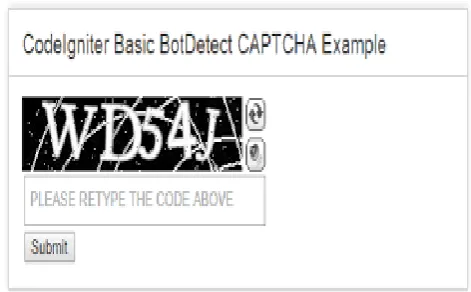
[image:2.595.39.266.283.646.2]241 Like Text CAPTCHA, where distorted alphanumeric letters are shown in an image and user needs to identify those letters. Flash games are often used in the form of CAPTCHA where user needs to play that game for successful submission of datasets. CAPTCHA increased the security of websites from various attacks and if it is used to generate the input credentials, then definitely it can enhance the security level that oppose from various attacks.
Fig. 1.2 Present System GUI
2. PROBLEM STATEMENTS
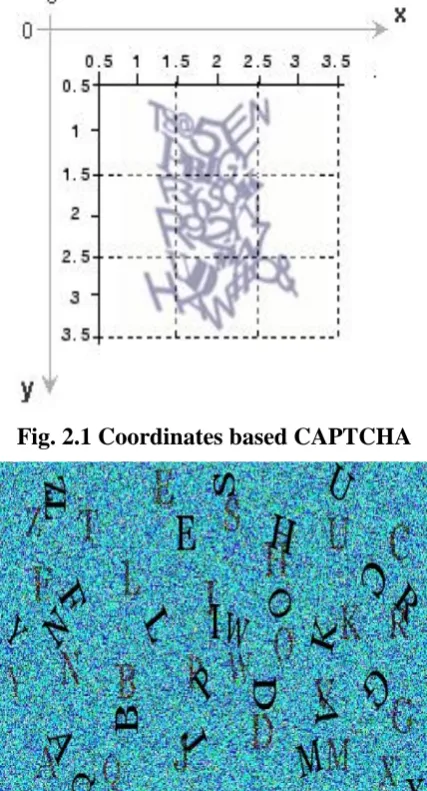
Existing systems are based on clicks over distorted letters which only can be recognized by human. But some attacks can affect the system by recognizing its representation of letters on behalf
of coordinate values.
[image:2.595.336.536.309.519.2]Some hard AI problems confuse users to recognize similar faces or sequence of faces and hard to remember at the time of login. A sequence of animal is often hard to remember for login authentication. We require a system which can secure the input credentials and password should be on user’s choice. This credential should be secured while registering or authenticating it at all. The previously proposed system is based on layers where each alphabet is a layer that reflects its value. If motion has been stopped then all layers become still or in a static position.
Fig. 2.1 Coordinates based CAPTCHA
[image:2.595.330.544.317.713.2]International Journal of Emerging Technology and Advanced Engineering
Website: www.ijetae.com (ISSN 2250-2459, ISO 9001:2008 Certified Journal, Volume 8, Issue 5, May 2018)
[image:3.595.51.266.128.521.2]242
Fig. 2.3 Replica Alphabets [7]
Fig. 2.4 Soley Edge Detection [7]
Soley Edge detection method can recognize edges through which layers will be highlighted and identified.
3. PROPOSED WORK
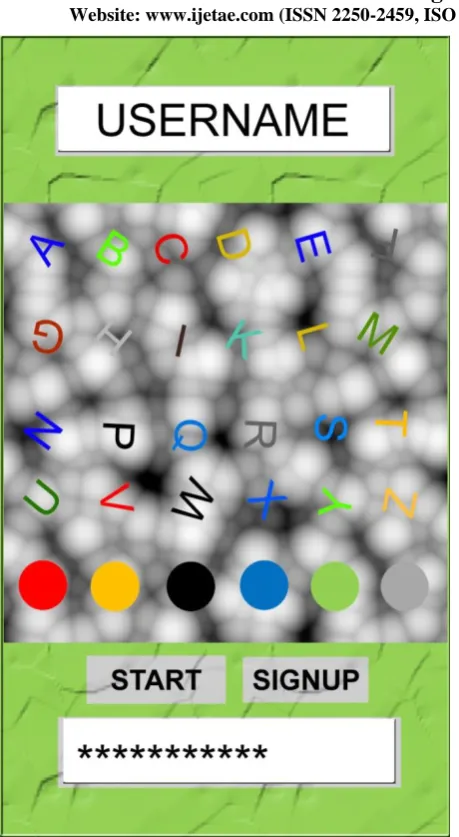
Due to the various flaws found in the prior developed technique, the proposed system is aimed to prevent authentication from different attacks by securing input credentials that can differentiate human and robots. Proposed method provides an Artificial Intelligence problem in the form of CAPTCHA through which valid pair of input credentials need to feed to authenticate particular web application. It stated that if a robot is not able to make any input then it is impossible to break the security threat of authentication. The
proposed system aimed to oppose machine fraudulent activities in the form of CAPTCHA. Developed system denies those inputs which are made through keyboard. Proposed technique operates in a form of virtual keyboard along with AI problems. In the proposed method, a CAPTCHA is appeared in the form of AI problem which is used to input the username and password to access the application. Following steps are required to solve the CAPTCHA and fill the credentials for authentication:
User will have to drag desired alphabets with the same color of circle.
After each selection the color of alphabets will get changed and the position will also get shuffled.
Colors appearances are not color sensitive where user will have to recognize identical color shades that cannot differentiate by bots. There are no co-ordinates values behind the
alphabets, which can be extracted by image processing.
Background is complex that cannot be easily understood by bots but possible to observe by human.
There is an intellectual efforts required at every selection where as present system is only based on clicks that return respective alphabets.
International Journal of Emerging Technology and Advanced Engineering
Website: www.ijetae.com (ISSN 2250-2459, ISO 9001:2008 Certified Journal, Volume 8, Issue 5, May 2018)
[image:4.595.46.276.117.536.2]243
Fig. 3.1 Proposed Work - Register Fig. 3.2 Proposed Work – Login 4. PROPOSED METHODOLOGY
[image:4.595.325.552.130.534.2]International Journal of Emerging Technology and Advanced Engineering
Website: www.ijetae.com (ISSN 2250-2459, ISO 9001:2008 Certified Journal, Volume 8, Issue 5, May 2018)
[image:5.595.50.376.160.766.2]244 select password from CAPTCHA and password field will be disabled that does not allow keyboard entries.
Fig. 4.1 Flow Chart for Enrollment
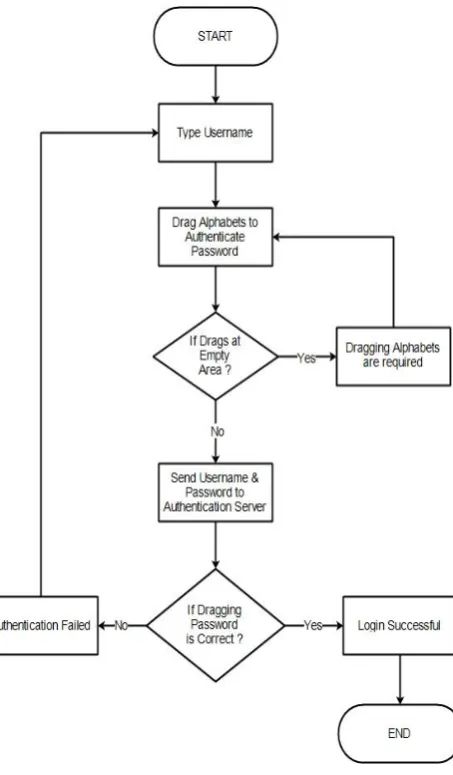
[image:5.595.326.553.285.673.2]As per the flow chart of enrollment, first of all user will choose username and a password will be selected through dragging alphabets to the target position or color. If drag is at the empty area or at wrong references or target then it will return invalid attempt and it will be continue till right selection has not been made. A combination of valid username and password send to the authenticating server.
Fig. 4.2 Flow Chart for Authentication
International Journal of Emerging Technology and Advanced Engineering
Website: www.ijetae.com (ISSN 2250-2459, ISO 9001:2008 Certified Journal, Volume 8, Issue 5, May 2018)
245
EGT (Enigma Game Theory) Algorithm -
Require: The target color set Cn, alphabets
position As, alphabets updated position Ac, target
position Cs, updated target position Cc, start button
Bn, alphabet An, current state s, steps m, target
object O, target position T, time t and non-target position n.
Input: Drag & Drop
Output: O (x, y) hits T (x, y) // x-axis, y-axis 1: Steps ← 0
2: t ← 0 // Seconds 3: Drag Objects ← False
4: //Check if start button clicked if Bn get clicked then
Drag Objects ← True 5: if Bn get clicked then
(t=0; t≤3; t++); // 3 minutes end if
6: if An(x, y) hits Cn(x, y) then // x, y axis
An.return ← true
else
An.return ← false
end else end if
7: while (t > 0) do
Drag Objects ← True end while
8: if t = 0 then As ← Ac
Cs ← Cc
end if 9: End
5. RESULT ANALYSIS
Users Un Time Taken t Failed Users Fu Successf ul Users Su
Password Length
U1 22 0 1 Moderate
U2 15 0 1 Weak
U3 19 0 1 Moderate
U4 29 0 1 Moderate
U5 35 0 1 Strong
U6 28 0 1 Weak
U7 45 0 1 Moderate
U8 40 0 1 Moderate
U9 19 0 1 Weak
U10 24 0 1 Weak
U11 49 0 1 Moderate
U12 43 0 1 Strong
U13 37 0 1 Weak
U14 - 1 - Failed
U15 47 0 1 Strong
U16 51 0 1 Strong
U17 18 0 1 Weak
U18 26 0 1 Moderate
U19 29 0 1 Moderate
U20 39 0 1 Moderate
U21 50 0 1 Strong
U22 22 0 1 Weak
U23 32 0 1 Moderate
U24 - 1 - Failed
U25 44 0 1 Strong
U26 51 0 1 Strong
U27 31 0 1 Weak
U28 41 0 1 Strong
U29 38 0 1 Strong
U30 29 0 1 Moderate
Total Un
μ (s) = 34.03
2 28 W – 8, M –
International Journal of Emerging Technology and Advanced Engineering
Website: www.ijetae.com (ISSN 2250-2459, ISO 9001:2008 Certified Journal, Volume 8, Issue 5, May 2018)
[image:7.595.29.270.167.340.2]246
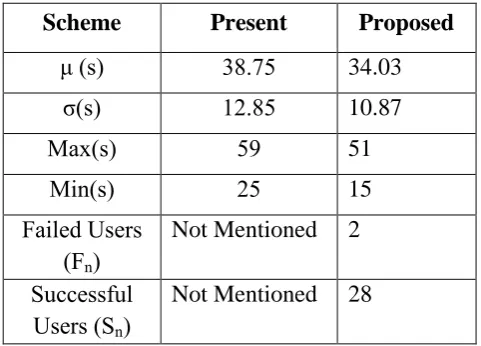
Table No. 5.1 Result Analysis
Scheme Present Proposed
μ (s) 38.75 34.03
σ(s) 12.85 10.87
Max(s) 59 51
Min(s) 25 15
Failed Users (Fn)
Not Mentioned 2
Successful Users (Sn)
Not Mentioned 28
Table No. 5.2 Result Comparison 6. CONCLUSION & FUTURE SCOPE
Thus the proposed work is able to secure the authentication system from machine based attacks that can break the data confidentiality. Attack is a programming loop that can attempt all possible stabs to break the authenticity of the system. Proposed system can deny these machine entries to getting registered and prohibits them during authentication. So, the proposed work overcomes the previously implemented problems that affect the security premises. The present systems get enhanced in future by turning it in hard AI problems which can only solved by human.
7. REFERENCES
[1] Captcha as Graphical Passwords—A New Security Primitive Based on Hard AI Problems proposed by Bin B. Zhu, Jeff Yan, Guanbo Bao, Maowei Yang, and Ning Xu in IEEE 2014.
[2] Click and Session Based—Captcha as Graphical Password Authentication Schemes for Smart Phone and Web proposed by Vikas K. Kolekar and Milindkumar B. Vaidya in 2015 on IEEE.
[3] Captcha As Graphical Passwords-Enhanced With Video-Based Captcha For Secure Services proposed by Anjitha K and Rijin I K in 2015 on IEEE.
[4] The Graphical Security System by using CaRP proposed by Pooja Jaiprakash Kulkarni and Dr. G. M. Malwatkar in 2015 IEEE.
[5] Captcha As Graphical Password For High Security proposed by Devina Vinod1, Anjana S.2 in 2015 of Global Journal of Advanced Engineering Technologies .
[6] Review Paper on Improved Security Using Captcha as Graphical Password proposed by Priyanka J. Charde, Prof. M. S. Khandare in 2016 IJSRSET.
![Fig. 2.3 Replica Alphabets [7]](https://thumb-us.123doks.com/thumbv2/123dok_us/8679202.874232/3.595.51.266.128.521/fig-replica-alphabets.webp)