International Journal of Emerging Technology and Advanced Engineering
Website: www.ijetae.com (ISSN 2250-2459, UGC Approved List of Recommended Journal, Volume 7, Issue 8, August 2017)499
A Comprehensive Review on Load Frequency Control
Deepesh Sharma, Naresh Kumar Yadav
Electrical Engineering Department
DCR University of Science & Technology, Murthal (Sonepat)
[email protected], [email protected]
Abstract— Load Frequency Control (LFC) was considered as a
significant and vital problem in power schemes. It is the most important demanding issue in various regions of interrelated power system. This paper presents a review on LFC that has been demonstrated in this part. The survey includes both the current and traditional control approaches to prevail over the various problems present in the LFC. The objective of this survey is to offer the different structural and control methods of LFC available in power system. This editorial moreover takes account of soft computing methods that are exploited by numerous researchers earlier in LFC system. At last, one of the current method is demonstrated, which is said to be the Lion Algorithm (LA).
Keywords—Load Frequency Control (LFC), Power System, Soft Computing methods, Lion Algorithm (LA).
I. INTRODUCTION
Usually, power system in various regions includes numerous organized areas. In the contemporary world, the production possessions of the power systems in various regions consist of dissimilar categories [14] [7]. Position of fossil fuels, natural resources, accessibility of tidal power and wind influences the position of production resources. Consequently, conservative sources and renewable sources are positioned far apart geologically. In appropriate functioning of power system, the requirement of power constantly remains elevated and accessible transmission lines were exploited to convey the power, and hence lines of transmission are functioned close to their thermal restrictions [15] [5]. As a result of the function of power system over the links of transmission consequences in fabrication of constant frequency oscillations in light of unexpected alteration in supply or requirement. Immediate transform in the consequent frequency deviation and insistence of load may cause faulty working in the relays of frequency, accordingly having an effect on the consistency of the power system [6]. The unexpected alteration in frequency of the system may perhaps have an effect on generator voltage constancy rather than tripping of relays in frequency, owing to a certain region of entire power system that might face pass out [8] [9]. As a result, the constancy of the system is governed by the auxiliary control called LFC and the crisis in the deviation of frequency is brought to a solution.
LFC is a basic component in power system process and control [10] [11]. LFC assists in modifying the output of real power from Generating Units (GUs) in interrelated power systems subsequent to a alteration in frequency of system and secure line power interactions contained by prearranged restrictions owing to the happening of immediate perturbation of load and irregular stipulations at anyplace in the network [12] [13]. The uninterrupted observation is required for the adequate contribution and continuous power. Consequently, LFC handles the crisis of distributing the insisted power to the load with oscillation at least transients [7].
International Journal of Emerging Technology and Advanced Engineering
Website: www.ijetae.com (ISSN 2250-2459, UGC Approved List of Recommended Journal, Volume 7, Issue 8, August 2017)500
II. NON-LINEARITIES IN LFC
Generation Rate Constraint: If there is any variation in the rate of producing power, there will be utmost restrictions. For instance, in thermal system, 0.1p.u per minute is measured as a GRC,
“i.e. ∆pg ≤ 0.1p.u.MW /min= 0.0017 p.u.MW /s”
“4.5% /s rate of generation is measured in case of hydro system”.
Dead Band: Governor Dead Band (GBD) is described as the entire magnitude of a constant speed variation included where there is lack of variations in the outcomes of valve locations. The repercussion nonload linearity has a propensity to generate a uninterrupted sinusoidal oscillation with usual duration of 2s. The velocity controlling dead band has major consequence on the dynamic concert of LFC system. Demonstrating the techniques of functions is employed to integrate the governor dead band non-linearity.
III. CONTROLLINGSCHEMES LFC methods may be categorized as classical governing process and soft computing methods.
Classical Control methods:
1) Linear Quadratic Regulator (LQR)
LQR dependent controlling method is focused with processing a dynamic system at least cost. The system dynamics are described by a group of linear differential formula, and the cost is explained by a quadratic function, known as the LQ crisis. The best control crisis for various linear variable systems with the quadratic measure is one among the usual crisis in linear system hypothesis.
2) Proportional Integral (PI) Controlling method
Along with a variety of kinds of LFC’s, the PI controller is extensively employed for velocity controlling system in LFC system. A significance of the PI control method is to decrease the error of steady-state to zero.
3) Proportional, Derivative, Integral (PID) Controlling method
A PID controller efforts to make accurate the error among a calculated value and a required value when prompting a remedial accomplishment that can regulate the method consequently and quickly, to maintain the least error. PID controller comprises of three individual factors, that is, derivative, proportional and integral. The proportional controller establishes the value depending on the faults when the integral controller eliminates the error in system’s steady state, and the derivative controller verifies the values depending on the rate by which the error has been varying [4].
The output of PID controller can be achieved by integrating the three factors [1]
4) Integral Controlling method
In this method, velocity variation setting can be accustomed mechanically by observing the deviation in frequency. The scheme performs based on an integral controller that offers the zero steady state error.
Soft-computing method:
1) Fuzzy Logic Control (FLC) scheme
FLC is modelled to reduce deviations in output of the system. Numerous tasks has previously been performed by means of FLC. FLC is modeled to eradicate the requirement for uninterrupted consideration of operator and utilized mechanically to regulate various variables in which the variable of the process is maintained with the value of reference. A FLC includes three parts that is, rule base, defuzzifier, and fuzzifier.
2) Artificial Neural Network
PID controller has predetermined constants for integral, derivative and proportional term. Throughout the transient state, the effect of controller could be able to carry out better distinction of the constants. ANN controller is adopted to establish this property. It is qualified with the data set to verify the PID controller terms.
3) Partial Swarm Optimization
PSO is assigned by a population of arbitrary solutions and possible solution is allotted with a randomized speed. Probable solutions said to be particles are subsequently “flown” during the space of issue. Every particle maintains the path of its coordinate that are related with the most excellent solution or robustness accomplished up to date. The widespread best value is called gbest and value of fitness is accumulated which is known as pbest. Therefore at every time, the particle varies its speed and shifts in the direction of its gbest and pbest. It is considered as the comprehensive description of PSO.
4) Genetic algorithm
International Journal of Emerging Technology and Advanced Engineering
Website: www.ijetae.com (ISSN 2250-2459, UGC Approved List of Recommended Journal, Volume 7, Issue 8, August 2017)501
IV. RELATED WORKS
In 2016, Sathya and Mohamed [3] have modeled the resources in various regions of power system with appropriate LFC by means of natural optimization depending on dual mode gain scheduling of fractional order proportional integral controllers (BBODMFOPI). As, the alternating method of the system was governed by three factors, the optimization based on BBO was adopted. In addition, the presentation of the scheme was improved with the dual concept mode. The simulation was performed in a bi-regional power system and the outcomes have confirmed that the steady state and transient response of the system were enhanced. Also with the help of the implemented technique, the system was autonomous to the deviation of the factors and robust in varied circumstances of functions.
In 2016, Nikmanesh et al. [4] have established the Multi-objective Uniform-diversity GA (MUGA) to manage the power system of LFC. Frequency of settling time, least ratio in damping of dominant Eigen values, Integral Time multiply Absolute Error (ITAE), and variation of tie- line were measured as the targeted function. The investigational outcomes were distinguished with a variety of traditional algorithms like BFOA-PSO BFOA, and NSGA-II to confirm the dominance of the implemented technique. At last, the outcome has demonstrated that the system robustness was augmented in varied alteration in factors. In addition, three different systems of hydro thermal were employed to comprise the nonlinearities and physical restrictions of power system.
In 2016, Shankar and Mukherjee [1] have introduced a met heuristic technique known as Harmony Search Algorithm (HSA) to manage the LFC of a particular region together with the bi-regional power system. The assigning of production jumping and memory of the technique was done by means of quasi antagonism depending on learning technique. The HSA optimization was extremely adopted for managing the best possible controller gains. Primarily, the transient concert of the system was estimated in power system of a particular region and endorses in bi-regional power system. Consequently, the simulation was performed in cooperation with AC- DC tie line and it has confirmed that the computation of the implemented technique in AC-DC tie line is better and improved than AC tie line.
In 2016, Dipayan et al. [2] have deployed the GWO technique to find out the issues of LFC of a bi-regional source of hydro, gas and thermal power plant systems. This technique has focused the GRC of the steam turbine for the simulation. The implemented GWO technique has deployed the ITAE dependent function for fitness for evaluating the gain.
In addition, efficiency of the GWO technique was investigated by distinguishing its presentation with various optimization techniques such as collection of crossover and mutation schemes, Comprehensive Learning PSO (CLPSO), and factors in Differential Evolution (DE) etc. Accordingly, the robustness of the implemented technique was augmented together with improved tuning capacity.
In 2016, Sukhwinder et al. [7] have suggested the hybrid heuristic technique that includes the Bacterial Foraging Algorithm (BFA) and PSO algorithms to manage the LFC of the large interrelated systems of power. The alleviation of the scheme beneath the oscillations of frequency was measured in this research. The investigational outcomes of the implemented algorithm have offered the method with improved damping concert together with the quick improvement in low frequency oscillation.
V. LITERATURE SURVEY
The literature review demonstrating the characteristics and limitations of the optimization techniques are revealed in Table 1.
Table 1: Features and challenges optimization techniques for enhancing LFC of power system
Author [Citation]
Adopted Methodology
Features Challenges
Sathya and Mohamed [1]
Biogeography optimization
Enhanced steady state and transient response
Less responsive to the disparity of the factor of the system
Vigorous to dissimilar functioning conditions
Poor in utilizing the solution
Production of infeasible solution
No condition for choosing the most excellent solution
Nikmanesh et al. [2]
Multi-Objective Uniform-Diversity Genetic Algorithm
Robust under varied factor change
Happening of perturbation
Complicate d to prefer the optimum weight Shankar
and Mukherjee [3]
Harmony Search Algorithm
Manages the optimal gain
Develops the stability margin and
Less precision
Less speed of
International Journal of Emerging Technology and Advanced Engineering
Website: www.ijetae.com (ISSN 2250-2459, UGC Approved List of Recommended Journal, Volume 7, Issue 8, August 2017)502
dynamic performance Dipayan et
al. [4]
Grey Wolf Optimization
Augmented robustness
Improved tuning potential
Dynamics of the system are not enhanced under concerned condition Sukhwinde
r et al. [5]
Bacterial foraging algorithm and Particle swarm optimization
Improved damping performance
Fast alleviation of the system
Slow convergence in sophisticate d explore stage
Propensity to a quick and hasty convergence in most favourable points
It exposes the significance of varied optimization techniques for enhancing the LFC of power systems in various regions. Such optimization techniques comprise BBODMFOPI [3], BFA [14] GWO [2], MUGA [4] and HSA [1] through which the benefits of the mentioned techniques were detailed in the novel. Nevertheless, these techniques require important developments to manage certain confronts. The major disadvantage in the development of LFC in power systems of various regions comprise production of in appropriate solution [3], reason of interruption [4], utilization error of the solution[5], reduced speed of convergence [1] less enhancement in dynamics [2], etc. The current techniques as detailed in the novel were carried out successfully, however it does not prevail over certain disadvantages as revealed earlier. Consequently, an enhanced technique is supposed to be simulated to face the forthcoming limitations that lie under the power system in various regions or various resources for improving the LFC.
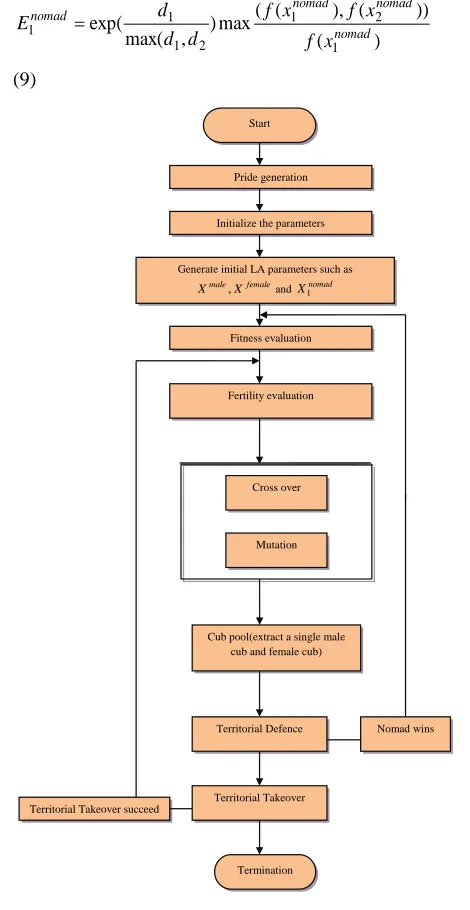
LION ALGORITHM
The LA explores for most excellent gain depending on the behaviour of social lion that is territorial defence and protective invasion. In territorial defence, the pride is acquired by the nomads that are random solutions, only when the nomads are well than the pride. In protective invasion
procedure, the efficient solutions exceeds beyond the previous solutions, if the previous solutions are weaker than the modernized solutions.
The fundamental configuration of LA comprises of four chief mechanisms, explicitly, (a) creation of pride (b) Mating, in which the novel solutions are obtained, (c) protective defence and (d) protective invasion. These four mechanisms are exploited to optimize the controller and to obtain the necessary controller.
Creation of pride: This process is considered
asX female,Xmale,X1nomad in which Xmale and Xfemale
generate pride. The gain of controller is the pride that are assigned asGp,Gi, i.e.
p i
female male
G G X
X .
Estimation of fitness: In this process, the fitness
ofX female, X1nomad and Xmale are explained by means of the presentation index as given in Eq. (1) and are indicated as f(X female), f(X1nomad)andf(Xmale).
f p dtJ
t
ij tieline i
0
2
2 ( )
)
( (1)
Where, Jdenotes the performance index.
For the given steps, assign f(Xmale) fref and 0 g
N ,
in which, Ng is indicated as production counter that are
adopted to check the finalizing condition.
Assessment of fertility: This process [32] measures and offers the constructiveness of the defensive lion and lioness. The assessing process of fertility also produces an efficient female lion, denoted as Xfemale that are achieved by means of Eq. (2), in which the arbitrary integer is represented by k.
female k
x and xlfemale are the kthandlth constituents of
female
X . From Eq. (4), the expression indicates the modified female and r1, r2 are indicated as arbitrary integers.
otherwise x
k l if x
X
female female k female
; ;
1
(2)
,max( , )
min kmax kmin k
female
k x x
X (3)
kfemale (0.12 0.05)( kmale 1 kfemale)
k x r x rx
International Journal of Emerging Technology and Advanced Engineering
Website: www.ijetae.com (ISSN 2250-2459, UGC Approved List of Recommended Journal, Volume 7, Issue 8, August 2017)503 Mating: In this technique, most excellent solution are obtained from the conventional solutions. The procedure comprises of two initial processes known as, mutation and cross over. According to the process of crossover, four cubs, namelyXcubs are produced and every cub is produced depending on evenly disseminated arbitrary crossover probabilityCr.
The Eq. (5) demonstrates the numerical representation of cross over process as specified in Eq. (5), where, the crossover mask is given by B, and the one's complement ofBis denoted by B.
female p
male p cubs
X B X B p
X ( ) (5)
The Xcubs are provided to consistent mutation rate of
r
M . The corresponding amounts of new cubs Xneware produced from the process of mutation. The subsequent pace is femininity clustering where the female cubX f_cub and male cub Xm_cub are taken out depending on the first and second optimal fitness of Xnew, correspondingly.
Once the female cubX f_cub and male cubXm_cub are chosen, their agesAcubare adjusted to zero.
Function of Cub development: In this process
cub m
X _ and Xf_cubare moved towards to consistent arbitrary mutation withGr. It restores the previous cubs if the mutated
cub is physically powerful, and the years Acub of new cubs are enhanced at each update individually.
Protective defence: The protective defence is organized for generating the nomad union subsequent to the endurance struggle, nomad and pride union modifications. This is mostly dependent on the capability of subsequentXnomad. The endearing nomad is chosen depending on the given criteria as in Eq. (6), Eq. (7) and Eq. (8).
) ( )
(Xe_nomad f Xmale
f (6)
) (
)
(Xe_nomad f Xm_cub
f (7)
) (
)
(Xe_nomad f X f_cub
f (8)
When Xmale is beaten in the protective defence, the pride is modified by substituting Xmale along with Xe_nomad to prevail over the nomad union. It is moreover updated by choosing a particularXnomad. This procedure chooses
nomad
X1 if
nomad
E
e 1 is satisfied, otherwise, it may
chooseX2nomadand the exponential of unity is indicated bye.
The parameter E1nomad is given by Eq. (9) in which d2andd1 represents the Euclidean distance among the pair
) , ( 2
male nomad
X
X and ( 1 , )
male nomad
X
X correspondingly. If the
outcome of the defence is said to be zero, f(Xmale) and
male
X are accumulated and the procedure is recurred from assessment of fertility.
) (
)) ( ), ( ( max ) , max( exp(
1 2 1
2 1 1
1 nomad
nomad nomad
nomad
x f
x f x f d
d d
E
[image:5.612.332.567.228.683.2](9)
Fig. 1: Overall process in Lion Algorithm
Start
Pride generation
Initialize the parameters
Generate initial LA parameters such as female
male X
X , and X1nomad
Fitness evaluation
Cub pool(extract a single male cub and female cub)
Territorial Defence
Territorial Takeover
Termination Fertility evaluation
Cross over
Mutation
Nomad wins
International Journal of Emerging Technology and Advanced Engineering
Website: www.ijetae.com (ISSN 2250-2459, UGC Approved List of Recommended Journal, Volume 7, Issue 8, August 2017)504 Protective invasion: This procedure occurs only if the condition Amax Acub is fulfilled or else it may continue the
procedure from the function of cub development. This procedure provides province to the Xf_cubandXm_cub after they mature and enlarge into more powerful thanXfemaleandXmale.
Termination measure: The termination measure is the concluding phase of this technique. When the procedure gets over f(Xmale)andXmale is accumulated. Fertility assessment
is continued if the condition Nfmax Nf is not fulfilled, in which the greatest number of function evaluations is given by
max f
N and Nfis indicated as figure of function assessments.
VI. CONCLUSION
LFC has been a significant measurement of power system and it is a command of nowadays. Modifying the frequency and following the variations in orders of load are the major aims of LFC. Tie-line power variations can be managed to particular values by means of certain LFC techniques. This paper has contributed certain prose of pre-deregulation state in the area of LFC and has contributed certain significant improvements that are well sufficient in current deregulated state. It is considered that this research will offer a important resource to enthusiastic persons who are performing researchers in this significant area.
References
1. G. Shankar and V. Mukherjee, “Quasi oppositional harmony search algorithm based controller tuning for load frequency control of multi-source multi-area power system”, Electrical Power & Energy Systems, vol. 75, pp. 289-302, February 2016.
2. Dipayan Guha, Provas Kumar Roy and Subrata Banerjee, “Load frequency control of interconnected power system using grey wolf optimization”, Swarm and Evolutionary Computation, vol. 27, pp. 97-115, April 2016
3. M.R. Sathya and M. Mohamed Thameem Ansari, “Design of biogeography optimization based dual mode gain scheduling of fractional order PI load frequency controllers for multi source interconnected power systems”, Electrical Power & Energy Systems, vol. 83, pp. 364-381, December 2016.
4. E. Nikmanesh, O. Hariri, H. Shams and M. Fasihozaman, “Pareto design of Load Frequency Control for interconnected power systems based on multi-objective uniform diversity genetic algorithm (MUGA)”, Electrical Power & Energy Systems, vol. 80, pp. 333-346, September 2016.
5. Y. Mi, Y. Fu, C. Wang and P. Wang, “Decentralized Sliding Mode Load Frequency Control for Multi-Area Power Systems”, IEEE Transactions on Power Systems, vol. 28, no. 4, pp. 4301-4309, Nov. 2013.
6. M. A. Abdel-Halim, G. S. Christensen and D. H. Kelly, “Optimum load frequency control of multi-area interconnected power systems”, Canadian Electrical Engineering Journal, vol. 10, no. 1, pp. 32-39, Jan. 1985.
7. Sukhwinder Singh Dhillon, J. S. Lather and S. Marwaha, “Multi objective load frequency control using hybrid bacterial foraging and particle swarm optimized PI controller”, Electrical Power & Energy Systems, vol. 79, pp. 196-209, July 2016.
8. Dipayan Guha, Provas Kumar Roy and Subrata Banerjee, “Load frequency control of large scale power system using quasi-oppositional grey wolf optimization algorithm”, Engineering Science and Technology, July 2016.
9. K. Naidu, H. Mokhlis, and A.H.A. Bakar, “Multi-objective optimization using weighted sum Artificial Bee Colony algorithm for Load Frequency Control”, Electrical Power & Energy Systems, vol. 55, pp. 657-667, February 2014.
10. Jin Gou, Wang-Ping, GuoCheng Wang and Wei Luo, “A multi-strategy improved particle swarm optimization algorithm and its application to identifying uncorrelated multi-source load in the frequency domain”, Neural Computing and Applications, pp.1-22, 2016.
11. Dipayan Guha, Provas Kumar Roy and Subrata Banerjee, “Application of backtracking search algorithm in load frequency control of multi-area interconnected power system”, Ain Shams Engineering Journal, February 2016.
12. Marimuthu Ponnusamy, Basavaraja Banakara, Subhransu Sekhar Dash and Moorthy Veerasamy, “Design of integral controller for Load Frequency Control of Static Synchronous Series Compensator and Capacitive Energy Source based multi area system consisting of diverse sources of generation employing Imperialistic Competition Algorithm”, Electrical Power & Energy Systems, vol. 73, pp. 863-871, December 2015.
13. M. Elsisi, M. Soliman, M.A.S. Aboelela and W. Mansour, “Bat inspired algorithm based optimal design of model predictive load frequency control”, Electrical Power & Energy Systems, vol. 83, pp. 426-433, December 2016.
14. Mohammad Hassan Khooban and Taher Niknam, “A new intelligent online fuzzy tuning approach for multi-area load frequency control: Self Adaptive Modified Bat Algorithm”, Electrical Power & Energy Systems, vol. 71, pp. 254-261, October 2015.
15. H. A. Yousef, K. AL-Kharusi, M. H. Albadi and N. Hosseinzadeh, “Load Frequency Control of a Multi-Area Power System: An Adaptive Fuzzy Logic Approach”, IEEE Transactions on Power Systems, vol. 29, no. 4, pp. 1822-1830, July 2014.
16. B. R. Rajakumar, “Lion algorithm for standard and large scale bilinear system identification: A global optimization based on Lion's social behavior”, 2014 IEEE Congress on Evolutionary Computation (CEC), pp. 2116-2123, 2014.
Article History:
Received 25th June, 2017 Received in revised form 06thJuly, 2017