4239
THE IMPACT OF FACILITY, SOCIAL MEDIA AND
LEARNING MATERIAL ON STUDENT ENGAGEMENT
MASTER IN TECHNOLOGY ONLINE STUDENT IN
INDONESIA
1LINDA W, 2SFENRIANTO
12Information Systems Management Department, BINUS Graduate Program – Master of Information
Systems Management, Bina Nusantara University, Jakarta, Indonesia 11480 E-mail: 1[email protected], 2[email protected]
ABSTRACT
The importance of knowing the factors that affect Student Engagement is required in Online Learning in Indonesia because if the Online Master Student has a good Student Engagement in the place where they study it will create a successful study in line with expectations, have a good student engagement is mean student can enjoy study in they place. Factors that can improve the Student Engagement of Online Master Learning students can come from the facilities provided in the Learning Management System, the material provided and also comes from Social Media that can not be separated from the people of today. Some problems are found in a student who does not achieve a GPA that has been established Online Learning providers and the level of student satisfaction with LMS is lacking. So this study aims to determine the influence of factors related to Student Engagement Online Learning students that can be improved by Online Learning in Indonesia, so as to improve the condition of the problems that occur.
Keywords: Online Learning, Student Engagement, Learning Management System, Social Media
1. INTRODUCTION
Education is important for the people of Indonesia today, where education is a means for the community to pursue education that will provide educational learning, thus the education will help the community to achieve higher education level as well as learning to shape the character of society so that can understand the norms that apply in the environment where he lived. Education can be reached by the community is divided into 3 types of formal education, non-formal education and informal education, where the formal education of the community get a structured and tiered education path as in general the community can take basic education as in elementary school, secondary education as well as higher education including diplomas, scholars, masters, to specialist experts, non-formal education is education outside the formal but still has a structure and also structured, and the last type of education is the informal education that people get from learning or education of their families and the environment from the community itself [1].
Education in Indonesia is increasing from year to year from since 1999 it can be concluded that the people of Indonesia began to realize the importance of education including master's education [2].
4240 In implementing distance education learning there are strategies and dimensions of factors for the success of the study period and the success of getting good grades for students such as from the use of technology skills, facilities / tools Online Learning providers themselves, the ability and the way of students in doing online learning, and also the skills, goals and objectives of the students at the time of online class taking that can impact on learning motivation, student lifestyle, individual character[4] as well as other components of learning methods undertaken by students[5]
The way in which the environment of an Online Learning can make students have a success factor of study and produce good grades and also increase the satisfaction of the learner is to create a student engagement with his students through various ways as found from previous studies of learning management facilities system owned by the university or from Online Learning provider of student learning that can be seen from the quality of learning materials, easy accessing of learning materials by students, where students see learning outcomes, as well as facilities supporting the learning of the university as an indirect discussion with teachers (discussion forums, student-accessible tasks and feedback from teachers) or media for live discussion (video conferencing or other communication media) that can measure student interactions and make students have the motivation, interest and desire to make the process of success of learning so that it can be called by students have a student engagement with the learning media[6],[7],[8],[9]
The use of social media is very rapidly growing today, social media is not only a social network, but social media can now be used as a supporting media for learning for E-Learning, not as a substitute for E-Learning because social media has a medium for dissemination media information related to learning, media so that students can interact with fellow students and with teachers, in previous research social media proved as a practical medium to be applied as a medium of learning that can improve student engagement, E-Learning can also be combined with social media as a medium of learning informal because of some things in a profitable social media that allows students to make students can communicate in real-time and also user-friendly[10],[11].
So that will be researched research to help Online Learning in Indonesia who has majoring Master in Technology to evaluate factors that can be increase student engagement for them Online Master Student because found from result of questionnaire
that obtained is student satisfaction still less than 80%, which is where 80% is the achievement of desired quality and also average the average achievement of GPA Online Master in Technology Student still below 3.00 out 4.00, so it needs to do research things that can improve student engagement which will affect student satisfaction and also student achievement besides from side of Learning Management System also researcher want to know whether social media students can become a supporting medium of Online Learning in Indonesia to improve student engagement so that students can graduate with good, qualified and satisfied achievement on learning in Indonesia major for Master in Technology major.
From the background description that has been put forward, then the problems to be discussed by researchers are as follows:
Q1 : How is the influence of students' material on student engagement Online Master in Technology Student?
Q2 : How is the influence of students' facility in Learning Management System on student engagement Online Master in Technology Student?
Q3 : How is the influence of students' social media usage on student engagement Online Master in Technology Student?
2. LITERATURE REVIEW 2.1 Learning Management System
A learning system that provides for the needs of well-designed learners and easy navigation for learning activities, rules and management for learning using information technology [12].Learning Management System has a feature that is divided into 3 namely from the learner, supporters and technical features. Learning features include communication (discussion forum, internal email, real time chat, video service), for productivity (bookmarks, help, search in course, calendar / review progress, synchronization work), and learner involvement in LMS (teamwork, self-assessment, student community building, learner portfolio). Supporting features such as for administration, delivery of materials, as well as curriculum design (including content, templates, etc.). In terms of LMS technical specifications in the form of hardware / software and also pricing / license [13]
2.2 Student Engagement
4241 interaction with the teacher and also create a
comfortable environment for the learner so as to make the learner active learning online [15]. To create an engagement on the learner it is necessary to facilitate a system with a more personalized design, has a good design aesthetics for the learner and also the navigation system easy to use by the learner, because the learner will feel having a good relationship with the system when the learner has an interest long in system usage[16]
2.3 Social Media as Student Engagement Social Media allows users to create a community to create something, collaborate and also change the content of their own users, by utilizing the latest features of web 2.0 then users can also create other users as contributors by providing comments, searching for information and tagging [17].
Social Media can be used by users to collaborate with each other and also share information that can be used for learners in an academic purpose to improve a student engagement and social media can be used to facilitate a better learning process, with the use of social media as a medium of learning, the learner inter-connected between social media network it will feel connected with other learners, improve liaison between learners so that learners can also be triggered to participate [18].
3. METHOD
Framework for thinking in this research is divided into 4 activities as follows:
1. Determining Research
In determining this research activity is where done background making problems faced by object of research, formulate problem and also conducted analysis condition related to problem which want to be studied. In doing background research problems will be done by searching literature studies from related journal sources, then do the formulation of the problem and make direct observation of the data obtained from Online Learning in Indonesia who has majoring Master in Technology which divided into Master Information Technology and Master Information System.
2. Designing Research
The design of the research will be done by making a hypothesis of the formulation of research problems conducted, complete the study of literature sourced from journals and scientific papers for variables that affect student engagement from Online Learning student to be used for research,
analyze each variable that has been determined by describing the research indicators for these variables.
3. Doing Research
In conducting the research, the population will be determined from the research that is determining the population of the active students for the Master in Online Learning which will then be determined the number of samples from the student population, compile questionnaire question from predetermined indicator when conducting the research design, test reliability and validity questionnaires using Cronbach Alpha and AVE, after the questionnaire is said to be valid and reliable it will be distributed questionnaires, then perform data collection from questionnaires distributed to sample research, from the questionnaire will be calculated by using Partial Least Square Structural Equation Modeling method and the results of the research hypothesis testing are accepted or rejected.
4. Describe Research
In describing the research will be presented the results of research that has been done then will be made conclusions from research and suggestions for further research.
There are 2 types of variables used in this study that is Independent Variable and Dependent Variable.
1. Independent Variable
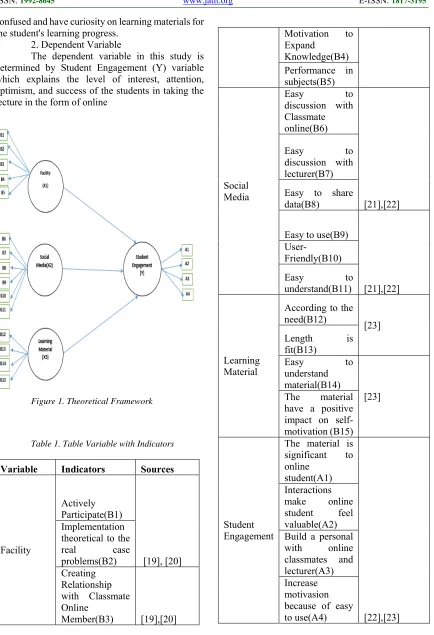
In this research will be reviewed some facilities provided by Online Learning in Indonesia in Facility (X1), social media (X2) as an active learning alternative for students outside Learning Management System Online Learning in Indoenesia and material related to student’s learning about in Learning Material (X3), .
Variable X1 explains where the activities performed by students while doing lectures such as posting in forums, attending video conference with lecturers and classmates, work on tasks to enrich teaching materials so as to make the students feel enriched of their knowledge which resulted in the students' college students increasingly interested in the subject, the more curious, the spirit and optimism provided by Online Learning in Indonesia’s facility. Variable X2 explains how social media can help students to facilitate flexible communication with the intensity of these students do group work, sharing of materials between learners so as to increase knowledge for progress and that is learned by the students
4242 confused and have curiosity on learning materials for the student's learning progress.
2. Dependent Variable
[image:4.612.95.529.78.713.2]The dependent variable in this study is determined by Student Engagement (Y) variable which explains the level of interest, attention, optimism, and success of the students in taking the lecture in the form of online
[image:4.612.93.299.204.468.2]Figure 1. Theoretical Framework
Table 1. Table Variable with Indicators
Variable Indicators Sources
Facility
Actively Participate(B1)
[19], [20] Implementation
theoretical to the
real case
problems(B2) Creating Relationship with Classmate Online
Member(B3) [19],[20]
Motivation to Expand
Knowledge(B4) Performance in subjects(B5)
Social Media
Easy to
discussion with Classmate online(B6)
[21],[22]
Easy to
discussion with lecturer(B7)
Easy to share data(B8)
Easy to use(B9)
[21],[22]
User-Friendly(B10)
Easy to
understand(B11)
Learning Material
According to the
need(B12) [23]
Length is
fit(B13)
Easy to
understand material(B14)
[23] The material have a positive impact on self-motivation (B15)
Student Engagement
The material is significant to online
student(A1)
[22],[23] Interactions
4243 Based on the theoretical framework that has been made then the order of hypothesis is as follows:
‐ Ho1 = Student Activity has no influence on Student Engagement
‐ Ha1 = Student Activity has influence on Student Engagement
‐ Ho2 = Social Media has no influence on Student Engagement.
‐ Ha2 = Social Media has influence on Student Engagement
‐ Ho3 = Learning Material has no influence on Student Engagement
‐ Ha3 = Learning Material has influence on Student Engagement
The population for this study is the students of Online Learning in Indonesia active or not yet graduation who have majoring Master Information Technology and majoring Master Information System.
With the total population of active students majors Master Information Technology as many as 334 students and student majors Master Information System as many as 441 students. Sampling technique used is probability sampling technique that is simple random sampling method with sampling using Yamane/Slovin technique from the journal of Sampling Technique and Determination of Sample Size in Applied Statistics Research: An Overview [24].
‐
n
‐ Information :
‐ n = sample size
‐ N = total population is 775 online student ‐ E = is the percentage of errors tolerated in
sampling there is 10% for tolerated.
so
n
. = 88.57 / 89 OnlineStudent
the sample to be used is a minimum of 89 students, to anticipate inaccurate data then the researchers took 100 students.
4. RESULT AND DISCUSSION
Respondents in this study were enrolled students active in lectures Online Master Student who has majoring in Master of Informatics and Master of Information Systems Management. Questionnaires made using Google Form were distributed to 440 respondents randomly via email
on 18 - 27 September 2017. The results of reciprocity there are 103 respondents who fill out the questionnaire and 100 respondents is completely in the filling questionnaire.
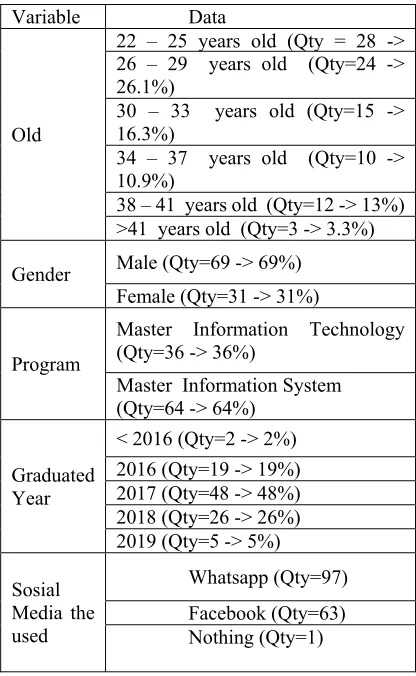
[image:5.612.314.522.235.573.2]Characteristics of respondents are described based on the program study, gender, graduated year student, age, and social media used by the respondents. Here is a table 2 that explains that respondent's characteristics.
Table 2. Characteristic Respondent
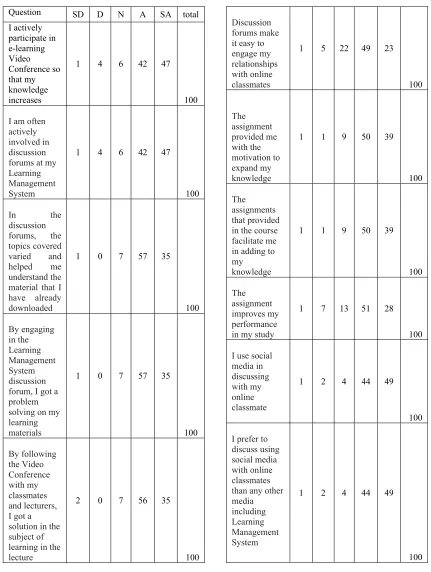
There’s summary respondent answer question at questionnaire. 5 answers that can be choose by respondent are SA is Strongly Agree, A is Agree, N is Neutral, D is Disagree and SD is Strongly Disagree.
Variable Data
Old
22 – 25 years old (Qty = 28 -> 26 – 29 years old (Qty=24 -> 26.1%)
30 – 33 years old (Qty=15 -> 16.3%)
34 – 37 years old (Qty=10 -> 10.9%)
38 – 41 years old (Qty=12 -> 13%) >41 years old (Qty=3 -> 3.3%)
Gender Male (Qty=69 -> 69%) Female (Qty=31 -> 31%)
Program
Master Information Technology (Qty=36 -> 36%)
Master Information System (Qty=64 -> 64%)
Graduated Year
< 2016 (Qty=2 -> 2%) 2016 (Qty=19 -> 19%) 2017 (Qty=48 -> 48%) 2018 (Qty=26 -> 26%) 2019 (Qty=5 -> 5%)
Sosial Media the used
4244 Table 3. Summary Respondent Answer
Question SD D N A SA total I actively
participate in e-learning Video Conference so that my knowledge increases
1 4 6 42 47
100
I am often actively involved in discussion forums at my Learning Management System
1 4 6 42 47
100
In the
discussion forums, the topics covered
varied and
helped me
understand the material that I have already downloaded
1 0 7 57 35
100
By engaging in the Learning Management System discussion forum, I got a problem solving on my learning materials
1 0 7 57 35
100
By following the Video Conference with my classmates and lecturers, I got a solution in the subject of learning in the lecture
2 0 7 56 35
100
Discussion forums make it easy to engage my relationships with online classmates
1 5 22 49 23
100
The assignment provided me with the motivation to expand my knowledge
1 1 9 50 39
100
The assignments that provided in the course facilitate me in adding to my knowledge
1 1 9 50 39
100
The assignment improves my performance in my study
1 7 13 51 28
100
I use social media in discussing with my online classmate
1 2 4 44 49
100
I prefer to discuss using social media with online classmates than any other media including Learning Management System
1 2 4 44 49
4245
I find it easier to discuss with my classmates online when using social media
1 2 4 44 49
100
I use social media in discussions with lecturers
1 4 25 60 10
100
I prefer to discuss using social media with lecturers than other media including LMS
1 4 25 60 10
100
I find it easier to discuss with lecturers when using social media
1 4 25 60 10
100
Social media makes it easy for me to share (upload) learning materials to online classmates
0 4 17 44 35
100
Social media facilitate the lecturer in sharing or upload learning materials to me
0 4 17 44 35
100
Social media is easy to use
1 3 12 46 38 100 Social media
is easy to
understand 1 1 15 35 38 90
The length of the material on the lecture notes matches with our need
2 2 25 56 15
100
The length of the
material/total slide on the presentation material is in accordance with the needs
2 2 25 56 15
100
The length of the material on the lecture notes is fit (not too long and not too short)
2 4 24 57 13
100
The material length or total slide in the presentation material is fit
2 4 24 57 13
100 Lecture notes
and powerpoint
which is given allows me to understand the course material
1 1 21 53 24
100
Supporting materials provided facilitate me in
understanding the course material
1 1 21 53 24
100
The lecture notes and ppt given gave a positive impact on my motivation in college
1 1 17 59 22
100
Supporting the material provided has a positive impact on my motivation in college
1 1 17 59 22
100
I feel that I need to read the learning materials
1 0 2 53 44
4246
I feel reading the learning material is important
1 0 2 53 44
100
I feel my opinion is considered by friends and lecturers in discussion forums
1 0 15 62 22
100
My interactions with my classmates and lecturers made me feel valuable (both in forum and social media)
1 0 16 61 22
100
The facilities provided me to build a personal relationship with classmates
1 0 10 65 24
100
The facilities provided me to build a personal relationship with lecturers
1 0 10 65 24
100
The social media provide me to build personal relationships with classmates
1 0 10 65 24
100
The social media provide me to build personal relationships with lecturers
1 0 10 65 24
100
My motivation increased with the ease of accessing the material
1 0 3 71 25
100
My motivation increased with the ease of discussion through the facilities provided
1 0 3 71 25
100
My motivation increased with the ease of discussion through social media
1 0 3 71 25
100
4.1 CompositeReliability
Composite Reliability is an alternative to Cronbach's Alpha to assess whether a variable is reliable. A variable can be said to be acceptable, consistent and reliable when it meets the range of values for composite reliability and cronbach's alpha is as follows:
When the value of composite reliability / cronbach's alpha > 0.8 then the indicator can be said very well and composite reliability / cronbach's alpha.
When the value of composite reliability / cronbach's alpha> = 0.7 then the indicator can be said well and composite reliability / cronbach's alpha.
When the value of composite reliability / cronbach's alpha> = 0.6 then the indicator can be said to be still acceptable but needs further research and still comply with the composite reliability / cronbach's alpha.
If the value of composite reliability / cronbach's alpha <0.6 then the indicator is said not meet the composite reliability / cronbach's alpha [25], [26]
Table 4. Result of Reliability Test Variabel Cronbach’s
Alpha
Composite Reliability
Facility 0.819 0.874
Social
Media 0.867 0.909
Learning Material
0.857 0.896
Student
4247 It can be concluded from the results of reliability testing based on data processing using SmartPLS application from Table 3 where Facility variable has Cronbach's Alpha value of 0.819 and Composite Reliability value of 0.874, Social Media variable has Cronbach's Alpha value of 0.867 and Composite Reliability of 0.909, Learning variable The material has Cronbach's Alpha value of 0.857 and the value of Composite Reliability of 0.896, Student Engagement variable has Cronbach's Alpha value of 0.859 and Composite Reliability value of 0.904 so that from the values described it can be said that all the results of the value of each variable is good / reliable and meet requirement because overall value> 0.7.
Table 5. Summary Result of Reliability Test
Variable Summary
Facility Reliable
Social Media Reliable
Learning Material Reliable Student Engagement Reliable
4.2 Outer Loadings
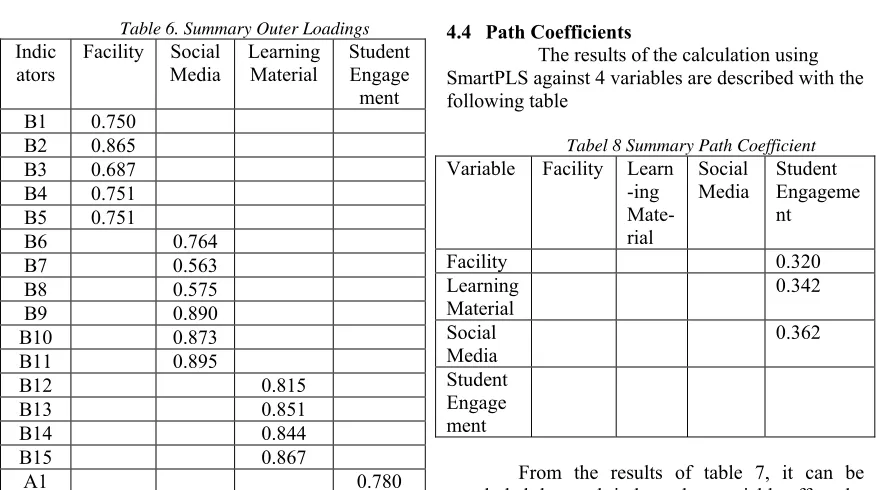
Is the values (factor loadings) for the indicators can be said to be valid whether or not from the data questionnaire that has been filled by the respondents. An indicator can be said to be valid if it meets the following values:
‐ Value > 0,5 is mean indicators is eligible or valid.
‐ Value < 0,5 is mean indicators is not
[image:9.612.324.511.319.408.2]eligible or not valid[26]
Table 6. Summary Outer Loadings Indic
ators
Facility Social Media Learning Material Student Engage ment B1 0.750
B2 0.865 B3 0.687 B4 0.751 B5 0.751
B6 0.764
B7 0.563
B8 0.575
B9 0.890
B10 0.873
B11 0.895
B12 0.815
B13 0.851
B14 0.844
B15 0.867
A1 0.780
A2 0.857
A3 0.856
A4 0.858
4.3 Average Variance Extracted
Used to perform convergent and divergence tests of validity, which reflect the mean correlation between latent variables within a reflective model. The values that are said to qualify for subsequent tests are as follows
AVE > 0.5 is mean the indicators is eligible or qualify.
AVE < 0.5 is mean the indicators is not eligible or not qualify, then table 6 describes the results of data processing of each variable for the Average Variance Extracted value.
Table 7 Summary of Result AVE
Variable Average Variance
Extracted (AVE)
Facility 0.583
Social Media 0.713
Learning Material 0.598 Student
Engagement 0.703
After evaluating the measurements of the variables and being considered reliable, valid, qualified and
having correlation between variables, the next step is to evaluate the structural model with Path Coefficients
4.4 Path Coefficients
The results of the calculation using SmartPLS against 4 variables are described with the following table
Tabel 8 Summary Path Coefficient Variable Facility Learn
-ing Mate-rial
Social
Media Student Engageme nt
Facility 0.320
Learning
Material 0.342
Social
Media 0.362
Student Engage ment
[image:9.612.90.528.478.723.2]
4248 dependent variable with the variable value Facility affect the Student Engagement variable of 0.320, the Learning Material variable affects the Student Engagement variable of 0.342 and Social Media variable affects the Student Engagement variable of 0.362
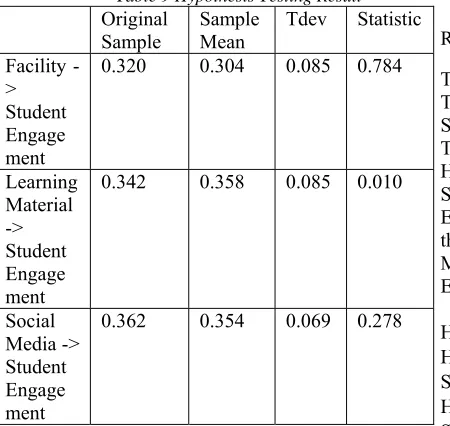
[image:10.612.93.318.239.452.2]In the result of data processing in this research to test the hypothesis will using Tvalue and Tstatistics which can be seen from the following table8
Table 9 Hypothesis Testing Result Original
Sample Sample Mean Tdev Statistic Facility
-> Student Engage ment
0.320 0.304 0.085 0.784
Learning Material -> Student Engage ment
0.342 0.358 0.085 0.010
Social Media -> Student Engage ment
0.362 0.354 0.069 0.278
From table 8 can be intrepreted result of hypothesis testing as follow :
Hypothesis 1 :
Ho : Facility has no influence on student Student Engagement
Ha : Facility has influence on student Student Engagement
Decision Making :
Tvalue > TStatistic, Accepted Ho, Rejected Ha Tvalue < TStatistic, Rejected Ho, Accepted Ha
Result :
Tvalue = 1.960 TStatistic = 3.784 Summary :
Tvalue < TStatistic then Rejected Ho and Accepted Ha so, Facility has an influence on Student Engagement of students, has a strong relationship so that any increase or decrease in the value of the
facility variable will affect the value of the Student Engagement variable.
Hypothesis 2 :
Ho : Social Media has no influence on student Student Engagement
Ha : Social Media has influence on student Student Engagement
Decision Making:
Tvalue > TStatistic, Accepted Ho, Rejected Ha Tvalue < TStatistic, Rejected Ho, Accepted Ha
Result :
Tvalue = 1.960 TStatistic = 5.278 Summary :
Tvalue < TStatistic then Rejected Ho and Accepted Ha,
Social Media has an influence on Student Engagement students, has a strong relationship so that any increase or decrease in the value of Social Media variable will affect the value of the Student Engagement variable.
Hypothesis 3 :
Ho : Learning Materials has no influence on student Student Engagement
Ha : Learning Material has influence on student Student Engagement
Decision Making :
Tvalue > TStatistic, Accepted Ho, Rejected Ha Tvalue < TStatistic, Rejected Ho, Accepted Ha
Result :
Tvalue = 1.960 TStatistic = 4.010 Summary :
Tvalue < TStatistic then Rejected Ho and Accepted Ha so, Learning Material has an influence on student's Student Engagement, has a strong relationship so that any increase or decrease in the value of Learning Material variables will affect the value of the Student Engagement variable.
4.5 Implications for research
The result of research that can be describe is :
4249 Based on the results of data processing and also the discussion that shows that Facility has a significant influence on Student Engagement and seen from the indicators that most affect Facility is an indicator can apply the theory on new problems, which can be concluded that to improve Student Engagement Online Learning can see from side facilities that need to be provided to students is a facility that can make students apply the theory that may be supported by enriching the topic of discussion in the discussion forum facilities or video conferencing with teachers, making a modification of assignment features in the Learning Management System so that students can apply the theory obtained on the problems in the office / case studies encountered.
Based on the previous research found that facilities within a Learning Management System affect students' motivation and engagement such as rapid responses to problems faced by students, the presence of audio, visual, and text in the features of discussion forums [27]
The lowest indicator that affects Student Engagement is an indicator to create a relationship with team members, so it can be concluded that the facilities provided, especially discussion forums of the Learning Management System found not yet support the creation of student relationships with his online classmates
.
The relation of Social Media with Student Engagement
Based on the results of data processing and also the discussion that shows that Social Media has a significant influence on Student Engagement, and is the variable that has the greatest influence compared with the Facility variable and Learning Material variable. and seen from the indicators that most affect Social Media Student Engagement is easy to use, followed by indicators easy to understand and user-friendly, it can be said that Social Media 99% in use by Online Learning students to support lectures have an easy view making it easier for students to discussing with students in they online class.
Supported by 95 respondents out 100 respondents agree more using Social media than other media including Learning Management System to discuss with classmates. One that can improve Student Engagement of students is one of them is the establishment of a good interaction
between lecturers and students, because with good interaction between students and lecturers can make students interested to actively interact and have a sense of ownership in a community/they class [27],
but in this research found that the weak indicator are related to discussion with lecturers and also sharing data / material with lecturers in the use of Social Media. So it can be concluded that students do not use social media to be able to discuss and share material with lecturers.
.
And it can be improved the Student Engagement through Social Media then it can be recommended Learning Management System Online Learning in Indonesia which added real-time discussion feature by embed with social media which is widely used by students to get a media that is easy to use, understandable, user-friendly and to make it easier for students to create a relationships with classmates and lecturers.
Similar researches related to Social Media have a strong influence in influencing a Student Engagement where Social Media is used by students and lecturers almost at any time and has been attached to smartphones students and lecturers, so that with the Social Media of an educational institution can increase student interaction and enlarge engagement with learning materials[28]. The interactions between Online Student with they online classmate or with lecture proved influencing Student Engagement Online Student in Indonesia[22]
The relation of Learning Material with Student Engagement
Based on the results of data processing and also the discussion that shows that Learning Materials has a significant influence on Student Engagement and seen from the most influencing indicators Learning Materials is the indicator of Positive Impact on Self Motivation (B15) can be said most strongly affect the variable Learning Materials, where the material provided able to make active students to motivate themselves to learn and engage further search on a material offered
.
4250
So that the Online Learning in Indonesia can improve Student Engagement from the students it is necessary to present the material with the appropriate material with the right length and easy to understand (in terms of language, etc.), providing materials that can motivate students to search from the material that has been provided (primary material, additional material), so the material that already in the Learning Management System in Online Learning in Indonesia needs to be reviewed by the expert material and the determination of the standard at the university so that each department has the same standard in its presentation.
5. CONCLUSION
With the results of data processing and also the hypothesis testing to produce analysis and discussion in the previous chapter on the influence of Facility, Social Media and Learning Materials on Student Engagement Online Master in Technology student then it can be concluded that the Facility variable can be said significantly and positively affect the variable Student Engagement, Social Media variables can be said significantly and positively affect Student Engagement variables, and Learning Material variables can also be said significantly and positively affect Student Engagement variables.
In this research study contributed as a literature on the variables that affect Student Engagement determined by the previous variables by researchers there are Facility variables, Social Media variables and Learning Material Variables. So the advice can be given as follows :
For Online Learning in Indonesia who has major Master Information Technology and Master Information System, where the Facility variable affects the Student Engagement, it is recommended to review the Facility provided, combined with the needs of the students such as Facility that supports the students to apply the theory in a case study, so that the student can be more interested and want to use the Facility , in addition, Facility can also improve the relationship between fellow students Online and Teachers, because it is important to make students actively participate in the facility if there is a relationship established between fellow students Online with teachers
For Online Learning in Indonesia who has major Master Information Technology and Master Information System, where Social Media variable affect the improvement of Student Engagement, then
the recommended thing is the incorporation of Social Media features into the Learning Management System because the features of Social Media are already easy to understand, easy to use by students to discuss in real-time with other fellow Online students as well as for discuss with the lecturer. The importance of combining the features provided by Social Media is seen from the influence of Social Media compared with Facility in Learning Management System, the suggestion from the students on the Learning Management System to add function that allows students, to discuss with fellow students Online who choose to use Social Media (more than 75%) than discussed using Learning Management System(Forum Discussion) and the importance of students can discuss in real-time in order to increase Student Engagement Online students.
For Online Learning in Indonesia who has major Master Information Technology and Master Information System, where the variables of Learning Material affect the improvement of Student Engagement, then it is recommended to review the material that has been given, standardize for each creator to provide materials that can improve self-motivation to students to learn the material in accordance with the needs and the right length , can be presented with something interactive / gamification depending on the application of technology to be used.
Suggestions for future research, for each variable need to be tested with the enhancement that has been implemented in Learning Management System Online Learning in Indonesia and evaluated the results of its application yields positive results or not, the other suggestions may also test other variables outside Facility, Learning Materials and Social Media for things that can improve Student Engagement for Online Student or Regular Student.
REFERENCES:
[1] B. Kesowo, "Sindiker Dikti," 2003. [Online]. Available:
http://sindikker.dikti.go.id/dok/UU/UU20-2003-Sisdiknas.pdf.
4251 [3] A. H. Pratama, "Perkembangan Pengguna
Internet di Indonesia Tahun 2016 Terbesar di Dunia," 31 January 2017. [Online]. Available:
https://id.techinasia.com/pertumbuhan-pengguna-internet-di-indonesia-tahun-2016. [4] L. Schrum and S. Hong, "DIMENSIONS
AND STRATEGIES FOR ONLINE
SUCCESS: VOICES FROM
EXPERIENCED," JALN Volume 6, Issue 1, pp. 57-67, 2002.
[5] E. Yukselturk and S. Bulut, "Predictors for Student Success in an Online Course," Educational Technology & Society, pp. 71-83, 2007.
[6] L. Wong, "Student Engagement with Online Resources and its impact on Learning Outcomes," Journal of Information Technology Education: Innovations in Practice, pp. 129-146, 2013.
[7] J. A. Gray and M. DiLoreto, "The Effects of Student Engagement, Student Satisfaction, and Perceived Learning in Online Learning Environments," National Council of Professors of Educational Administration (NCPEA), pp. 1-20, 2016.
[8] D. Williams and A. Whiting, "Exploring the Relationship Between Student Engagement, Twitter, and a Learning Management System: A Study of Undergraduate Marketing Students," International Journal of Teaching and Learning in Higher Education, pp. 302-313, 2016.
[9] N. P. Salter and M. R. Conneely, "Structured and unstructured discussion forums as tools for student engagement," Elsevier Computers in Human Behaviour, pp. 18-25, 2015. [10] R. Kalasi, "The Impact of Social Networking
on New Age Teaching and Learning: An Overview," Journal of Education and Social Policy, pp. 23-28, 2014.
[11] M. Mbodila, C. Ndebele and K. Muhandji, "The Effect of Social Media on Student’s Engagement and Collaboration in Higher Education: A Case Study of the Use of Facebook at a South African University," Journal Communication, pp. 115-125, 2014. [12] M. R. Istambul, "E-Learning Design Activity
to Improve Student’s Knowledge and Skills: A Case Study of Database Design," International Journal of Information and Education Technology, pp. 423-429, 2016.
[13] N. Cavus and T. Zabadi, "A Comparison Of Open Source Learning Management Systems," Elsevier Procedia - Social and Behavioral Science, pp. 521-526, 2014. [14] M. M. Handelsman, W. L. Briggs, N. Sullivan
and A. Towler, "A Measure of College Student Course Engagement," The Journal of Educational Research, pp. 184-192, 2005. [15] S. Young and M. A. Bruce, "Classroom
Community and Student Engagement in Online Courses," Journal of Online Learning and Teaching, 2011.
[16] P. I. Santosa, "Student Engagement with Online Tutorial : A Perspective on Flow Theory," International Journal of Emerging Technologies in Learning(IJET), pp. 60-67, 2015.
[17] E. Alwagait, B. Shahzad and S. Alim, "Impact of social media usage on students academic performancein Saudi Arabia," Elsevier Computers in Human Behaviour, pp. 1-6, 2014.
[18] K. Tarantino, J. McDonough and M. Hua, "Effects of Student Engagement with Social Media on Student Learning," Student Affair E-journal, 2013.
[19] B. J. Mandernach,Ph.D, "Indicators of Engagement in the Online Classroom," February 2012. [Online]. Available: https://www.minotstateu.edu/oit/documents/ online-student-engagement-report.pdf. [Accessed July 2017].
[20] M. R. Istambul, "E-Learning Design Activity to Improve Student’s Knowledge and Skills: A Case Study of Database Design Courses," International Journal of Information and Education Technology, pp. 423-429, 2016. [21] D. Y. Shee and Y.-S. Wang, "Multi-criteria
evaluation of the web-based e-learning system: A methodology based on learner satisfaction and its applications," Elsevier Computer and Education, pp. 894-905, 2008. [22] W. M. Al-Rahmi, M. S. Othman and L. M. Yusuf, "The Role of Social Media for Collaborative Learning to Improve Academic Performance of Students and Researchers in Malaysian Higher Education," International Review of Research in Open and Distributed Learning, pp. 177-204, 2015.
4252 Theory," International Journal of Emerging Technologies in Learning, pp. 60-67, 2015. [24] A. S. Singh and M. B. Masuku, "Sampling
Techniques & Determination of Sample Size in Applied Statistics Research : An Overview," International Journal of Economics, Commerce and Management, pp. 1-22, 2014.
[25] I. Ghozali, Aplikasi Analisis Multivarite dengan SPSS, Semarang: Badan Penerbit Universitas Diponegoro, 2006.
[26] G. D. Garson, Partial Least Squares : Regression and Structural Equation Model, USA: Statistical Publishing Associates, 2016. [27] D. Gedera, J. Williams and N. Wright, Identifying Factors Influencing Students’ Motivation and Engagement in Online Courses, Singapore: Springer, 2015.