6784
A NEW E-COMMERCE MODEL OF C2M BASED ON B2C:
FOCUS ON BIYAO CASE
1JING CHEN, 2MYUNGKEUN JEE, 3*JONGCHANG AHN
1,2Co-first author, 1Wuhan Branch, Inspur Corp., China
2Department of Starting Technology Growth, Korea Technology and Information Promotion Agency for
SMEs, Republic of Korea
3*Corresponding author, Department of Information Systems, Hanyang University, Republic of Korea
E-mail: 1[email protected], 2[email protected], *[email protected]
ABSTRACT
C2M (consumer to manufacturer) is a new kind of Internet e-commerce model. This study analyses the BIYAO mall, which is a representative platform of C2M. This study investigates the macro developing environment of BIYAO by the aid of the PEST analysis method, the result indicates that BIYAO is basically conducive to the development of a social environment, and the support of laws and regulations, and information technology, which are the powerful backbone of BIYAO. In addition, the consumers’ changing consumption ideas are the strong driving force of BIYAO. The study surveys the development situation of BIYAO by means of the SWOT analysis approach. The findings are that BIYAO should eliminate the potential threat which may occur in its development process with the help of their team work’s rich experience and favorable environment. BIYAO will provide consumers with "high quality and low price" goods and services with the principle of strict investment promotion and the principle of "removing the intermediate circulation". BIYAO has developed a strict transaction process, return process and customer complaints process, the greatest extent to provide pre-sales and after-sales service facilities for consumers. In addition, the study points out the developing advantages of BIYAO, and proposes a solution to the C2M. Finally, the advantages and disadvantages between C2M and F2C (factory to consumer) are compared.
Keywords: C2M (consumer to manufacturer), BIYAO case, E-commerce, B2C (business to consumer), F2C (factory to consumer), Case study
1. INTRODUCTION
At present, the three kinds of business modes, B2B (business to business), B2C (business to customer) and C2C (customer to customer), are generally accepted as the classification of business functions and service objects [1]. As the first development trend of e-commerce, e-commerce supporting policies have been introduced and industry regulation is more pragmatic and clear. The second, logistics and after-sales is becoming more and more important, and the key point of the enterprise turns to build logistics system by themselves, which are the large-scale B2C enterprises. The third, both of synthesis and details can be carried out together and the development of e-commerce is more subdivided. Large-scale B2C enterprises have to expand the product line and
expand the comprehensive strength. A large number of small and medium B2C enterprises continue to emerge and the development potential of the vertical field is huge. B2B e-commerce has been developed in the direction of deepening. The fourth is to explore the new mode, new markets, and new areas. A new mode of combining online and offline, it further promotes the integration of e-commerce and traditional enterprises. Development of mobile e-commerce, video network, community shopping and group purchase in e-commerce promote the development of new markets. The amalgamation of B2B and B2C, integration of B2C and C2C were conducted to achieve the integration of the industry chain and supply chain.
6785 business mode, that is, customer to manufactory [2]. This mode is a new e-commerce mode based on B2C and SNS (social network site) platform, also known as the short-circuit economy [3], and it can be simply summarized as “reserving to purchase, producing on demand”. C2M means the factory directly connect to consumers, cutting off the flow of fare-increase links and removing intermediate links, so that consumers can purchase autonomous customization and low-cost high-quality products. C2M reflects the characteristics of customized production, so that the manufacturing process to respond positively to user needs, achieves the interaction between manufacturing and customers.
The emergence of C2M means a major change in business productivity and customer demand direction. Its ultimate goal is to connect different production lines through the Internet, using a huge computer system to exchange data at any time, and set up suppliers and products according to the customer's product order requirements, to produce personalized products of industrial customization mode. In theory, the C2M mode is the farthest to meet the trend of e-commerce to remove the middle process, to bring lower prices of products to consumers. For manufacturers, producing on demand can eliminate inventory ratio, if there are orders, and then produce, there are no orders, then do not produce. C2M platform is to make full use of intelligent platform system and the advantages of the Internet to achieve customer (C) and manufacture (M) real-time interaction, interoperability [4]. The enterprise uses C2M e-commerce platform sells products directly from the manufacturers to consumers, cut off the intermediate links, including the dealers, inventory, operations, warehousing, taxes, profits etc. and only need to consider the manufacturer's profits [4].
Therefore, no matter what form of C2M electronic business, the value of its existence is to connect demand and production ends: making the consumer demand and production lines connect.
In this paper, first, we analyze C2M case through PEST and SWOT tools for BIYAO case. Second, based on the literature study, we present the advantages and challenges of C2M mode, and application areas and effects of C2M. Third, comparison of C2M and F2C mode having similar characteristics with C2M is discussed through each mode’s advantages and disadvantages. Finally, we present the findings and conclude this paper by discussing the implications, limitations and suggestions for further research.
2. C2M CASE ANALYSIS
2.1 BIYAO Case Analysis
November 24, 2011, once the LETAO network founder Bi Sheng, made a speech of the ‘E-commerce is a hoax’ as the title in the 2011 Chinese Economic Leaders China Europe Preach. This topic is made by an e-commerce CEO that is instantly caused a comparatively great echo. His "electric business fraud" is not only against the morale of own employees, but also makes him become the industry public enemy [5]. He believes that the accumulation scale for the idea of profit on the vertical electronic business is not feasible, vertical electronic business not only has limited market space, but also it has accepted pressure from growing platform-type electronic business. At that time, he also once hopes: if vertical electronic business is to develop deeper, it may be a good choice. However, even if the LETAO has a few self-brand on the line, it cannot stop the trend of the loss. In this way, he sold the LETAO because its long-term loss, and began to sum up the experience of failure and learn a lesson.
Until 2014, he appeared in front of the public with the C2M electronic business platform BIYAO, and claimed that the luxury goods would be sold at a few hundred dollars of cabbage prices. This is a new platform created by Bi Sheng after experiencing a failure of vertical electronic commerce. Its emergence, development, and impact have become the mainspring of this research, which is discussed in this article, the new e-commerce mode C2M.
6786
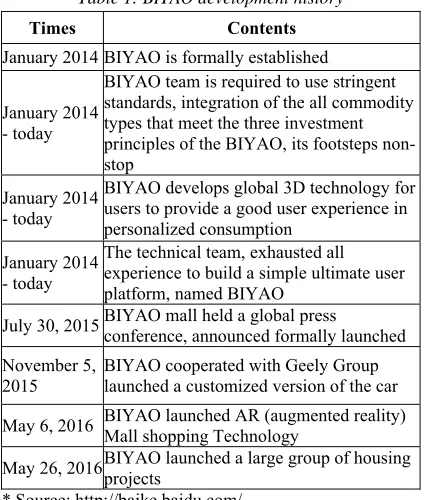
Table 1: BIYAO development history
Times Contents
January 2014 BIYAO is formally established
January 2014 - today
BIYAO team is required to use stringent standards, integration of the all commodity types that meet the three investment principles of the BIYAO, its footsteps non-stop
January 2014 - today
BIYAO develops global 3D technology for users to provide a good user experience in personalized consumption
January 2014 - today
The technical team, exhausted all experience to build a simple ultimate user platform, named BIYAO
July 30, 2015 BIYAO mall held a global press conference, announced formally launched
November 5, 2015
BIYAO cooperated with Geely Group launched a customized version of the car
May 6, 2016 BIYAO launched AR (augmented reality) Mall shopping Technology
May 26, 2016 BIYAO launched a large group of housing projects * Source: http://baike.baidu.com/
The value for the user is that all users can enjoy the high-quality, personalized consumer life. The value for manufacturing is the use of Internet technology and mode to open the prelude of Chinese industrialization 4.0 upgrading. C2M mode is on-demand production and avoids waste, so that social development will be more green and sustainable business mode. BIYAO C2M mode will help the Chinese industry to enhance competitiveness in the new round of industrial revolution. It is the vision of the BIYAO (http://www.biyao.com/minisite/ljby).
BIYAO has some transaction principles. The first principle is 7 days return and exchange. Customer receipt of goods within 7 days, the following circumstances can be free to return and freight is reborn by the merchant: 1) Received product and its description do not match: such as size, color, type, order are different from the propaganda; 2) Received damage or lack product, accessories and other situations; National law or functional failure the commodity has the flaw of quality problems; 3) Customers sign goods for more than 7 days. The BIYAO platform businesses are to strictly enforce the national policy of the three packages. The second is compensation first. When a dispute arises between the customer and the merchant, the customer may initiate a complaint directly, which is BIYAO answers for the first time. If the customer complaints established, it is directly compensated for customers. The third is that overtime compensation. The business of BIYAO, if
failure to delivery time is, the system automatically compensates. Claim amount is 30% of the amount and the upper limit is 500 Yuan. In online apparel industry, return rate reaches at 30% to 40% [6]. The fourth is that regular invoice. BIYAO provides all incoming merchants’ formal invoices to consumers.
2.2 BIYAO PEST Analysis of Macro Environment
2.2.1 political and legal environment
BIYAO not only impacts Chinese e-commerce market, but also is influenced by the development of Chinese e-commerce and is restrained by the national macro-economic policy. Chinese e-commerce laws and regulations are nearly blank before 1999 year of the Chinese e-commerce introduction. After 1999, e-e-commerce and Internet legislation have made significant progress, the relevant laws and regulations have been introduced. These laws and regulations related to the Internet security, confidentiality, infrastructure construction, financing, advertising, business license, press release and other fields, initially formed a system and basically in line with international standards. Overall, Chinese e-commerce laws and regulations mainly show the following characteristics.
6787 2.2.2 economic environment
E-commerce economic environment refers to the economic conditions that built the business activities in the technical platform based on information and network technology. It includes the information network infrastructure, corporate information and financial electronic content. Since the 1990s, Chinese network information technology (IT) and infrastructure have been rapidly developed, there is already a certain basis, but there is a comparatively great gap compared with the developed countries in the world.
The financial system is the basis for the guarantee of business activities. E-commerce payment and settlement require cooperation with the electronic financial system. Chinese financial information construction has rapidly developed since 1993. The purpose of development is to establish a unified national bank card service system, to achieve cross-regional, cross-bank real-time transfer and to create a safe, fast, economical payment environment to create the conditions for the development of e-commerce. However, since the information network technology involved in the financial sector, the security of financial information has become a problem. In order to ensure financial security, people invented a variety of encryption technology, but the theft of financial information events still occurred, it is still a problem in e-commerce development.
The other economic environment problem is the logistics problem. At present, China has two main ways to solve the logistics problem. On the one hand, some e-commerce enterprises have traditional basis, mainly rely on the original distribution channels and advantages to distribution; and for other new network enterprises, the establishment of their own logistics and distribution system costs are too high, they often need to rely on third-party platform. In addition to the cost, the logistics also need to involve the management and technical problem. Although Chinese current logistics system is not perfect, but many traditional enterprise transformation and the emergence of professional companies bring the hope to solve the logistics problem.
2.2.3 social and cultural environment
In addition to the improvement of laws and regulations and the development of IT, e-commerce also benefits from changes in the social environment. Network users' spending awareness and spending power are changing. On the one hand, with the concept of the Internet has gradually lodged itself in the public mind, more and more
people begin to contact the network and try to do network consumption. On the other hand, people's lives have formed a high dependence on the network now, young people will become consumption subject, this trend will be sustained and strengthened in the future.
In addition, the social credit system has yet to be improved. As the network transaction means is difficult to provide comprehensive quality information of goods and services, thus forming a high transaction risk and hindering the development of online transactions are the global e-commerce enterprises’ common problems. The network attribute and the product quality attribute are the objective reasons leading to the quality uncertainty. The credit problem is the human reason for the quality uncertainty. If it cannot get a good solution, also it may be an important factor hindering the healthy development of Chinese e-commerce.
2.2.4 technical environment
E-commerce technology includes infrastructure, hardware, application platform, security technology and other aspects of the content. At present, globalization of these areas and division of labor are relatively clear. In December 2013, Ministry of Industry and Information Technology of the People’s Republic of China officially issued 4G license to China's three major telecom operators, it is marked China formally enter into the 4G mobile communications phase. With the further development of 4G technology, it not only can better meet the mobile Internet users’ high-speed wireless Internet access requirements, but also can promote mobile e-commerce, mobile production and mobile logistics and other information services continue to improve. With the rapid development of mobile Internet technology corresponds to the mobile terminal, various types of mobile terminals’ applications also emerged, more and more electronic business enterprises have launched their own mobile brand applications.
6788 2.3 BIYAO Micro Environment Analysis
2.3.1 BIYAO mall strengths
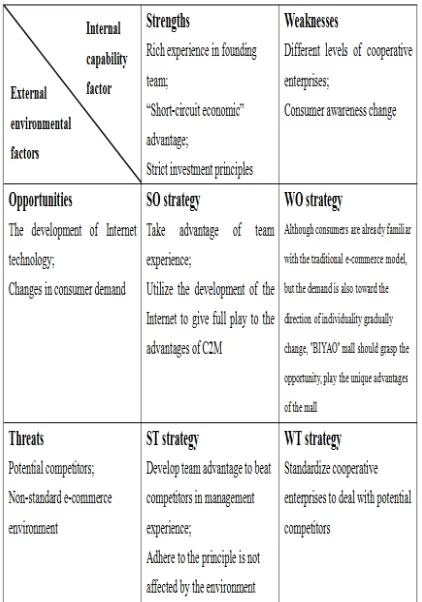
The BIYAO mall founding team has experienced and participated in many times of the Internet changes, accumulated a large number and rich experience, it has become the one of the most favorable factors in the mall development. The mall is the unique C2M platform in the world so far and it received the 2015 Acech Award (www.eciawards.org) Gold Prize in business mode innovation part. This innovation business mode has large space for development. In the mall, all orders are on-demand production, zero inventory, short-circuit intermediate links, and the elimination of channel costs. With the advent of information and personal customization era, the biggest advantage of the mall is to eliminate inventory, avoids waste and has a sustainable development. The mall has a strict investment principle; 1) must be the top manufacturers, 2) must comply with the BIYAO pricing policy, and 3) must cooperate with the best designers. Therefore, consumers can really experience the "high quality and low price" luxury products, the ultimate beneficiaries of cost-effective is the consumer. The key way is to order first and then produce, if there are no orders it will not produce. There is to the maximum solute of inventory problem, the Internet plus will play to the extreme.
2.3.2 BIYAO mall weaknesses
BIYAO mall’s strict investment principle may be also a weakness. The investment and cooperation of different enterprises within the different structure and informatization level, it will bring some impacts for the mall management and control. The part of the luxury goods manufacturers is at the beginning of the transformation of traditional enterprises, there are some difficulties for BIYAO. On the other hand, as C2M e-commerce mode appears, consumers will have some obstacles in the understanding of the change. The "high quality low-cost" product trust crisis and acceptance of all consumers are the threatening factors.
2.3.3 BIYAO mall development opportunities The development of IT, big data, and other technologies of a large extent to promote the development of e-commerce brings a very good opportunity to BIYAO platform. For the C2M new e-commerce mode, the development of information and internet plus can promote the new mode
development. Consumer demand is changing to the customization, personalized direction [1]. These changes are just in line with C2M business mode.
2.3.4 BIYAO mall threats
The BIYAO mall is the unique and formal operation platform of C2M, but with the development of new modes, it will no longer make the only one, and other new e-commerce platforms will be the potential threat for the platform [9, 10]. On the other hand, the essence of the mall is the e-commerce platform, but BIYAO needs to face the threat that the current e-commerce environment is
not standardized status [8]
(https://wenku.baidu.com/view/19).
[image:5.612.317.528.314.615.2]In total, table 2 presents the results of BIYAO PEST analysis of macro environment
Table 2. Macro-environment SWOT Analysis
2.4 BIYAO Success Factors
6789 advantage of C2M is on demand production and is to eliminate inventory. Because the traditional manufacturers can not accurately estimate the market demand, so it leads to inventory problems easily. While the C2M mode is produced by order, solve the inventory problem farthest. The third is short-circuit economy. Personal customization era has come and consumers can first order in BIYAO platform. The platform provides the number of orders to the manufacturer, the manufacturer in accordance with the order quantities produces. Therefore, the platform will clearly show the production cycle. The fourth is the development of network technology. The C2M platform was born in the times of cloud computing, big data, and high-speed development of IT, C2M’s application of new technology is like a revolution in the traditional mode. The last is that private ordering will be the mainstream of consumption. With the improvement of living standards, popular and universal goods have been unable to meet the needs of consumers, personalized and customized products are more loved by consumers [1] (https://wenku.baidu.com/view/).
2.5 BIYAO Development Trend
C2M e-commerce mode provides the most efficient and economical mode of production, it will be the future direction of e-commerce development. BIYAO should actively cooperate with the traditional industry, there will be other C2M platform in the future. Although the competition is inevitable, but it should also maintain the initial in the future competition, and ultimately should give benefits to consumers.
3. ADVANTAGES AND CHALLENGES OF C2M MODE
3.1 C2M Mode Application Advantages
The first advantage is to minimize inventory and produce on demand. C2M mode is that users first order and then the manufacturer(s) reproduce, so the manufacturer can determine the output according to sales, getting the basic realization of zero inventory, it is to facilitate customers without increasing the cost of customers while significantly reducing the manufacturer's operating costs. C2M's path is to make the M-side become platform, making it have the ability to connect with the C-side consumer. In simple terms, we can understand as the manufacturer's commercialization, the manufacturer is both a manufacturer and a distributor. In line with the enterprise C2M business platform, farthest cutting
off the intermediate links, farthest making the goods have lower price and manufacturers have higher profit, shorten cycle of the production to the sales and a substantial increase in efficiency.
The second one is to meet the individual needs of consumers. In the era of e-commerce, enterprises are trying to meet the individual needs of consumers. C2M can best meet the consumer demand for customized products. C2M mode built a bridge between consumers and manufacturers, no longer relying on the middle of a large platform, making the mobile Internet portal gradually fragmented, diversified, personalized development. C2M mode opened up the road for personal tailor, so that consumers can enjoy the process of consumption and participation in the fun of production, it will become a popular consumer experience in the future. In addition, supporting the development of C2M mode is the data analysis that makes the user’s needs as the core, the key is data source and data processing capacity. For the users created the process of customization, enterprises should accurately record and analyze the behavior and needs of the users comprehensively. Through the mining of large data, the guidance is given to arrange the production, realize the data in the process, and realize the efficiency of the production [2].
3.2 Challenges from C2B to C2M Mode Development
The first challenge is that high quality low price is difficult to prove. C2M mode is that consumers directly communicate with manufacturers in the mobile Internet entrance to meet the personalized needs, at the same time, because consumers cannot experience directly before buying the product, so this mode is difficult to provide consumers with experiential shopping, resulting ‘high quality low price’ is difficult to prove. In the apparel industry as an example, among the international brands and no brand labels, consumers may do not know accurately whether the same raw materials and processes are used or not. Therefore, how to prove to consumers for ‘low-cost high quality’ will be a big problem in C2M promotion process.
6790 the manufacturers in order to ensure timely delivery, have to take production, which will lead to loss of manufacturers.
The third one is the long production cycle. Consumers encounter their favorite products naturally hope to immediately get, but the C2M mode is pre-sale mode, therefore, needs the collection of pre-sale orders. M-side needs the production time after consumers’ order, resulting the longer time in products from the purchase of production to send up to the consumers, the general situation is for 14-29 days. Because this consumption of the process cycle was significantly elongated, a study found that consumers in the process of consumption, the sense of pleasure will be greatly reduced [2]. In the current mature e-commerce environment, B2C can be ‘the next day delivery’, so there will be disadvantages in C2M, C2M in the shopping experience exists short board.
C2M mode change leads the development direction of the new era of e-commerce platform. Though it has farthest to remove the intermediate links, to meet customer needs and reduce production costs and other advantages, it still has some urgent problems to be solved. Under the C2M mode, the production of ‘planned, customized, quality’, supply reform, industry restructuring and upgrading will lead to more entrepreneurs’ attention, whether C2M can seize the opportunity to overcome the challenges or not, the future will be given the answer [2].
4. APPLICATION AREA AND EFFECT OF C2M
4.1 Application area
In recent years, the development of the new custom mode with the rise of technology, its core is a thinking of mobile Internet and large data, customer-centric, digital-based and design-oriented. C2M of personalized customization directly connects producers and consumers, the product is broken down into the multiple modules, and then in accordance with the needs of customers to combine these modules, and ultimately forms personalized products that meet the needs of customers for customized products. The current C2M mode is gradually accepted by the public, it has been applied to home decoration, cars, clothing and other industries [9, 10].
Some of the leading home decoration companies have begun to try new possibilities, by the customer personally involved in the early design stage, in advance to see their own home in the future, to adjust and choose according to their
own preferences. The system can directly place an order to the factory that from the overall design to brand style, after the completion of the production and then directly distribute to the customer's home to assemble, forming a high-quality custom home decoration of C2M sales mode.
C2M process of clothing industry is also very clear. First, the customer's physical data transmitted to the factory through the Internet, the factory according to the consumer's body size data modeling, plays version and cut, and then enters into the factory assembly line of production and the last according to the customer's individual needs (lettering, etc.) to product for the final processing. Compared with the clothing industry in C2M, questions of traditional clothing industry are that the cycle is long, the equipment is single, and the operator’s demand is high. However, the C2M mode developers in the clothing industry use the data of the machine, the consumer forms data acquisition, the 3D scanning, the clothing cloud data, the information industry chain and so on to achieve intelligent applications [9, 10]. Through compared with the traditional industry, the C2M mode further reflects an innovative direction of the transformation and upgrading.
6791 achieve the needs of consumers. But because production capacities and financial capacities of some small and medium enterprises are relatively weak, they cannot effectively integrate resources and on-demand scheduling.
The last is to weaken the brand positioning. In the C2M mode, the factory e-commerce directly connects with consumers, there is no clear brand positioning, and it is not able to form a brand advantage, so it cannot have a long-term impact on consumers. It can be seen, in the C2M customization mode, there are still some shortcomings need to continue to improve [9].
4.2 A butterfly effect
Since the BIYAO mall was established, the industry discussion for the C2M mode has become more and more, and there is even bold prediction that C2M mode will subvert the existing e-commerce mode. Although C2M’s emergence was not long, but it can be seen that C2M search fever has been rising. Bi Sheng compared their team to a butterfly with the fanned wings of the “butterfly effect”. Therefore, does C2M has the power to subvert the e-business mode?
In theory, the C2M mode farthest to meet the trend of e-commerce removes intermediaries and brings the consumer with the lowest price of goods. But another feature of customization of C2M is the biggest two point advantages. In recent years of the e-commerce industry, the younger consumer groups have the more customized demand on the product and C2M is just to meet the young consumer groups to pursue personalized, differentiated product needs.
At present, C2M e-business platform presents two forms, one is the third party C2M business platform of BIYAO as the representative, the other is the enterprise C2M business platform of China C2M clothing industry as the representative [10]. Regardless of which form, it is connected with the consumer demand and production lines.
But the consumer demand has a strong impromptu characteristic, consumers that favorite products naturally hope to be available immediately, but in the C2M pre-sale mode, orders’ integration needs to take time. After the manufacturer received orders and production also takes time, which leads to the product to reach the consumers will be relatively long, usually take 15-30 days [9, 10]. The extension of the consumption cycle, will make consumer behavior brought the sense of pleasure be reduced. B2C has been able to do "the next day delivery", C2M timeliness has an obvious weakness. Second, the C2M mode to do the zero inventory,
making the efficiency and cost reduction, but the production behavior is directly initiated by the consumers, which led to the orders are scattered and uneven distribution. Though the orders from the C2M platform are not large, manufactures have to produce them in order to ensure timely delivery. It may lead to losses for manufacturers.
It seems that C2M would like to subvert the existing e-commerce mode but there are many aspects need to continuously improve and perfect. First of all, C2M e-commerce mode should try to shorten the time of product from the consumer side and again back to the consumers in the future. In addition, C2M also needs to make more consumers to accept such a new mode, in order to achieve the purpose of expanding orders. If the pre-sale period cannot guarantee the number of orders, the manufacturer may be loss, so that the existence of C2M almost has no meaning. In this case, if the e-commerce enterprise wanting to survive will have to raise the price of goods, so that itself contrary to the original intention with C2M mode. Therefore, the expansion of orders is also needed to solve the problem in the future.
Although C2M has problems, but the improving and perfecting the space are remained for development. C2M should not be able to completely subvert the existing e-commerce pattern. As a new mode, C2M is still in the exploring stage, but the future development space is infinite with broad prospects. More importantly, C2M provides a good direction for the traditional enterprise information transformation, fully embodies the meaning of Internet plus.
5. COMPARATIVE ANALYSIS OF F2C AND C2M
5.1 F2C e-business mode
F2C is from the factory to the consumer business mode [1]. F2C mode is based on the brand company to design a good product and takes it to the factory for product, the last through the terminal to reach consumers, to ensure that the product is reasonable, while quality services are guaranteed. They provide consumers with cost-effective products. The development of e-commerce for a company means a business opportunity and the birth of the network economy.
6792 as fake and shoddy products, and the price also has a certain attraction.
The biggest advantage of F2C is a strong line of industry support, effective whole product control, and rapid market reaction. In the online shopping process, consumers are often worried about the problem that product quality cannot be guaranteed. As results of the purchase channel and the product supply chain are uneven, manufacturers’ quality varies greatly, so consumers are confused by a lot of pictures on the bright and beautiful goods. After the receipt only found that the quality is exaggerated, or even fake and shoddy products, so F2C is expected to change this status. Internet of things (IoT) can everyone become mobile phone shopping dealers and shoppers, really achieve the business mode of ready to buy, ready to sell.
5.2 F2C Direct Sales Mode Case: Dell’s e-commerce
Dell Computer is one of the most successful computer companies in the world with use of Internet direct marketing. Dell's idea is simple: creates computers in accordance with customer requirements and ships directly to customers so that companies can more effectively and clearly understand the customer's demand, and then quickly responds to it. It is a direct network marketing concept that contacts with the customer make Dell become one of the most successful enterprises in the 1990s [12, 13].
The first of Dell’s direct sales mode is order processing. A customer orders the computer through Dell's website, and Dell confirms the integrity of the order and returns the customer proof and verifies the payment. The second is pre-production. The order sheet for the order computer is generated and saved in the database. Each computer gets a barcode as a permanent identification of the machine. The third is the preparation of accessories. Material requirements management system will count all parts of the product information, full-time staff from time to time (about 2 hours), from the warehouse to extract parts into the factory, to ensure that customers order production. The fourth is assembly. Parts are sent to the assembly line via a conveyor belt and assembled into a computer via pipelining. The fifth is the test. It includes physical testing, software preload, high voltage test. The sixth is packaging. Through automatic packaging equipment, products will be packaged, attached to the shipping documents and addresses, waiting for shipment. The seventh is ready for shipment. Products will be
delivered to the delivery site with the hoist and battery forklift, waiting for the logistics company for home delivery. The eighth is shipping. Dell takes third-party logistics form and promises to deliver to customers at 2-5 days. Customers can view the delivery of goods through the website.
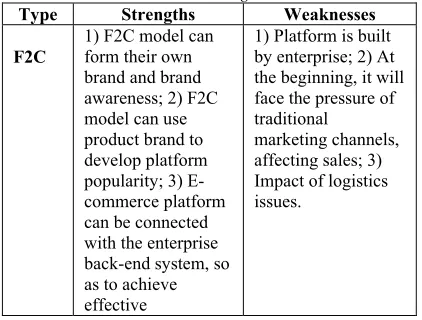
[image:9.612.312.523.573.733.2]Dell's e-business direct sales mode has been a great success, in addition to relying on its economic environment, technical environment and advanced logistics industry support for its sales mode, the key lies in Dell's internal advantages. The first is the first-class infrastructure. Dell has an advanced automated assembly line. Second is the scientific standardization of work processes and modular product management. Dell uses standardized work procedures, which are documented in the ISO documentation, and each of the company's work is part of its standardized work program. Third is information management by the internal management. Dell has a mature, advanced ERP management system. Fourth is high quality after-sales service. In the pre-sale and sales services, Dell through e-commerce supports that customers can easily find and make orders. Through the use of third-party logistics mode, Dell provides customers with efficient and accurate delivery on-site service. In the after-sales service, Dell helps for customers to set up a special technical support website, providing technical advice and software downloads and other services. As a result of custom sales mode, Dell established a detailed customer information database and tracking service. In the maintenance, the technical staff can know exactly all the configuration of the customer computer, the problem will be more conveniently solved. The Dell's e-business model is the representative of the F2C e-business mode [12, 13]. Table 3 presents advantages and disadvantage regarding each mode of F2c and C2M [8, 12, 13].
Table 3. Comparison of F2C and C2M Advantages and Disadvantages
Type Strengths Weaknesses
F2C 1) F2C model can form their own brand and brand awareness; 2) F2C model can use product brand to develop platform popularity; 3) E-commerce platform can be connected with the enterprise back-end system, so as to achieve effective
1) Platform is built by enterprise; 2) At the beginning, it will face the pressure of traditional
6793 information
exchange; 4) The price of the product may be lower than that of other forms.
C2M
1) The price of the product may be lower than that of other forms; 2) Personalized, customized demand is more easily accepted by consumers.
1) C2M model cannot form a brand; 2) Manufacturers often do not have the brand effect; 3) Production cycle is long; 4) Platform is built by enterprise.
5.3 Other model: DTC (Direct-To-Consumer) model
Dollar Shave Club was founded in 2012 and acquired at US$1 billion by Unilever in 2016. This company is sending a high quality and changeable razor blade at least US$1 every month. However, Gillette takes from 15 to 20 dollars by one purchase including several razor blades from the customer, so the company’s market share is now shrinking. The core of this DTC model is a direct connection between manufacturer and final customer. Namely, the total value chain’s consolidation can be realized via the direct connection of manufacture-side and demand-side without a delivery or logistics stage. Thus, this business model innovation like DTC makes mass customization for smart supply chain management (SCM) possible [14].
Recently, the cases introducing DTC model among global companies are increasing. Mondelez International, producing Oreo of the most popular cookie brand in the US, has an investment plan to earn the revenue of US$1 billion through the DTC by 2020. Nike began to serve DTC service through Amazon on July in 2017. If a customer orders directly to Nike through the Nike’s brand shop in Amazon.com, Nike directly provides the product to the final customer. The two businesses can provide customized services at a low cost after understanding customer’s taste and demand and making data. DTC is a kind of smart SCM and business model innovation [14]. DTC model has a similar side compared to C2M model.
6. CONCLUSION
At present, the commercial use of C2M is still mainly based on the large-scale direct selling enterprises and e-commerce platform, and relies on ‘classification and customization of product function modules’, which are designed by C2M mode. The e-commerce platform needs leading C2M to customize service platform, and in the meantime it not only needs the high-end brand factory to design flexible supply chain, but also to provide more customized services based on C2M. Dollar Shave Club, Mondelez International, and Nike cases introduced DTC model are based on flexible SCM and customized services.
This research analyzed BIYAO -- the representative platform of C2M in order to better understand the emergence and development of C2M. First of all, in the rapid development of e-commerce environment, Bi Sheng summarized the failure in the vertical e-commence experience, and created BIYAO. The main form of C2M e-commerce is to remove all the intermediate links in circulation, the two dealing parties are manufacturers and customers. This transaction form fully reflects the customers’ needs for customization and personalization. Therefore, this model can save cost and provide consumers with high quality and low price products, so that consumers will eventually benefit. BIYAO platform uses the same ways to cooperate with the luxury goods manufacturers directly, orders directly pass to the manufacturer through the BIYAO platform, and then send products to the consumers through the third party logistics directly.
6794 Through the analysis, we can conclude that direct selling enterprises and traditional manufacturing enterprises need ‘Internet +’ to establish a new Internet direct selling relationship, to adapt to the consumer’s fragmented consumption patterns, and to meet customer demand for product upgrades. In the Internet era, for direct selling enterprises and traditional manufacturing enterprises to establish a C2M-based ‘Internet +direct selling’ mode, it should follow the characteristics of manufacturing enterprises. On the one hand, they are to optimize the supply chain design of direct marketing companies, on the other hand to focus on customer experience and grasp the important impact of mass customization services in the future development of direct selling enterprises.
The study presented C2M’s advantages, challenges, development direction, application area, and comparison with other e-commerce type or new business model innovation through BIYAO case. Potential enterprises or their managers can refer to the findings of this case study which may give a guideline in the future.
This research takes C2M as the opportunity. BIYAO mall is so far a few years since it is formally established, and the reference for the actual information is limited. Therefore, there are a lot of difficulties for a deep study. At the same time because the companies are not willing to open the annual report, BIYAO mall’s accurate revenue data could not be acquired. The only specific data can be used to analyze the development of BIYAO, so it can be understood through environmental analysis and comparative analysis and other methods to catch the BIYAO mall. BIYAO and C2M e-commerce are still in the stage of continuous exploration, the beginning of the new things has a huge space for development, whether it is BIYAO or C2M mode itself. In addition, it should be combined with their own and environmental advantages, and efforts to weaken the impact of short board on development. Through this analysis, BIYAO may come to the top in the future development, and C2M e-commerce mode can also become the mainstream of the future e-commerce mode.
REFRENCES:
[1] Laudon, K.C and Traver, C.G. “E-commerce 2017- business. technology. Society”, 13th global
ed. Pearson, 2017.
[2] Xu J. “Opportunities and challenges of e-commerce platform from C2B to C2M”,
Enterprise reform and management, Feb. 2017, p.
58.
[3] You, R.H., Zhang, D.L., Liang, G.H., Li, Z.X., Liu, D., and Wang, S. “Research on transformation and upgrading of traditional export enterprises to realize integration of IT application with industrialization”, China Standardization, Vol. 10,
2014, pp. 127-129.
[4] Tao, Y.H. and Wang X.W. “The analysis of the e-commerce faced plight and solution countermeasure”, Westleather (Economy and society), Vol. 38-22, 2016, pp. 135-136.
[5] Qian Y.J. “Breaking the form of C2M E-commerce”, China Economic Information, Vol.
548, Feb. 2015, pp. 68-71.
[6] Reagan, C. “A $260 billion ‘Ticking time bomb’: the costly business of retail returns”, Dec. 16, 2016, www.cnbc.com.
[7] Libin E. and Huang, Y.W. “A new approach to international trade: cross border e-commerce”,
Journal of Dongbei University of Finance and Economics, Vol. 92-2, 2014, pp. 22-31.
[8] Liu Y. and Zhang J.L. “Opportunities and challenges of Chinese e-commerce under the new technology environment”, China Business, Feb.
2014, pp. 10-11.
[9] Liu, X.H. and Zheng, G.Z. “Advantages and development of apparel intelligent personalized customization based on C2M”, Journal of Clothing Research, Vol. 1, No. 5, Feb. 2016, pp.
477-480.
[10] Zhou, Y.F., Xu, M., and Di, R. “Research on the Radical Innovation of C2M Business Model—A
Case Study on Redcollar MTM Men’s Suits in China”, International Journal of Business and Management, Vol. 11, No. 4, 2016, pp. 194-202.
[11] BIYAO exchange procedure and appeal procedure (http://www.biyao.com/minisite/bzzx) [12] Liu, F. and Du, S. “Dell's e-business application
model analysis”, E-commerce, Feb. 2012, pp.
127.
[13] Zhao, X.L. and Zhou, Q. “DELL's e-commerce direct selling model”, Enterprise reform and management, Vol. 2, 2003, pp. 20-21.
[14] Song, S.H. “Smart SCM and business model-mass customized production’s core is ‘demand’ innovation, how to connect with consumer is a key success factor”, Donga Business Review, No.