Journal of Theoretical and Applied Information Technology 15thDecember 2016. Vol.94. No.1
© 2005 - 2016 JATIT & LLS. All rights reserved.
ISSN:1992-8645 www.jatit.org E-ISSN:1817-3195
MODELING FRAMEWORK FOR INTERMODAL DRY PORT
BASED HINTERLAND LOGISTICS SYSTEM
1,2LAAZIZ EL HASSAN,
1EMI, Université Mohammed V, MOAD/SCM, Industrial Engineering Department, , Rabat, MOROCCO
2ESITH, Industrial and Logistics Department, Casablanca, MOROCCO
E-mail: 1,2[email protected]
ABSTRACT
Intermodal transportation has known a great development during last decades as consequence to the development of container transportation services but also because of its sustainability advantages. The development of gateways infrastructures (ports, air ports) but also the extension of gateway concept to dry ports leads to the development of hinterland logistics networks that requires efforts and researches to optimize the design and the configuration of both their infrastructures and their services.
The design, configuration and the service network design of a system(network) performing hinterland logistics, obeys to the same objectives as for a transportation and /or distribution network but could differ because of either its specific structure, cost function and/or specific constraints related to the actors points of view. To be cost effective and mitigate the negative environmental and human health effects of distribution operations of road mode, hinterland freight logistics systems should be intermodal by integrating more and more rail and land waterway traffic. The planning of these systems at tactical level, deserve more attention because a great deal of cost effectiveness could be reached at this level.
The purpose of this paper is to address a modeling framework for service network design for a based dry ports hinterland logistics system. The models are based on a path fixed charged capacitated formulation and give as outcomes shipping frequencies by service class of each path and by the way the required capacity in gateways and the intermodal dry ports.
Keywords:Hinterland, Dry port, Intermodal Transportation, consolidation, Service Network Design. 1. INTRODUCTION
Port-Hinterland logistics networks are taking more active roles in freight forwarding and in shaping supply chains solutions generally, due to the increasing reliability of intermodal transportation. The hinterland distribution of containers from/to sea ports (and other gateways) has received more and more attention lately due the pressure on these gateways as a consequence to the limitation of their capacities in one hand and to the maritime vessels capacities increase in the other hand.
Gateways are extended to hinterland areas and dry ports are considered to be a solution to this pressure, in terms of administrative lead time (borders customs procedures) and in term of port terminals congestion. Different transportation modes are used in port hinterland distribution from (and to) ports, depending on the infrastructures in the hinterland area. As road transport is still the
Journal of Theoretical and Applied Information Technology 15thDecember 2016. Vol.94. No.1
© 2005 - 2016 JATIT & LLS. All rights reserved.
ISSN:1992-8645 www.jatit.org E-ISSN:1817-3195
intermodal logistics systems require transportation and transshipment facilities that are defined and designed in the strategic level. Carrier and/or logistics provider should , afterward, deal with the Service Network Design in the tactical level (one to several months) to determine measures concerning routes to provide transportation services, frequency of each service and minimum capacity for each terminal (either ports and dry ports) and its operating resources. As per our literature review, the contributions on planning of these systems at tactical level are scarce and the objective of this article is to fill this gap and give an insight and a modeling framework aiming at their cost effectiveness.
In the following section of the paper, we will give an overview of the previous contributions and models relevant to service network design and dry ports based hinterland logistics systems. In section 3, we define our application case for modeling purpose. In Section 4, we developed a modeling framework for hinterland service network design containing a linear integer program and non linear integer program. Last, in section 5, we conclude and give perspective of our future works.
2. LITERATURE REVIEW
2.1 Port hinterland container logistics
A gateway Hinterland traffic concerns traffic originated to and from the hinterland region (interior region near to the gateway) which passes through that gateway (port, airport…). In the context of port (seaport), the gateway could be defined as a coastal metropolis with port access to both its hinterland area and the rest of the world which captures a substantial share of total regional and international trade volumes [3].
Hinterland traffic is usually based on a gateway and a transportation (logistics) system, composed of transportations arcs and terminals. This is going straight with the increasing integration of intermodal transportation in freight forwarding and in sustainable supply chains. The interaction between port-maritime systems and the inland freight forwarding networks has led to a new concept called “port regionalization”[4] while the growing role of terminals in supply chain strategies had output “supply chain terminalization” concept [5].
In such a logistics system (but also generally), the generalized cost of transport contain internal (or private) costs and external costs. The former are directly generated by the users of transport system.
The latter, are related to transportation system impact cost on society, environment and ecology. The addition of internal and external costs results in the social cost of transport [6].
Road transport is responsible for by far the largest share in transport external costs. Meanwhile, intermodal transport solutions are capturing more and more attention for its limited external cost compared to unimodal road transportation solutions, particularly in hinterland traffic. They are recognized to mitigate the negative external impacts of transport operations and to increase efficiency and sustainability of freight logistics systems.
2.2 Dry Ports And The Extended Gateway Concept
Journal of Theoretical and Applied Information Technology 15thDecember 2016. Vol.94. No.1
© 2005 - 2016 JATIT & LLS. All rights reserved.
[image:3.612.88.297.73.216.2]ISSN:1992-8645 www.jatit.org E-ISSN:1817-3195
Figure 1: Dry ports based logistics system [21] As per any freight logistics system, a dry ports based hinterland logistics system requires cooperation and integration among different actors, including shipping lines, inland intermodal carriers, customs, and dry ports managers. The cooperation and coordination have to be implemented in operations decision level but also in tactical one, assuming that some strategic stakes are undertaken when the hinterland logistics system and its facilities were committed and designed. Dry ports hinterland logistics systems are a relevant option to reduce freight external cost and to improve the connectivity of freight destination (origins) to hinterland logistics systems especially when the dry ports are intermodal/multimodal.
Dry ports should become new client for seaports, which will assist to reduce costs and capitalize on the added value of the whole multimodal transport [22]. Dry ports are predictable to progress the performance of seaports. Hence, the idea of creating dry port is to mitigate seaport congestion [23]. In case of road freight hinterland systems, the negative external impacts of transport and their associated costs have been the subject of extensive research during the past years. A recent review of the different external cost categories and their associated estimation methods is provided in the handbook by Maibach et al. [24] produced within the IMPACT project (Internalization Measures and Policies for All external Cost of Transport) funded by the European Commission. However, the integration of the negative external costs of transport into tactical planning of freight transportation in the hinterland logistics systems is still relatively little analyzed and optimized in scientific literature.
2.3 Intermodal Transportation And
Consolidation In The Intermodal Terminals
Intermodal freight transport is the movement of goods in one and the same loading unit or vehicle
by successive modes of transport without handling of the goods themselves when changing modes (European Conference of Ministers of Transport et al., 1997 [25]). The intermodal transfer of containers between truck and rail, taking place at rail terminals, is specific to intermodal transportation. Containers thus arrive at the rail terminal by truck and are either directly transferred to a rail car or, more frequently, are stacked in a waiting area. Then, containers are picked up from the waiting area and loaded unto rail cars that will be grouped into blocks and trains (Crainic and Kim, 2007 [26]). In case of intermodal dry port, the same operations take place similarly in conjunction with customs procedures and inspection routings and the issues are very similar to those arising in container port terminals. Intermodal transport is considered as a competing mode and can be used as an alternative to unimodal transport. There is a growing intermodal industry for equipment and services, especially because of its sustainability opportunities but also of the great deal of consolidation possibilities. On the other side, consolidation is one of the two strong leitmotivs for intermodality (with the distance). Intermodal transportation is cost effective as long as consolidation is possible for shippers transportation demand, especially when this demand could be known and forecasted in advance. Studies by Lium et al. 2007 [27] showed that cost reduction could be realized by planning on the basis of known demand long enough time in advance. Consolidation could sometimes reduce flexibility for customers (shippers) and this will lead to the lost of sale advantage for the carrier. This is mainly true for consolidation efforts in operational level. However, in tactical decision level; on the basis of well forecasted demand, the consolidation brings several advantages for the carrier and the shipper. Namely, it reduces costs, increases operations efficiency and profitability and improves service quality and shippers satisfaction when their freight demand is well forecasted.
Measures a, d and e coupled with f, are the main and relevant ones for tactical level of decision. The adaptation of train capacity is mainly the strongest one. This measure is discussed against the classical ways to adapt train capacity: (1) delaying departures to maximize loading, (2) timetabling with number of train below demand to create a shortage and (3) fixed frequency and wagons number variation. In our modeling proposal of SND in hinterland context, we suggested an integrated way to optimize the loading space (and thus freight) by train lot size adaptation while adapting train routes and assigning terminals dynamically.
In port hinterland logistics systems, consolidation effort should be continuous for the following reasons:
Intermodal nature of hinterland traffic: generally there, mandatory, are at least a couple of modes when importing/exporting: oversee shipping and/or airline cargo shipping and another mode (waterway, rail, road or all of them). This nature exploits intermodal transportation for long haul economies of scale but it is necessary to be sure that end points operations and transshipment terminals don’t generate other hided costs.
In contrast with industrial goods transportation (from manufacturer down streaming, door to door), carrying importation flows from gateways (ports and airports) to destination cities (and vice versa for exportation flows) takes advantages from the nature of gateways nodes (ports and air ports) that are themselves hubs representing Economies of scale .
2.4 Service Network Design
For strategic level, design and the configuration of transportation (freight forwarding, either intermodal or not) is generally referring to the so called “System Network Design Problem” which have two formulations: Uncapacitated NDP (Balakrishnan et al, 1989 [30]) and the capacitated NDP (Gendron et Crainic, 1994[31], 1996 [32], Choumon et al 2003 [33] and Choumon et al, 2008 [34]). In tactical level, Transportation and other logistics network are given (defined in strategic level) and the stakes concerns decisions related to allocation of resources and the determination of capacities and other network dimensions. Additionally, SND deals with:
Decision on paths/routes to provide transportation services between origin and destination nodes.
Decision on the service type to use, such as door-to-door delivery, non-stop, express…
Decision on frequency of each service. Determination of minimum capacity for
each terminal and its operating resources; These concerns are generally called “Service Network Design, SND”. It is more difficult to formulate in a model than NDP because of the several tradeoffs to find between predefined infrastructures (capacitated some time), the cost minimization and the maximization of service rate. SND attracted so much attention, however and there was a great amount of contributions on modeling and resolution: Assad, 1980 [35], Crainic (1988 [36], 2000 [37]), Delorme et al. 1988 [38] . These issues are specific to carrier (freight forwarder) perspective and point of view and make service design and planning complex. Reviews of Christiansen et al. 2004 [39], Cordeau et al. 1998 [40], Crainic 2003 [41], Crainic and Kim 2007 [42] and Crainic and Laporte 1997 [43] had lighted this complexity.
Carrier tactical decisions related to service design and planning are built given existing transportation facilities and resources (Vehicles, terminals, crews…) of his own or under his control (case of freight forwards).
The issues are mainly constrained and driven by: - Transportation consolidation aim in
terminals :
- Tradeoffs between flexibility to shippers demand satisfaction and cost effectiveness - Shippers transportations demand
forecasting (horizon) and advanced booking
- Full asset utilization (Crainic and Kim, 2007):
Crainic ET Rousseau 1986 [44] proposed a general formulation for an intermodal, fixed charged, multi-commodity service network.
In this model, for a commodity, the trafic are carried following paths ( ) which defined the proceeding of the transfer and relevant services from the origin to destination of the demand. Decision variables are:
ℎ being the flow volume of commodity
(product) p routed across the path
Journal of Theoretical and Applied Information Technology 15thDecember 2016. Vol.94. No.1
© 2005 - 2016 JATIT & LLS. All rights reserved.
ISSN:1992-8645 www.jatit.org E-ISSN:1817-3195
(planning window). Is a defined service.
The model minimizes the total cost of the system operating services while maximizing the demand satisfaction.
Terms of objective functions are:
(y) Total cost of setting a service s with a frequency y.
(y,h) total unit cost of transfer of commodity p, along the path .
The proposed model is :
(y) + (y, h) + Θ(y, h) (1) Subject to:
∑ ℎ = , , ( comodity p demand) (2)
≥ 0 , (3)
ℎ ≥ 0, (4)
An additional cost term Θ(y, h) is added, to take into account operational restrictions or/and penalties.
Crainic ET Rousseau (1986), proposed this model with a solution algorithm based on decomposition and column generation techniques. Later, Kim 1997 [45] gave a general description of a large scale transportation service network design.
Lately in recent years, intermodal service network design for hinterland logistics systems had captured some attention. Crainic et al.2015 [46] presented optimization challenges arising from the presence of dry ports in intermodal freight transport systems and gave solution for the tactical planning problem, using an existing original service network design model. A more detailed review of SND models is presented in Laaziz 2015 [47] with a comparison of their costing structure and their deepness in term of constraints.
3. MODELING FRAMEWORK FOR
INTERMODAL DRY PORT BASED HINTERLAND LOGISTICS SYSTEM 3.1 Problem Definition
In This section, we explain an application case based on a realistic dry ports hinterland logistics system. We explain the problem parameters, constraints and assumptions. Then, we suggested a modeling framework containing a linear integer
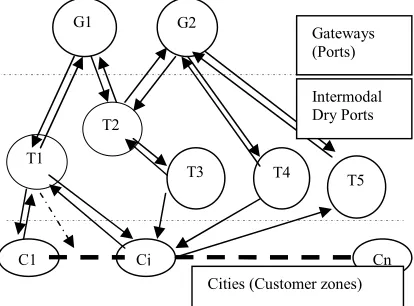
program and a non linear integer program. Both of them are fixed charged path based models. In this paper, our effort was focused on modeling issues. Thus, the models are discussed but no solving approaches are elaborated. Our application case is based on hinterland logistics system, composed mainly of rail and road network and a set of intermodal dry ports. In this system, the rail network and intermodal dry port are under the control of the freight forwarder.. The design, configuration and the service design of such a transportation network performing hinterland, obeys to the same objectives as for a distribution network but could differ because of network structure, costing objective function and / or specific constraints. Some differences also rise from the perspective considered. Modeling a service network design from carrier (freight forwarder) perspective differs from shippers one. Other terms in objectives functions and other constraints are added. In this article, we will focus on gateway-hinterland service network design, from a carrier (freight forwarder) perspective with an intermodal rail-road transportation system performing mainly import and export flows from gateways to hinterland (and vice versa). The graph here below gives a synopsis of such a logistics system:
Figure 2: The Dry Ports Based Hinterland Logistics System
The system is composed of a set of gateways (sea ports) Gi, that are freight origin for importation flow (and destination for exportation one) and contain railway yards. Terminals Ti are intermodal terminals (Rail-Road) and dry ports that are served by rail, from/to gateways. The cities distribution centers (Cj) are origin nodes for exportation flows in destination of gateways, and destination nodes for importation flows from gateways.
The main objective is to develop a modeling framework for a sustainable intermodal dry port
G1 G2
T1
T2
T3 T4 T5
C1 Cj Cn
Gateways (Ports)
[image:5.612.315.522.412.565.2]based hinterland logistics system that optimizes freight cost and service. The main assumptions for these models are:
The carrier/ freight forwarder has the ownership or at least the control of a fleet of rail cars (and locomotives) and trucks. All the ports are linked to dry ports by rail.
Cities in dry ports hinterland could be served mainly by road.
Consolidation and the maximum usage of rail are the main sub objectives of the proposed models. At tactical level, the carrier aims at composition of a maximum number of complete train to satisfy shippers (customers) demand and the minimum (residual) of direct shipping by truck.
From freight forwarders perspective, a set of feasible paths is determined depending on transportation and terminals facilities in his own or under his control but also on his objective in term of freight consolidation and service level.
For the application case discussed so far, we made model proposals for service network design for hinterland freight forwarding.
3.2 Notations And Parameters
The following notations are considered: G: set of gateways, indexed byi
T: set of intermodal nodes, indexed byt C: set of customer zones, indexed byj
P: set of paths corresponding to feasible services, indexed byp
S: Set of services class (mainly express, ordinary and highly consolidated services)
: Variable transportation cost on path pper TEU (Depends on distances of rail and road arcs and marginal costs related to path).
: Infrastructure fixed cost related to service class s and pathp
Θ: Penalty term or function representing service respect penalties, or/and capacity usage penalties
: Origin node of service related to pathp : Destination node service related to pathp : Intermodal terminal used by services related to pathp
I: Importation flow transportation forecasted demand of customer zone i from gateway j
E: Exportation flow transportation forecasted demand of customer zonejtowards gatewayi
: Capacity of rail arc(i,k) during the planning period (maximum number of trains that could be shipped on therailarc (i,k) in GxT).
W:averageweight of aTEUcontainer Wmax: trainmaximumauthorizedtotal weight Wmin: trainminimumprofitable weight(minimum weight justifying a train service) .
L: train averagetotal length(in TEUs)
Lmax: trainmaximumauthorizedlength(in TEUs) Lmin: train minimum profitable length (minimum lenght inTEUsjustifying a train service)
: average train length (or capacity) in number of TEUs related to service class s.
3.3 The Modeling Framework
The main focus of this modeling framework is to give a general model for service network design for intermodal dry ports based hinterland logistics system. Consolidation is considered by the carrier as a premium leverage of profitability and thus, the models proposed will give as outputs tactical schedules (in term of frequencies) of complete and direct trains from gateways to dry ports. Rail-road Transshipment is operated only in dry ports. Train to train transshipment are avoided.
The objective of the two models proposed are cost minimization of transferring the hinterland flow, service level required by demand segments and a full asset (mainly train fleet) utilization. The two models are both constrained by Consolidation on railway arcs and adaptation of train capacities to demand segments. As stated before, a set of feasible paths are considered at tactical level and each path has as attributes: Origin, destination in addition to intermodal terminal fixed cost (indexed by the service class for the first model) and railway arc capacity in term of train frequency. For the linear model (Model 1), on each path, a set of three differentiated services are considered. A service is characterized by transfer time, booking procedure, and price incentive…. (Express, ordinary, highly consolidated….). For example, at least three types of service could be considered, a priori, on each path:
Journal of Theoretical and Applied Information Technology 15thDecember 2016. Vol.94. No.1
© 2005 - 2016 JATIT & LLS. All rights reserved.
ISSN:1992-8645 www.jatit.org E-ISSN:1817-3195
service class will require a dynamic timetabling.
Ordinary/Normal service, with a fixed cost and a correspondent minimum standard profitable train size of OTEU’s. Here the carrier schedules regular trains for regular traffic for medium added value regular traffic. Price incentives and in advance booking help for this class service.
Highly consolidated service, with a fixed cost and a correspondent minimum standard profitable train size of L TEU’s. Here the carrier schedules non regular trains for some regular and much of occasional freight demand. Price incentives at operational level would help also for this service class.
3.3.1 Model 1: a fixed charged path based Linear Integer program
In this model, decision variable represent the service class s frequency, on the path p.The model is as follows:
∑ ∑ ∗ + ∑ ∗ ∑ ∗ +
x (1)
Subject to:
∗ ∑ ( ∗ ) ≥ ∑ ∗ ⍱ (2)
∗ ∑ ( ∗ ) ≤ ∑ ∗ ⍱ (3)
∑ ( ∗ ) ≥ ∑ ∗ ⍱ (1)
∑ ( ∗ ) ≤ ∑ ∗ ⍱ (2)
∑ , , ∑ ≤ ⍱ , (3)
∑ , , ∑ ≤ ⍱ , (4)
∑ ∑ , , ,∑ =
∑ ∑ , , ,∑ ⍱ ( )
∑ , ∑ ( ∗ ) ≥ ∑ , ⍱ ( )
∑ , ∑ ( ∗ )≥
∑ ⍱ ( )
, ⍱ , ⍱ ( )
The objective (1) is to minimize the total freight cost for the hinterland logistics system aiming a maximum of full and direct trains (of several service classes) from gateways to dry ports. The Penalty term is added to count for possible service respect penalties, or/and capacity usage penalties. Constraints 2-3 and 4-5 stand for service (path-service) limitations in term of total train weight and train length respectively; they reflect also a stress on consolidation and full asset utilization objectives with regard to profitability. Constraints 6 & 7 define traffic capacity limitations on rail arcs (between gateways and terminals on paths). Constraints 8 guaranties that the same number of vehicles (trains) arrives and departs from each node (either gateway or dry port). Transportation demand satisfaction is expressed by constraints 9 & 10 for exportation freight and importation freight, respectively. Finally, constraint 11 sets the integrity and positivity of decision variables.
The model direct outputs are the service classes frequencies on each path that satisfies shippers transportation demand in the covered hinterland of gateways. Indirect outputs could be derived such as the loading of rail yards on gateways and dry ports and the trucks fleet for final delivery to shippers (in case of importation flow) or for pick up (in case of exportation flows).
3.3.2 Model 2: a fixed charged path based non Linear Integer program
In this model, we consider that there are neither service classes, nor train services average capacities in term of TEU’s (average lot size). We consider it, instead, as a decision variable impacting direct cost, targeted service level, and consolidation effort. Let z be the train lot size on path p andL andL , respectively minimum and maximum loadings of a train in term of TEU’s. These limits reflect real technical limitations for a train in term of weight (tons) and length (in TEU’s). x stands for service frequency on path p. The other notations explained for Model 1 are kept unchanged. The model is as follows:
( + ∗ ∗ ) + ( , ) (12)
Subject to:
∗ ∗
≥ ∗ ⍱ ( )
∗ ≥ ∗ ⍱ ( )
∗ ≤
∗ ⍱ ( )
∑ , , ≤ ⍱ , ( )
∑ , , ≤ ⍱ , ( )
∑ ∑ , , , =
∑ ∑ , , , ⍱ ( )
∑ , ∗ ≥
∑ ⍱ ( )
∑ , ∗ ≥ ∑ ⍱ ( )
⍱ , ≤ ≤ ( )
, , ⍱ (23)
The objective is the same as for the model 1 and the direct output is the optimal frequency and the optimal train size for each path. Here, there is no service classification a priori. The constraints 13 -21 meanings are similar to those of the previous model (2-10). Constraint 22 expresses the limitation of train size in term of TEU’s (Wagons). Constraint 23 stands for the integrality of variables . The outputs are similar to those of the previous model. The model gives the service frequency of each path and the optimal train size on the path, with regard to the forecasted demand. The concept of service class (on the overall system) is lost here in the advantage of path service.
The two models exposed in this section could be sophisticated in term of right hand coefficients (in both objective function and constraints) and the penalty term detailing but we do believe on its following strengths:
- Detail level in demand/supply constraints expressions related to hinterland traffic nature
- Its focus on the intermodal freight forwarder perspective
- Its focus on the maximization of rail transportation use.
On the other hand, the models has a strong requirement which is a forecasting routing (of transportation demand) based on the customer bookings and a forecasting engine able to feed the model with supply/Demand matrices.
4. CONCLUSION AND PERSPECTIVES The objective of our work was to develop a modeling framework for hinterland intermodal logistics systems. The models objective functions are cost minimization and demand satisfaction. Tactical sub objectives consist in consolidation and train capacity full usage. The models could be applied in many contexts or freight forwarders business models: carriers, with or without fleet and infrastructures, intermodal freight forwarders and maritime terminal operators operating in freight forwarding. This is possible due to costing function structure emphasizing fixed and variable costs. We experimented the solving of the linear model (model 1) On ILOG/CPLEX on an instance of 2 ports, 4 dry ports and 14 cities. The demand data are composed of demand forecast for a planning period of 3 months. In our future works, we will focus more deeply on three axes:
- Enrichment of constraints set with constraints relevant to borders customs that are executed in the intermodal terminals including a dry port and Integration of specific constraints related to customers bookings.
- Detailing the penalty term with significant aspects in hinterland context
- Solving approaches for the non linear model.
REFRENCES:
[1] Aronietis, R., Meersman, H., Pauwels, T., Sys, C., Van De Voorde, E., & Vanelslander, T. Hinterland Transport Charging: Impact On Port Hinterland Connections.
[2] NEA, 2010. Ports and their connections within the TEN-T. Final Report. NEA, Zoetermeer, December.
[3] Berechman, Joseph (2007), « The social costs of global gateway cities : case of the port of New York”, paper presented at the conference on Gatways and Corridors, Vancouver, B.C.,Mai 2007.
[4] Notteboom, T. and Rodrigue, J.-P. (2005), Port regionalization: towards a new phase in port development, Maritime Policy & Management, 32(3), pp. 297-313.
Journal of Theoretical and Applied Information Technology 15thDecember 2016. Vol.94. No.1
© 2005 - 2016 JATIT & LLS. All rights reserved.
ISSN:1992-8645 www.jatit.org E-ISSN:1817-3195
[6] European Commission. (2008b) Proposal for a Directive of the European Parliament and of the Council amending Directive 1999/62/EC on the charging of heavy goods vehicles for the use of certain infrastructures.
[7] Rodrigue, J.-P., Notteboom, T., 2009. The terminalization of supply chains: reassessing the role of terminals in port/hinterland logistical relationships.Maritime Policy & Management 36 (2), 165–183.
[8] Rodrigue, J.-P., Slack, B. and Comtois, C., 2001. Green logistics. In: Brewer, A.M., Button, K.J., Hensher, D.A. (Eds.), The Handbook of Logistics and Supply-ChainManagement. Handbooks in Transport, 2. Pergamon/Elsevier, London, 339–351. [9] Roso, V., 2008. Factors influencing
implementation of a dry port. International Journal of Physical Distribution & Logistics Management 38 (10), 782–798.
[10] Roso, V., Lumsden, K., 2010. A review of dry ports. Maritime Economics & Logistics 12 (2), 196–213.
[11] Thore, S., 2007. Some thoughts on the past and the future of Economic Logistics. In: Borruso, G., Forte, E. and. Musso, E. (Eds.), Economia dei Trasporti e Logistica Economica: Ricerca per l’Innovazione e Politiche di Governance. Giordano Editore, Naples, 24–26.
[12] UNCTAD, 1982. Multimodal Transport and Containerisation (TD/B/C.4/238/Supplement 1, Part Five: Ports and Container Depots). United Nations, Geneva.
[13] UNCTAD, 1991. Handbook on the Management and Operation of Dry Ports. United Nations, Geneva.
[14] Cullinane, K., Wilmsmeier, G., 2011. The contribution of the dry port concept to the extension of port life cycles. In: Bose, J.W. (Ed.), Handbook of Terminal Planning. Springer, New York, pp. 359–379.
[15] Harrison, R., 2007. International trade, transportation corridors, and inland ports: Opportunities for Canada. Discussion paper presented at the Canada’s
Asia-Pacific Gateway and Corridor Initiative – International Conference. Center for Transportation Studies, University of British Columbia, Vancouver,May.
[16] Hayut, Y., 1980. Inland container terminal – function and rationale. Maritime Policy & Management 7 (4), 283–289.
[17] Iannone, F., Thore, S., Forte, E., 2007. Inland container logistics and interports. Goals and features of an ongoing applied research. In: Borruso, G., Forte, E. and. Musso, E. (Eds.), Economia dei Trasporti e Logistica Economica: Ricerca per l’Innovazione e Politiche di Governance. Giordano Editore, Naples, 385–414.
[18] Iannone, F., Thore, S., 2010. An economic logistics model for the multimodal inland distribution of maritime containers. International Journal of Transport Economics 37 (3), 281–326.
[19] Kirkland, C., 2007. Assessing potential for inland port success. Discussion paper presented at the Canada’s Asia-Pacific Gateway and Corridor Initiative – International Conference. Center for Transportation Studies, University of British Columbia, Vancouver, May.
[20] Leitner, S.J., Harrison, R., 2001. The identification and classification of inland ports. Research Report Number 0–4083-1. Center for Transportation Research, Bureau of Engineering Research, The University of Texas at Austin.
[21] Roso, V., Woxenius, J., & Lumsden, K. (2009). The dry port concept: connecting container seaports with the hinterland. Journal of Transport Geography, 17(5), 338-345. [22] Paixao A., Marlow P. Fourth generation
ports – a question of agility International Journal of Physical Distribution and Logistics Management, 33 (2003), pp. 355–376
[23] Bichou, K., Gray, R., (2004). A logistics and supply chain management approach to port performance measurement. Maritime Policy & Management 31 (1), 47–67
[24] Maibach, M., Schreyer, C., Sutter, D., van Essen, H.P., Boon, B.H., Smokers, R., Schroten, A., Doll, C., Pawlowska, B., Bak, M., 2008. Handbook on Estimation of External Cost in the Transport Sector. CE Delft, Delft.
[25] European Conference of Ministers of Transport et al., 1997
[26] Crainic, T.G., and Kim, K.H., Intermodal Transportation, Chapter 8, in Handbooks in oreations research and Management science, C.Barnhart and G.Laporte(Eds), North-Holland-Amsterdam, 467-537, 2007.
programming: A case from stochastic service network design. Asia-Pacific Journal of Operational Research, 24(02), 161-179. [28] J. Woxenius, E. Andersson, F. Bärthel, G.
Troche, R. Sommar, J. Trouvé, A Swedish intermodal transport service based on line-trains serving freight forwarders, the 10th World Conference on Transport Research, Istanbul, 4-8 July, 2004.
[29] Woxenius, J., Persson, J. A., & Davidsson, P. (2013). Utilising more of the loading space in intermodal line trains–Measures and decision support. Computers in industry, 64(2), 146-154.
[30] Balakrishnan A., Magnanti T. L., and Wong R. T., 1989. A Dual-Ascent Procedure for Large-Scale Uncapacitated Network Design.
Operational Research 37 (5): 716-740. [31] Gendron B. and Crainic T.G., 1994.
Relaxations for multicommodity capacitated network design problems. In: Publication CRT-965, Centre de recherche sur les transports, Université de Montréal.
[32] Gendron B. and Crainic T.G., 1996. Bounding procedures for multicommodity capacitated network design problems. In: Publication CRT-96-06, Centre de recherche sur les transports, Université de Montréal.
[33] Chouman M., Crainic T.G. and Gendron B., 2003. A cutting-plane algorithm based on cutset inequalities for multicommodity capacitated fixed charge network design, Publication crt-316, Centre de recherche sur les transports, Université de Montréal. [34] M. Chouman, T.G. Crainic, B. Gendron, 2008.
A Branch-and-Cut Algorithm for Multicommodity Capacitated Fixed Charge Network Design, available:
http://www.di.unipi.it/di/groups/optimize/Events/pr oceedings/M/C/1/MC1-1.pdf
[35] Assad, A.A. (1980). Models for rail transportation. Transportation Research Part A: Policy and Practice 14, 205–220.
[36] Crainic, T. G., & Roy, J. (1988). OR tools for tactical freight transportation planning. European Journal of Operational Research, 33(3), 290-297.
[37] Crainic, T. G. (2000). Service network design in freight transportation. European Journal of Operational Research, 122(2), 272-288. [38] Delorme, L., Roy, J., Rousseau, J.-M. (1988).
Motor-carrier operation planning models: A state of the art. In: Bianco, L., Bella, A.L.
(Eds.), Freight Transport Planning and Logistics. Springer-Verlag, Berlin, pp. 510– 545.
[39] Christiansen,M. Fagerholt,M, and Ronen,D.Ship Routing and scheduling: Status and perspectives, Transportation Science 38(1): 1-18, 2004.
[40] Cordeau, J.-F., Toth, P., Vigo, D. (1998). A survey of optimization models for train routing and scheduling. Transportation Science 32 (4), 380–404.
[41] Crainic, T.G. (1988). Rail tactical planning: Issues, models and tools. In: Bianco, L., Bella, A.L. (Eds.), Freight Transport Planning and Logistics. Springer-Verlag, Berlin, pp. 463–509.
[42] Crainic, T.G., and Kim, K.H., Intermodal Transportation, Chapter 8, in Handbooks in oreations research and Management science, C.Barnhart and G.Laporte(Eds), North-Holland-Amsterdam, 467-537, 2007.
[43] Crainic, T.G., and Laporte,G. Planning models for freight transportation, European Jouranal of operational research, 97(3):409-438, 1997. [44] Crainic, T.G., Rousseau, J.-M. (1986).
Multicommodity, multimode freight transportation: A generalmodeling and algorithmic framework for the service network design problem. Transportation Research Part B: Methodological 20, 225– 242.
[45] Kim D (1997) Large scale transportation service network design: models, algorithms and applications. Ph.D. dissertation, Center for Transportation Studies, Massachusetts Institute of Technology, Cambridge, MA [46] Crainic, T. G., Dell’Olmo, P., Ricciardi, N., &
Sgalambro, A. (2015). Modeling dry-port-based freight distribution planning. Transp Resear Part C: Emerging Technologies, 55, 518-534.
![Figure 1: Dry ports based logistics system [21]](https://thumb-us.123doks.com/thumbv2/123dok_us/8907935.957729/3.612.88.297.73.216/figure-dry-ports-based-logistics-system.webp)