3383
PC-MAC: PRIORITY CONSTRAINED AND CONGESTION
AWARE MAC PROTOCOL FOR MULTICASTING IN
WIRELESS BODY SENSOR NETWORKS
V.T. VENKATESWARLU1 Dr. P.V. NAGANJANEYULU2
Dr. D.N.RAO3
1
Associate Professor, Dept., of ECE, VVIT Guntur, Andhra Pradesh 522508 2
Professor and Principal, Dept., of ECE MVRCET Vijayawada, Andhra Pradesh 3
Professor and Principal
Email: [email protected], [email protected], [email protected]
ABSTRACT
MAC (Medium Access Control) protocol is a critical objective in the BSN (Body Sensor Networks).Achieving Quality of Service in Mac protocols towards heterogeneous data transmissions generated from varied sensors is significant research objective. In particular, the efficacy of MAC protocol performance, focusing on the congestion avoidance in multicasting is very essential. Predominantly, the physiological data monitoring applications always generate varied types of traffic comprising multimedia data packets and it is very important to ensure that the heterogeneous traffic schedule of such traffic types are classified based on the priorities and for transmission of the data packets. Considering the pros and cons of various MAC protocol solutions for multicasting that proposed earlier, in this paper, the emphasis is on a novel model of MAC protocol called Priority constrained and CongestionAware MAC Protocol (PC-MAC) for multicasting, in which, the medium access control designed based on traffic prioritization. The structure of data transmission redefined to ensure that the critical data packets transmitted without congestion. PC-MAC protocol shall deliver the missing frames to the multiple sinks with reduced delay that retains the sequence of frames that delivered. The effectiveness of PC-MAC protocol evaluated using experimental studies of simulation carried out in mannasim that build over NS-2. Simulation results have depicted that
the proposed model certainly outperforms other contemporary models for BSNs.
Keywords:
Medium access control, Wireless Body Area Networks, Wireless Sensor Networks, Energy-Efficiency, Multicast routing, Priority scheduling, congestion avoidance1. INTRODUCTION
Wireless sensor networks are widely used in applications ranging from healthcare to industrial monitoring. In a complex operating environment, the WSN plays a vital role in augmenting operating support systems [1]. To fulfill WSN capacity, QoS (quality of service) requirements must be enhanced to bring about tangible results. By its very nature, QoS is difficult to achieve owing to the nature of resource constrain of the sensor nodes, fragile wireless links, and rugged operating environments. QoS based media access control (MAC) protocols can be fine-tuned to achieve great energy efficiency, and enhancing QoS parameters, such as reducing the duty cycle of the sensor devices, yielding greater output. Classifying data packets according to their type and differentiating these according to their requirements is becoming a
normal trend, instead of providing deterministic QoS guarantees.
The number of applications of WSNs is increasing daily, especially those combining automated sensing, embedded computing, and wireless networking into tiny embedded devices. WSNs are widely used in agriculture and environmental monitoring, and have now been deployed in healthcare, industrial automation, and so on. This shift in trend is due to the proliferation of low cost hardware, micro cameras, and microphones. All these devices have paved the way for WSN applications in non-traditional areas. In these newer application areas, performance and QoS are considered to be crucial [2].
3384 solutions, the wearable and implantable sensors have become affordable and have become integral part of medical monitoring solutions. Among the key advantages that are extended by BSN, the scope of mobility and the option of implanting the low power implantable or wearable sensor devices in a single body [1] [5] are some of the intrinsic benefits. The level of mobility that supported by the BSNs enables the environment, wherein the patients need not be at hospital for regular monitoring. [6]. in a typical BSN, there are certain low power implantable devices and easily monitored using a smartphone device too.
In the absence of a proper definition of QoS in WSN, it has been widely noted that QoS provides varying ability to users based on their priority,
applications, and data flows. However,
guaranteeing a certain QoS is challenging owing to the unstable nature of wireless links and network
topologies. Moreover, in contemporary
applications like health monitoring through body sensors, QoS support is inevitable and the main challenge in this field is energy efficiency [7].
QoS challenges in BSNs differ from those in traditional wireless networks. The challenges faced in WSNs are typically related to resource constraints, node deployment, topology changes, data redundancy, multiple traffic types, real-time traffic, unbalanced traffic, and scalability, whereas QoS challenges are bounded delay, guaranteed throughput, duty cycles, and contention window size. Some QoS aware protocols have been developed for event driven applications based on assigning varying priorities like static priority, dynamic priority, and hybrid priority [7].
Health monitoring environment envisage
challenges of different kind of delays and reliability constraints in an application specific context [8] for transmission of data packets from System to the control unit. For instance in the case of ECG (Electro Cardiogram) the data has to be transmitted with very minimal delay and with high reliability levels, and also to ensure that the body temperature measurements has no kind of delay or reliability constraints. In the other dimension, it is very essential that the system have to treat differently than the crucial physiological data packets. The crux of the factor is about developing a protocol, which takes various QoS requirements in consideration, applies data delivery protocols, and ensures suitable application of data delivery protocol.
MAC protocol plays a vital role in the transmission of data packets and the energy consumption pattern [9] and it is very essential to focus on improving the performance of QoS aware MAC protocol for BSN.
There are many studies that were carried out on QoS requirements [10] [11] that have focused on improving the vatious factors such as congestion avoidance, energy efficiency of BSNs. IEE 802.15.4 [12] has the basic idea of defining a frame structure for meeting the varied range of QoS requirements. However, the constraints of rame not being elastic have resulted in a facet, where the protocol does not have priority for missing frames. Body QoS [13] has proposed that addresses the problems of GTS by focusing on the QoS scheduler in the underlying MAC protocol, but the issue of preemption not addressed in the process, thus resulting in lack of transmission slots for the missing data frames, due to the presence of many new frames in the sequence.
PNP-MAC [14] has proposed the concept of preemption and the model focus on giving importance to high priority data packets those transmitted before transmitting the lower priority ones. But one of the key limitation is that there could be more accumulation of low priority data packets. In [15], PLA-MAC (Priority and Traffic Load Aware-MAC) protocol has been introduced in which a new traffic class is introduced, thus focusing on differentiating among the QoS constraints for diverse range of traffic. The PLA-MAC has optimized the ETS (Energy Time Slots) by considering the traffic elements too. However, the pre-assigned ETS might be resourceful or non-resourceful depending on the emerging traffic conditions, and hence the scope for wastage of resources is high. In addition, the other challenge that envisaged in the model is that instantaneous delivery may not be feasible even for the missing frames.
3385 Taking such limitations of the existing models in to account, in this paper, proposal of low overhead priority constrained and congestion aware MAC protocol for BSN has discussed. The critical objectives of the proposed model are:
i. Handling diverse range of traffic classes
more efficiently
ii. The missing packets transmission should
achieve with high priority
iii. The group level transmission should
enable multicasting, which is usually a
sequence transmission in other
contemporary models.
iv. Pre-assigned ETSs should not be in use
that ensures to deliver missing frames any time during the regular transmission of the frames.
v. The
ACK
frames should be limited toavoid the transmission complexity,
concerning this, the proposed model
dispatches
ACK
frames to acknowledgethe successful delivery of missing frames,
whereas the existing contemporary
models dispatches
ACK
frames againstsuccessful delivery of each frame.
vi. The protocol comprises a resourceful
algorithm for averting the transmission of
missing frames conditionally in
congestion free environment.
The further sections of the manuscript organized such that the section-2 discusses contemporary models that proposed in the recent past. The Section-3 explores the proposed model and the assumptions considered in the study in detail. The
section-4 elaboratessimulation study and
performance evaluation of the proposal, and the conclusion of the paper depicted in section-5.
2. RELATED WORKS
IEEE 802.15.4 indicates the sub-layer specification for a medium access control that targets low-date-rate wireless connectivity and also in addressing
the issues of energy consumption. GTS
(Guaranteed Time Slots) with delay-guarantee is developed based on the slot allocation in CFP (Contention Free Period) to receive data from the neighboring nodes. BSN coordination provides GTS slots based on the requests from the nodes during the CAP period. The protocols might have limitations that might have adverse impact of features and performance of BSN.
In compliance to IEEE 902.15.4, seven GTSs are allowed which is not sufficient for BSN applications. In addition, the latency in the allocations of slots are also high, which could be a concern for handling significantly important data. But BSN coordinator also focus on GTS in FCFS manner.
In [17] LDTA-MAC focused on addressing the issues discussed as challenges on GTSs. The novelty of the solution is, GTSs are not fixed and the slot allocation is dynamic based on the traffic load encountered. Super-frame is used for data packets transmission to every successful GTS allocation request. However, the issue of not considering the priority of data packets or the back-off value is a key challenge in the process.
In [13], Body QoS with emphasis on interference in data transmission accounts are considered. The protocol separates QoS scheduler from MAC implementation. This protocol critically addresses limitations of GTS numbers and enabling the QoS Scheduler detached from the MAC protocol that works independently, but in the lower priority data packets could lead to blockage of high priority data packets due to non-preemptive slot allocation. Also, the polling scheme creates additional overheads and towards capturing the scarce BSN resources.
In [18] the model ATLAS is proposed which comprise MAC protocol which has awareness of the traffic load and the super frame structure varies based on the traffic load anticipated. Also, the protocol acclimates multi-hop network model for curtailing occurrence of energy loss because of long range transmission. The critical contribution of the model is super frame structure, which is dynamic and changes according to the traffic load. The limitations in the solution are that it do not differentiate the packets and back off classes. But four types of adaptive super-frame structure based on traffic load is considered, which could result in high computational load issues.
3386 time and energy, and lead to holding of critical data for transmission.
In the instance of IP (Inactive Period) getting generated, it could be lost due to issues of idle listening which is not right for emergency and reliability constraints. Major limitation in the proposed model is that GTS requests alone are received by CAP and if any emergency data is generated in such period, it encounters waiting time. Issues pertaining to poor management of priority and load, factors like ETS turn outs are some of the key factors that impact the efficacy of the solution.
In [15], PLA-MAC is proposed with objective of fixing the CFP problems. The model of idle listening in the inactive instances was proposed. The CAP protocol supports transmission of emergency data and also it estimates the quantum of ETs that rely on history and also the volume of ETSs that were earlier used. The protocol also takes in to account the load factor and works on the priority based on traffic generated volume. However, any kind of preemption may not exist and thus resulting in poor response to delivering emergency packets instantaneously.
PRIMA is a priority-based QoS MAC protocol for networks with a large number of sensors [19]. It defines two components: (1) a clustering algorithm to increase scalability, and (2) a channel access method for multi-hop communication. The second component executes the hybrid MAC, which uses CSMS and TDMA. It also minimizes idle listening by forcing non-data nodes. PRIMA uses the basic functionalities of Q-MAC to define the various traffic types, and it maintains four different traffic priorities; high, medium, normal, and low. This protocol executes carrier sensing using the back-off algorithm; it does not use RTS and CTS, but supports only the back-off algorithm [20].
The IH-mac protocol is a type of hybrid protocol. The main objective of IH-MAC is to achieve greater energy efficiency when a large number of nodes are involved in the network. The assignment of time slots to nodes is referred to as broadcast scheduling and for edges this is called link scheduling, which executes parallel communication [21].
This method results in a MAC protocol that gives priority to a queue with the maximum load, which
means that an overloaded node gets the highest priority for the channel avoiding packet delay and dropped packets [22], [23], [24]. An enhanced version of the distributed channel access method has been developed, the performance of which with and without contention-free bursts (CFB) was compared with respect to energy consumption using IEEE 802.11 DCF. This proved that EDCA CFB gives better performance [25].
RL-MAC uses a similar frame structure to S-MAC and T-MAC, but has distinct feature. When compared to the above protocol, its duty cycle is dynamically changed according to the intended traffic load for the node [26]. It proposed the AQ-MAC protocol, Asynchronous AQ-MAC for QoS in WSN satisfies the energy efficiency by classifying data into various static priority. Performance is compared with RI (Receiver Initiated)-MAC [27], [28].
AS-MAC (An asynchronous scheduled MAC) inherits the concepts from PW-MAC (predictive– wakeup), it’s used to avoid the collision and re-transmission [29].
RF-MAC (Radio Frequency-MAC) protocol used to recharge the wireless sensor nodes by setting the priority level based on the battery level. A specific battery threshold is set for the sensor nodes in the case power level is less than the threshold value, and that particular sensor node gets charged. The requesting node sends the Radio frequency Energy packet for instant charging [30], [31].
Two Tiered Service Differentiation (TTSDM) and Data Rate Adjustment Scheme (DRAS) is based on CSMA/CA protocol, for security application in battle field. This protocol transmits continuously monitoring the data periodically, if any event is introduced like for e.g. battlefield, it overcomes the regular data monitoring prioritizing critical data that is a real time video traffic. Instead of giving
energy efficiency it gives importance to
minimizing the latency [32].proposed method is based on open source frame work KS pot energy consumption minimized by node load balance making tree structure, balancing the data transfer load by synchronizing the node [33].
3387 protocol is dynamic reconfiguration of the channel which is used for the nodes to recover from the connection loss [34].
In [16], McMAC is proposed which supports data types based on the delay and reliability constraints. Also, it reduces usage of BSN resource according to the variation in the types of transmissions. The issues of starvation resulting from non-delivery of constrained packets and the ordinary packets not delivered due to CFP period are addressed in the solution. In the instances of non-delivered packets traced, BSN coordinates dispatch poling message to sensors prior and post the transmission, and it supports in captivating information pertaining to varied scare resources of BSN.
Also, the other key loophole envisaged is that it classifies the CAP and CFP in to vivid sections. In the absence of type-1 packets, there is certain quantum of pre-defined waiting time, resulting in loss of bandwidth.
It is imperative from the earlier contributions that many researches have focused on improving the energy efficiency of BSNs [35] [36]. In [36], the model proposes the method of wake-up schedule for sensor nodes, which could result in improving the energy-efficiency. However, the issues of accuracy plague the proposed model. The study has introduced secondary transmission channel for passive receiver service and the receivers were proposed for receiving energy from the frequencies established with the coordinator, but such method could lead to implications for human health. Also, the model do not focus on reliability, delay and other such critical QoS constraints that are essential for data generated from the sensor nodes.
The contribution depicted in [16] is considering the objectives similar to the objectives considered by the model contributed in this manuscript. However, the model depicted in [16] is not resourceful for health tracking applications and the model supports data of one or more traffic classes to be unavailable in any instance. In PC-MAC, concatenated CAP and CFP‘s are used for curtailing the waiting time to few data packets, while other packets are not available.
Secondarily, McMAC adopts the FCFS system for allocating the similar kind of packets and it could lead to packet drops because of lifetime expiry of packets due to missing sequence.
On contrary, PC-MAC focuses on sequencing the packets resulting from traffic based on missing frames information. Such method leads to transmit the missing frames first, and reducing the packet drops, leading to increasing the reliability issues. Instead of broadcasting missing frames at every slot for handling emergency traffic, PC-MAChalts the transmission of regular traffic until missing frames delivered successfully. Considering such factors, it can state that PC-MAC reduces the
congestion and process overhead whilst
maintaining the higher data delivery performance.
3. PRIORITY CONSTRAINED CONGESTION AWARE MEDIUM ACCESS CONTROL PROTOCOL (PC-MAC) FOR MULTICAST DATA TRANSMISSION
The proposed model is a designed for Priority Constrained Congestion aware MAC level routing that focuses on reducing the delay in the data delivery and improves the reliability for high priority data. In addition, the act of inducting mini slots for contention free period in proposed model supports the instant transmission of high priority packets, which is important in health monitoring applications. The preemption algorithm that devised in the proposed model provides high priority for urgent packets and addresses the issues of starvation problem, which is a critical, constrained observed in the existing works. The crux of PC-MAC is about reliability transmission of packets to the neighbor nodes. In the PC-MAC designed based on transmission window structure that influenced by IEEE 802.11 transmission structure, the operational overview of the proposed model is reliant on the following aspects.
3.1 IEEE 802.11 Transmission Overview
IEEE 802.11 which is used as a collision avoidance scheme which includes RTS/CTS/ACK kind of control frames that are adapted for transmission of unicast packets. In 802.11, the DCF (Distributed Coordination Function) depicts the basic access method which mobile node is impacting in terms of sharing the wireless channel. Scheme combines CSMA and the acknowledgement of ACK. Mobile nodes depending on their need can focus on virtual carrier sense mechanism that provides RTS/CTS
exchange for channel reservation and
3388 data exchange in terms of destination of node. Reception of RTS, CTS or the data frames is not turning out to be the real destination of any node, and the crux is about real destination node. For the broadcast packets, IEEE 802.22 nodes only execute the process of avoiding the collisions and transmit data frame.
3.2 PC-MAC Transmission Window Structure
The general scenario of the data multicast transmission between a node and all its hop level
target nodes is as follows. Each node n that
multicasts the prescribed frames, maintains the list
NHL
of one hop level neighboring nodes and thelist
TF
of frames already transmitted. Node nutilizes the frames that received to track the target
nodes from the list
NHL
. The listTF
caches theframes, which already transmitted and the same is critical to retain the frame that requires
retransmitting. The list
TF
eventually refines bypruning the frames those successfully delivered to
target nodes. The node
tn
that exists in the listNHL
of the nodenalso maintains a listRF
to retainthe sequence id of the frames received, which further transfers toits one-hop neighbors. The node
n shares
RTS
(Request to Send) frame to all itstarget nodes that carries sequence ids of the frames
to be transmit. Then each target node
tn
verifiesthe missing sequence ids by comparing the
sequence ids found in
RTS
frame and the sequenceids exists in
RF
, such that any sequence idsbetween the sequence ids exists in
RTS
frame andthe list
RF
. If missing frames observed, then targetnode
tn
informs the same to source nodenbytransmitting a
CTS
(clear to send) frame thatcontains the list of sequence ids of the missing frames.Each target node acknowledges if desired
frames delivered successfully. If the nodenthat
sends frames observed any of the frame in corrupted state, then pauses the RTF frame
transmission process until it receive the
corresponding frame with desired content from the buffer. Upon successful replacement of the
corrupted frame, the node n resumes the process
and executes the whole process that explored. The overall process of transmission of missing frames
usually denotes as
CTS DATA ACK
/
/
(Clear-to-Send/ Missing-Frames-Transmission/
Acknowledgment). Each target node utilizes the
CTS
frame even to alert the source node n aboutthe further frames in sequence of present frames
delivered. During this, the node n pauses the
further transmission to the target node
tn
thatreceived all frames successfully, which is until all
other target nodes in the list
NHL
sendsacknowledgement about the successful delivery of the all transmitted frames in earlier cycle. Hence, it is evident that the repetitive transmissions due to collision factors and the delay transmissions to the node that does not have any missing frame in transmission cycle.
In order to overcome these limits, the PC-MAC
performs channel verification for collision
avoidance that termed as Carrier-sense multiple access with collision avoidance (CSMA/CA), which does prior to the transmission of RTS. The rest of the process that transmitting RTS frame to target nodes and using this RTS frame, the respective target node identifies missing frames and sends CTS to source that notifies source node about the missing frames.PC-MAC also focuses on minimizing the process delay to notify the status of the frames sequence that delivered to target nodes. In this regard, PC-MAC relies on a Boolean flag
cf . The frames that should transmit to target
nodes accumulated in to list
RF
and frames thattransmitted to target nodes listed in list
TF
. Theflagcf value is true by default, and if flag value is
true then respective node initiates the transmission
of the
RTS
frame that carries the information aboutsequence of frames accumulated in list
RF
. Duringthe
RTS
frame transmission process, if any newframe joined to
RF
, then flagcf will be set tofalse, if Boolean flag value is false then
corresponding node pauses the next
RTF
frametransmission process and completes the
RTF
frametransmission of current cycle and its related missing frame requests if any. Upon completion of
the current
RTF
frame transmission andcorresponding missing frame requests, if new
frames found in
RF
then flag cf is set to true elsehalts the transmission process until flagcf value
set to true.
3.3 Critical Packet Sequencing By PC-MAC to Avoid Congestion
3389 on ordering first sequence to cast the packet for all target nodes in broadcast manner. Following the PC-MAC process explored using illustrative representation.
step 1:Let node n1 multicasts the data frames to
one-hop neighbor nodes {n n n n2, 3, 4, 5}
denoted as list HNL n( )1 in further discussion.
step 2:The flag cf n( )i set to true if frames exists
in list RF n( )1 of the node n1that further
multicasts to the target nodes in listHNL n( )1 .
step 3:Since the flag is set to true, the node n1
initiates to broadcast
RTS
frame that representsthe sequence of ids {fid0,fid1,fid2,...,fidi}
of the frames found in listRF n( )1 concerning
the first cycle of the transmission to the target nodes in listHNL n( )1 .
step 4:Further, the node n1 broadcasts the frames
represented by sequence of ids
0 1 2
{fid ,fid,fid ,...,fidi}to all target nodes. During this phase, if any of the new frames
arrived to noden1, which buffers in to list
1
( )
RF n , the flag cf n( )1 turns to false.
step 5:Upon completion of transmission of frames
represented by sequence of ids
0 1 2
{fid ,fid,fid ,...,fidi}, the node ni buffers the copy of all these frames in to list TF n( )1 and verifies the status of the listRF n( )1 and if
new frames found in list RF n( )i then flag
1
( )
cf n sets to true. Since the flag cf is set to
true, the node ni initiates next cycle of
transmission that broadcasts
RTS
frame withsequence ids{fidi+1, fidi+2, ...fidi+j}.
step 6:Further the target nodes those received the
RTS
frame of the current cycle verifies themissing frames if any, which performs by verifying that the ids of the frames received
and ids represented by the current
RTS
frameare in sequence or not.
step 7:If missing frames identified by any of the
target nodes in list HNL n( )1 then respective
nodes send
CTS
frame that represents themissing frame ids to the nodeni .
step 8:Upon receiving the
CTS
frame if any, node1
n sets flag cf value false and abundance the
present cycle of transmission of the frames represented by ids{fidi+1, fidi+2, ...fidi+j}.
step 9:Then initiates the broadcasting of the
frames found in list TF n( )1 referred by ids
found in respective
CTS
frames received fromone or more target nodes.
step 10:Upon completion of retransmission of the
missing frames, the node n1 resets the flag
1
( )
cf n to true and reinitiate the new
transmission cycle that broadcasts the
RTS
frame, which represents the sequence ids
1 2
{fidi+ ,fidi+ , ...fidi+j} of the frames found in listRF n( )1 .
step 11:On other dimension of the process, if node
1
n does not receive any
CTS
frame, or itreceived the
ACK
frame from one or moretarget nodes that represents the successful delivery of the all missing frames, then the
node n1 discards the copy of the frames those
transmitted in earlier cycles from the list
1
( )
TF n .
step 12:In addition, resets the flag cf n( )1 to true,
which allows the node n1 to resume the
transmission of the frames buffered in list
1
( )
RF n .
This transmission process explored in steps 1 to 12 is cyclic at all nodes those required to multicast the data to all of their one-hop neighbor nodes, which continues until the data transmission ends between the source and all of the target sinks.
4. SIMULATIONS AND RESULTS DISCUSSION
3390
Table1: Simulation Parameters Chosen For Experiments
Number of nodes Range 10 to 40
Network range 1100 m × 700 m
Payload 512 bytes/packet
Route request timeout threshold
40 seconds
Bandwidth at physical links 2 Mbps
Cache update strategy Priority First
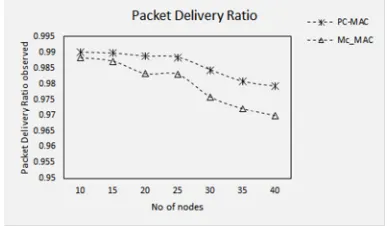
[image:8.612.97.292.271.384.2] [image:8.612.318.521.370.491.2]The packet delivery ratio observed for both PC-MAC and MC-PC-MAC is above 95% that depicted in figure 1.
Figure 1: The Comparison Of Packet Delivery Ratio Observed For MC-MAC And PC-MAC
Figure 2: Comparison Of Packet Delivery Ratio With Bounded Time Persistence Between PC-MAC And
[image:8.612.92.296.417.544.2]MC-MAC
Figure 3: Comparison Of End-To-End Delay Observed Between PC-Mac And MC-MAC
However, packet delivery ratio with bounded time persistence is substantially low in MC-MAC that compared to PC-MAC (depicted in figure 2). The bounded time persistence and end-end delay observed for PC-MAC is significantly high and low respectively, which is since successful avoidance of congestion and control packet overhead in PC-MAC that compared to MC-MAC. Hence, the end-end delay also considerably low in PC-MAC (see fig 3).
The process overhead is depicted by the aggregate value of the number of retransmissions occurred for data frames (due to congestion) and the number of control packets involved that depicted in figure 4. The occurrence of retransmission of the data frames is very low in PC-MAC, which is due to the successful priority based multicast strategy proposed in PC-MAC. In addition, the control packets involved in PC-MAC are low, since the
ACK
frames sent by target nodes only toacknowledge the successful delivery of the missing packets.
Figure 4: The Comparison Of Process Overhead Observed For MC-MAC And PC-MAC
The phenomenal advantage of the PC-MAC that senses from the experimental study is successful avoidance of the congestion during multicasting the data frames at MAC level, which achieves linearity in process complexity. This is since, the retransmission of the frames are conditional and limited to only missing frames and the node that multicasts the sequence of data frames is not flooded with acknowledgements as the target nodes
send
ACK
frames upon receiving missing framessuccessfully.
5. CONCLUSION
[image:8.612.95.292.592.704.2]3391 networks. The critical objective of the proposal is congestion avoidance at group level transmission occurs at multicasting routes. Unlike existing contemporary models that transmit data in sequence at group level, the proposed model multicasts at group level with minimal control overhead and congestion avoidance. The PC-MAC can use as underlying mac layer for any contemporary multicasting protocols found in
literature. The experiments conducted on
simulation environment and performance of the proposed model assessed through metrics like Packet delivery ratio with and without bounded time persistence, process overhead and end-to-end delay. The results obtained concerning these metrics were compare to the other contemporary model called MC-MAC, which evinced the significance of the proposal towards congestion avoidance, bounded time persistence and minimal process overhead. The future research can extend this model to schedule the frames based on their delay sensitivity.
Conflict of Interest:
All authors certify that they have participated sufficiently in the work to take public
responsibility for the content, including
participation in the concept, design, analysis,
writing, or revision of the manuscript.
Furthermore, each author certifies that this material or similar material has not been and will not be submitted to or published in any other publication
REFERENCES:
[1] Milenkovic, A., Otto, C., & Jovanov, E.
(2006). Wireless sensor networks for personal
health monitoring: issues and an
implementation.Computer Communications,
29(13–14), 2521–2533. doi:10.1016/
j.comcom.2006.02.011. (Wireless Sensor
Networks and Wired/Wireless Internet
Communications).
[2] Martı´nez, J.-F., Garcı´, A.-B., Corredor, I., Lo
´pez, L., Herna´ndez, V., & Dasilva, A. (2007). QoS in wireless sensor networks: Survey and approach. InProceedings of the
2007 Euro American conference on
Telematics and information systems(p. 20).
[3] Gopalan, S.A., Energy-efficient MAC
protocols for wireless body area networks: Survey, Ultra-Modern Telecommunications
and Control Systems and Workshops
(ICUMT), 2010.
[4] Latre, B.; Braem, B.; Moerman, I.; Blondia,
C., A Survey on Wireless Body Area Networks. Wireless Networks Volume 17 Issue 1, January 2011.
[5] Chris Otto, Aleksandar Milenkovic, Corey
Sanders, Emil Jovanov System architecture of a wireless Body area sensor Network for ubiquitous health monitoring, Journal of Mobile Multimedia, vol. 1, no. 4, pp. 307–326, Jan. 2006
[6] Ian F. Akyildiz, W. Su, Y.
Sankarasubramaniam, E. Cayirci Wireless
sensor networks: a survey. Computer
Networks, vol. 38, no. 4, Mar 2002.
[7] Yigitel, M. A., Incel, O. D., & Ersoy, C.
(2011). QoS-aware MAC protocols for wireless sensor networks: A survey.Computer Networks, 55(8), 1982–2004.
[8] M.A. Ameen, Ahsanun Nessa, Kyung Sup
Kwak, QoS issues with focus on Wireless Body Area Networks. Third 2008 International Conference on Convergence and Hybrid Information Technology
[9] Petcharat Suriyachai, Utz Roedig, and Andrew
Scott, A Survey of MAC Protocols for
Mission-Critical-Applications in Wireless
Sensor Networks, IEEE Communications Surveys and Tutorials, vol. 14, no. 2, pp. 240– 264, Mar. 2011.
[10]Dr. Md. Abdur Razzaque QoS Provisioning in
Wireless Sensor Network. For Location Aware Network. VDM Verlag.
[11]Hossain, M.S., El Saddik, A., QoS
Requirement in the Multimedia Transcoding Service Selection Process., IEEE Transactions on Instrumentation and Measurement, June 2010, vol. 59 , no. 6, pp. 1498–1506 )
[12]Wireless Medium Access Control (MAC) and
Physical Layer (PHY) Specifications for Low-Rate Wireless Personal Area Networks (WPANs), IEEE Std 802.15.4-2006
[13]Gang Zhou, Jian Lu, Chieh-YihWan, Mark D.
Yarvis, and John A. Stankovic BodyQoS: Adaptive and Radio-Agnostic QoS for Body Sensor Networks, INFOCOM 2008. The 27th Conference on Computer Communications, IEEE, April 2008.
[14]Yoon, J.S. , Gahng-Seop Ahn , Seong-Soon
3392
[15]Iffat Anjum, Nazia Alam, Md. Abdur
Razzaque, Mohammad Mehedi Hassan, Atif Alamri A Priority Based Traffic Load Adaptive MAC Protocol for QoS Provisioning in Body Sensor Networks, International Journal of Distributed Sensor Networks, vol. 2013 (2013)
[16]Muhammad Mostafa Monowar, Mohammad
Mehedi Hassan, Fuad Bajaber, Musaed Al-Hussein, and Atif Alamri McMAC: Towards a MAC Protocol with Multi-Constrained QoS Provisioning for Diverse Traffic in Wireless Body Area Networks, sensors ISSN 1424-8220, 2012.
[17]Li C, Hao B, Zhang K, Liu Y, Li J. A novel
medium access control protocol with low delay and traffic adaptivity for wireless body area networks. Journal of Medical Systems, Springer. October 2011, vol. 35, pp. 1265– 1275.
[18]Md. Obaidur Rahman, Choong Seon Hong,
Sungwon Lee, and Young-Cheol Bang. ATLAS: A Traffic Load Aware Sensor MAC Design for Collaborative Body Area Sensor Networks. Sensors 2011, pp. 11560–11580
[19]Ben-Othman, J., Mokdad, L., & Yahya, B.
(2011). An energy efficient priority-based QoS MAC protocol for wireless sensor networks. In
Communications (ICC), 2011 IEEE
International Conference on (pp. 1–6).
[20]Zarei, Z., Safavi, S. M., & Abbasi, A. (2012).
A MAC protocol for provisioning QoS and energyefficiency in WSNs. International Journal of Computer Theory and Engineering, 4(4), 489–493.
[21]Arifuzzaman, M., Matsumoto, M., & Sato, T.
(2013). An intelligent hybrid MAC with traffic-differentiation- based QoS for wireless sensor networks. IEEE Sensors Journal, 13(6), 2391–2399.
[22]Khiati, M., & Djenouri, D. (2012)
Cluster-based fast broadcast in duty-cycled wireless sensor networks. In Network Computing and
Applications (NCA), 2012 11th IEEE
International Symposium on (pp. 249–252).
[23]Lu, J., Van Den Bossche, A., & Campo, E.
(2012) Improving robustness and flexibility of MAC layer for guaranteed QoS indoor monitoring in wireless mesh sensor networks. In Wireless Communications in Unusual and
Confined Areas (ICWCUCA), 2012
International Conference on (pp. 1–6).
[24]Touil, H., Fakhri, Y., & Benattou, M. (2012). Energy-efficient MAC protocol based on IEEE 802.11e for wireless multimedia sensor
networks. In Multimedia Computing and
Systems (ICMCS), 2012 International
Conference on (pp. 53–58).
[25]Wang, Y., Vuran, M. C., & Goddard, S.
(2012). Cross-layer analysis of the end-to-end delay distribution in wireless sensor networks. IEEE/ACM Transactions on Networking, 20(1), 305–318.
[26]Zhao, J., Qiao, C., Sudhaakar, R. S., & Yoon,
S. (2013). Improve efficiency and reliability in single-hop WSNs with transmit-only nodes. IEEE Transactions on Parallel and Distributed Systems, 24(3), 520–534.
[27]Nguyen, K., & Ji, Y. (2012). Asynchronous
MAC protocol with QoS awareness in wireless sensor networks. In GLOBECOM—IEEE Glob. Telecommun. Conf. (pp. 555–559).
[28]Fafoutis, X., Di Mauro, A., Vithanage, M. D.,
& Dragoni, N. (2015). Receiver-initiated medium access control protocols for wireless sensor networks. Computer Networks, 76, 55– 74.
[29]Jang, B., Lim, J. B., & Sichitiu, M. L. (2013).
An asynchronous scheduled MAC protocol for wireless sensor networks. Computer Networks, 57(1), 85–98.
[30]Naderi, M. Y., Nintanavongsa, P., &
Chowdhury, K. R. (2014). RF-MAC: A medium access control protocol for re-chargeable sensor networks powered by wireless energy harvesting. IEEE Transactions on Wireless Communications, 13(99), 3926– 3937.
[31]Doudou, M., Djenouri, D., Badache, N., &
Bouabdallah, A. (2014). Synchronous
contention-based MAC protocols for delay-sensitive wireless sensor networks: A review and taxonomy. Journal of Network and Computer Applications, 38, 172–184.
[32]Ozen, Y., Bayilmis, C., Bandirmali, N., &
Erturk, I. (2014). Two tiered service differentiation and data rate adjustment scheme for WMSNs cross layer MAC. In Proceedings of 11th International Conference on Electronics, Computer and Computation (pp. 1–4). Abuja, Nigeria.
[33]Andreou, P. G., Zeinalipour-Yazti, D.,
Samaras, G. S., & Chrysanthis, P. K. (2014). A network-aware framework for energy-efficient data acquisition in wireless sensor networks.
Journal of Network and Computer
Applications, 46, 227–240.
3393 coexistence in wireless sensor networks. Computer Networks, 76(1), 1–16.
[35]X. Zhang, H. Jiang, X. Cheng, L. Zhang, An
energy efficient implementation of on demand MAC protocol in medical Wireless Body Sensor Networks. Circuits and Systems, 2009, ISCAS 2009, IEEE International Symposium, May 2009.
[36]X. Zhang,H. Jiang , L. Zhang, C. Zhang, An
Energy-Efficient ASIC for Wireless Body Sensor Networks in Medical Applications. Biomedical Circuits and Systems, IEEE Transactions, vol. 4, no. 1, Feb. 2010.
[37]Pereira, Rodolfo Miranda, LinnyerBeatrys
Ruiz, and Maria Luisa Amarante Ghizoni. "MannaSim: A NS-2 extension to simulate Wireless Sensor Network." ICN 2015 (2015): 107.
[38]Downard, Ian T. Simulating sensor networks