4140
AN ADVANCED REVENUE DISTRIBUTION MODEL FOR
CLOUD MEDIA CONTENTS SALES WITH MULTI-DRM
1YOUNGMO KIM, 2BYEONGCHAN PARK, 3EUNJI SEO, 4BYUNG-GI KIM, 5SEOK-YOON KIM
Soongsil University, Seoul, Korea
E-mail: 1[email protected], 2[email protected], 3[email protected],
4[email protected], 5[email protected]
ABSTRACT
DRM technology to prevent illegal copying of digitized contents can control illegal copying by controlling usage of contents according to user's rights. However, options for revenue sharing were rather limited since DRM technology is dependent on the platform and uses only one technique applied by a content distributor. This problem is conspicuous in the case of contents used on multiple platforms, and inconveniences and additional costs arise due to the application of multiple DRMs.To slove this problem, this paper suggests a profit sharing model in cloud-based media service with application of multiple DRMs, in which contents providers can choose their favorate DRMs and get their share of profit after saling contents. The proposed model is more flexible than the existing models in that it can accept various profit sharing policies for each stake-holder’s interests.
Keywords: Cloud Media Service, DRM, Copyright, Accounting Models
1. INTRODUCTION
As the sales platform of contents has changed from off-line to online distribution market, digitized contents can be purchased more quickly and easily through network. Recently, the number of providers to build online services using cloud computing has increased because of low cost and high efficiency. Also, in the distribution of digital contents, there are increasing cases of using cloud services to produce and process UHD-TV and 3D broadcasting contents. The digital content purchase method in the cloud environment is advantageous in that contents can be supplied at any time when necessary, and physical space is not required, but there is a problem about piracy due to malicious usage.
There are many technical and legal efforts to solve this problem. One of the representative technologies is DRM technology. DRM is a technology for preventing the illegal copying by restricting the use of the applicable contents, and controlling illegal copying by controlling the usage of the contents.
In existing online-based content distribution platforms, only the purchaser of the encrypted content can acquire both the encrypted
content and the right to use it using the key, and the amount thus sold is distributed to the copyright owner and the content distributor. However, there is a problem in that such a content distribution platform is advantageous only to USER because the fee is payed a at a rate determined by the content distribution platform without consideration of the content usage amount of USER, which is disadvantageous to the content seller or DRM provider [1].
In this paper, we propose a more flexible profit distribution model than existing ones for the purpose of presenting the clear, objective and reasonable criteria to both participants and USER. To this purpose, it is necessary that content providers can select a DRM to be applied to their content among multiple DRMs on cloud-based media platforms and the platform can estimate the contribution amount of each participant to the revenue generated by the content.
2. RELATED STUDIES
2.1 DRM Technology
4141 distributed and used, and controls the use of digital contents in accordance with the granted rights information. The existing DRM technology mainly targets the stored contents and protects contents by using encryption technology, authentication technology, key management technology, packaging technology, rights expression technology, and usage control technology.
The four most fundamental components of DRM are User, Contents, Permission, and Condition. Content should be protected for use only by authorized users as an information unit with valuable intellectual property. Content is an information unit that is worthy of intellectual property and should be protected to be used only by authorized users. A user is a subject who uses content according to usage rights and conditions, and the use of the content is determined by each specified usage right. The usage conditions include requirements and constraints to grant usage rights. The association between these elements must be able to be continuously protected during the life cycle of the content, be systematically processable, and be controllable according to the specified rights [2].
DRM can effectively block the illegal use of digital contents, but the standardization and interchangeability between different DRM solutions are not achieved yet. In other words, content users cannot use downloaded contents or streaming service on a device with a different DRM, and new DRM should be applied whenever platform is changed [3].
2.2 Multi-DRM Technology
Multi-DRM technology is a technology that ensures compatibility among a plurality of DRM technologies through a common encryption scheme, and enables contents using different DRM technology to be used in various devices. Since the user can authenticate the DRM according to the platform of his / her own device, the user can protect the copyright of the digital content. The content provider(CP) can also enjoy the service provision on various platforms by uploading the digital content only once because multiple DRMs are applied to the digital content. Multi-DRM technology adopts DRM technology using common encryption scheme, so it can induce participation of various DRM vendors, and content users can use services in various devices [4].
3. SALES REVENUE DISTRIBUTION
MODEL WITH THE APPLICATION OF MULTI-DRM
In this paper, we propose a multi-DRM technology that enables the use of DRM-applied
content in various devices, ensuring
interoperability between different DRM
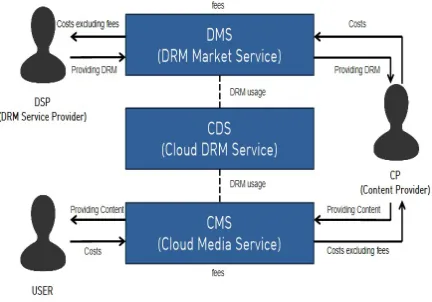
technologies. This model also enables the efficient revenue distribution among content provider, DRM service providers, and the cloud media service providers when the content is sold. The revenue distribution model proposed in this paper starts with the integrated media cloud platform. The cloud platform consists of three subsystems and three members. Each system consists of DMS (DRM Market Service), CMS (Cloud Media Service) and CDS (Cloud DRM Service). Members consist of DSP (DRM Service Provider), CP (Content Provider) and User. We also define the revenue structure and settlement model for each member in the content distribution model.
3.1 Integrated Media Cloud Platform
The primary purpose of integrated media cloud platform is to sell the content to USER through the application of DRM to the content by CP when the DSP distributes the DRM in the online market. The integrated media cloud platform for DRM technology royalty collection is
[image:2.612.321.537.467.618.2]shown in Figure1[5].
Figure 1: Integrated Media Cloud Platform A description of each term is as follows. - CP: Contents Provider, a person who sells
content, who purchases DRM from DSP through DMS
4142 - DMS: DRM Market Service, DRM service
provider
- CDS: Cloud DRM Service, DRM authentication system
- CMS: Cloud Media Service, content service provider
One of primary purposes of integrated cloud media platform is to provide the online marketplace for distributing DRMs of DSP.
DMS receives DRM from DSP and sells DRM to CP. CMS is a market where CP uploads and sells contents, and shares DRM information with DMS. Therefore the CMS must be able to handle all the DRMs sold by the DMS. The CP must provide DRM-applied content when uploading content to the CMS. When applying DRM, it is basically required to go through DMS, but it can also be registered in CMS in case of applying CP-owned DRM, only if the CP-owned DRM is registered in the DMS. CDS is a DRM management server provided by DSP and functions as basic DRM metadata generator and DRM license authentication server at the same time. Finally, the user receives the DRM-applied content through the CMS. At this time, the content service provided by the CMS to is limited to streaming.
3.2 Revenue Distribution Model
In the existing revenue distribution models, DSP and CP have obtained a certain rate from the amount paid by USER, which is determined by the content distribution platform, and the remaining amount has been distributed to the distribution platform and the advertisement company. Therefore, the CP and the DSP were structured so as not to receive the amount proportional to the content and DRM service provided.
In the content distribution platform structure proposed in this paper, a CP can select a DRM to be applied to his/her content and the revenue generated by the content can be distributed objectively and reasonably to each participant by the estimates of the contribution degree.
In a cloud-based media service with multi-DRM technology, CP can choose either flat-rate or meter-flat-rate for content sales according to the DRM technology. The flat-rate system will transfer the usage rights for the content to the User
for a certain period of time, and the User pays the corresponding fee in advance. The meter-based system freely uses DRM-applied content but measures and charges the amount of usage for a certain period. It is necessary to pay the content usage fee through a separate prepayment system because the content should be used first and the content usage fee must be paid in advance. Each DRM / content purchase can be chosen in either flat-rate or meter-rate system, and the total scenario can be classified into four revenue distribution models.
3.2.1 Revenue Distribution Model For Flat-rate DRM Purchase And Flat-rate Content Purchase
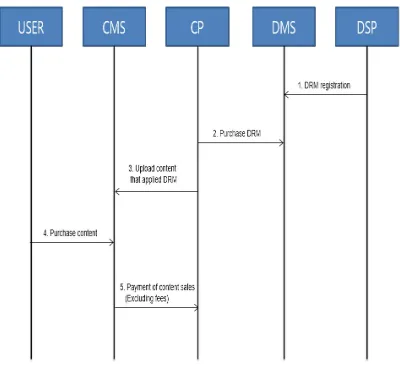
[image:3.612.320.520.403.588.2]Figure 2 shows the model in which CP purchases DRM technology with a flat fee and USER purchases content at a flat-rate and distributes revenue. When CP purchases DRM technology through a DMS and uploads content to CMS, USER purchases the content uploaded to CMS at a fixed price. Since the rights to use the content are paid in advance for a certain period of time, there is no need to record how much the content has been used
Figure 2: Revenue Distribution Model for Flat-Rate DRM Purchase and Flat-Rate Content purchase
The scenario of DRM and content distribution process for this model is as follows. 1. DSP registers DRM technology in DMS.
2. CP purchases the DRM provided by the DSP at
flat-rate through the DMS.
4143 4. USER pre-pays to CMS at flat-rate for a month
(all contents are available).
5. CMS pays CP, excluding any appropriate
commissions accrued from sales revenue. If
CP has its own CMS, all the sales revenue is transferred to the CP.
3.2.2 Revenue Distribution Model For
[image:4.612.318.523.221.375.2]Flat-rate DRM Purchase And Meter-rate Content Purchase
[image:4.612.91.299.338.495.2]Figure 3 shows a model in which content providers purchase DRM technology for a flat fee and users distribute the content as a basis to distribute revenue. When a CP purchases a DRM technology through a DMS and uploads the content to the CMS, the content usage fee is imposed on the CMS by recording how much the content user has used the content and calculating the amount of the content.
Figure 3: Revenue Distribution Model for Flat-Rate DRM Purchase and Meter-rate Content purchase
The scenario of DRM and content distribution process of this model is as follows. 1. DSP registers DRM technology in DMS. 2. CP purchases the DRM provided by the DSP at
a flat rate through the DMS.
3. CP applies the DRM purchased through the DMS to the content and uploads it to the CMS. 4. USER purchases content through CMS at a
meter-rate (e.g., one week for each content). 5. CMS records the content used by USER. 6. CMS pays CP, excluding any appropriate
commissions accrued from sales revenue. If CP has its own CMS, all the sales revenue is transferred to the CP.
3.2.3 Revenue Distribution Model For M
eter-rate DRM Purchase And Flat-rate Content
Purchase
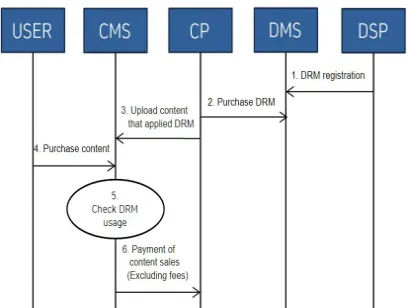
Figure 4 shows the profit sharing case of using a flat rate for purchasing some contents and a meter rate for purchasing a DRM technology. In this case, CMS records the amount DRM usage during the fixed period using exterior cloud DRM server whenever the user uses contents and calculates the charge accrued.
Figure 4: Revenue Distribution Model for Meter-rate DRM Purchase and Flat- rate Content purchase
The scenario of DRM and content distribution process for this model is as follows. 1. DSP registers DRM technology in DMS. 2. CP purchases the DRM provided by the DSP at
flat-rate through the DMS.
3. CP applies the DRM purchased through the DMS to the content and uploads it to the CMS. 4. USER purchases content through CMS at a flat
rate.
5. CMS records the DRM used.
6. CMS pays CP, excluding any appropriate commissions accrued from sales revenue.
If CP has its own CMS, all the sales revenue is transferred to the CP.
3.2.4 Revenue Distribution Model For M
eter-rate DRM Purchase And Meter-rate Content
Purchase
4144 at a meter-rate, and finally CMS calculates the portion of sales revenue for the used DRM.
Figure 5: Revenue Distribution Model for Meter-rate DRM Purchase and Meter-rate Content purchase
The scenario of DRM and content distribution process for this model is as follows. 1. DSP registers DRM technology in DMS. 2. CP purchases the DRM provided by the DSP at
a flat-rate through the DMS.
3. CP applies the DRM purchased through the DMS to the content and uploads it to the CMS. 4. USER purchases content through CMS at
meter-rate (e.g., one week for each content). 5. CMS records the content used by USER. 6. CMS will settle the content used every month
and pay to CP, DMS, excluding any appropriate commissions accrued from sales revenue.
4. EXPERIMENTAL RESULTS
For the models proposed in this paper, we have experimented the sales revenue distribution process among the 5 participants by applying fictional numers for DRMs and contents. For the USER, CMS, DMS, DSP, and CP, we apply the proposed four sales revenue distribution policies to calculate the settlement. Content is basically defined as video content and is defined as 1000 won per basic unit. When the user chooses a flat rate, it is defined as 20,000 won per month. DRM is defined as 50,000 won per content when used without limit. Finally, since multiple DRMs are allowed in the platform, we experiment with supporting multiple DSPs.
4.1 Settlement Based On Sales Revenue Distribution Model With Flat-Rate DRM And Flat-rate Content Purchase
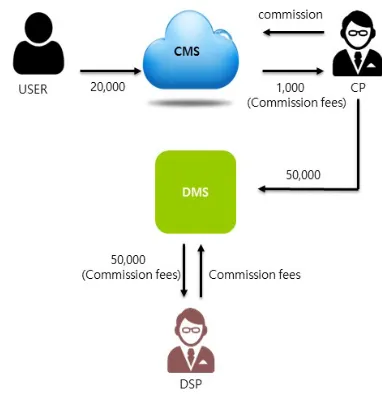
When DRM and content are purchased at a flat rate, the sales revenue distribution proceeds as shown in Figure 6 and Table 1.
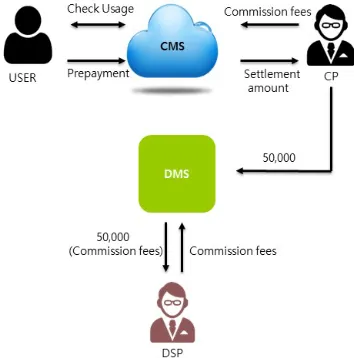
Figure 6: Settlement Process When Purchasing both DRM and Content at a Flat-Rate
[image:5.612.325.516.174.371.2]In Fig. 6, DSP registers DRM technology to DMS with the selling price of 50,000 won. CP purchases a DRM at 50,000 won through DMS, then applies it to the content and uploads it to the CMS. USER buys content for 20,000 through CMS. At this time, the CMS pays CP for the portion of sales revenue from USER excluding the commission.
Table 1: Settlement Result Example When Purchasing both DRM and Content at a Flat-Rate
(Unit: won) User CMS CP DMS DSP#1 DSP#2 percentCMS
[image:5.612.309.530.545.702.2]4145 Table 1 shows that when the sales revenue of content and DRM is settled at a flat rate, the results of DSP # 1 and DSP # 2 are the same. Comparing the case of providing one DRM and the case of providing multiple DRMs, this experiment shows no difference.
4.2 Settlement Based On Sales Revenue Distribution Model With Flat-Rate DRM And Meter-rate Content Purchase
[image:6.612.107.284.284.463.2]When DRM is purchased at a flat rate and contents are purchased at a meter-rate, the sales revenue distribution proceeds as shown in Figure 7 and Table 2.
Figure 7: Settlement Process When Purchasing DRM at a Flat-Rate and Content at a Meter-Rate
In Fig. 7, DSP registers DRM technology to DMS with the selling price of 50,000 won. CP purchases DRM at a rate of 50,000 won through DMS, applies DRM to the content, and uploads it to the CMS. USER purchases the content on a meter-rate and pays for the amount of usage. The CMS records the amount of content used by USER. At this time, the CP settles the settlement amount received from the CMS to pay 1,000 won on the premise that the user watches a video content to the end. The CMS pays CP, excluding the commission from the sales revenue obtained from USER.
Table 2: Settlement Result Example When Purchasing DRM at a Flat-Rate and Content at a Meter-Rate
(Unit: won)
Analyzing the results in Table 2 shows that CMS measures the usage of contents for the case of purchasing contents at a meter rate, and calculates the revenue amount according to the usage amount. In this case, it is preferable to settle the sales revenue for a certain period of time (e.g., Week, Month) since the problem may occur if CMS makes settlement every time whenever the content is used.
4.3 Settlement Based On Sales Revenue Distribution Model With Meter-rate DRM And Flat-rate Content Purchase
[image:6.612.319.516.486.640.2]When DRM is purchased at a meter rate and contents are purchased at a flat-rate, the sales revenue distribution proceeds as shown in Figure 8 and Table 3.
Figure 8: Settlement Process When Purchasing DRM at a Meter-Rate and Content at a Flat-Rate
After the DSP registers the DRM technology in the DMS in Fig. 8, the CP selects the DRM to be applied through the DMS and purchases the DRM in a meter rate. The DRM is
User CMS CP DMS DSP #1 DSP #2 percenCMS tage
DMS percen tage
Used contents
* 1000
4146 applied to the CP content and uploaded to the CMS. USER buys content for 20,000 through CMS. At this time, the CMS pays CP to the portion of sales revenue obtained from USER excluding the commission.
Table 3: Settlement Result Example When Purchasing DRM at a Meter-Rate and Content at a Flat-Rate
(Unit: won)
Table 3 shows that DRM costs are significantly reduced when DRM is used at a flat rate. In this experiment, the DRM cost can be reduced for CP because it is assumed that two devices with different DRMs are used when consuming one content.
4.4 Settlement Based On Sales Revenue Distribution Model With Meter-rate DRM And Meter-rate Content Purchase
[image:7.612.313.523.308.479.2]When both DRM and content are purchased and used at meter rates, the sales revenue distribution proceeds as shown in Figure 9 and Table 4.
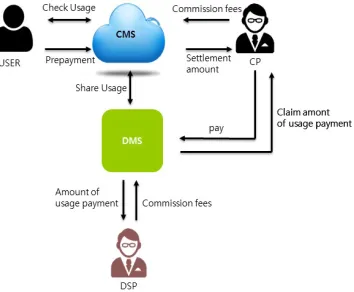
Figure 9: Settlement Process When Purchasing both DRM and Content at a Meter-Rate
After the DSP registers the DRM technology in the DMS in Fig. 9, the CP selects the DRM to be applied through the DMS and purchases the DRM in a meter rate. Then CP applies DRM to the content and upload it to CMS. USER purchases content on a meter rate and pays for the amount of usage.
CMS and the DMS receive fees from CP and DSP, respectively, in the form of commision. CMS shares the content usage with the DMS and pays the revenue amount based on the usage amount to CP and DSP excluding the commission. The commision fee is paid to CMS and DMS.
Table 4: Settlement Result Example When Purchasing both and Content at a Meter-Rate
(Unit: won)
USER CMS CP DMS DSP#1 DSP#2 percentCMS age
DMS percen tage
DRM #1 Usage
DRM# 2 Usage
Used Contents
* 1,000
400 600 20,000 20,000 30,000 40% 40% 0.4 0.6
350 550 17,500 31,000 19,000 35% 35% 0.62 0.38
300 500 15,000 39,000 11,000 30% 30% 0.78 0.22
250 450 12,500 17,000 33,000 25% 25% 0.34 0.66
200 400 10,000 34,500 15,500 20% 20% 0.69 0.31
150 350 7,500 14,500 35,500 15% 15% 0.29 0.71
The analysis of Table 4 results shows that the cost burden of consumers (contents USER) and CPs (DRM consumers) is significantly reduced when DRM and content are used at meter rates. Therefore, it is possible to create an environment where CP can use DRMs efficiently if multi-DRMs are used.
In addition, since the DRM is priced in proportion to the amount of service provided to the CP by selling the DRM to the DSP, it becomes a fair transaction condition for the DRM service provision performance.
5. CONCLUSION
Businesses who want to build media services using cloud computing have technology limitation in protecting copyright and applying business model using it due to the problem of applying only one copyright protection
USER CMS CP DMS DSP#1 DSP#2 percentCMS age
DMS percent age
DRM# 1 Usage
DRM# 2 Usage 20,000 400 600 20,000 20,000 30,000 40% 40% 0.4 0.6
20,000 350 550 17,500 31,000 19,000 35% 35% 0.62 0.38
20,000 300 500 15,000 39,000 11,000 30% 30% 0.78 0.22
20,000 250 450 12,500 17,000 33,000 25% 25% 0.34 0.66
20,000 200 400 10,000 34,500 15,500 20% 20% 0.69 0.31
[image:7.612.95.272.561.707.2]4147 technology. In addition, the current online content distribution platforms use only one DRM technology applied by the content distributor, so the content provider has limited right of choice in content distribution and sales revenue distribution.
In this paper, we have proposed an advanced revenue distribution model to solve this problem in a cloud-based media service platform with two or more DRMs. In the content distribution platform structure proposed in this paper, a CP can select a DRM to be applied to his/her content and the revenue generated by the content can be distributed objectively and reasonably to each participant by the estimates of the contribution degree.
The proposed revenue distribution model has shown that CPs and DRM vendors are more advantageous than existing models, and it has also provided a greater flexibility in selecting content
and DRM services to service providers, copyright
holders and users since the profit is distributed according to the content usage amount of users.
However, there is a limitation in the proposed model in that USER's fee for content usage is inevitably raised in order to distribute more profit to CPs and DRM providers, and the proposed profit distribution model is not fixed. Future studies will need to be done in the implementation and verification field using this model, and in expanding and complementing the model to portray the real content transaction activities with more sophisticated modeling.
REFERENCES:
[1] Seunghyeok Baek, Sangkyu Byun and Gwangjae Kim, “Broadcasting Contents Market and Profit Distribution Model,” KCI, Vol. 29, No. 1, 2015.
[2] Kim Jae Woo and Kang Hee Kim, “Digital Rights Management (DRM),” TCI REPORT, BA551, 2006.
[3] Ji Hyun Park, Jung Yeon Jeong, and Yi Kee-Seung, “DRM Technology Trends,” Electronic Communications Trend Analysis, Vol. 22, No. 4, August 2007.
[4] D. Jo, S. Hwang, G. Jeong, and H. Rim, “A Digital Media Service System Supporting Multi-DRM in Cloud Environment,” Journal of Korea Multimedia Society, Vol. 19, No. 4, April 2016.
[5] Y. Kim, “A DRM Charging Model Depending on Contents Usage in Cloud-Based Contents Distribution Platform”, EEECS, Vol-3 ISSN 2466-152X
[6] H. Lee, C.Seo and S.U, Shin, “DRM cloud Architecture and Service Scenario for Content Protection,” Journal of Internet Service and Information Security, Vol. 3, No. 3, 2013, pp. 94-105.
[7] S. H Cho, S. Y. Jeong, S. C. Lim, J. H. Kim, D. Y. Lee, and J. S. Choi, “Paradigm Shift on Broadcasting Contents Productions and Services based on Cloud Computing, Electronics and Telecommunications Trends,” Vol. 29, No. 3, 2014.
[8] Y. D. Seo, “Flat-rate vs. Usage-based Pricing in Digital Music Industry,” KACE , Vol.16 , No. 3, 2013.
[9] D. C. Jang and B. H. Ahn, “ Pricing Strategy, Profit Sharing, and Market Structure in Digital Music Contents Industry,” KORMS, Vol. 34, No. 1, 2009.