IJPSR (2014), Vol. 5, Issue 5 (Research Article)
Received on 12 December, 2013; received in revised form, 22 January, 2014; accepted, 28 March, 2014; published 01 May, 2014
FORMULATION AND DEVELOPMENT OF FLAVOXATE HYDROCHLORIDE EXTENDED RELEASE CAPSULES
K. Satyavathi*, M. Venu, P. Gayathri, P. Bhojaraju and L.K. Kanthal
Koringa College of Pharmacy, Department of Pharmaceutics, Korangi-533 461, Tallarevu (M), E.G. Dist., Andhra Pradesh, India
ABSTRACT: Flavoxate Hydrochloride is an antispasmodic, mainly used for treating painful urination, urgency of urination and incontinence. The primary objective of the study was to formulate extended release capsules of Flavoxate hydrochloride to reduce dosing frequency and decreasing the associated side effects. The extended release capsules were formulated using extrusion spheronisation process with ethyl cellulose, HPMC polymers. First, pellets (C1 to C6) containing varying amounts of Ethyl cellulose or Microcrystalline cellulose, Dicalcium phosphate and Eudragit NE30D55 were prepared using extrusion spheronisation (C6 was selected). Then the selected pellets were coated with different drug loading solution (DL 1 to DL7) with varying concentrations of Methocel (DL7 was selected).Finally extended release coating was applied to optimized drug loaded pellets and ten batches (E1 to E10) were prepared.. The dissolution profile comparison of the prepared batches E1 to E10and market preparation (Urispass) was done by difference factor (f1) and similarity factor (f2) determination. The formulation E9 (EC: HPMC 1:1 ratio) with a difference factor f1 (5.9) and similarity factor (f2) of 64.6 was selected as the optimized formulae for scale-up batches. The dissolution data were fitted into zero-order, first-order, Higuchi and Korsmeyer-Peppas models to identify the pharmacokinetics and mechanism of drug release.
INTRODUCTION: Pelletization is an agglomeration process that converts fine powders or granules of bulk drugs and excipients into small, free-flowing, spherical or semi-spherical units,
referred to as pellets 1. Pellets are defined as small
spherical or semispherical particles made up of fine powders or granules of drugs and excipients, by a
variety of processes 2, 3. The use of polymers such
as chitosan 4, crosspovidone 5, starch 6, pectin 7, 8,
dextrin 9 and carrageenan 10, for the manufacture of
pellets by extrusion-spheronization has been
described.
QUICK RESPONSE CODE
DOI:
10.13040/IJPSR.0975-8232.5(5).1949-56
Article can be accessed online on:
www.ijpsr.com
DOI link: http://dx.doi.org/10.13040/IJPSR.0975-8232.5(5).1000-06
Extended Release dosage forms release drug slowly, so that plasma concentrations are maintained at a therapeutic level for prolonged
period of time 11.
Flavoxate HCl is a competitive muscarinic receptor antagonist, mainly used for the treatment of overactive bladder with urinary urgency and
incontinence 12.
The present work aims to formulate and evaluate
extended release capsules of Flavoxate
hydrochloride to reduce dosing frequency and the associated side effects with conventional tablets.
MATERIALS AND METHODS:
Chemicals and reagents
Flavoxate HCl sample was obtained from Hetero Drugs Pvt. Ltd, Jadcharla, India; Microcrystalline
Keywords: Pelletization, Extrusion, spheronisation, extended release.
Correspondence to Author: Dr. K. Satyavathi
Principal Koringa College of Pharmacy, Korangi-533461, Tallarevu Mandal, Andhra Pradesh, India.
cellulose, Dicalcium phosphate were purchased from Signet chemicals, India; Ethyl cellulose was purchased from CP kilico, Newzealand; Hydroxy propyl methyl cellulose was purchased from Dow Chemicals, USA.
Preformulation Study: Preformulation can be defined as the investigation of physical and chemical properties of drug substance alone and when combined with excipients. The parameters like Bulk density, Tapped density, Angle of repose, Carr’s compressibility Index, and Hausner’s ratio, solubility were found during preformulation studies. The IR spectrum of the drug was compared with that of the physical mixture to check any possible drug-excipients interaction.
Procedure for the Preparation of calibration curve by HPLC: Initially 50mg of Flavoxate
hydrochloride was accurately weighed and
dissolved in 50ml of distilled water to get primary stock solution of 1000µg/ml. From this primary stock solution aliquots of 1-5ml were pipetted and diluted to 100ml to get the solutions having concentrations of 10-50 µg/ml. Area of each solution was measured using HPLC (LUNA 100A).
Formulation of Extended Release Capsules:
Extended release capsules of Flavoxate
hydrochloride were formulated in the following stages
1. Preparation of pellets by extrusion
spheronization technique.
2. Drug loading on the prepared pellets.
3. Extended release coating on the drug
loaded pellets.
Preparation of pellets (C1-C6) by Extrusion Spheronization: Microcrystalline cellulose/ ethylcellulose and dicalcium phosphate were weighed accurately and the contents were mixed for 2-3 min in Rapid mixer granulator (RMG). Then Eudragit NE30D was added and dry mixing was continued for further 2-3min.Then purified water was added to the above mixture and mixed for 3-4min at 0.75amp in RMG.
Extrusion: The above blend was then transferred into an extruder (Umang Pharm ltd, EXT 65/9-2000) to obtain extrudes. By using extruder extrudes, of 0.8mm were obtained.
Spheronization: Extrudes obtained from the above step were spheronized using spheronizer (Umang Pharm ltd, 250/11). The process parameters used for spheronizer were as follows: Spheronization time 3min 15sec; Atomization air velocity
-1kg/cm2; 2455rpm. Then the obtained spheroids
were sifted using #30mesh and dried by using rapid drier. Process parameters used for the rapid drier
were as follows: Inlet temperature, Fluidization
temperature -60°C; Time 30 min.
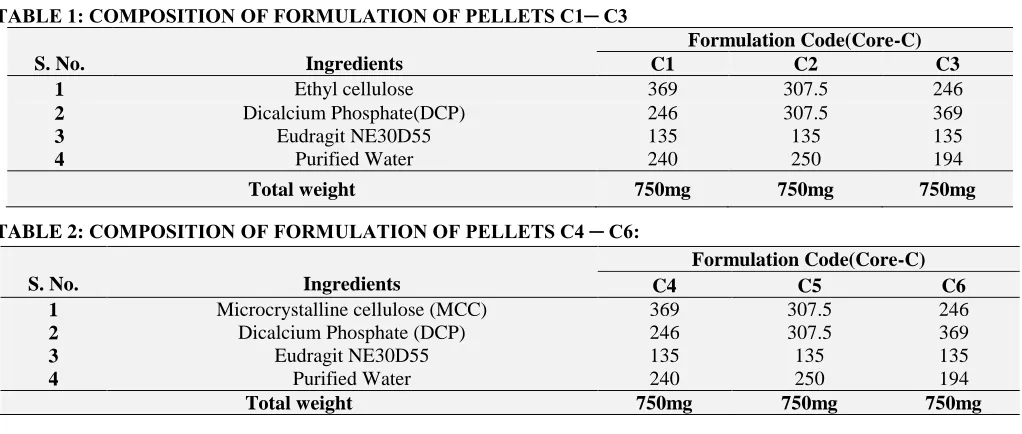
The composition of formulation of pellets for C1─
C3 is given Table 1 and the composition of
formulation of pellets for C4─ C6 is given Table 2.
[image:2.612.51.562.525.742.2]The characteristics of the pellets were observed.
TABLE 1: COMPOSITION OF FORMULATION OF PELLETS C1─ C3
S. No. Ingredients
Formulation Code(Core-C)
C1 C2 C3
1 Ethyl cellulose 369 307.5 246
2 Dicalcium Phosphate(DCP) 246 307.5 369
3 Eudragit NE30D55 135 135 135
4 Purified Water 240 250 194
Total weight 750mg 750mg 750mg
TABLE 2: COMPOSITION OF FORMULATION OF PELLETS C4 ─ C6:
S. No. Ingredients
Formulation Code(Core-C)
C4 C5 C6
1 Microcrystalline cellulose (MCC) 369 307.5 246
2 Dicalcium Phosphate (DCP) 246 307.5 369
3 Eudragit NE30D55 135 135 135
4 Purified Water 240 250 194
Drug loading on prepared pellets: MCC/DCP extrudes of selected batch (C6) obtained from extrusion spheronization in the first step were loaded in fluidized bed processor (Glatt, Japan GPCG1.1) and warmed for 10 min. Then drug loading was carried out in fluid bed processor.
Preparation of drug Coating solution: Flavoxate hydrochloride was dissolved in ethanol. The solution was stirred at 1000 rpm using stirrer. Methocel E5LV was added to the above mixture and stirring was continued for 10 min. Then purified water was added and stirring was continued until a homogeneous dispersion was obtained .The drug loading process parameters used in fluid bed processor are: Inlet Temperature (50-60˚C); Product temperature (45-55˚C); Exhaust Temperature (40-50˚C); Drive Speed (40-50CFM); Spray Rate (2-5ml/min); Atomization (1.5-1.7barr); Wurster Height (20-40cm). The compositions of coating solution were varied to achieve optimum drug loading. Different compositions of coating
solution were mentioned in Table 3. Drug loaded
pellets were subjected to drug content estimation and optimized batch was selected.
Extended release coating: Optimized batch (D7) of drug loaded pellets was taken for extended
release coating. Methocel (HPMC) and
ethylcellulose were used as polymers for extended release coating. Drug loaded pellets were loaded into fluidized bed processor and warmed to a
temperature of 30-35oC for 10 minutes and coating
was carried out using extended release coating solution.
Preparation of extended release coating solution
Required quantities of ethanol and dichloro methane were taken in a beaker and Methocel was added to it and stirred for certain time. Then ethylcellulose was added to the above dispersion and stirring was continued to get a homogeneous dispersion. The different compositions of coating
solution were given in Table 4.
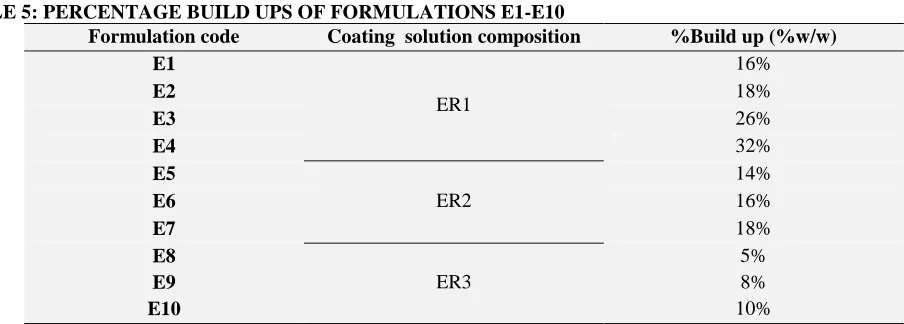
Each of the coating solutions was applied to get different percentage coating build up to obtain the desired release profile. The different coating
buildups formulated were given in the Table 5.
TABLE 3: DIFFERENT COMPOSITIONS OF COATING SOLUTIONS DL1-DL7
S. No. Ingredients Formulation code(drug loading-DL) mg/cap
DL1 DL2 DL3 DL4 DL5 DL6 DL7
1. MCC/DCP extrudes 120 120 120 120 120 120 120
2. Flavoxate
hydrochloride 4 4 4 4 4 4 4
3. Methocel E5 LV
Premium (HPMC) 6 5 4 3 2 1 1.6
4. Ethanol 100 100 100 100 100 100 100
5. Purified Water 60 60 60 60 60 50 50
TABLE 4: DIFFERENT COMPOSITIONS OF COATING SOLUTIONS ER1-ER3
S. No. Ingredients
Formulation Code (Extended release-ER)
ER1 ER2 ER3
[EC: HPMC]
Extended Release Coating (1:1) (1:0.8) (1:0.6)
1 Drug loaded Pellets
( DL7) (mg) 125.6 125.6 125.6
2 Ethyl cellulose (mg) 13 13 13
3 Methocel E5LV premium (HPMC) (mg) 13 10.4 7.8
4 Ethanol (ml) 156 156 156
TABLE 5: PERCENTAGE BUILD UPS OF FORMULATIONS E1-E10
Formulation code Coating solution composition %Build up (%w/w) E1
ER1
16%
E2 18%
E3 26%
E4 32%
E5
ER2
14%
E6 16%
E7 18%
E8
ER3
5%
E9 8%
E10 10%
Coated pellets (161.6 mg) were filled into the capsules and the capsules were evaluated.
In vitro drug release study: The in vitro
dissolution studies of extended-release tablets were performed using USP Type I dissolution apparatus (basket type) (Electro labs, India TDT-08L). The dissolution medium consisted of 900 ml of 0.01N
HCl (1st h) and phosphate buffer (pH=6.8) during
the rest of the study period maintained at 37±0.2°C. The speed of the paddle was set at 100 rpm. Aliquot of samples (5 ml) were withdrawn at specific time intervals and the same amount of buffer was replaced into the dissolution bowl to maintain the sink conditions
Release kinetics: To analyze the in vitro release data, various kinetic models were used. The drug release profile obtained in dissolution test was plotted in Zero order kinetics, First order kinetics, Higuchi square root kinetics, and Korsmeyer-Peppas model.
Comparison of dissolution profiles: The similarity in the drug release pattern of the marketed product and the formulation developed was determined by calculating the difference factor
(f1) and similarity factor (f2). The two products are
said to be similar if the value of f1 is 0 and 15 and if the value of f2 lies between 50 and 100. f2 is
given by the formula given below:
f1= {[S t=1n |Rt-Tt|] / [S t=1n Rt]} x100...
f2= 50xlog {[1+ (1/n) S t=1n (Rt-Tt) 2] -0.5 x100}....
Accelerated stability studies: Short-term accelerated stability studies for a period of three months according to International Conference on Harmonization guidelines were performed on the optimized blister-packed extended-release capsules. They were subjected to stability studies at 40°C/75%RH in a stability chamber for a period of three months. Initial evaluation of the capsules was done and at the end of first, second and third month the tablets were again analyzed for physical
appearance, water content and in vitro drug release
profile.
RESULTS AND DISCUSSION:
Preformulation Studies: In the preformulation studies, the results indicated that the drug has very poor flow properties (Carr’s compressibility index 33.3% and Hausner’s ratio 1.5).The solubility studies indicated that the drug has good aqueous solubility (16.26mg/ml)
Drug-compatibility studies: The compatibility between the drug and other excipients was evaluated using FTIR peak matching method which confirmed the absence of any chemical interaction.
The results were shown in Figure 1 a & b. The
following bands were observed in the spectra:
tertiary amine (3415), C-H stretching in CH3
FIGURE 1 a: IR SPECTRUM OF DRUG
FIGURE 1 b: IR SPECTRUM OF DRUG +MCC+DCP
Calibration curve of Flavoxate hydrochloride
Calibration curve of Flavoxate hydrochloride was
plotted using HPLC (Fig. 2).The standard curve
was generated for the entire range from 10-50 µg/ml. The chromatographic conditions are as follows:
Mobile phase- Acetonitrile: Phosphate buffer (55:45) pH-7.0; column - C-18; Detector
wavelength -210nm; Flow rate -1ml/min.;
Software-Empower photo iodide array software.
FIGURE 2: CALIBRATION CURVE OF FLAVOXATE HYDROCHLORIDE
Formulation of Extended release capsules:
Preparation of pellets by extrusion spheronization: Six batches pellets were prepared by extrusion spheronization technique and the characteristics of the prepared pellets were observed. Of all the six, C6 formulation has smooth surface with suitable hardness.
Drug loading on prepared pellets: Pellets of formulation C6 were coated using different coating compositions. The drug content was estimated from the drug coated pellets and DL7 formula was selected (99.8% drug content).
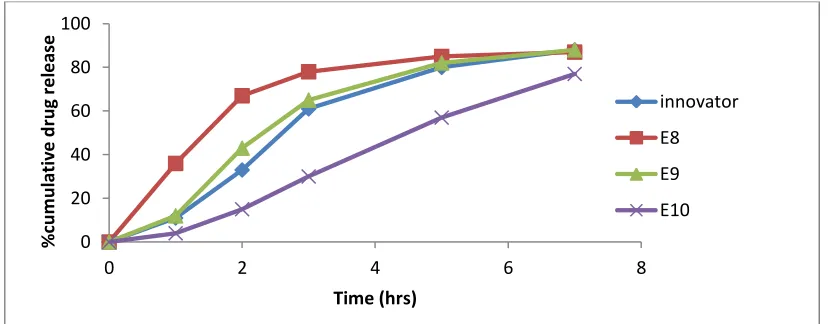
Dissolution data of formulations E1-E10: The coated pellets E1-E10 were filled in to capsules and they were subjected to in vitro drug release studies. The results were tabulated and compared with
innovator product (urispass).Of all the
[image:5.612.47.299.556.701.2]FIGURE 3: COMPARATIVE DISSOLUTION PROFILE OF FORMULATIONS E1-E4 WITH INNOVATOR’S PRODUCT
FIGURE 4: COMPARATIVE DISSOLUTION PROFILES OF FORMULATIONS E5 – E7 WITH INNOVATOR’S PRODUCT
FIGURE 5: COMPARATIVE DISSOLUTION PROFILES OF FORMULATIONS E8-E10 WITH INNOVATOR’S PRODUCT
DRUG RELEASE KINETICS
When the dissolution data was fitted into various
models, it was found that the drug release followed
first order kinetics. The n value (0.2) from the
Korsemeyer Pappas model showed that the drug
release pattern follows mainly the Fickian diffusion
mechanism as the n value is below 0.5.
0 10 20 30 40 50 60 70 80 90 100
0 1 2 3 4 5 6 7 8
%
Cu
m
u
lativ
e
d
ru
g
re
le
ase
Time(hrs)
innovator E1 E2 E3 E4
0 20 40 60 80 100
0 2 4 6 8
%
c
u
m
u
lativ
e
d
ru
g
re
le
ase
Time (hrs)
innovator E5 E6 E7
0 20 40 60 80 100
0 2 4 6 8
%
cu
m
u
lativ
e
d
ru
g
re
le
ase
Time (hrs)
innovator
E8
E9
[image:6.612.118.532.462.624.2]TABLE 6: RELEASE KINETICS OF URISPASS AND FORMULATION E9
Release kinetics Correlation coefficient (r2) of Urispass Correlation coefficient (r2) of formulation E9
Zero order equation 0.969 0.943
First order equation 0.985 0.994
Higuchi coefficient 0.969 0.943
Korsemeyer–Peppas coefficient 0.863 0.800
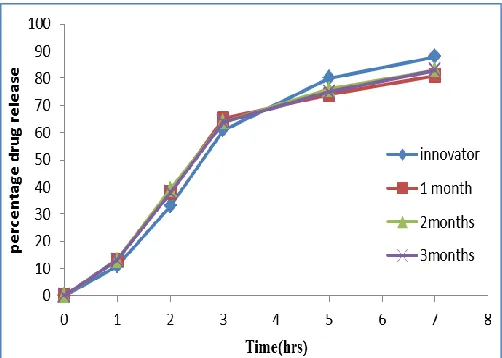
Stability studies: The accelerated stability studies for three months reveal that the formulation (E9) has not undergone any physical or chemical degradation during the period. There are no
significant differences in the in vitro drug release
and the drug content of the optimized formulation.
FIGURE 7: COMPARATIVE DISSOLUTION PROFILE
OF FORMULATION E9 WITH MARKETED
PRODUCT URISPASS AFTER ACCELERATED
STABILITY STUDY
CONCLUSION: Extended release pellets of
Flavoxate hydrochloride were successfully
prepared by extrusion spheronization technique. Incorporation of MCC and DCP facilitated the process of extrusion and spheronization. Coating of ethyl cellulose containing small amounts of HPMC as pore former helped in sustaining the release of the drug. The coated pellets were found to be stable when stored at accelerated conditions for 3 months. The formulated extended release capsules E9 were found to match the innovator product (urispass). Once a daily extended release capsule of Flavoxate hydrochloride would be thus helpful in reducing dosing frequency and decreasing the associated side effects.
ACKNOWLEDGEMENT: The authors are thankful to the management of Koringa College of Pharmacy, Korangi, Andhra Pradesh, India for availing all the facilities.
REFERENCES:
1. Supriya P, Rajini B and Rana AC: Pelletization Techniques: A literature review. IRJP, 2012; 3(3): 43-47.
2. Erkoboni DF: Extrusion-spheronisation as a granulation technique. In, Parikh DM (ed). Handbook of Pharmaceutical Granulation Technology. NewYork, Marcel Dekker Inc, 2010, 281-360.
3. Dukić-Ott A, Thommes M, Remon JP, Kleinebudde P ,Vervaet C: Production of pellets via extrusion-spheronisation without the incorporation of microcrystalline cellulose: a critical review. Eur J Pharm Biopharm, 2009; 71:38-46.
4. F.J. Otero-Espinar, A. Luzardo-Alvarez, J. Blanco-Méndez, Non-MCC materials as extrusion-spheronization aids in pellets production. Production of pellets via extrusion-spheronisation. J. DRUG DEL. SCI. TECH., 2010; 20 (4) 303-318.
8. Satishkumar P. Jain, Dharmini C. Mehta, Sejal P. Shah, Pirthi Pal Singh, and Purnima D. Amin melt in mouth pellets of fexofenadine hydrochloride using crosspovidone as an extrusion spheronisation aid AAPS PharmSciTech. 2010 June; 11(2): 917–923. 9. O’Connor RE, Holinej J and Schwartz JB:
Spheronization I: processing and evaluation of spheres prepared of commercially available excipients. Am J Pharm, 1984; 156:80-87.
10. Tho I, Kleinebudde P, Sande SA: Extrusion/spheronization of pectin-based formulations. I. Screening of important factors. AAPS Pharm Sci Tech, 2001; 2:54-62.
11. Rama Mallipeddi, Kalyan K. Saripella1, Steven H. Neau Use of fine particle ethylcellulose as the diluent in the production of pellets by extrusion-spheronization, Saudi Pharmaceutical Journal, Nov 2013.
12. Almeida Prieto S, Blanco Mendez J, Otero Spinar FJ: Starch-dextrin mixtures as base excipients for extrusion-spheronization pellets. Eur J Pharm Biopharm, 2005; 59:511-521. Thommes M, Kleinebudde P: The behavior of different
[image:7.612.49.300.247.426.2]extrusion/spheronization. Pharm Dev Technol, 2008; 13:27–36.
13. Isha C, Nimrata S, Rana AC, Surbhi G: Oral sustained release drug delivery system: An overview, IRJP, 2012; 3(5): 57-62.
14. Wyndaele JJ, Castro D, Madersbacher H: Neurologic urinary and faecal incontinence. In: Abrams P, Cardozo L. Health Publications, Incontinence Edition, 2005, 1059–162.
All © 2013 are reserved by International Journal of Pharmaceutical Sciences and Research. This Journal licensed under a Creative Commons Attribution-NonCommercial-ShareAlike 3.0 Unported Licens
This article can be downloaded to ANDROID OS based mobile. Scan QR Code using Code/Bar Scanner from your mobile. (Scanners are available on Google Playstore)
How to cite this article: