Improve Computational Complexity of Sobel
Edge Detection using Parallel Contract Anytime
Algorithm
Department of Computer Science and Engineering
School of Engineering and Computer Science
BRAC University
Supervisor
Dr. Jia Uddin
Md. Kamal Hossain
12101073
Md. Asif Ibtehaz
14341001
DECLARATION
We, hereby declare that this thesis is based on the results found by ourselves. Materials of work found by other researcher are mentioned by reference. This Thesis, neither in whole or in part, has been previously submitted for any degree.
Supervisor
_____________
Dr. Jia Uddin
Ass professor
BRAC University
Department of Computer Science &
Engineering
[email protected]
Authors
__________________
Md. Kamal Hossain
12101073
[email protected]
__________________
Md. Asif Ibtehaz
14341001
[email protected]
________________________
Md. Assaduzzaman Ashique
12301017
[email protected]
Contents
Table of Contents ………... III
List of Figures ……….………. V
List of Tables ………... VII
Preface ……… VIII Acknowledgement ……….………... X Abstract ……… 1 Chapter I : Introduction 1.1 Introduction ……… 2 1.2 Contribution Summary ………... 3 1.3 Thesis Orientation ……….. 3
Chapter II : Background Study 2.1 Parallel Computing - Definition ………. 4
2.1.1 General Purpose Parallel Computing Architecture ……… 4
2.1.2 Kernels ……….... 4 2.1.3 Thread Hierarchy ……….... 5 2.1.4 Memory Hierarchy ……….. 6 2.2 Anytime Algorithm ………. 9 2.2.1 Certainty ……….. 10 2.2.2 Accuracy ………. 10 2.2.3 Specificity ………... 11
2.2.4 Properties of Anytime Algorithm ……….……….. 11
2.2.5 Type of Anytime Algorithm ……….……….. 11
2.2.5.1 Contract ……….……….. 11
2.2.5.2 Interruptible ……….……… 12
2.2.6 Difference between Interruptible and Contract Anytime Algorithm …….……. 12
2.2.6.1 Interruptible ………. 12
2.2.6.2 Contract ………... 13
2.2.7 Sample Algorithm of Anytime Algorithm ……….…………. 13
2.2.8 Reduction Theorem ………... 13
2.3 Sobel Algorithm ……….…. 14
Chapter III : Proposed Model 3.1 Proposed Model ……….………. 16
Chapter IV : Experiment and Result Analysis 4.1 Experimental Environment and Tools …...……….……… 19
4.2 Experimental Results of Parallel Sobel Detection ……….. 20
4.3 Experiment with Parallel Contract-time anytime and Sobel Detection ……….. 21
Chapter V : Application 5.1 Application ………….………. 26
Chapter VII : Conclusion and Future Works 6.1 Conclusion ………….………. 29
List of Figures
Figure 1 Grid of Thread Blocks 7
Figure 2 Memory Hierarchy 8
Figure 3 CUDA Multithreaded Programming Model 9
Figure 4 Workflow of anytime algorithm 10
Figure 5 Model of contract-time Anytime Algorithm. 12
Figure 6 Performance profiles of interruptible and contract algorithms 14
Figure 7 Sobel operator Convolution Kernel/Mask. 14
Figure 8 Proposed Model 16
Figure 9 Contract-time Anytime Algorithm task processing. 17
Figure 10 3x3 sub-mask filters (1-8). 18
Figure 11 Image (a) and (b) are Sample Image I and II. (c) and (d) are the output of
Sobel 16 and 32 block 20
Figure 12 Console Result for 16 block dimension. 21
Figure 13 Console Result for 32 block dimension 21
Figure 14 Three contract-time process test for 32 block dimension Test (b, c, and d). 22
Figure 15 Three contract-time process test for 16 block dimension test (b, c and d). 23
Figure 16 Sample outputs 23
Figure 17 Process versus Time for 16 and 32 block dimension. 24
Figure 18 Time Comparison of 1920 x 1024 Input Image. 24
Figure 19 Time Comparison of 4096 x 4096 Input Image. 24
Figure 20 Sample Image III 26
Figure 21 Sample Image IV 26
List of Tables
Table 1: GTX 550TI GPU ENGINE SPECS 19
Preface
Image processing has a vast impact on today’s world. Every steps we are giving forward being dependent on image processing kinds of thing. This is call modernization of the world. And in this world image processing is needed as we are giving vision to our robots, we are operating robotic arms to do operations there we need high quality camera with good encoding software. Again we are trying to shorten the process of any decision taken visually by test or judging by cameras there we need image processing.
Whenever image processing topic comes there is always some limitations and its time range or time limit that needed to do the process. In normal CPU it’s so tough and risky to run a complete image processing as this might damage the machine. For high quality CPU it’s okay but till now it takes a lot of time to do a good quality image processing. And sometimes may be after waiting a long time the expected result is not there so it increases the disappointment.
Another problem is we cannot get a result partially based on the present methods of image processing or edge detection. We have to wait the whole time where a partial processed could have worthy.
Based on these problems stated above we came with an idea where we can resolve both the problems based on hardware and software solution.
When it comes to solve the first problem none but the solution came in to our head is parallel computing and that’s been made easy by NVIDIA releasing support for GPU’s to use with CPU’s. This GPU technology is the main part here and also challenge for as.
Anytime algorithm is a artificial intelligence based algorithm. And the main challenge was to implement it on NVIDIA CUDA C programming. Where we have gone through many books and web sites and the outcome was disappointed for us. As once only the anytime algorithm was theoretically solve using parallel computing but they failed to implement practically. That was a bad news for us as all other so far implemented AI algorithms in parallel computing doesn’t work as great as thought in theoretically.
Then we decided to partition the problem and started working on it. We have to wait two month long to get our first progress. And it was implementing only Sobel in CUDA C. and so we did it. Then our next part was to do something with anytime algorithm. We had to go through tons of references and works done by others for anytime algorithm and till then all the works for anytime algorithm was done in CPU based models only. Never in any parallel things.
After making a process model of anytime algorithm for GPU programming we did it successfully. We are now able to get a result on given time. If we give the process till how many we want to get the final result now our can do that.
We did successfully implemented anytime algorithm with Sobel edge detection method in GPU computing by NVIDIA that is CUDA C. Comparing the result of the output and other conventional CPU edge detection process we came to an end with 4 times faster edge detection process.
Acknowledgement
With great contentment, we would like to express our gratitude to all the people who helped us through this research period. First of all, special thanks are due to Assistant Professor Dr. Jia Uddin, our advisor, who gave us invaluable advice and instructions and helped us to implement this research work by giving advises how should we proceed. What should we do in time where we were stuck in work progress he helped us all the time. Providing us with vast resources he made our work easier.
Then we would like to thank Dr. Md. Haider Ali our honorable Head of the Department. He is a very kind person to permit us to start our research work. And because of him we learnt a lot about Image processing. As well as Dilruba Showkat Mam’s given idea about image processing course did helped a lot.
Our great gratitude to also our honorable teacher Rubel Biswas Sir and Professor Mohammad Zahidur Rahman sir. Because of them we get interested on Artificial Intelligence. Where we did give a think to solve our problem by Artificial intelligence.
We want to thank Moin Mostakim Sir because of him we could think about algorithms to solve any problem and how to approach towards algorithm.
We would be so grateful to Annajiat Alim Rasel Sir. He helped us to get allocated Lab room to do our research work there.
Finally, we would like to thank our parents. We owe a lot to them. Without their support we might not come this far. They helped us in every aspects of life. They encourage us to continue our research. This work would not be came to light without their collective help.
Abstract
Edge detection is a considerably important factor in image or video processing. Detecting the edges of an image play a significant role in image segmentation, data compression, well matching, and image reconstruction. There are several approaches available to detect the edges of an image. In this paper we focus on Sobel edge detection using contract-time anytime algorithm in CUDA. To reduce the computational complexity we implemented our proposed edge detection method using an NVIDIA GPU. In the experimental setup we have used NVIDIA GTX 550Ti GPU along with AMD FX8150 Processor and 8 GB RAM. Finally, we measure speedup as well as quick, moderate and final (3steps of contract) of our proposed parallel implemented model. Comparing with conventional serial CPU based edge detection we have experienced maximum 4X speedup of proposed implementation for 16 block dimension.
Chapter I
Introduction
1.1 Introduction
Edge detection from a color image is a very important and basically critical area in low level image processing. For performing high speed industrialized application based on image processing, edge detection is a mandatory thing to enhance work rate as well as accuracy. A number of researchers works on several edge detection algorithms and they give different responses and details to the different input images [1-7]. Edge detection quality has a great impact on realization of complex automated computer/machine vision systems [1]. Among them, the Sobel edge detection algorithm is much more popular than simple gradient operators due to its property to counteract the noise sensitivity and easier implementation process [2]. While using Sobel operator for GPU takes much less time than CPU. Again, the use of Interruption-Algorithm for image processing much less time efficient [3]. Moreover, in case of canny edge detection in GPU time process seems efficient but not enough for real time [4]. The use of anytime algorithm for GPU architecture makes it run faster in association with Dijkstra’s algorithm [5, 10]. In addition, anytime algorithm seems much efficient when it is used for observing different tasks [6]. Interruptible Anytime Algorithm for image processing is much faster than normal image processing algorithms and also gives the privilege of getting output in different stage of time [7]. That is why, we are choosing contract-time anytime algorithm in coordination with Sobel operator for proposed parallel implementation.
1.2 Contribution Summary
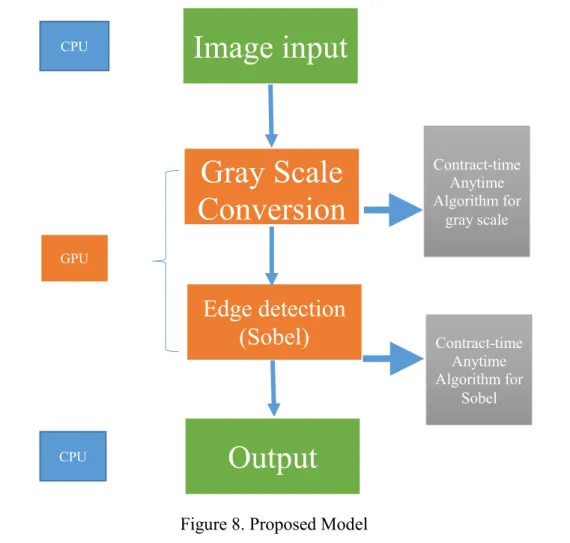
The proposed edge detection of images was designed by passing through five main steps: Image input taking in CPU, image conversion (gray scale) using the Sobel Algorithm along with Contract-time Anytime Algorithm in GPU, essential Sobel Algorithm was used to detect the edge of the image. We also used Contract-time Anytime Algorithm here for faster processing in GPU Edge detection calculation of an image was done in CUDA environment. Finally, processed image and calculated time is showing in CPU.
1.3 Thesis Orientation
The rest of this thesis is organized as follows: Chapter II discusses on the premises of our thesis Parallel Computing and different components of parallel computing, anytime algorithm, its features and Sobel Edge Detection Technique. Chapter III discusses our proposed model. Chapter IV describes Experiment and result analysis on both CPU and CUDA Environment. Chapter V will tell the Application of this thesis. Finally, Chapter VI will conclude this paper with our future direction regarding this research.
Chapter II
Background Study
2.1 Parallel Computing - Definition
Parallel computing is operating on the idea that large problems can be divided into smaller ones, which are then solved at the same time. All of the calculations are carried out at the same time.
2.1.1 General-Purpose Parallel Computing Architecture
NVIDIA introduced CUDA™, a general purpose parallel computing architecture, a new parallel programming model and instruction set architecture. It leverages the parallel compute engine in NVIDIA GPUs to solve many complex computational problems. It is more efficient way than on a CPU. CUDA comes with a software environment that allows developers to use C as a high-level programming language. Other languages, application programming interfaces, or directives-based approaches are supported (i.e.) FORTRAN, DirectCompute, OpenCL, OpenACC.
2.1.2 Kernels
CUDA C extends C by allowing the programmer to define C functions, called kernels. When called, are executed N times in parallel by N different CUDA threads. In regular C functions, it
will be executed only once. A kernel is defined using the __global__. It specifies the number of
CUDA threads that execute when a kernel is called using a new <<<…>>> execution configuration syntax. Each thread that executes, given a unique thread ID. It is accessible within the kernel through the built-in threadIdx variable. As an illustration, the following sample code adds two vectors A and B of size N and stores the result into vector C.
Here, each of the N threads that execute VecAdd() performs one pair-wise addition.
2.1.3 Thread Hierarchy
ThreadIdx is a 3-component vector. The threads can be identified using a one-dimensional, two-dimensional, or three-dimensional thread index. It forms a one-two-dimensional, two-two-dimensional, or three-dimensional thread block respectively. This provides a way to invoke computation across the elements in a vector, matrix, or volume.
The index of a thread and its thread ID relate to each other in a straightforward way. For a one-dimensional block, they are the same. For a two-one-dimensional block of size (Dx, Dy), the thread ID of a thread of index (x, y) is (x + y Dx). For a three-dimensional block of size (Dx, Dy, Dz), the thread ID of a thread of index (x, y, z) is (x + y Dx + z Dx Dy).
As an example, the following code adds two matrices A and B of size N x N and stores the result into matrix C:
1. // Kernel definition
2. __global__ void VecAdd(float* A, float* B, float* C){ 3. int i = threadIdx.x;
4. C[i] = A[i] + B[i]; 5. }
6. int main() {
7. ... // Kernel invocation with N threads 8. VecAdd<<<1, N>>>(A, B, C);
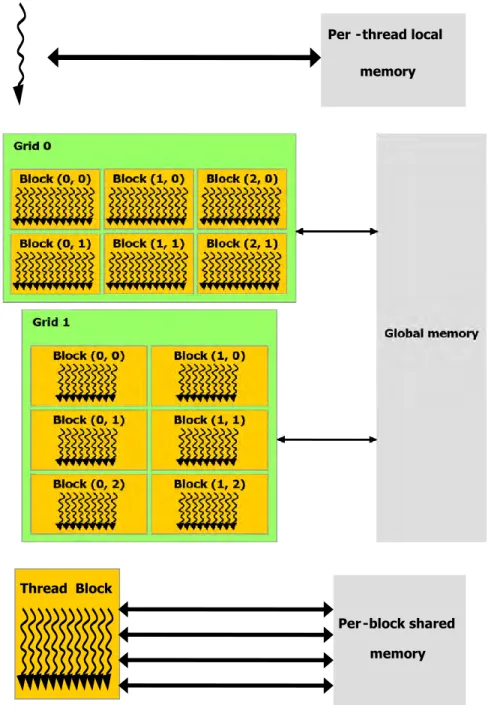
There is a limit to the number of threads per block. On current GPUs, a thread block may contain up to 1024 threads. A kernel can be executed by multiple equally-shaped thread blocks. The total number of threads is equal to the number of threads per block times the number of blocks. Blocks are organized into a one-dimensional, two-dimensional, or three-dimensional grid of thread blocks as illustrated by Figure 1.
A thread block size of 16x16 (256 threads), is a common choice. Thread blocks are required to execute independently. This allows thread blocks to be scheduled in any order across any number of cores.
2.1.4 Memory Hierarchy
Each thread has private local memory. They have shared memory visible to all threads of the block and shared the same lifetime as the block. All threads have access to the same global memory.
There are also two additional read-only memory spaces accessible by all threads: the constant
and texture memory spaces.The global, constant, and texture memory spaces are persistent across
kernel launches by the same application. Figure 3 illustrates a basic memory hierarchy block.
1. // Kernel definition
2. __global__ void MatAdd ( float A[N][N], float B[N][N], float C[N][N]) { 3. int i = threadIdx.x;
4. int j = threadIdx.y; 5. C[i][j] = A[i][j] + B[i][j]; 6. }
7. int main() {
8. ... // Kernel invocation with one block of N * N * 1 threads 9. int numBlocks = 1;
10. dim3 threadsPerBlock(N, N);
11. MatAdd<<<numBlocks, threadsPerBlock>>>(A, B, C); 12. ... }
Figure 2. Memory Hierarchy
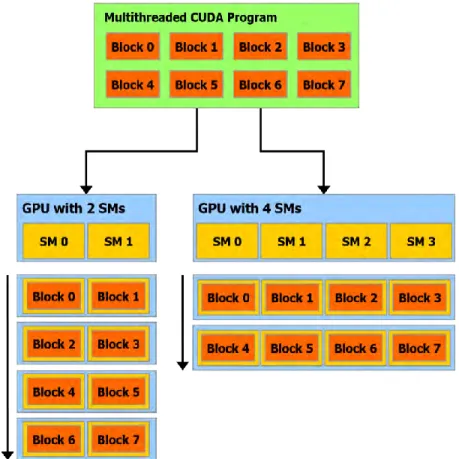
A multithreaded program is partitioned into blocks of threads. It executes independently from each other. A GPU with more multiprocessors will automatically execute the program in less time than a GPU with fewer multiprocessors.
Per-thread local memory
Thread Block
Per-block shared memory
Figure 3. CUDA Multithreaded Programming Model
2.2 Anytime Algorithm
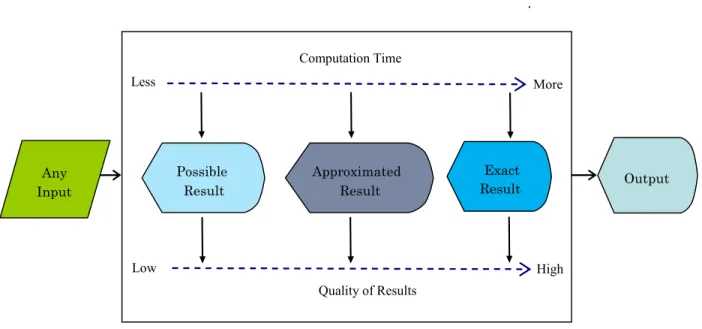
Anytime algorithm is a class of algorithm whose quality of results improves gradually as computation time increases. However, it offers trade-off between the resource consumption and output quality. The most wonderful feature of anytime algorithm is that it can be stopped anytime and an approximate result will be given based on the so far calculated data. It is the best part of anytime algorithm that other algorithm’s cannot do. In case of any other algorithm, the program
increases. The computation of anytime algorithm extends the traditional idea of computational procedures by allowing to return many possible approximate answers to any given inputs. The specialty of anytime algorithm is the use of well-defined quality measures to monitor the progress in problem solving. It also allocates the computational resources effectively.
Figure 4. Workflow of anytime algorithm.
According to S. Zilberstein’s paper [11] metrics of various kind can be used to get the quality of the result which is produced by anytime algorithm.
2.2.1 Certainty
This metrics reflects the certainty whether the result is correct. Certainty can be expressed using probabilities, certainty factors, or any other approaches.
2.2.2Accuracy
This metric reflects the difference between the approximate result and the exact answer. Many anytime algorithms can provide a guarantee of a bound on the error, where the bound is reduced over time. . Quality of Results Computation Time Less Low High More Possible Result Approximated Result Exact Result Any Input Output
2.2.3 Specificity
This metric reflects the level of detail of the result. Anytime algorithm always produces the correct results, but the level of detail increases over time.
2.2.4 Properties of Anytime Algorithm
This section explains the properties of anytime algorithm according to S. Zilberstein’s paper [11]. Anytime algorithm has the properties that satisfy the following features –
Measurable quality: Quality of result can be defined exactly.
Recognizable quality: Quality of an approximated result is easy to determine at
intermediate processing time.
Monotonicity: Quality of result is an increasing function of time and input quality. Consistency: Quality of result is connected with computation time and input quality.
Diminishing returns: The solution’s quality improves much larger than previous stages of computation and diminishes over time.
Interruptibility: The algorithm can be stopped at any time and given some answer.
Preempt ability: The algorithm can be stopped and started again at any time with minimal
overhead.
2.2.5 Type of Anytime Algorithm
not be able to produce the required result. In case of contract anytime time algorithm, there are few ways to be adopt. Among them, one is knowing the full time of the program and another is till which processes the program can give results.
Figure 5. Model of contract-time Anytime Algorithm.
2.2.5.2 Interruptible
Anytime algorithm also produce an acceptable or required result based on the requirement when interrupted. The total run time of this algorithm is unknown. It can provide the output at any step of the result.
2.2.6 Differences Between Interruptible and Contract Anytime Algorithms
2.2.6.1 Interruptible
Total execution time is unknown.
It is always contract algorithms.
It is more complicated to construct than contract algorithm
Flexible and widely applicable.
2.2.6.2 Contract
Total execution time must be known in advance.
Cannot be interrupted at any time, if it is interrupted between the execution time, it
cannot provide the required result.
It is not interruptible algorithms.
Easier to construct.
2.2.7 Sample Algorithm of anytime algorithm
1. Result ← INITIALIZATION-STEP (Input(x, y))
2. REGISTER-RESULT (Result) 3. x ← 0; y ← 0; 4. While (x < h) 5. { a. While (y < w) b. {
i. Output(x, y) ← Input(x, y);
ii. y ← y + 2; c. } d. SIGNAL (TERMINATION) e. HALT 6. } 7. w ← w/2; 8. h ← h/2;
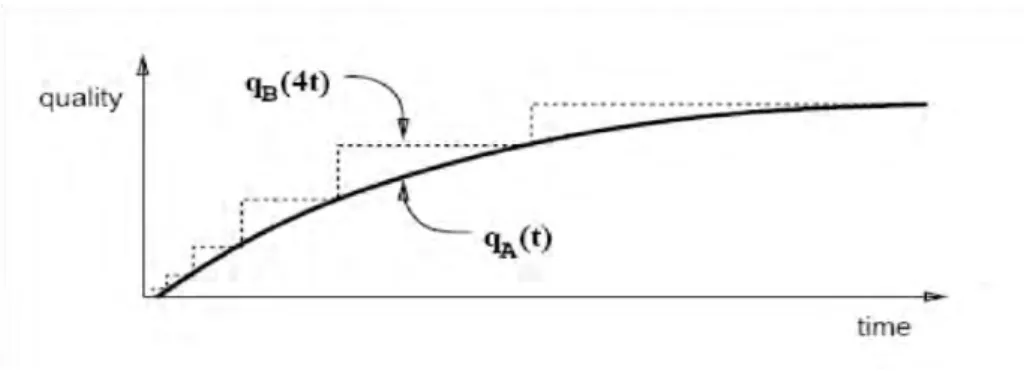
For any contract algorithm, an interruptible algorithm B can be constructed such that for any
particular input qB(4t) ≥ qA(t).
Figure 6. Performance profiles of interruptible and contract algorithms
2.3 Sobel Algorithm
The Sobel operator is widely used for edge detection in images. It is based on the computing the approximation of the gradient of image intensity function. The Sobel filter uses two 3 x 3 spatial masks to calculate the gradient. Two filters are Sx and Sy.
Figure 7. Sobel operator Convolution Kernel/Mask.
Sobel operator is based on convolving the image with a small, separable and integer valued filter in both horizontal and vertical directions. The local edge strength is defined as the gradient magnitude is given by equation 1. Equation 2 can give approximate magnitude for the computation, much faster to compute the gradient.
S=√ (Sx²+Sy²) (1)
|S| = | Sx | + | Sy | (2)
The above mentioned scheme is for grayscale images. For color images (RGB color space), this scheme is applied separately for each color component. Final color edge map of color image is computed by using the edge maps of each color component.
Chapter III
Proposed Model
3.1 Proposed Model
Figure 8 shows the block diagram of proposed parallel implementation of CPU-GPU based edge detection method. To evaluate our proposed model have utilized different test images. First of all, we have taken the images as input. As the images are color images, we converted it into gray scale images. The process ran in GPU and we used contract-time anytime algorithm to make the conversion process faster, as depicted Figure 8.
Edge detection
(Sobel)
Contract-time Anytime Algorithm for SobelGray Scale
Conversion
Image input
CPU Contract-time Anytime Algorithm for gray scale GPUOutput
CPUAfter that, the edge detection process runs in GPU. Again, used contract-time anytime algorithm to detect the edges. We have calculated the time for Sobel operator in CUDA environment and took the time for processing and compared results. Our all the outputs shows in CPU that were calculated in GPU that is the primary aspiration of parallel implementation of Sobel operator along with any time algorithm. Figure 10 is a Sobel operator matrix that we used to calculate value for
detecting edges in our CUDA environment. Here weused the general Sobel operator gradient
matrix with CUDA. That detects edges and the time taken here is less than normal Sobel operator in CPU.
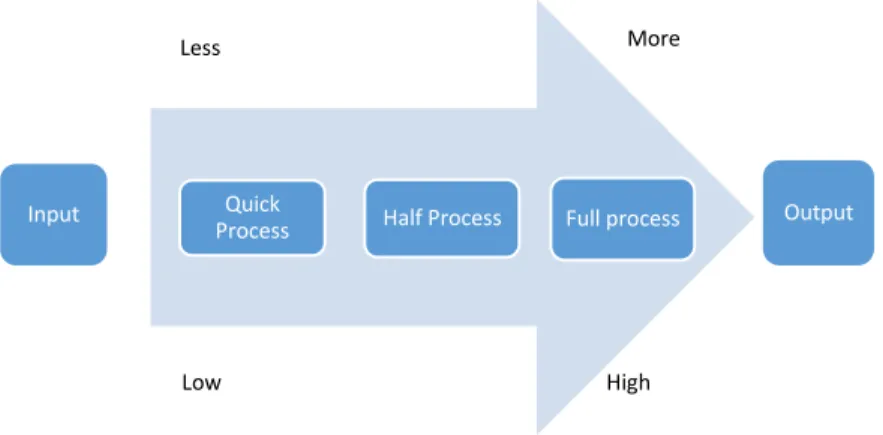
Figure 9. Contract-time Anytime Algorithm task processing.
In Figure 7 Sx represents horizontal convolution mask and followed by Sy represents vertical convolution mask. These convolution mask is being used for calculating the gradient.
Sobel operator 2D gradient based measurement is performed on an image. High spatial frequency which correspond to edges is mainly used to perform the measurement. For
Input Quick
Process Half Process Full process Output
Less More
time anytime algorithm. Gradually for half process and complete process of the program gives better output.
Figure 10. 3x3 sub-mask filters (1-8).
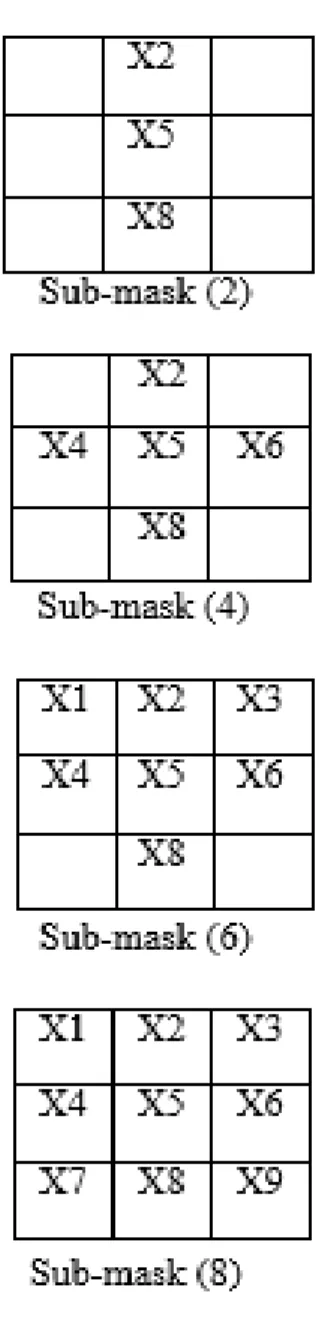
Figure 10 depicted how we divide every image into eight 3x3 sub-masks to use Sobel operator and use contract-time in different time period. We initially experiment only 3 contracts using these sub-masks and calculate process time in GPU and CPU system.
Chapter IV
Experiment and Result Analysis
4.1 Experimental Environment and Tools
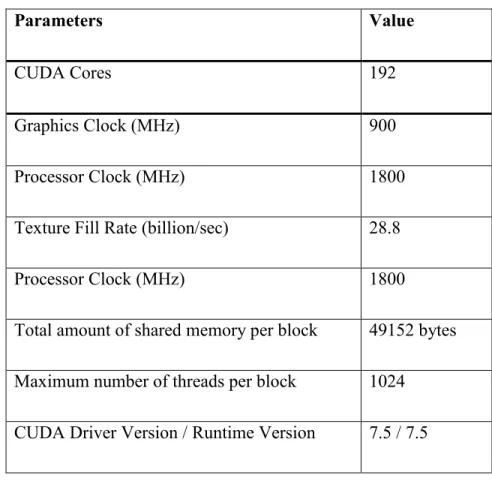
In the experimental setup, we have used AMD FX 8150 CPU, 8 GB RAM with a GTX 550TI
GPU. We have also used Visual Studio 2013, CUDA ToolKit 7.5, OpenGL, Java 7, .NET C++, Eclipse Mars editor and Create a graph (online tool). Table I describes the detailed specification
of GTX 550TI GPU.
Table I. GTX 550ti GPU Engine Specs
Parameters Value
CUDA Cores 192
Graphics Clock (MHz) 900
Processor Clock (MHz) 1800
Texture Fill Rate (billion/sec) 28.8
Processor Clock (MHz) 1800
Total amount of shared memory per block 49152 bytes
4.2 Experimental Results of Parallel Sobel Detection
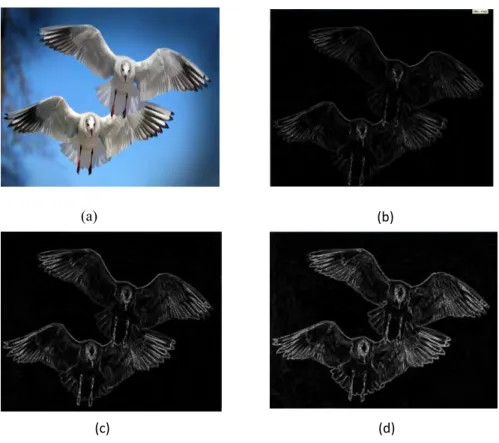
To evaluate our proposed edge detection model, we have used a 4096 image [Image I] and a 1920x1080 image [Image II]. Figure 11(a) is our sample image [Image I] for this experiments. Figure 11 (c) and (d) are the two outputs of input we present in Figure 11 (a).
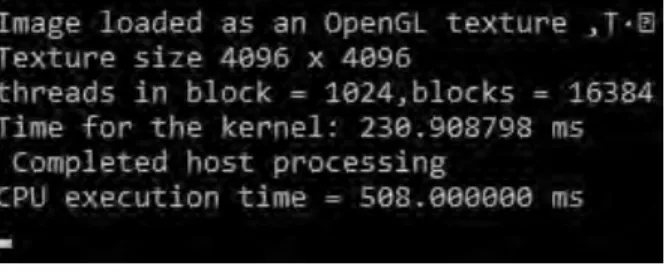
Figure 11 (c) & (d) are two outputs for our experiment image. For large pixel images we capture the real image in 4096x4096 texture and then we send it to the GPU for gray scale conversion and edge detection. CPU execution time is the total time to read the image and printing the output. GPU time is the time for kernel that is calculating the total time to execute the kernel in GPU. We have taken block dimension 16 and 32 to calculate threads lowest threads for 16 block dimension is 256. And for 32 block dimension uses highest 1024 threads. For our experiment, we have calculated the blocks using Equation 3.
Figure 11. (a) And (b) are the Sample Image I and II. (c) And (d) are the output of Sobel 16 and 32 block.
𝐵𝑙𝑜𝑐𝑘 𝑠𝑖𝑧𝑒 = (𝑋
1
, 𝑌
1
)
(3)
𝑋
1
= 𝑊/𝐵
d
𝑌
1
= 𝐻/𝐵
d
Where, width and height of image are from input image and block dimension is our default value. Width of image = W, Height of image = H, and Block dimension = Bd.
Figure 12. Console Result for 16 block dimension.
Figure 13. Console Result for 32 block dimension.
This program process 4K ultra HD images that is a normal conventional CPU programming Sobel edge detection cannot do. As we have also implemented Sobel for conventional CPU programming language with 3840 x 2400 image [Image 1] but it cannot read the image.
Figure 14 shows that we have used 32 block dimension for test contract-time anytime algorithm. Where we have got different output and execution time from 3 contract of our program. Test 1 is the result of quick process. Test 2 is for half process and Test 3 is for Full process. Test 1 takes comparatively less time than test 3. Same goes for the image tested in 16 block dimension that’s showed in Figure 15.
Figure 16 illustrates the sample outputs of our process. Where process of our algorithm is anytime algorithm output [Output 1], here user defines which process will be calculated. This output is for 16 block dimension half process. We have processed an image also in conventional CPU programming language to compare our results. Conventional CPU result is shown in Figure 16 (b).
Figure 14. Three contract-time process test for 32 block dimension Test (b, c, and d).
(a) (b)
(a) (b)
(c) (d)
Figure 15. Three contract-time process test for 16 block dimension test (b, c and d).
Figure 17. Process versus Time for 16 and 32 block dimension.
Figure 18. Time Comparison of 1920 x
Table II. Result Comparison PROCESS CPU–G PU TIME (MS) THREADS PER BLOCK BLOCK SIZE CPU EXECUTION TIME (MS) SPEEDUP (AGAINST CPU) 16 BLOCK DIMENSION QUICK 119.899 256 8192 480 4.003X HALF 127.809 3.7X FULL 127.992 3.75X 32 BLOCK DIMENSION QUICK 138.227 1024 2048 480 3.47X HALF 141.027 3.4X FULL 141.601 3.38X
Table II represents the comparison of our program with conventional CPU programming. Comparing with the CPU program we have calculated speedup of our program and for 16 block low it is 4.003x and for high quality edge detection it is 3.75x. Figure 17 graph represents the detailed comparison between 16 and 32 block dimension with respect to execution time.
Chapter V
Application
5.1 Application
Edge detection is a fundamental feature of Image Processing. It is the basic step of image analysis. The purpose of edge detection is to discover the information about the shapes and the reflectance or transmittance in an image. We can apply edge detection in many sectors.
Our first thought of applying this technology in game of cricket. In Cricket, there are some contradiction in giving out. To determine, whether it was out or not, they took help of snicko technology (sound wave based). In this case, we can apply our proposed model instead of snicko technology.
Figure 20 and Figure 21 are the sample image III and sample image IV to use in our application. Figure 22 and Figure 23 are the same output of III and sample image IV are the output image. It is clearly visible that whether the ball touched the bat or not.
We can also implement our edge detection methods on medical science (detect the edge of lungs CT image), shape and object recognition, traffic management and line detection from blurry image.
Chapter VI
Conclusion and Future Works
6.1 Conclusion
This paper presented a new parallel edge detection method using Sobel and Contract Anytime Algorithm. As a parallel platform we utilize an NVIDIA GTX GPU and 8 Core CPU. For sample test images, we calculate the execution time of proposed CPU-GPU parallel method and conventional CPU based algorithm. In addition, by varying thread and block sizes, we observed the effect of computation time. Experimental results show that the proposed parallel implementation exhibits above 4X speedup over the conventional serial implementation.
6.2 Future Works & Limitations
Among the various difficulties and limitations we have faced, the most important one is the Visual Studio 2013 extension error with CUDA C environment. Moreover, CUDA C 7.0 toolkit did not permit some of our coding technique. So, we have to wait till CUDA C toolkit 7.5. In addition, due to lack of Kepler Architecture GPU, we were not able to implement the interruptible anytime algorithm. Normal GTX architecture that we used and are available to us does not support the techniques required.
References
[1] M. B. Ahmad and T. S. Choi, “Local threshold and boolean function based edge detection,” IEEE Transactions on Consumer Electronics, vol. 45, no. 3, pp. 674–679, 1999.
[2] T. A. Abbasi and M. U. Abbasi, “A novel FPGA-based architecture for Sobel edge detection operator,”International Journal of Electronics, vol. 94, no. 9, pp. 889–896, 2007.
[3] W. Kywe, D. Fujiwara, and K. Murakami., “Scheduling of Image Processing Using Anytime Algorithm for Real-time System,” Pattern Recognition, 2006. ICPR 2006. 18th International Conference on, vol.3.2006.
[4] Ogawa, Kohei, Y. Ito, and K. Nakano. “Efficient Canny Edge Detection Using a GPU.” First International Conference on Networking and Computing. 2010.
[5] M. Rahul, and A. A. Saba. “Anytime Algorithms for GPU Architectures.” 2011 IEEE 32nd Real-Time Systems Symposium, 2011.
[6] Baxter, J W, J. Hargreaves, N. Hawes, and R. Stolkin. “Controlling Anytime Scheduling of Observation Tasks.” Research and Development in Intelligent Systems XXIX: 219-24, Oct 2012. [7] W. Kywe, D. Fujiwara, and K. Murakami, “An Approach to Linear Spatial Filtering Method based on Anytime Algorithm for Real-time Image Processing,” 18th International Conference on Pattern Recognition (ICPR'06), vol. 4, no. 12, 2012.
[8] Rostov Kremlin Available from:
<https://wallpaperscraft.com/wallpaper/rostov_velikij_kreml_rossiya_kh ram_103672> [9] Gulls Available from:
[10] J. Uddin, E. Oyekanlu, C.H. Kim, and J. M. kim, “High Performance Computing for Large Graphs of Internet Applications using GPU,” International Journal of Multimedia and Ubiquitous Engineering, Vol. 9, No. 3, pp. 269-280, 2014.
[11] S. Zilberstein, ‚Using Anytime Algorithms in Intelligent Systems‛, AI Magazine, vol. 17, no. 3, pp. 73-83, (1996).
[12] S. Zilberstein and S. J. Russell. In S. Natarajan (Ed.), ‚Approximate Reasoning Using Anytime Algorithms, Imprecise and Approximate Computation‛, Kluwer Academic Publishers, (1995).
[13] J. Grass and S. Zilberstein. In M. Pittarelli (Ed.), ‚Anytime Algorithm Development Tools‛, SIGART Bulletin Special Issue on Anytime Algorithms and Deliberation Scheduling, 7(2):20-27, (1996).
[14] Harley R. Myler and Arthur R. Weeks, ‚The handbook of image processing algorithms in C‛, Prentice-Hall PTR, 1993.
[15] R.C. Gonzalez and R.E. Woods, ―Digital image processing,‖ Prentice Hall, 2nd Edition,
2002.
[16] R.K. Sandhu, P.S. Maan, ―A spatial-domain filter for digital image De-noising used for Real
time applications‖, International Journal of Computer Science and Technology, IJCST Vol. 2, Issue
[19] A. K. Jain, ‚Fundamentals of Digital Image Processing‛, Prentice-Hall, Inc. U.S.A, 1989. [20] J. Cheng, M. Grossman, T. McKercher, Professional CUDA C programming, Wrox, a Wiley brand, INpolis, IN, 2014.
[21] I. Hatzilygeroudis, V. Palade, Combinations of intelligent methods and applications: proceedings of the 3rd International Workshop, CIMA 2012, Montpellier, France, August 2012, Springer, Heidelberg, 2013.
[22] J. Sanders, E. Kandrot, CUDA by example: an introduction to general-purpose GPU programming, Addison-Wesley, Upper Saddle River, NJ, 2011.
[23] T. Masters, Deep belief nets in C and CUDA C, n.d. [24] http://www.profc.udec.cl [25] http://www.eng.iastate.edu/ee528/sonkamaterial/chapter_1.htm [26] http://www.eng.iastate.edu/ee528/sonkamaterial/chapter_2.htm#Image%20functions [27] http://en.wikipedia.org/wiki/ [28] http://www.nvidia.com/object/what-is-gpu-computing.html [29] http://www.nvidia.com/object/cuda_home_new.html [30] http://docs.nvidia.com/cuda/cuda-c-programming-guide/#axzz465OFzRvq [31] http://www.nvidia.co.kr/content/cudazone/download/showcase/kr/Tutorial-DKIRK.pdf [32] https://blogs.nvidia.com/blog/2013/05/03/trump-card-why-a-pro-poker-player-bet-on-cuda [33] http://docs.nvidia.com/cuda/ [34] http://www.cc.gatech.edu/~vetter/keeneland/tutorial-2012-02-20/07-intro_to_cuda_c.pdf
[35] https://devblogs.nvidia.com/parallelforall/easy-introduction-cuda-c-and-c [37] https://devblogs.nvidia.com/parallelforall/using-shared-memory-cuda-cc [38] http://www.pgroup.com/resources/cuda-x86.htm [39] http://developer.download.nvidia.com/compute/developertrainingmaterials/presentations/cuda_la nguage/Introduction_to_CUDA_C.pptx [40] http://cs.unc.edu/~prins/Classes/633/Readings/CUDA_C_Programming_Guide_4.2.pdf [41] http://www.codeproject.com/Articles/202792/Using-Cudafy-for-GPGPU-Programming-in-NET [42] http://developer.download.nvidia.com/books/cuda-by-example/cuda-by-example-sample.pdf [43] Create A Graph (Online tool) - https://nces.ed.gov/nceskids/createagraph/