EWSolutions
The Importance of Meta
Data and Data Governance
in Process and Data
Management
By David Marco
President
EWSolutions’ Background
EWSolutions
is a Chicago-headquartered strategic partner and full life-cycle
systems integrator providing both
award winning
strategic consulting and
full-service implementation full-services
. This combination affords our clients a full
range of services for any size enterprise information management, meta data
management, data governance and data warehouse/business intelligence
initiative. Our notable client projects have been featured in the Chicago Tribune,
Federal Computer Weekly, Crain’s Chicago Business, and won the 2004
Intelligent Enterprise’s RealWare award, 2007 Excellence in Information Integrity
Award nomination and DM Review’s 2005 World Class Solutions award.
For more information on our Strategic Consulting Services, Implementation Services, or
World-Class Training, call toll free at 866.EWS.1100, 866.397.1100, main number
630.920.0005 or email us at [email protected]
Best Business Intelligence Application
Information Integration
Client: Department of Defense
World Class
Solutions Award
Data Management
2007 Excellence in Information
EWSolutions’ Partial Client List
Arizona Supreme Court
Bank of Montreal
BankUnited
Basic American Foods
Becton, Dickinson and Company
Blue Cross Blue Shield companies
Branch Banking & Trust (BB&T)
British Petroleum (BP)
California DMV
California State Fund
Capella University
Cigna
College Board
Comcast
Corning Cable Systems
Countrywide Financial
Defense Logistics Agency (DLA)
Delta Dental
Department of Defense (DoD)
Driehaus Capital Management
Eli Lilly and Company
Environment Protection Agency
Farmers Insurance Group
Federal Aviation Administration
Federal Bureau of Investigation (FBI)
Fidelity Information Services
Ford Motor Company
GlaxoSmithKline
Harbor Funds
Harris Bank
The Hartford
Harvard Pilgrim HealthCare
Health Care Services Corporation
Hewitt Associates
HP (Hewlett-Packard)
Information Resources Inc.
International Paper
Janus Mutual Funds
Johnson Controls
Key Bank
LiquidNet
Loyola Medical Center
Manulife Financial
Mayo Clinic
Microsoft
NASA
National City Bank
Nationwide
Pillsbury
Quintiles
Sallie Mae
Schneider National
Secretary of Defense/Logistics
Singapore Defence Science & Technology
Agency
Social Security Administration
South Orange County Community College
SunTrust Bank
Target Corporation
The Regence Group
Thomson Multimedia (RCA)
United Health Group
United States Air Force
United States Army
United States Department of State
United States Navy
United States Transportation Command
University of Michigan
University of Wisconsin Health
USAA
US Cellular
Waste Management
Wells Fargo
Professional Profile/Contact Information
Best known as the world’s foremost authority on meta data management, he is an internationally
recognized expert in the fields of data warehousing, data governance and enterprise information
management. In 2004 David Marco was named the
“Melvil Dewey of Metadata”
by
Crain’s
Chicago Business
as he was selected to their very prestigious
“Top 40 Under 40”
list. David
Marco has authored several books including the widely acclaimed
“Universal Meta Data Models”
(Wiley, 2004) and the classic
“Building and Managing the Meta Data Repository: A Full
Life-Cycle Guide”
(Wiley, 2000).
Selected to the prestigious
2004 Crain’s Chicago Business “Top 40 Under 40”
2008 DAMA Data Management Hall of Fame (
Professional Achievement Award
)
Chairman of the Enterprise Information Management Institute (EIMInstitute.ORG)
2007 DePaul University named
him one of their
“Top 14 Alumni Under 40”
Presented hundreds of keynotes/seminars across four continents
Published hundreds of articles on information technology
Author of several best selling information technology books
Taught at the
University of Chicago
and
DePaul University
Session materials adapted from the books...
Universal Meta Data Models (Wiley, 2004)
Building and Managing the Meta Data
Repository: A Full Life-Cycle Guide
(Wiley, 2000)
Marco Masters Series
Teaching the full 3 day version of our Meta
Data Management course from June 6 – 8,
2011 in Chicago, IL
Teaching the full 3 day version of our Data
Governance course from October 3 – 5,
2011 in Chicago, IL
Visit www.MarcoMastersSeries.com
for
details
Fundamentals
and
Data Governance Fundamentals
Enterprise Information Management (EIM):
The
systematic processes and governance procedures for
applications, processes, data, and technology at a holistic
enterprise perspective
The purpose of enterprise information management is to
bring enterprise order, purpose, structure, efficiency, and
performance to applications, processes, data, meta data
and technology
EIM is not a single technology or component, but a
coordinated framework of disciplines for managing data,
meta data and information assets throughout the
organization
EIM Focus Areas
Enterprise
Information Management
Data Architecture
Process Management
Information Quality
IT
Portfolio
Management
Master Data Management
Information Delivery
Information Security
Data Management is
the foundation for all
of the other EIM
focus areas.
Regardless of which
focus area you target
first, you will need to
do Data
Process Management
Process Management:
is the application of
knowledge, skills, tools, techniques and
systems to define, visualize, measure,
control, report and improve processes with
the goal to meet customer requirements
Why do we need to manage processes?
What does one process look like for a large
corporation?
Process Management
Process management:
looks to holistically manage the
Information Technology (IT) and business processes that exist
within the organization in order to streamline, optimize,
historically track, ensure quality and prevent redundancy of the
IT processes at an enterprise level.
Process (people & technical) Management Target Areas
¾
What processes exist?
¾
What processes are used?
¾
What function does the process perform?
¾
Who uses the process?
¾
What data is utilized by the process?
¾
What inputs does the process get from which people?
¾
Which processes are used in which applications?
¾
Workflow (process dependencies and scheduling)
Process Management
Why do we need to manage processes?
What does one process look like for a large
corporation?
Fortune 100 – One Process
ST O Sales Request W eb/ Em ai l/Fax W eb/ Em ai l/Fax W eb/ Em ai l/Fax Web/Email/Fax Web/Email/Fax Sales Request W eb/ Em ai l/Fax W eb/ Em ai l/Fax W eb/ Em ai l/Fax W eb/ Em ai l/Fax Web/EDI Web/EDI Tele/Web Tele/Web Ki os k O rder Ki os k O rder Ki os k O rder Te le /W e b EDI Order Kiosk Order W eb/ ED I W eb/ ED I Sal e s R eques t Sal es R eques t Sal es R eques t Sal e s R eques t IPS Onl y IPS Only C TO pr oduc ts W eb/ Em ai l/Fax Te le /W e b ePrime - HPGlobal Biz Link (Extranets) -NA - CPQ Catalog Procurement CGBX NA -CPQ Vendor eMarket Place -CPQ Fast-Web & Ptnr Prime -CPQ B2B Integ SVR / CEI's Web Svr -CPQ Buysite & Market Site.com Biz-Store - HP Kiosk -CPQ Kiosk -HP SAP 3.1 EPH -OM - CPQ SAP - Consumer Direct SV OM -HP Commerci al SMB Enterprises QMS - AQS -NA -CPSA/MSS - CPQ FOCUS - CPQ CDAT - Rack Assistant Kylor (AA) -CPQ Virtual Sales Rep - HP EDI Gateway -NA - CPQ WWOMS US - HP APOGEE -Storage - HP Rack Builder - CPQ Consumer s / Micro Corporate Relationships Commercial Resellers Agents Heart - HP Sales Force Vista - Fulfillment - CPQ Vista - OM - CPQ SAP - Replenishment D7 - OM - HP
SAP - Replenishment D7 - Fulfillment - HP SAP - Fusion - NA - Fulfillment - HP SAP Fusion NA OM -HP SAP 3.1 EPH Fulfillment -CPQ Retailer HP Shopping Financial Institution SAP - HPS NA Upfront Astro NA -HP Fireman NA -SCA - NA - HP ITRC - SUM - NA - HP SAP HPS NA -OM - HP SAP HPS NA -OM Finance - HP SAP HPS NA Virtual Sourcing -HP Field Admin PM Tools - HP Parts Repair Customers and Partners Tiger -NA - HP TIM -HP SW Depot -Shopping - HP Legacy OM Finance -HP Legacy Parts -OM - HP Legacy Parts -SC - HP SAP - HPFO - NA - HP APOGEE/SHIP US Services -HP HPFO Legacy SAP IPC D7 -Channel Links Descartes DAC Compucom WWOMS Canada - HP WW CISYS -HP SAP XRS SAP XRS -Matl - HP SAP -XRS - IPC - HP Ryder MM300 0 - HP Business PC, Servers, Consum er Call Center -LJ Call Center -US GEM GEMS NA -CPQ CAFE -CPQ CEI's Omaha Call Center, or Littleton eCAT - CPQ Watson -HP SBW - HP Quick Quote - eStore Canada -HP SAP CaLado -OM - HP Business Advantage -CPQ SAP CaLado -Fulfillment - HP Factory Outlet -SW Depot -OM - HP SW Depot Fulfillment -HP SAP -Consumer Direct SV Fulfillment -HP Compucom -OM Conrad - HP System T - CPQ Earl -HP SAP -Consumer Direct SV -Finance - HP CPQ Financial Services CyberS Affiliates ACS -CPQ LSO -HP OLS - Chameleon -CPQ Microsoft Call Centers -Rockville, Roseville, Cupertino, Ontario Vista Finance -CPQ Product Advisor DAC Fulfillment eTracking - EDR -CPQ Game DB -CPQ Active Answers Cybrant - HP CPL -Prod. & Price VISA -CPQ GPSY CPL -HP Golden Eggs -CPQ ICON -HP OSS - HP WWSNRS -CPQ Customer Advantage Direct Plus -CPQ Customer Advantage eProcurement -CPQ Customer Advantage Extranets -CPQ NCAS NA -CPQ NCAS QL -CPQ CCSU Eclipse -HP PPS -CPQ Les Web -CPQ COPE/BET Clear Contract -CPQ Prophecy SBS -Pears - NA - CPQ SIS -CPQ SRS -CPQ FOCUS (252) -CPQ ASM -CPQ CPN -CPQ CSN NA -CPQ eFLS -CPQ RMS -CPQ ORS -CPQ Primus NA -CPQ Compaq Direct Support Pricing Tool CCDB NA -HP Aurora Mgr -NA - HP Plato -NA - HP OM Server - NA - HP AUE -NA - HP SWAT - HP eParts ePO - NA - HP SAM -NA - HP CMG - NA - HP MAT -NA - HP SORDS NA -HP SACS -NA - HP EEureka -NA - HP Allegro -NA - HP IOM -NA - HP PROMIS NA -HP Norm NA -HP SPD NA -HP Siebel eChannel BPS - CPQ PWEB US -Profiler - HP Explorer4 - CPQ SFDM (M1/M2) -CPQ Remedy US - HP Reseller Web - HP Siebel Call Center 2000 - US - CPQ Quoters WB - CPQ MAXCIM - HP RosettaNet Portal - HP ESN US Fast -CPQ Armada NA -Partner Direct -CPQ Backplane/Shopfloor -NA - HP Clarify WFM -NA - HP Clarify Pulse -CPQ Core -CPQ Entitlement -NA - HP EDI/XML Gateway - NA/AP - HP GOLD - CPQ Power -CPQ RCM - HP SAP 3.1 - EPH Finance -CPQ FAI - NA - HP EIA - NA - HP WWFTP -HP SSIM - HP ePack -Resource Marketplace - NA - HP Plus NA -HP SmartCube - HP GDS -NA - HP SAP Education -NA - HP CDO NA -HP Knight - CPQ WWPAK - HP eStores - CPQ Xelus Plan NA -HP SAP 4.6 - SW Supply Chain - HP WW Comcat -SMART db -CPQ eParts - HP HP Shopping At Home - CPQ Customers Shopping/ Quoting Order Management Supply Chain Finance
Data Management
Data Management:
Data Resource
Management is the development and
execution of architectures, policies,
practices and procedures that properly
manage the full data lifecycle needs of an
enterprise (DAMA International)
Data Management
Data Management:
is the function of
managing the data within an organization
This is the keystone focus area
Without this area it is almost impossible to
address the other focus areas
Business requirements will drive this
initiative
Data Management Objectives
Data Management looks to answer questions on
the data in a company:
¾
What does it mean (data lineage)?
¾
What is its source (data heritage)?
¾
What are the valid values?
¾
What formulas were used to calculate it?
¾
What are its business rules?
¾
What are its technical rules?
Subject area definition
Define business entities
Enterprise conceptual model
Data Management
Maybe data management looks better than
process management?
Islands of Data
Operational
Applications
Islands of
Data
End User
Reporting
Systems
Claims Pharmacy Financial AnalysisHealth & Medical Services (CQM, HSA)
Actuarial & Underwriting Analysis Sales & Mktg / Network Development Utilization Membership/Enrollment & Billing Standard Adhoc Standard Adhoc Standard Adhoc Standard Adhoc Standard Adhoc Standard Adhoc Standard Adhoc Standard Adhoc North E/B TOPPS ES-9000
IPS- Inter Practice SystemVAX(Burlington) PSIMED HPE-980
MGD Claims AS/400 Query
Pharmacare (outside vendor)AS/400 Pharmaview (outside vendor)
NED E/B
ACPS- Automatic Claims Processing System PASS - Patient Appointment Scheduling System ENCOUNTER FFS - Fee For Service REF - Referrals HP-992 NEDClinical Computer Pharmacy DB Provider Master AMISYS MARS •Hospital Summary •Quality Assurance Request
HP (9 series) •Network & Medical Request •Actuarial End User Request •Claims
Prov DB Drug DB
AMRS-Advanced Medical Record System
RIS- Radiology Information System
LAB/LIS- Laboratory Information System
VAX Cluster RX42 HPE-980
MHUM - Mental Health Utilization Management
AST 486 server
HealthchexPentium PC Bulletin Board System (BBS)
NED DatawarehouseHP937 HSA dept. Lan Server
NED Multiview GL and AP
PHC Pharmacy Server PHC Actuarial Analysis Server Analytic Database
Quantum Dec Alpha MAMSYS/PAPSYS PHC JV Finance Server
PHC Network Development Server
PHC Medical Services Server PHC Multi-view GL.
(14) Foxpro Applications ASAP - Actuarial System Analysis Program
MS SQL Server
DB2 and SAS dataset Decision Analyzer
GL
SAS , SAS screens, Viewpoint GMIS-Claim Check Actuarial SAS dataset
ES-9000
Medical Groups
HCD MGD NED PHC
Legend Multiple colors indicate the system is used by multiple divisions.
Process & Data Management
Clearly we can see that there is a problem
Question: What are the key disciplines to
resolve this problem?
Answer: Data Governance (people) and
Meta Data Management (technology)
Data Governance
Background &
Data Governance Defined
Data Governance:
defines the people,
processes, framework and organization
necessary to ensure that an organization’s
information assets (data and meta data) are
formally, properly, proactively and efficiently
managed throughout the enterprise to secure its
trust, accountability, meaning and accuracy
Understanding Data Governance
Data
Misunderstood
Inaccurate
Misleading
Data Governance
Actionable Information
Understood
Accurate
Consistent
Policies, Procedures, Consensus,
Knowledge, Information, Data, Meta Data
T r a n s f o r m D a t a I n t o I n f o r m a t i o n
Data Stewards
Data Stewards
How Do You Manage Information Assets?
You cannot manage what you do not measure
You cannot measure what you do not understand
You do not understand…….
This is all Data
Governance
Data Governance Metrics
Defined “hard” and “soft” dollar savings and earnings
Testimonials from participating areas (lines-of-business, divisions,
etc.)
Improvements in process and data performance (limiting redundancy,
increasing reuse, improving performance, etc.)
Documented improvements in information quality
Number of times meta data is read/updated/added/deleted from the
MME
Number of participating Data Stewards
Number of defined Subject Areas
Number of entities, attributes and relationships actively managed
Number of entities, attributes and relationships with corresponding
The Cost of Redundancy
Large healthcare insurance company
Has a $1.6 billion IT budget
They estimate it costs them $2 per month to store
each gigabytes of data
$8 per month if you add in services and
maintenance
They estimate that they have 1.6 petabytes of
redundant data
What does this cost them yearly? Simple math
$8 x 12 months x 1,000,000 (1.6 petabytes) =
How Does a Lack of Data
Governance Impact IT
Case Study – NASA
Problem
NASA has a history of financial mismanagement. “The agency’s
contract-management function has earned a spot on the GAO’s “high
risk” watch list every year since 1990
In early 2004 NASA’s auditor (PricewaterhouseCoopers) proclaimed
several issues with NASA’s 2003 financial statements
“NASA couldn’t adequately document more than $565 billion –
billion
–
in year end adjustments”
Because of “the lack of a sufficient audit trail…it was not possible to
complete further audit procedures”
NASA has a $204 million line item called “Other” that “could not be
explained or supported, indicating that NASA had not correctly
reconciled its budgetary resources to its net cost of operations”
NASA’s stated fund balance was $2 billion more than the balance in
the treasury account
NASA’s proposed 2005 budget is $16.244 billion (source: NASA)
Case Study – NASA
Why does this problem exist?
NASA says this problem is caused by enterprise software
implementation called Integrated Financial Management Program
(IFMP)
NASA’s CFO Gwendolyn Brown said the conversion to the new
system caused the problem with the audit, specifically the agency had
great difficultly converting the historical financial data from 10 legacy
systems to the new system
NASA has a “stovepipe” structure, in which each center behaves as
an independent entity with a unique history and culture that is loath to
brook “outside” interference from other parts of NASA
¾
For example, NASA has 10 centers, each with a different financial
reporting system
“It’s like a dozen dueling fiefdoms,” says Keith Cowing, editor of NASA
Information As A Corporate
Asset
Information as a Corporate Asset
“
Information and knowledge are the primary
resources of the knowledge society of the 21
st
century.”
P. Drucker, 1992
“Organizations that do not understand the
overwhelming importance of managing data and
information as tangible assets in the new
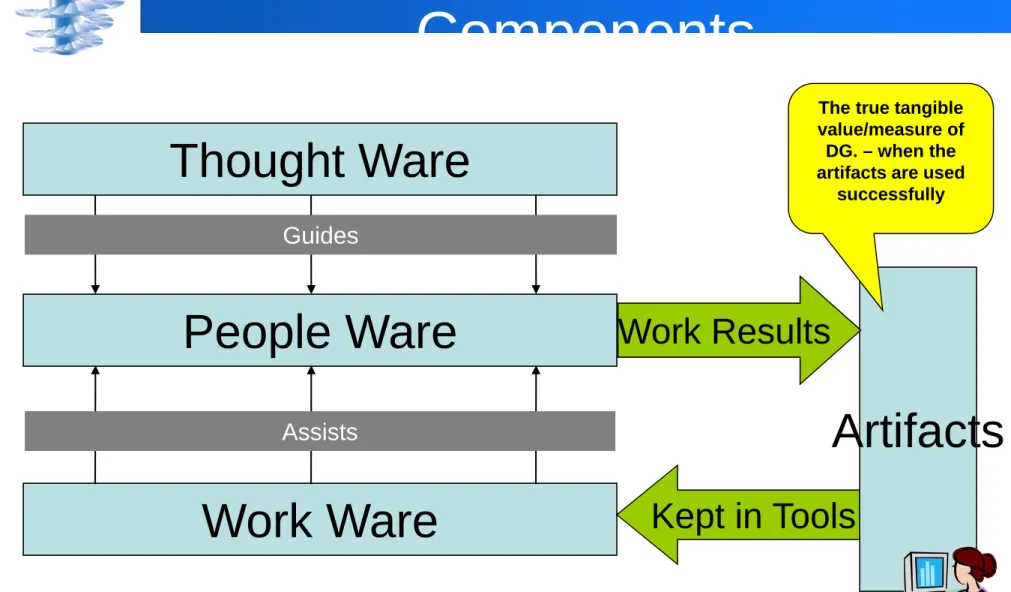
Data Governance Components
Thought Ware:
Mission/Core Values, Goals/Objectives,
Charters/Principles, Critical Success Factors, Plans,
Documents/Policies, Communication Plan (messages and
vehicles), Roles/Functions and Responsibilities
Definitions, Accountability Matrix, Organizational
Interdependencies, Workflow
People Ware:
Structures, Organizations, Committees,
Teams/Groups, People
Work Ware:
Managed Meta Data Environment, Software,
Training and Education, References, Templates,
Standards
Artifacts:
Meta Data, Data Rules and Definitions, Decision
Illustration of the Four
Components
Thought Ware
Artifacts
People Ware
Work Ware
Assists
Guides
Work Results
Kept in Tools
The true tangible
value/measure of
DG. – when the
artifacts are used
Governance and Strategy
Data governance is the method for
connecting information management and
the corporate business strategy
Data Governance
Organization
Data Governance Organization
Every organization forms their data governance
organization a little differently
Some have a more or less complex organization
What is critical is that the organization:
¾
is actively using the MME
¾
has clear lines of communication
¾
has a defined and well understood decision making
process
Subject Area
A logical grouping of items of interest to the
enterprise, or areas of interest within the
company
About 10 – 20 Subject Areas in an
organization
The “nouns of an entity. Examples:
¾
Legal Entity
¾
Cost Center
¾
Account
¾
Product
Data Governance Organization
Subject Area
Groups
Subject Area User Group #1 • Chief Steward • Business Steward(s) • Technical Steward(s) • Interested PartiesRecommendations
Data
Stewardship
Coordination
Group
Program Manager Chief StewardsEIM Focus Area/
Project #1
Steward Team
Data Governance
Council
Policies, Procedures, Standards, etc. Members: •Executive Sponsor (s) •Program Manager •Chief Stewards •CIO•Key business staff •Key IT staff
Managed Meta Data Environment
Enterprise
Oversight
Subject Area User Group #2 • Chief Steward • Business Steward(s) • Technical Steward(s) • Interested Parties Subject Area User Group #3 • Chief Steward • Business Steward(s) • Technical Steward(s) • Interested PartiesEIM Focus Area/
Project #2
Steward Team
EIM Focus Area/
Project #3
Steward Team
Technical Stewards Data Custodian TeamInformation Technology
Requirements
Data Governance Organizations
• Chief Stewards
• Business Data Stewards • Technical Data Stewards
• Data Governance Program Mgr. • Chief Stewards
• Business Stewards • Technical Data Stewards Strategic
Tactical
Operational – by Subject Area, not by LOB
• Data Governance Program Mgr. • Various Data Stewards
< 20% < 5%
80-85% Conflicts Resolved
at this level
Data Governance Executive Committee
Subject Area Groups Data Stewardship Groups
Meta Data
Management
Meta Data vs. Data
Meta Data:
Meta data contains the knowledge
that a
1)
field is called “Customer_Name”, is 40
characters in length, and exists in systems A, B,
and C;
2)
that our company has 3 systems which
contain customer master data. These systems
are…
Data:
Data would be a specific instance of
“Customer_Name” equaling “John Doe”
Information:
Data that is meaningful to a
Data Governance Fundamentals
What is Meta Data?
Meta Data
By definition meta data is
1.
“Data about data”.
2.
“Everything that data is not”.
What is Meta Data?
Meta Data Definition
All physical data (contained in software and
other media) and knowledge (contained in
employees and various media) from within and
outside an organization, containing information
about your company’s physical data, industry,
technical processes, and business processes.
Managed Meta Data Environment ROI
“The key to your company’s prosperity is how well
you gather, retain and disseminate knowledge”
“Managed meta data environments are the key to
gathering, retaining and disseminating knowledge”
Managed Meta Data Environment ROI
Meta Data for the Business (business meta
data)
Meta Data for the IT Department (technical
meta data)
MME ROI
Intel finds huge ROI in managing meta data
¾
Estimates
$6 in savings for every $1 spent
• Emphasis on reducing developer’s average research time of 30%
• Uses “Centralized” architecture
• Key to success is based on regular, frequent “scan updates”
Source: Computer World magazine – July 2005
A Canadian government agency achieved:
¾
More than 90 percent reuse of existing data definitions
¾
85 percent improvement in application integration
¾
25 percent reduction in DW analysis and design
¾
Impact analysis study in 2 hours vs. 36 person-days of consulting
“Knowledge workers spend up to 2.5 hours each day looking for information… but find
what they are looking for only 40% of the time.”
Managed Meta Data Environment ROI
Meta Data for the Business (business meta data)
Provides the semantic layer between a company’s
systems (operational and business intelligence) and their
business users
Meta Data for the Business
Reduces training costs
Makes strategic information (e.g. data
warehousing, CRM, SCM, etc.) much more
valuable as it aids analysts in making more
profitable decisions
Create
actionable
information
Limits incorrect decisions
Assists business analysts in finding the
information they need, in a timely manner
Bridges the gap between business users and IT
professionals
Business
Meta Data Providing the
Semantic Layer
Enter Your Search Terms Below
Search
Logistics Reports
Ad-Hoc Reporting Customer Relationship & Sales Management Reports
Marketing Reports
Finance Reports
“Monthly Product Sales”
1. “Global Sales by Month”
This report shows a years worth of U.S., international, and Totals, of summarized sales figures
by product category, on a monthly basis.
2. “Global Sales by Region, by Month”
This report shows a years worth of U.S., international, and Totals, of summarized sales figures
by product category, on a monthly basis by region.
3. “Global Product Sales by Region, by Month”
Meta Data for the Business
2007 Monthly Global Sales Report
February 7, 2008
Month
Sales $ (in thousands)
U.S
Sales $ (in thousands
International
Product Category
Sales $ (in thousands
Total
December
TV
22,101
VCR
12,190
Digital
4,002
1,209
Miscellaneous
Cellular Phone
11,190
10,200
7,193
1,301
870
4,300
32,301
19,383
5,303
2,079
15,490
November
TV
42,000
VCR
28,193
Digital
8,901
2,730
Miscellaneous
Cellular Phone
21,190
22,200
12,193
2,901
1,530
9,878
64,200
40,386
11,802
4,260
31,068
October
TV
70,100
VCR
41,700
Digital
20,000
4,850
Miscellaneous
Cellular Phone
31,900
32,950
17,550
4,100
2,850
14,878
103,050
59,250
24,100
7,700
46,778
“Sales $ U.S.” is comprised of aggregated sales revenues from the United States, Canada, and Mexico, but does not subtract sales dollars
Meta Data for the Business
November 20, 2008
Carrier/Usage Summary Report
NoTeleCo
Month
Carrier
Name
Usage
Type
Discounted
Usage (M seconds)
October
BigTeleCo Long
Distance
7,201
4,288 11,489
Regular
Usage (M seconds)
Total
Usage (M seconds)
Local
72,033
42,000 114,033
TeleBell Long
Distance
630
777
1,407
Local
23,000
17,255 40,255
NewBell Long
Distance
220
310 530
Local
1,100
757 1,857
September
BigTeleCo Long
Distance
6,400
4,000 10,400
Local
73,450
42,702 116,152
TeleBell Long
Distance
645
750
1,395
Local
23,500
17,923 41,423
NewBell Long
Distance
124
175 299
Local
1,175
703 1,878
August
BigTeleCo Long
Distance
6,220
4,010 10,230
Local
71,207
41,918 113,125
Discounted Usage:
Any local or long
distance phone usage that has a discount
applied to it. Discounts include
non-prime
,
holiday
and
rate specials
.
Last Updated: 3/31/2004, Bob Jones
Non-Prime Usage:
Any local or long
distance phone usage that occurs
between the time of 8:00pm – 7:00am.
Meta Data Makes for
Better Decisions
Meta Data for the Business
2007 Monthly Global Sales Report
February 7, 2008
Month
Sales $ (in thousands)
U.S
Sales $ (in thousands
International
Product Category
Sales $ (in thousands
Total
December
TV
22,101
VCR
12,190
Digital
4,002
1,209
Miscellaneous
Cellular Phone
11,190
10,200
7,193
1,301
870
4,300
32,301
19,383
5,303
2,079
15,490
November
TV
42,000
VCR
28,193
Digital
8,901
2,730
Miscellaneous
Cellular Phone
21,190
22,200
12,193
2,901
1,530
9,878
64,200
40,386
11,802
4,260
31,068
October
TV
70,100
VCR
41,700
Digital
20,000
Cellular Phone
31,900
32,950
17,550
4,100
14,878
103,050
59,250
24,100
46,778
Managed Meta Data Environment ROI
Meta Data for the IT Department (technical meta data)
Help IT departments better manage, maintain and grow their IT
Meta Data for the IT Department
Dramatically reduces the probability of project failure
Speeds system’s time-to-market
Reduce system development life-cycle time
Limit redundant data
Limit redundant processes
Managing IT portfolios
Leverage work done by other teams
Reduced rework
Reduce research time
Reduce unproductive work
Technical
Meta Data for the IT Department
Impact Analysis Report
January 7, 2008
Impact Field
Tables/Files
Impacted
Fields Impacted
Program Impacted
Customer_Name CUSTOMER_PR02
DW_CUSTOMER
T
I02_CUSTOMER
Cust_Name_First
Cust_Name_Middle
Cust_Name_Last
Source
System
Order Entry
Table
Type
I
Cust_Name_First
Cust_Name_Middle
Cust_Name_Last
CUSTOMER_PR01
Source
Table
CUST
Customer_Addr
DW_CUSTOMER
T
I02_CUSTOMER
Cust_Name_Address
Cust_Name_City
Cust_Name_State
I
Cust_Name_Address
Cust_Name_City
Cust_Name_State
CUSTOMER_PR02
CUSTOMER_PR01
Cust_Name_Zip
Cust_Name_Zip
Question: Show all decision support tables/files, programs, and fields impacted by a change to the
“CUST” table in the “Order Entry” system
*Legend
“T” = Target
“I” = Intermediate
Meta Data for the IT Department
Impact Analysis Report
January 7, 2008
Domain
Tables/Files
Fields
Alphanumeric 20
DW_CUSTOMER
Order Entry
ORDER_HEADER
CUST_NAME
CUST_NAME
CUST_NAME
Field
Customer Name
System
CUST_NAME
CUST_NAME
Cust_Name
EXPENSES
I01_CUSTOMER
Cust_Name
Cust_Name
Cust_Name
Cust_Name
Cust_Name
Question: Show all systems, tables/files, fields, and their domains impacted by a change to the length of
all occurrences of the Customer_Name field
General Ledger
Data Warehouse
Alphanumeric 20
Alphanumeric 20
Alphanumeric 20
Alphanumeric 20
I02_CUSTOMER
I03_CUSTOMER
CUST_ACCOUNTS
CUSTOMER
ORDER_DETAIL
CUSTOMER_SHIP_TO
CUSTOMER_SELL_TO
CUSTOMER_BILL_TO
Cust_Name
Alphanumeric 20
Alphanumeric 20
Alphanumeric 20
Alphanumeric 20
Alphanumeric 35
Alphanumeric 35
Alphanumeric 35
MME For Systems
Consolidation
Meta Data for the IT Department
August 15, 2008
Systems Consolidation Report
Small Town Bank
BigCity Bank
Attribute
Name
Attribute
Definition
Entity
Name
System
Name
Attribute
Name
Attribute
Definition
Entity
Name
System
Name
Cust_Nbr Cust_Nbr is the attribute of record for BigCity Bank customer numbers
Cust_Tbl Central Customer System
CUSTNUM Customer numbers from the deposit system.
CUSTTABLE CUSTAPPL
Purchase_No Customer numbers from the purchase in the legacy deposit system
Purch_Tbl CUSTSYS
Borwr_No Customer numbers from the loan system.
Borrower_File LoanSys
Cust_Type Cust_Type is the attribute of record for BigCity Bank customer types (affluent, upward, standard, high risk).
Cust_Tbl Central Customer System
CUSTCDE Customer types from the general ledger system.
GL_CUST GLAPPL
Cust_Card_Ind Cust_Card_Ind is the attribute of record for BigCity Bank customer ‘s that have a BCB credit card.
Cust_Tbl Central Customer System
None applicable
Cust_Crdt_Ratg Cust_Crdt_Ratg is the Cust_Tbl Central Credit_Rate Customer rate is from the GL_CUST GLAPPL
Meta Data for the IT Department
August 15, 2008
Systems Consolidation Report
Small Town Bank
BigCity Bank
Entity
Name
Attribute
Definition
Attribute
Name
Domain
Value
Attribute
Name
Transformation
Rules
Entity
Name
Domain
Value
Cust_Type Cust_Type is the attributeof record for BigCity Bank customer types: 1 = affluent 2 = upward 3 = standard 4 = high risk Cust_Tbl
1 Cust_Type = 1 WHEN CUSTCDE CUSTCDE = 3 AND
CUSTBAL > 500,000
GL_CUST 3
CUSTBAL High cardinality fieldGL_CUST
2 Cust_Type = 2 WHEN CUSTCDE CUSTCDE = 4 AND
CUSTBAL <= 500,000 AND CUSTBAL > 200,000
GL_CUST 3
CUSTBAL High cardinality fieldGL_CUST
3 Cust_Type = 3 WHEN CUSTCDE CUSTCDE = 1 or 2 AND
CUSTBAL <= 200,000 AND CUSTBAL > 75,000
GL_CUST 3
CUSTBAL High cardinality fieldGL_CUST
4 Cust_Type = 4 WHEN CUSTCDE CUSTCDE = 0 AND
CUSTBAL < 75,000 AND Credit_Rate < 22
GL_CUST 3
CUSTBAL High cardinality fieldGL_CUST
Credit_Rate High cardinality fieldGL_CUST Cust_Card_Ind Cust_Card_Ind is the
attribute of record for BigCity Bank customer ‘s that have a BCB credit card.
Cust_Tbl
Managed Meta Data
Environment
Managed Meta Data Environment
When implementing a meta data
management system there is a lot more to it
than just a meta data repository
Important:
The MME is an operational
system, not a data warehouse
Managed Meta Data Environment
Managed Meta Data Environment (MME):
The managed meta data environment
represents the architectural components,
people and processes that are required to
properly and systematically gather, retain and
disseminate meta data throughout the
Managed Meta Data Environment
Meta Data Sourcing Layer
Meta Data
Extract
Meta Data
Repository
Messaging/Transactions (EAI, web services, XML, etc.)
Software Tools
Meta Data Delivery Layer
Meta Data
Management Layer
Documents/ Spreadsheets
End Users (business and technical) Third Parties (business partners, vendors,
customers, government agencies) Meta Data Extract Meta Data Extract Meta Data Extract Meta Data Extract
M
e
t
a
D
a
t
a
I
n
t
e
g
r
a
t
i
o
n
L
a
y
e
r
Data Warehouse/ Data Mart(s) Websites/E-CommerceThird Parties (vendors, customers, government agencies)
Meta Data Marts
End Users
(business and technical) Business Users
Applications (CRM, ERP, etc.)
End Users
(business and technical)
Websites/ E-Commerce Applications
(CRM, ERP, data warehouses, etc.)
Meta Data Extract
Messaging/Transactions (EAI, web services, XML, etc.)
Meta Data Management in Governance
Stewards manage data (instances of data
values) and meta data (information
concerning the data)
Meta data management is the
key
technical enabler
for the performance of
successful governance
Difficult to do governance successfully
without managed meta data environment
Meta Data Subject Areas
Data Models & Business Definitions
Entities, Attributes, Relationships and Rules,
Business Definitions
Process Models
Functions, Activities, Roles, Inputs/Outputs, Workflow,
Business Rules
Data Integration
Sources, Targets, Transformations, Lineage, ETL Performance, EAI, EII,
Migration / Conversion
Analytics
Data, Definitions, Reports, Users, Usage,
Performance
Data Governance
Policies, Standards, Programs, Roles, Organizations, Stewardship Assignments
System Portfolio & IT Governance
Databases, Applications, Projects, Integration Roadmap
Reference Data Values
Internal & External Codes, Domain Values and Meanings
Business Architecture
Organizations, Strategies, Alignment, Performance
Data Structures
Files, Tables, Columns, Views, Business Definitions, Indexes, Usage, Performance,
Change Management
Document Content Management
Unstructured Data, Documents, Taxonomies, Ontologies, Name Sets, Legal Discovery,
Search Engine Indexes
Data Security
Classifications, Users, Groups, Filters, Authentication, Audits, Privacy, Risk Management,
Compliance
Data Quality
Defects, Metrics, KPIs, Ratings
System Design & Development
Requirements,
UML, Java, EJB, Legacy System Wrappers, Code/Component Reuse Legacy Systems Understanding VSAM, COBOL, Impact Analysis, Restructuring, Reuse, Componentization Service Oriented Architecture (SOA) Web Services, MQ, XML Technologies,
Enterprise Service Bus
Managed Meta Data Environment ROI
“We Build Systems To Manage Every
Aspect Of Our Business, Except One To
Manage The Systems Themselves.”
“A Managed Meta Data Environment Is A
System That Manages Our Systems.”
Understanding the
Big Picture
EIM Functional Framework
Data Stewardship
Database
Management
Unstructured
Data
Management
Reference &
Master Data
Management
Data
Warehousing
& Business
Intelligence
Information
Quality
Management
Data Governance
Data Architecture
Meta Data Management
Information Security Management
The DAMA-DMBOK Framework
Version 3
© 2008 DAMA International -
http://www.dama.org
Document &
Content
Management
Data
Warehousing
& Business
Intelligence
Management
Reference &
Master Data
Management
Data
Security
Management
Data
Development
Meta Data
Management
Data
Quality
Management
Data
Architecture
Management
Database
Operations
Management
Data GovernanceEIM Maturity Model
Level 1
Level 2
Emerging
Processes
• Redundant, undocumented data. • Disparate databases without
architecture.
• Little or no business meta data. • Diverging semantics.
• Minimal data integration.. • Minimal data cleansing. • Dependent on a few skilled
individuals.
• Responsibilities assigned across separate IT groups.
• Few defined IT roles.
• Some commonly used approaches but with no commitment to their use. • Some management awareness, but
no enterprise-wide buy-in.
• Little or no business involvement, no defined business roles.
• General purpose tools used as point solutions.
• Reactive monitoring and problem solving.
• Data regarded as a minor by-product of business activity, with no
estimated business impact.
• Growing intuitive executive awareness of the value of data assets in some business areas. • Initial forays in data
stewardship and
governance but roles are unclear and not ongoing. • Initial efforts to implement
enterprise-wide management, but with contention across groups with differing perspectives. • New skills requirements are
recognized and addressed with training.
• Enterprise architecture and MME projects underway. • Data Distribution Services
are deployed as strategic solutions
• Some processes are repeatable.
• Active executive Involvement across the enterprise.
• Ongoing, clearly defined business data stewardship. • Central EDM organization. • Standard processes,
metrics, and tools used enterprise wide.
• Enterprise data architecture guides implementations. • Centralized meta data
management.
• Quality SLA’s are defined and monitored regularly. • Commitment to continual
skills development. • Periodic audits and proactive monitoring.
Level 3
Engineered
Processes
Level 4
Controlled
Processes
Level 5
Optimizing
Processes
• Measurable process goals are established for each defined process • Measurements are collected and analyzed. • Quantitative (measurement) analysis of each process occurs • Beginning to predict future performance • Defects are proactively identified and corrected. • Quantitative and qualitative understanding used to continually improveeach process. • Value is monitored continuously. • Understanding ofhow each process contributes to the business strategies and goals of the enterprise.