FOURTH ANNUAL CONFERENCE ON
COMPETITION AND REGULATION IN NETWORK INDUSTRIES 25NOVEMBER 2011
BRUSSELS,BELGIUM
Pump-storage small hydropower as an example of co-evolution between institutions and technologies
CRETTENAND Nicolas
Ecole Polytechnique Fédérale de Lausanne (EPFL)
Chair, Management of Network Industries (MIR) and Energy Center (CEN) Station 5, 1015 Lausanne, Switzerland
Phone: +41 21 693 00 89 Fax: +41 21 693 00 00 [email protected]
Abstract
The aim of this paper is to explore the storage and pump-storage application of small hydropower as an example of co-evolution between institutions and technologies.
The context of the research is given by the liberalisation of the electricity sector and the government‘s aim to increase the part of renewable energy technologies (RET) within the electricity production mix. As a consequence, the part of intermittent RET such as wind and solar power is increasing significantly. Furthermore, the electrical grid is becoming ―smarter‖ with the implementation of ICT which may significantly change how the electricity network is operated locally and regionally.
Within the facilitation of RET, quantity (i.e. kWh) as well as ‗quality‘ should be promoted. RET need to contribute to peak electricity, be available on demand and also be part of the balancing of the electrical grid frequencies. If this is not the case, the facilitation of RET is incoherent as it focuses only on quantity, and not on the sector specific technical aspects such as the real-time balancing of demand and supply.
The storage, and where technically and environmentally feasible, the pump-storage application of small hydropower (SHP) appears to be an option for distributed peak electricity, regional integration of intermittent RET and grid balancing. SHP being part of the facilitated RET, the storage and pump-storage application should be taken into account in the institutional frameworks.
With the conceptual background based on the literature of co-evolution between institutions and technologies and the coherence framework, the technical and institutional feasibility of the implementation of storage and pump-storage SHP has been evaluated in the case of Switzerland. The technical potential was evaluated with an explorative approach. Using qualitative research methods, institutional instruments were identified which allow the economically viable deployment of storage and pump-storage SHP. The implementation of such instruments leads to policy recommendations.
Finally, the analysis on this concrete example gives an illustration of the coherence framework and contributed to further develop it.
Keywords
Co-evolution, coherence, institutional frameworks, small hydropower, storage and pump-storage, Switzerland
Introduction
The electricity sector is undergoing significant changes such as the liberalisation process, the increasing deployment of renewable energy technologies (RET) and the so-called ―smart grid‖ developments. Firstly, the liberalisation in the network industries is a major institutional change, i.e. de- and re-regulation (including unbundling which is a pre-requisite for introducing competition). Competition is introduced in situations or sectors so far characterised by monopolies. The aim behind the liberalisation process is to increase the economic and systemic efficiency as well as the quality of the service. Due to this process, the institutional framework has changed from a public utility-oriented system towards a market-oriented system even though services such as electricity are still seen as an essential service. In the electricity sector, competition has been introduced at the production, access and sale levels although transport and distribution remain monopolies and are strictly regulated. Small hydropower (SHP) as RET has to compete at the production level with the other energy sources. Finally, the liberalisation process favours the development of distributed and small-scale power production, which requires less investment and is perceived as being less risky (Künneke, 2008: 235).
Secondly, RET are institutionally facilitated in many countries, including Switzerland, which contributes to deploy much more distributed and partly intermittent technologies. Prior to Fukushima, the Swiss government was aiming to increase the total amount of RET between 2010 and 2020 from 16% to 24% of the total energy consumption (EnergieSchweiz, 2008: 6). By 2030, the RET target in the electricity sector aims to have reached at least additional 5‘400 GWh compared to 2000 (Bundesversammlung der Schweizerischen Eidgenossenschaft, 2011). One of the seven measures to enable this is the facilitation of hydropower, including (SHP). In the light
of political decisions after the Fukushima accident, such as the very likely phase out of nuclear power in Switzerland, the facilitation of RET will even further increase, along with additional measures concerning energy efficiency. In order to cover the hitherto nuclear production, which represents nearly 40% of today‘s production (see Figure 1), and the growing electricity demand (+4% last year) (BFE, 2011a), additional RET and energy efficiency might not be enough to cover the demand. Thus gas thermal plants are likely to be built.
In addition to governments RET targets, there are RET targets at the regional and local level. Initiatives such as the ―Covenant of Mayors‖ lead to increasing RET electricity demand from cities. The ―Covenant of Mayors‖ involves 2‘930 local and regional authorities (October 2011) who voluntarily commit to increasing energy efficiency and the use of RET on their territories1. By their commitment, Covenant signatories aim to meet and exceed the EU 20% CO2 reduction objective by 2020. Several Swiss cities joined the covenant.
Finally, the electricity sector is affected by ICT developments enabling so-called ―smart grids‖. Smart grids2 contribute to the integration of the intermittent RET. They are electricity networks that use ICT to monitor and manage efficiently the transport of electricity from all generation sources to meet the varying electricity demands of consumers. They shift the electricity network from centralised, large scale and supply side dominated system towards a more decentralised, flexible, responsive system and bi-directional electrical flows.
This paper is structured as follows: First, the argument for storage RET is developed which lies the ground to deploy storage and pump-storage SHP. These latter technologies and their institutional frameworks are presented in the Chapters 2 and 3. The theoretical framework lies then the ground for the analysis in Chapter 5, followed by the conclusion.
1. Argument to develop storage RET and in particular pump-storage SHP
Within the changes in the electricity sector, the increase of distributed and intermittent production from RET leads to the need of more storage capacities to operate the electricity grid (Denholm, Ela et al., 2010). Storage capacities are complementary to the ICT developments which contribute as well to grid balancing. These storage capacities can be developed at the large scale level, as well as at the small scale and household level.
RET facilitation should therefore also take storage RET into account. It should not only aim at increasing the quantity of electricity from RET (i.e. kWh), but also consider the alignment between production and the actual electricity demand, and available peak power and contribution to the grid balancing.
Storage and pump-storage SHP is a small scale technology and can be developed on watercourses and within infrastructures. Storage and pump-storage hydropower remain the most
1http://www.eumayors.eu/index_en.html (accessed on 05.10.2011)
2 There are various definitions for smart grids. The European Smart Grid Task Force defines Smart Grids as
electricity networks that can efficiently integrate the behaviour and actions of all users connected to it — generators, consumers and those that do both — in order to ensure an economically efficient, sustainable power system with low losses and high quality and security of supply and safety.
efficient and profitable option to ―store‖ electricity. Furthermore and within the RET institutionally facilitated, SHP is the only technology which can be used for storage and flexible production.
In Switzerland, most of the large hydropower potential is already exploited or will be exploited in the near future. Large storage and pump-storage schemes have a national and continental role to play within the electricity sector in line with the role of electricity hub which Switzerland holds in Europe. Small scale schemes on the other hand have a local and regional role. The potential of storage and pump-storage SHP in Switzerland has not been evaluated yet, neither the necessary evolution of the institutional frameworks to facilitate these technologies.
2. Storage and pump-storage SHP in Switzerland
In Switzerland, SHP is defined by an installed capacity of up to 10 MW (BFE, 2004: 2). In 2010, SHP produced 3‘630 GWh and covered 5.48% of the Swiss electricity production (BFE, 2011d). This is by far the biggest share within the electricity production from RET (not including large hydropower) as shown in Figure 1.
Figure 1: Swiss electricity production mix in 2010, total production of 66.3 TWh
Sources: (BFE, 2011d, 2011a, 2011b)
Compared to other RET, hydropower has a high energy payback ratio3. The ratio for hydropower varies between 150-280, whereas for wind power between 20-40 and for solar photovoltaic 5-20 (Gagnon, 2005). In addition, SHP has, on average, lower production costs (including financial
3 For each electricity generation system, the ―energy payback‖ is the ratio of energy produced during its normal life span, divided by the energy required to build, maintain and fuel the generation equipment, and to deconstruct the system.
costs) than wind power and significantly lower than solar photovoltaic (BFE, 2007). With wind power it has the lowest GHG emissions per kWh (Sovacool, 2008).
2.1History and potential of SHP
Table 1 highlights SHP figures during the 20th century when the number of operated SHP plants below 300 kW greatly decreased because of the construction of large scale power plants, before increasing again in the 21st century thanks to the institutional facilitation. Large plants have continually increased in number since the early 20th century.
Table 1: Hydropower in Switzerland during the 20th century and in 2010
Installed electrical capacity (kW)
1914 1947 1985 2010
Plants MW Plants MW Plants MW Plants MW
% of total electricity production Below 300 ~6‘700 85 ~5'700 85 ~700 46 ~1000 60 0.4% 301 - 10'000 154 275 218 475 274 624 367 781 5.1% Above 10'000 14 290 65 2‘300 171 11'780 200 14‘118 51.1% Total hydropower ~6’870 650 ~6'085 2’860 ~1’150 12'450 ~1’567 14’959 56.6%
Sources:(Leutwiler and Dasen, 2008; BFE, 2011d, 2011b)
The last in depth study of the SHP potential was done in 1987 (Desserich and Funk, 1987). The technical SHP potential in Switzerland was evaluated around 9‗000 GWh/year, whereby approximately 3‗000 GWh/year were actually used. In November 2008, the Swiss government initiated a new study on the evaluation of the remaining technical potential of SHP in Switzerland. The final results will be available at the end of 2011. Current estimations by the author suggest that SHP could generate 1‘810 – 3‘620 GWh more by 2030.
2.2Storage and pump-storage SHP
Storage plants have an upper reservoir which can store water till a maximum level given by technical characteristics of the site. They can provide flexible production and ―store‖ electricity by not producing, thus storing the water, while for example other RET feed into the grid to cover the electricity demand.
Pump-storage plants have both an upper and lower reservoir (see next Figure 2), which have minimal and maximum water levels. When the electricity prices are low or there is a need for example for negative power balancing, the water is pumped up from the lower reservoir. During demand and prices peak, or when there is a need of positive power balancing, the water is released through the turbine from the upper reservoir. Up to more than 80% of the energy consumed during the overall cycle can be recovered, which means that 100 kWh stored deliver more than 80 kWh at peak time or when needed for flexible production.
Figure 2: Pump-storage plant in turbine mode
Source: adapted from Energy Center (2011)
In Switzerland, storage plants account for 60.1% of the operating hydropower plants and pump-storage for 13.8%. Table 2 shows the current installed capacities.
Table 2: Storage and pump-storage plants in Switzerland in 2010 Installed capacity at generator [MW] Storage plants Number Capacity [MW] Pump-storage plants Number Capacity [MW] < 1 1 0.4 0 0 < 10 18 105.8 3 14.7 > 10 67 8‘157.2 14 1‘878.8 Total 86 8‘263.4 17 1‘893.5 Source: (BFE, 2011d)
Storage and pump-storage SHP are electricity storage technologies which have a very high technical efficiency and long lifetime, as well as very low GHG emissions per produced kWh. The environmental integration of storage and pump-storage SHP plants on watercourses needs to take into account sustainability as well, thus take measures such as against hydropeaking and for sediment transport. Nevertheless and within the RET institutionally facilitated for electricity generation, SHP is currently the sole technology which can be adapted to storage. Therefore the institutional frameworks have to further evolve in order to facilitate storage and pump-storage SHP.
However, they are not the only storage technologies which should be institutionally facilitated within RET policies in the future. Other options such as sustainable storage technologies will emerge at the household level. The Energy Strategy 2050 of the Swiss government recommends the establishment of an action plan including the development of energy storage technologies for
Upper reservoir
Lower reservoir
electricity which could then benefit from federal grants for demonstration plants. This is an opportunity for innovative storage and pump-storage SHP plants.
Storage and pump-storage SHP can contribute to deal with the daily and in certain cases, where the reservoirs have important capacities, with the weekly fluctuations in the electricity sector. It could therefore substitute partly the daily grid balancing of large storage and pump-storage plants which could keep their capacity mainly for seasonal balancing. The increasing quality of weather forecast4 improves the regional and local coordination between intermittent RET, such as solar and wind power, and storage and pump-storage SHP to deal with the production fluctuations.
Storage SHP offers the opportunity to combine hydropower production with the regulation of the flow downstream of the storage capacity. Climate change is going to further reduce water flows during the summer. Storage plants could therefore contribute to store water, e.g., from heavy rains and melting snow, in order to release more water during natural low flow periods (Pfammatter, Zysset et al., 2007). Furthermore, more extreme flooding can be expected in the future and storage SHP plants could provide mitigation infrastructure as well. In any case, the storage capacity would probably have to be increased and beside daily operational hydropower cycles, seasonal environmental water flow regulation would come into play.
With the construction of large storage or pump-storage plants grid reinforcements become often necessary. In the case of SHP, grid reinforcements are in most cases not required5. However, if they are necessary, the reinforcement costs have been paid by the national transmission operator (Swissgrid) till 20116. Swissgrid transfers these costs onto the final customers. Distributed production such as SHP increases the grid stability, decreases energy losses during transport and reduces network congestions. In addition, a multitude of small scale distributed production units enhance reliability of the electricity network, as the probability to loose big amounts of production at a time is much reduced, and the N-1 criterion7 is easier to fulfil. Local consumers of closed-by SHP production should thus pay significantly less for their electricity transport and high-voltage ancillary services.
3. The institutional frameworks concerning SHP in Switzerland
The institutional frameworks in Switzerland are very complex. SHP is not only affected by cross-sectorial regulation (e.g., water and energy sector, spatial planning), but also has to develop within a multi-level governance framework. Certain administrative procedures are completed at the national level (e.g., feed-in remuneration allocation), others at the cantonal level (e.g. water concession) and finally some at the commune level (e.g. construction permit). Transaction costs
4 E.g., http://www.meteocentrale.ch/en/current-weather-switzerland.html (accessed 10.08.2011)
5 In February 2011, the ElCom had treated 5 cases of grid reinforcement linked to FIR projects (Newsletter 2/2011,
www.elcom.admin.ch). At that time, about 1600 RET plants were operating (Report Warteliste, 01.03.2011,
www.swissgrid.ch). Therefore, in 3%0 of the cases, grid reinforcement was necessary.
6 Elcom Newsletter 2/2011:
http://www.elcom.admin.ch/dokumentation/00115/00117/index.html?lang=de&download=NHzLpZeg7t,lnp6I0NT U042l2Z6ln1acy4Zn4Z2qZpnO2Yuq2Z6gpJCDdIB7e2ym162epYbg2c_JjKbNoKSn6A--
7 The N-1 criterion expresses the ability of the system to lose a linkage (i.e. a power line) or a node (i.e. production unit) without causing an overload failure elsewhere in the system.
linked to the administrative procedures are similar than for large hydropower which means that in relative terms these costs are much higher for SHP than for large hydropower.
The latest major institutional development was the introduction of the feed-in remuneration (FIR) in 2009. It is a cost-effective net metering and applies to RET which are not yet competitive in the liberalised electricity market. It includes SHP. From the judicial point of view it is not a ―tariff‖ nor a subsidy, but a feed-in remuneration schemes. The SHP FIR depends on the installed capacity, yearly production, head and a bonus linked to the hydraulic civil work. The FIR is based on reference plants, varies between 5 - 35 cts/kWh and is guaranteed for 25 years. There is no digression of the remuneration in time. The FIR cannot be combined with green tariffs and there are no ecological constraints to it, however, all the environmental regulations must be fulfilled in order to get the water concession. The pool to fund the FIR is limited and its income is provided currently by 0.45 cts per consumed kWh. The fund pays the difference between the set FIR and the market price at the moment of production, i.e. a premium-price FIR. The market premium-price is taken from the Swissix trading premium-price. The FIR offers adequate remuneration for SHP and boosts its development. It does, however, lack certain provisions for low-head sites and continually maintained and rehabilitated plants, the procedures remain too heavy, and furthermore the applied differentiation for the different FIR is not enough to account for the strongly differing characteristics of the SHP plants. Nevertheless, the authorities are submerged with project demands.
SHP can benefit from green tariffs through labelled green electricity (Naturemade and TÜV labels). However, it cannot generate CO2 credits or tradable green certificates (TGC) in the current institutional frameworks in Switzerland. Furthermore, SHP is affected by water regulation, such as the water use concession, and by environmental regulation such as minimum residual flow and environmental impact assessment (above 3 MW). It is supported through the federal ―SwissEnergy‖ program which is mainly concerned with offering a network platform for all SHP actors and continues till 2020. Finally, there are Canton specific institutional measures and regulations related to SHP.
4. The coherence framework
The conceptual framework for the research and analysis is the framework of coherence between institutions and technologies. The broader theoretical background is the literature on the co-evolution between institutions and technologies in the case of network industries. An approach based on this literature and framework is relevant as SHP is part of the electricity sector as a network industry.
Network industries, such as the electricity, are conceived as complex systems in which technological and institutional elements are strongly interwoven (Hughes, 1987). There is a co-dependence and co-evolution between the institutions and the technologies.
North defines institutions as “the rules of the game in a society or, more formally, the humanly
devised constraints that shape human interaction. In consequence they structure incentives in human exchange, whether political, social, or economic. Institutional change shapes the way societies evolve through time and hence is the key to understanding historical change.” (North, 1990: 3)
Saviotti (2005: 12) defines technology as “the set of activities by means of which human beings
modify their external environment.” These ―activities‖ mostly refer to technical artefacts and do not include ideas. Within this research storage and pump-storage SHP represents the technologies. Being part of the electricity sector, specificities of the latter have to be taken into account (e.g. continuous and instant adjusting of demand and supply).
Co-evolution is the reciprocal interactions between two populations, entities or systems. These interactions have a significant causal impact on each other and need to be strong and in localised proximity (Kallis, 2007). The literature of co-evolution between institutions and technologies in the cases of network industries describes the general process of changes within them and highlights the necessity to align these changes (Finger, Groenewegen et al., 2005; Künneke, 2008; Künneke, Groenewegen et al., 2008). It does not provide a framework to measure and compare institutions and technologies nor measure the impact of the changes. Neither does it explain how governments could facilitate such an alignment. The framework of coherence between institutions and technologies tries to overcome this problem.
This framework aims to evaluate the coherence between institutions and technologies and thus leading to an evaluation of the performance of the network industry. As developed by Künneke, Finger, Groenewegen and Menard, it contains a way to compare institutions to technologies (Finger, Groenewegen et al., 2005; Groenewegen, 2005; Künneke and Finger, 2007; Künneke, 2008; Künneke, Groenewegen et al., 2008; Ménard, 2009). The framework is conditioned by the fact that it applies to networks or technical systems and not the individual products so often described in theories of co-evolution. It currently continues to be developed (Finger, Crettenand et al., 2011).
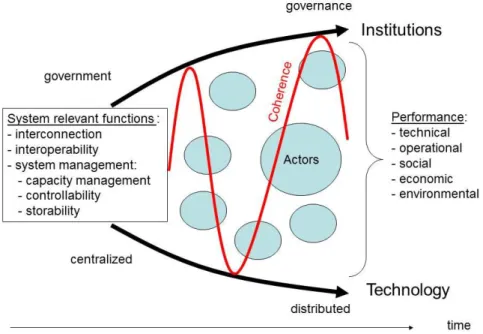
The coherence between institutions and technologies is defined by the coherence in scope of control (i.e. the technological and institutional geographical scope have comparable boundaries), the coherence in resolution (i.e. level at which the scope of control is compared), the coherence between coordination mechanisms (i.e. centralised, decentralised or peer to peer), and the coherence between the speed of adjustment (e.g., operational balancing, duration of contracts and lifetime of infrastructure) (Crettenand, Laperrouza et al., 2010). The coherence is evaluated by taking into account the system-relevant functions (interconnection, interoperability and system management). The literature on this framework highlights the need of alignment between institutions and technologies when changes are made. It does not yet provide a roadmap of implementation, but should contribute to formulate policy recommendations.
Figure 3 schematizes the framework. The system relevant functions have to be insured by the technological and institutional settings. Historically, network industries where centralised technologically and the relevant institutions were set by the governments. More recently, technology becomes distributed and the multi-level governance (e.g., regional, local, supra-national, etc.) shapes the institutions. Actors, i.e. stakeholders, define performance (along five categories: technical, economic, social, environmental and operational), as well as institutions and the further development of technologies. A change on one side influences the other (marked by the red curve) leading to the co-evolution which should happen in a coherent8 way.
8 The coherence framework continues to be developed. In its latest version, the term ―coherence‖ is replaced by ―alignment‖.
Figure 3: The coherence framework
Source: (Crettenand, Laperrouza et al., 2010)
As an example, in the electricity sector the liberalisation brings an institutional change because of the unbundling of the vertical and centralised structure. If the technological side does not change and remains centralised and vertically intergraded, the coherence between institutions and technologies decreases and therefore the performance of the infrastructure will decline. The smart grid developments show that the technological side is changing to ensure the coherence. At the same time, technology has to be supported by suitable institutional frameworks in order to perform, which leads to this co-evolution between institutions and technologies.
The coherence between institutions and technologies should not only to be insured at the sector level, but also for individual technologies such as SHP.
5. Analysis and discussion
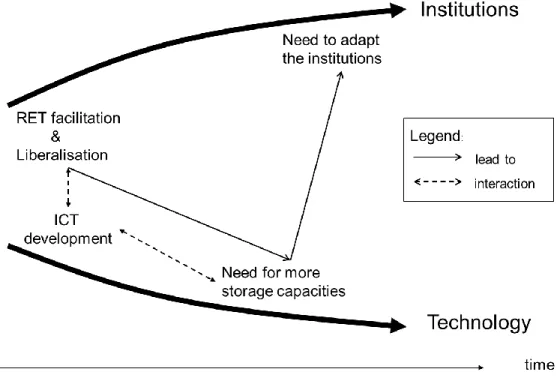
Storage and pump-storage SHP schemes are an example of co-evolution between institutions and technologies. The institutional changes such as the liberalisation process and the policy targets regarding RET lead to the increase of intermittency within production and thus the need of load shifting and smoothing, thus storage. Technologies adapt and innovate, such as developing SHP for storage purposes. This technological evolution requires further shaping of the institutions in order to be implement within the overall institutional frameworks regarding RET, which is necessary from a coherence perspective as it is developed below.
Figure 4: Need of storage in the electricity sector in the co-evolutionary process
Source: Author
The institutional facilitation of RET focuses currently on increasing the produced quantity (i.e. kWh). In order to include the above consideration on additional storage capacities and flexible production due to the facilitated intermittent RET, the institutional facilitations, mainly governmental policies, have to include aspects such as the alignment between production and the actual electricity demand, available peak power and contribution to the system management of the electricity grid. The latter refers mainly to storability and partly capacity management (see Chapter 4), e.g. the regulation of the capacity at the decentralised level.
Taking the coherence framework and its four coherence perspectives, the argument to include storage within the RET facilitation can be further enforced. The scope of control aims at an overlapping of the technical and institutional scope. If institutions become more and more decentralised because of liberalisation and smart grid regulation, the technical way the electricity grid will be operate will have to become more and more decentralised as well, thus requiring capacities to insure decentralised system management. This will require distributed storage capacities and distributed flexible production which is also supported by the coordination perspective (i.e. decentralised coordination mechanism). The resolution perspective further enforces the need to insure that at each institutional relevant level, the system-relevant functions (mainly system management) are technically secured. Finally, the time perspective can be used as an argument that the reaction to a perturbation, in this case from distributed intermittent RET, has to occur locally as close as possible and within the same scale of capacity. Hence, it is in favour of distributed and small scale flexible generation for small scale deployment of intermittent RET. Therefore, storage RET such as storage and pump-storage SHP have to be institutionally facilitated and included in the institutional frameworks.
5.1Evaluation of the technical potential of storage and pump-storage SHP in Switzerland
The technical potential of storage and pump-storage SHP was evaluated in Switzerland based on a methodology developed by the author (Crettenand, 2011). The technical potential was evaluated by looking primarily at existing and already planned reservoirs to reduce environmental opposition and costs. The methodology was bottom-up and explorative. The following reservoirs options were evaluated.
Table 3: Reservoirs for storage and pump-storage SHP schemes Drinking
Watercourse
Dammed lake (e.g. with the option of increasing the storage capacity) Natural small unused lake (if ecological value allows hydropower usage) Glacier (with global warming glaciers become new lakes)
Flood protection weir
Underground water
Underground water lake
Infrastructure
Snow making infrastructure (to be used in summer)
Irrigation reservoir (in mountain areas to be used in winter) Inoperative gallery (e.g. former construction or purge galleries) Unused military infrastructure (bunker, galleries)
Drinking water reservoir (in mountain areas to be used during off-tourism season)
Source: Adapted from (Crettenand, 2011)
The next table presents the results for Switzerland compared to the existing plants. SHP accounts for about 6.3% of the hydropower installed capacity. However, for storage schemes SHP accounts for only 1.3 % of the installed capacity and for pump-storage schemes even less with 0.7%. There is potential to increase these figures.
Table 4: Technical potential evaluation of storage and pump-storage SHP in Switzerland
Switzerland 2010 (in operation) Additional technical potential
Storage SHP 18 plants with a total of 106 MW 110 – 200 MW Pump-storage SHP 3 plants with a total of 15 MW 70 – 150 MW
Source: Adapted from (Crettenand, 2011)
The storage scheme potential lies mainly with SHP on watercourses. About 2/3 of this potential is with existing plants where the increase of the reservoir capacity could be evaluated. To reduce
environmental impacts and opposition, the potential with existing plants should first be exploited.
The pump-storage scheme potential is held in various infrastructures and lakes. The SHP potential (excl. storage and pump-storage) within infrastructures has already been exploited in Switzerland, mainly in potable and waste water networks. However, there remains a considerable potential for pump-storage schemes in the case of rehabilitation or new infrastructures. The aim should be to optimise the use of reservoirs whilst converging different sectors (e.g. electricity, tourism, agriculture and drinking water). During the period when water is stored but not used for its final purpose (e.g., snow, irrigation), the water can be used within closed systems for pump-storage. The given range in Table 4 is significant because the identified projects can have important differences in installed capacities depending on their final design.
The storage and pump-storage SHP potential is even more important if installed capacities below 300 kW per project are considered. Should it become technically possible to automatize completely micro hydropower plants between 20-100 kW, then such plants could also play a role within decentralised electricity services. This offers a field for further research.
The potential must be compared to large storage and pump-storage hydropower. For example, should the whole pump-storage SHP potential be constructed, it would only come up to about two thir of the second biggest existing pump-storage plant Force Motrices Hongrin-Léman (FMHL) which has currently an installed capacity of 240 MW. Furthermore, if large pump-storage schemes presently under construction are considered (e.g. Linthal 2015, Nant de Drance, Lago Bianco) which are designed with capacities around or above 900 MW, then the debate leads to whether to build storage and pump-storage SHP schemes at all or of whether to add another large scale project. However, small and large scale plants are not in competition, but complementary. Large scale schemes are built with an international perspective of operation (e.g. European super grid), whereas small scale schemes should be built with a regional and so-called ―smart grid‖ perspective.
5.2Evolution of the institutional frameworks
As argued above, the institutional frameworks have to evolve in order to facilitate the development of storage and pump-storage SHP. Storage and pump-storage SHP schemes have mostly regional and local importance for the grid operation and the integration of intermittent RET. Therefore the regional and local institutional frameworks matter for their development. On the other hand and from a national policy perspective (e.g. RET targets), storage and pump-storage SHP should have a national importance. Thus the national institutional frameworks have to be shaped as well to include the development of storage and pump-storage SHP.
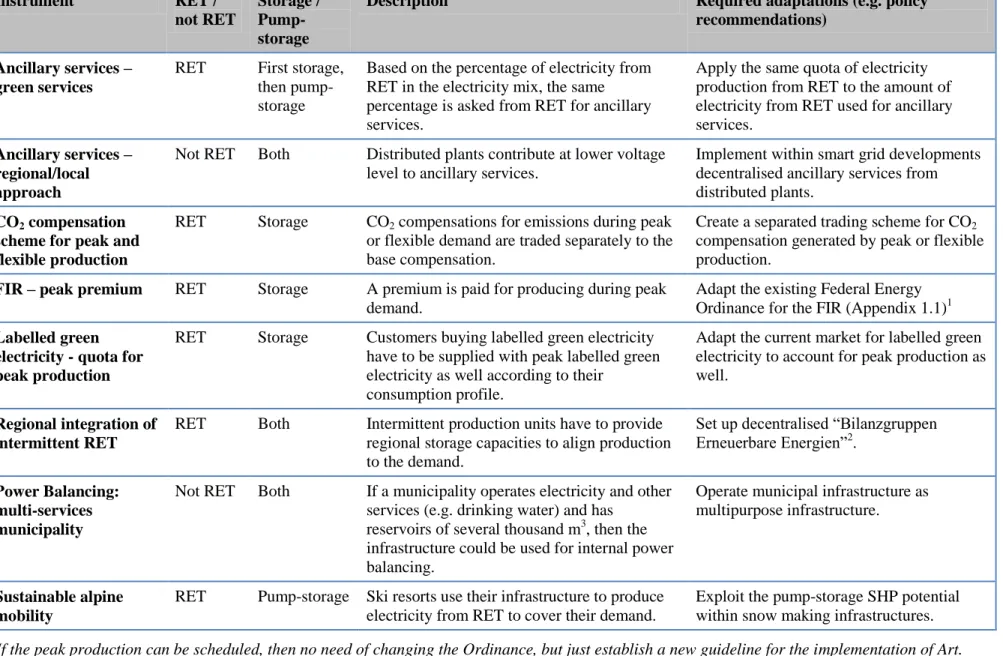
The institutional barriers for storage and pump-storage SHP are economic, administrative and environmental. On the economic side, the main barriers are the higher production costs compared to other technologies which can store energy and/or produce on demand (e.g., large storage and pump-storage hydropower, gas thermal plant). As developed above, technologies which are not yet cost-competitive in the liberalised electricity market require economic facilitation in order to be developed. Following the argument for energy storage and flexible production within RET facilitation, storage and pump-storage SHP has to be economically facilitated with adequate remuneration instruments. Some instruments were identified and are developed below.
The administrative procedures remain the same than for SHP in general. Some suggestions concerning the simplification, streamlining and harmonisation account for storage and pump-storage SHP as well and are developed below.
The environmental barriers are not studied within this paper as it was not within the scope of this research and other scholars are currently working on it (e.g. at EPFL).
The research was based on 19 semi-structured expert interviews and a survey send to all SHP operators which received FIR in 2010 (190 responses). The interview questions related to remuneration instruments for storage and pump-storage SHP, as well as reducing transaction costs and facilitating administrative procedures for SHP in general. The survey questions related to the possibilities of simplifying the administrative procedures and to evaluate if storage and pump-storage SHP should be facilitated within RET policies.
Remuneration instruments for storage and pump-storage SHP
In the case of SHP as storage RET, a differentiation between storage and pump-storage plants has to be made. Storage plants belong to the RET, but pump-storage plants are only part of RET if the pumping energy comes from RET as well. In some cases this is possible (see remuneration instruments ―regional integration of intermittent RET‖), but in most cases electricity from RET is used by consumers and not for pumping water up which leads to additional losses in the production cycle. Therefore, pump-storage SHP which pump with electricity from not-RET have to be remunerated with instruments outside of the RET facilitation schemes. However, if there are natural inflows in the upper reservoir, pump-storage SHP plants can differentiate their production between renewable (i.e. natural inflows) and not-renewable (i.e. pumped water with electricity from not-RET) and thus benefit from RET remuneration schemes.
In Europe, only Portugal and the Czech Republic have remuneration instruments taking into account flexible production. In Portugal, the feed-in tariffs depend on the time of electricity generation, i.e. peak/off peak (Haas, Panzer et al., 2011). In the Czech Republic, the guaranteed tariff differentiates between run-off and storage plants in peak or semi-peak production9. The additional income for peak and semi-peak production is 25%.
It is not the scope of this research to compare in depth the different instruments below, but to identify and develop some remuneration instruments which would facilitate the economically viable development of storage and pump-storage SHP (see Table 5). Such remuneration should allow enough income for the environmental integration of the storage capacities as well.
Table 5: Remuneration instruments for storage and pump-storages SHP Instrument RET / not RET Storage / Pump-storage
Description Required adaptations (e.g. policy
recommendations)
Ancillary services – green services
RET First storage,
then pump-storage
Based on the percentage of electricity from RET in the electricity mix, the same percentage is asked from RET for ancillary services.
Apply the same quota of electricity production from RET to the amount of electricity from RET used for ancillary services.
Ancillary services – regional/local approach
Not RET Both Distributed plants contribute at lower voltage
level to ancillary services.
Implement within smart grid developments decentralised ancillary services from distributed plants.
CO2 compensation scheme for peak and flexible production
RET Storage CO2 compensations for emissions during peak
or flexible demand are traded separately to the base compensation.
Create a separated trading scheme for CO2
compensation generated by peak or flexible production.
FIR – peak premium RET Storage A premium is paid for producing during peak
demand.
Adapt the existing Federal Energy Ordinance for the FIR (Appendix 1.1)1
Labelled green electricity - quota for peak production
RET Storage Customers buying labelled green electricity
have to be supplied with peak labelled green electricity as well according to their
consumption profile.
Adapt the current market for labelled green electricity to account for peak production as well.
Regional integration of intermittent RET
RET Both Intermittent production units have to provide
regional storage capacities to align production to the demand.
Set up decentralised ―Bilanzgruppen Erneuerbare Energien‖2
.
Power Balancing: multi-services municipality
Not RET Both If a municipality operates electricity and other
services (e.g. drinking water) and has reservoirs of several thousand m3, then the infrastructure could be used for internal power balancing.
Operate municipal infrastructure as multipurpose infrastructure.
Sustainable alpine mobility
RET Pump-storage Ski resorts use their infrastructure to produce
electricity from RET to cover their demand.
Exploit the pump-storage SHP potential within snow making infrastructures. 1
If the peak production can be scheduled, then no need of changing the Ordinance, but just establish a new guideline for the implementation of Art. 24 of the Energy Supply Ordinance.
2
Storage and pump-storage SHP schemes can also sell their electricity on the sport market or within current ancillary services frameworks. However, for the former the price difference between peak and low price is too low (except if several SHP plants are regrouped to a virtual plant), and for the latter the remuneration for tertiary control reaches only about half of the current feed-in remuneration10.
Simplification, harmonisation and streamlining of administrative procedures
The action plan of the Swiss Federal Office of Energy released following the revision of the federal energy strategy after the Fukushima accident recommends to take measures in order to simplify the administrative procedures for RET plants (BFE, 2011c, measure 35). This recommendation is in line with a motion passed in the Federal Parliament in June 2011 which requests the evaluation of a national law coordinating all procedures related to RET plants as per their technology and size. If a national law is not possible the evaluation has to suggest other juridical changes11. The purpose is to optimise the procedures among the three levels of the Confederation, Cantons and Communes, as well as to optimise the cross-references between the spatial planning, environmental, water concession and construction regulations. The need also comes from the lack of coordination among the different administrative authorities.
Simplification and harmonisation are not only an issue in Switzerland but also across the EU and in the USA. The SHAPES project strongly recommends more research on this topic for the EU (SHAPES, Mhylab et al., 2010). In the latest current status report on SHP in the EU, similar challenges to Switzerland concerning the administrative procedures are also identified in Austria, Belgium, France, Slovenia and Spain (ESHA, 2011). Obviously these are also countries (excluding Belgium) with strong hydropower potential where the institutional frameworks should be aligned to the SHP development.
In the USA, the administrative procedures to get all authorisations for a SHP plant are also subject to too many regulatory agencies at federal, state, and local levels (Kosnik, 2010). This leads to fragmented, costly, and inefficient time consuming administrative procedures, and results from the use of procedures for SHP which are based on the procedures for large hydropower. Procedures must be adapted and aligned to the size of the technology.
The review of the allocation of the different procedures to the different levels should include the quest to align the institutions with the technology according to the coherence framework. Thus, the institutional frameworks (incl. administrative procedures) should be aligned with SHP as a small-scale and geographically distributed technology. Institutions should also remain small in size, as much as possible, and within the geographical scope of the SHP technology. As the water concessions and most procedures are at the cantonal level, the cantonal level is the relevant level for many administrative procedures. In additional, Cantons ensure a regional perspective and contribute to regional ownership thus possible reducing of opposition to projects. Therefore, promoters should have the Cantons as a main partner for the administrative procedures. Further procedures would occur at the federal and communal level providing that the allocation is more
10 Personal communication with Swissgrid, February 2011
aligned to the SHP development. This has to be further elaborated within the current action plan mentioned above. Nevertheless, some recommendations can already be made.
The survey results showed that general simplifications and shortening of the approval procedures was the most frequent need concerning further facilitating SHP development. Simplifying the administrative procedures could be achieved by bundling all administrative applications such as in Norway (SMART, 2009). Then the SHP promoter would not have to apply for one authorisation to use the water, another to construct the plant and finally another to connect to the grid. The promoter would compose one application to develop hydro power, and if the permission was granted, automatically the promoter would have the authorisation to use the water, build the power station (including the intake and the pipes) and connect to the grid. This is an effective way of evaluating an application and developing a SHP plant as a whole. Such a ―one in all application‖ could be submitted to the Canton.
A further measure to simplify procedures is to deal with grouped projects (e.g., within the same sub-basin zone) and not with single projects. This would technically optimise interlinked projects instead of focusing on single plants and would lead to the concept of virtual power plants. The administrative procedures would be done commonly for the grouped projects. Furthermore it would include better spatial planning aspects.
Another measure to simplify and ensure coherence in size between the institutions and the technology is to review the procedures based on the installed capacity of SHP plants. This is already partly the case with plants below 3 MW not requiring the full environmental impact assessment and plants below 300 kW not requiring consultation with the federal administration. The procedures could be further simplified for rehabilitation projects and plants where the water concession comes to the end.
A harmonisation of the institutional frameworks across the country would reduce transaction costs and lead to a more coherent SHP facilitation and development nationwide. The above mentioned motion passed in the Federal Parliament in June 2010 is also along the lines of harmonisation. Harmonisation does not just include having the same procedures at the same governance level (e.g. cantonal level), but also a harmonised and national perspective on the development of SHP. Geographical priority areas for SHP development could be commonly defined. This could be done within cantonal hydropower master plans as developed below. A major issue to streamline administrative procedures is to reduce opposition. Two approaches can be implemented, one at the project level, the other at the river zone level. For the former, a filter for feasible projects is developed which is used prior to the start of the official administrative procedures. The filter includes technical, ecological, social and economic values, and is implemented by a local expert, such as in the Canton of Valais. The second approach aims at evaluating the SHP potential based on a holistic approach within a geographical region (Hemund, 2010). The methodology considers ecological, social and economic aspects, as well as regional water management and spatial planning. The outcomes are 1) river zones where SHP development is feasible and even wished and therefore opposition possibilities are reduced, 2) river zones where no further SHP development is allowed and 3) river zones where more discussion is required. This approach could be used to develop cantonal hydropower master plans, including for storage and pump-storage SHP.
5.3Contribution to the coherence framework
The example of facilitating storage within RET policies has been developed as an example of co-evolution, whereby institutions and technologies should be aligned (i.e. following the coherence framework).
In the case of storage and pump-storage SHP, the alignment, i.e. insuring coherence, relates mainly to the geographical scope of the technologies and institutions and has to consider the specificities of storage and pump-storage SHP as a distributed, small scale and storage technology.
Three contributions can be made to the coherence framework. Firstly, the way the system-relevant functions (see Figure 3) are insured evolves with the dynamics in the sector. In the case of the electricity sector, the system management function is not insured solely be centralised technology and institutions, but more and more by decentralised technologies and multi-level governance. Thus the coherence between institutions and technologies to insure the well operating of the system-relevant functions evolves as well over time and is a key factor determining the performance in the sector.
Secondly, the institutions within themselves have to be coherent. For example, a SHP plant operator received the FIR guaranteed for 25 years whereas its water concession was granted only for 20 years. The time durations need to be aligned. Furthermore, they are granted water concessions which have never been used which is incoherent with SHP development. The coherence is not only to be insured between institutions and technologies, but also within the institutions and the technological settings themselves.
Finally, some further considerations concerning the unit of analysis can be added. Within the coherence framework, the unit of analysis remains to be clearer defined. It is not yet delimited if the unit is given by the technical borders of the system analysed or by the institutionally relevant entity (e.g. nation states). Furthermore, the choice of the unit of analysis is closely interrelated with the coherence perspective of the geographical scope of control. Thus, the unit has first to be set by the actor which requires the analysis and only then, the coherence framework can be used to align the various institutions at the coherent level of resolution and scope of control with the technologies in order to reach the performance aimed at in the sector.
6. Conclusion
The institutional facilitation of RET can not only consider quantity (i.e. production of kWh), but needs to include as well ―quality‖ such as the alignment between production and the actual electricity demand, available distributed peak and flexible power, and the contribution to grid operations.
The technical potential of storage and pump-storage SHP in Switzerland is important as shown in Table 4. Therefore, it should be one of the technologies institutionally facilitated within policy making as storage RET.
The institutional feasibility depends mainly on the introduction of adequate remuneration instruments which should be included within the institutional frameworks facilitating RET. The instruments vary between storage and pump-storage as shown in Table 5. Policy recommendations, such as introducing green ancillary services, including peak and flexible CO2 credits to account for peak and flexible production compensation, introducing a premium for peak production in the existing FIR scheme, etc., were developed. In addition, administrative procedures should be harmonised across the country and streamlined in order to be aligned in size and scope with the technology. Finally, environmental aspects have to be considered as well. In conclusion, SHP storage and pump-storage schemes have a clear potential worth facilitating and developing in Switzerland.
Finally, this example of co-evolution on storage and pump-storage SHP contributed to further develop the coherence framework. The alignment between institutions and technologies could be explored in the case of storage and pump-storage SHP.
Acknowledgment
The author thanks EOS Holding (Switzerland) and the Energy Center at EPFL for the funding of the PhD research.
References
BFE (2004) Positionspapier Energie aus Kleinwasserkraftwerken: Bundesamt für Umwelt und Bundesamt für Energie, Eidgenössisches Departement für Umwelt, Verkehr, Energie und Kommunikation UVEK, Schweiz.
BFE (2007) Die Energieperspektiven 2035 - Band 1. Synthese. Bundesamt für Energie, Eidgenössisches Departement für Umwelt, Verkehr, Energie und Kommunikation UVEK, Schweiz, .
BFE (2011a) Schweizer Elektrizitätsstatistik 2010. Bundesamt für Energie, Eidgenössisches Departement für Umwelt, Verkehr, Energie und Kommunikation UVEK, Schweiz, . BFE (2011b) Schweizer Statistik der erneuerbaren Energien 2010. Bundesamt für Energie,
Eidgenössisches Departement für Umwelt, Verkehr, Energie und Kommunikation UVEK, Schweiz, .
BFE (2011c) Skizze des Aktionsplans Energiestrategie 2050: Bundesamt für Energie, Eidgenössisches Departement für Umwelt, Verkehr, Energie und Kommunikation UVEK, Schweiz, .
BFE (2011d) Statistik der Wasserkraftanlagen der Schweiz in 2010. Bundesamt für Energie, Eidgenössisches Departement für Umwelt, Verkehr, Energie und Kommunikation UVEK, Schweiz, .
BUNDESVERSAMMLUNG DER SCHWEIZERISCHEN EIDGENOSSENSCHAFT (2011) Energiegesetz
(EnG). 730.0. Schweizerische Eidgenossenschaft. Bern, Schweiz.
CRETTENAND,N. (2011) Small hydropower - storage and pump-storage schemes for decentralized electricity supply. HYDRO 2011. Prague, Czech Republic.
CRETTENAND,N., LAPERROUZA,M., et al. (2010) Performance and Coherence in Network Industries. Third Annual Conference on Competition and Regulation in Network Industries. Brussels, Belgium.
DENHOLM,P., ELA,E., et al. (2010) The Role of Energy Storage with Renewable Electricity Generation. Colorado: National Renewable Energy Laboratory, U.S. Department of Energy.
DESSERICH and FUNK (1987) Möglichkeiten des Ausbaus der Wasserkraftnutzung in der Schweiz - Studie Energiepotential aus Kleinwasserkraftwerken: Bundesamt für Umwelt und Bundesamt für Energie, Eidgenössisches Departement für Umwelt, Verkehr, Energie und Kommunikation UVEK, Schweiz.
ENERGIESCHWEIZ (2008) EnergieSchweiz nach 2010. Zwischenbericht der Strategiegruppe. Bundesamt für Umwelt und Bundesamt für Energie, Eidgenössisches Departement für Umwelt, Verkehr, Energie und Kommunikation UVEK, Schweiz.
ESHA (2011) Current status of Small Hydropower development in the EU-27. Stream Map Project: European Small Hydropower Association, Intelligent Energy Europe.
FINGER,M., CRETTENAND,N., et al. (2011) Critical system-relevant fucitons and performance in network industries. Workshop on Performance in Network Industries. Florence: Florence School of Regulation, Robert Schuman Centre for Advanced Studies, European
University Institute.
FINGER,M., GROENEWEGEN,J., et al. (2005) "The quest for coherence between institutions and technologies in infrastructures", Journal of Network Industries, 6 (No. 4): 227-259. GAGNON,L. (2005) Energy Payback Ratio: Hydro-Quebec, Montreal.
GROENEWEGEN,J. (2005) Designing markets in infrastructures: from blueprint to learning. Reader PhD Course "De- and re-regulation of network industries", TU Delft, April 2009. HAAS,R., PANZER,C., et al. (2011) "A historical review of promotion strategies for electricity
from renewable energy sources in EU countries", Renewable and Sustainable Energy Reviews, 15 (2): 1003-1034.
HEMUND,C. (2010) Integrated investigation of the small hydropower potential in Switzerland. Hidroenergia 2010 - International Congress and Exhibition on Small Hydropower. Lausanne, Switzerland.
HUGHES,T. (1987) The evolution of large technological systems. Cambridge, MA: MIT Press. KALLIS,G. (2007) "When is it coevolution?", Ecological Economics, 62 (1): 1-6.
KOSNIK,L. (2010) "The potential for small scale hydropower development in the US", Energy Policy, 38 (10): 5512-5519.
KÜNNEKE,R. (2008) "Institutional reform and technological practice: the case of electricity", Ind Corp Change, 17 (2): 233-265.
KÜNNEKE,R. and FINGER,M. (2007) "Technology matters: the cases of the liberalization of the electricity and railways", Competition and Regulation in Network Industries, 8 (3): 303-335.
KÜNNEKE,R., GROENEWEGEN,J., et al. (2008) Aligning institutions with technology: Critical transactions in the reform of infrastructures. Working Paper, TU Delft.
LEUTWILER,H. and DASEN,G. (2008) Datenblatt alle Wasserkraftwerke in der Schweiz: Interessenverband Schweizerischer Kleinkraftwerk-Besitzer (ISKB), Schweiz.
MÉNARD,C. (2009) "From technical integrity to institutional coherence: regulatory challenges in the water sector", In C. Ménard and M. Ghertman (eds), Regulation, deregulation and reregulation. Institutional perspectives. Cheltenham: E. Elgar pub.
NORTH,D. (1990) Institutions, institutional change and economic performance. Cambridge University Press.
PFAMMATTER,R., ZYSSET,A., et al. (2007) Wasserwirtschaft Schweiz 2025. Herausforderungen und Handlungsmöglickheiten. Ernst + Basler AG.
SAVIOTTI,P.-P. (2005) On the Co-Evolution of Technologies and Institutions. Springer. SHAPES, MHYLAB, et al. (2010) Work package 2: SHP Research and Development activities
within the European Union and associated states: Small Hydro Action for the Promotion of Efficient Solutions (SHAPES).
SMART (2009) Small Hydro Power Plants In Europe: Handbook On Administrative Procedures Requested. SMART - Strategies to Promote Small Scale Hydro Electricity Production In Europe.
SOVACOOL,B. K. (2008) "Valuing the greenhouse gas emissions from nuclear power: A critical survey", Energy Policy, 36 (8): 2950-2963.