On the Security of A Provably Secure Certificate
Based Ring Signature Without Pairing
Ji Geng
1, Hu Xiong
1,2, Fagen Li
1, and Zhiguang Qin
1 (Corresponding author: Hu Xiong)School of Computer Science and Engineering, University of Electronic Science and Technology of China1
No. 4, North Jianshe Road, Chenghua District, chengdu, Sichuan 610054, China
State Key Laboratory of Information Security, Institute of Software, Chinese Academy of Sciences2
No. 19 Yuquan Road, Shijingshan District, Beijing 100190, China (Email: [email protected])
(Received Feb. 11, 2014; revised and accepted Nov. 6, 2014)
Abstract
Featured with anonymity and spontaneity, ring signature has been widely adopted in various environments to of-fer anonymous authentication. To simplify the certifi-cate management in traditional public key infrastructure (PKI) and solve the inherent key escrow problem in the Identity-based cryptography, Qinet al. propose a pairing-free ring signature scheme in the certificate-based cryp-tosystem recently. Unfortunately, we demonstrate that their scheme is not secure against the malicious certifi-cate authority (CA) and key replacement attacks by giv-ing concrete attack. Concretely, a malicious certificate authority (CA) can forge a signature on arbitrary mes-sage in name of any user’s identity and a uncertified user is also able to forge a message.
Keywords: Certificate-based signature, forgery attack, ring signature
1
Introduction
Ring signature [19], which allows a user to issue a signa-ture on behalf of a group of possible signers (ring), has been introduced by Rivest et al. in Asiacrypt 2001. The resulting ring signature can convince a verifier that one member in the ring indeed signed the message without revealing the real identity of the actual signer. Differ-ent from group signature [4], there is not group manager in the ring signature to handle the enrollment and re-vocation of the ring members. Specifically, the actual signer can conscript the other ring members to form the ring without their consent. Featured with anonymity and spontaneity, ring signature has been widely adopted to of-fer anonymous authentication in various scenarios. As a representative example, portable devices or mobile appli-cations in the infrastructure-less mobile ad hoc networks (MANETs) can share data with the other participants
to behave in intelligent manners. It is challenging to se-cure MANETs due to the openness and lack of the central authority. Taking MANETs as an example, there are sev-eral security requirements a practical system must satisfy, including:
• Authenticity: In the situation of MANETs, the data sent from the other participants would be mis-leading if it is forged by adversaries. Thus, it is desir-able to authenticate the receiving data to resist the attacks mounted by the outside adversaries;
• Anonymity: The shared data in MANETs contains vast information of users, from which one can extract the location of the target users, etc. Therefore, any failures with regard to the privacy preserving may lead to the reluctance from the users to share data with others;
• Ad hoc: In the MANETs, the formation of a group
where the actual user hidden from is spontaneous due to the lack of central authority; and
• Efficiency: Taking the huge number of users in MANETs into account, a practical system must lower the computation and communication overhead as much as possible.
Ring signature can be viewed as an efficient solution on the aforementioned situation where the data authen-ticity and anonymity are expected. In addition to the data sharing in the MANETs (instantiated as Vehicular
ad hoc networks [21] and wireless sensor networks [11]), ring signature can also be deployed in other environments such as routing protocol [16] and electronic auction pro-tocol [22, 23]. Furthermore, ring signatures can also be viewed as the building block of concurrent signatures [5, 7] and optimistic fair exchange [12]. The survey of ring sig-natures can be found in [6, 25].
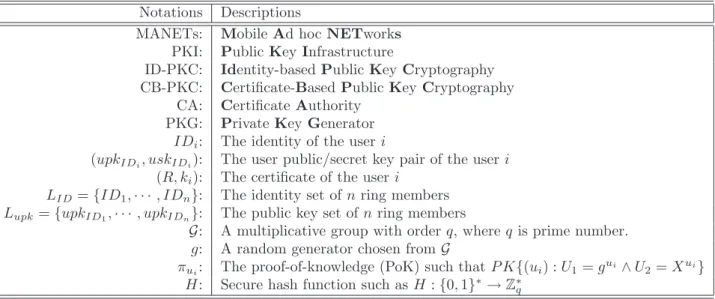
Table 1: Notations Notations Descriptions
MANETs: MobileAd hoc NETworks PKI: PublicKeyInfrastructure
ID-PKC: Identity-basedPublicKeyCryptography CB-PKC: Certificate-Based PublicKeyCryptography
CA: CertificateAuthority PKG: PrivateKeyGenerator
IDi: The identity of the user i
(upkIDi, uskIDi): The user public/secret key pair of the user i
(R, ki): The certificate of the user i LID={ID1,· · ·, IDn}: The identity set of nring members
Lupk={upkID1,· · ·, upkIDn}: The public key set ofnring members
G: A multiplicative group with orderq, whereqis prime number. g: A random generator chosen fromG
πui: The proof-of-knowledge (PoK) such thatP K{(ui) :U1=g
ui∧U
2=Xui}
H: Secure hash function such asH :{0,1}∗→Z∗ q
In traditional public key infrastructure (PKI), a semi-trusted certificate authority (CA) is involved to generate a digital certificate to bind the public key and the cor-responding identity. The management overhead of the public key certificate is considered to be costly. To sim-plify the certificate management, the notion of Identity-based public key cryptography (ID-PKC) has been in-troduced [20]. In ID-PKC, the public key of user can be easily derived from its digital identity such as email address or telephone number. To enjoy the merits of ID-PKC, the notion of ID-based ring signature schemes along with the extensions have been extensively investi-gated [2, 8, 24]. Unfortunately, a fully-trusted private key generator (PKG) is needed to generate the private key for each user according to its respective identity in ID-PKC. Thus, the key escrow problem is introduced into ID-PKC. To simplify the heavy certificate management in tradi-tional PKI and solve the key escrow problem in ID-PKC, a new paradigm, certificate-based public key cryptogra-phy (CB-PKC), is proposed by Gentry [10]. In CB-PKC, each user will generate the public and private key pair itself and the CA will issue the certificate using the pri-vate key generation algorithm in ID-PKC. In this way, the certificate will be used as part of the private key and third-party queries on certificate status in traditional PKI has already been eliminated in CB-PKC. Au et al. [1] intro-duce the notion of ring signature in the CB-PKC setting to enjoy the merits of CB-PKC and ring signature to-gether, and further proposed a concrete certificate based ring signature based on bilinear pairing.
In order to remove the costly bilinear pairing opera-tion, Qin et al. [18] proposed a pairing free certificate-based ring signature recently. Furthermore, they claimed that their scheme is provably secure in the random ora-cle model assuming the Discrete Logarithm assumption holds. Unfortunately, in this paper, we show that their
scheme cannot achieve the claimed security by demon-strating two forgery attacks. Concretely, a malicious CA equipped with the master secret key can forge a valid sig-nature on arbitrary message. In addition, a uncertified entity without a certificate issued by CA can also forge a valid signature on arbitrary message but replacing the public keys.
The rest of this paper is organized as follows. In Sec-tion 2, we review Qinet al.’s pairing-free certificate based ring signature scheme. In Section 3, we show that Qinet al.’s scheme is not secure and analyze the basic reason for the attack. Finally, the conclusions are given in Section 4.
2
Review of Qin et al.’s Scheme
Qin et al.’s certificate based ring signature scheme [18] is based on certificate-based signature scheme in [17] and ID-based ring signature scheme in [13]. The notation used in [18] is listed in Table 1 to improve the readability and we review Qinet al.’s scheme as follows.
1) Setup: Let G be a multiplicative group with order q. The CA selects a random generator g ∈ G and randomly chooses x∈R Z∗q as the master secret key.
It sets X =gx. Let H : {0,1}∗ →Z∗
q be a
crypto-graphic hash function. The public parameters are given by params=(G, q, g, X, H) The multiplicative group can be implemented on the Elliptic curve cryp-tography (ECC). According to [3], to achieve the comparable level of security to 1024-bits RSA, the Koblitz elliptic curve y2 = x3+ax2+b defined on
F2163 providing ECC group can be adopted. Here,a is equal to 1 and bis a 163-bit random prime. Thus, the size of the element in groupG(the master public key and the user public key) is assumed to be 163-bit.
as his secret keyuskIDi, and computes his public key upkIDi = (gui, Xui, πui) where πui is the following non-interactive proof-of-knowledge (PoK):
P K{(ui) :U1=gui∧U2=Xui.}
The subscript of ui has been inadvertently omitted
in [18]. This omission has been corrected to be con-sistent.
3) CertGen: Let ˜hi=H(upkIDi, IDi) for userIDi with public key upkIDi and binary string IDi which is used to identify the user. To generate a certificate for user IDi, the CA randomly chooses r ∈R Z∗q,
computesR=grandk
i=r−1(˜hi−xR) modq. The
certificate is (R, ki). Note that a correctly generated
certificate should satisfy the following equality: RkiXR=g˜hi.
4) Ring-Sign: Suppose there is a group of n users whose identities form the setLID={ID1,· · ·, IDn},
and their corresponding public keys form the set Lupk = {upkID1,· · ·, upkIDn}. To sign a message m∈ {0,1}∗on behalf of the group, the actual signer,
indexed by s using the secret key uskIDs and the certificatecertIDs, performs the following steps.
a. For each i∈ {1,· · · , n} \ {s}, selectsyi ∈R Z∗q
uniformly at random and computesYi=R−yi. b. Compute hi = H(mkLupkkLIDkYi) for i ∈
{1,· · ·, n} \ {s}. c. Choose ys ∈R Z∗q, computes Ys = R−ys Q i6=s (gui)hi˜hi Q i6=s (Xui)−hiR. d. Computehs=H(mkLupkkLIDkYs). e. Computez= (Pni=1yi+hsksus) modq.
f. Output the ring signature on m as σ = {Y1,· · ·, Yn, R, z, πu1,· · · , πun}. Though
{R, πu1,· · · , πun} is needed in the Verify al-gorithm, it has been inadvertently omitted in the signature of [18]. This omission has been corrected to be consistent.
5) Verify: To verify a ring signature σ= {Y1, · · ·, Yn,
R, z, πu1,· · ·, πun} on a messagem with identities in LID and corresponding public keys in Lupk, the
verifier performs the following steps.
a. Check whether πui is a valid PoK. If not, out-puts⊥, Otherwise, run the next step.
b. Compute hi = H(mkLupkkLIDkYi) and ˜hi =
H(upkIDi, IDi) for all i∈ {1,· · ·, n}.
c. Check whether n Y i=1 (gui)hi˜hi=? RzY 1· · ·Yn n Y i=1 (Xui)hiR
d. Accept the ring signature as valid and outputs 1 if the above equation holds, otherwise, output 0.
3
Analysis of Qin
et al.’s Scheme
It is non-trivial to devise secure certificate-based encryp-tion/signature scheme since the certificate of the user will no longer be used to certify the corresponding public key instead it will be implicitly used as part of private key in the decryption/signing algorithm. In fact, several based encryption scheme [26] and certificate-based signature scheme [14, 17] have been shown to be insecure against the attacks mounted by an uncertified en-tity or malicious CA respectively [9, 15, 27]. Motivated by these attacks, we observe that Qinet al.’s certificate-based ring signature [18] is also insecure against the forgery attack. Comparing with the existing attack algorithms with respect to certificate based encryption/signature schemes [9, 15, 27], our work mainly focus on the insecu-rity of the certificate-based ring signature, where a large number of users are involved in the process of the signa-ture generation.
According to [14, 15, 18, 27], two different types of attacks by the malicious CA and by an uncertified user should be considered in CB-PKC. On the one hand, the malicious CA, who has the master secret key, cannot ob-tain the user secret key and mount the public key replace-ment attack. On the other hand, the uncertified user can replace public keys of any entities in the system, but is not allowed to obtain the target user’s certificate.
3.1
Malicious CA Attack on Qin
et al
.’s
Scheme
Given a ring signature σ = {Y1, · · ·, Yn, R,
z, πu1, · · ·, πun} with the identities in LID =
{ID1,· · · , IDn}and corresponding public keys inLupk=
{upkID1,· · ·, upkIDn}, the CA equipped with the master keyxcan forge a valid signature on arbitrary messagem0
as follows:
1) Randomly choose j∈R{1,· · ·, n}. 2) Compute ˜hj=H(upkIDj, IDj).
3) ComputeR0=x−1h˜
j, where xis the master key. 4) For each i∈ {1,· · · , n} \ {j}, selects y0
i ∈R Z∗q
uni-formly at random and computesY0
i = (R0)−y 0 i. 5) Compute h0 i = H(m0kLupkkLIDkYi0) for i ∈ {1,· · ·, n} \ {j}. 6) Choose y0 j ∈R Z∗q, computes Yj0 = (R0)−y0 j Q i6=j (gui)h0ih˜i Q i6=j (Xui)−h0iR0. 7) Computez0=Pn i=1y0imodq.
8) Output the ring signature on m0 as σ =
{Y0
The following equations show that the signature σ= {Y0 1,· · ·, Yn0, R0, z0, πu1,· · ·, πun} is valid. n Y i=1 (gui)hi˜hi = Y i6=j (gui)h0i˜higxujh0jx−1˜hj = Y i6=j (gui)h0i˜higxujh0jR0 = Y i6=j (gui)h0i˜hiXujh0jR0 = (R0)Pni=1y0i Y i6=j (R0)−yi0·(R0)−yj0 Y i6=j (gui)h0i˜hi Y i6=j (Xui)−h0iR0 n Y i=1 (Xui)h0iR0 = (R0)z0 Y0 1· · · · ·Yn0 n Y i=1 (Xui)h0iR0.
3.2
Key Replacement Attack on Qin
et
al
.’s Scheme
In the following, we show that the scheme is not against an uncertified entity attack. Concretely, an entity without a certificate issued by CA can forge a valid signature on arbitrary message m0 by replacing the public keys. The
attack is depicted as follows:
1) Randomly choose r∈RZ∗q and computeR0=gr. 2) Randomly choose j∈R{1,· · · , n}.
3) For each i ∈ {1,· · ·, n} \ {j}, selectsy0
i ∈R Z∗q
uni-formly at random and computesY0 i =g−y 0 i. 4) Compute h0 i = H(m0kLupkkLIDkYi0) for i ∈ {1,· · ·, n} \ {j}. 5) Choose y0 j ∈R Z∗q, computes Yj0 = X−aR0 g−y0 j Q i6=j (gui)h0i˜hi Q i6=j (Xui)−h0iR0. 6) Compute ˜hj=H(upkIDj, IDj).
7) Computeuj= ˜haj as the secret key of user with
iden-tity IDj, and set upkIDj = (guj, Xuj, πuj) as the public key of this user, where πuj is the following non-interactive proof-of-knowledge (PoK):
P K{(uj).:U1=guj∧U2=Xuj}. 8) Computez0=ah0j r + Pn i=1y0i r modq.
9) Output the ring signature on m0 as σ =
{Y0
1,· · · , Yn0, R0, z0, πu1,· · ·, πun}.
The following equations show that the signature σ=
{Y0 1,· · ·, Yn0, R0, z0, πu1,· · ·, πun} is valid. n Y i=1 (gui)hi˜hi = guj˜hjh0j Y i6=j (gui)h0i˜hi = g˜hja˜hjh0jY i6=j (gui)h0i˜hi = gah0j Y i6=j (gui)h0i˜hi = gah0jX−aR0 Y i6=j (gui)h0ih˜iX a h0jh 0 jR0 = gah0 jX−aR0 Y i6=j (gui)h0ih˜iXujh0jR0 = (gr)ah 0 j r + Pn i=1yi0 r Y i6=j g−y0 iX−aR0g−y0j Y i6=j (gui)h0i˜hiY i6=j (Xui)−h0iR0 n Y i=1 (Xui)h0iR0 = (R0)z0 Y0 1· · · · ·Yn0 n Y i=1 (Xui)h0iR0.
4
Conclusions
In this paper, we have showed that the Qin et al. [18]’s certificate based ring signature scheme is not secure against the forgery attack. We consider pairing-free cer-tificate based ring signature scheme along with provable security as an open problem and our future research work.
Acknowledgments
This work is partially supported by National Natural Sci-ence Foundation of China under Grant Nos. 61003230, 61370026, 61300191 and 61103206, the Fundamental Re-search Funds for the Central Universities under Grant No. ZYGX2013J073 and ZYGX2012J077, and the Ap-plied Basic Research Program of Sichuan Province under Grant No. 2014JY0041.
References
[1] Man Ho Au, Joseph K. Liu, Willy Susilo, and Tsz Hon Yuen, “Certificate based (linkable) ring sig-nature,” in3rd International Conference on Informa-tion Security Practice and Experience-ISPEC 2007, pp. 79–92, Hong Kong, China, May 2007.
[2] Amit K Awasthi and Sunder Lal, “Id-based ring sig-nature and proxy ring sigsig-nature schemes from bilin-ear pairings,” International Journal of Network Se-curity, vol. 4, no. 2, pp. 187–192, 2007.
[3] Xuefei Cao, Weidong Kou, and Xiaoni Du, “A pairing-free identity-based authenticated key agree-ment protocol with minimal message exchanges,”
In-formation Sciences, vol. 180, no. 15, pp. 2895–2903, 2010.
[4] David Chaum and Eugene van Hevst, “Group sig-nature,” in Advances in Cryptology-EUROCRYPT 1991, pp. 257–265, Brighton, UK, April 1991.
[5] Liqun Chen, Caroline Kudla, and Kenneth G. Pa-terson, “Concurrent signatures,” in Advances in Cryptology-EUROCRYPT 2004, pp. 287–305, Inter-laken, Switzerland, May 2004.
[6] Sherman S. M. Chow, Richard W. C. Lui, Lucas Chi Kwong Hui, and Siu-Ming Yiu, “Identity based ring signature: Why, how and what next,” in Eu-roPKI 2005, pp. 144–161, Canterbury, UK, June 2005.
[7] Sherman S.M. Chow and WILLY Susilo, “Generic construction of (identity-based) perfect concurrent signatures,” in 7th International Conference on Information and Communications Security-ICICS 2005, pp. 194–206, Beijing, China, December 2005.
[8] Sherman S.M. Chow, Siu-Ming Yiu, and Lucas C.K. Hui, “Efficient identity based ring signature,” in3rd International Conference on Applied Cryptography and Network Security-ACNS 2005, pp. 499–512, NY, USA, June 2005.
[9] David Galindo, Paz Morillo, and Carla R`afols, “Breaking yum and lee generic constructions of certificate-less and certificate-based encryption schemes,” in 3rd European PKI Workshop: Theory and Practice-EuroPKI 2006, pp. 81–91, Turin, Italy, June 2006.
[10] Craig Gentry, “Certificate-based encryption and the certificate revocation problem,” in Advances in Cryptology-EUROCRYPT 2003, pp. 272–293, War-saw, Poland, May 2003.
[11] Daojing He, Jiajun Bu, Sencun Zhu, Sammy Chan, and Chun Chen, “Distributed access control with privacy support in wireless sensor networks,” IEEE Transactions on Wireless Communications, vol. 10, no. 10, pp. 3472–3481, 2011.
[12] Qiong Huang, Guomin Yang, Duncan S. Wong, and Willy Susilo, “Efficient optimistic fair exchange secure in the multi-user setting and chosen-key model without random oracles,” in The Cryptogra-phers’ Track at the RSA Conference, CT-RSA 2008, pp. 106–120, San Francisco, CA, USA, April 2008.
[13] Germ´an S´aez Javier Herranz, “New identity-based ring signature schemes,” in6th International Confer-ence on Information and Communications Security-ICICS 2004, pp. 27–39, Malaga, Spain, October 2004.
[14] Bo Gyeong Kang, Je Hong Park, and Sang Geun Hahn, “A certificate-based signature scheme,” in
Topics in Cryptology-CT-RSA 2004, pp. 99–111, CA, USA, February 2004.
[15] Jiguo Li, Xinyi Huang, Yi Mu, Willy Susilo, and Qianhong Wu, “Certificate-based signature: Security model and efficient construction,” inEuroPKI 2007, pp. 110–125, Palma de Mallorca, Spain, June 2007.
[16] Xiaodong Lin, Rongxing Lu, Haojin Zhu, Pin-Han Ho, Xuemin (Sherman) Shen, and Zhenfu Cao, “As-rpake: An anonymous secure routing protocol with authenticated key exchange for wireless ad hoc net-works,” in Proceedings of IEEE International Con-ference on Communications, ICC 2007, pp. 1247– 1253, Scotland, UK, June 2007.
[17] Joseph K. Liu, Joonsang Baek, Willy Susilo, and Jianying Zhou:, “Certificate-based signature schemes without pairings or random oracles,” in11th Interna-tional Conference on Information Security-ISC 2008, pp. 285–297, Taipei, Taiwan, September 2008.
[18] Zhiguang Qin, Hu Xiong, and Fagen Li, “A prov-ably secure certicate based ring signature without pairing,” International Journal of Network Security, vol. 16, no. 3, pp. 244–251, 2014.
[19] Ronald L. Rivest, Adi Shamir, and Yael Tauman, “How to leak a secret,” in Advances in Cryptology-AsiaCrypt 2001, pp. 552–565, Gold Coast, Australia, December 2001.
[20] Adi Shamir, “Identity-based cryptosystems and sig-nature schemes,” in Advances in Cryptology-Crypto 1984, pp. 47–53, California, USA, August 1984.
[21] Hu Xiong, Konstantin Beznosov, Zhiguang Qin, and Matei Ripeanu, “Efficient and spontaneous privacy-preserving protocol for secure vehicular communica-tion,” in Proceedings of IEEE International Confer-ence on Communications, ICC 2010, pp. 1–6, Cape Town, South Africa, May 2010.
[22] Hu Xiong, Zhong Chen, and Fagen Li, “Bidder-anonymous english auction protocol based on revo-cable ring signature,” Expert Systems with Applica-tions, vol. 39, no. 8, pp. 7062–7066, 2012.
[23] Hu Xiong, Zhiguang Qin, and Fagen Li, “An anony-mous sealed-bid electronic auction based on ring sig-nature,” International Journal of Network Security, vol. 8, no. 3, pp. 235–242, 2009.
[24] Hu Xiong, Zhiguang Qin, and Fagen Li, “A certifi-cateless proxy ring signature scheme with provable security,”International Journal of Network Security, vol. 12, no. 2, pp. 92–106, 2011.
[25] Hu Xiong, Zhiguang Qin, and Fagen Li, “A taxon-omy of ring signature schemes: Theory and appli-cations,” IETE Journal Of Research, vol. 59, no. 4, pp. 376–382, 2013.
[26] Dae Hyun Yum and Pil Joong Lee, “Identity-based cryptography in public key management,” in1st Eu-ropean PKI Workshop: Research and Applications-EuroPKI 2004, pp. 71–84, Samos Island, Greece, June 2004.
[27] Jianhong Zhang, “On the security of a certificate-based signature scheme and its improvement with pairings,” in 5th International Conference on In-formation Security Practice and Experience-ISPEC 2009, pp. 47–58, Xi’an, China, April 2009.
Ji Gengis a professor in the School of Computer Science and Engineering, University of Electronic Science and Technology of China. He received his M.S. degree from
Southwest Jiaotong University in 1990. His research in-terests include: information security and system software.
Hu Xiong is an associate professor at University of Electronic Science and Technology of China (UESTC). He received his Ph.D degree from UESTC in 2009. His research interests include: cryptography and network security.
Fagen Li received his Ph.D. degree from Xidian Uni-versity in 2007. He is now an associate professor in the School of Computer Science and Engineering, University of Electronic Science and Technology of China. His re-cent research interests include cryptography and network security.
Zhiguang Qinis the dean and professor in the School of Computer Science and Engineering, University of Elec-tronic Science and Technology of China (UESTC). He ceived his PH.D. degree from UESTC in 1996. His re-search interests include: information security and com-puter network.