A dissertation for the degree of
Doctor of Philosophy
Canonical Duality Theory
for Global Optimization Problems
and Applications
Yi Chen
Faculty of Science and Technology
Abstract
The canonical duality theory is studied, through a discussion on a general global optimization problem and applications on fundamentally important problems. This general problem is a formulation of the minimization problem with inequality con-straints, where the objective function and constraints are any convex or nonconvex functions satisfying certain decomposition conditions. It covers convex problems, mixed integer programming problems and many other nonlinear programming prob-lems. The three main parts of the canonical duality theory are canonical dual trans-formation, dual principle and triality theory. The complementary-dual principle is further developed, which conventionally states that each critical point of the canonical dual problem is corresponding to a KKT point of the primal problem with their sharing the same function value. The new result emphasizes that there exists a one-to-one correspondence between KKT points of the dual problem and of the primal problem and each pair of the corresponding KKT points share the same function value, which implies that there is truly no duality gap between the canonical dual problem and the primal problem. The triality theory reveals insightful information about global and local solutions. It is shown that as long as the global optimality condition holds true, the primal problem is equivalent to a convex problem in the dual space, which can be solved efficiently by existing convex methods; even if the condition does not hold, the convex problem still provides a lower bound that is at least as good as that by the Lagrangian relaxation method. It is also shown that through examining the canonical dual problem, the hidden convexity of the primal problem is easily observable.
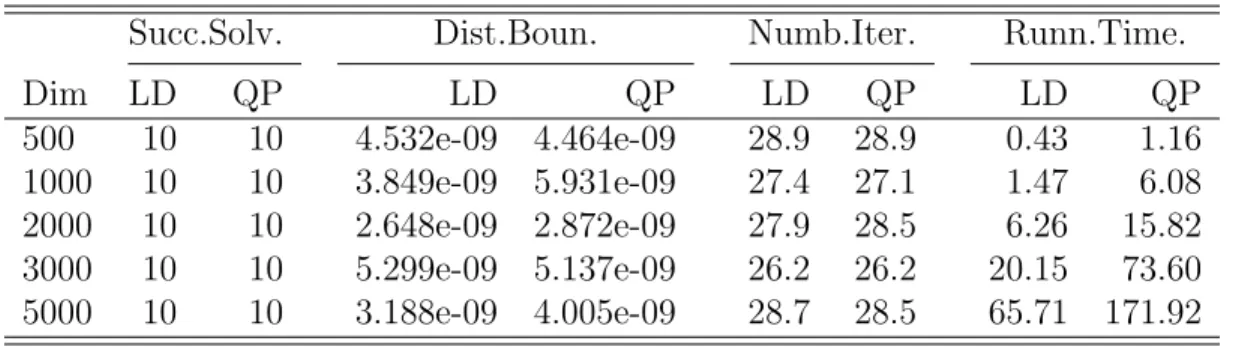
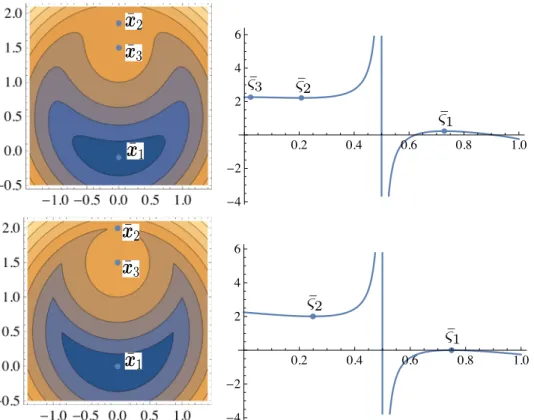
The canonical duality theory is then applied to dealing with three fundamentally important problems. The first one is the spherically constrained quadratic problem, also referred to as the trust region subproblem. The canonical dual problem is one-dimensional and it is proved that the primal problem, no matter with convex or nonconvex objective function, is equivalent to a convex problem in the dual space. Moreover, conditions are found which comprise the boundary that separates instances into “hard case” and “easy case”. A canonical primal-dual algorithm is developed, which is able to efficiently solve the problem, including the “hard case”, and can be used as a unified method for similar problems. The second one is the binary quadratic problem, a fundamental problem in discrete optimization. The discussion is focused on lower bounds and analytically solvable cases, which are obtained by analyzing the canonical dual problem with perturbation techniques. The third one
is a general nonconvex problem with log-sum-exp functions and quartic polynomials. It arises widely in engineering science and it can be used to approximate nonsmooth optimization problems. The work shows that problems can still be efficiently solved, via the canonical duality approach, even if they are nonconvex and nonsmooth.
Acknowledgements
I would like to gratefully and sincerely thank my supervisors, Professor David Yang Gao and Professor John Yearwood, whose contributions of time and mentoring are of great importance to the completion of my PhD study and thesis. I would also like to thank the university and the sta↵ for your excellent support.
Special thanks to my family and friends. It is your understanding and support that encouraged me to carry on with my doctoral journey.
Contents
1 Introduction 1 2 Preliminaries 4 2.1 Convex analysis . . . 4 2.1.1 Convex sets . . . 4 2.1.2 Convex functions . . . 6 2.1.3 Conjugate functions . . . 82.2 Optimization problems and optimality conditions . . . 10
2.2.1 Problem statements . . . 10
2.2.2 Optimality conditions . . . 11
2.3 Lagrangian duality and convex optimization problems . . . 16
2.3.1 Lagrangian duality . . . 16
2.3.2 Convex optimization problems . . . 18
3 Canonical Duality Theory 25 3.1 Problem statements . . . 25
3.2 Canonical duality theory . . . 26
3.2.1 Canonical dual problem . . . 26
3.2.2 Complementary-dual principle . . . 28
3.2.3 Global optimality condition . . . 30
3.3 Quadratic operators and triality theory . . . 32
3.3.1 Canonical duality with quadratic operators . . . 32
3.3.2 Triality theory . . . 33
3.3.3 Hidden convexity . . . 36
3.3.4 Convex optimization for global solutions . . . 41
3.3.5 Examples . . . 42
4 Spherically constrained quadratic minimization 46 4.1 Introduction . . . 46
4.2 Canonical duality and optimality . . . 48
4.2.1 Canonical dual problem . . . 48
4.2.2 Global optimality condition . . . 49
4.2.3 Existence conditions . . . 51
4.3 A perturbation method . . . 56
4.4 Canonical primal-dual algorithm . . . 59
4.5 Numerical experiments . . . 61
4.5.1 Small-size examples . . . 61
4.5.2 Large-size examples . . . 64
5 Unconstrained Binary Quadratic Optimization 67 5.1 Introduction . . . 67
5.1.1 formulations . . . 67
5.1.2 Combinatorial problems and complexity . . . 68
5.1.3 Algorithms . . . 70
5.2 Lagrangian relaxations . . . 73
5.3 Canonical duality for binary quadratic problems . . . 81
5.3.1 Canonical dual problem . . . 81
5.3.2 Global optimality conditions . . . 82
5.3.3 Existence and uniqueness . . . 84
5.3.4 Examples . . . 85
5.4 Perturbed problems . . . 86
5.4.1 Canonical duality for perturbed problems . . . 86
5.4.2 Analytically solvable cases . . . 89
6 Nonconvex optimization of log-sum-exp functions and quartic poly-nomials 92 6.1 Introduction . . . 92
6.2 Canonical dual problem . . . 93
6.3 Triality theory . . . 96
6.4 One-dimensional dual problem . . . 98
6.5 Examples . . . 100
7 Conclusions 103 Appendix A Linear algebra 105 A.1 Column space, nullspace and rank . . . 105
A.2 Orthogonality . . . 105
A.3 Eigenvalues and eigenvectors . . . 106
A.4 Symmetric matrices and eigenvalue decomposition . . . 106
A.5 Singular value decomposition . . . 107
A.6 Moore-Penrose pseudo-inverse . . . 108
A.7 Schur lemma . . . 109
A.8 Inverse of the sum of matrices and inverse of block matrix . . . 110
Appendix B Matrix di↵erentiation 112 B.1 Derivatives with vectors . . . 112
Glossary
R Real numbers.
R+ Nonnegative real numbers.
R++ Positive real numbers.
Rn n-dimensional Euclidean space.
Rn⇥m n⇥m-dimensional real matrices space.
Sn {A2Rn⇥n|AT =A}.
Sn
+ all positive semidefinite matrices inSn. Sn
++ all positive definite matrices inSn.
{a, b}n Set of n-dimensional vectors whose components are a or b.
|S| Cardinality of the set S.
kxk Euclidean norm, i.e., kxk2. {xi}ni=1 Column vector (x1, . . . , xn)T.
e All-ones vector.
I Identity matrix.
AT Transpose of matrix A.
A† Moore-Penrose or pseudo-inverse of matrix A.
tr(A) Trace of matrix A. rank(A) Rank of matrixA.
diag(A) Diagonal vector of matrixA.
diag(x) Diagonal matrix with diagonal elements x1, . . . , xn.
A B Hadamard product of matrices, i.e. A B ={aijbij}ni,j=1. A·B Inner product of matrices, i.e. A·B = tr(AB).
Q 0 Denotes Q is a positive definite matrix.
Q⌫0 Denotes Q is a positive semidefinite matrix.
f⇤ Conjugate function of f.
domf Domain of functionf.
rf Gradient of functionf.
r2f Hessian of functionf.
@f /@x Partial derivative of functionf with respect tox. exp(x) Exponential function ex.
Chapter 1
Introduction
TheCanonical duality theorywas developed from Gao and Strang’s original work for solving a general nonconvex/nonsmooth variational problem [54]:
min{⇧( ) =W(D ) F( )| 2Xc}. (1.1)
The function F( ) models the external energy and must be linear on its domain
Xa; while the function W : Wa ! R models the internal energy and must possess
“objectivity”1. Here the linear operator D : X
a ! Wa assigns each configuration
to an internal variable ✏ = D . The feasible set Xc = { 2 Xa| D 2 Wa}
is called the kinetically admissible space. Through the model (1.1), the canonical duality theory can be illustratively described, and more detailed explanations can be found in the recent paper [48].
The “objectivity” that the internal energy W must possess is mathematically defined in [38] (Definition 6.1.2). In Euclidean space, the definition is given as follows: let Xa ✓ Rn, Wa 2 Rm, and R = {R 2 Rn⇥m| RT = R 1}, i.e., the set of all
orthogonal matrices; a real-valued function W : Wa ! R is said to be “objective”,
if Wa and W satisfy R✏2 Wa, W(R✏) = W(✏), 8✏ 2 Wa, 8R 2 R. Geometrically,
it means that the domain and the function are invariant under any rotations about the origin.
There are principally three parts which comprise the canonical duality theory: 1) a canonical dual transformation, which is used to reformulate nonconvex or
discrete problems arising in di↵erent systems as a unified canonical dual prob-lems;
2) a complementary-dual principle, which illustrates the perfect duality relation between the primal and dual problems (there are no duality gaps) and provides unified analytical solutions for the primal problem in terms of the canonical dual solutions;
1Here, the word means that the function only depends on certain measure of its variables [48], in contrast to the meaning of target or goal in “objective function” in mathematical optimization.
3) a triality theory, which reveals an intrinsic duality pattern, being composed of
canonical min-max duality, double-min duality and double-max duality, which can be used to identify global optimal solutions and local solutions.
The canonical duality theory has been used successfully for solving a wide range of difficult problems, within a unified framework. The applications of canonical duality in global optimization include solving quadratic problems [32, 42, 46, 47, 51], poly-nomial optimization problems [44], transportation problems [52], location problems [49, 111], network optimization problems [114], geometry problems [115], fixed point problems [118], fractional programming problems [113], optimization problems in machine learning [112, 82, 81], and mixed integer programming problems [128, 110]. Recently, an open problem left in the triality theory has been solved [56] and some efficient algorithms have been developed [55].
As emphasized in the paper [48], the “objectivity” is a necessity for the canonical duality theory. However, many optimization problems arising in the real world do not possess the “objectivity”, even if they are convex. For example, when the ma-trix Q is indefinite, the quadratic function h(x) = 1
2x
TQx can not be transformed
into W(Dx) with D being a linear operator and W being “objective”. The objec-tive here is to investigate the theory and applications of the canonical duality for general convex/nonconvex optimization problems, which may not possess the “ob-jectivity”. In mainly two aspects, the thesis attempt to achieve positive results: (1) revealing insightful relations that might not otherwise be observed; (2) inspiring the development of unified solution methods.
In this thesis, the investigation of the canonical duality theory focuses on a gen-eral optimization problem, which is only assumed to satisfy certain decomposition conditions and where the “objectivity” is not a necessity. This general problem cov-ers convex problems, mixed integer programming problems and many other nonlinear programming problems. The three main parts of the canonical duality theory are then developed. The complementary-dual principle, which conventionally only says that each critical point of the canonical dual problem is corresponding to a KKT point of the primal problem with they sharing the same function value, is further developed, and it truly reveals that there are no duality gaps between primal and dual problems. In the case where all operators are quadratic, the triality theory is proposed, and besides the global optimality condition, comprehensive relations among certain local solutions are also presented. Through examining the canonical dual problem, the hidden convexity of the primal problem is discussed.
Then the canonical duality theory is applied to dealing with three fundamentally important problems. The first one is the spherically constrained quadratic problem, also referred to as the trust region subproblem. The difficulty here is to efficiently solve problems in “hard case”. By applying the canonical duality, a boundary that separates instances into “hard case” and “easy case” is discovered, and it inspires a canonical primal-dual algorithm. The second problem is the binary quadratic prob-lem, a fundamental problem in discrete optimization. The discussion is focused on lower bounds and analytically solvable cases, which are obtained by analyzing the
canonical dual problem with perturbation techniques. The third one is a noncon-vex problem with log-sum-exp functions and quartic polynomials. It arises widely in engineering science and it can be used to approximate nonsmooth optimization problems. The discussion attempts to show that the optimization problems, even if they are nonconvex and nonsmooth, can still be efficiently solved via the canonical duality approach.
The remaining chapters are organized as follows. In Chapter 2, the basic defi-nitions and results of convex analysis, mathematical optimization, and Lagrangian duality are presented as a preparation for the later discussions. In Chapter 3, the canonical duality theory for the proposed optimization problem is developed; both the general case and the case where operators are quadratic are discussed. Then, three important problems are provided to illustrate the application of the canonical duality theory: the spherically constrained quadratic problem in Chapter 4, the bi-nary quadratic problem in Chapter 5, and a nonconvex problem with log-sum-exp functions and quartic polynomials in Chapter 6. In the end, the key findings are summarized in Chapter 7, with some remarks on the future directions.
The work in Chapter 4 has been presented in The 3rd World Congress of Global Optimization (July 8-12, 2013, The Yellow Mountains, China) and published in [24] and [25]. The work in Chapter 6 has been presented in The 5th International Conference on Optimization and Control with Applications (December 4-8, 2012, Beijing, China) and published in [23].
Chapter 2
Preliminaries
2.1
Convex analysis
In this section, convex sets, convex functions and their properties, and the theory of conjugate are introduced. For more comprehensive descriptions and proofs, refer to [21, 12].
2.1.1
Convex sets
A set C 2 Rn is said to be convex if the line segment joining any two points in the
set also belongs to the set, i.e., if for any x1,x2 2C and any 2[0,1], we have
x1+ (1 )x2 2C.
The line segment, x1 + (1 )x2 with 2[0,1], consists of all points between x1
and x2 on the line that passes through. The formPni=1 ixi with Pni=1 i = 1, i
0, i = 1, . . . , n is called a convex combination of x1, . . . ,xn. If the nonnegativity
conditions, i 0, i= 1, . . . , n, are dropped, the combination is known as an affine
combination, and if the multipliers i, i = 1, . . . , n are simply required to be in R,
the form is known as a linear combination.
For any C 2Rn, the smallest convex set containingC is called convex hull, which
is the set of all convex combinations of points inC: conv(C) = ( n X i=1 ixi|xi 2C, i 0, i= 1, . . . , n, n X i=1 i = 1 ) .
Hence, if C is a convex set, its convex hull is C itself.
The following foundamental sets are convex: (1) hyperplanes,{x|aTx=b}; (2)
halfspaces,{x|aTxb}and{x|aTx< b}; (3) Euclidean balls,{x|kx x0k r};
(4) polyhedra, {x|aT
jxbj, j = 1, . . . , m,ckTx=dk, k = 1, . . . , p}.
Convexity is preserved under some operations, which appears to be useful in convex analysis. If Ci, i= 1, . . . , n are convex, then \ni=1Ci is convex. The property
still hold if n is infinity. The affine mapping also preserves the convexity: if C is convex and f : Rn ! Rm is an affine function, then the image of C under f,
f(C) ={f(x)|x2C}, is convex.
A set K ✓ Rn is called a cone if ↵x 2 K for every x 2 K and ↵ 0. If, in
addition, K is convex, K is called a convex cone. From its definition, we know that a cone always contains the zero point. A cone K ✓ Rn is called a proper cone if it
is convex, closed, solid and pointed, wheresolid meansKhas nonempty interior and
pointed means Kcontains no line.
The following convex cones are well-known and important in mathematical opti-mization:
• the nonnegative orthant Rn
+={x2Rn|x 0}, • the set ofsymmetric matrices
Sn=
{X 2Rn⇥n|X =XT}, • the set of symmetric positive semidefinite matrices
Sn
+ ={X 2Sn|X ⌫0}, Sn
++ ={X 2Sn|X 0},
• the second-order cone (quadratic cone, Lorentz coneor ice-cream cone )
SOCn ={(x, t)2Rn+1|kxk t}, • the set of symmetric copositive matrices
COPn={X 2Sn|yTXy 0,8y2Rn+},
• the set of symmetric completely positive matrices CPn ={Y = k X i=1 yiyiT |k >0,yi 2Rn+, i= 1, . . . , k}. Among them, Rn
+, Sn+, SOCn,COPn and CPn are proper cones. Moreover, it is true
that
CPn✓Sn
+✓COPn.
Let K be a cone in Rn. An associated cone which is called dual cone is defined
by
The dual cone K⇤ is always a convex cone, even when the original cone K not. We
have the following properties: (1) K⇤ is closed and convex; (2) K
1 ✓ K2 implies K⇤
2 ✓K1⇤; (3) IfK has nonempty interior, thenK⇤ is pointed; (4) If the closure of K
is pointed then K⇤ has nonempty interior; (5) K⇤⇤ is the closure of the convex hull
of K.
If K⇤ =K, then K is called a self-dual cone. Among the convex cones presented
above, we have
(Rn+)⇤ =Rn+, (Sn+)⇤ =Sn+, and (SOCn)⇤ =SOCn.
Whereas, the symmetric copositive matrices cone and the symmetric completely positive matrices cone are dual to each other, i.e.,
(CPn)⇤ =COPn and (COPn)⇤ =CPn.
Here, only the proof forSn
+ is presented. By the definition, the dual cone for S+n is
(Sn+)⇤ ={Y 2Sn⇥n|X·Y 0,8X 2Sn+},
whereX·Y = tr(XY), denoting the inner product of two matrices. SupposeY 2Sn
+.
Then, for anyX 2Sn
+, we have X·Y = n X i=1 i(uiuTi )·Y = n X i=1 iuTi Yui 0,
where i 0, i = 1, . . . , n are the eigenvalues of X and ui, i = 1, . . . , n are the
corresponding eigenvectors. This shows that Y 2 (Sn
+)⇤. Now suppose Y 2 (Sn+)⇤.
For anyx2Rn, as xxT 2Sn
+ , we havexTYx=xxT·Y 0, which is equivalent to
Y 2Sn
+.
At the end of this part, we present a very important result about the separation of two convex sets. Let C1 and C2 be nonempty convex sets in Rn and suppose that C1 \C2 is empty. Then there exists a hyperplane that separates C1 and C2; that is, there exists a nonzero vector p2Rn such that
inf{pTx|x2C1} sup{pTx|x2C2}.
2.1.2
Convex functions
LetD be a nonempty set in Rn. The functionf :D!R is said to be convex if the
setD is convex and
f( x1+ (1 )x2) f(x1) + (1 )f(x2)
for each x1,x2 2D and for each 2(0,1). The function f is called strictly convex
onD if f satisfies the above inequality with being replaced by<. The function f
important property of convex and concave functions is that they are continuous on the interior of their domain.
Examples given below are some important convex functions that arise very often in practice.
1. (Nonnegative weighted sums) Let f1, . . . , fm : Rn ! R be convex functions.
Thenf(x) =Pmj=1↵jfj(x) with ↵j 0, j = 1, . . . , m is a convex function.
2. (Pointwise maximum) Let f1, . . . , fm : Rn ! R be convex functions. Then
f(x) = max{f1(x), . . . , fm(x)}is also convex.
3. (Composition with an affine mapping) Let g : Rm ! R be a convex function,
and let h : Rn ! Rm be an affine function of the form h(x) = Ax+b with
A 2Rm⇥n and b 2 Rm. Then the composite function f = g(h(x)) : Rn !R
is a convex function.
4. (Inverse) Suppose thatg :Rn!Ris a concave function. LetD ={x|g(x)>
0}. Then the function f(x) = 1/g(x) :D !R is convex onD.
5. (Supremum) Suppose that g(x,y) : C ⇥D ! R is convex in x for each fixed
y2D. Then the function f(x) = supy2Dg(x,y) is convex in x.
6. (Minimization) Suppose that g(x,y) : C ⇥D ! R is convex in (x,y). Then the function f(x) = infy2Dg(x,y) is convex in x.
The ↵-sublevel set of a convex function f :D!R is defined by
D↵ ={x2D | f(x)↵}.
If f is concave, its ↵-superlevel set is defined by {x 2 D | f(x) ↵}. All sublevel sets of a convex function are convex, but the converse is not true.
The epigraph of a functionf :D!R is a subset of Rn+1 defined by
epif ={(x, t)|x2D, f(x)t}.
The hypograph of f is defined by
hyp f ={(x, t)|x2D, f(x) t}.
It is true that a function being convex is equivalent to its epigraph being a convex set.
For di↵erentiable functions, besides the definition and epigraph, there are other necessary and sufficient conditions that can be used to characterize convexity. Sup-pose that D is a nonempty open convex set in Rn and f : D ! R is di↵erentiable,
i.e., its gradient rf exists at each point in D. Then f is convex if and only if for any ¯x2D, we have
While,f is strictly convex if and only if the above inequality is strict for any x6= ¯x. It is also true that f is convex if and only if for each x1,x2 2D we have
(rf(x2) rf(x1))T(x2 x1) 0;
Similarly, f is strictly convex if and only if the above inequality is strict for any distinctx1,x2 2D.
From a computational standpoint, checking the above conditions is difficult. If the function is twice di↵erentiable, a simple and more manageable characterization, at least for quadratic functions, can be obtained. Letf :D !Rbe twice di↵erentiable onD. Then f is convex if and only if the Hessian matrix is positive semidefinite,
r2f(x)⌫0,
at each point inD. If the Hessian matrixr2f is positive definite at each point, then f is strictly convex. But, the converse for strictly convexity does not hold, i.e., for a general strictly convex function, its Hessian may not be positive definite at each point in D. While if f is a quadratic function, the strict convexity is equivalent to positive definiteness.
There is an insightful connection between the univariate and multivariate cases. Consider a function f :Rn !R, and for any point ¯x2 Rn and a nonzero direction
d 2 Rn, define F( ¯
x;d)( ) = f( ¯x+ d) as a function of 2 R. Then f is (strictly)
convex if and only ifF( ¯x;d)( ) is (strictly) convex for all ¯xand d6= 0 in Rn.
2.1.3
Conjugate functions
Fenchel’s conjugate for convex functions plays an essential role in duality, including the canonical duality theory discussed in this study. LetDbe a nonempty set inRn.
The Fenchel conjugate(conjugate for short) off :D!Rn is defined as
f⇤(y) = sup
x2D{
xTy f(x)}.
The conjugatef⇤(y) is the point-wise supremum of a family of affine functions. Thus,
it is a convex function, without regard to whetherf is convex or not. The domain of the conjugate function contains ally 2Rnfor which the supremum is finite. Passing
fromf to the conjugate f⇤ is called the Legendre-Fenchel transformation.
Immediately, we have the following inequality, which is calledFenchel’s inequality
( also known as Fenchel-Young inequality),
f(x) +f⇤(y) xTy
for all x,y in the domains.
Suppose that D is a nonempty open convex set and the convex function f is di↵erentiable, thus continuously di↵erentiable ( or smooth) [106]. Given ¯y, any
¯
¯
y=rf( ¯x), then ¯x maximizes xTy¯ f(x). Thus, the following equivalence always
holds
y=rf(x)()f(x) +f⇤(y) =xTy. (2.1) In the case whenfis di↵erentiable, the conjugate is closely related to the Legendre conjugate. Let (rf) 1 denote the inverse mapping of rf, defined by
(rf) 1(y) = {x|y =rf(x)}.
Let C be the image of D under the gradient mapping rf. The Legendre conjugate
is defined as
g(y) = yT(rf) 1(y) f((rf) 1(y)).
For a general di↵erentiable convex function, (rf) 1(y) may contain more than one
elements for somey, and thus the gradient mapping rf is not one-to-one. However, here we can show that the Legendre conjugateg(y) is always well-defined (i.e., single-valued) under the assumption above. For a given y, no matter which x we choose in (rf) 1(y), by the relationship (2.1) we get the same value yTx f(x) =f⇤(y).
Thus,g is the restriction of f⇤ to C. The process of passing from f to the Legendre conjugateg is referred to as Legendre transformation.
In general, the conjugate function f⇤ need not be di↵erentiable. One of the
corner-stone results in convex analysis states that the di↵erentiability dualizes under the Legendre-Fenchel transformation to the strict convexity: the conjugate function
f⇤ is essentially smooth if and only if f is strictly convex (Theorem 26.3 in [106]).
LetC = int(domf⇤). Here, function f⇤ is essentially smooth if (1) it is di↵erentiable throughout C, which should not be empty, and (2) limi!1krf⇤(xi)k = +1
when-everx1,x2, . . . ,is a sequence inC converging to a boundary pointxofC. Notice that ifC =Rn a smooth convex function is essentially smooth. When f⇤ is di↵erentiable,
by the equivalence (2.1), we have
rf⇤( ¯y) = ¯x
for any ¯y and ¯x satisfying ¯y = rf( ¯x). Thus, ¯y maximizes ¯xTy f⇤(y), which
implies that
f⇤⇤( ¯x) = sup
y2domf⇤{x¯
Ty f⇤(y)}= ¯xTy¯ f⇤( ¯y) =f( ¯x). (2.2)
Conversely, if the last equality in (2.2) holds, then it is true that rf⇤( ¯y) = ¯x.
Therefore, we have
y=rf(x)()x=rf⇤(y)()f(x) +f⇤(y) =xTy. (2.3) In addition, if f(x) is twice di↵erentiable, then the mapping rf is one-to-one if and only if the Hessian matrix r2f is nonsingular. Given x and y satisfying y =rf(x), let F(x,y) = rf(x) y. If r2f(x) is nonsingular, which also means
that the Jacobian ofF(x,y) is not zero, the equation F(x,y) = 0 uniquely defines a di↵erentiable function x=x(y) in the neighborhood of (x,y), which implies that
f⇤(y) = xTy f(x) is di↵erentiable and we have rf⇤(y) = x(y). Thus, rf⇤ is
the inverse mapping ofrf and is di↵erentiable, and the conjugate functionf⇤(y) is
actually twice di↵erentiable, with r2f⇤(y) = rx. Taking derivative on both sides
of y =rf(x) with respect to y, we have I =rxr2f(x). Therefore, by replacing
rxwith r2f⇤(y), it shows that the Hessian matrices off(x) andf⇤(x) are inverse
to each other, i.e.,
r2f⇤(y) = r2f(x) 1. (2.4)
2.2
Optimization problems and optimality
condi-tions
In this section, a general optimization problem is described and then optimality conditions are introduced. A special class of optimization problems, called convex optimization problems, is of particular interest. For the proof of the main results, refer to [12].
2.2.1
Problem statements
Amathematical optimization problem, or just optimization problem, is generally for-mulated as: min x f(x) (2.5) s.t. g(x)0 h(x) = 0 x2X0,
in which x ={xi}ni=1 2 Rn, g(x) = {gi(x)}mi=1 and h(x) = {hi(x)}li=1. Here, f(x), gi(x), i = 1, . . . , m and hi(x), i = 1, . . . , l are functions defined on Rn, and X0 is a
subset of Rn.
The function f is called the objective function (also called criterion function or
cost function). The restrictions g(x) 0 and h(x) = 0 are called constraints, of which the former consists ofinequality constraints and the latter consists ofequality constraints. The set X0 might typically include lower and upper bounds on the variables, which even if implied by the other constraints can play a useful role in some algorithms. Alternatively, this set might represent some specially structured constraints that are highlighted to be exploited by the optimization routine, or it might represent certain regional containment or other complicating constraints that are to be handled separately via a special mechanism. A vector x 2 X0 satisfying
all such solutions forms the feasible region. A feasible solution that minimizes the objective function is called anoptimal solutionor simply asolution. If ¯xis an optimal solution, then we have f(x) f( ¯x) for any feasible solution x. If there exists an "-neighborhood N"( ¯x) around ¯x such thatf( ¯x)f(x) for allx2N"( ¯x), then ¯xis
called a local optimal solution or simply a local solution; while if f( ¯x)< f(x) for all
x2N"( ¯x) andx6= ¯x, ¯xis called astrict local solution. In contrast to local solutions,
an optimal solution is also called aglobal optimal solutionor simply a global solution. Clearly, a global solution is also a local solution. In this context (a minimization problem), a global solution and a local solution can also be, respectively, called a
global minimizerand a local minimizer.
Optimization problems can be categorized into families or classes, by charac-terizing particular forms of the target and constraint functions. The optimization problem (2.5) is called a linear program if the objective function f and constraint functions gi, i = 1, . . . , m and hi, i = 1, . . . , l are linear and X0 is a polyhedral set.
If the optimization problem is not linear, it is called a nonlinear program. From the point of view of convexity, optimization problems can be grouped into convex opti-mization problemsandnonconvex optimization problems. The problem (2.5) is called a convex optimization problem, if f and gi, i = 1, . . . , m are convex, hi, i = 1, . . . , l
are affine, that is,h(x) = Ax b, andX0is a convex set; otherwise, it is a nonconvex optimization problem. The standard form of convex optimization problems is
min x f(x) (2.6) s.t. g(x)0 Ax=b x2X0.
2.2.2
Optimality conditions
We assume that X0 is a nonempty open set, f and gi, i= 1, . . . , m are di↵erentiable
and hi, i= 1, . . . , l are continuously di↵erentiable.
Unconstrained problems
A vectordis called adescent directionoff :Rn !Ratxif there exists a >0 such
thatf(x+ d)< f(x) for all 2(0, ). It can be proved that if rf(x)Td<0,dis
a descent direction of f at x; conversely, if d is a descent direction, rf(x)Td 0.
Thus, for a di↵erentiable function f, if ¯x is a local minimizer, we have
rf( ¯x) = 0.
In addition, iff is twice di↵erentiable, the Hessian matrix being positive semidefinite at the point is another necessary condition. Then, for a twice di↵erentiable function
f, if ¯x is a local minimizer, we have
However, these conditions are only necessary conditions, for if r2f( ¯x) = 0, the
point could be neither a local minimizer nor a local maximum (such a point is called a saddle point). If ⌫ is replaced with in the conditions, they become sufficient conditions for the point being a strict local minimizer. While, if the function f is convex, the condition rf( ¯x) = 0 alone is sufficient to guarantee that ¯x is a local minimizer, and actually, the point ¯x is also a global minimizer.
KKT conditions
First we consider the case where there are only inequality constraints. Let Xg =
{x2X0|g(x)0} be the feasible region. Let
F ={d|d6= 0,x¯+ d2Xg for all 2(0, ) for some >0}
be the cone of feasible directions of Xg at a point ¯x2Xg, and
D={d|f( ¯x+ d)< f( ¯x) for all 2(0, ) for some >0}
be the cone of improving directions of f at a point ¯x 2 Xg. Then, if ¯x is a local
minimizer, it is obvious that F \D = ;, i.e., all the feasible directions will not be improving or descent directions.
Let I = {i| gi( ¯x) = 0} be the index set for the active (or binding or tight )
constraints. As any vector d satisfying rgi( ¯x)Td<0 is a descent direction of gi at
¯
x, if let
F0 ={d|rgi( ¯x)Td<0, i= 1, . . . , m},
we have F0 ✓F, and similarly we have D0 ✓D where D0 ={d|rf( ¯x)Td<0}.
Hence,F0\D0 =;is a necessary condition for the point ¯xbeing a local minimizer. By the result of separation of two convex sets, F0\D0 =; implies that there exist
u0, ui, i2I such that
u0rf( ¯x) +X i2I uirgi( ¯x) = 0 (2.7) (u0,uI) 0 (2.8) (u0,uI)6= 0, (2.9) whereuI ={ui}i2I.
Conditions (2.7-2.9), together with the feasibility condition, ¯x2Xg, are called FJ
(short for Fritz John) conditions, and points satisfying FJ conditions are called FJ points. It is shown above that FJ conditions are necessary conditions of a point being a local minimizer. However, FJ conditions may be trivial: each point withrgi( ¯x), i2
I being linearly dependent is an FJ point, and in some instances, each feasible solution could be an FJ point (see examples in [12]). If rgi( ¯x), i 2 I are linearly
independent, it must be true that u0 > 0, which leads to KKT (short for
Karush-Kuhn-Tucker) conditions. The KKT conditions are precisely the FJ conditions with the added requirement that u0 >0, and they encompass FJ points for which there exist values (u0,uI) such that u0 > 0 and hence force the gradient of objective
function to play a role in the optimality conditions.
When rgi( ¯x), i 2 I are linearly independent, without loss of generality, we can
let u0 be equal to one in the conditions (2.7-2.9), which then becomes
rf( ¯x) +X
i2I
uirgi( ¯x) = 0
ui 0, i2I
Asgi fori /2I are also di↵erentiable at ¯x, the forgoing conditions can also be written
as rf( ¯x) + m X i=1 uirgi( ¯x) = 0 uigi( ¯x) = 0, i= 1, . . . , m ui 0, i= 1, . . . , m.
Here, for i /2 I, as gi( ¯x) < 0, the condition in the second equation will force ui to
be zero, which results in disappearance of uirgi( ¯x) for i /2 I in the first equation.
These conditions, together with the feasibility condition, are calledKKT conditions:
g( ¯x)0 (2.10) ¯ x2X0 (2.11) uigi( ¯x) = 0, i= 1, . . . , m (2.12) u 0 (2.13) rf( ¯x) +rg( ¯x)u= 0, (2.14)
in which u = {ui}mi=1 and rg( ¯x) = (rg1( ¯x), . . . ,rgm( ¯x)) 2 Rn⇥m. The scalars ui
are called the Lagrangian (or Lagrange) multipliers. The requirement that gi( ¯x)
0, i= 1, . . . , m,x¯ 2X0is called theprimal feasibility condition, whereas the condition
rf( ¯x) +Pmi=1uirgi( ¯x) = 0, ui 0, i= 1, . . . , mis referred to as the dual feasibility
condition. The restriction uigi( ¯x) = 0, i = 1, . . . , m is called the complementary
slackness condition. Any point ¯x meeting the KKT conditions, i.e., there exist Lagrangian multipliers such that conditions (2.10-2.14) hold, is called a KKT point. It should be pointed out that when X0 is an open set and the requirement is
met thatrgi( ¯x), i2I are linearly independent, KKT conditions are necessary local
optimality conditions. If the linear independence does not hold true at a local so-lution, there may not exist multipliers such that conditions (2.12-2.14) are satisfied and hence it is not a KKT point.
Next, consider the general problem with both inequality and equality constraints. KKT conditions can be written as:
g( ¯x)0 (2.15) h( ¯x) = 0 (2.16) ¯ x2X0 (2.17) uigi( ¯x) = 0, i= 1, . . . , m (2.18) u 0 (2.19) rf( ¯x) +rg( ¯x)u+rh( ¯x)v = 0, (2.20) wherev ={vi}il=1 and rh( ¯x) = (rh1( ¯x), . . . ,rhl( ¯x))2Rn⇥l.
Similarly, for the general problem, KKT conditions may not be necessary for a point being a local solution. There are several requirements under which the KKT conditions become necessary for a point being a local solution. These requirements are referred to as constraint qualifications. The requirement that rgi( ¯x), i 2 I
are linearly independent is calledlinear independence constraint qualificationfor the problem with only inequality constraints. For the general problem, with both in-equality and in-equality constraints, the linear independence constraint qualification is that
rgi( ¯x), i2I and rhi( ¯x), i= 1, . . . , lare linearly independent.
For the convex problem (2.6), a widely known constraint qualification is the one calledSlater’s constraint qualification: there exists a feasible solution such that
g(x)<0.
Under certain convexity assumptions onf,gi and hi, the KKT conditions will be
sufficient local optimality conditions. Let ¯x be a KKT point. If hi, i = 1, . . . , l are
affine functions andf andgi, i2I are convex in the neighbourhood N"( ¯x) for some
" >0, then ¯x is a local minimizer. Immediately, for the convex problem (2.6), any KKT point is a local minimizer and, actually, a global minimizer. Thus, when the Slater’s constraint qualification holds true, the KKT conditions become necessary and sufficient for a point being an optimal solution to the convex problem (2.6); that is, ¯x is an optimal solution of (2.6) if and only if there exists (u,v) such that conditions (2.15-2.20) hold true.
Saddle point optimality conditions
The Lagrangian function1 for the problem (2.5) is defined as L(x,u,v) = f(x) +uTg(x) +vTh(x).
1It should be noticed that the original definition of Lagrangian function comes from Lagrange’s work on applying the principle of stationary action to classical mechanics [80].
A solution ( ¯x,u,¯ v¯) is called a saddle point of the Lagrangian function if ¯x 2 X0, ¯
u 0 and
L( ¯x,u,v)L( ¯x,u,¯ v¯)L(x,u,¯ v¯) (2.21) for allx2X0 and all (u,v)2Rm+l with u 0. The equation (2.21) implies that ¯x
minimises L(x,u,¯ v¯) over X0, i.e.,
L( ¯x,u,¯ v¯) = min{L(x,u,¯ v¯)|x2X0}, (2.22) and ( ¯u,v¯) maximises L( ¯x,u,v) over all (u,v)2Rm+l with u 0, i.e.,
L( ¯x,u,¯ v¯) = max L( ¯x,u,v)|(u,v)2Rm+l,u 0 . (2.23)
If ( ¯x,u,¯ v¯) is a saddle point of the Lagrangian function, then ¯x is a global so-lution of the problem (2.5). From the primal feasible condition and complementary slackness condition, we have
f( ¯x) =L( ¯x,u,¯ v¯).
Moreover, sinceh(x) = 0 and ¯uTg(x)0 hold true for each feasible solution x, we
have
L(x,u,¯ v¯) = f(x) + ¯uTg(x) + ¯vTh(x)f(x).
By the equation (2.22), it is proved thatf( ¯x)f(x) for all feasible solutionsx, and thus ¯x is a global solution.
A saddle point is always a KKT point. If ( ¯x,u,¯ v¯) is a saddle point, it is clear that we must haveg( ¯x) 0 and h( ¯x) = 0, otherwise the right side of the equation (2.23) will be +1. From the inequality
f( ¯x) + ¯uTg( ¯x) + ¯vTh( ¯x) f( ¯x) +uTg( ¯x) +vTh( ¯x),
we have ¯uTg( ¯x) uTg( ¯x). If let u = 0, we then have ¯uTg( ¯x) 0. But the
feasibility of ¯x shows that ¯uTg( ¯x)0. Thus, it must be true that ¯u
igi( ¯x) = 0, i =
1, . . . , m, which is the complementary slackness condition. As X0 is supposed to be
an open set, the minimiser ¯x is a stationary point ofL(x,u,¯ v¯), that is,
rxL( ¯x,u,¯ v¯) =rf( ¯x) +rg( ¯x) ¯u+rh( ¯x)¯v = 0.
Therefore, ¯xis a KKT point and ( ¯u,v¯) are the corresponding Lagrangian multipliers. However, a KKT point is generally not a saddle point, since it may not even a local minimizer. Suppose ¯x is a KKT point and ( ¯u,v¯) are the corresponding Lagrangian multipliers. Then, if ¯xsolves the minimization problem in (2.22), ( ¯x,u,¯ v¯) is a saddle point. It is obvious that if L(x,u,¯ v¯) is a convex function with respect to x, ¯x is a minimizer of L(x,u,¯ v¯) since rxL( ¯x,u,¯ v¯) = 0. Hence, for the convex problem (2.6), any KKT points are saddle points. Therefore, the KKT conditions and saddle point optimality conditions are equivalent for the convex problem (2.6), which further implies that when the Slater’s condition holds true, ¯xis a global solution of (2.6) if and only if there exist ( ¯u,v¯) such that ( ¯x,u,¯ v¯) is a saddle point for the Lagrangian function.
2.3
Lagrangian duality and convex optimization
problems
Given the problem (2.5), several closely related problems can be derived, which are calleddual problems. The original problem can be solved indirectly by solving its dual problem and the latter may be easier than the former. Among the various duality formulations, the Lagrangian duality formulation is most well-known. It has been successfully applied to deal with convex and nonconvex problems and also discrete optimization problems.
2.3.1
Lagrangian duality
Let
d(u,v) = inf{L(x,u,v)|x2X0}.
The Lagrangian dual problemfor the problem (2.5) is defined as sup
u,v d(u,v) (2.24)
s.t.u 0.
Accordingly, the problem (2.5) is called the primal problem. The function d(u,v) is called theLagrangian dual function, and the optimization problem that evaluates
d(u,v) is sometimes referred to as theLagrangian dual subproblem. The Lagrangian multipliersuandv are also calleddual variables. When the supremum is achievable, we can replace sup with max.
Notice that it is the setX0where the infimum is taken for the Lagrangian function. Given an optimization problem, di↵erent Lagrangian dual functions can be defined by handling di↵erently the constraints, i.e., which constraints are treated as g(x) 0 and h(x) = 0 and which constraints are included in the set X0. This choice can a↵ect both the optimal value of (2.24) and the e↵ort expended in evaluating and updating the dual function during the course of solving the dual problem. Hence, an appropriate selection of the set X0 must be made, depending on the structure of the problem and the purpose for solving (2.24).
There are significant relations between the primal and dual problems. For any feasible solution x to the primal problem (2.5) and any feasible solution (u,v) to the dual problem (2.24), we have
d(u,v)f(x) +uTg(x) +vTh(x)f(x),
where the second inequality results from h(x) = 0 and uTg(x) 0. It shows that
the objective value of any feasible solution to the dual problem yields a lower bound on the objective value of any feasible solution to the primal problem. This result is referred to as the weak duality. Immediately, we have
Hence, if there exist ¯x and ( ¯u,v¯) such that f( ¯x) = d( ¯u,v¯), then ¯x and ( ¯u,v¯) are optimal solutions to (2.5) and (2.24), respectively.
The Lagrangian dual function d(u,v) may assume the value of 1 for some vectors (u,v). For example, if inf{f(x)| x2 X0,g(x) 0,h(x) = 0} = 1, then
d(u,v) = 1 for each u 0. Whereas, if sup{d(u,v)| u 0} = 1, then the primal problem has no feasible solution, since d(u,v) is upper bounded byf(x).
If the strict inequality in (2.25) holds true, there is a duality gap between the primal and dual problems. Only when there is no duality gap, the primal problem can be solved by solving the dual problem; otherwise, the dual problem is only able to provide a lower bound for the primal problem and it is called the Lagrangian relaxation problem. If the equality in (2.25) holds, i.e.,
sup{d(u,v)|u 0}= inf{f(x)|x2X0,g(x)0,h(x) = 0}, (2.26) then we say that strong duality holds.
The strong duality generally does not hold for the problem (2.5). Whereas, for the convex problem (2.6), we usually have strong duality, but not always. Suppose
X0 is a nonempty open set. Then, for the convex problem (2.6), ( ¯x,u,¯ v¯) satisfies
the KKT conditions if and only if ¯x and ( ¯u,v¯) are optimal solutions to the primal and dual problems and f( ¯x) = d( ¯u,v¯). The proof is direct and simple. If ¯x is a KKT points with Lagrangian multipliers ( ¯u,v¯), then ¯x must be a minimiser of
L(x,u,¯ v¯) overX0, becauseL(x,u,¯ v¯) is a convex function with respect to xand the
dual feasible conditions implies thatrxL( ¯x,u,¯ v¯) = 0. Thus, we have
f( ¯x) =f( ¯x) + ¯uTg( ¯x) + ¯vTh( ¯x) = min{L(x,u,¯ v¯)|x2X0}=d( ¯u,v¯),
that is, ¯x and ( ¯u,v¯) are optimal solutions to the primal and dual problems with no duality gap. Conversely, from the strong dualityf( ¯x) = d( ¯u,v¯), equality holds true through the following
d( ¯u,v¯) = inf{L(x,u,¯ v¯)|x2X0}
f( ¯x) + ¯uTg( ¯x) + ¯vTh( ¯x) =f( ¯x) + ¯uTg( ¯x)
f( ¯x).
In particular, we have ¯uTg( ¯x) = 0 and ¯xis a minimizer ofL(x,u,¯ v¯) in the open set
X0, which impliesrxL( ¯x,u,¯ v¯) = 0. Hence, ( ¯x,u,¯ v¯) satisfies the KKT conditions.
As discussed in the previous section, for the convex problem (2.6), the KKT conditions are sufficient conditions for the point being a global solution, but not necessary conditions. When any of the constraint qualifications holds true, a global solution ¯x must be also a KKT point, and then there exist Lagrangian multipliers ( ¯u,v¯) such that ( ¯u,v¯) solves the dual problem and there is no duality gap. For example, if the Slater’s constraint qualification holds true, i.e., there is a pointx2X0
such that
we have the strong duality.
For the convex problem (2.6) with a nonempty open set X0, the strong duality
with the infimum in (2.26) being achievable is also equivalent to the existence of a saddle point: ( ¯x,u,¯ v¯) is a saddle point of the Lagrangian function if and only if ¯x
and ( ¯u,v¯) are optimal solutions to the primal and dual problems with no duality gap. It is because ( ¯x,u,¯ v¯) being a saddle point is equivalent to it satisfying the KKT conditions. The equivalence can also be seen in another way. The following equality holds true
inf{f(x)|g(x)0,h(x) = 0,x2X0}= inf
x2X0 sup
(u,v),u 0
L(x,u,v),
because the supremum ofL(x,u,v) over (u,v) withu 0 will be infinity if x does not satisfy g(x) 0 and h(x) = 0. Then, the strong duality (2.26) can also be expressed as sup (u,v),u 0 inf x2X0 L(x,u,v) = inf x2X0 sup (u,v),u 0 L(x,u,v).
Thus, if the infimum and supremum are achievable, there must be a saddle point.
2.3.2
Convex optimization problems
Some broadly known convex optimization problems and their Lagrangian dual prob-lems are presented.
Linear program
The linear program (LP) is normally written in the following standard form: min
x c
Tx (2.27)
s.t. Ax=b x 0,
where A 2 Rl⇥n, c 2 Rn and b 2 Rl. The problem has inequality constraints
g(x) = x0 and equality constraints h(x) =Ax b, with X0 =Rn.
The Lagrangian function for the problem (2.27) is
L(x,u,v) = cTx uTx+vT(Ax b),
from which we obtain the dual function,
d(u,v) = inf
x2RnL(x,u,v) =
(
vTb ATv u+c= 0
The Lagrangian dual problem of the standard LP is then formulated as max u,v v Tb (2.28) s.t. ATv u+c= 0 u 0.
The dual variable u can be omitted, and the equality constraints will become in-equality constraints. The problem (2.28) is then equivalent to
max
v v
Tb (2.29)
s.t. ATv+c 0,
which is an LP in inequality form. The strong duality between (2.27) and (2.29) always holds true.
Conversely, if the problem (2.29) is treated as the primal problem, then its dual problem is exactly the problem (2.27). It can be verified by rewriting the problem (2.29) into an equivalent minimization problem and then applying the procedure of constructing the Lagrangian dual problem.
Quadratic program
The problem (P0) is called a quadratic program (QP), if the objective function is a quadratic function, and the constraint functions are affine. If the inequality con-straints are also quadratic functions, the problem is then aquadratically constrained quadratic problem(QCQP): min x 1 2x TQ0x xTf0 (2.30) s.t. 1 2x TQ ix xTfi ci, i= 1, . . . , m Ax=b, where Qi 2 Sn, i = 0,1, . . . , m, fi 2 Rn, i = 0,1, . . . , m, b 2 Rl, and ci 2 R, i =
1, . . . , m. Here, for a general QCQP, Qi, i = 0,1, . . . , m are not supposed to be
positive semidefinite. While ifQi, i= 0,1, . . . , mare positive semidefinite, the target
and inequality constraint functions are convex and the problem becomes a convex QCQP.
The Lagrangian function for the problem (2.30) is
L(x,u,v) = 1 2x TG(u)x xTf(u) uTc vTb where G(u) = Q0+ m X i=1 uiQi, and f(u) = f0+ m X i=1 uifi ATv.
Notice that given (u,v), the positive semidefiniteness of Q0 +Pmi=1uiQi is only
necessary for L(x,u,v) being lower bounded; if Q0 +Pmi=1uiQi has eigenvalues of
the value of 0, the sufficiency will be achieved by recruiting the additional condition that f0 + Pmi=1uifi ATv is perpendicular to the subspace generated from the
corresponding eigenvectors.
If Q0 0, we have Q0 +Pmi=1uiQi 0 for any u 0 and thus the Lagrangian
function is always lower bounded. The dual function then can be analytically defined and the dual problem can be formulated as
max 1
2f(u)
TG(u) 1f(u) uTc vTb (2.31)
s.t. u 0.
We have the strong duality between (2.30) and (2.31) if the Slater’s condition holds true.
Second-order cone program
A quadratic program is called a second-order cone program (SOCP) if it is of the form min x f T 0 x (2.32) s.t. kQix+fik cTi x+di, i= 1, . . . , m Ax=b,
where Qi 2 Rni⇥n and A 2 Rl⇥n. Here, the matrices Qi need not be symmetric.
The inequality constraints in (2.32) require that (Qix+fi,ciTx+di)2 SOCn, and
they are referred to as second-order cone constraints. By the fact that each convex quadratic constraint can be written in the form of a second-order cone constraint with ci = 0, a convex QCQP can also be formulated as an SOCP.
Let
yi =Qix+fi and ti =cTi x+di,
and place the constraintskyik ti into the set X0, that is, X0 ={(x,y,t)|x2Rn,ky
ik ti, i= 1, . . . , m},
wherey = (y1, . . . ,ym) and t={ti}mi=1. The Lagrangian function for the SOCP is L(x,y,t,u,v,w) = (f0 m X i=1 QT i ui m X i=1 vici+ATw)Tx+ m X i=1 (uT i yi+viti) m X i=1 uTi fi vTd wTb
where u = (u1, . . . ,um), v = {vi}mi=1, w = {wi}li=1 and d = {di}mi=1. The dual
function is lower bounded only when the first item in the Lagrangian function is zero and (ui, vi)2SOCnfor i= 1, . . . , m. Thus, the dual problem for the problem (2.32)
is max u,v,w m X i=1 uTi fi vTd wTb (2.33) s.t. f0 m X i=1 QTi ui m X i=1 vici+ATw = 0 kuik vi, i= 1, . . . , m.
The Slater’s conditions are
kQix+fik<cTi x+di, i= 1, . . . , m
for some x2Rn.
Semidefinite program
Asemidefinite program(SDP) is an optimization problem in the spaceSnof the form
min
X C·X (2.34)
s.t. Ai·X =bi, i= 1, . . . , m
X 2Sn+,
where X is the variable in Sn, and C, A
i 2 Sn, i = 1, . . . , m. As mentioned
pre-viously, C·X = tr(CX) denotes the inner product. There is an analogy between LPs and SDPs: in the SDP, the objective function and equality constraints are also linear, in the space Sn, and the positive semidefiniteness of X is corresponding to
the nonnegativity of x. LetX0 =Sn
+. The Lagrangian function for the SDP is then
L(X,u) =C·X+ m X i=1 ui(Ai·X bi) = (C+ m X i=1 uiAi)·X uTb,
in which u = {ui}mi=1 and b = {bi}mi=1. Since the cone Sn+ is self-dual, if C +
Pm
i=1uiAi 2/ Sn+, the dual function will be equal to 1. Thus, the dual problem for
(2.34) is max u u Tb (2.35) s.t. C+ m X i=1 uiAi ⌫0.
For the SDP, the Slater’s condition is that there exists a feasible solution X 2 Sn
such thatX 0.
Copositive program
IfSn
+ expands intoCOPn, the SDP problem becomes a copositive program(COP),
min
X C·X (2.36)
s.t. Ai·X =bi, i= 1, . . . , m
X 2COPn.
Since Sn
+ ✓ COPn, every SDP is a COP. Comparing to SDPs, the Lagrangian dual
problem can be similarly constructed for the COP. As the dual cone ofCOPnisCPn, the dual function is equal to uTb whenC+Pm
i=1uiAi 2CP
n; otherwise, the dual
function is unbounded below. So the dual problem is max u u Tb (2.37) s.t. C+ m X i=1 uiAi 2CPn.
The Slater’s condition for the COP is that there exists a feasible solutionX of (2.36) such thatX 2intCOPn.
Geometric program
An optimization problem of the following form is called a geometric program (GP), min
x f0(x) (2.38)
s.t. fi(x)1, i= 1, . . . , m
hi(x) = 1, i= 1, . . . , l,
wherefi are posynomials,
fi(x) = Ki X k=1 ↵ikx a(1)ik 1 x a(2)ik 2 · · ·x a(ikn) n , i= 0,1, . . . , m,
and hi are monomials,
hi(x) = ixc (1) i 1 x c(2)i 2 · · ·x c(in) n , i= 1, . . . , l.
Here, ↵ik > 0, i = 0,1, . . . , m, k = 1, . . . , Ki and i > 0, i = 1, . . . , l. The problem
(2.38) is the standard form of a GP. The GP in the standard form is not a convex optimization problem, since posynomials are not convex functions. However, it can be transformed to a convex problem by a change of variables.
Let yi = logxi, bik = log↵ik and di = log i. The problem (2.38) can be
equiva-lently turned into the following problem: min y K0 X k=1 exp(aT0ky+b0k) (2.39) s.t. Ki X k=1 exp(aTiky+bik)1, i= 1, . . . , m exp(cTi y+di) = 1, i= 1, . . . , l,
whereaik ={a(ikj)}nj=1 and ci ={c(ij)}nj=1, which is further equivalent to
min y ˜ f0(y) = log K0 X k=1 exp(aT 0ky+b0k) (2.40) s.t. ˜fi(y) = log Ki X k=1 exp(aTiky+bik)0, i= 1, . . . , m ˜ hi(y) = cTi y+di = 0, i= 1, . . . , l.
By the fact that thelog-sum-exp function g(x) = log
n
X
i=1
exp(xi)
is convex, the problem (2.40) is a convex problem. It is referred to as the convex form for the GP.
In order to obtain the dual problem, first let
tik =aTiky+bik, i= 0,1, . . . , m, k= 1, . . . , Ki,
and replace aT
iky+bik in the problem (2.40) with tik. The Lagrangian function is
then formulated as L(y,t,u,v,w) = log K0 X k=1 exp(t0k) + m X i=1 uilog Ki X k=1 exp(tik) + m X i=0 Ki X k=1 vik(aTiky+bik tik) + l X i=1 wi(cTi y+di),
in which t = {tik}, u = {ui}, v = {vik} and w = {wi}. Given (u,v,w), the
Lagrangian functionLis convex with respect totand linear with respect toy. Take derivatives of L with respect to (y,t), we can analytically define the dual function as d(v,w) = K0 X k=1 v0klogv0k m X i=1 Ki X k=1 viklog vik PKi k=1vik + m X i=0 Ki X k=1 vikbik+ l X i=1 widi.
Notice that the multipliersui do not appear in the dual function, which results from
the relation PKik=1vik =ui, induced by letting the derivatives of L be equal to zero.
Therefore, the dual problem is max v,w d(v,w) (2.41) s.t. m X i=0 Ki X k=1 vikaik+ l X i=1 wi = 0, K0 X k=1 v0k= 1, vik 0, i= 0, . . . , m, k = 1, . . . , Ki.
The Slater’s condition for a GP requires that there exists a point y such that the inequalities constraints hold strictly,
log
Ki
X
k=1
Chapter 3
Canonical Duality Theory
3.1
Problem statements
Consider the following global optimization problem:
(P) min
x ⇧(x) =g0(x) (3.1)
s.t. gi(x)0, i= 1, . . . , m,
x2Rn.
It is assumed that gi(x), i = 0,1, . . . , m are functions (not necessary convex) that
can be written as
gi(x) =Vi(⇤i(x)) +⇤i0(x)
with ⇤i(x) : Rn ! Ei ✓ Rp and ⇤i0(x) : Rn ! Ei0 ✓ R being twice continuously
di↵erentiable, where⇤i(x) ={⇤ik(x)}pk=1, andVi(⇠i) :Rp !Rbeing strictly convex
and di↵erentiable. We denote as
X ={x2Rn|g
i(x)0, i= 1, . . . , m}
the feasible region of the problem (P). Of course, It is assumed that the problem (P) has at least one optimal solution in X.
A broad range of optimization problems can be formulated as the problem (P), which is illustrated by the applications in the following chapters. In [83], a related problem is discussed. Based on the problem (P), the three parts of the canonical duality theory are detailedly presented. The complementary-dual principle is further developed, and it is proved that there exists a one-to-one correspondence between KKT points of the primal problem and the canonical dual problem and each pair of corresponding KKT points share the same function value. Then the triality theory is presented, and it is proved that solving globally the primal problem becomes a convex optimization problems as long as there is a KKT point in the positive semidefinite region in the dual space. It is shown that the canonical duality covers the classical Lagrangian duality for convex optimization problems.
The rest of the chapter is organised as follows: the canonical duality theory for the problem (P) is discussed in Section 3.2. Then, in Section 3.3, the case where operators are quadratic is discussed, for which the triality theory is proposed and proved. All the results are explained by examples in the end.
3.2
Canonical duality theory
3.2.1
Canonical dual problem
For each of Vi(⇠i), i= 0,1, . . . , m, a duality mapping is introduced
&i ={&ik}pk=1 =rVi(⇠i) : Ei !Ei⇤ ✓Rp. (3.2)
If Vi, i = 0,1, . . . , m are canonical functions [38], that is, the inverse mapping
(rVi) 1(&i) is single-valued, we have
⇠i =rVi⇤(&i)
whereV⇤
i (&i) is the conjugate of Vi(⇠i) and it is defined by
Vi⇤(&i) = sup
⇠i2Rn
{&iT⇠i Vi(⇠i)}.
Since Vi, i = 0,1, . . . , m are assumed to be strictly convex in Rp, by Theorem 26.3
[106] the conjugate functionsV⇤
i (&i) are di↵erentiable. Then the following equivalence
holds true:
&i =rVi(⇠i) , ⇠i =rVi⇤(&i) , ⇠Ti &i =Vi(⇠i) +Vi⇤(&i). (3.3)
From the equation (3.3), we then have
Vi(⇤i(x)) =&iT⇤i(x) Vi⇤(&i) (3.4)
for each x satisfying &i =rVi(⇤i(x)).
Let ⇠ = (⇠0,⇠1, . . . ,⇠m), & = (&0,&1, . . . ,&m), Ea = E0 ⇥E1⇥· · ·⇥Em and Ea⇤ =
E⇤
0 ⇥E1⇤⇥· · ·⇥Em⇤. The pair (⇠,&) is called canonical duality pair on Ea⇥Ea⇤. As
the Lagrangian is introduced in Lagrangian duality, here the total complementary function[43, 45, 51, 47, 56, 116] (or theextended Lagrangian[38, 54]) is defined from
Rn⇥Rm
+ ⇥Ea⇤ toR:
⌅(x, ,&) =⇤00(x) +&0T⇤0(x) V0⇤(&0) +
m
X
i=1
i(⇤i0(x) +&iT⇤i(x) Vi⇤(&i)),
where = { i}mi=1 2 Rm+ are the Lagrangian multipliers associated with inequality
canonical dual function is then defined by
⇧d( ,&) = extx2Rn{⌅(x, ,&)}
=U( ,&) V0⇤(&0) m X i=1 iVi⇤(&i), (3.5) where
U( ,&) = extx2Rn{⇤00(x) +&0T⇤0(x) + m
X
i=1
i(⇤i0(x) +&iT⇤i(x))}
and ext{·} denotes computing extrema for the function in braces.
Since ⌅is di↵erentiable with respect to x, all extrema happen at critical points. Let F(x, ,&) = {Fi(x, ,&)}ni=1 denote the partial derivative of the function in U( ,&) with respect to x,
F(x, ,&) = r⇤00(x) +r⇤0(x)&0+
m
X
i=1
i(r⇤i0(x) +r⇤i(x)&i), (3.6)
which is also the partial derivative of ⌅(x, ,&) with respect to x. As ⇤i(x), i =
0,1, . . . , m are assumed twice continuously di↵erentiable, Fi(x, ,&), i = 1, . . . , n
then have continuous partial derivatives with respect tox. On the other hand, with respect to ( ,&), Fi(x, ,&), i = 1, . . . , n also have continuous partial derivatives.
Given a pair ( ,&), any stationary point x in (3.5) is a solution of the following system of equations
F(x, ,&) = 0. (3.7)
By the implicit function theorem, in an appropriate neighborhood of each (x, ,&) that satisfies (3.7) and has a nonzero Jacobin
JF = det(
@F(x, ,&)
@x )6= 0, (3.8)
a unique set of continuous functions
x=x( ,&) (3.9)
is determined by the system (3.7). Then, in the neighborhood, the functionU( ,&) and thus the dual function ⇧d( ,&) are well-defined. Substitutingxwith x( ,&) in
U( ,&), the dual function ⇧d( ,&) can then be rewritten as
⇧d( ,&) =⇤00(x( ,&)) +&0T⇤0(x( ,&)) V0⇤(&0)+
m
X
i=1
Because the implicit function theorem also guarantees that the function x( ,&) is continuously di↵erentiable, the dual function is di↵erentiable. Taking a partial derivative with respect to i, we have
@⇧d( ,&)
@ i
= @x( ,&) @ i
F(x, ,&) +⇤i0(x) +&iT⇤i(x) Vi⇤(&i).
Since F(x( ,&), ,&) = 0, the first item in the partial derivative vanishes. Hence, we have @⇧d( ,&) @ = ⇤i0(x) +& T i ⇤i(x) Vi⇤(&i) m i=1. (3.11)
Similarly, the partial derivatives of ⇧d( ,&) with respect to & are
@⇧d( ,&) @&0 =⇤0(x) rV0⇤(&0), (3.12) @⇧d( ,&) @&i = i(⇤i(x) rVi⇤(&i)). i= 1, . . . , m (3.13)
Let Sa ✓ Rm ⇥Ea⇤ denote a dual feasible region on which the canonical dual
function⇧d( ,&) is well-defined, that is, for each ( ,&)2S
a there exists a vectorx
such that (3.7) and (3.8) hold. Thecanonical dual problem is defined as (Pd) ext{⇧d( ,&)| 0,( ,&)2S
a}. (3.14)
The complementary-dual principle discussed below states that the canonical dual problem (Pd) is perfectly dual to the primal problem (P), that is, there is no duality
gap between (P) and (Pd). If the global optimality condition holds true, solving the
problem (P), either convex or nonconvex, becomes solving a convex subproblem in the dual space.
3.2.2
Complementary-dual principle
The duality relation between (P) and (Pd) is illustrated by the following result.
Theorem 1 Assume x¯ is a KKT point of the primal problem(P)with a Lagrangian
multiplier ¯. Let I = {i| ¯i >0} and &¯i, i = 0,1, . . . , m be any vectors that satisfy
¯
&i = rVi(⇤i( ¯x)) for i 2 {0}[I. If ( ¯,&)¯ 2 Sa, then ( ¯,&)¯ is a KKT point of the
dual problem(Pd).
Let ( ¯,&)¯ be a KKT point of the dual problem (Pd) andx¯ be a vector defined by
(3.9), i.e., x¯ =x( ¯,&)¯. If x¯ satisfies gi( ¯x) 0 for i= 1, . . . , m, then x¯ is a KKT
point of the primal problem (P) and ¯ is the corresponding Lagrangian multiplier. Moreover, for both statements, we have