University of the Basque Country UPV/EHU Department of Computer Architecture and Technology
A Context- and Template-Based Data Compression
Approach to Improve Resource-Constrained
IoT Systems Interoperability
Dissertation
for the degree of Doctor of Philosophy
Candidate
Jorge Berzosa Macho
Supervisors
Roberto Cortiñas - Luis Gardeazabal
Abstract
The Internet of Things (IoT) has emerged as a powerful paradigm with a huge range of possi-bilities, promoting its adoption across multiple technological domains. Roughly speaking, the IoT abstraction aims to interconnect every kind ofthings, like simple devices (a light bulb or a thermostat) or more complex and abstract systems, e.g., facility management. Behind these things, there are physical devices tasked with specific sensing or actuation roles. Similarly to thethingsthemselves, these devices often have significant differences among them in terms of capabilities and the set of communication technologies they use. This heterogeneity leads to an integration challenge regarding interoperability at the connectivity level, including data representation.
A common approach to deal with interoperability in IoT systems is to re-use Internet mature technologies and approaches. At data level, this can be implemented by structuring data following a standard data model and using text-based data formats, e.g., XML. However, the type of devices usually deployed in IoT systems has limited capabilities as well as scarce processing and communication resources. Due to these restrictions, text-based data formats cannot be integrated into resource-constrained devices and networks in an easy and efficient way. Consequently, these limitations also apply to interoperable technologies that rely on text-based data formats such as Web Services.
In this thesis, we present a novel data compression approach for text-based data formats, namelyContext- and Template-based Compression(CTC), which is specially designed taking into account the limitations of resource-constrained devices and networks. CTC enhances data-level interoperability in IoT systems while keeping very low resource requirements (in terms of communication bandwidth, memory size and processing power). This thesis also includes the specification of a set of complementary solutions which facilitate the deployment of CTC in IoT networks and its integration into applications targeted at resource-constrained devices.
Interestingly, CTC is designed with interoperability and extensibility in mind so that it can be applied to different data formats. This work also includes the evaluation of the proposed solution for two popular data formats, XML and JSON, both in real and simulated scenarios. Additionally, the results of the evaluations have been compared with some other current data compression approaches, showing that CTC is a suitable candidate for data compression in resource-constrained IoT deployments.
Laburpena
Gauzen Interneta (the Internet of Things, IoT) aukera anitz eskaintzen dituen paradigma bihurtu da, bere erabilera domeinu teknologiko desberdinetan sustatuz. IoT-ren helburu nagusia mota askotakogauzakelkar konektatzea da: bonbila edo termostatoa bezalako gailu sinpleetatik hasita, etxea edo makina moduko elementu abstraktu eta konplexuagoraino iritsiz . Gauza hauen atzean, sentsore eta aktuazio ardura espezifikok dituzten gailu fisikoak daude. Gauzekin gertatzen den bezala, gailu hauek elkarrengan oso ezberdinak dira, bereziki gaitasunei eta era-biltzen dituzten teknologiei dagokienez. Heterogeneotasun honek konektagarritasun mailako elkarreragingarritasunean integrazioa erronka handia aurkezten du, datuen errepresentazioa barne.
IoT sistemetan, elkarreragingarritasuna, Interneten denbora luzez erabili diren teknologiekin jorratzea ohiko joera da. Planteamendu honek, datuen errepresentazio mailan, datuak eredu estandar bat jarraituz egituratzea eskatzen du, baita testuan oinarritutako datu formatuak era-biltzea ere (esaterako, XML). IoT sistemetan erabili ohi diren gailuak, aldiz, gaitasun mugatuak eta prozesatzeko eta komunikatzeko baliabide urrikoak izan ohi dira. Murrizketa hauek medio, testuan oinarritutako datu formatuak, baliabide murriztuko gailu eta sareetan era erraz eta era-ginkor batean integratzea ez da posible. Are gehiago, murrizketa hauek, testuan oinarritutako datu formatuak erabiltzen dituzten bestelako teknologia elkarreragileetara ere hedatzen da, besteak beste, Web Zerbitzuak.
Tesi honetan, testuan oinarritutako datu formatuen konpresiorako soluzio bat aurkezten da, baliabide murriztuko gailu eta sareen mugak aintzat hartuta diseinatua izan dena. Soluzio honekContext- and Template-based Compression, CTC, du izena. CTC-ek IoT sistemen datu mailako elkarreragingarritasuna hobetzea du helburu, beharrezko komunikazio banda zabalera, memoria tamaina eta prozesamendu-ahalmen erabilera minimizatuz. Aurrekoaz gain, tesi honetan, CTC soluzioa IoT sareetan eta baliabide murriztuko gailuetan errazago integratzeko bidean, zenbait soluzio osagarri proposatzen dira.
CTC elkarreragingarritasuna eta hedagarritasuna ardatz izanik diseinatu da, datu formatu ezberdinetan aplikagarria izanik. Proposatutako soluzioa bi datu formaturekin ebaluatu da, XML eta JSON, ingurune simulatu eta errealetan. Ebaluazio hauen emaitzak, datu konpresioa jorratzen duten gaur egungo beste soluzio batzuen emaitzekin ere konparatu dira. Konparaketa honetan, CTC baliabide murriztuko IoT sistemen datu konpresiorako hautagai ona dela ikusi da.
Resumen
El Internet de las Cosas (the Internet of Things, IoT) ha surgido como un paradigma con un amplio número de posibilidades, promoviendo así su adopción en múltiples dominios tecnológicos. El objetivo de IoT es el de interconectar todo tipo decosas, desde dispositivos simples, como una bombilla o un termostato, a elementos más complejos y abstractos como una máquina o una casa. Detrás de estascosasse encuentran dispositivos físicos que desempeñan roles específicos de sensor o activador. De manera similar a lascosas, estos dispositivos varían enormemente entre sí, especialmente en las capacidades que poseen y el tipo de tecnologías que utilizan. Esta heterogeneidad genera una gran complejidad en los procesos integración en lo que a la interoperabilidad se refiere, incluyendo la representación de los datos.
Un enfoque habitual para abordar la interoperabilidad en sistemas IoT es el de reutilizar tecnologías de Internet ya consolidadas. Más concretamente, a nivel de representación de los datos, los datos se pueden representar siguiendo un modelo de datos estándar, así como formatos de datos basados en texto, e.g., XML. Sin embargo, normalmente el tipo de dispositivos que se encuentra en sistemas IoT tiene capacidades limitadas, así como recursos de procesamiento y de comunicación escasos. Debido a estas limitaciones no es posible integrar formatos de datos basados en texto de manera sencilla y eficiente en dispositivos y redes con recursos restringidos. Además, esta situación también aplica a tecnologías interoperables que dependen de formatos de datos basados en texto como, por ejemplo, los Servicios Web.
En esta Tesis, presentamos una novedosa solución que permite una gestión eficiente de los datos mediante la compresión de datos para formatos de datos basados en texto y que está especialmente diseñada teniendo en cuenta las limitaciones de dispositivos y redes con recursos restringidos. Denominamos a esta soluciónContext- and Template-based Compression (CTC). CTC mejora la interoperabilidad a nivel de los datos de los sistemas IoT a la vez que requiere muy pocos recursos en cuanto a ancho de banda de las comunicaciones, tamaño de memoria y capacidad de procesamiento. Esta Tesis también especifica una serie de soluciones complementarias que facilitan el despliegue de CTC en redes IoT, así como su integración en aplicaciones orientadas a dispositivos con recursos limitados.
Como aspecto destacable, CTC está diseñado con la interoperabilidad y extensibilidad en mente, por lo que puede ser aplicado a diferentes formatos de datos. En este trabajo se presenta la evaluación de la solución propuesta para dos formatos de datos populares, XML y JSON, tanto en entornos reales como en simulados. Además, los resultados de estas evaluaciones se han contrastado con soluciones actuales de compresión de datos Los resultados muestran que CTC es un candidato válido para la compresión de datos en despliegues IoT con recursos limitados.
Acknowledgements
A Maite, por su paciencia y apoyo cuando más lo necesitaba. Además, por decirme que desconectara de la tesis de vez en cuando.
A mis padres, porque me dieron el primer empujón que me ha traído hasta aquí y ahora. A mis hermanos y hermana, por creer en mí aun sabiendo cómo soy.
Nire zuzendarientzat, dokumentu honi forma eman dioten finketak, hobekuntzak, eta, bereziki, zuzenketa guztiengatik.
Acronyms
6LowPANInternet Protocol (IPv6) and
Low-power Wireless Personal Area Net-works
ACKAcknowledgement
APIApplication Programming Interface CBORConcise Binary Object Representation CoAPConstrained Application Protocol CoREConstrained RESTful Environments CPSCyber Physical System
CP UCentral Processing Unit
CTCContext- and Template-based Compres-sion
DNSDomain Name System DOMDocument Object Model
DPWSDevices Profile for Web Services DTDDocument Type Definition
DTLSDatagram Transport Layer Security EXIEfficient XML Interchange
EXIPEXIProcessor
HTMLHyper Text Markup Language
HT TPHyperText Transfer Protocol
IANAInternet Assigned Numbers Authority IDLInteractive Data Language
IEEEInstitute of Electrical and Electronics En-gineers
IETFInternet Engineering Task Force INFInfinity
IoTInternet of Things IPInternet Protocol
IPSecInternet Protocol Security
IPv4Internet Protocol version 4 IPv6Internet Protocol version 6 JSONJavaScript Object Notation
LPWPANLow-power Wireless Personal Area
Networks
M2MMachine to Machine MACMedium Access Control MCUMicroController Unit
MQT TMessage Queuing Telemetry Transport
NaNNot a Number
OGCOpen Geospatial Consortium OSOperating System
OSIOpen Systems Interconnection PCPersonal Computer
RAMRandom Access Memory
RDFResource Description Framework RESTRepresentational State Transfer RFCRequest for Comments
ROMRead Only Memory RPCRemote Procedure Call
SASL Simple Authentication and Security Layer
SOAPSimple Object Access Protocol SOSSensor Observation Service TCPTransmission Control Protocol TLSTransport Layer Security UDPUser Datagram Protocol URIUniform Resource Identifier URLUniform Resource Locator
UTF-88-bit Unicode Transformation Format
W3CWorld Wide Web Consortium WoSWeb of Services
WoTWeb of Things WSWeb Service
WSDLWeb Service Definition Language WSNWireless Sensor Network
XMLeXtensible Markup Language
XMPP Extensible Messaging and Presence Protocol
XSFXMPP Standards Foundation ix
Contents
Abstract i
Acronyms ix
Contents xiii
List of Figures xvii
List of Tables xix
1 Introduction 1
1.1 Motivation . . . 1
1.2 Contributions . . . 2
1.3 Document Structure . . . 4
2 Motivation and Background 7 2.1 The Internet of Things and Cyber-Physical Systems . . . 7
2.2 Towards IoT Interoperability . . . 9
2.3 Structured Data and Interoperability . . . 12
2.4 Compression of Structured Data . . . 13
2.5 Conclusions . . . 14
3 Related Work 17 3.1 Text-Based Data Formats . . . 17
3.1.1 eXtensible Markup Language (XML) . . . 18
3.1.2 JavaScript Object Notation (JSON) . . . 23
3.2 Structured Data Compression . . . 26
3.2.1 Efficient XML Interchange . . . 28
3.2.2 Concise Binary Object Representation . . . 34
3.2.3 Protocol Buffers . . . 36
3.2.4 Other Proposals on Compression for Structured Data . . . 38
3.2.5 Compression of Protocols Over Text-Based Data Formats . . . 40
3.3 IoT Communication Protocols . . . 42
3.3.1 Constrained Application Protocol, CoAP . . . 43
3.3.2 MQTT . . . 48
3.3.3 XMPP . . . 50
3.3.4 Summary and Conclusions . . . 56 xi
4.1 CTC Components . . . 60
4.1.1 Context Table . . . 62
4.1.2 Template Table . . . 64
4.1.3 Context Table and Template Table Creation . . . 65
4.1.4 Schema Mapping . . . 67
4.2 CTC Codification Algorithm . . . 73
4.2.1 Rules . . . 73
4.2.2 Example . . . 76
4.3 Summary and Conclusions . . . 77
5 CTC Communication Model 79 5.1 Communication Architecture . . . 79
5.2 Schema Repository . . . 81
5.2.1 Schema Link Register Structure . . . 83
5.2.2 Schema Registration Management Abstract Methods . . . 84
5.3 CoAP Binding . . . 85
5.3.1 Schema Directory . . . 86
5.3.2 Schema Directory Registration Interface . . . 87
5.3.3 Schema Directory Lookup Interfaces . . . 89
5.3.4 Schema Directory Registration Deletion . . . 92
5.3.5 CTC Link Format . . . 92
5.4 Summary and Conclusions . . . 93
6 CTC Library 97 6.1 Architecture and Components . . . 97
6.2 CTC Compiler . . . 101
6.2.1 CTC Compiler Example . . . 102
6.3 Summary and Conclusions . . . 107
7 Evaluation 109 7.1 XML Compression Performance Evaluation . . . 109
7.1.1 First comparison: compression size . . . 110
7.1.2 Second comparison: processing time . . . 111
7.1.3 Third comparison: memory usage . . . 115
7.2 JSON Compression Evaluation . . . 117
7.2.1 XML, JSON and CTC comparison . . . 119
7.3 CTC Impact on Communication Performance . . . 120
7.3.1 Message Fragmentation . . . 123
7.3.2 Overhead of the schema register and download processes . . . 124
7.3.3 Direct impact on transmitted message quantity . . . 125
7.3.4 Long-term impact on transmitted message quantity . . . 126
7.4 Summary and Conclusions . . . 129 xii
8 Conclusions 131
8.1 Summary of the Contributions . . . 132
8.2 Future Work . . . 133
A Data formats: technical aspects 135 A.1 XML Schema . . . 135
A.1.1 Basic Structure . . . 135
A.1.2 Built-in Data Types . . . 136
A.1.3 Complex Data Types . . . 138
A.1.4 Simple Data Types . . . 139
A.1.5 Global and Local Declarations . . . 141
A.1.6 Element Cardinality . . . 142
A.1.7 TheanyDeclaration . . . 143
A.1.8 Schema Reuse . . . 143
A.2 JSON Schema . . . 144
A.2.1 JSON Schema Structure . . . 147
A.2.2 JSON Schema Validation Keywords . . . 148
A.2.3 Keywords for Numbers . . . 148
A.2.4 Keywords for Strings . . . 148
A.2.5 Keywords for Arrays . . . 149
A.2.6 Keywords for Objects . . . 149
A.2.7 Keywords for Any Instance Type . . . 150
A.2.8 Metadata Keywords . . . 150
References 162
List of Figures
2.1 The IoT and CPS relationship. . . 8
3.1 XML element and attribute example. . . 18
3.2 XML tree structure example. . . 19
3.3 XML prolog example. . . 19
3.4 XML processing instruction example. . . 20
3.5 XML namespace declaration example. . . 21
3.6 XML namespace prefix declaration example. . . 22
3.7 Multiple XML namespace prefix declaration example. . . 22
3.8 XML Schema simple example. . . 24
3.9 JSON simple structure example. . . 24
3.10 JSON Schema root schema and subschema example. . . 26
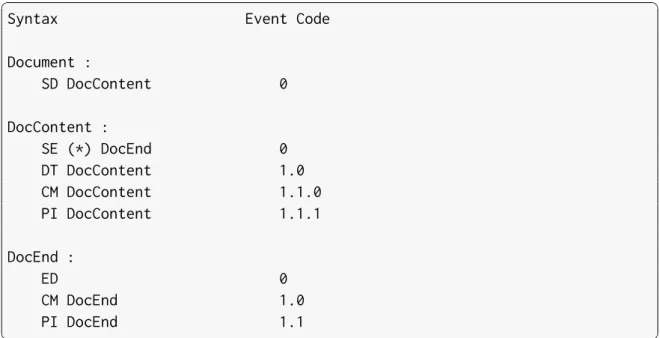
3.11 Built-in Document Grammar. . . 30
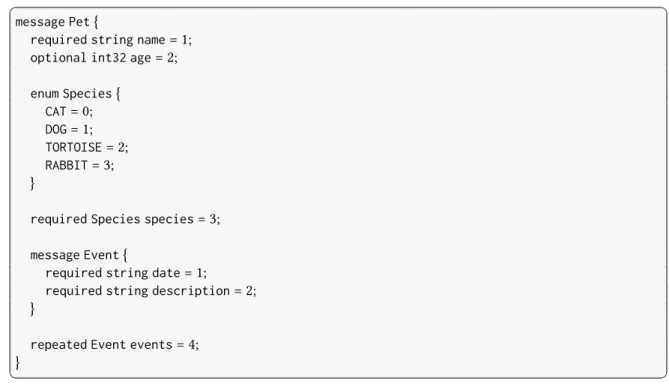
3.12 Protocol Buffer “.proto” file example. . . 37
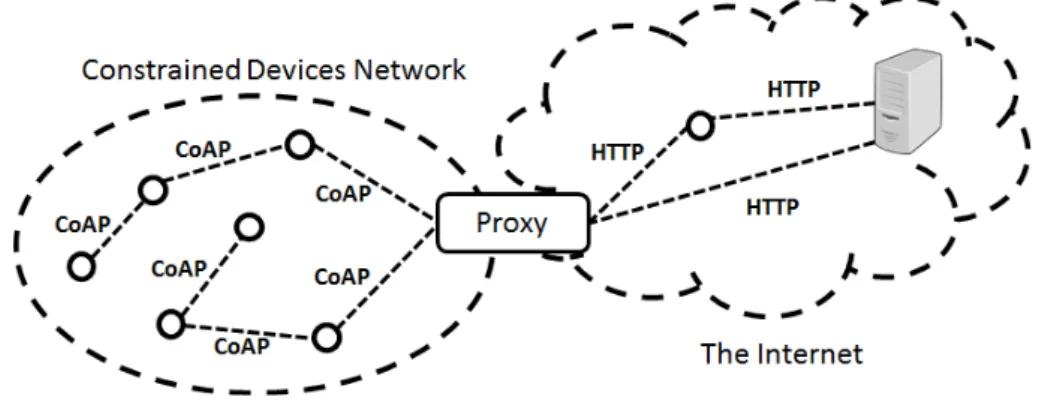
3.13 CoAP architecture. . . 44
3.14 CoAP reliable message. . . 45
3.15 CoAP piggybacked response. . . 45
3.16 CoAP separate response. . . 45
3.17 CoAP architecture. . . 47
3.18 MQTT architecture. . . 48
3.19 MQTT topic example. . . 49
3.20 MQTT-SN architecture. . . 49
3.21 Transparent and Aggregating Gateways. . . 50
3.22 XMPP opening stream example. . . 51
3.23 XMPP closing stream example. . . 51
3.24 XMPPmessagestanza example. . . 52
3.25 XMPP basic architecture. . . 52
3.26 XMPP distributed architecture example. . . 53
3.27 XMPP; two streams example. . . 54
3.28 XMPP EXI streamStart example. . . 55 xv
4.1 Simplified target network architecture of CTC. . . 60
4.2 Schema context graph example. . . 61
4.3 Example of representation of CTC components. . . 61
4.4 Template tablestructure detail with exemplary content. . . 65
4.5 Algorithm forSchema contextcreation . . . 66
4.6 Notebook XML Schema document. . . 69
4.7 Template table Notebook example. . . 70
4.8 Notebook JSON Schema document. . . 72
4.9 Schema instance example. . . 76
5.1 CTC communication model general architecture. . . 80
5.2 Template location. a) at the Node, b) at an external Server. . . 82
5.3 CTC abstract methods Register, Assign and Download. . . 85
5.4 CTC abstract methods Lookup and Delete. . . 86
5.5 Example discovery of aschema directoryexample. . . 87
5.6 Example registration request on aschema directory. . . 89
5.7 Example schema lookup request on aschema directory. . . 90
5.8 Example schemaId lookup request on aschema directory with a single “uid” value. . . 91
5.9 ExampleschemaIdlookup request on aschema directorywith a context param-eter. . . 91
5.10 ExampleschemaId resource query on aschema directory. . . 91
5.11 ExampleschemaId resource deletion on aschema directory. . . 92
5.12 JSON schema for “application/link-format+ctc”. . . 94
6.1 Architecture of theCTC Library. . . 98
6.2 CTC Library configuration for resource-constrained devices. . . 100
6.3 Full-featuredCTC Library configuration. . . 101
6.4 Inputs and outputs of theCTC Compiler. . . 102
6.5 Internal process of theCTC Compiler. . . 103
6.6 Notebook XML Schema document. . . 103
6.7 Code snippet of the “notebook-sc.c” file. . . 105
6.8 Code snippet of the “template-table.c” file. . . 105
6.9 Code snippet of the C structure binding of theNotebookXML Schema document. 106 6.10 Code snippet of the basic C function wrappers for theNotestructure binding of theNotebook XML Schema document. . . 106
7.1 XML document compression comparative in bytes. . . 112 xvi
7.2 XML document decoding time comparative. . . 114
7.3 Flash code memory usage comparative in bytes. . . 116
7.4 REST validation deployment. . . 120
7.5 Layouts of NodeA and NodeB CoAP APIs. . . 120
7.6 OPC-UA data model instance. . . 121
7.7 SEP2 data model instance. . . 121
7.8 SenML data model instance. . . 122
7.9 Software architecture of the resource-constrained devices and CTC Gateway. . 122
7.10 Message fragmentation. . . 123
7.11 Message structure fo the evaluation. . . 124
7.12 Link format information returned by theschema repository. . . 124
7.13 Schema link register for the OPC-UA case. . . 124
7.14 Schema link register for the SEP2 case. . . 125
7.15 Schema link register for the senML case. . . 125
7.16 Logical sequence of the schema register, schema download and data transmis-sion processes. . . 127
A.1 Schema element general format. . . 136
A.2 XML Schema example. . . 136
A.3 XML Schema nested content models example. . . 138
A.4 XML Schema complex data type extension example. . . 139
A.5 XML Schema complex data type restriction example. . . 139
A.6 XML Schema restriction declaration example. . . 140
A.7 XML Schema list declaration example. . . 140
A.8 XML Schema union declaration example. . . 141
A.9 XML Schema global complex element declaration example. . . 141
A.10 XML Schema global element declaration by reference example. . . 142
A.11 XML Schema local element declaration example. . . 142
A.12 XML Schema element cardinality example. . . 143
A.13 XML Schemaany declaration example. . . 144
A.14 XML Schema import declaration example. . . 145
A.15 XML Schema include declaration example. . . 146
A.16 JSON Schema root schema and subschema example. . . 147
List of Tables
1.1 Summary of Scientific and Technological contributions and related publications. 4
3.1 Summary of compression technologies targeted at structured data. . . 27
3.2 EXI Event types and codes. . . 29
3.3 Built-in EXI Data Type Representations and associated XML data types. . . 30
4.1 Schema context table example. . . 64
4.2 Schema context Notebook example, afterContext Collapsing. . . 69
4.3 CTC Templates generated from theNotebook JSON Schema. . . 71
4.4 Schema context generated from theNotebook JSON Schema. . . 73
6.1 Schema context Notebook example, afterContext Collapsing. . . 104
6.2 Notebook XML Schema’s templates, afterContext Collapsing. . . 104
7.1 XML document compression comparative in bytes. . . 111
7.2 XML document decoding time comparative. Numbers are in microseconds. . . 113
7.3 Flash code memory usage comparative in bytes. . . 116
7.4 Data memory (RAM) usage comparative in bytes. . . 117
7.5 JSON instance document compression comparative in bytes (B) and proportion (%). . . 118
7.6 senML instances’ size comparison in bytes for XML, JSON and CTC cases. . . 119
7.7 Transmitted messages and raw bytes quantity for the registration and schema download processes. . . 125
7.8 Messages per data unit transmission. . . 126
7.9 Accumulated messages transmitted including schema download process. . . . 128
7.10 Accumulated messages transmitted not taking into account schema download-ing process. . . 129
1
|
Introduction
This introductory chapter aims at setting the motivation of the thesis and to establish its objectives. In this work, we presentContext- and Template-based Compression(CTC), a com-pression approach for structured data represented in text-based data formats. CTC addresses the IoT interoperability problem at the data representation level and is specially targeted at resource-constrained devices and networks, typically deployed in IoT systems.
In this introductory chapter, we start in Section 1.1 with a brief explanation of the need for efficient data compression technologies for resource-constrained devices and networks in order to improve IoT interoperability. Next, in Section 1.2, we describe the core objectives of this thesis as well as the main contributions. Finally, in Section 1.3, we outline the structure of the thesis document.
1.1
Motivation
The Internet of Things (IoT) leads the trend to integrate almost any kind of devices (Things) into a global network (the Internet). In this scenario, interoperability has become one of the main integration challenges. On the one hand, different APIs and protocols are required at communication and application levels in order to interconnect a wide range of different devices and systems. On the other hand, data shows even more diversity regarding semantics and structure, resulting in complex data (pre)processing procedures (translation, filtering, aggregation, storing, etc.) and flows.
A promising solution is to leverage already available Internet technologies and standards and to apply them on top of IoT deployments. This approach involves the integration of mature Internet technologies directly on, or as close as possible to, the devices. At data level, interoperability is addressed by structuring the data following an agreed data model and representing it in platform-independent data formats which are usually text-based, such as XML or JSON.
However, this approach requires the technologies to be implemented either in the lower architectural layers (close to the physical devices) or in intermediary layers (such as gateways or middle-wares). In the latter case, the deployment of specific purpose intermediaries only moves the complexity related to the interoperability, without removing (or reducing) it while, in the former case, devices typically deployed in IoT systems may not have enough resources or
capabilities to implement the technologies natively. These resource-constrained devices have very different characteristics of those commonly found through the Internet. The most impor-tant ones are the limited resources of the devices and the low bandwidth of the communication channel.
Due to these restrictions, the majority of the technologies that make the Internet a success cannot be directly integrated into resource-constrained devices and networks. In the specific case of data level interoperability, text-based data formats such as XML or JSON cannot be efficiently used in resource-constrained devices and networks due to limitations in processing power, memory size, transmission bandwidth and available energy. By extension, this is also the case for Internet technologies that rely on text-based data formats such as Web Services, which are one of the key technologies on today’s interoperable Internet.
A viable solution for the use of verbose data formats on resource-constrained devices and networks is to compress structured data using a more efficient encoding. However, reducing data size effectively reduces the memory and communication resources needed but incurs in a processing overhead that may be beyond the capabilities of resource-constrained devices. Furthermore, if the data format is modified to ad-hoc encodings, the benefits of text-based formats and interoperability with the original format may be lost, if not handled properly. In order to apply data compression technologies to resource-constrained devices and networks to raise interoperability, technologies must be efficiently integrated within the limited resources and capabilities while keeping backwards and seamless compatibility with the original data format.
Interoperability has been key in the extension and adoption of Internet technologies, and it is expected to be equally (or more) important in the integration of IoT systems. The work presented in this thesis provides a solution for data level interoperability targeted at resource-constrained devices and networks typically found in IoT deployments and represents a step towards an interoperable IoT.
1.2
Contributions
This work aims to address the paradigm of efficient compression technologies for structured data targeted at resource-constrained devices in the following context:
• The IoT suffers from a generalised interoperability lack problem.
• There are several standard and mature technologies used across the Internet, but they are not directly usable on resource-constrained devices due to processing, storing and communication channel limitations.
• Specifically, the adaptation of standard data representation formats would significantly increase interoperability within the IoT as well as become an enabler for approaches such as Web Services.
Section 1.2. Contributions 3
• Data compression technologies can help in the use of text-based data formats in resource-constrained devices but current data compression technologies a) are designed for specific formats, b) are not easily integrable in a seamlessly way and c) impose constraints that may not be met by resource-constrained devices and networks.
This thesis presentsContext- and Template-based Compression(CTC), a compression approach for structured data represented in text-based data formats, which allows resource-constrained devices to deal with high level, standard information data-formats, in pursuit of the seamless integration of information. Roughly speaking, templates are extracted from data model schemas so that their representation can be replaced in the data with a minimum number of references. Data are then compressed (by using lossless-compression) following an algorithm that takes into account the context(s) and templates derived from the original data format and schema.
This thesis considers the representation of data, which can be done using many different formats, as well as the impact of the data format on processing time, memory usage and data transmission performance. First, the processing performance is increased by representing the data in a more efficient format. Second, the use of templates minimizes the memory needed to store schema information and data structures. Third, data is codified in a more compact format, effectively reducing the message quantity needed to transmit the whole data.
In this work, we focus on text-based data formats. More precisely, we use W3C’s XML (Extensible Markup Language) and JSON (JavaScript Object Notation). XML and JSON are widely extended and are the basis for many application layer protocols, Web Services and related protocols. Although the work presented here uses XML and JSON as illustrative examples, CTC could be easily extended to other formats.
This document also specifies the communication model of CTC, including generic mechanisms for the management of the contextual information required by CTC. Basically, this implies gathering, identifying and referencing the schema related information efficiently. CTC builds these functionalities based on the concept of aschema repositorywhich is a network component responsible for gathering, storing and managing schema information as well as assign and maintain references (i.e., links) and identification information. Although theschema repository was originally designed for CTC, it is generic enough to be applied to other data compression technologies based on contextual information. Theschema repositoryconcept is designed in a generic way, independent from any underlying communication protocol.
The core work performed in this thesis is based on the following hypothesis:
The proposed generic data model description structure and compression approach keep backward compatibility and interoperability while providing a more memory, processing and transmission efficient solution compared to the original data format.
In order to validate the hypothesis described above, this thesis has the following main scientific and technological objectives:
Table 1.1: Summary of Scientific and Technological contributions and related publications. Scientific and Technological Contribution Chapter(s) Publication(s)
CTC Specification 4 [BGC17, MGC16]
CTC Communication Model 5 [BGC18]
CTC Software Framework 6 [BGC17]
Objective-1 Study and analyse that, through the use of templates and context information, it is
possible to seamlessly use standard data models and data formats in an interoperable and backwards compatible way.
Objective-2 Design and develop a generic data model description structure not tied to a specific data
model or data format.
Objective-3 Design and develop data compression mechanisms and algorithms that support the
generic representation of structured data and that enable an efficient implementation concerning processing time, memory usage and transmission bandwidth, tailored to resource-constrained devices and networks.
Objective-4 Develop generic context information transference mechanisms suitable to
resource-constrained devices and networks.
The most relevant scientific and technological contributions of this thesis are listed in Table 1.1, together with the chapters and publications in which they are addressed.
1.3
Document Structure
This introductory chapter is followed by a more extensive description of the motivation and scope of this work in Chapter 2. The chapter includes a description of the scope of this thesis within the IoT domain focused on interoperability as well as the role of structured data formats and data compression technologies within the context of resource-constrained devices and networks.
The motivation chapter is complemented with Chapter 3 which contains the related work for this thesis. This related work chapter is divided into three main sections: a brief introduction to text-based data formats including structural concepts and terms, an in-depth state-of-the-art description of structured data compression technologies and an overview of the most relevant communication protocols within the IoT domain for this thesis.
The core technical content of this thesis starts in Chapter 4 with the specification of Context-and Template-based Compressionapproach. This chapter includes the description of the core components of CTC, the codification algorithm and two practical applications to XML and JSON data formats. The CTC specification is followed by Chapter 5 where the CTC communication model, how it fits within a typical IoT system, and the complementary mechanisms needed to be effectively used are explained. The technical content of this thesis finishes with Chapter 6
Section 1.3. Document Structure 5
and the description of the software framework that implements CTC and all the developed support tools.
Chapter 7 contains all the empirical tests performed during the development of the thesis in order to evaluate and verify the work done and the objectives fulfilment. The evaluation chapter is followed by The conclusions in Chapter 8. This chapter includes a wrap-up of this document, the main conclusions and the future work.
2
|
Motivation and Background
The purpose of this chapter is to establish in more detail the motivation and scope of this thesis. First, in Section 2.1 we describe the scope of this work within the Internet of Things and Cyber-Physical Systems domains and why interoperability is one of the main challenges of IoT deployments. We continue in Section 2.2 by describing the current approaches in the IoT to reduce the interoperability gap and their implications. Next, in Section 2.3, we introduce the application of structured data formats in an interoperable IoT followed in Section 2.4 by a brief introduction to compression technologies for enabling structured data representation formats within the context of resource-constrained devices. Finally, Section 2.5 presents a summary and the conclusions of this chapter.
2.1
The Internet of Things and Cyber-Physical Systems
This section briefly discusses the Internet of Things (IoT) and Cyber-Physical Systems (CPS) domains as well as outline the main paradigms relevant to this thesis. The purpose is not to formulate a definite definition of the IoT and CPS concepts. However, there is a general confusion between the terms IoT and CPS, sometimes used interchangeably. This section aimsto explain what this thesis considers as IoT and CPS, why they are relevant and what paradigms are addressed by this work.
The IoT could be described as a network formed by interconnectedThingsthat are uniquely identifiable. The network can be formed by heterogeneous elements, from simple sensors to full-featured computers. However, the termThing has been adopted because the elements of the network can also represent more generic and complex concepts such as a car, a person or a place. Thus, eachThing may differ significantly in complexity, capabilities and purpose, forming cooperation patterns and clusters with otherThings, and creating a final application from the sum of all the added functionalities.
The IoT is often associated with Machine-to-machine (M2M) communications. M2M is tradi-tionally seen as the communication of two (or more) elements over an isolated network where applications do not interact with the outside. In contrast, the IoT is seen as distributed heteroge-neous applications (sensing, actuation, etc.) producing and consuming data and being globally accessible to third-party applications. The IoT relies on the idea that a globally interconnected network of information will provide more added value than isolated (sub-)networks.
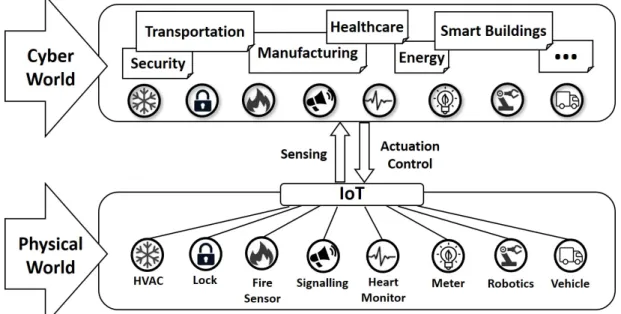
Figure 2.1: The IoT and CPS relationship.
From an infrastructure point of view, the IoT provides a communication architecture that links data producers and consumers of a highly heterogeneous nature, regarding various aspects such as communication bandwidth, processing capabilities, role, autonomy, smartness, etc.
This was not easily achievable before the upcoming of IPv6 [DH17] due to the complexity of addressing and escalating an increasing number of interconnectedThings. IPv6 has brought a significant increment on the IP address range compared to IPv4. Specifically, the address range covers 2128 unique addresses, approximately 6.65×10²³per square meter of the Earth [Hag06]. This new address range provides more than enough addresses to uniquely identify every each and every one of theThingsthat can be reasonably expected.
Cyber-physical Systems (CPS) are described as the integration of physical objects and environ-ments together with their virtual counterparts (sometimes referred to as “digital twin”). CPS are often built on complex architectures and synergies which are composed by physical devices (sensors, actuators, routers. . . ), connected by a multi-layered communication infrastructure and middleware, and high-level applications that model the cyber-representation as well as implement the management of the physical entities. Examples of CPS include Smart Cities and Smart Factories, which may be composed by (smart) buildings, (smart) homes, inhabitants, workers, (smart) waste collection systems, (smart) equipment, (smart) machinery. . . .
This thesis sees the IoT as an integral part and an enabling technology of CPS. The IoT serves as the natural link between the physical and cyber/virtual world of CPS, as is represented in Figure 2.1.
The IoT approach, and hence CPS, imposes several challenges that derive from the distributed, heterogeneous and large-scale nature of typical IoT systems. These challenges range from the efficient management and scalability of a massive number of data points (processing, timing, storage, etc.) to interoperability in the communication protocols, application interfaces and data.
Section 2.2. Towards IoT Interoperability 9
For instance, the IoT security and privacy is one of the domains that is gaining attention rapidly. The increased number of connected devices and infrastructure grow as well as its application to a broader range of application domains, has proportionally increased the appealing and risk of intentional attacks. Additionally, putting private data “on the net” and making it globally/remotely available, also increased the risk of stolen data as well as raised regulatory and legal management concerns regarding data privacy.
Nevertheless, although the integration of added-value capabilities such as security is an acknowledged need, interoperability is raising as one of the major integration challenges as the number of IoT enabled devices and applications increases exponentially. Interoperability challenges are mainly gathered within three domains: applications, communications and data. On the one hand, applications and communication channels require standard APIs and protocols in order to handle the increasingly heterogeneous devices and systems. On the other hand, data diversity regarding semantics and structure entail complex formatting procedures and complicate the creation of homogeneous and seamless data processing solutions.
This situation enforces the deployment of specific purpose gateways, proxies and middle-wares with multi-protocol interfaces and data preprocessing capabilities in order to provide the APIs and data formats (which sometimes do not even follow a standard) required by applications. Thus, although the IoT pretends to overcome the inherent limitations of M2M systems, in practice, interoperability clashes often turn IoT networks into isolated networks leading to fragmented applications.
2.2
Towards IoT Interoperability
One of the main barriers to overcome for today’s IoT is that there is no easy way to globally and seamlessly connect all the existing (and forthcoming)Things. In the current IoT landscape, several incompatible technologies are being deployed. Actually, despite theraison d’êtreof the IoT, nowadays IoT systems often result in a group of isolated intra-nets that cannot directly interact across the several heterogeneous networking interfaces that exist. In this scenario, the connection and integration of services, interfaces and data from severalThings is very costly and complex. Thus, it is essential to remove the interoperability gap and provide universal standards and mechanisms for theThingsto interact between them and the overall ecosystem.
There are various approaches to tackle interoperability issues in the IoT. An interesting approach is the one proposed by the Web of Things (WoT) [GTMW11, KKD18] which purpose is to overcome the IoT fragmentation and promote platform-independent standards. Compared to the IoT, the WoT is a more current trend which takes the IoT paradigm one step forward. The WoT concept was first developed by theWebof Things.orgcommunity [wc] which defines it as “. . . a refinement of the Internet of Things by integrating smart things not only into the Internet (network) but into the Web Architecture (application)”. The main purpose of WoT is to (re-)use and leverage already available Web protocols and standards, and apply them on top of the IoT paradigm in order to remove the existing interoperability gap whether it applies to data, communication protocols, services or transversal technologies (such as security or discovery).
WoT is totally based on application layer protocols (from a network OSI layer point of view), in contrast to the IoT which is usually more focused on network and transport layers. The purpose of focusing on the application layer is to effectively abstract lower layers (e.g., physical or transport layers), which are the ones showing the highest degree of heterogeneity and main source of interoperability clashes in traditional IoT networks.
Although WoT only adds functionality at the application layer, it defines an architecture to organize the several existing Web technologies into a standard and functional structure. The WoT architecture stack is further divided into four layers. Each of these layers adds a higher level of functionality, briefly described in the list below.
• Access Layer: the first layer is in charge of providing a standard Web interface, such as
an HTTP-REST API.
• Find Layer: the second layer includes semantic Web standards to describeThings(and
their services) in order to provide standard mechanisms to automatically (i.e., without human intervention) find them.
• Share Layer: the main purpose of the third layer is to secure the data interchanged
between theThings.
• Compose Layer: the final layer includes the tools and frameworks to integrate and
build applications on top of the heterogeneous data and services provided by theThings.
The WoT architecture promotes generic/standard Web interfaces in order to enhance overall interoperability and build loosely coupled services by providing mechanisms for highly config-urable services/interactions. The WoT architecture includes Web scripting languages such as javascript, data encodings such as JSON [Bra14] and EXI [SKPK14], and Web protocols such as HTTP [FR14] and WebSockets [MF11]. In summary, WoT architecture aims to bring Web technologies to the IoT and add a standardization layer on top of the traditional IoT.
WoT has also attracted the interest of the W3C, which created the Web of Things Working Group [W3C]. The W3C’s Web of Things Working Group focuses on platform-independent APIs and discovery procedures for inter-platform operations in order to overcome the lack of interoperability across IoT systems. The group is mainly working on descriptive metadata and interaction models as well as communication and security requirements.
The W3C’s Web of Things Working Group released the Web Thing Model [TGC17] which describes a common model and Web API for the “virtual counterpart of physical objects in the Web of Things”. The aim is to provide an interoperable model and protocols to access and interact withThingsusing Web standards. The document contains three main sections:
• The first section (Integration Patterns) proposes three patterns to connect and integrate Thingswith the Web.
Section 2.2. Towards IoT Interoperability 11
• The second section (Web Things Requirements) provides domain agnostic constraints and recommendations about protocol implementations for the WoT.
• The final section (Web Things Model) specifies a RESTful Web protocol together with the resource types, data models and payload syntax thatThings should implement.
The Integration Patterns proposal contemplates three distinct patterns depending on the capabilities and architecture of the network. In theDirect Connectivity Pattern, clients send requests directly to theThing’s API, whether they both are on the same or different network. This is the simplest pattern because it avoids the deployment of intermediaries. If theThing is not able to provide a Web API, the Gateway-Based Connectivity Pattern is used. In this integration pattern, an intermediate element (a gateway or proxy) provides the Web API on behalf of the Thing and makes the proper translations/adaptations. Sometimes it is more convenient to deploy a cloud service to act on behalf of theThing(to provide the Web API), for instance, when aThinghas to be globally accessible. This is the third pattern and is called the Cloud-Based Connectivity Pattern.
As can be extrapolated from these integration patterns, one of the methods to overcome the lack of interoperability across networks is to directly implement Web technologies, tools and methods on theThings. However, the majority of the devices used to implement the core of the Things tend to have very scarce resources due to technical, economical and practical reasons. These resource-constrained devices are designed with low memory capacity (<256KBytes Flash/ROM and a few KBytes of RAM), limited processing capabilities (<48MHz, typically 8-16MHz) and average consumption of a fewµA due to energy source limitations and autonomy requirements. Thus, it is usually not possible to integrate Web technologies directly on the resource-constrained devices. In these cases, an intermediary such as a physical gateway/proxy or software middle-wares is used. The intermediary will provide an abstraction layer on top of the physical and transport layers as well as data encodings and formats of the underlying Thing(s).
Regardless of the integration pattern used, ideally, Web technologies should be pushed as close to theThingas possible. In this way, less specific translation layers and intermediaries would be necessary in order to achieve communication, data and application level interoperability. Failing that, using intermediaries to leverage domain-specific protocols and translate them to Web technologies is a viable option but, in truth, it only moves the complexity to the intermediaries. Either domain/application/protocol specific intermediaries are deployed, or general intermediaries that must implement the myriads of protocols and standards should be used. In order to minimize the impact and complexity of the intermediaries, they should try to avoid specific technologies as much as possible and focus on general purpose technologies that are able to seamlessly adapt to the technologies used across network boundaries. This approach is not only applicable to the WoT philosophy, but to similar approaches (such as the one followed by Open Connectivity Foundation [OCF]) or IoT architectures in general if interoperability has to be supported.
2.3
Structured Data and Interoperability
When two (or more) distributed applications communicate between them, they need to use the same protocol and data “language”. This is mandatory so that each application can be able to decode and interpret the information sent by other applications. At data-level, this is achieved by structuring the data following an agreed data model. A data model defines the concepts used to describe the data and the semantic relationships between them (or concepts outside the data model). In turn, data models are implemented using data formats that capture the data model’s structure and vocabulary (the terms defined within the data model). A data format defines how the concepts are syntactically represented. Data models can be more or less generic (such as the one specified by SenML [JSA+18] standard which is used to describe the capabilities of generic sensors) or for specific applications (such as the model described by GeoJSON [BDD+16], for location information).
Structured data formats specify two levels of structural information. The first one is the structure and grammar of the format itself, i.e. how elements and their relationships are described. The second level is related to the data that is being formatted and contains the structure and terms of the data model, sometimes referred to as vocabulary or language. Additionally, structured data formats are not only used to describe data that follows a given data model, but also to implement protocols (that, actually, also follow a particular data model). Until the general adoption of text-based data representation formats, data were interchanged over the Internet following ad-hoc binary formats. These binary formats were hard to maintain, and any change or update in the structure of the format could create parsing and interpretation mismatches between the communicating elements.
Nowadays, binary formats have been mainly dropped (except in the most resource-constrained scenarios) in favour of formats such as XML or JSON, which are text-based. The main ad-vantage of text-based data formats is that they allow the representation of information in an interoperable way by setting a clear separation between data itself and how it is presented. Data can be interchanged between different machines, systems and entities with all the neces-sary information for the processing and interpretation of the data contained in the data itself. Additionally, rules can be set for validation and pruning of wrongly structured data.
One of the Internet technologies that more relies on structured data formats is Web Services (WS). Interoperability is one of the core design principles of WS; they allow the direct interaction between different types of platforms, software and users (human or machine). They are based on the simple client/server model and are used in all kind of applications. Many widely used high-level protocols, such as DPWS [CCK+06], SOS [BSE12] or SensorThingsAPI [LHK16], are built on top of WS.
Apart from enhancing overall interoperability, WS enable the application of high-level services, such as the “self-*” services family (where “self-*” stands for self-discovery, self-configuring, etc.), directly on top of the devices.
Section 2.4. Compression of Structured Data 13
• Based on services. These type of WSs are mainly based on Remote Procedure Calls
(RPCs) to access the services offered by a server. One of the most popular technologies used to implement RPCs is Simple Object Transfer Protocol (SOAP [12a]). The description and transport of SOAP is made by means of XML files.
• Based on resources. The data and services are represented as resources and they are
accessed using Representational Transfer State (REST [Fie00]) approach. REST sees everything as an HTTP resource although the resource itself is typically described in HTML, XML or JSON.
As can be seen, WS need to rely on text-based data formats at some point, either for formatting a protocol, the data itself, or both. However, traditional text-based data format management technologies are unsuitable for their application in resource-constrained devices and networks. This is why binary formats are usually preferred or needed in resource-constrained networks. The price to pay is interoperability and the need for specific purpose intermediaries, though. These intermediaries are usually gateways or proxies that are needed in order to ensure interoperability across networks. This is, for instance, the strategy followed by WoT.
Interoperability has been a key enabler capability of the Internet and, as has been explained in the previous sections, it is key for a successful deployment and integration of the IoT and its associated technologies. Developing efficient and reliable technologies for data formats targeted at resource-constrained devices and networks would be a large step towards an interoperable IoT.
2.4
Compression of Structured Data
An effective technique used to reduce the size of the data is to compress the data itself using a more efficient encoding. Generic compressed data formats have been around for several years and are widely used in everyday technologies. These formats can be based on lossless compression algorithms (such as GZIP [lGA] which is based on DEFLATE [Deu96]) or lossy algorithms which are mainly used for audiovisual file formats (such as JPEG [Ham92] for images or MP3 [ISO93] for audio) where a controlled loss of information does not significantly affect the overall perceived result.
Generic compressed data formats can be applied to data without any assumption of structure or semantics. In contrast, compression techniques for structured data can directly take advantage from both, the structure of the original data format and the structure of the data model, and produce a more compact and efficient encoding of the data. This kind of technologies can also encapsulate, and derive further context information from the original data format, such as data types or the semantics of a specific token.
Compression technologies for structured data are primarily based on information extracted from the structure itself and they make use of this knowledge to compress data streams efficiently. These technologies take advantage of the formal structure and grammar specification
followed by the data format as well as the structure followed by the data model, usually described by means of a schema.
For instance, current compression technologies based on structured data are EXI, CBOR and Protocol Buffers. EXI [SKPK14], adopted as a recommendation by W3C, has emerged in recent years as the most prominent XML compression algorithm. CBOR (Concise Binary Object Representation) [BH13] is a compact data format based on the JSON data model optimized for simplicity, processing speed, minimum resource usage and implementation compactness. Protocol Buffers [18e] is Google’s proposal for structured data serialization. The structure of the data is described as an IDL document that acts as the data schema. This IDL document is pre-compiled in order to produce the code stubs that are used to marshal/un-marshal the coded streams to/from runtime objects. A more in-depth description of EXI, CBOR and Protocol Buffers is provided in Section 3.2.
Compression technologies for structured data require the use of schema or structure infor-mation in order to achieve the most efficient compression. Although these technologies can compress data without schema information (i.e., solely relying on the data format structure), the most efficient compression is achieved when the schema is also available. However, how this information is shared and referenced, is usually not specified or it is assumed that an out of band method is used.
Additionally, the entities that interchange the compressed data require the identification of the schema (if any) that has been used as the base for the data compression. This identification has to be either advertised at runtime or agreed beforehand between all the parties.
However, compressing data only solves part of the problem. Reducing data size effectively reduces communication resources, but the compression process itself produces an overhead that may be beyond resource-constrained devices’ capabilities. Additionally, compressing data implies changing the data format in which the data is encoded. This can raise another interoperability issue and loss all the benefits of text-based formats, if not done correctly. Ideally, the compression/decompression should be performed in a seamless and transparent way.
2.5
Conclusions
Currently, the IoT suffers from a generalized interoperability problem mainly produced by the increasingly number of heterogeneous applications, protocols, data and devices that are being deployed. This heterogeneity is especially notable in the semantics, formats and structures followed by the produced and consumed data.
Resource-constrained devices and networks usually found in IoT deployments have very different characteristics of those commonly found through the Internet. Notably, the capabilities of the devices are severely limited, and communication channels are based on low bandwidth technologies. These restrictions complicate the integration of solutions and applications readily
Section 2.5. Conclusions 15
available on the Internet because they require significantly more resources than those offered by resource-constrained devices and networks.
This also applies to text-based data representation formats. Resource-constrained devices cannot process formats such as XML or JSON efficiently (regarding processing time) and will put to test resources such as energy or memory. Additionally, using these formats has an impact on the network bandwidth needed which, again, has an impact on the devices’ energy and network load.
Using compression technologies for structured data results in more compact encodings than text-based formats. However, compression technologies also produce a processing overhead that may be beyond resource-constrained devices’ capabilities. Additionally, if the format is modified, the benefits of text-based formats and interoperability with the original format may be lost, if it is not handled properly. If compression technologies are to be used in resource-constrained devices and networks to raise interoperability, they must be efficiently executed within the limited resources of the devices while keeping backwards compatibility with the original format.
This thesis aims to address the paradigm of efficient compression technologies for structured data targeted at resource-constrained devices in order to leverage existing standard data formats and enhance IoT interoperability at data-level.
3
|
Related Work
The objective of this chapter is to give the reader an insight of the technologies, researches and developments related to this thesis. The chapter is divided into three main sections.
Section 3.1 gives a brief introduction to two text-based data formats: XML and JSON. These two data formats are used through this work as application examples. The section includes information about structural concepts and terms used across the document as well as relevant characteristics.
The next section, Section 3.2, describes state-of-the-art compression technologies or ap-proaches targeted at structured data, including standards and open researches. For complete-ness reasons, Section 3.2 also includes protocols based on structured data and/or text-based data formats. The presented approaches are analysed within the context of resource-constrained devices and networks.
Finally, Section 3.3 contains an overview of the most relevant IoT communication protocols for this thesis. This section introduces concepts and approaches of IoT communication protocols addressed in the technical chapters of this document (especially in Chapter 5) as well as briefly discuss their relevance and applicability.
3.1
Text-Based Data Formats
Text-based data formats are the preferred way to represent and interchange data over the Internet. Text-based data formats are mainly used for two purposes: to represent data in a structured way and to add metadata. By representing data in a structured and known way, a clear separation is set between data itself and how it is presented. The main advantage is that rules can be set for validation and wrongly structured data can be rejected. By the addition of metadata, the data can be enriched with capabilities such as self-description or high-level validation.
The main advantage of Text-based data formats is that they allow the representation of information in an interoperable way. Data can be interchanged between different machines, systems and entities with all the necessary information for the processing and interpretation of the data contained in the data itself.
In this section, we focus on the two text-based data formats used for data interchange that dominate the Internet: XML and JSON. These two data formats are also used through this
<pet species="Cat"> <name>Calcetines</name> <age>1</age>
<gender>Female</gender> </pet>
Figure 3.1: XML element and attribute example.
work as relevant application examples. However, the principles and approaches developed within this thesis apply to other text-based data formats such as Hypertext Markup Language (HTML [FEL+17]) or the Resource Description Framework (RDF [(W3c]) set of recommenda-tions.
Nevertheless, this section does not pretend to be an exhaustive description of the XML and JSON specifications but it intents to give the necessary information to understand the technical development shown in this thesis. Complementary information is available in Appendix A.1 and Appendix A.2.
3.1.1
eXtensible Markup Language (XML)
Among text-based data formats, eXtensible Markup Language (XML [BPSM+08]) is one of the most famous ones. XML is a recommendation promoted by W3C and one of their leading technologies.
XML documents are formatted following a tree structure where the main nodes are XML elements. The tree starts with theroot element, branching throughchild elementsand finish in leave elements.
Elements represent the base information item of an XML document. There must be at least one element, theroot element, and any additional item must be a child of this element. Thus all the items in an XML document form a hierarchical tree with theroot element on the top. Elements can be defined in two ways: with a full start and end tags (<element_name> . . . </element_name>) or with a self-closing tag (<element_name. . . />).
The other main item of XML documents is attributes. Attributes are name/value pairs in the form “attribute_name=value”. Every attribute is bound to an element and they are defined within the element’s start or self-closing tag.
Figure 3.1 shows an example of an XML document containing four elements and one attribute. “pet” is the root element and it contains the child elements “name”, “age” and “gender” with the
values “Calcetines”, “1” and “Female” respectively. “species” is an attribute of the “pet” element with the value “Cat”. The tree structure is shown in Figure 3.2.
Section 3.1. Text-Based Data Formats 19
root element
<pet> species attribute
<name> <age>
leave element <gender>
Figure 3.2: XML tree structure example.
<?xml version="1.0" encoding="UTF-8"?>
Figure 3.3: XML prolog example.
3.1.1.1 XML Structure Representation
After the appearance of XML, many technologies adopted it and developed their own model abstractions and terminology. This led to some confusion in the XML community and the need for a common model arose. In order to solve this issue, the W3C‘s released the recommendation XML Information Set [CT04], commonly known as XML Infoset. The main purpose of the XML Infoset is to provide a common terminology and to abstract an XML document into an idealized model.
The XML Infoset defines eleven components, denotedinformation items. Each of the informa-tion items contains a set of properties as well as links to the nested items.
• Document Information Item:as the name suggests, the Document Information Item
provides general information about the XML document as well as contain all the other items in the document. This information includes, for instance, properties set in the prolog and the root element.
Theprolog is an XML construct gives contextual information to the XML parsers. For instance, theprologshown in Figure 3.3 declares that the XML version used is “1.0” and that the text encoding is “UTF-8”. Theprologis optional but if an XML document contains one, it must a appear at the beginning of the document before any other item.
• Element Information Item: every element has one associated Element Information
Item. The properties of this item contain information related to the element including the name, parent item, children (not only elements but also other items such as comments or processing instructions) and attributes.
• Attribute Information Item:every attribute has one associated Attribute Information
Item. The properties of this item include the name and the parent element (the element in which this attribute is declared).
• Processing Instruction Information Item:the model will contain one Processing
In-struction Information Item per processing inIn-struction (PI). The information contained in a PI is not intended for an XML Parser but for the application processing the XML document. This information is usually composed by instructions on how to process the document or
<?app param1="123" param2="example"?>
Figure 3.4: XML processing instruction example.
to control different behaviours. Basically, a PI has a target that identifies the application as well as data that is used as parameters. For instance, the example in Figure 3.4 shows a PI for the application “app” with the content “param1="123" param2="example"” Basically, the properties of a Processing Instruction Information Item will contain infor-mation about the PI’s target and content.
• Character Information Item:although in theory, the model should contain one
Char-acter Information Item per charChar-acter in the document, in practice charChar-acters are grouped in strings and processed as such by applications. Nevertheless, the properties of the Character Information Item include the character code (following the ISO 10646 standard) and the parent item.
CDATA sections are also included within Character Information Items. CDATA declara-tions are used to define secdeclara-tions with no XML markup. This secdeclara-tions will be escaped by parsers.
CDATA sections are defined through a “<![CDATA[escaped_text ]]>” declaration. The content of a CDATA section is considered simple text and it is not necessary to escape characters reserved by the XML Recommendation. This is very useful to avoid repetitive escaping of characters.
• Comment Information Item:each item is linked to a comment in the XML document.
The properties of this item contain the text of the comment and the parent item.
• Namespace Information Item:each item of the document will contain one Namespace
Information Item per namespace in scope. XML Namespaces are explained in more detail in the following section.
• Document Type Declaration Information Item, Unexpanded Entity Reference
Information Item, Unparsed Entity Information Item and Notation
Informa-tion Item: a model will contain these items only if the source document defines a
document type declaration. The properties of these items contain information to manage DTD’s associated with the document such as the retrieval of the XML document’s DTDs or notations for the inclusion of non-XML content.
XML Infoset provides a standard model to represent and refer to XML components. However, there are other technologies used to represent an in-memory instance of an XML document. The most popular data models for representing, storing, accessing and processing XML documents is W3C’s Document Object Model (DOM [(W3a]).
DOM represents XML documents as a tree-structure where everything is a node: the document itself, elements, attributes, etc. As with other tree-structures, DOM is represented as a graph
Section 3.1. Text-Based Data Formats 21
<pet xmlns="http://example.com/namespaces/pets" species="Cat"> <name>Calcetines</name>
<age>1</age>
<gender>Female</gender> </pet>
Figure 3.5: XML namespace declaration example.
and the relationships between nodes are described using terms like parent, child, sibling, etc. DOM also specifies a low-level Application Programming Interface (API) for accessing and processing XML documents. The API also allows to modify the nodes at run-time, which in effect, is equivalent to modifying the values of those nodes in the XML document itself.
3.1.1.2 Namespaces
In XML, namespaces are used to group elements and attributes. The name of an element or attribute within a namespace must be unique but it can be reused in another namespace because the namespace itself is used to solve the ambiguity.
Namespaces are especially useful when XML documents are shared or mixed with other XML documents developed by third parties. Namespaces ensure that the names of elements and attributes defined in each XML document format do not clash and XML applications parse them correctly.
Namespaces usually follow the URI [BLFM05] format. It is common practice to use registered domains as part of the namespace in order to assure the uniqueness (as well as provide an obvious means for identification) and avoid clashes with other entities’ choices.
Namespaces can be declared implicitly or explicitly. To declare a namespace implicitly, the namespace is declared within the element it will be associated with. This is known as declaring a default namespace and it is in the scope of the element in which it is declared as well as all the child elements. In this context, being “in scope” means that the namespace is available to be used. As we will see later, a namespace may be in scope but not assigned. On the other hand, attributes are not covered by a default namespace.
Figure 3.5 shows an example of a default namespace declaration. The namespace “http: //example.com/namespaces/pets” is in scope for the elements “pet”, “name”, “age” and “gender” and the four elements are associated with it.
In order to declare a namespace explicitly a prefix has to be assigned to it using the following form:
xmlns:prefix="namespace_URI"
The name of the prefix must follow the same naming rules as elements and must not start with the character string “xml”. In the example of Figure 3.6, the four elements “pet”, “name”, “age”