Evaluating and Predicting Flexible Pavement Performance
Bethel Lulu Gebeyehu ( M.Sc in Road and Railway Engineering)Department of CoTM Engineering, College of engineering, Wolaita Sodo University PO.box 138, Wolaita sodo, Ethiopia
Abstract
The Ethiopia Road Authority (ERA) pavement design guide uses empirical models which were adopted and modified from AASTHO design guides. As with any empirical model, the prediction capabilities are limited to the conditions for which it was developed. Mechanistic Empirical Pavement Design Guide (MEPDG) has been recently developed to account for increase in truck traffic and minimize premature failure of pavements. Since the new design uses mechanistic approach, it is expected that the design guide can better predict performance of pavements. In addition, mechanistic approach allows use of design guide for different pavement and environmental conditions by calibrating model parameters for different conditions. Thus, the design guide can be used for Ethiopia roads and was focus of this study.The mechanistic empirical design requires parameter inputs in four different modules: Traffic, materials, environment & pavement structure. These parameters may or may not be available for Ethiopia conditions. To identify parameters that influence performance prediction significantly, the design guide was evaluated for Humbo to Arba Minch road pavement and environmental conditions. After successful identification of parameters, the MEPDG analysis was performed and compared with the ERA design guide.The results of the analyses indicated that the expected performance can be achieved at lower Equivalent Single Axle Loads (ESALs) but not at higher ESALs.
Introduction
Highway pavement is important for socio-economic development of any country. Now a days significant amount of budget is being made in Ethiopia for connecting small and major cities; also neighbor countries such as Ethiopia to Sudan road project by ERA (Ethiopian Road Authority). Many of the road projects are currently undertaken under public private partner ships (ERA).
In most of the projects the construction company guarantees the performance of the pavement to the government. However, the government will take over these highways at the end of the guarantee periods. These mega road infrastructure projects consume a large quantity of natural resources. If this roads are not design to carry the expected traffic load and the pavements are design lack environmental considerations, it causes to increase demand for maintenance of the road infrastructure will be a challenge for the government in the year to come.
The MEPDG is comprehensive software that can be used for flexible as well as rigid pavement design. It used most of the variables currently available for the design of road way structures, including the material properties of HMA, base, sub-base, and sub-grade layers. The software guide in cooperate discussion on the causes and practical methods of preventions of commonly experienced distress. Steps of each process, applicable questions, some defaults values and background information regarding the results of each testis are included in the guide. Since Ethiopian pavement conditions (i.e. soil type, environmental, traffic load etc.) vary significantly, it is essential to use the MEPDG rather than empirical relationships and will focus on this study.
1.1Scope of the Study
This study will conduct on examining and evaluating the performance of pavement with regard to traffic load, traffic volume and environmental conditions. Under this study we also consider the pavement performance evaluation ways that already used and new techniques (MEPDG) that will use to evaluate the performance of pavement respect to the design constraints (i.e. that means traffic load and environmental condition).
1.2Limitation of the Study
This study only concentrated in Humibo to Arba Minch road Project construction due to the limitation of resource.
Some amount of the analysis data have been taken by default from AASHTO calibrated due to shortage of information.
The MEPDG software is working on only on-line or in connection to the internet. We cannot get an access to have latest version MEPDG software because of its costly. 1.3Research Methodology
A multi-method approach is used in this study. Information used was obtained by using available literature, this included national and international pavement design guide books. The main instruments employed at the fieldwork were questionnaire, interviews and observation. A well-prepared and structured questionnaire,
arranged in sequence and designed to be self-administered were sent out. As a result, four structured questionnaires were used to solicit information regarding the thesis topic. The first questionnaire was designed for ERA in WOLAITA SODO branch. The second questionnaire was designed for project manager of DMC in ARBAMICH branch. Furthermore, random interviews were conducted.
1.1.1. Mechanistic-Empirical Pavement Design Guide
The major components of the MEPDG are the input system, mechanistic pavement analysis model, transfer functions, and an output system that consists of predicted pavement distresses. A new feature in the MEPDG, absent from the current AASHTO design guide, is the availability of hierarchical input levels. Users have the option to choose to any one of them for design. Depending on the accuracy of the input parameter, three levels of input are provided, from level 1 to level 3. However, it should be recognized that irrespective of the input design level, the computational algorithm for the design procedure is the same. In addition, a mix of levels can be used for a given design project. To decide on a suitable input level, a designer should recognize which input parameter would be important for the results.
Fig 1 Way of inputs and out puts of MEPDG
2. Pavement structure composition 1. Bituminous surfacing
It shall consist of either a wearing course or a binder course with a wearing course depending upon the traffic load carried to be.
The selection criteria for the grade of bitumen to be used for bituminous courses are given in the table below, 2. Granular Sub-Base
Granular sub-base (GSB) materials should have minimum CBR of 20% for cumulative traffic up to 2 msa or ESAL and 30% for traffic exceeding 2 msa or ESAL. The material should be tested for CBR at the dry density and moisture content expected in the field. The thickness of sub-base should not be less that150mm for design traffic less than 10 msa or ESAL and 200mm for design traffic of 10 msa and above. The preferably the sub-grade soil should have a CBR of 2%.
3. Base Course
The recommended minimum thickness of granular base is 225mm for traffic up to 2msa and 250mm for traffic exceeding 2 msa.
Majority of the pavements constructed in Ethiopia are flexible pavements with asphalt concert as a surface layer. The current method of asphalt pavement design in Ethiopia is empirical in nature. Typically the empirical pavement design procedures are suitable the conditions developed and may not be applicable for the different condition (i.e. environmental and /or pavement conditions). Thus; predicted service life of pavements may not be reliable. Mechanistic procedures involve the use of analytical methods to determine pavement responses and the
the road, such as rutting, cracking, potholes and other such surface distresses, to acceptable levels. At the end of the design period, a strengthening overlay would normally be required but other remedial treatments, such as major rehabilitation or reconstruction, may be needed. The design method aims at producing a pavement which will reach a relatively low level of deterioration at the end of the design period, assuming that routine and periodic maintenance are performed during that period. To give satisfactory service, a flexible pavement must therefore resist the deterioration caused by the various deterioration mechanisms that are at work. These are the effects of traffic and the effects of the environment (essentially the effects of water and temperature).
2.1.1. Economic Considerations
The pavement design engineer, on the basis of the site investigations, should ascertain that materials required for all components of the pavement structure are available. This task should be performed concurrently with the design discussed in the following topics since, for a given traffic and subgrade conditions, several structures are offered. Hence, the availability of materials will often influence or dictate the choice between the alternate pavement structures.
2.2.1.2. Design Period
Determining an appropriate design period is the first step towards pavement design. Many factors may influence this decision, including budget constraints. However, the designer should follow certain guidelines in choosing an appropriate design period, taking into account the conditions governing the project. Some of the points to consider include: Functional importance of the road, Traffic volume, Location and terrain of the project, Financial constraints
2.2.1.3. Traffic
Pavement design relies on knowledge of the expected level of traffic. Axle load studies (to determine equivalent axle loads) and traffic counts (to determine initial traffic volumes) are essential for a reliable design, together with estimates of traffic growth. Yet traffic forecasting remains a difficult and often uncertain task. The parameters are rarely well known, particularly the axle loads and the projected growth. Although every effort must be made to reduce the uncertainty inherent to these estimates, caution is still recommended and some conservatism is justified. Moreover, sensitivity analyses of the resulting pavement structures to these parameters are recommended.
The design guide considers traffic in terms of the cumulative number of ESALs to be carried by the pavement during the design life. Mixed traffic stream consisting of different axle load and different axle configuration is converted into equivalent repetition of a standard axle load. Traffic is considered in terms of equivalency standard axel load 80KN to be carried by the pavement during the design life.
3. Results and Discussion
In this chapter, the results of the sensitivity analysis are summarized and discussed. The main focus of the analysis was to Predicted distress, Fatigue Cracking, Thermal Cracking and Predicted rutting on the pavement performance. The pavement structure of Table 4.2 was used for the analysis with AADT of 592. The results of the sensitivity analysis are discussed in the following sections.
3.1.Predicted Distress
Pavement failure /distress/ defect is a condition of the pavement structure that reduces serviceability or leads to a reduction in serviceability.
Defect of road pavement can classify into two.
1. Structural defect: - is the type of that affects the structural part and makes the pavement incapable of sustainable the load imposed up on its surface.
2. Surface defects: - is a type defect that affect the pavement surface and which may or may not be progressively changed into structural defect.
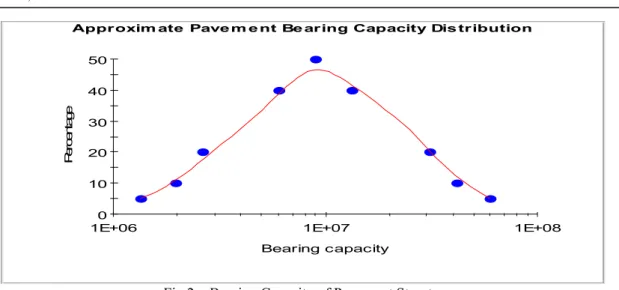
Fig 2 Bearing Capacity of Pavement Structures
The pavements do not carry out its intended function without causing discomfort to the users. AADTT of 592, design life of 10 years, and initial IRI of 75 in. /mile were selected for the analysis. IRI, permanent deformation in AC layer, and the total permanent deformation predicted are summarized in the table because change in binder type influence rutting in the pavement. Overall, the predicted IRI varied from 75 to 102.2 in. /mile. The change in IRI was most significant in the presence of poor quality base and sub grade material.This significant change of IRI has direct relationship with Asphalt thickness, sub grade material, the asphalt binder.
For instance, the predicted IRI varied between 75.2 and 134.2, it increase as increasing life of pavement. The predicted data also suggests that modulus of base and sub-grade significantly influences IRI in comparison to layer thickness. The data suggested that the AC layer permanent deformation is more for higher cumulative heavy truck at increasing of time.
0 10 20 30 40 50
1E+06 1E+07 1E+08
P er ce nt ag e Bearing capacity
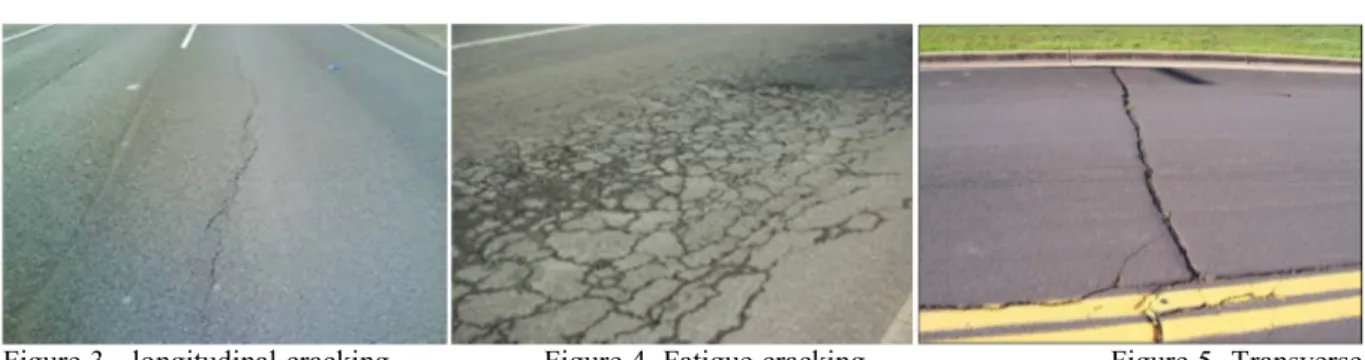
Figure 3 longitudinal cracking Figure 4. Fatigue cracking Figure 5 Transverse cracking.
The significant change of Top to down cracking, Bottom to up cracking (Alligator), surface Down crack (Longitudinal) and surface Down Damages of predicted is increase with increase the age of the pavement .similarly the reliability fatigue cracking increase but the fatigue damage will be almost uniform at the termination of the road pavement service .this indicate that the quality of the pavement material disappear at the end of design life of the pavement. To identify Fatigue cracking on the pavement, reliability of the pavement should be known.
Fig.7 surfaces down cracking. 3.3.Thermal Crack
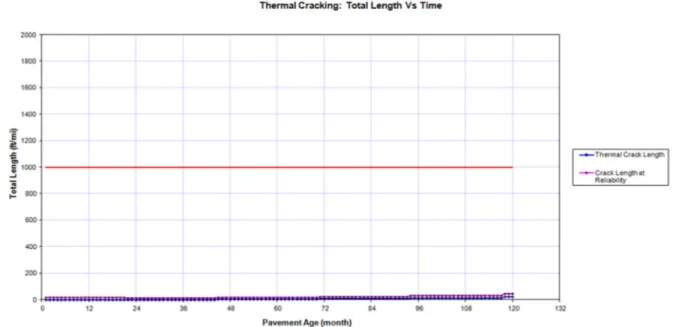
Thermal cracking can be occurring in depth and length with the age of the pavement design. Due to our input climate, material property and design period. The total length of thermal cracking is increase with time –i.e. it approach to 23.5ft/mile (444.89cm/km) as increscent of age of the pavement. The total depth of thermal cracking is increase with time i.e. approach to 0.1cave/hac.
Fig 9. Thermal cracking: Total Length Vs. Time. 3.4. Rutting
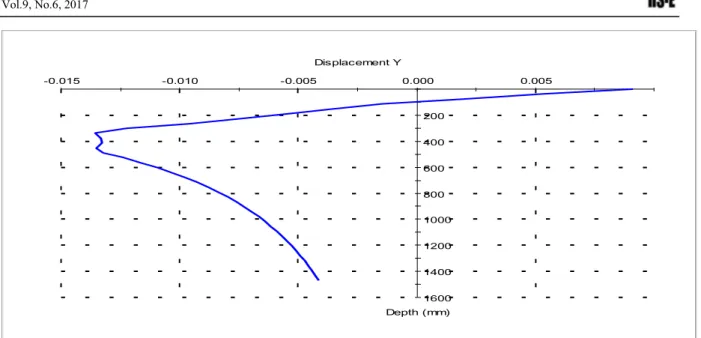
A rutting is longitudinal surface depression or vertical displacement which occurs in the pavement wheel path. (figure 5) Pavement up lift may occur along the side of a rut. Rutting stems from a permanent deformation in of the pavement layer, it results from traffic loading concentrated on narrow width of the carriage way, over stress in the HMA layer, underlying layers or sub grade and significant rutting can lead to major structural failure of the pavement. From our input result the total Reliability rut change from 0.0129 to 0.2892 with the change of the age of the pavement. Permanent deformation: Rutting is occurs due to the results of change in; Sub-total AC, Subtotal base, Subtotal SG, Total rutting and Total Rut Reliability with the age of the pavement. The effects of all factors on the pavements are increase significantly as the age of pavement increase.
Fig 11. Pavement vertical displacement 3.5. International Roughness Index
Roughness is the measurement of the unevenness of the pavement in the direction of travel. It is measured in units of IRI, inches per mile and it indicates the ride comfort of the road.
The roughness of the pavement is increase with increment of the age of the pavement, i.e. it increases from 75 to 106.78. The targeted reliable IRI is 90 and it changes to 99.75 at predicted reliability IRI. It is acceptable because the IRI will change as the age of the pavement increase.
200 400 600 800 1000 1200 1400 1600 -0.015 -0.010 -0.005 0.000 0.005 Depth (mm) Displacement Y
4.2.Conclusions
The conclusions made from the study are as follows:
Pavement performance is very sensitive to the base thickness, the base modulus, and the climatic changes The asphalt mix has minimal effect on the pavement performance.
Pavement performance is highly sensitive to AADTT.
The Impact of Axle load data on pavement performance is high.
The vehicle classification has also significant influence on the pavement performance. 4.3.Recommendations
The recommendations for the further study are:
♦ To do effective research on a given topic the respective organization should be loyal to give the required information.
♦ The constructed road pavement gives reliable service in full design period.
♦ Before going to construct any road project; it is important to predict the performance of pavement design related to Traffic and environmental condition by using MEPDG software.
♦ Since this software (MEPDG) is the first software to evaluate the pavement design in Africa; if Ethiopia use this software it will be able to use and makes the first country in Africa.
♦ If Ethiopian road Authority (ERA) applies this software in addition to ERA manual; Millions of ETB can be save i.e. maintenance cost, property damage cost and also can save human life lost.
♦ If Ethiopia applies this software (MEPDG); easily ensure the quality, durability, accessibility, cost effectiveness, Traffic feasibility and other criteria’s.
Reference
1. ARA Guide for Mechanistic-Empirical Design of New and Rehabilitated [Report]. - Champaign, IL: National Cooperative Highway Research Program, 2004.
2. ERA’s Pavement Design Manual Volume I flexible Pavements, 2002 3. ERA’s Pavement Design Manual Volume I flexible Pavements, 2013
4. Murphy, Michael Ray, 1998, A Mechanistic-Empirical Approach to Characterizing Subgrade Support and Pavement Structural Condition for Network Level Applications,
5. NCHRP 1-37A. 2004. Guide for Mechanistic-Empirical Design of New and Rehabilitated Pavement Structures.
6. Sugandh, R. Zea, M., Tandon, V., Smit, A., and Prozzi, J. “Performance Evaluation of HMA Consisting of Modified Asphalt Binder, Research Report No. FHWA/TX-06/0-4824-2, Center for Transportation Infrastructure Systems, The University of Texas at El Paso, El Paso, Texas, 2006.