_____________________________________________________________________
Cargo Handling Date: 11/00
CO N T E N T S
6.0.
Cargo Handling
Contents6.1.
Responsibility
7
6.1.1. Acceptance of Cargo 8 6.1.1.1. Loading Principles 8 6.1.2. Cargo Documentation 86.1.2.1. Air Waybill (AWB) 8
6.1.2.2. Cargo Manifest 9
6.1.3. Cargo Loadplanning 10
6.1.4. Determination of Weights 11
6.1.5. Documentation of Weights 11
6.2.
Cargo Loading
13
6.2.1. Unit Load Devices - ULD Procedures 13
6.2.1.1. ULD Tags 13
6.2.1.2. Loading Devices and Accessories 14
6.2.1.3. Provision of Unit Load Devices 14
6.2.1.3. Control of Unit Load Devices 14
6.2.1.4. Circulation of Loading Material (UCM/LUC) 14
6.2.1.4.1. ULD Control Message (UCM) 15
6.2.1.4.2. Load Unit Control Message (LUC) 15
6.2.1.4.3. Stock Control of Unit Load Devices 16
6.2.1.5. Damage of Unit Load Devices 16
6.2.2. Pallet Loading 16
6.2.2.1. Loading Principles for Pallet Build-up 16
6.2.2.2. Contour of Pallet Load 17
6.2.2.3. Securing of Pallet Load 17
6.2.2.4. Pallet Stacks 17
6.2.3. Container Loading 19
6.2.3.1. Loading Principles for Containers 19
6.2.3.2. Securing within Load Container 19
6.2.4. Cabin Load 20
CO N T E N T S
6.3.
Dangerous Goods
21
6.3.1. Hazard Classification 23
6.3.2. Markings and Identification 25
6.3.2.1. Hazard Labels 25
6.3.2.1.1. Class 1 - Explosive (Division 1.1, 1.2, 1.3, 1.4 (except 1.4S), 1.5, 1.6) 25 6.3.2.1.2. Class 1 - Explosive (Division 1.4S) 25 6.3.2.1.3. Class 2 - Flammable Gas (Division 2.1) 26 6.3.2.1.4. Class 2 - Non-Flammable, Non-Toxic Gas (Division 2.2) 26
6.3.2.1.5. Class 2 - Toxic Gas (Division 2.3) 26
6.3.2.1.6. Class 3 - Flammable Liquid 27
6.3.2.1.7. Class 4 - Flammable Solid (Division 4.1) 28 6.3.2.1.8. Class 4 - Substance Liable to Spontaneous Combustion (Division 4.2) 28 6.3.2.1.9. Class 4 - Substance which in Contact with Water emit Flammable Gases (Division 4.3) 28 6.3.2.1.10. Class 5 - Oxidizing Substance (Division 5.1) 29 6.3.2.1.11. Class 5 - Organic Peroxide (Division 5.2) 29 6.3.2.1.12. Class 6 - Toxic Substance (Division 6.1) 30 6.3.2.1.13. Class 6 - Infectious Substance (Division 6.2) 30 6.3.2.1.14. Class 7 - Radioactive (Category I - White) 31 6.3.2.1.15. Class 7 - Radioactive (Category II - Yellow) 31 6.3.2.1.16. Class 7 - Radioactive (Category III - Yellow) 31
6.3.2.1.17. Class 8 - Corrosive 32
6.3.2.1.18. Class 9 - Miscellaneous Dangerous Goods 32
6.3.2.2. Handling Label 33
6.3.2.2.1. Magnetized Material (MAG) 33
6.3.2.2.2. Cargo Aircraft Only (CAO) 33
6.3.2.2.3. Package Orientation (This Way Up) 34
6.3.2.2.4. Cryogenic Liquid (RCL) 34
6.3.3. Acceptance of Dangerous Goods 35
6.3.4. Handling Advice for Dangerous Goods 36
6.3.5. Documentation for Dangerous Goods 37
6.3.5.1. Shipper's Declaration for Dangerous Goods 37 6.3.5.2. Dangerous Goods Acceptance Check Sheet 38
6.3.5.3. Air Waybill (AWB) 39
6.3.5.4. Notification of Dangerous Goods to the Captain (NOTOC) 41 6.3.5.4.1. Responsibilities of Issuing and Handling of NOTOC 42 6.3.5.5. Dangerous Goods in Excepted Quantities 43
_____________________________________________________________________
Cargo Handling Date: 05/03
CO N T E N T S
6.3.6. Handling and Loading of Dangerous Goods 45
6.3.6.1. Incompatibility of Dangerous Goods 45
6.3.6.2. Loading of Packages Containing Liquid Dangerous Goods 46
6.3.6.3. Securing of Dangerous Goods 46
6.3.6.4. Replacement of Labels 46
6.3.6.5. Identification of ULDs Containing Dangerous Goods 46
6.3.6.6. Handling of Dry Ice (ICE) 46
6.3.6.7. Handling of Cars and Motorcycles (RMD) 47
6.3.6.7.1. Conditions of Vehicles 47
6.3.6.7.2. Loading of Cars 47
6.3.6.8. Handling of Polymeric Beads (RSB) 49
6.3.6.9. Handling of Self-Reactive Substances (RFS) and Organic Peroxide (ROP) 49 6.3.6.10. Handling of Toxic (RPB) and Infectious Substances (RIS) 49 6.3.6.11. Handling of Dangerous Goods and Animals (AVI) 49
6.3.7. Incidents with Dangerous Goods 51
6.3.7.1. Damage or Leakage of Package containing Dangerous Goods 51
6.3.7.2. Dangerous Goods Incident Report 51
6.3.8. Emergency Procedures for Incidents/Accidents with Dangerous Goods 53
6.4.
Heavy Items (HEA)
55
6.5.
Pipes, Bars, Beams
56
6.6.
Human Remains (HUM)
57
6.6.1. Transportation Request 57
6.6.2. Acceptance 57
6.6.3. Documentation 57
6.6.4. Loading of Human Remains 58
6.6.5. Notification to Captain 58
6.6.6. Information to next Station and to Destination 58
6.7.
Wet Freight (WET)
59
CO N T E N T S
6.9.
Valuable Cargo (VAL)
63
6.10.
Perishable Cargo (PER)
65
6.10.1. Foodstuffs (EAT) 65
6.10.2. Hatching Eggs (HEG) 65
6.10.3. Vaccines, Medical Supplies and Live Organs (LHO) 66
6.10.4. Flowers/Plants (PEF) 66
6.10.5. Meat and Seafood/Fish Shipments (PEM/PES) 67
6.10.5.1. Temperature Requirements for Meat and Seafood/Fish 67 6.10.5.2. Loading on Pallets and in Containers 67
6.10.5.3. Loading as Bulk Cargo 67
6.10.5.4. Desinfection of Loading Equipment 67
6.10.6. Fresh Fruit and Vegetables (PEP) 68
6.11.
Film and Press Shipments
69
6.12.
Air Mail
71
6.12.1. Air Mail Label (AV-8) 71
6.12.2. Delivery Bill AV-7 71
_____________________________________________________________________
Cargo Handling Date: 06/01
CO N T E N T S List of Tables and Figures
table 1 incompatibility chart ...45
figure 1 cargo label...8
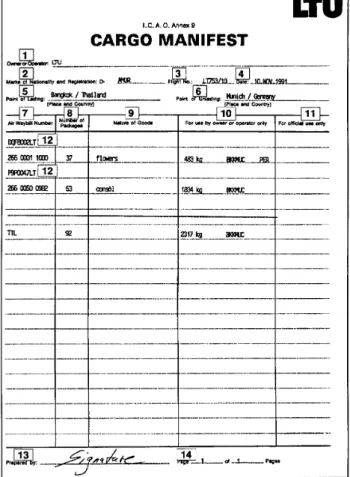
figure 2 cargo manifest ...9
figure 3 ULD tag - cargo loaded...13
figure 4 ULD DG tag ...13
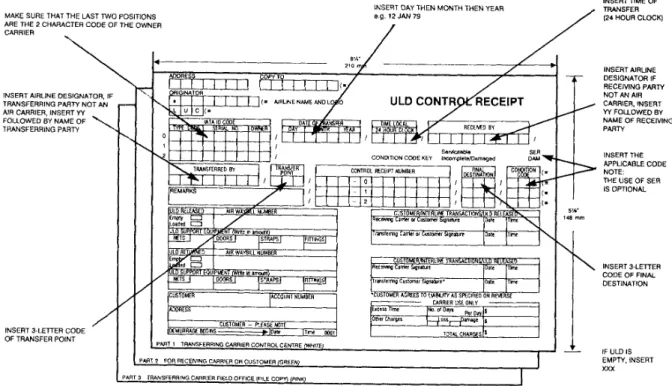
figure 5 load unit control message (LUC) ...15
figure 6 hazard labels - explosive ...25
figure 7 hazard label - explosive 1.4S ...25
figure 8 hazard label - flammable gas ...26
figure 9 hazard label - non-flammable, non-toxic gas ...26
figure 10 hazard label - toxic gas ...26
figure 11 hazard label - flammable liquid...27
figure 12 hazard label - flammable solid...28
figure 13 hazard label - spontaneous combustion ...28
figure 14 hazard label - dangerous when wet ...28
figure 15 hazard label - oxidizer ...29
figure 16 hazard label - organic peroxide...29
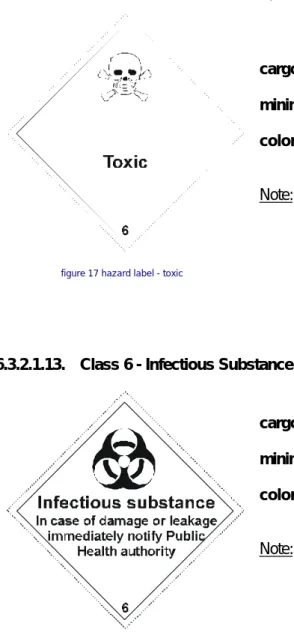
figure 17 hazard label - toxic...30
figure 18 hazard label - infectious substance ...30
figure 19 hazard label - radioactive - I White...31
figure 20 hazard label - radioactive - II Yellow...31
figure 21 hazard label - radioactive - III Yellow...31
figure 22 hazard label - corrosive ...32
figure 23 hazard label - miscellaneous...32
figure 24 handling label - magnetized material ...33
figure 25 handling label - cargo aircraft only (CAO) ...33
figure 26 handling label - this way up...34
figure 27 handling label- cryogenic liquid...34
figure 28 shipper's declaration for dangerous goods...37
figure 29 dangerous goods acceptance check sheet ...38
figure 30 AWB handling information - dangerous goods as per attached shipper's declaration...39
figure 31 AWB handling information - dangerous goods and non-dangerous goods ...39
figure 32 AWB handling information - dangerous goods in a consolidated shipment...39
figure 33 AWB handling information - shipper's declaration not required ...39
figure 34 AWB nature and quantity of goods - dangerous goods in excepted quantities...39
figure 35 NOTOC...41
figure 36 reverse side of NOTOC - load codes for dangerous goods ...42
figure 37 label - excepted quantities ...43
figure 38 lashing of a crated coffin...58
figure 39 AV-8 - air mail label ...71
CO N T E N T S
-_____________________________________________________________________
Cargo Handling Date: 11/00
RE S P O N S I B I L I T Y
6.1. Responsibility
Leisure Cargo GmbH (DUSFBLT) has been founded by LTU and SWISSCARGO and manages among other carriers the sales of LTU's aircraft cargo compartment capacity.
Leisure Cargo has the responsibility for cargo and mail handling in LTU's whole network at cargo acceptance points, warehouses, transfer points and delivery areas. The responsibilities are specifically laid down in the Contribution Share Contract between Leisure Cargo and LTU.
This include all contracted and subcontracted cargo GSAs and cargo handling companies. Industry standards as laid down in IATA AHM and all provisions of GOM must be followed and all concerned staff must be qualified and certified for dangerous goods handling.
Inspections and audits of all cargo facilities at all stations must be maid regularly and records must be filed. Any findings must be reported immediately to the Manager Ground Operations DUSOGLT.
In particular the following duties of Leisure Cargo, contracted and subcontracted cargo handling agents and cargo GSAs must be reviewed for adequacy and compliance by DUSFBLT but is not limited to:
• compliance with legal regulations such as embargoes, custom regulations, etc.
• compliance with air cargo security measures
• pre-notification of booked weights to relevant loadcontrol departments and dispatch
• pre-notification of any special load to relevant loadcontrol departments and dispatch (DG, PER, AVI, WET, BIG, HEA, OHG, LHO)
• proper freight documentation (AWB, cargo manifest, DGD, NOTOC, etc.)
• proper identification and labelling of every cargo shipment
• ULD build-up and contour limitations
• determination and documentation of actual freight weights
• meeting the cargo close-out times of each station
• notification of actual freight weights (net and gross) and advice of special load to relevant loadcontrol department
• issuing of ULD tag
• irregularity handling of all cargo and mail shipments
• notification of ULD circulation to relevant loadcontrol/ULD control department (UCM/LUC) Leisure Cargo DUSFBLT must authorize the following special loads according to legal certification requirements:
• authorization and acceptance of dangerous goods
• authorization for HEA
• authorization and loading instructions for AVI in exceptional cases
• approval for VAL
Leisure Cargo DUSFBLT supervises and maintain records of
• reliability of shippers (DGR)
• training and qualification of cargo handling agents acceptance and warehouse staff
• dangerous goods shipments,
Leisure Cargo DUSFBLT must report every incident or accident with dangerous goods subject to aircargo immediately to the German CAA (LBA) and to the Manager Ground Operations DUSOGLT and to the Supervisor Dangerous Goods.
RE S P O N S I B I L I T Y
6.1.1. Acceptance of Cargo
LTU has the authorization for transport of passengers and freight. This chapter contains the necessary informations and regulations for transportation of revenue and non-revenue cargo, as well as air mail and service cargo.
Detailed informations are contained in the LTU Cargo Manual published by DUSFBLT.
6.1.1.1. Loading Principles
International standards and recommended practices for the clearance of aircraft crew, passengers and cargo are laid down in Annex 9 "Facilitation" to the Convention of the International Civil Aviation Organisation, Chicago 1944, as amended from time to time. Deviations from those standards and
recommended practices as laid down in this Annex 9 are only possible if the respective government has notified ICAO accordingly. The variations will be published in a valid supplement to Annex 9.
For all cargo items the cargo label shall be completed and affixed to every package.
figure 1 cargo label
Cargo personnel must note that cargo load could be excluded from transportation:
• if it is not properly packed and/or may cause damage to the aircraft and/or other load,
• if the weight of the load is not properly determined,
• if it may contaminate the compartment and/or other load (wet freight, dirty pallets, dirty tarpaulin, etc.),
• if it is not packed according to the applicable packing requirements (e.g. for dangerous articles, human remains, live animals, etc.),
• if special handling instructions cannot be observed,
• if necessary loading accessories and gear are not supplied or are not held available,
• if cargo documentation is not complete or incorrect.
6.1.2. Cargo Documentation
6.1.2.1. Air Waybill (AWB)
Air Waybill means the document entitled "Air Waybill/Air Consignment Note" made out by or on behalf of the shipper to evidence the contract between the shipper and the carrier(s) for transportation of freight over routes of the carrier(s).
The AWB serves as:
• proof of receipt of goods for carriage
• a dispatch note (borderau) on which the documents to accompany and the shipper's special instructions are noted
• an invoice for transportation charges
• an insurance certificate if insurance coverage has been obtained through the intermediary of carrier
• the document for export, transit and import to meet the requirements of custom authorities
• a guide to the carrier's personnel for purposes of handling, dispatching and delivering the consignment
_____________________________________________________________________
Cargo Handling Date: 11/00
RE S P O N S I B I L I T Y 6.1.2.2. Cargo Manifest
The Cargo Manifest is the document required for the clearance of cargo as agreed between national governments being members of ICAO, and published in Annex 9 "facilitation". It is generally accepted by all countries served by LTU. Within the Company, the Cargo Manifest is an essential working paper and accounting document.
A Cargo Manifest for airmail is not required (see Chapter 6.12. Air Mail on page 71).
In all cases when no cargo is transported, a "NIL Manifest" must be prepared and carried with the other aircraft documents pertaining to the flight. The manifest heading is filled in as normal, the column "Nature of Goods" carries the "NIL" declaration (no items listed).
The manifest will be prepared according to the following instructions. Deviations according to "Inbound Clearance Procedures of Countries" have to be observed. All entries are made by typewriter or in block letters. Corrections must not interfere with the legibility.
Operator (1)
Registration of Aircraft (2)
Flight Number (3)
Date (4)
Point of Lading (5)
place of loading station
giving full airport name and country Point of Unlading (6)
place of unloading
giving full airport name and country Air Waybill (AWB) Number (7)
complete AWB number (prefix and serial number). Segregate serial number in two blocks for better identification by one space
Number of Packages (8)
Nature of Goods (9)
the goods must be described in such a way that they can be clearly recognized. Considering the limited space available, abbreviations must be distinctive in their description; e.g.
Machine Parts (not mach.pts.) Food Samples (not samples) Typewriters (not off.mach.)
for specifying the contents regarding dangerous goods (DGR), the IATA Dangerous Goods Regulations must be observed, i.e. the same description as shown in the corresponding AWB must be entered.
For Use by Operator Only (10) For Official Use Only (11)
a) gross weight [kg] in left part of column. some states require certain statements b) origin and destination in three letter code acc. to the AWB.
c) for special loads use loadcodes.
IATA Equipment Code No. (12) Prepared By (13)
Page .. of .. Pages (14)
RE S P O N S I B I L I T Y
6.1.3. Cargo Loadplanning
For load planning purposes, the passengers and their baggage as checked in take overall priority. Planning of cargo load is generally based on the number of passengers booked for each individual flight, but also the following factors have to be considered:
- the number of passengers booked
- the estimated baggage for booked passengers
- the actually booked amount of excess and oversize baggage (e.g. live animals, bicycles, surf boards, large sports gear, etc.)
- the contracted mail load (if any) - booked cargo load, incl. service cargo
- estimated cargo from free sale with guaranteed carriage.
The operational requirements for the flight take precedence over other considerations.
For load planning or estimated calculations, the following average figures shall be used:
• Passenger baggage, short/medium range - 17 kg/head
• Passenger baggage, long range - 20 kg/head
• Baggage - 170 kg/m3, 1 - 2 pieces
• Mixed mail - 170 kg/m3
• Letter mail - 230 kg/m3
• Parcel mail - 130 kg/m3
• Booked oversize baggage or special commodities - actual known weights
• Booked cargo - actual weights
_____________________________________________________________________
Cargo Handling Date: 11/00
RE S P O N S I B I L I T Y
6.1.4. Determination of Weights
LTU base and all other stations and/or contracted agents guarantee that the weights of cargo and mail loads to be loaded into an aircraft and transmitted to the aircraft handling department are correct. For determination of cargo and/or mail weights the following methods may be applied:
• Weighing and adding up of weights of individual cargo and/or mail shipments (consignments) Weighing and adding up of weights of made up parts of positioned cargo and/or mail load, i.e. ULDs, trolleys, pallets, etc.
• Acceptance of weights stated on air waybills, AV-7s or other recognized weighing documents, provided that it has been ascertained, for instance by spot checks, that the stated weights can be accepted as correct.
If none of the above quoted methods can be applied, DUSFBLT cpy DUSOGLT is to be notified and further advice is to be obtained.
The department responsible for aircraft handling is advised to familiarize itself with the methods of weight determination applied at its stations.
6.1.5. Documentation of Weights
• Unit Loading Devices (ULDs)
For ULDs, the determined weight shall be entered in the ULD tag.
• Bulk Load
The determined net weight shall be entered in the column "Net Weight in kg" in the trolley tag.
• Confirmation of Weight Determination
The entries of weight in ULD and/or trolley tags shall be confirmed by the signature of the person responsible for the weight determination. The determined weight shall be transmitted to aircraft operations in form of a written statement, according to local arrangements and facilities. EDP-print-outs, cargo manifests or ULD and/or bulk load statements can be used.
RE S P O N S I B I L I T Y
-_____________________________________________________________________
Cargo Handling Date: 04/00
CA R G O LO A D I N G
6.2. Cargo Loading
Cargo loading compartments differ in size, contour, size of access doors, compartment equipment, floor bearing strength, restraint possibilities and positions. The differences are between aircraft types,
sometimes even within aircraft series, always depending on the manufacturers or the operators requirements.
It is therefore essential to consider aircraft types, their equipment and facilities for carriage of cargo, apart from individual operating characteristics of flight category for the make up of cargo loads. This refers equally to special commodities and layout of aircraft for bulk load and Unit Loading Devices (ULDs) and pallets.
The carriage of passenger baggage, crew baggage, mail, service freight and company cargo as well as special commodities may demand commodity separation, e.g. live animals, human remains, perishable commodities or chemicals, etc.
6.2.1. Unit Load Devices - ULD Procedures
To obtain the weight and the center of gravity of an aircraft, among other items the real weight of cargo and/or mail load shall be determined.
Responsibility for the application of correct cargo and mail weights in the weight and balance calculation and documentation remains entirely with LTU department in charge of aircraft handling and/or its agents and contractors at other stations.
6.2.1.1. ULD Tags
After completion of loading and weighing of pallets and/or containers, an ULD tag shall be completed for each individual ULD. The reverse side of the container/pallet cargo ULD tag is intended or may be used for empty ULD's.
CA R G O LO A D I N G 6.2.1.2. Loading Devices and Accessories
Loading accessories, such as tie-down rings, tie-down straps, lashing rope, supporting planks and platforms, roller platform plastic bags, plastic foil, net bags, pouches and seals for valuable cargo, dry-ice boxes, pot kennels, but also pallets and containers etc. are held available at the stations DUS/MUC and must be requested in case of need in good time before the intended date of shipping.
The request must contain the following data:
- Part number or IATA ID code of the requested item - The required quantities in units
- Latest arrival date of the material
- Flight number and date for which the material will be used - if known.
6.2.1.3. Provision of Unit Load Devices
All stations served with containerized aircraft hold a standard stock of unit load devices corresponding to the effective scheduled requirements.
Possible changes shall be reported to LTU headquarters container tracing (DUSOCLT).
6.2.1.3. Control of Unit Load Devices
Stocks of unit load devices exceeding the stations' presumed stock shall be returned to DUS/MUC immediately or forwarded to stations as directed by DUSOCLT.
6.2.1.4. Circulation of Loading Material (UCM/LUC)
The described procedure serves the purpose of a centralized circulation and stock control of loading material with the intention to dispose the material to the best operational and economical requirements and to protect valuable company owned/leased property from loss/damage.
All changes of stock of loading material of LTU added to or removed from station inventory will be recorded by an "ULD Control Message" (UCM). LTU material received from or transferred to Third Parties (other airlines, agents or customers) will be controlled by an ULD Control Receipt ("ULD Receipt") together with a telex "Load Unit Control Message"(LUC).
The circulation and stock control are based on IATA Identification Codes, except for pallet nets. It is, however, understood that each pallet is accompanied by the appropriate net. This refers also to pallets where the load is secured by tie-down straps in place of the net. In these cases, the net must be added to the load in order to keep the load unit complete.
If and when loading material with its own IATA ID code is carried, but not permanently attached to the base pallet (e.g. motorcycle pallet, etc.), the ID code of the respective loading material shall be recorded in addition to the code of the base pallet.
_____________________________________________________________________
Cargo Handling Date: 04/00
CA R G O LO A D I N G 6.2.1.4.1. ULD Control Message (UCM)
For every flight operated with containerized aircraft (with ULD Loading System, also in case of cargo trucking, for every truck where ULDs are carried), stock changes of loading material added to or removed from station stock shall be reported to DUSOCLT by means of ULD Control Message (UCM). Details for the UCM shall be entered in the form "ULD Control Message" and shall be dispatched immediately after arrival/departure of aircraft or truck.
The responsibility for the correct transmission of the UCM remains with the dispatching station.
Therefore, written and transmitted messages shall be cross-checked to avoid discrepancies. In case of discrepancies, correction messages shall be transmitted immediately.
6.2.1.4.2. Load Unit Control Message (LUC)
figure 5 load unit control message (LUC)
For short releases of ULDs to customers or agents, a "ULD Control Receipt" shall be completed for the purpose of local control. A telex LUC message shall not be sent.
CA R G O LO A D I N G 6.2.1.4.3. Stock Control of Unit Load Devices
All stations holding LTU ULDs in stock are requested to send once a week (on Sunday or Monday) a station inventory to DUSOCLT by telex. These telexes are the basis of a computerized ULD Control System.
6.2.1.5. Damage of Unit Load Devices
In case of damaged ULDs, inform DUSOCLT and send ULDs ASAP to DUS or as directed by DUSOCLT.
6.2.2. Pallet Loading
6.2.2.1. Loading Principles for Pallet Build-up
A complete ULD consists of the pallet and the net. The net is an integral part of the aircraft restraint system. The pallet and the net are approved by the airworthiness authority as one unit, therefore only those nets approved with specified pallets may be used together.
Before loading pallet units, the serviceability of the material shall be checked.
Pallets shall be build-up only, placed on pallet dollies or on other roller equipped loading form.
All shipments loaded on one pallet must be bound for the same station of unloading. As far as possible, transfer cargo should be loaded on separate pallets to avoid sorting at the point of unloading. All pieces of one shipment shall be loaded on one platform, if possible.
Heavy and/or strongly packed items shall be placed on the bottom. They should be stowed as near to the center of the pallet as possible.
Lighter items shall be distributed over heavy cargo. This arrangement will decrease the possibility of damage and ensures that the center of gravity of the pallet remains within the prescribed limits.
All parts of the load shall be stowed as evenly as possible on top of each other to prevent slipping of the whole load. Small items shall be properly secured on the pallet to avoid sliding through the pallet net meshes.
The loading area of a pallet is confined by the contour unit or by the tie-down track at the edge of a pallet respectively. The net attachment fittings shall always be kept free from load and shall be easily accessible.
Aircraft related limitations (compartment cross section, door height, maximum capacity) as well as load limitations of unit load devices shall be considered accordingly for pallet loading.
For details see chapter 1.1. A320-214, 1.3. (B767-300ER) or 1.4. (A330-200/A330-300).
When pallet build-up is completed, the load has to be secured to the pallet by means of a pallet net and/or straps.
Each fitting for attaching the net to the pallet is designed to take a certain load. Therefore, all fittings must be secured to their corresponding place on the pallet.
Tension of tie-down equipment must be sufficient; overtension must be avoided as it may cause the pallet edge rails to bend up, which eventually complicates transport and locking with the aircraft loading system.
In order to avoid damage caused by water, loads on pallets susceptible to moisture shall be covered with plastic foil. Pallets containing live animals (other than fish and mollusks), flowers, fruit or vegetables are except from this regulation. These shipments may be protected from rain during the transport to and from the aircraft, using plastic foil drawn over the net. However, the foil sheet has to be removed before loading the pallet into the aircraft.
The bottom of the pallets shall be covered with plastic foil if the first layer of loaded goods should be susceptible to moisture. The sheet of foil shall be large enough to wrap the first layer.
Accumulation of water or snow shall be removed from the pallet load before loading into the aircraft.
_____________________________________________________________________
Cargo Handling Date: 06/01
CA R G O LO A D I N G 6.2.2.2. Contour of Pallet Load
Pallet load shall be shaped in a way that it suits the compartment cross section. This is guaranteed with special contour units respectively pallet contour frames.
The maximum height of 64" shall never be exceeded. The installed fire fighting system requires the remaining space.
The contour limitations can be taken from chapter 1.1. (A320-214), 1.3. (B767-300ER) or 1.4. (A330-200/A330-300).
6.2.2.3. Securing of Pallet Load
The load shall normally be secured by a pallet net. The net will be attached to the pallet by net
attachment fittings, which will be snapped into the track profile at marked points. All nets are designed to secure the maximum permissible load against 3 G in all directions.
Instead of pallet nets, straps or ropes may also be used for an individual lashing. However, the following dispositions must be observed:
- The straps or ropes must be attached in the area of the marked net attachment point at the edge rail of the pallet.
- In the area of a net attachment point, only one strap or rope for each directional force may be attached.
- The unused net shall be forwarded together with the secured load.
6.2.2.4. Pallet Stacks
Pallet stacks can be carried according to the following procedure: - Locking of bottom pallet by means of regular aircraft locking devices. - Tie-down to base (bottom) pallet:
a) for stacks up to 24 pallets including bottom pallet use eight straps, four across and four longitudinally in order to prevent individual pallets from turning free.
b) For stacks from 25 to 40 pallets including the bottom pallet use a pallet net.
c) Cargo loads on pallet stacks have to be secured additionally under observation of the tie-down procedures to the bottom pallet.
- Supporting of the pallet stack on the base pallet by means of either: four stacks with three supporting planks each
or
three stacked supporting platforms positioned in the center (heavy item pallets) or
three adjacent Euro-Pallets or
any other equivalent supporting material in order to allow proper locking in the aircraft.
The aircraft compartment contour and/or the maximum load limitations of the pallet position must be observed.
For details refer to chapter 1.1. (A320-214), 1.3. (B767-300ER) or 1.4. (A330-200/A330-300).
CA R G O LO A D I N G
-_____________________________________________________________________
Cargo Handling Date: 02/99
CA R G O LO A D I N G
6.2.3. Container Loading
6.2.3.1. Loading Principles for Containers
Container doors put on the roof shall be secured against falling down by attaching the hook on the strap to the ring fitted on the container roof.
A container shall be exclusively filled with baggage, cargo or mail. Mixing of loads must be avoided. A LMC container may be the only exception.
Heavy items should be loaded on pallets or, if unavoidable, on the bottom of a container.
Containers with heavy loading must be handled with extreme care in order to avoid damage to the container.
The outer loading limit in the door area is indicated by the metal edge of the base.
After loading has been finished, the container doors shall be closed and locked. In case of flexible reinforced doors, each strut must be checked for proper fitting in the lock.
The height of the containers does not permit further loading on their top. Never attempt to stow flat cargo on top of a container!
6.2.3.2. Securing within Load Container
Inside lashing is required if
- pieces with high individual weight or cargo which is sensitive against jolts and tilting are loaded as single items,
- the container is not filled up to 2/3 of its loading height and mainly small pieces with a comparatively high individual weight (high density cargo) are loaded. In this case, planks shall be spread across all items in order to ensure an efficient lashing of the total load.
In case of doubt, a decision should always be made in favor of lashing
Inside lashing is performed by means of tie-down track segments positioned at the base and the interior side panels of the container. For lashing the standard capacity tie-down equipment is applicable. Inside lashing is not required for:
- completely filled containers, applicable even if heavy items are stored amongst the load, - containers which are at least loaded up to 2/3 of their loading height. They are considered as
completely filled.
- containers which are not completely filled, provided the load consists mainly of large pieces with a comparatively low individual weight (low density cargo).
CA R G O LO A D I N G
6.2.4. Cabin Load
LTU will generally not accept cabin load of commercial or non-commercial cargo while carrying passengers, with the exception of: stretchers under special circumstances and only with proper
stretcher equipment,
live animals as baggage up to published weights and sizes, live human organ (LHO),
CoMail in small quantities (care of CDC/purser)
6.2.4.1. Cabin Load of Bulk Cargo
LTU may, carry cargo in the cabin, provided the seat units can be restored in the cabin and space made available for bulk load of cargo. In such exceptional cases, the floor load restrictions and restraint point capacities must be strictly observed. The performance department of flight operations (SITA:
DUSNVLTATTN Performance) is to be consulted for advice and instructions in each case before the date of shipping.
_____________________________________________________________________
Cargo Handling Date: 06/01
DA N G E R O U S GO O D S
6.3. Dangerous Goods
LTU's policy for the carriage of dangerous goods is based on the published IATA Dangerous Goods Regulations. Unless otherwise stated and specified in this chapter, the IATA regulations will apply. In consideration of the basic characteristics of LTU's flight operations - being the transportation of passengers and their baggage - the Company restricts itself from the general carriage of dangerous goods.
Several dangerous goods items may be accepted, provided the following procedure is complied with:
• dangerous goods can be accepted subject to air cargo only
• all dangerous goods must be approved by telex from cargo department DUSFBLT
• all persons accepting dangerous goods must be qualified and licensed according to IATA requirements and up to date with the current IATA regulations
• a handling advice for every dangerous goods material must be sent to all departments concerned (from DUSFBLT)
• all dangerous goods must be properly packed
• all dangerous goods must be secured safely on board a LTU aircraft by adequate lashing material
• all dangerous goods must be inspected prior to onloading for any leakage or damage
• the proper conditions must be reported (NOTOC) to the Pilot in Command
• any package with dangerous goods which appears to be damaged or leaking must be removed from the aircraft and safe disposal arranged
• in case of leakage, it must be ensured that the remainder of the consignment is undamaged, and that no other load has been contaminated
• all dangerous goods must be inspected directly after unloading for any leakage or damage, and must be confirmed on the incoming NOTOC by the signature of the rampagent
• a copy of all documents (TLXs, Dangerous Goods Acceptance Check Sheet, Shipper's Declaration, AWB, and NOTOC) shall be filed with all departments concerned
• every incident with dangerous goods must be reported immediately to the cargo department DUSFBLT and DUSOTLT, which, in turn, will inform the Civil Aviation Authorities
The following dangerous goods will never be accepted for carriage on board of any aircraft:
• Class 7, radioactive material
• ULDs built up by the shipper shall not be accepted when containing other dangerous goods items than cosmetics and/or medicines, prepared according to packing instruction 910, or dry ice (ICE) used for refrigerant for other than dangerous goods.
• Dangerous Goods allowed for freighters only (CAO) or packed according to the packing instructions for cargo aircraft only (CAO) shall not be transported.
If a dangerous goods shipment is limited per hold or compartment (e.g. USG/ICE/RSB), the following nomenclature for inaccessible cargo compartments apply:
A320-232/-214 FWD hold (compartment 1) AFT hold (compartment 3 and 4 incl. Bulk/5)
B757-200 FWD hold (compartment 1 and 2) AFT hold (compartment 3 and 4)
B767-300 FWD hold (compartment 1 and 2) AFT hold (compartment 3 and 4 incl. Bulk/5)
A330-200/-300 FWD hold (compartment 1 and 2) AFT hold (compartment 3 and 4 incl. Bulk/5) Only two freight compartments/holds are available for segregation of goods or for any limitations (e.g. flights to/from USA or limit of RSB/ICE)
DA N G E R O U S GO O D S
-_____________________________________________________________________
Cargo Handling Date: 02/99
DA N G E R O U S GO O D S 6.3.1. Hazard Classification
Dangerous Goods are divided into nine different hazard classes. Some hazard classes are further subdivided into hazard divisions due to the wide scope of the class.
The order in which they are numbered is for convenience and does not imply a relative degree of danger.
Class 1 Explosives
• Division 1.1 - articles and substances having a mass explosion hazard
• Division 1.2 - articles and substances having a projection hazard but not a mass explosion hazard
• Division 1.3 - articles and substances having a fire hazard, a minor blast hazard and/or a minor projection hazard but not a mass explosion hazard
• Division 1.4 - articles and substances presenting no significant hazard
• Division 1.5 - very insensitive articles having a mass explosion hazard
• Division 1.6 - extremely insensitive articles which do not have a mass explosion hazard
Class 2 Gas
• Division 2.1 - flammable gas
• Division 2.2 - non-flammable, non-toxic gas
• Division 2.3 - toxic gas
Class 3 Flammable Liquid
Class 4 Flammable Solids; Substances liable to Spontaneous Combustion; Substances which, in contact with Water, emit Flammable Gases
• Division 4.1 - flammable solids
• Division 4.2 - substances liable to spontaneous combustion
• Division 4.3 - substances which, in contact with water, emit flammable gases
Class 5 Oxidizing Substances and Organic Peroxides
• Division 5.1 - oxidizers
• Division 5.2 - organic peroxides
Class 6 Toxic (poisonous) and Infectious Substances
• Division 6.1 - toxic substances
• Division 6.2 - infectious substances
Class 7 Radioactive Material
Class 8 Corrosives
DA N G E R O U S GO O D S
-_____________________________________________________________________
Cargo Handling Date: 06/01
DA N G E R O U S GO O D S 6.3.2. Markings and Identification
6.3.2.1. Hazard Labels
The label identifying the primary hazard of the dangerous goods must bear the class or division number as appropriate in the bottom corner of the label.
Until 30 June 2001 a label identifying a subsidiary risk must not show the class or division number and this number must be obliterated if already included.
Effective 1 July 2001 all hazard labels (primary and subsidiary hazard labels) must show the class number.
All labels (hazard and handling labels) used on packages of dangerous goods must conform, in shape, color, format, symbol and text to the specimen designs of IATA DGR (Subsection 7.3).
Text on hazard labels is not required but may be additionally printed on the lower half of the label.
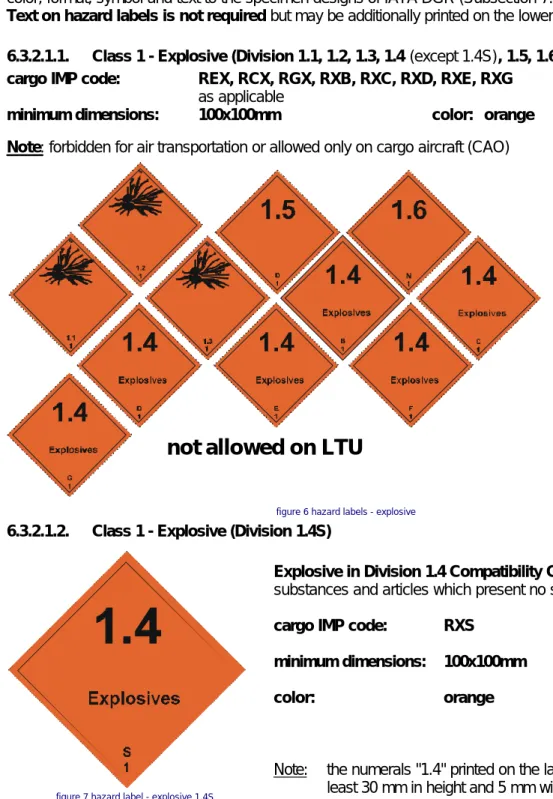
6.3.2.1.1. Class 1 - Explosive (Division 1.1, 1.2, 1.3, 1.4 (except 1.4S), 1.5, 1.6)
cargo IMP code: REX, RCX, RGX, RXB, RXC, RXD, RXE, RXG
as applicable
minimum dimensions: 100x100mm color: orange
Note: forbidden for air transportation or allowed only on cargo aircraft (CAO)
figure 6 hazard labels - explosive
6.3.2.1.2. Class 1 - Explosive (Division 1.4S)
Explosive in Division 1.4 Compatibility Group S
substances and articles which present no significant hazard
cargo IMP code: RXS
minimum dimensions: 100x100mm
color: orange
Note: the numerals "1.4" printed on the label must be at least 30 mm in height and 5 mm wide
figure 7 hazard label - explosive 1.4S
DA N G E R O U S GO O D S 6.3.2.1.3. Class 2 - Flammable Gas (Division 2.1)
cargo IMP code: RFG
minimum dimensions: 100x100mm color: red
figure 8 hazard label - flammable gas
6.3.2.1.4. Class 2 - Non-Flammable, Non-Toxic Gas (Division 2.2)
cargo IMP code: RNG, RCL as applicable
minimum dimensions: 100x100mm color: green
Note: RCL packages must be labelled with an additional cryogenic liquid handling label
(see 6.3.2.2.4. Cryogenic Liquid)
figure 9 hazard label - non-flammable, non-toxic gas
6.3.2.1.5. Class 2 - Toxic Gas (Division 2.3)
cargo IMP code: RPG
minimum dimensions: 100x100mm
color: white
figure 10 hazard label - toxic gas
_____________________________________________________________________
Cargo Handling Date: 02/99
DA N G E R O U S GO O D S 6.3.2.1.6. Class 3 - Flammable Liquid
cargo IMP code: RFL
minimum dimensions: 100x100mm
color: red
DA N G E R O U S GO O D S 6.3.2.1.7. Class 4 - Flammable Solid (Division 4.1)
cargo IMP code: RFS
minimum dimensions: 100x100mm color: red/white
figure 12 hazard label - flammable solid
6.3.2.1.8. Class 4 - Substance Liable to Spontaneous Combustion (Division 4.2)
cargo IMP code: RSC
minimum dimensions: 100x100mm color: white/red
figure 13 hazard label - spontaneous combustion
6.3.2.1.9. Class 4 - Substance which in Contact with Water emit Flammable Gases (Division 4.3)
cargo IMP code: RFW
minimum dimensions: 100x100mm color: blue
_____________________________________________________________________
Cargo Handling Date: 02/99
DA N G E R O U S GO O D S 6.3.2.1.10. Class 5 - Oxidizing Substance (Division 5.1)
cargo IMP code: ROX
minimum dimensions: 100x100mm color: yellow
figure 15 hazard label - oxidizer
6.3.2.1.11. Class 5 - Organic Peroxide (Division 5.2)
cargo IMP code: ROP
minimum dimensions: 100x100mm color: yellow
DA N G E R O U S GO O D S 6.3.2.1.12. Class 6 - Toxic Substance (Division 6.1)
cargo IMP code: RPB
minimum dimensions: 100x100mm color: white
Note: For packages containing solid or liquid poisonous or toxic substances.
figure 17 hazard label - toxic
6.3.2.1.13. Class 6 - Infectious Substance (Division 6.2)
cargo IMP code: RIS
minimum dimensions: 100x100mm color: white
Note: for small packages the label dimensions may be 50 x 50 mm
_____________________________________________________________________
Cargo Handling Date: 06/01
DA N G E R O U S GO O D S 6.3.2.1.14. Class 7 - Radioactive (Category I - White)
cargo IMP code: RRW
minimum dimensions: 100x100mm color: white
not allowed on LTU
figure 19 hazard label - radioactive - I White
6.3.2.1.15. Class 7 - Radioactive (Category II - Yellow)
cargo IMP code: RRY
minimum dimensions: 100x100mm color: yellow/white
not allowed on LTU
figure 20 hazard label - radioactive - II Yellow
6.3.2.1.16. Class 7 - Radioactive (Category III - Yellow)
cargo IMP code: RRY
minimum dimensions: 100x100mm color: yellow/white
not allowed on LTU
DA N G E R O U S GO O D S 6.3.2.1.17. Class 8 - Corrosive
cargo IMP code: RCM
minimum dimensions: 100x100mm
color: white/black
figure 22 hazard label - corrosive
6.3.2.1.18. Class 9 - Miscellaneous Dangerous Goods
cargo IMP code: RMD, RSB, ICE as applicable
minimum dimensions: 100x100mm
color: white/black
_____________________________________________________________________
Cargo Handling Date: 11/00
DA N G E R O U S GO O D S 6.3.2.2. Handling Label
6.3.2.2.1. Magnetized Material (MAG)
cargo IMP code: MAG
minimum dimensions: 90x110mm color: blue/white
Note: This handling label replaces the "MISCELLANEOUS DANGEROUS GOODS" hazard label for a package with magnetized material.
figure 24 handling label - magnetized material
6.3.2.2.2. Cargo Aircraft Only (CAO)
cargo IMP code: CAO
minimum dimensions: 110x120mm
color: orange/black
figure 25 handling label - cargo aircraft only (CAO)
DA N G E R O U S GO O D S 6.3.2.2.3. Package Orientation (This Way Up)
minimum dimensions: 74x105mm
color: red or black on a contrasting
background
Note: for liquid dangerous goods in combination packagings (on two opposite sides)
6.3.2.2.4. Cryogenic Liquid (RCL)
cargo IMP code: RCL
minimum dimensions: 74x105mm
color: green
Note: This handling label must be affixed to a package containing cryogenic liquids (refrigerated liquefied non flammable gases) additionally to the "NON-FLAMMABLE GAS" hazard label
(see 6.3.2.1.4. Class 2 - Non-Flammable, Non-Toxic Gas (Division 2.2))
figure 26 handling label - this way up
_____________________________________________________________________
Cargo Handling Date: 02/99
DA N G E R O U S GO O D S
6.3.3. Acceptance of Dangerous Goods
Any request for the transportation of dangerous goods must be directed to cargo DUS (DUSFBLT).
Only the cargo department is authorized to give the approval for the acceptance of dangerous goods under the Company provisions.
If solid, liquid or gaseous materials with hazardous characteristics or items containing such materials are offered for air transportation, the acceptability has to be checked with the help of the alphabetical list in the current section 4 of the IATA Dangerous Goods Manual. If this type of commodity is not specifically named there, the applicable "n.o.s." entry, as explained exactly in the IATA regulations, has to be taken.
If an article or substance contains a chemical which could be suspected of being dangerous, but does not meet the criteria for any of the hazard classes or divisions, it may be transported as not restricted if the words "Not Restricted" (no abbreviations) are included in the description of the article or substance on the Air Waybill to indicate that it has been checked.
You may be confronted with an article or package showing a warning symbol or consumer warning label. The article or substance contained in the package may not necessarily meet the criteria for classification defined by the IATA Dangerous Goods Regulations. Clarifications should be obtained from the shipper and DUSFBLT, if required, before accepting the package as "not restricted".
The Shipper's Declaration must show the UN-number and proper shipping name, the net quantity per package, hazard class, packing instruction and the used packing material as well as complete addresses of the shipper and consignee.
The acceptance control must not be confined to the check of the documentation. The packages have to be checked as well. They must be checked for proper labeling (hazard label(s), markings, handling label(s) as required and their condition). Damaged or not properly packed shipments must be refused. Every employee in charge of cargo acceptance is obliged to check carefully all shipments for goods which are subject to the IATA Dangerous Goods Regulations. Same applies to shipments being
transferred by other carriers to LTU. Goods may only be carried if it has been made certain that, either these are not subject to the Dangerous Goods Regulations or, if dangerous, that the package(s) and accompanying documents fully meet the requirements of the IATA Dangerous Goods Regulations. Staff accepting dangerous goods must be qualified and licensed according to IATA requirements and up-to-date with the current IATA Dangerous Goods Regulations.
In case of doubt, shipments must not be accepted.
As an aid or guidance for the acceptance or refusal of dangerous goods shipments, the "Dangerous Goods Acceptance Check Sheet" has to be used.
If LTU is handled by other airlines which are member of IATA or by an IATA Handling Agent, equivalent check sheets are acceptable.
A copy of the completed check sheet has to accompany the shipping documents during the entire period of transport.
DA N G E R O U S GO O D S
6.3.4. Handling Advice for Dangerous Goods
For every Dangerous Goods item accepted and approved by LTU cargo DUSFBLT, a handling advice must be sent to all concerned departments of origin, transit stations and destinations.
The handling advice for dangerous goods must include: - date and flight number of shipment
- number of AWB
- proper shipping name and UN/ID number - number of pieces and net weights
- for operations with a containerized aircraft, type and number of ULD - IMP Code
- drill code
- special handling, if required
Specimen of the handling advice for dangerous goods:
zczc
qd mucfblt mucgolt dusoolt dushqlt dusffxh cunin7x cuntolt cunffco .dusfblt 201630nov93/xxx
handling advice for dangerous goods
o/b lt8403/21 and lt410/21 muc-dus-cun dgr transpo under awb 266-0042 3382 one motorbike
proper shipping name: engine, internal combustion un3166 weight net: 300kg
build on paj9001lt
imp code: rmd - miscellaneous dangerous goods drill code: 9l
no special handling required =
_____________________________________________________________________
Cargo Handling Date: 02/99
DA N G E R O U S GO O D S
6.3.5. Documentation for Dangerous Goods
6.3.5.1. Shipper's Declaration for Dangerous Goods
DA N G E R O U S GO O D S 6.3.5.2. Dangerous Goods Acceptance Check Sheet
_____________________________________________________________________
Cargo Handling Date: 02/99
DA N G E R O U S GO O D S 6.3.5.3. Air Waybill (AWB)
Air Waybill(s) accompanying dangerous goods consignment(s) must include one of the following statements in the "handling information" box:
• for a passenger aircraft shipment:
figure 30 AWB handling information - dangerous goods as per attached shipper's declaration
• for a shipment containing dangerous goods and non-dangerous goods:
figure 31 AWB handling information - dangerous goods and non-dangerous goods
• for a consolidated shipment containing dangerous goods:
figure 32 AWB handling information - dangerous goods in a consolidated shipment
• consignment containing dangerous goods for which a shipper's declaration is not required:
figure 33 AWB handling information - shipper's declaration not required
• consignment containing dangerous goods in excepted quantities: (see 6.3.5.5. Dangerous Goods in Excepted Quantities for details)
figure 34 AWB nature and quantity of goods - dangerous goods in excepted quantities
• Note: consignments for cargo aircraft (CAO) -dangerous goods as per attached shipper's declaration - cargo aircraft only - are strictly prohibited.
DA N G E R O U S GO O D S
-_____________________________________________________________________
Cargo Handling Date: 02/99
DA N G E R O U S GO O D S
6.3.5.4. Notification of Dangerous Goods to the Captain (NOTOC)
When dangerous goods are loaded on board of a LTU aircraft, the Pilot in Command is to be notified in writing about the category and hazard class of these goods, the number of packages, their weights and loading position as well as all drill codes for emergency response. This must be signed by the Ramp Agent to confirm the proper condition of each package. The original remains with the Captain, one copy with the issuing cargo department, one copy with the originating station file, and one copy with the arrival file. Additional copies (three blue) are available for every transit station or for planned crew changes.
figure 35 NOTOC
LTU will also accept computerized NOTOCs when issued in recommended IATA format.
DA N G E R O U S GO O D S
The reverse side of the Notification to Captain (NOTOC) shows all IMP codes (load codes) concerning dangerous goods:
figure 36 reverse side of NOTOC - load codes for dangerous goods
6.3.5.4.1. Responsibilities of Issuing and Handling of NOTOC
The NOTOC shall be prepared by cargo department completely except the loading position. For shipments with planned connecting flights or crew changes the appropriate amount of NOTOCs should be prepared for the entire transportation. All documents shall be handed over to loadcontrol, which in turn complete the loading position according the loading instruction.
The ramp agent at originating station must make a final visual check and shall confirm with his signature that there is no evidence that any damaged or leaking packages containing dangerous goods have been loaded on the aircraft.
This NOTOC shall be presented and signed by the PIC. All further NOTOCs for connecting flights and/or joining crews shall be handed over also to the PIC.
After arrival the ramp agent will get a copy of the NOTOC from the PIC. He shall confirm the proper conditions during offloading.
No further action is required at transit stations without cargo reloading and remaining crew.
At station where a new crew takes over flight duties or a reloading becomes necessary, the already prepared NOTOC must be completed with the loading position and the proper conditions must be confirmed (off- as well as onloading).
Note: If a prepared NOTOC is not available the informations shall be obtained from the incoming NOTOC and a new NOTOC must be issued.
_____________________________________________________________________
Cargo Handling Date: 04/00
DA N G E R O U S GO O D S 6.3.5.5. Dangerous Goods in Excepted Quantities
Very small quantities of dangerous goods may be transported, as described below, in such a manner that the may be excepted from the marking, loading and documentation requirement of the IATA DGR.
When they are transported under these provisions, such goods are called "dangerous goods in excepted quantities". They are subject to IATA DGR subsection 2.7.
Dangerous goods in excepted quantities are not permitted in or as checked or carry-on baggage nor in mail.
It is the shipper's responsibility, to ensure before offering to the operator that a package containing
dangerous goods in excepted quantities will withstand normal conditions of air transport and will not require any special handling, stowage or storage conditions which might necessitate shading from direct sunlight, ventilation, storage away from heat or segregation requirements, etc.
For detailed quantity limits of dangerous goods in excepted quantities refer to IATA DGR Table 2.7.A. Note: Depending of the class or division and packing group of the article or substance the
- inner packaging limit is 1 g or 1 mL to 30 g or 30 mL and the - outer packaging limit is 300 mL or 300 g to 1 kg or 1 L.
A package containing dangerous goods in excepted quantities must not contain other dangerous goods that require a shipper's declaration.
For packing requirements and package test refer to IATA DGR 2.7.
figure 37 label - excepted quantities
Dangerous goods in excepted quantities are identified by a
Excepted Quantities Label, which replaces all other marking, labelling and documentation requirements. Shippers Declaration for Dan-gerous Goods and NOTOC are not required (except AWB). The label must be completed by the shipper and must have a minimum dimension of 100 x 100 mm, also the package must have at least two of the three outside dimension of 100 mm, in case of a cylinder the minimum height and diameter must be 100 mm.
DA N G E R O U S GO O D S
-_____________________________________________________________________
Cargo Handling Date: 05/03
DA N G E R O U S GO O D S
6.3.6. Handling and Loading of Dangerous Goods
Dangerous goods must not be carried in an aircraft cabin occupied by passengers, except as permitted by the provisions for dangerous goods carried by passengers or crew (see chapter 5.3.).
Dangerous goods bearing the "Cargo Aircraft Only" CAO label are strictly prohibited on LTU aircraft.
6.3.6.1. Incompatibility of Dangerous Goods
Packages containing dangerous goods which might react dangerously with each other or are harmful to other non-dangerous goods must not be stowed on an aircraft next to each other or in a position that would allow interaction between them in the event of leakage.
As a minimum, the following segregation table must be observed:
Note 1: Shall not be loaded in close proximity of each other or in a position that would allow interaction between them in the event of leakage (minimum distance 1 m).
Note 2: Must not be loaded in the same bulk load compartment/ULD. If loaded in separate ULD's, the ULD's must not be loaded adjacent to each other (minimum distance 1 loading position).
Note 3: Animals which are natural enemies shall not be loaded in close proximity of each other. Note 4: intentionally left blank
Note 5: Must no be loaded in the same hold.
Note 6: Must not be loaded in the same non-ventilated compartment. In ventilated compartments up to 200 kg ICE may be loaded together with animals but not in close proximity of each other (minimum distance 1m).
Note 7: intentionally left blank
Note 8: Shall not be loaded in close proximity of each other (minimum distance 1m). Animals which smell intensively shall not be loaded in the same hold as EAT and/or baggage, if possible.
table 1 incompatibility chart
Adjacent positions are two positions side by side (e.g. 11L and 11R) or diagonal (e.g. 31L and 32R).
Packages must be segregated according to the note number, irrespective of whether the hazard is the primary or subsidiary risk
HAZ ARD CL ASS or D IVIS ION IMP cod e effective 1 July 2001
CAO, RCX, REX, RGX, RXB, RXC, RXD, RXE, RXG, RPG, RRW, RRY are not allowed
DA N G E R O U S GO O D S
6.3.6.2. Loading of Packages Containing Liquid Dangerous Goods
Packages bearing the package orientation "This Way Up" label must be loaded and stowed accordingly. Single packaging with end closures containing liquids must be stowed with such closures upwards notwithstanding that such single packaging may also have side closures.
6.3.6.3. Securing of Dangerous Goods
When dangerous goods are loaded in an aircraft, everybody must protect the dangerous goods from being damaged. Every package must be secured in the aircraft or on/in an ULD by adequate lashing material to prevent any movement in flight which would change the orientation of the packages. Securing by blocking with other load (e.g. baggage) is insufficient.
Special attention must be paid during their preparation for transport (acceptance point, warehouse, ground transport to (and back) from aircraft, receiving and delivery point). The dangerous goods package(s) and shipment(s) must be protected from being damaged.
6.3.6.4. Replacement of Labels
When LTU employees or handling agents discover that labels have become lost, detached, or illegible, they must replace them in accordance with the information provided on the Shipper's Declaration for Dangerous Goods. This requirement does not apply where the labels are found to be missing or illegible at time of acceptance.
6.3.6.5. Identification of ULDs Containing Dangerous Goods
Each ULD containing dangerous goods which require a hazard label, must clearly display on its exterior an indication that dangerous goods are contained within the ULD. The primary class(es) or division(s) of such dangerous goods must be visibly indicated on this ULD tag. The tag must be removed from the ULD immediately after dangerous goods have been unloaded.
6.3.6.6. Handling of Dry Ice (ICE)
Dry Ice (ICE) may be carried for cooling perishable goods or as cargo. Following loading instructions must be observed:
- a maximum of 200 kg unpacked/packed dry ice (e.g. in wooden, cardboard, plastic, or polystyrene boxes according to the IATA Dangerous Goods Regulations) may be carried per aircraft hold
- the structure of compartments, pallets and containers must be protected against direct contact with dry ice by insulating material
- transit stations and the destination station must ventilate the compartments before entering because of the danger of suffocation
- must not be loaded in the same non-ventilated compartment
- in ventilated compartments up to 200 kg ICE may be loaded together with animals, but not in close proximity of each other. AVI's are to be transported on a higher level than ICE and should be loaded in front of the dry ice. This is also applicable for the loading of refrigerating units together with live animals in the same compartment.
_____________________________________________________________________
Cargo Handling Date: 05/03
DA N G E R O U S GO O D S 6.3.6.7. Handling of Cars and Motorcycles (RMD)
Miscellaneous Dangerous Goods
All vehicles are subject to transportation within LTU air cargo service only and will be transported according to the current IATA Dangerous Goods Regulations.
6.3.6.7.1. Conditions of Vehicles
• The vehicle must be drained of fuel as far as practicable and if any fuel remains it must not exceed ¼ of the tank capacity. The dangerous goods acceptance check includes the task of performing a visual and acoustical check of the fuel tank ensuring that the tank is emptied and fuel remains inside the injection or carburetor system only.
• Installed batteries must be securely fastened in the battery holder or to the frame in an upright position. The battery terminals protected in such a manner as to prevent damage and short circuits.
• Additional bags or cases affixed to the motorcycle, or the car and trunk, must be unlocked for inspections through LTU cargo staff and customs.
• The motorcycle must be cleaned and all systems (fuel, oil, hydraulic) must be tight.
• Labelling is not required when the vehicle is not fully enclosed by packing, crates or other means that prevent the ready identification of a motorcycle or car.
• Serviceable tires are not restricted, damaged tires must be totally deflated.
• Accepted motorcycles shall be secured by standard lashing on the LTU motorcycle-pallet (available by DUSFBLT) or an equal pallet. For containerized aircraft the respective ULD has to be used.
• Loading of motorcycles is only permitted in an upright position.
6.3.6.7.2. Loading of Cars
Cars up to a length of 4,80 m (or longer with special loading care) may be loaded in the FWD of A330 as non-unitized cargo on normal secured pallets.
The procedure describes the loading in A330-200 (some steps are not required for A330-300 as the pallet floor is not overlapping the door area.
Onloading
4 PAJ pallets (88"x125"), secured by the relevant latches, must make the floor on which the car drives
with own power into the hold. Between the latch gaps of the pallets, wooden supporting planks must be placed, to avoid any punctual pressure from the tires to the a/c floor as the design will not withstand this forces. The ballmat (entry) area is designed for these forces and the car may drive there.
The entry area of A330-200 is half covered of the PAJ secured on position 11P but this does not affect the loading. The car will be placed on a PAJ and lifted to the entry and the pallet will be taken half in the entry area (overlaying the secured pallet of position 11P on the left side). Then the driver will steer to maximum left into the hold as far as possible, the pallet will be moved more inward and the procedure will be repeated until the car is straight on the centerline of the hold (facing aft). Therefore the pallet acts as an additional steering of the rear axle.
All four rims must be tied-down by normal straps (special wheel straps are not required and not used) to the two pallets and the planks must be taken out of the gaps and tied-down separately.
Offloading
An empty pallet will be pushed about 3/4 of its length in the entry area overlaying the secured pallet of position 11P. The supporting planks must be placed between the latch gaps of the pallets and the straps will be opened.
The car will be maneuvered (own power) backwards on this pallet with its rear axle. The pallet will be pulled outward a little bit and the driver maneuvers the car. This procedure will be repeated until the car is straight on the pallet.
DA N G E R O U S GO O D S Damage During Handling
Any damage to the aircraft must be reported immediately to the station engineer and to DUSHQLT DUSMCLT DUSOGLT. Damaged to car must be reported additionally to DUSFBLT MUCFBLT. Cars must be handled with utmost care to avoid any damage to the aircraft or the car itself.
Loading Accessories
Wooden planks, tied-down fittings, straps and an additional PAJ for ground transportation and loading must be available before loading.
ULD Preparation
As the pallet with the car moves over the secured pallet inside the cargo compartment, this pallet should only be secured at the wall and no net fittings should be fixed on the forward side to enable a smooth movement of the sliding onloading pallet (as well as offloading).
Ground Handling of Car
After dangerous goods acceptance check the car must be positioned on long wooden planks on the aircraft pallet, to avoid a bending of the pallet and the rims must be tied-down to the pallet.