1
UNIVERSITI TEKNIKAL MALAYSIA MELAKA
Light Control System Using Z-Wave
This report submitted in accordance with requirement of the Universiti Teknikal Malaysia Melaka (UTeM) for the Bachelor’s Degree of Electronic Engineering Technology
(Telecommunications) with Honours.
by
MUHAMMAD AMEERUL AFIQ BIN SAIDIN
B071310578
940112-10-6193
2
DECLARATION
I hereby, declared this report entitled “Light Control System Using Z-wave” is the results of my own research except as cited in references.
Signature :………
Name : MUHAMMAD AMEERUL AFIQ SAIDIN
3
APPROVAL
This report is submitted to the Faculty of Engineering Technology of UTeM as a partial fulfillment of the requirements for the degree of Bachelor of Engineering Technology (Telecommunication) with Honours. The member of the supervisory is as follow:
4
ABSTRAK
“Sistem Pengawalan Lampu menggunakan Z-wave”adalah dicipta untuk mengawal
5
ABSTRACT
6
DEDICATION
7
ACKNOWLEDGEMENT
I would like to thank our at Universiti Teknikal Malaysia Melaka lecturers especially my project supervisor Puan Aziean Binti Mohd Azize and Encik Mohd Erdi Bin Ayob who really helped me a lot throughout finishing my project. They don’t hesitate to teach me whenever I need help or support.
I also would like to thank my friends and my classmates who really help by giving advice and sharing information in finishing my project.
8
TABLE OF CONTENT
Declaration i
Approval ii
Abstrak iii
Abstract iv
Dedication v
Acknowledgement vi
List of Tables ix
List of Figures iv
CHAPTER 1 : INTRODUCTION 1
1.1 Introduction 1
1.2 Background 1
1.3 Problem Statement 3
1.4 Objectives 3
1.5 Scopes 4
CHAPTER 2: LITERATURE REVIEW 5
2.1 Introduction 5
2.2 Z-Wave 5
2.2.1 ZigBee and Z-Wave 9
2.3 Home Automation 10
9
2.5 Microcontroller 14
2.5.1 Arduino Microcontroller 16 2.6 Previous project on home automation 17 2.6.1 Zigbee-Based Home Automation System 17 2.6.2 GSM-Based Home Automation System 20
2.7 Home Automation Hub 23
CHAPTER 3:METHODOLOGY 24
3.0 Introduction 24
3.1 Flowchart for The Overall Process of The Project 24
3.2 Setting up the Hub 26
3.3 Microcontroller For The Z – Wave Device 27 3.3.1 Coding The Arduino Microcontroller And Assembling the Circuit 27
3.5 Simulation 29
CHAPTER 4: RESULTS AND DISCUSSIONS
4.0 Introduction 30
4.1 Project Setup 30
4.2 Results and Discussions 31
4.2.1 Z-wave 31
4.2.2 Samsung Smartthings Hub 35
4.2.3 Simulation 40
CHAPTER 5: CONCLUSIONS AND FUTURE WORKS
5.0 Conclusion 43
10
REFERENCES 46
11
LIST OF TABLES
1. Summary of Pros and Cons of Different Radio Technologies 7
2. Different Regions With Different Z-Wave Frequency 8
3. Connection of the Z-uno to the Hub 36
12
LIST OF FIGURES
1. Z-wave alliance logo 7
2. Generalized Functional Block Diagram of Microcontroller 15
3. Flow-Chart for The ZigBee Project 19
4. Past Experimental Environment 20
5. Stage Realization 21
6. Simulation of The Proposed GSM based Home Automation System 22
7. Prototype of Proposed GSM based home automation system 23
8. Flowchart of overall process 25
9. Diagram on how the Hub will work 27
10. Flowchart for Arduino Coding 28
11. Diagram on how the project will look like 30
12. Z-uno device 31
13. Z-Uno Technical Diagram 32
14. Tools Section of the Arduino IDE 33
15. Coding of the Z-Uno 34
16. Malaysian Spectrum Allocation for 902 MHz to 928 MHz frequency 36
17. Hub in Inclusion Mode of a Z-wave device 37
18. Hub in Exclusion Mode of a Z-wave device 38
13
20. Light turned on 40
14
CHAPTER 1
INTRODUCTION
1.1 Introduction
This Chapter discusses about the project background, the problem statements, objectives of this project and the scope of the project
1.2 Background
Imagine if everyone can control everything by using one single remote control. With just one click at your smartphone, all of the electrical appliances can be control. Now everyone can throw away all those unecessary remote controls that they always misplace and out of battery.This is what we called home automation.
For many years, Home Automation is mainly used as a feature of science fiction writing, but it is also becoming more practical since the early of the 20th Century .This is because of the introduction of electricity and rapid improvement in information technology.
15
popular. Different wireless technologies that supports remote data transfer, control and sensing such as RFID, Wi-Fi, Bluetooth, and also cellularnetworks have been evolved to add intelligence at various levels in the home.
It is also the residential extension of building automation. It is automation of the home, housework or household activity. Home automation may include centralized control of lighting, HVAC (heating, ventilation and air conditioning), appliances, and other systems, to provide improved convenience, comfort, energy efficiency and security.
Z-Wave is a wireless communications protocol for home automation. It is oriented to the residential control and automation market and is intended to provide a simple and reliable method to wirelessly control lighting, HVAC, security systems, home cinema, automated window treatments, swimming pool and spas controls, and garage and home access controls. There are hundreds of interoperable Z-Wave products marketed under different brands, and over 35 million have been sold since 2005. Z-Wave was developed by a Danish startup called Zen-Sys that was acquired by Sigma Designs in 2008.
As with many systems, Z-wave also supports two-way communication so devices can report their status back to the controller. This project will use Z-wave as it communication protocol as Z-wave is a new type of communication protocol in home automation system.
A Hub naturally is a gateway or a home controller that act as a central connection from a device to another device. A hub also can be used as a standalone device or can be connected to another hub and create a link between the two hubs
1.3 Problem Statement
16
In this new era of technology, a lot of new technologies have been developed to ease the user to become more comfortable and live easier life than before. Z- wave is a wireless home control technology that is retrofit-able into existing homes. Z- wave consists of low power radio waves that travel through the walls and floors of user house.
As this Z- wave can travel through those obstacles. It is suitable technology to control all the appliances in user house. It is also can be control by android application.
1.4 Objectives
The objective of this project are shown below:
i. To study about z-wave protocol and its function
ii. To study the relationship between a hub and z-wave device iii. To develop a light system that can be control by z-wave
1.5 Scope
17
18
CHAPTER 2
LITERATURE REVIEW
2.1 Introduction
This chapter will provide the review of previous researches that is related to this final year project. There are previous researches understanding on the z-wave, home automation system, and android based applications.
2.2 Z – Wave
19
A Z-Wave automation system can be remote controlled via the Internet, using a Z-Wave gateway or central control device which serves as both the Z-Wave hub controller and portal to the outside. The main purpose of this project is to ease the users to control the light in their houses. A Z-Wave controller uses radio signals to communicate with devices installed around your home, and usually with an app which you can use to control your system. It is a popular system amongst DIYers because it is relatively simple to install - no special technical knowledge needed but can also be hacked and modded by enthusiasts with more advanced knowledge.
One of the most important technical features of Z-Wave technology is the fact that it uses a 'mesh network'. The mesh network topology simply means that every communication is broadcast to all devices within range, and each device then acts as a 'repeater', passing on the message to all of its neighbors. There are two major advantages to the use of a mesh network. The first is that it improves reliability. The fact that a message between, for example, a controller in the living room and a radiator in an upstairs bedroom can take multiple routes simultaneously means that it is less likely to get lost or suffer from interference during its journey.
[image:19.612.175.495.544.708.2]The second is range extension. Most systems will require the use of dedicated repeaters if there is a large spatial separation between a controller and the device to be controlled. Because each device in a Z-Wave network acts as a repeater this is usually not necessary - as long as there is another device in between the two (a stairway light for example).
20
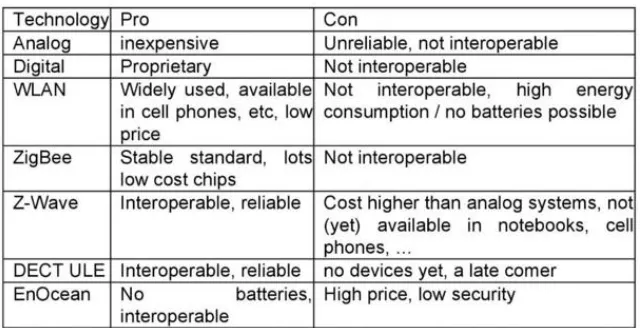
Christian Paetz said that Z- wave was designed for a standard microcontroller and a radio transceiver (Paetz, 2015). Table 1.1 shows a variety of technologies with their pros and cons.
`
Figure 1.1 : Z-wave alliance logo
[image:20.612.152.532.506.733.2]The author also said that the development of Z-wave alliance consisting more than 250 manufactures enhance the standard and quality and also managing of central marketing events such as trade shows.This alliance also maintain the interoperability of the devices on the basis of wave protocols. Figure 1.1 show the logo for the Z-wave alliance.
21
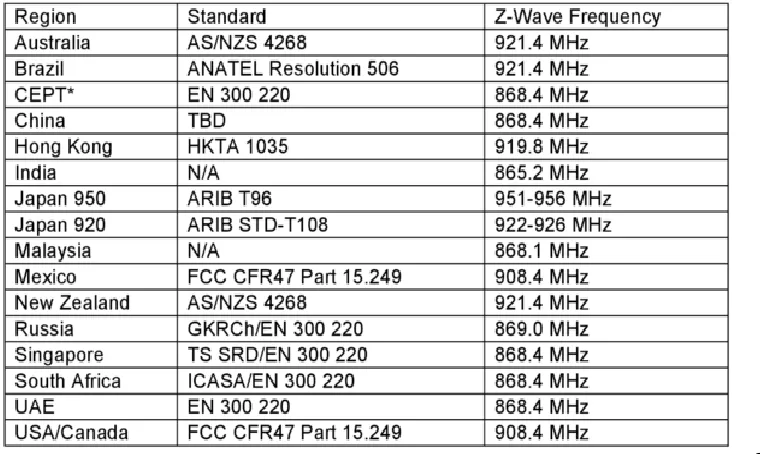
Z-wave usually uses license free but regulated frequency bands.The first is important from the cost point of view, the second ensures a fair usage of the frequency band and reliable transmission even for low energy wireless technologies such as Z-wave. There is one multinational regulation driven by the CEPT organization. Table 1.2 shows different region have different standards and different z-wave frequencies.
This shows that every region have their own frequency but there are a few region that are or almost the same with each other. So, they can use devices from the other region that have almost the same frequency.
Z-wave also required to bridge a minimum of 25m in a close buildings witout any loss. A maximum distance to bridge with a wireless technologies depends on the radio frequency, the transmitting power and the antenna.
Cheng Wen Yuan, Hai Rui Wang, Jun Ying He said that currently embedded remote monitoring technology step into a rapidly developing period. With the advancement of related technology, low cost remote monitoring system which is web-based, powerful and reliable at the same time will become the mainstream (Cheng, Hai, Jun, 2010). The overall system established a LAN using zensys's Z-WAVE module ZW0301, then select Freescale 16-bit microcontroller MC9S12NE64 with which the OpenTCP protocol built-in to implement the networking of the embedded wireless LAN. Thus realized the remote monitoring and controlling of the embedded devices within the wireless LAN.
Miya Knight said that a rival technology to ZigBee, called Z-Wave, has received the support of chip giant Intel, as well as networking heavyweight Cisco. In many ways, Z-Wave and ZigBee are similar (Knight,2006). Both are wireless standards. Both use mesh networks. Both are designed for low power. Though ZigBee provides for a higher data rate than Z-Wave, both standards provide for relatively low throughput. But proponents of ZigBee claim that Z-Wave is considerably less robust.
22
driver OSGi bundle in order to provide control, monitor and simple test scenarios execution on Z-wave devices.
2.2.1 ZigBee and Z-wave
The ZigBee and Z-Wave short-range wireless technologies are used for remote monitoring and control. However, their specifications and applications are different. Both technologies are ideal for home-area networks (HANs), which are becoming more widespread in the world. Here is a comparison of these two widely used wireless technologies.
ZigBee has a higher bandwidth, so it can accommodate richer information, such as metadata from your music library. Z-Wave has the benefit of being a real “standard,” meaning Z-Wave products from one manufacturer are interoperable with those from other vendors (with a few exceptions). ZigBee is trying to get there, but currently you cannot mix-and-max ZigBee products from multiple vendors. The latest version, ZigBee 3.0, promises better interoperability between devices and versions.
Proponents from both camps claim they will own the market for “smart meters” and therefore will become the de facto standard. Price-wise, the common perception is that Z-Wave is cheaper than ZigBee, but that really is not the case. It just so happens that most of the ZigBee implementers in the home-control space (AMX, Crestron, Colorado vNet, for example) serve higher-end markets. Yet a ZigBee dimmer from Control4 can cost less than a Z-Wave dimmer from Leviton.
Lou Frenzel said that ZigBee and Z-Wave target the same general applications. Of the two, ZigBee is by far the more versatile since it can be configured for virtually any short-range wireless task (Frenzel,2012). Profiles are readily available to minimize development time for common applications. On the other hand the protocol is far more complex, resulting in longer development times. Z-Wave uses a far simpler protocol, so development can be faster and simpler.
23
products are available in stores like Home Depot and Lowes, but many don’t state that Z-Wave is used. ZigBee chips are available from Ember, Freescale, Microchip Technology, and Texas Instruments. Complete, ready to use ZigBee modules are also available from multiple sources like Atmel, CEL, Digi, Jennic, Lemos, and RFM.
For a given power level of 0 dBm, Z-Wave’s range is greater than ZigBee simply because the lower operating frequency supports it with pure physics (Friis formula). That also translates into a more reliable connection in some applications.
ZigBee uses the widely populated 2.4-GHz ISM band, which it must share with Wi-Fi, Bluetooth, and other radios that can produce interference. Most ZigBee devices have co-existence features that help mitigate interference, yet the potential is greater in the 2.4-GHz band than the 908.42-MHz channel of Z-Wave.
2.3 Home Automation
Home automation is the use and control of home appliances remotely or automatically. Early home automation began with labour-saving machines like washing machines. Some home automation appliances are stand alone and do not communicate, such as a programmable light switch, while others are part of the internet of things and are networked for remote control and data transfer.
Hardware devices can include sensors (like cameras and thermometers), controllers, actuators (to do things), and communication systems. Remote control can range from a simple remote control to a smartphone with Bluetooth, to a computer on the other side of the world connected by internet. Home automation systems are available which consist of a suite of products designed to work together. These typically connected through Wi-Fi or power line communication to a hub which is then accessed with a software application.
24
Carles Gomez said that Wireless home automation networks comprise wireless embedded sensors and actuators that enable monitoring and control applications for home user comfort and efficient home management (Gomez, 2010). This article surveys the main current and emerging solutions that are suitable for WHANs, including ZigBee, Z-Wave, INSTEON, Wavenis, and IP-based technology.
Per Printz Madsen said that in the last couple of year's computer based home control systems are getting more and more common in modern homes. For instance these systems take care of light control, heat control and security systems (Madsen, 2009). The latest trend is to use wireless communication like Z-Wave and ZigBee to interconnect different components in these systems. One of the characteristics is that each system, like for instance heat and light, has their own specific way of using the communication system. This paper describes a way to connect different home control systems through an intelligent gateway, called a HomePort. The HomePort consists of a number of subsystem communication drivers, a virtual communication layer, an interpreter and a PC-based compiler for a high level control language, called GIL (gateway intelligence language). The focus in this paper will be on the upper two layers in the HomePort, the interpreter and the application layer.