International Journal of Innovative Technology and Exploring Engineering (IJITEE) ISSN: 2278-3075, Volume-8 Issue-8S3, June 2019
Abstract: In Recent years, many supervision methods can monitor the actual time information and detecting the object that is visible in its. Various supervision system working successfully on the market, it must, above all, provide reliable and precise motion detection. Automation of a home is a trending field for security applications. This area has developed new techniques like Internet-of-Thing, computer vision and many more. Raspberry Pi 3 is the first 64bit version and they have inbuilt features of Bluetooth and Wi-Fi and the size is like a debit card was used at this system and the camera is connected by the Raspberry Pi 3. Basically, In IOT the system is connected and controlled the gadgets to a central hub or the “gateways”. The system is controlled by the User interface by the medium of Tablets, Desktop computer, the mobile application either a web Interface. In this study, blend of IOT with Computer vision for detecting the people that are visible to the cameras and it is helpful for us to identify that specific person. Afterward, human identity in the image they detected the face and captured it as an image and sent the image that contains the face and appearance time to the mobile or tablets by using web gateways in the form of TEXT message. At that time the user can check the image and the details verifying the person and they have the control to permit or denied there entrains.
Keywords: Internet-of-Thing (IOT), Computer Vision, Face Detection, Raspberry PI 3, Web Gateways.
I. INTRODUCTION
Nowadays, Home automation system is a scientific solution that allows automating the bulk of digital, static and technology-based tasks within a residence. It uses a blend of computer hardware and computer software techniques which permit management and supervision through equipment and devices within a home. At best, the movement detector has a small form factor and a nominal price point. It also needs to work indoors and outdoors, be programmable and offer the right connectivity. The latter enables it to trigger an alarm or convey with other tools, such as email or text message, to announce the user if the system detects motion. Lastly, energy-efficiency is and will continue to be a big topic in the fields of home and building mechanization and smart homes.
The trends such as the Internet-of-Things (IoT) and Computer Vision can increase the accuracy and time Complexity.
Revised Manuscript Received on May 24, 2019.
Vinay Yogendra Mishra, Department of Computer Science, Shri Ramdeobaba college of Engineering, India.
Dr. Ramchand Hablani, Department of Computer Science, Shri Ramdeobaba college of Engineering, India.
[image:1.595.327.524.243.394.2]Many of these – from small household appliances through huge communication networks to complex, industrial automation systems are controlled by special-purpose, embedded computing systems or manage by the Android App/Websites.
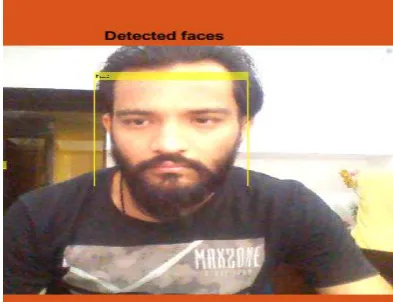
Fig 1: Basic idea of Face Detection
As Fig 1, shows a generalized working of the System which
consist of following Components,
a) CCTV Camera
It is used for Video supervision and it is nothing but a video camera that primarily, use for transfer of a signal to a definite place, they are not openly transmitted. For transmitting them use generally two methods and they are Point to Point and Point to Multipoint by the connection of mesh wired or wireless links.
b) Image Pre-processing
It's used for improved the image quality or extract some beneficial data/information into it. They give out as attributes or features with that image. Basically, it can be analysing and enhancing the Image quality which is easily and clearly identifiable to the human eyes. The main purposes of image pre-processing are contracts balancing, Whiteness balancing, Noise Reduction, Image Scaling.
c) Face Detection:
The human face is a dynamic object and it is difficult to detect for computer vision. They first trace the face into the video if any available then. Generally, they try to tract the human face onto the digital image and the detection process is divided into three parts and they recognize a face to track, identify face to track and then we can track down the face. This domain mainly consists
of Severs and surveillance applications, which help the user by giving him alerts
Face Detection by using Computer Vision and
IoT for Security Application
.
about the visitors that can come to the home.
Default password and Username Problems:
A report that shows certain surveillance cameras can have their predefined user Id and password that’s why the private videos streams from cameras are open to all on the internet and those unsecure Cameras will leak your private information for everyone to view, which is pretty dangerous. In case you cannot change the username and problem then it is quite risky, that other person can access your private information.
Security Camera Pictures Visibilities Problems:
In case, security cameras image quality difficulty occurs and they are not able to detect the particular person who can come then it is also a very big loophole. They have various solutions for that problem but, in such a way that kind of issue is handled and maintained by human efforts. And the general, issue are:
a) Picture is Too Bright: This problem occurs when the sun rays or any kind of reflection can come on the cameras. Then is enlarge the shine of the image and the image is not clearly visible.
b) Picture is Too Dark: When the contracts and brightness get decrease then the camera image goes darker and the image is not properly visible.
This kind of basic problems occur in all types of camera and they try to remove the problem by applying some image quality enhancement classifiers for enhancing the visibility of the image and make easy to detecting the person that is coming on the cam range.
II. LITERATURE REVIEW
In this part separated the literature survey into three modules namely,
1. Image Pre-processing 2. Face Detection
3. Sending the Details to the Web gateways
As these are three integral studies which will be helping us to build a secure, Home surveillance system.
I.1. Papers based on Image Pre-processing:
Prashant K. Manglik et al proposed an image pre-processing phase involves numbers of steps and the steps are facing normalization, Grayscale Transformation, and frequency analysis. Transformed images in various angles and they divided the image into two parts first parts contains the eyes and eyebrow, and the second part contains nose, mouth, and cheeks, after that process, the feature vector obtains and they use the feature vector as a training Hopfield Neural Network. [1]
Pratiksha Andhare et al proposed finding the a, b points of the object that shows the axis’s that detected in the image. It converting pixel axes into real-world coordinates with the help of 2 Dimensional transformations. The 2 Dimensional transformation can change the dimension of the image that makes easier to find x, y coordinates of the image. [2]
Hong-Bin Yu et al proposed an image pre-processing schemes, one of them (PQIC) is independent of the image coding algorithm, so they can integrate it into an existing image compression system easily [3]
U.K. Jaliya et al proposed a new pre-processing approach to eliminate the radiance effect from the human face images. In our approach they first use Log transform on the input image to improve brightness effect, the output of this is given as input to the Difference-of-Gaussian filters for flattening the image and then performing image normalization so they get the brilliance eliminated image. [4]
Yassin Kortli et al. revealed that, they use three descriptors for face detection and they are: Local Binary Pattern (LBP), Local binary Pattern Histogram (LBPH), and Histogram of Gradient (HOF) for getting the features of the faces. [30]
I.2. Papers based on Face Detection:
Mohammad Da'san et al proposed that a multi-stage model for face detection is integrated based on Viola and Jones algorithm, Gabor Filters, Principal Component Analysis, and Artificial Neural Networks (ANN). [10]
Michael Jones et al. revealed that using a machine learning approach for visually objects detections and it performs image processing for rapidly detecting the images and it’s quite faster than other. They use three parameters and they are an Integral image, ADA boost and the third is a method for combining increasingly more complex classifiers in a “cascade” which allows background regions of the image to be quickly discarded while spending more computation on a promising object-like region. [12]
Timo Ojala et al. revealed that, the multiresolution grayscale and rotation invariant texture category based on Local binary patterns and prototype distributions. [13]
Timo Ahonen et al. revealed that Local binary pattern (LBP) texture feature is an efficient facial image representation by performing the operation on these features vectors. [14] Peter N. Belhumeur et al. revealed that, a face identification algorithm which is insensitive to large variation in lighting direction and facial expression. Taking a pattern classification approach, they consider each pixel in an image as a coordinate in a high-dimensional space. [15]
Ji Zhu et al. revealed that, the Adaboost algorithm is used for minimizing exponential loss for the multi-class classification. [16]
Rajkiran Gottumukkal et al. revealed that, PCA algorithm improved the recognition rate for large variation and lighting directions and facial expression. By dividing the image into parts of sub-images and applied the PCA approach for increasing the accuracy rate. [17]
Prathap Nair et al. revealed that Face detection is performed by classifying the transformations between model points and candidate vertices based on the upper-bound of the difference of the parameters from the mean model. [20]
Kyu-Dae Ban et al. revealed that Normalized Cross-Correlation is used to detect the exact face region in the low-resolution face image. [21]
Huajie Wu et al. revealed that they count the people on the bases of the face detected/ tracking in the image. In the real-time processing of the video images for tracking and detecting the people faces
International Journal of Innovative Technology and Exploring Engineering (IJITEE) ISSN: 2278-3075, Volume-8 Issue-8S3, June 2019
character algorithm to detect faces and uses Camshift algorithm to track faces. [24]
R. Lienhart et al. revealed that, compute set of rotated haar features as well as a novel post optimization procedure for boosted classifiers and improve the object detection rate and accuracy. [25]
Devendra Sakharkar et al. revealed that they use face image retrieval technique from the video frames and detect the human face automatically which contain semantic cues of the face photo to improve the content of the face retrieval. [27] Aryuanto Soetedjo et al. revealed the fusion of face detection and face tracking techniques. The proposed methods combine the Camshift tracking, Viola-Jones method, and Kalman filter tracking. The objective is to improve the face detection rate and they used a Raspberry Pi module that is a low-cost embedded system. [28]
Neethu A et al. they count faces by the combinations of three different face detection methods and they are: Normalized Pixel Difference (NPD), Haar classifier for profile face and haar classifiers. By the combination of these three methods, the detection accuracy improves and reduce the false detection also. [29]
I.3. Papers based on sending the details to the web gateways with the help of IOT:
Nashwan Adnan Othman et al. revealed that they use a camera for getting the image and detecting the face when any action is found through the Passive Infrared sensor. They use Computer vision for detecting the images and grabbed the image and sent the images it to the mobile phones or tablets. [18]
Ilhan AYDIN et al revealed that human is detected in the captured image and sends images to a mobile phone by using telegram app. [19]
Agung Nugroho Jati et al proposed that detected face is captured by the camera and the final image is sent to the server for further computation through a mobile app. [9] Chih-Lin Hu et al proposed that, LED lighting and dimming control in the smart homes. They develop a prototype for the testing or adjusting the lighting and diming of the LED by using Cloud services and IoT. [22]
Kumar Mandula et al proposed, two prototypes namely Horne automation using Bluetooth in an indoor environment and Horne automation using Ethernet in an outdoor environment. [23]
Mrs. Paul Jasmin Rani et al. revealed that, a voice command system for home automation that interpreted by the mobile device using Natural Language Processing. The mobile device work as a console that gives determine the operation that commanded to the users for completion. [26]
[image:3.595.312.555.50.219.2]III. THEORETICAL ANALYSIS
TABLE 1. Different Image Pre-processing Technique
Sr. No.
Algorithm/Methods Result
1
Gray Scale
Transformation
Reducing the
dimensionality of the images and improve for classification of the algorithm that used.
2
Pixels Co-ordinate transformation
Grasping the
co-ordinates are the images that captured by the Camera.
3
Pre-quantization with importance
classification
Improve the quality of the image at low bit rate
4
Log transform, DoG
(Difference of
Gaussian), HE
(Histogram
Equalization), AHE (Adaptive Histogram Equalization).
Improve the low
[image:3.595.237.535.254.828.2]lighting condition and manage the brightness of the images
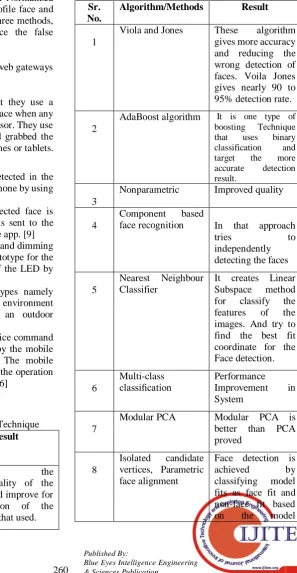
TABLE 2. Different Face Detection Techniques
Sr. No.
Algorithm/Methods Result
1
Viola and Jones These algorithm
gives more accuracy and reducing the wrong detection of faces. Voila Jones gives nearly 90 to 95% detection rate.
2
AdaBoost algorithm It is one type of boosting Technique that uses binary classification and target the more accurate detection result.
3
Nonparametric Improved quality
4
Component based
face recognition In that approach
tries to
independently detecting the faces
5
Nearest Neighbour Classifier
It creates Linear Subspace method for classify the features of the images. And try to find the best fit coordinate for the Face detection.
6
Multi-class
classification Performance Improvement in System
7
Modular PCA Modular PCA is
better than PCA proved
8
Isolated candidate vertices, Parametric face alignment
Face detection is
achieved by
classifying model fits as face fit and non-face fit based
parameters
9
AdaBoost Improved the
Detection Rate.
10
AdaBoost Improved the
Detection Accuracy of faces
11
Haar and AdaBoost It increases the overall performance of the system and easy to detect the objects.
12
Viola-Jones The video frame
contains sets of images. To achieve the higher rate of detection of the face. And Voila Jones algorithm reads the video by
frame reading
manner.
13
Viola-Jones and CamShift
It improves the detection rate by using Raspberry Pi 3 as a hardware and Faces detection methods gives the accurate result.
14
Normalized Pixel Difference and Haar features
High Detection
[image:4.595.310.541.49.173.2]Rate.
TABLE 3. Different Method of Sending Detail to clients and IoT devices
Sr. No. Algorithm/Methods Result
1
Telegram Use android
application names “Telegram” for
sending the
notification to the user.
2
Telegram This application
use for home or offices security and
manage the
notification by using Telegram for
sending the
captured images.
3
FTP Servers They use FTP
server for sending the notification to the user servers to
aim that all
detected face
images are sent properly to the user
server or not.
4
Blue mix IoT platform/ URL Service
Properly, Control the System
5
Bluetooth, Ethernet and Raspberry Pi
User Friendly UI for the User’s
6
Arduino / Genuino MKR1000
Systematic Working
IV. METHODOLOGY
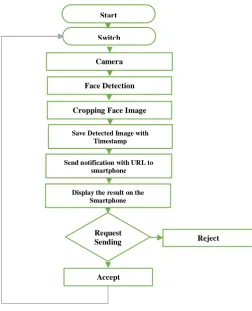
[image:4.595.311.564.333.645.2]In the proposed System, Infrared/ Night Vision closed-circuit television camera(CCTV) that is mainly used in Surveillance System, are connected to the IoT Device and used for Computer Vision Module to read the Video frame by frame that detects the human faces in the frames. After Detecting the face of the person it will be sent the message to the registered user that contains detected face, text message and a URL link which is directly connected to the live Stream of that particular CCTV Camera. Then, the accessibility is permitted by the user using the URL. Fig. 1 illustrates the flow chart for the proposed system.
Figure 2: Flowchart for System
In figure 1, Door Sensors is Connected to the IoT device when the registered Users permitted then the sensors open the door. CCTV are Recording the Live Stream and algorithm read the Video Frame by frame at a time when person appears in front of the camera for more than 10 seconds then Face Detection algorithm plays their role and Detected the Person Face, save into the system
with the Timestamp and sent
the Crop face and
notification message to the Start
Camera Switch
Face Detection
Cropping Face Image
Request Sending
Accept
Reject
Save Detected Image with Timestamp
Send notification with URL to smartphone
International Journal of Innovative Technology and Exploring Engineering (IJITEE) ISSN: 2278-3075, Volume-8 Issue-8S3, June 2019
User. After that, the user verifies the person and for more surety, they can check the live stream using the URL link that provided and then accept and reject the visitor entry. Viola Jones algorithm help use for the detection of the person more accurately because the algorithm read the video Frame by Frame to achieve the Detection accuracy.
V. STUDYANDINTERPRETATION
[image:5.595.306.532.186.314.2]We have studied different combination types of combination that are done in the Viola-Jones method and we premeditated that the face detection accuracy varies on the method and the blend that we apply on the Images. As the below figure suggests that Viola-Jones has 86.23%, Viola-Jones + Gabor filters have 90.31%, SVM Based 76.25 and Neural Network has a 96.6% accuracy rate.
Fig 3: Different Face Detection Techniques
We have studied different types of Image Pre-processing techniques, in which we studied that in time of detection the image then in is not compulsory that the image quality / Resolution is clear. Many time image has contained some noise or low or low contrast that effect on the image and the image is not clearly visible, that why they firstly apply image pre-processing techniques for getting the clear image that easily helps to identify the Object / Person.
Fig 4: Different Image Pre-processing Techniques
VI. EXPERIMENTALRESULTS
In the Proposed System, we develop a Standalone application for security and surveillance using Computer Vision. The PIR sensor and Raspberry Pi 3 camera capture images successfully. And the algorithm successfully detects the person and sent the crop image and notification successfully.
Proposed System performs seven operations such as Registration of User, Face Detection, Cropping the detected face, Saving the detected face with the timestamp, Sending Notification to the Users, User access the live steam at that time they got the notification and provide authority to permit or denied the entry of the person. Fig 5, is the registration form for the application that contains all the details of the user and saves it to the Database. The notification can go only to the registered user and for verification of the mobile number we use OTP that shows in Fig 6 if the OTP is verified then and the only user is able to use the application.
[image:5.595.52.295.243.387.2]Fig 5: Registration Form for the Application
Fig 6: OTP Verification
[image:5.595.320.535.347.473.2]Fig7, is the Login page of the application that were the user can login and access the other features of the application. Login is verifying by the use of the database and cross validate the records that previously enter during the registration time. Fig 8, is the Home page of the Application where one side the Live video stream is play and other side we provide some basics that help us to visualize the clearer view of the detected image.
[image:5.595.302.551.610.836.2]Fig 8: Home Page of the Application
Fig 9: The output of the System
Fig 9, shows the output that goes to the user when someone detects successfully and then by the use of the URL user can view the live stream and permit the guest. In TABLE 1 we compare the different types of Image Pre-processing techniques that we can use in the system for enhancing the detected image Quality.
TABLE 2, compares the different types of face detection techniques but Voila Jones algorithm gives a better result as compare to others and the accuracy rate of the algorithm is also high as compared to others.
VII. CONCLUSION
In this paper, we study 24 papers regarding reviewing the smart security system for face detection using computer vision and system design for automatic detection of faces of the human and capturing the image into the system and sending the notification to the smartphone in the form of the text message using Web Gateway. And by the use of the Web Gateway is the user can permit the sensors to provide the entry or not. The proposed system is used on the various grounds of Security and Surveillance and we automate the security and reduce the human efforts. Also, by using Computer Vision and IoT Device we make it possible for the proposed system in this paper. The results show of the proposed system give more accuracy and fast result as compare to other algorithms.
REFERENCES
[1] Prashant K. Manglik et al, “Facial Expression Recognition,” International Conference on Systems, Man and Cybernetics, pp.2220-2224, IEEE (2004).
[2] Pratiksha Andhare et al, “Pick and Place Industrial Robot Controller with Computer Vision,” IEEE.
[3] Hong-Bin Yu et al, “A NOVEL IMAGE PREPROCESSING SCHEME BASED ON FACE DETECTION,” Int. Conf. Neural Networks & Signal Processing Nanjing, China, IEEE, pp.1021-1026, 14-17 December 2003.
[4] U.K. Jaliya et al, “An Efficient Illumination Invariant Human Face Recognition using New Preprocessing Approach,” International Conference on Computer Science and Network Technology.
[5] Mohammad Da'san et al, “Face Detection using Viola and Jones Method and Neural Networks,” International Conference on Information and Communication Technology Research (ICTRC2015), IEEE, pp.40-43, 2015.
[6] P. Viola et al, “Rapid object detection using a boosted classifier of simple features,” Conference on Computer Vision and Pattern Recognition, IEEE, pp. 511–518, 2001.
[7] Timo Ojala et al, “Multiresolution Gray-Scale and Rotation Invariant Texture Classification with Local Binary Patterns,” TRANSACTIONS ON PATTERN ANALYSIS AND MACHINE INTELLIGENCE, IEEE, Vol.24, NO.7, JULY 2002. [8] T. Ahonen et al, “Face description with LBP: Application to face recognition,” Transactions on Pattern Analysis and Machine Intelligence, IEEE, Vol. 28, pp. 2037–2041, December, 2006. [9] P. N. Belhumeur et al, “Eigenfaces vs. fisherfaces: recognition
using class specific linear projection,” Transactions on Pattern Analysis and Machine Intelligence, IEEE Vol. 19, pp.711–720, July 1997.
[10] T. Hastie et al, “Multi-class Adaboost,” Statistics and its Interface, Vol. 2, pp. 349-360, January 2006.
[11] R. Gottumukkal et al, “An Improved Face Recognition Technique Based on Modular PCA Approach,” Pattern Recognition Letters, Elsevier, Vol. 25, pp.429- 436, Mar. 2004. [12] N. A. Othman et al, “A New IoT Combined Face Detection of
People by Using Computer Vision for Security Application,” International Conference on Artificial Intelligence and Data Processing (IDAP17), IEEE, 2017.
[13] N. A. Othman et al, “A New IoT Combined Body Detection of People by Using Computer Vision for Security Application,” International Conference on Computational Intelligence and Communication Networks (CICN 2017), IEEE, Vol.9th, pp.108-112, 2017.
[14] Prathap Nair et al, “3-D Face Detection, Landmark Localization, and Registration Using a Point Distribution Model,” TRANSACTIONS ON MULTIMEDIA, IEEE, Vol. 11, No. 4, pp.611-623, JUNE 2009.
[15] Kyu-Dae Ban et al, “Face Image registration methods using Normalized Cross Correlation,” International Conference on Control, Automation and Systems, COEX, Seoul, Korea, pp.2408-2411, Oct. 14-17, 2008.
[16] Chih-Lin Hu et al, “IoT-Based LED Lighting Control in Smart Home,” International Conference on Applied System Innovation, IEEE, pp.877-880, 2018.
[17] Kumar Mandula et al, “Mobile based Horne Automation using Internet of Things(IoT),” International Conference on Control, Instrumentation, Communication and Computational Technologies (lCCICCT), IEEE, pp.340-343, 2015.
[18] Huajie Wu et al, “Research of People Counting Based on Face Detection and Area-Tracking”, International Conference on Computer Science and Network Technology, IEEE, Vol.3rd, pp.525-528, 2013.
[19] R. Lienhart et al, “An extended set of haar-like features for rapid object detection,” Image Processing, IEEE, pp. I-900-I-903, 2002.
[20] Mrs. Paul Jasmin Rani et al, “Voice Controlled Home Automation System Using Natural Language Processing (NLP) And Internet of Things (IoT),” International Conference on Science Technology Engineering & Management (ICONSTEM), IEEE, Vol.3rd, pp.368-373, 2017.
[21] Devendra Sakharkar et al, “A Study on Various Face Detection Techniques in Real
Time Video
Environment,” International
International Journal of Innovative Technology and Exploring Engineering (IJITEE) ISSN: 2278-3075, Volume-8 Issue-8S3, June 2019
Computing (ICPC), IEEE, 2015.
[22] Aryuanto Soetedjo et al, “Implementation of Face Detection and Tracking on A Low Cost Embedded System Using Fusion Technique,” International Conference on Computer Science & Education (ICCSE 2016), Nagoya University, Japan, IEEE, Vol.11th, pp.209-213, August 23-25, 2016.
[23] Neethu A et al, “People Count Estimation Using Hybrid Face Detection Method,” International Conference on Information Science (ICIS), IEEE, pp.144-148, 2016.
[24] Yassin Kortli et al, “A novel face detection approach using local binary pattern histogram and support vector machine,” in Proc. IEEE, 2018.
AUTHORS PROFILE Vinay Yogendra Mishra is currently Pursuing MTech in CS from Shri. Ramdeobaba College of Engineering and completed Bachelor of Engineering in Information Technology from S B Jain Institute of Technology, Management and Research (State University of RTMNU) in 2017. His interest of research is Computer Vision, Feature Detection, Recognition, Internet-of-Things(IoT), Neural Networks, Machine Learning, and Data Analytics.
Dr. Ramchand Hablani received the ME degree from University of Technology in Madhya Pradesh, India in 2004 and the Ph.D. degree from Devi Ahilya Vishwavidyalaya University in Indore, India in 2014 both in Computer Science. In 1998 to till, he served as a Research Consultant at the Neural Network, Artificial Intelligence, Digital Image Processing, Operating System, and Robotics in Ramdeobaba College of Engineering and Management, Nagpur since 2015.More than 15 Research paper and Guided more than 30 MTech students in their Projects and thesis he is author of more than 70 papers, including five book chapters.