Towards HPC-ABDS: An Initial High-Performance Big Data Stack
Judy Qiu∗, School of Informatics and Computing, Indiana University, Bloomington, USA
Shantenu Jha∗, RADICAL, Rutgers University, Piscataway, USA
Andre Luckow, RADICAL, Rutgers University, Piscataway, USA
Geoffrey C.Fox, School of Informatics and Computing, Indiana University, Bloomington, USA
∗ Contributed Equally
Many scientific problems depend on the ability to analyze and compute on large amounts of data. This analysis often does not scale well, its effectiveness hampered by the increasing volume, variety and rate of change (velocity) of big data. There is a need to integrate features of traditional high-performance comput-ing, such as scientific libraries, communication and resource management middleware, with the rich set of capabilities found in the commercial ecosystem, resulting in an integrated system generically called high-performance big data system (HPBDS). Our proposed preliminary implementation of the HPBDS – includ-ing many important software systems such as Hadoop available from the Apache open source community and thus referred to as High-Performance Computing-Big Data Stack (HPC–ABDS) – has two fundamental building blocks: (i) Middleware for Data-Intensive Analytics and Science (MIDAS) that will enable scalable applications with the performance of High Performance Computing (HPC) and the rich functionality of the commodity Apache big data Stack. (ii) The second building block will design and implement a set of cross-cutting high-performance data-analysis libraries SPIDAL (Scalable Parallel Interoperable Data Analytics Library), which will support new programming and execution models for data-intensive analysis in a wide range of science and engineering applications. These libraries will be implemented to be scalable and inter-operable across a range of computing systems including clouds, clusters and supercomputers. The project libraries will have the same beneficial impact on data analytics that scientific libraries such as PETSc, MPI and SCALAPACK have had for supercomputer simulations. In this paper, we study many big data applications from a variety of research and commercial areas and suggest a set of characteristic features and possible kernel benchmarks that stress those features for data analytics. We draw conclusions for the hardware and software architectures that are suggested by this analysis.
General Terms: Big Data, HPC, Apache Hadoop
ACM Reference Format:
ACM1, 1, Article 1 (August 2014), 22 pages.
DOI:http://dx.doi.org/10.1145/0000000.0000000
1. INTRODUCTION
The growing importance of data is evident in many fields including physical and biolog-ical sciences, and the ability to derive insight and knowledge from increasing volumes of complex data points is essential for advanced analytics. Analytics needs to be able to utilize the full range of available infrastructure. However, the coupling between tools, analytic engines and infrastructure is often rigid, thus it is difficult to employ existing solutions for contemporary environments for which they were not natively or origi-nally designed. Further, many tools were developed at a time when parallelism was not essential, while interoperability at multiple levels remains elusive.
Permission to make digital or hard copies of part or all of this work for personal or classroom use is granted without fee provided that copies are not made or distributed for profit or commercial advantage and that copies show this notice on the first page or initial screen of a display along with the full citation. Copyrights for components of this work owned by others than ACM must be honored. Abstracting with credit is per-mitted. To copy otherwise, to republish, to post on servers, to redistribute to lists, or to use any component of this work in other works requires prior specific permission and/or a fee. Permissions may be requested
from Publications Dept., ACM, Inc., 2 Penn Plaza, Suite 701, New York, NY 10121-0701 USA, fax+1 (212)
869-0481, or [email protected]. c
2014 ACM 1539-9087/2014/08-ART1 $15.00
The importance of advanced analytics to derive insight and knowledge from increas-ing volumes of complex data will continue to grow. The enterprise community has made impressive gains and seem to have converged around the Apache stack. A dis-tinctive feature is the existence of many implementations of the specific components of the Apache stack, providing sufficient richness in the tradeoff between performance and capability. In contrast, within the scientific computing community, progress has been reliant either on long-term foundational advances or short-term hardware fixes. In both domains, scalable yet general-purpose and broadly applicable solutions in the form of analytic libraries and abstractions are noticeable by their absence.
To remedy this major gap and proffer an integrated solution that brings the best of recent advances to the service of extreme-scale science requirements on current and future science production platforms, we are developing High Performance Computing-Apache Big Data Stack (HPC-ABDS) – a first implementation of a High Performance Big Data Stack (HPBDS) that integrates the best of the Apache developments and HPC capabilities. HPC-ABDS will utilize and expose the integrated relative technical strengths of the two hitherto disjoint approaches and communities, yet it will focus on delivering these as production grade implementations that will bring the best-of-both to shared-infrastructure – such as NSF’s XSEDE, DOE’s leadership machine, OSG and other domain-specific infrastructure, as well as the software developments underway as part of the SI2 software program. HPC-ABDS will translate these ap-plications characteristics, infrastructural requirements and existing capabilities into well-defined and implemented building blocks.
External Data Access
(Virtual Filesystem, GridFTP, SRM, SSH)
Resource Fabric
Compute, Storage and Data Resources
(Nodes, Lustre, Cores, HDFS)
Cluster Resource Manager
(YARN, Mesos, SLURM, Torque, SGE)
Communication
(MPI, RDMA, Hadoop Shuffle/Reduce, HARP Collectives, Giraph point-to-point)
Analytics Libraries Workload Management (Pilots, Condor) Higher-Level Workload Management (TEZ, LLama) Framework specific Scheduling (e.g. YARN)
Scalable Parallel Interoperable Data Analytics Libraries (SPIDAL) Community and Exemplars Middleware for Data-Intensive Analytics and Science (MIDAS) , Object Stores, NoSQL
In-memory Data Abstractions
(HBase, Object Stores, In-Memory, other NoSQL stores, Spatial) Message
Passing Iterative
MapReduce Search
Remaining Apache Big Data stack integrated without
need for HP enhancements (SQL-engines, Storm, Impala, Hive, Shark)
Classic MapReduce HPC-ABDS MapReduce Iterative Giraph Programming Models Application Layer
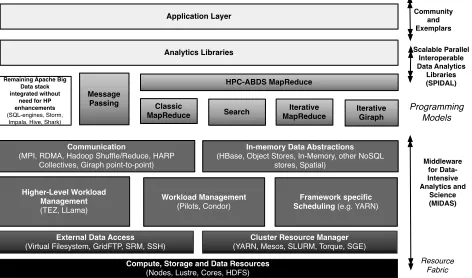
Fig. 1. Key components of integrated HPBDS stack. Many capabilities unaffected by integration are not shown explicitly
The key components of such an integrated platform are shown in Fig. 1. The aim of HPC-ABDS is to aim for the performance of HPC and the breadth and productivity of ABDS. The resultant integrated architecture is targeted at both production high-end computing platforms (such as leadership machines and XSEDE), as well as (commer-cial) cloud computing. As part of HPC-ABDS, we propose two fundamental building blocks, Middleware for Data-Intensive Analytics and Science (MIDAS) and the Scal-able Parallel InteroperScal-able Data Analytics Library (SPIDAL).
[image:2.612.191.427.351.490.2]data analytics and is based upon a careful analysis of architectures, tools and appli-cation characteristics/requirements. Although built from many existing components and capabilities, MIDAS is conceptualized and designed from first-principles to ensure achieving our productivity, interoperability and performance goals.
In earlier work [Jha et al. 2014b], we have discussed the need for merging the two “common” stacks. In addition to a qualitative motivation, Jha et al. [2014b] provided a quantitative analysis of the type of abstractions and support required to enable a successful hybrid stack. In this paper, we will move from a general motivation of the need for a hybrid approach to a discussion of the design philosophy & objectives in a specific implementation of HPC-ABDS, which serves as a first prototype towards a general purpose, interoperable high-performance big data stack to support analytics on high-end clusters, clouds and supercomputers.
2. SOURCES OF INFORMATION
Years of research have afforded us a plentiful if admittedly incomplete trove of infor-mation regarding big data applications. Here we selected 3 specific sources to utilize: a recent use case survey by NIST from Fall 2013 [NIST 2013a]; a survey of data in-tensive research applications by Jha et al. [2014a, 2013]; and a study of members of data analytics libraries including R [R Project 2012], Mahout [Apache Mahout 2012] and MLLib [MLLib 2014]. The following will examine these studies in greater depth.
In June 2013, NIST Big Data Public Working Group (NBD-PWG) began its run focusing on a set of working groups. These included Big Data Definitions, Big Data Technology Roadmap, Requirements, Reference Architectures White Paper Suvey, erence Architectures, Security and Privacy Requirements, Security and Privacy Ref-erence Architectures and Taxonomies. 51 use cases were collected from a public call by the Requirements group and then analyzed on the basis of reference architecture requirements [NIST 2013b]. From this we extrapolate shared patterns and features we deem essential to incorporate in the future development of big data hardware and software. Out of these 51 use cases we formed nine areas of interest ( the number of associated use cases are in parentheses): Astronomy and Physics (5); Commercial (8), Defense (3); Deep Learning and Social Media (6); Earth, Environmental and Polar Sci-ence (10); The Ecosystem for Research (4); Energy (1); Government Operation (4); and Healthcare and Life Sciences (10).
It is evident that research applications formed the core for a majority of these use case, with smaller attention paid to commercial, defense and government operations. Further efforts by the Requirements working group which allowed experts to catego-rize each use case by 26 features:
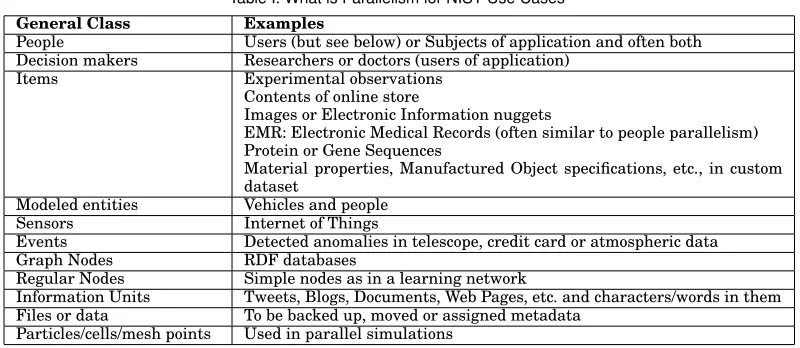
Table I. What is Parallelism for NIST Use Cases
General Class Examples
People Users (but see below) or Subjects of application and often both
Decision makers Researchers or doctors (users of application)
Items Experimental observations
Contents of online store
Images or Electronic Information nuggets
EMR: Electronic Medical Records (often similar to people parallelism) Protein or Gene Sequences
Material properties, Manufactured Object specifications, etc., in custom dataset
Modeled entities Vehicles and people
Sensors Internet of Things
Events Detected anomalies in telescope, credit card or atmospheric data
Graph Nodes RDF databases
Regular Nodes Simple nodes as in a learning network
Information Units Tweets, Blogs, Documents, Web Pages, etc. and characters/words in them
Files or data To be backed up, moved or assigned metadata
Particles/cells/mesh points Used in parallel simulations
2.1. Properties of the 51 NIST Use Cases
Fox and Luckow [2014] summarize the characteristics of the 51 use cases and intro-duce the concept of Big Data Ogres for describing and characterizing Big Data appli-cations. Note that Big Data and parallel programming are intrinsically linked as any Big Data analysis is inevitably processed in parallel. Parallel computing is almost al-ways implemented by dividing the data between processors (data decomposition); the richness here is illustrated in Table I which lists the members of space that are de-composed for different use cases. Of course these sources of parallelism are broadly applicable outside the 51 use cases from which they were extracted. In Table II, we identify use case features for 15 use cases and map these to Ogre facets. The second column maps to the use case that illustrates this feature; note these are not exclusive so any one use case will illustrate many features.
For commonly used machine learning applications, there is an interesting distinction between what is termed Local (LML) or Global machine learning (GML) in Table II. In LML, there is parallelism over items of Table I and machine learning is applied sep-arately to each item; needed machine learning parallelism is limited, typified by use of accelerators (GPU). In GML, the machine learning is applied over the full dataset with MapReduce, MPI or an equivalent. Typically GML comes from maximum likeli-hood or χ2 with a sum over the data items - documents, sequences, items to be sold, images and often links (point-pairs). Usually GML is a sum of positive numbers, as in least squares, and is illustrated by algorithms like PageRank, clustering/community detection, mixture models, topic determination, Multidimensional scaling, and (Deep) Learning that constructs a learning network integrating all images.
3. TOWARDS A HIGH-PERFORMANCE BIG DATA SOFTWARE (HPBDS) ENVIRONMENT
sus-Table II. Some Features of NIST Use Cases
Abbrev. # Description
PP 26 Pleasingly Parallel or Map Only
MR 18 Classic MapReduce MR (add MRStat below for full count)
MRStat 7 Simple version of MR where key computations are simple reduction as found in
statistical averages such as histograms and averages
MRIter 23 Iterative MapReduce or MPI
Graph 9 Complex graph data structure needed in analysis
Fusion 11 Integrate diverse data to aid discovery/decision making; could involve
sophisti-cated algorithms or could just be a portal
Streaming 41 Some data comes in incrementally and is processed this way
Classify 30 Classification: divide data into categories
S/Q 12 Index, Search and Query
CF 4 Collaborative Filtering for recommender engines
LML 36 Local Machine Learning (Independent for each parallel entity)
GML 23 Global Machine Learning: Deep Learning, Clustering, LDA, PLSI, MDS, Large
Scale Optimizations as in Variational Bayes, MCMC, Lifted Belief Propagation, Stochastic Gradient Descent, L-BFGS, Levenberg-Marquardt. Can call EGO or Exascale Global Optimization with scalable parallel algorithm
51 Workflow: Universal so no label
GIS 16 Geotagged data and often displayed in ESRI, Microsoft Virtual Earth, Google
Earth, GeoServer etc.
HPC 5 Classic large-scale simulation of cosmos, materials, etc. generating (visualization)
data
Agent 2 Simulations of models of data-defined macroscopic entities represented as agents
Applica'on Abstrac'ons/Standards
Graphs, Networks, Images, Geospa2al .
High Performance Applica'ons
120 So9ware projects
Scalable Parallel Interoperable Data Analy2cs Library (SPIDAL)
High performance Mahout, R, Matlab …..
Middleware for Data Intensive Analy2cs and Science
(MIDAS)
System Abstrac'on/Standards
Data Format and Storage
Resource Fabric Nodes, Cores, Lustre, and HDFS
HPC Yarn for Resource management Horizontally scalable parallel Programming model Collec2ve and Point to Point Communica2on Support for itera2on (in memory processing)
Fig. 2. HPC-ABDS
tainability model. There are key systems abstractions where Apache approach needs careful integration with HPC in areas of resource management, storage, programming model (for horizontal scaling or parallelism), collective and point-to-point communica-tion, support of iteracommunica-tion, and richness of data interface. In application areas, we define application abstractions to support Graphs/networks, Geospatial, Genes and Images.
Fox and Luckow [2014] identified a set of Ogres (big data patterns) covering big data analytics with multiple facets including specific algorithms, problem architecture and its features, application class and data source structure. Here we exploit these facets to identify the programming models, data source models and overall end-to-end application models that MIDAS needs to support.
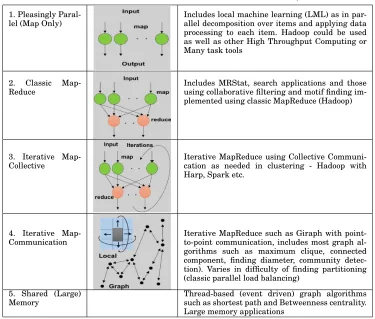
[image:5.612.114.502.101.327.2] [image:5.612.228.386.340.518.2]— PM1) Pleasingly Parallel (PP) includes many cases where there is sophisticated local machine learning applied in parallel – as in parallel image processing without global optimizations.
— PM2) Search (Srch) includes collaborative filtering (in Mahout), motif (meme) de-tection in graph (network) algorithms, and spatial relationship based queries for spatial data, and is implemented using classic MapReduce or non-iterative Giraph. — PM3) Iterative MapReduce or Map-Collective using Collective Communication are seen in many global machine learning algorithms applied over the complete dis-tributed dataset and are illustrated by clustering and dimensionality reduction us-ing parallel linear algebra at their core.
— PM4) Iterative Giraph is Map-Communication with point-to-point communication and includes graph algorithms such as maximum clique, connected component, find-ing diameter, and community detection. The problems differ in the difficulty of de-termining the data partitioning and this classic parallel load balancing issue can need sophisticated runtime techniques.
[image:6.612.121.496.310.629.2]— PM5) Asynchronous thread-based graph algorithms. These are illustrated by short-est path and betweenness centrality algorithms for shared memory machines and we do not integrate them into HPC-ABDS in this proposal.
Table III. Distinctive Software/Hardware Architectures for Data Analytics
1. Pleasingly Paral-lel (Map Only)
Includes local machine learning (LML) as in par-allel decomposition over items and applying data processing to each item. Hadoop could be used as well as other High Throughput Computing or Many task tools
2. Classic
Map-Reduce
Includes MRStat, search applications and those using collaborative filtering and motif finding im-plemented using classic MapReduce (Hadoop)
3. Iterative Map-Collective
Iterative MapReduce using Collective Communi-cation as needed in clustering - Hadoop with Harp, Spark etc.
4. Iterative Map-Communication
Iterative MapReduce such as Giraph with point-to-point communication, includes most graph al-gorithms such as maximum clique, connected component, finding diameter, community detec-tion). Varies in difficulty of finding partitioning (classic parallel load balancing)
5. Shared (Large) Memory
Thread-based (event driven) graph algorithms such as shortest path and Betweenness centrality. Large memory applications
which correspond to the four forms of MapReduce that we have presented previ-ously [Ekanayake et al. 2010a]. Note this only describes some core features of the facets [Fox and Luckow 2014]. There are many other issues that need to be addressed including support of workflow. In particular the architecture for the rapidly evolving field of streaming (distributed) data needs more work.
Note that we separate Map-Collective [Barrett et al. 1994; der Wijngaart et al. 2012] and Map-(Point to Point) Communication following the Apache projects Hadoop, Spark and Giraph that focus on these cases. These programming models or run times differ in communication style, application abstraction (key-value versus graph) and possible scheduling/load-balancing. HPC with MPI suggests that one could integrate into a single environment. This approach is illustrated by the Harp plug-in [Qiu and Zhang 2014] to Hadoop which supports both models.
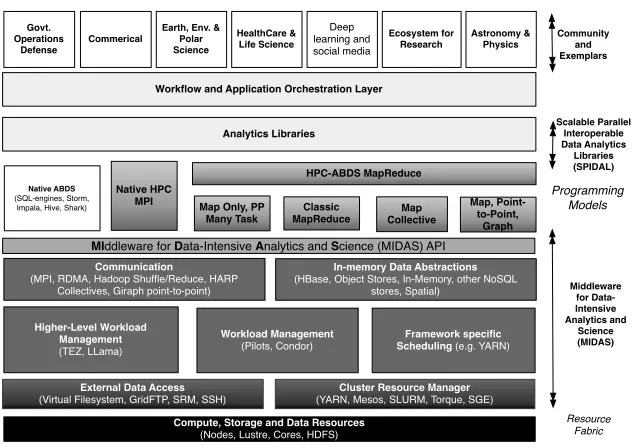
SPIDAL will capture these common characteristics and requirements by identifying key abstractions; it will utilize capabilities of the underlying middleware that will be exposed via well-designed and engineered libraries. The MIDAS middleware imple-ments these with high performance in an ABDS context. MIDAS is based on abstrac-tions in the following areas: a) Software defined System, b) Storage layer including a spatial access abstraction, c) Scheduling layer using advances in multi-level and application-level scheduling, d) Collective layer that permits Map Collective ization of Iterative MapReduce, e) Parallelism or Programming model which general-izes the popular Giraph and MPI SPMD models.
4. SCALABLE PARALLEL INTEROPERABLE DATA-ANALYTICS LIBRARY (SPIDAL)
This section summarizes the core algorithms proposed initially for SPIDAL.
External Data Access (Virtual Filesystem, GridFTP, SRM, SSH)
Resource Fabric Compute, Storage and Data Resources
(Nodes, Lustre, Cores, HDFS)
Cluster Resource Manager (YARN, Mesos, SLURM, Torque, SGE) Communication
(MPI, RDMA, Hadoop Shuffle/Reduce, HARP Collectives, Giraph point-to-point)
Workload Management (Pilots, Condor) Higher-Level Workload Management (TEZ, LLama) Framework specific Scheduling (e.g. YARN)
Scalable Parallel Interoperable Data Analytics Libraries (SPIDAL) Community and Exemplars Middleware for Data-Intensive Analytics and Science (MIDAS) , Object Stores, NoSQL
In-memory Data Abstractions (HBase, Object Stores, In-Memory, other NoSQL
stores, Spatial)
Programming Models
MIddleware for Data-Intensive Analytics and Science (MIDAS) API Govt. Operations Defense Commerical Deep learning and social media HealthCare & Life Science Earth, Env. &
Polar Science Ecosystem for Research Astronomy & Physics Analytics Libraries Native HPC
MPI Map,
Point-to-Point, Graph Map Only, PP
Many Task Native ABDS
(SQL-engines, Storm,
Impala, Hive, Shark) Classic
MapReduce
HPC-ABDS MapReduce
Map Collective Workflow and Application Orchestration Layer
Fig. 3. SPIDAL: Library and Algorithms
4.1. Graph and Network Algorithms
[image:7.612.148.465.365.589.2]algo-rithms [N. Edmonds 2010; Alam et al. 2013; Arifuzzaman et al. 2013; Zhao et al. 2010, 2012] and shared-memory algorithms [Prountzos and Pingali 2013; Ediger et al. 2012; Bader and Cong 2005, 2004; Madduri et al. 2007, 2009]. In a distributed memory sys-tem, every processor has its own local memory, and data is partitioned so that each processor contains one partition in its memory. Since processors may need to com-municate and exchange data with one another, poor locality is a major challenge for distributed-memory systems, causing communication overhead that can lead to de-creased performance. A distributed memory system is good for graph problems with high locality. In a shared-memory system, data is stored in a common shared memory accessed by all processors and locality is not critical, although efficient thread paral-lelism may still be hard.
Message Passing Interface (MPI) vs. Giraph. MPI is a general-purpose distributed memory system for parallel programming, with efficient communication primitives. Efficient MPI implementations have been developed for a number of graph problems, which scale to very large networks, using problem-specific knowledge of the computa-tion and communicacomputa-tion patterns; this requires significant HPC expertise. In contrast, Giraph is easy to use, but does not allow easy access to partitioning and load balancing. Two main challenges in parallelization are: obtaining good estimates of the computa-tion cost for each particomputa-tion, and load balancing, both of which require problem specific insights [Nguyen et al. 2013]. This makes the problem of finding good partitions that minimize communication cost very challenging [Alam et al. 2013; Arifuzzaman et al. 2013].
Madduri 2008; Madduri and Bader 2009; Bader 2010; Green et al. 2012; Jiang et al. 2009]. Edmonds, Hoefler and Lumsdaine [N. Edmonds 2010] recently developed a space-efficient parallel algorithm for computing betweenness centrality in distributed-memory systems, while efficient sequential algorithms have been fashioned for se-lected network analytics problems such as diameter, page rank, and counting triangles, at CMU (Christos Faloutsos) [Faloutsos 2012; Kang et al. 2009, 2011; Tsourakakis et al. 2009] and Sandia National Lab [Zhang et al. 2009; Seshadhri et al. 2012a,b]. There also are sequential libraries for network analytics such as Pajek [Batagelj and Mrvar 1998], Pegasus [Faloutsos 2012] (Christos Faloutsos), SNAP [Leskovec 2012] (Jure Leskovec at Stanford), NetworkX [Hagberg et al. 2008] (at Los Alamos National Lab) and statnet [Handcock et al. 2003]. Similar libraries for parallel graph algorithms are needed to work with emerging massive networks.
4.2. Spatial Queries and Spatial Analytics Algorithms Related Work
Spatial Data Management Systems (SDBMS) have major limitations on managing and querying large-scale spatial data. SDBMSs [pro 2013f,i,c,h] rely on parallel DBMS ar-chitectures such as a shared nothing architecture [Mehta and DeWitt 1995; Patel et al. 1997; pro 2013j,d,g] to scale out. Parallel SDBMSs through partitioning are not opti-mized for computationally intensive operations such as geometric computations [Wang et al. 2012], and lack spatial partitioning to balance data and task loads [pro 2013b]. Data loading overhead is another major bottleneck [Pavlo et al. 2009; Aji et al. 2013; Wang et al. 2013]. GIS systems [Chang 2003; pro 2013a] often use SDBMS as the backend spatial engine. Work in [Cary et al. 2009; Zhang et al. a,b; Liu et al. 2010; Pozdnoukhov and Kaiser 2011; Li et al. 2012; Guo et al. 2010; Ballesteros et al. 2011; Ma et al. 2009; Akdogan et al. 2010] tries to tackle specific spatial algorithms using MapReduce, and ongoing MapReduce spatial querying systems including [Eldawy and Mokbel 2013; Daszak 2000]. Our Hadoop-GIS [Aji et al. 2013; pro 2013e] provides a general framework for spatial queries and analytics with MapReduce. Hadoop-GIS is integrated into Apache Hive to support declarative spatial queries.
Spatial data has multiple dimensions and there is no concept of a key in a spatial space for data partitioning or task partitioning. We will partition space into tiles, and break down time-consuming spatial operations into smaller tasks on them, running in parallel in HPC-ABDS MapReduce. Thus a tile serves as a key, and the objects of a tile are the value. To avoid data skew, density-aware spatial partitioning methods are provided. Spatial query processing then becomes a problem of designing query meth-ods that can run on tiles independently while preserving correct semantics. A generic framework for distributed spatial data processing has the following steps. Initializa-tion includes data partiInitializa-tioning, uploading and indexing. For each spatial query, the index is used to identify regions of interest for the query. After that, spatial query processing is executed independently for each tile, in parallel. During each tile based query, on-demand indexing can be provided to accelerate queries. Then a normaliza-tion step will be performed to fix results due to partinormaliza-tioning. Most spatial processing methods can be mapped into the above patterns, and spatial clustering follows global machine learning patterns including nearest neighbor search, density and statistics-based spatial clustering and regression analysis.
4.3. Core Image Processing Algorithms Related Work on Pathology informatics
are two well-known libraries mainly designed to support Radiology images but se-quential processing can take hours for an image. Several recent research efforts, have investigated the use of GPUs, distributed memory parallel machines, and Grid com-puting to analyze large images and datasets. SPIDAL will build on and complement this and will enable much larger scale investigations. The abstractions will enable interoperability of image analysis with other methods such as clustering, motif detec-tion, complexity reducdetec-tion, and network abstracdetec-tion, leading to broader deployment and novel analyses.
While computer vision has a 50 year history, only recently have researchers con-sidered large-scale datasets driven by the dramatic rise of online social media. For instance, papers in 3D reconstruction [Crandall et al. 2011; Agarwal et al. 2009; Cran-dall et al. 2011; CranCran-dall and Snavely 2012], visual geolocation [Li et al. 2009; Hays and Efros 2008], denoising [Hays and Efros 2007], scene classification [Xiao, Hays, Ehinger, Oliva, and Torralba Xiao et al.], and object recognition [University 2014] use millions of images from Flickr. While there are established libraries for single machine computer vision, like OpenCV, Matlab, CImg, VLFeat, and ImageJ, there are no widely adopted libraries for large-scale computer vision, leading researchers to roll out their own ad-hoc libraries (although some nascent parallel libraries are under development, like CloudCV (Virginia Tech) and Hadoop Image Processing Interface (Virginia)).
In SPIDAL, we will provide a generic high-performance framework that frees vision researchers from considering system-level issues. Our core image processing library encapsulates common operations employed by computer vision, pathology informat-ics, spatial informatinformat-ics, and radar informatics. These routines include low-level image preprocessing like convolution, edge detection, color correction; core primitive object detection (e.g. Hough transform) and segmentation (MinCuts); low-level feature ex-tracting [Lowe 2004; Dalal and Triggs 2005; Torralba, Murphy, Freeman, and Rubin Torralba et al.]); registering images with 3D models; object matching; and 3D feature extraction.
The library also includes derived routines for specific domains. For example, in pathology and spatial informatics, whole slide images are extremely large (10 billion pixels per image) and cannot fit in memory requiring tiling as described above. This is not the case in computer vision, where images are typically from consumer cameras and the challenge is number of images and not their individual size. We will provide a generic parallel image processing pipeline that supports different image analysis al-gorithms with HPC-ABDS. For large images, we provide tile-based partitioning with buffered tiles at boundaries. Tiled images can be processed independently in paral-lel for image pre-processing, segmentation, and feature extraction. The results from tiles are converted into vector-based geometric shapes and structural features with correction for boundary object normalization. For 3D images, one performs 3D object grouping from 2D segmentation results, and 3D feature extraction, which again can be run in parallel.
4.4. Existing General Libraries and Machine Learning
We have studied Mahout [Apache Mahout 2012] carefully, and have chosen key algo-rithms to include in SPIDAL, including SVD, Random Forests, SVMs, K-means, HMM, and LDA. For some of these, either IU or Mahout already has parallelized code, which we will simply port to HPC-ABDS to make them available in our framework. Other Mahout algorithms are either not parallelized or require iteration (which in Hadoop requires costly disk I/O); for these, HPC-ABDS will offer much higher-performance implementations.
The Spark MLLib (MLbase) library [MLLib 2014] is another promising effort, offer-ing a few algorithms (SVM, K-means, gradient descent) supported by a small commu-nity. We will monitor developments in that library as it matures and port from there if possible. We will also port clustering routines from R [pro 2012] to test our ability to move algorithms from this important library to HPC-ABDS.
Parallelized implementations from IU include clustering with a sophisticated de-terministic annealing (DA) method which was originally developed with Rose [Rose 1998; Rose et al. 1990] but with recent parallel implementations by Fox [2013]; Fox et al. [2009a]. These codes cover the cases of both metric and non-metric spaces and have been used extensively in bioinformatics [Qiu et al. 2011; Fox et al. 2009b; Ruan et al. 2012a; Stanberry et al. 2012; Ruan et al. 2012b; Qiu et al. 2010; Hughes et al. 2012; Ruan and Fox 2013; Ruan et al. 2014; Fruhwirth et al. 2011]. These will build upon [Choi 2012], wherein was developed DA improvements to mixture model ap-proaches to find hidden factors and we will also implement this in HPC-ABDS. This was successfully applied to find the context of HPC jobs and improve pre-fetching [Choi et al. 2012].
The non-metric case uses Multi-Dimensional Scaling (MDS) using either SMACOF improved with DA [Ruan and Fox 2013; Bae 2012], or a method using nonlinear χ2 minimization [Kearsley et al. 1995] which is typically slower but allows a more flex-ible weighted objective function. There are several methods for dimension reduction with metric spaces and we will deploy in SPIDAL, e.g., a parallel DA enhanced GTM (Generative Topographic Mapping) from [Choi 2012; Choi et al. 2011].
5. MIDDLEWARE FOR DATA-INTENSIVE ANALYTICS AND SCIENCE (MIDAS)
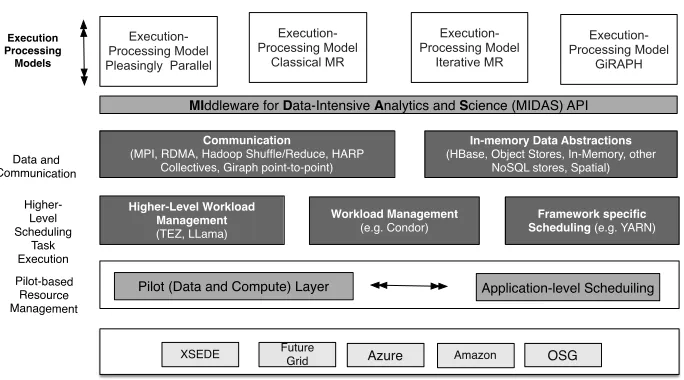
The aim of MIDAS is to provide a scalable runtime system and appropriate resource management abstractions enabling SPIDAL, and thereby Big Data applications. As identified by the Ogres and their facets, Big Data applications have a wide range of characteristics requiring different programming models and different forms of paral-lelism, from the execution of large numbers of loosely coupled tasks, to in-memory caching for iterative MapReduce, to parallel linear algebra computations to support GML algorithms such as Deep Learning. MIDAS provides the underlying resource management middleware and heterogeneous infrastructure access layer which will support SPIDAL libraries to work efficiently across these application types over a range of resources.
schedule compute units to pilot compute MIddleware for Data-Intensive Analytics and Science (MIDAS) API
Execution-Processing Model Pleasingly Parallel
Execution-Processing Model
Classical MR
Execution-Processing Model
Iterative MR
Execution-Processing Model
GiRAPH
Pilot (Data and Compute) Layer Application-level Scheduiling Workload Management
(e.g. Condor) Higher-Level Workload
Management (TEZ, LLama)
Framework specific Scheduling (e.g. YARN) Communication
(MPI, RDMA, Hadoop Shuffle/Reduce, HARP Collectives, Giraph point-to-point)
In-memory Data Abstractions (HBase, Object Stores, In-Memory, other
NoSQL stores, Spatial)
Execution Processing
Models
Data and Communication
Pilot-based Resource Management
Higher-Level Scheduling
Task Execution
XSEDE FutureGrid Azure Amazon OSG
Fig. 4. MIDAS Layered Architecture View: The Pilot-Layer provides the basis for higher-level MIDAS ab-stractions supporting e.g. access to heterogeneous compute and data resources and in-memory caching for the iterative MapReduce programming model.
HPC. MIDAS will provide the scalable runtime system to support these programming models via appropriate execution-processing capabilities on different platforms.
To support these programming models, we propose several abstractions: an inter-process communication layer and a layer handling computation, for example offering different data abstractions for Hadoop (key-value, dataflow) and Giraph (graph). Com-munication abstractions enable the coordination and exchange of data between tasks. In particular iterative MapReduce tasks need collective operations while graph pro-cessing largely needs point-to-point communication. We have already shown that us-ing classic MPI techniques can provide a collective layer that outperforms existus-ing (iterative) MapReduce approaches on both cloud and HPC environments [Jha et al. 2014b; Qiu and Zhang 2013, 2014]. We will expand this concept in MIDAS covering all 4 programming models and defining the HPC-ABDS MapReduce model shown in sys-tem architecture. The communication layer is designed in a pluggable, infrastructure agnostic way and can be used within Hadoop and HPC applications, e. g. based on the Pilot abstraction.
[image:12.612.138.480.93.283.2]frame-work, including K-means clustering, Multi-dimensional scaling and Page Rank. Harp being based on Hadoop means it leverages better sustainability and fault tolerance properties. The above is illustrative of a critical design challenge that faces MIDAS: balancing performance with flexibility.
In earlier Hadoop versions, it was necessary to retrofit non-MapReduce applications (as in for pleasingly parallel processing and machine learning) into the rigid MapRe-duce programming model. This is not necessary anymore for Hadoop-2 (YARN) [Hor-tonworks 2014], as YARN can co-locate and run any application (MPI, MapReduce, iterative MR, graph, or based on any other library/framework) on a Hadoop cluster. En-suring support for YARN on HPC platforms such as XSEDE will thus be an important objective. However, while YARN removes the programming model limitation, various challenges remain: (i) the current usability of YARN on HPC environments is limited (as it was designed as a system-level framework), (ii) resource containers cannot eas-ily be re-used across multiple tasks, and (iii) interoperability with HPC environments (Blue Waters, to a variety of XSEDE resources). To address these limitations, we pro-pose to build upon and extend the Pilot-abstraction, which is a proven approach in supporting data-parallel tasks on top of heterogeneous infrastructures [Luckow et al. 2012, 2014]. Using Pilot-Jobs, we allow processing frameworks to interoperably exploit YARN, common HPC and cloud resource managers. Further, we will extend the Pilot-Data abstraction to support in-memory processing required for iterative MapReduce in an infrastructure and data source agnostic way.
Looking at data source aspects of the Ogres (big data patterns), though most applica-tions use a collection of files we expect a growing interest in object stores and will sup-port both with thePilot-Dataabstraction. Several search problems need customizable dynamic indices. Also relevant is in-memory data storage, data format, data partition-ing and the access model. Thus, we will extend a canonical abstraction of Pilot-Jobs to Pilot-Data to support interoperable access of data stored in Hadoop, databases, and NOSQL as well as other types of HPC storage (Lustre, iRODS, etc.) as needed.
In addition to data access, MIDAS will support the common data processing pat-terns (partition, process, merge, etc.) on top of datasets managed by Pilot-Data. As demonstrated by the evolution to YARN, there is an increasing need to provide appli-cation specific scheduling and resource management control; the Pilot abstraction has demonstrated such capabilities. Application-level scheduling as provided by the Pilot-layer will be an essential tool to integrate library resource usage modes (see processing patterns) with resource allocation/usage. This will be required for the network science community, where flexible integration with a logical resource partitioner is important. For example, we will have to examine the trade-offs of partitioning at the MPI level or at the Giraph programming model depending upon data size and architecture. In gen-eral, MIDAS is intended to be agnostic to workflow models and will support gateways, scripting and specific workflow tools. Auto-tuning (akin to ATLAS for linear algebra software) and load balancing for each execution processing model to optimize data lo-cality and communication are critical capabilities to provide on analytical applications. Last but not least, the infrastructure access layer will use the existing capabilities of SAGA, which provides most resource access functionality using a standards-based layer. This will ensure that the new software footprint of MIDAS will be small, whilst providing reuse of established and existing building blocks.
6. DISCUSSION AND CONCLUSION
distinguished by its efforts to address the requirements of a well defined set of ap-plication patterns and their primary characteristics (referred to as Ogres), that are commonly required of data-analytics applications, via the construction of libraries that work across a range of high-end computing platforms, including clouds. We believe the design of such SPIDAL libraries – based upon an analysis of Big Data Ogres, as op-posed to a limited set of applications – along with a careful co-design of the resource management MIDAS layer makes HPC-ABDS distinctive.
In addition to the NIST use cases, HPC-ABDS will enable multiple communities to use a core set of libraries (SPIDAL – graphs, imaging, spatial, remote sensing, HPC simulation and modeling) on top of an abstractions-based (Job, data, communication, in-memory operations, parallelism) high performance middleware MIDAS. By inte-grating the two fundamental building blocks – MIDAS and SPIDAL, HPC-ABDS will provide new levels of scalability and application performance along multiple dimen-sions by combining application expertise, the broad Apache Big Data stack and best practice HPC. Specifically, HPC-ABDS will: (i) implement resource management ca-pabilities of MIDAS using job and data abstractions, as well as scalable and reusable fine-grained building blocks for HPC/high-end resources, (ii) define library interfaces (SPIDAL, with appropriate language bindings) to these fine-grained building blocks, (iii) provide scalable and parallel analytic libraries by integrating the aforementioned interfaces, the fine-grained building blocks with the resource management middleware capabilities of MIDAS.
Fig. 5. For updated figure see: http://hpc-abds.org/kaleidoscope/
7. APPENDIX REFERENCES
2012. CRAN Task View: Cluster Analysis and Finite Mixture Models. (July 21 2012). http://cran.cnr.berkeley.edu/web/views/Cluster.html
2013a. ArcGIS. (2013). http://www.esri.com/software/arcgis
2013b. Database Partitioning,Table Partitioning, and MDC for DB2 9. (2013). http: //www.redbooks.ibm.com/redbooks/pdfs/sg247467.pdf
2013c. Delivering Location Intelligence with Spatial Data. (2013). http://www. microsoft.com/sql/techinfo/whitepapers/spatialdata.mspx
2013d. Greenplum. (2013). http://www.greenplum.com/products/greenplum-database 2013e. Hadoop-GIS Wiki. (2013). https://web.cci.emory.edu/confluence/display/
HadoopGIS
[image:15.612.109.502.108.456.2]2013h. Oracle Spatial and Oracle Locator. (2013). http://www.oracle.com/us/products/ database/options/spatial/overview/index.html
2013i. PostGIS. (2013). http://postgis.refractions.net/ 2013j. Teradata. (2013). http://www.teradata.com/
Sameer Agarwal, Noah Snavely, Ian Simon, Steven M. Seitz, and Richard
Szeliski. 2009. Building Rome in a day. (Sept. 29-Oct. 2 2009).
DOI:http://dx.doi.org/10.1109/ICCV.2009.5459148
Ablimit Aji, Fusheng Wang, Hoang Vo, Rubao Lee, Qiaoling Liu, Xiaodong Zhang, and Joel Saltz. 2013. Hadoop-GIS: A High Performance Spatial Data Warehousing Sys-tem Over MapReduce. Proc. VLDB Endow.6, 11 (2013), 1009–1020.
Afsin Akdogan, Ugur Demiryurek, Farnoush Banaei-Kashani, and Cyrus Shahabi. 2010. Voronoi-Based Geospatial Query Processing with MapReduce. (2010).
Maksudul Alam, Maleq Khan, and Madhav V. Marathe. 2013. Distributed-memory parallel algorithms for generating massive scale-free networks using preferential attachment model. (2013). DOI:http://dx.doi.org/10.1145/2503210.2503291
N. Alon, P. Dao, I. Hajirasouliha, F. Hormozdiari, and S. Sahinalp. 2008. Biomolecular network motif counting and discovery by color coding. Bioinformatics24, 13 (2008), i241.
Apache Mahout. 2012. Apache Mahout Scalable machine learning and data mining. http://mahout.apache.org/. (2012).
V. Aravind and V. Raman. 2002. Approximate counting of small subgraphs of bounded treewidth and related problems. (2002).
Shaikh Arifuzzaman, Maleq Khan, and Madhav Marathe. 2013. PATRIC:
a parallel algorithm for counting triangles in massive networks. (2013). DOI:http://dx.doi.org/10.1145/2505515.2505545
D.A. Bader. 2010. Analyzing Massive Social Networks using Multicore and Multi-threaded Architectures. Facing the Multicore-Challenge: Aspects of New Paradigms and Technologies in Parallel Computing, Lecture Notes in Computer Science6310, 1 (2010).
D.A. Bader and G. Cong. 2004. Fast Shared-Memory Algorithms for Computing the Minimum Spanning Forest of Sparse Graphs. (April 26-30 2004).
D.A. Bader and K. Madduri. 2008. A Graph-Theoretic Analysis of the Human Protein-Interaction Network Using Multi-core Parallel Algorithms. Parallel Comput.34, 11 (2008), 627–639.
David A. Bader and Guojing Cong. 2005. A fast, parallel spanning tree algorithm for symmetric multiprocessors (SMPs). J. Parallel Distrib. Comput.65, 9 (2005), 994– 1006. DOI:http://dx.doi.org/10.1016/j.jpdc.2005.03.011
D. A. Bader and . J. JJ. 1996. Parallel Algorithms for Image Histogramming and Con-nected Components with an Experimental Study. J. Parallel and Distrib. Comput.
35, 2 (1996), 173–190.
Seung-Hee Bae. 2012. SCALABLE HIGH PERFORMANCE
MULTIDIMEN-SIONAL SCALING. Thesis. http://grids.ucs.indiana.edu/ptliupages/publications/ SeungheeBae Dissertation.pdf
Jaime Ballesteros, Ariel Cary, and Naphtali Rishe. 2011. SpSJoin: Parallel Spatial Similarity Joins. (2011). DOI:http://dx.doi.org/10.1145/2093973.2094054
R. Barrett, M. Berry, T. F. Chan, J. Demmel, J. Donato, J. Dongarra, V. Eijkhout, R. Pozo, C. Romine, and H. Van der Vorst. 1994. Templates for the Solution of Linear Systems: Building Blocks for Iterative Methods, 2nd Edition. SIAM, Philadelphia, PA.
Ariel Cary, Zhengguo Sun, Vagelis Hristidis, and Naphtali Rishe. 2009.
Experiences on Processing Spatial Data with MapReduce. (2009).
DOI:http://dx.doi.org/10.1007/978-3-642-02279-1 24
Kang-Tsung Chang. 2003. Introduction to Geographic Information Systems. Prentice Hall PTR. 384 pages.
Wo Chang. 2014. ISO/IEC JTC 1 Study Group on Big Data. http://jtc1bigdatasg. nist.gov/flyer BigDataEcosystem Workshop US.pdf. In1st Big Data Interoperability Framework Workshop: Building Robust Big Data Ecosystem, Vol. 2014. NIST. Jong Youl Choi. 2012. Unsupervised Learning Of Finite Mixture Models With
Deter-ministic Annealing For Large-scale Data Analysis. Thesis. http://grids.ucs.indiana. edu/ptliupages/publications/damix.final.v1.pdf
Jong Youl Choi, Mohammad H. Abbasi, David Pugmire, Scott Klasky, Judy Qiu, and Geoffrey Fox. 2012. Mining Hidden Mixture Context With ADIOS-P To Improve Predictive Pre-fetcher Accuracy. (October 8-12 2012). http://grids.ucs.indiana.edu/ ptliupages/publications/hcming(1).pdf
Jong Youl Choi, Seung-Hee Bae, Judy Qiu, Bin Chen, and David Wild. 2011. Browsing Large Scale Cheminformatics Data with Dimension Reduction. Concurr. Comput. : Pract. Exper. Special Issue on ECMLS2010 (2011). http://grids.ucs.indiana.edu/ ptliupages/publications/plotviz.v6.pdf
David Crandall, Andrew Owens, Noah Snavely, and Daniel P. Huttenlocher. 2011. Discrete-continuous optimization for large-scale structure from motion. (2011).
David Crandall and Noah Snavely. 2012. Modeling people and places
with internet photo collections. Commun. ACM 55, 6 (2012), 52–60.
DOI:http://dx.doi.org/10.1145/2184319.2184336
Navneet Dalal and Bill Triggs. 2005. Histograms of Oriented Gradients for Human Detection. (2005). DOI:http://dx.doi.org/10.1109/cvpr.2005.177
P. Daszak. 2000. Emerging Infectious Diseases of Wildlife– Threats to
Biodiversity and Human Health. Science 287, 5452 (2000), 443–449.
DOI:http://dx.doi.org/10.1126/science.287.5452.443
Rob F. Van der Wijngaart, Srinivas Sridharan, and Victor W. Lee. 2012. Extending the BT NAS parallel benchmark to exascale computing. (2012).
D. Ediger, K. Jiang, E.J. Riedy, and D.A. Bader. 2012. GraphCT: Multithreaded Algo-rithms for Massive Graph Analysis. ’IEEE Transactions on Parallel & Distributed Systems(2012).
Jaliya Ekanayake, Thilina Gunarathne, Judy Qiu, Geoffrey Fox, Scott Beason, Jong Youl Choi, Yang Ruan, Seung-Hee Bae, and Hui Li. 2010a. Applicability of DryadLINQ to Scientific Applications. Report. Community Grids Laboratory, Indi-ana University.
J. Ekanayake, H. Li, B. Zhang, T. Gunarathne, S. Bae, J. Qiu, and G. Fox. 2010b. Twister: A Runtime for iterative MapReduce. (2010). http://grids.ucs.indiana.edu/ ptliupages/publications/hpdc-camera-ready-submission.pdf
Ahmed Eldawy and Mohamed Mokbel. 2013. A Demonstration of SpatialHadoop: An Efficient MapReduce Framework for Spatial Data. (2013).
Christos Faloutsos. 2012. Project Pegasus Peta-Scale graph mining. (2012). http: //www.cs.cmu.edu/∼pegasus/
S. Fortunato. 2010. Community detection in graphs. Physics Reports486, 3-5 (2010), 75–174.
Geoffrey Fox. 2013. Robust Scalable Visualized Clustering in Vector and
non Vector Semimetric Spaces. Parallel Processing Letters 23, 2 (2013). DOI:http://dx.doi.org/doi/abs/10.1142/S0129626413400069
Geoffrey Fox, Seung-Hee Bae, Jaliya Ekanayake, Xiaohong Qiu, and Huapeng
IOS Press, Amsterdam. http://grids.ucs.indiana.edu/ptliupages/publications/ CetraroWriteupJune11-09.pdf
Geoffrey Fox, Xiaohong Qiu, Scott Beason, Jong Youl Choi, Mina Rho, Haixu Tang, Neil Devadasan, and Gilbert Liu. 2009b. Biomedical Case Studies in Data Intensive Com-puting. (December 1-4 2009). http://grids.ucs.indiana.edu/ptliupages/publications/ SALSACloudCompaperOct10-09.pdf
Judy Fox Fox, Shantenu Jha and Andre Luckow. 2014. Towards an Understanding of Facets and Exemplars of Big Data Applications. (October 13-14 2014).
Rudolf Fruhwirth, D. R. Mani, and Saumyadipta Pyne. 2011. Clustering with position-specific constraints on variance: Applying redescending M-estimators to label-free LC-MS data analysis. BMC Bioinformatics 12, 1 (2011), 358. http: //www.biomedcentral.com/1471-2105/12/358
I. G. Goldberg, C. Allan, J. M. Burel, D. Creager, A. Falconi, H. Hochheiser, J. Johnston, J. Mellen, P. K. Sorger, and J. R. Swedlow. 2005. The Open Mi-croscopy Environment (OME) Data Model and XML file: open tools for informat-ics and quantitative analysis in biological imaging. Genome Biol6, 5 (2005), R47. DOI:http://dx.doi.org/gb-2005-6-5-r47[pii];10.1186/gb-2005-6-5-r47
M. Gonen and Y. Shavitt. 2009. Approximating the number of network motifs. (2009). O. Green, R. McColl, and D.A. Bader. 2012. A Fast Algorithm for Incremental
Be-tweenness Centrality. (September 3-5 2012).
Danhuai Guo, Kaichao Wu, Jianhui Li, and Yuwei Wang. 2010. Spatial scene similarity assessment on Hadoop. (2010). DOI:http://dx.doi.org/10.1145/1869692.1869700 A. A. Hagberg, D. A. Schult, and P. J. Swart. 2008. Exploring network
struc-ture, dynamics, and function using NetworkX. (2008). http://conference.scipy.org/ proceedings/scipy2008/paper 2/
M. Handcock, D. Hunter, C. Butts, S. Goodreau, and M. Morris. 2003. statnet: Software tools for the Statistical Modeling of Network Data, Version 2.0. (2003). http://statnetproject.org
Linda Hayden, Geoffrey Fox, and Prasad Gogineni. 2007. CYBERINFRASTRUCTURE
FOR REMOTE SENSING OF ICE SHEETS. (June 4-8 2007). http://grids.ucs.
indiana.edu/ptliupages/publications/TeraGrid07 paper.pdf
James Hays and Alexei A. Efros. 2007. Scene completion
us-ing millions of photographs. ACM Trans. Graph. 26, 3 (2007), 4.
DOI:http://dx.doi.org/10.1145/1276377.1276382
James Hays and Alexei A. Efros. 2008. IM2GPS: Estimating Geographic Information from a Single Image. (2008).
Hortonworks. 2014. Apache Hadoop YARN is a sub-project of Hadoop introduced in Hadoop 2.0. (2014). http://hortonworks.com/hadoop/yarn/
Adam Hughes, Yang Ruan, Saliya Ekanayake, Seung-Hee Bae, Qunfeng Dong, Mina Rho, Judy Qiu, and Geoffrey Fox. 2012. Interpolative Multidimensional Scaling Techniques for the Identification of Clusters in Very Large Sequence Sets. BMC Bioinformatics 13(Suppl 2):S9, Special Issue of for Proceedings of GLBIO Great Lakes Bioinformatics Conference Ohio University Athens Ohio May 2-4 2011 (2012). DOI:http://dx.doi.org/10.1186/1471-2105-13-S2-S9
S. Jha, M. Cole, D. Katz, O. Rana, M. Parashar, and J. Weissman. 2013. Dis-tributed Computing Practice for Large-Scale Science & Engineering Applications.
Concurrency and Computation: Practice and Experience 25, 11 (2013), 1559–1585. DOI:http://dx.doi.org/10.1002/cpe.2897
Shantenu Jha, Judy Qiu, Andre Luckow, Pradeep Mantha, and Geoffrey C. Fox. 2014b. A Tale of Two Data-Intensive Approaches: Applications, Architectures and Infras-tructure. http://arxiv.org/abs/1403.1528. (June 27- July 2 2014).
K. Jiang, D. Ediger, and D.A. Bader. 2009. Generalizing k-Betweenness Centrality Using Short Paths and a Parallel Multithreaded Implementation. (September 22-25 2009).
U Kang, Charalampos Tsourakakis, and Christos Faloutsos. 2009. PEGASUS: A Peta-Scale Graph Mining System - Implementation and Observations. (December 2009). U Kang, Charalampos E. Tsourakakis, Ana Paula Appel, Christos Faloutsos, and Jure
Leskovec. 2011. HADI: Mining Radii of Large Graphs. ACM Trans. Knowl. Discov. Data5, 2 (2011), 1–24. DOI:http://dx.doi.org/10.1145/1921632.1921634
Howard Karloff, Siddharth Suri, and Sergei Vassilvitskii. 2010. A model of computa-tion for MapReduce. (2010).
Anthony J. Kearsley, Richard A. Tapia, and Michael W. Trosset. 1995. The Solution of the Metric STRESS and SSTRESS Problems in Multidimensional Scaling Using Newtons Method. Report. Rice University.
Hartmut Klauck, Danupon Nanongkai, Gopal Pandurangan, and Peter Robinson. 2013. The Distributed Complexity of Large-scale Graph Processing. Report. http: //arxiv.org/abs/1311.6209
J. Leskovec. 2012. Stanford Network Analysis Project. (2012). http://snap.stanford. edu/
Wengen Li, Weili Wang, and Ting Jin. 2012. Evaluating Spatial Keyword Queries un-der the MapReduce Framework Database Systems for Advanced Applications. Lec-ture Notes in Computer Science, Vol. 7240. Springer Berlin / Heidelberg, 251–261. DOI:http://dx.doi.org/10.1007/978-3-642-29023-7 26
Yunpeng Li, David Crandall, and Daniel P. Huttenlocher. 2009. Landmark Classifica-tion in Large-scale Image CollecClassifica-tions. (2009).
Yan Liu, Kaichao Wu, Shaowen Wang, Yanli Zhao, and Qian Huang.
2010. A MapReduce Approach to Gi*(d) Spatial Statistic. (2010).
DOI:http://dx.doi.org/10.1145/1869692.1869695
David G. Lowe. 2004. Distinctive Image Features from
Scale-Invariant Keypoints. Int. J. Comput. Vision 60, 2 (2004), 91–110.
DOI:http://dx.doi.org/10.1023/b:visi.0000029664.99615.94
Andre Luckow, Mark Santcroos, and Shantenu Jha. 2014. Pilot-Data: An Abstraction for Distributed Data. J. Parallel and Distrib. Comput.In press (2014). http://arXiv. org/abs/1301.6228
Andre Luckow, Mark Santcroos, Ole Weidner, Andre Merzky, Pradeep Man-tha, and Shantenu Jha. 2012. P*: A Model of Pilot-Abstractions. (2012). DOI:http://dx.doi.org/10.1109/eScience.2012.6404423
Qiang Ma, Bin Yang, Weining Qian, and Aoying Zhou. 2009. Query
Processing of Massive Trajectory Data Based on Mapreduce. (2009).
DOI:http://dx.doi.org/10.1145/1651263.1651266
K. Madduri and D.A. Bader. 2009. Compact Graph Representations and Parallel Con-nectivity Algorithms for Massive Dynamic Network Analysis. (May 25-29 2009). K. Madduri, D.A. Bader, J.W. Berry, and J.R. Crobak. 2007. An Experimental Study of
A Parallel Shortest Path Algorithm for Solving Large-Scale Graph Instances. (Jan-uary 6 2007).
M. E. Martone, J. Tran, W. W. Wong, J. Sargis, L. Fong, S. Larson,
S. P. Lamont, A. Gupta, and M. H. Ellisman. 2008. The cell centered
database project: an update on building community resources for
manag-ing and sharmanag-ing 3D imagmanag-ing data. J Struct Biol 161, 3 (2008), 220–31.
DOI:http://dx.doi.org/S1047-8477(07)00254-7[pii];10.1016/j.jsb.2007.10.003
M. E. Martone, S. Zhang, A. Gupta, X. Qian, H. He, D. L. Price, M. Wong, S. Santini, and M. H. Ellisman. 2003. The cell-centered database: a database for multiscale structural and protein localization data from light and electron microscopy. 1, 4 (2003), 379–95. DOI:http://dx.doi.org/NI:1:4:379[pii];10.1385/NI:1:4:379
Manish Mehta and David J. DeWitt. 1995. Managing Intra-operator Parallelism in Parallel Database Systems. (1995).
Henning Meyerhenke, David Ediger, and David A. Bader. 2011. Parallel Community Detection for Massive Graphs. (September 2011).
R. Milo, S. Shen-Orr, S. Itzkovitz, N. Kashtan, D. Chklovskii, and U. Alon. 2002. Net-work motifs: simple building blocks of complex netNet-works. Science298, 5594 (2002), 824.
MLLib. 2014. Machine Learning Library (MLlib). http://spark.apache.org/docs/0.9.0/ mllib-guide.html. (2014).
A. Lumsdaine N. Edmonds, T. Hoefler. 2010. A space-efficient parallel algorithm for computing betweenness centrality in distributed memory. (2010).
Donald Nguyen, Andrew Lenharth, and Keshav Pingali. 2013. A lightweight infras-tructure for graph analytics. (2013).DOI:http://dx.doi.org/10.1145/2517349.2522739 NIST. 2013a. Big Data Initiative Reports from V1. http://bigdatawg.nist.gov/V1
output docs.php. (2013).
NIST. 2013b. NIST Big Data Public Working Group (NBD-PWG) Use Cases and Re-quirements. http://bigdatawg.nist.gov/usecases.php, (2013).
Jignesh Patel, JieBing Yu, Navin Kabra, Kristin Tufte, Biswadeep Nag, Josef Burger, Nancy Hall, Karthikeyan Ramasamy, Roger Lueder, Curt Ellmann, Jim Kupsch, Shelly Guo, Johan Larson, David De Witt, and Jeffrey Naughton. 1997. Building A Scaleable Geo-Spatial DBMS: Technology, Implementation and Evaluation. SIG-MOD Rec.26, 2 (1997), 336–347. DOI:http://dx.doi.org/10.1145/253262.253342 A. Pavlo, E. Paulson, A. Rasin, D. J. Abadi, D. J. DeWitt, S. Madden, and M.
Stone-braker. 2009. A Comparison of Approaches to Large-Scale Data Analysis. (2009). Alexei Pozdnoukhov and Christian Kaiser. 2011. Scalable Local Regression for Spatial
Analytics. (2011). DOI:http://dx.doi.org/10.1145/2093973.2094023
Dimitrios Prountzos and Keshav Pingali. 2013. Betweenness centrality:
algorithms and implementations. SIGPLAN Not. 48, 8 (2013), 35–46.
DOI:http://dx.doi.org/10.1145/2517327.2442521
G. Qin and L. Gao. 2012. An algorithm for network motif discovery in biological net-works. International Journal of Data Mining and Bioinformatics6, 1 (2012), 1–16. Judy Qiu, Jaliya Ekanayake, Thilina Gunarathne, Jong Youl Choi, Seung-Hee
Bae, Hui Li, Bingjing Zhang, Tak-Lon Wu, Yang Ryan, Saliya Ekanayake,
Adam Hughes, and Geoffrey Fox. 2010. Hybrid cloud and cluster
comput-ing paradigms for life science applications. BMC Bioinformatics Proceed-ings of BOSC 2010 (2010). http://grids.ucs.indiana.edu/ptliupages/publications/ HybridCloudandClusterComputingParadigmsforLifeScienceApplications Pub.pdf Judy Qiu, Jaliya Ekanayake, Thilina Gunarathne, Jong Youl Choi, Seung-Hee Bae,
Yang Ruan, Saliya Ekanayake, Stephen Wu, Scott Beason, Geoffrey Fox, Mina Rho, and Haixu Tang. 2011.Data Intensive Computing for Bioinformatics. IGI Publishers. DOI:http://dx.doi.org/10.4018/978-1-6152971-2
edu/ptliupages/publications/MammothDataintheCloudClusteringSocialImage.pdf Judy Qiu and Bingjing Zhang. 2014. Harp: a runtime for efficient in-memory
commu-nication. (2014). http://salsaproj.indiana.edu/harp/
R Project. 2012. R open source statistical library. http://www.r-project.org/. (2012). P. Ribeiro, F. Silva, and L. Lopes. 2012. Parallel discovery of network motifs.J. Parallel
and Distrib. Comput.72, 2 (2012), 144–154.
Ken Rose. 1998. Deterministic Annealing for Clustering, Compression, Classification, Regression, and Related Optimization Problems. Proc. IEEE86 (1998), 2210–2239. Ken Rose, Eitan Gurewitz, and Geoffrey Fox. 1990. A deterministic annealing
ap-proach to clustering. Pattern Recogn. Lett.11 (1990), 589–594.
Yang Ruan, Saliya Ekanayake, Mina Rho, Haixu Tang, Seung-Hee Bae, Judy Qiu, and Geoffrey Fox. 2012a. DACIDR: Deterministic Annealed Clustering with In-terpolative Dimension Reduction using Large Collection of 16S rRNA Sequences. (October 7-10 2012). http://grids.ucs.indiana.edu/ptliupages/publications/DACIDR camera ready v0.3.pdf
Yang Ruan and Geoffrey Fox. 2013. A Robust and Scalable Solution for
In-terpolative Multidimensional Scaling with Weighting. (October 22-25 2013). DOI:http://dx.doi.org/10.1109/eScience.2013.30
Yang Ruan, Zhenhua Guo, Yuduo Zhou, Judy Qiu, and Geoffrey Fox. 2012b. HyMR: a Hybrid MapReduce Workflow System. (June 18 2012). http://grids.ucs.indiana.edu/ ptliupages/publications/HyMR submission HPDC workshop final.pdf
Yang Ruan, Geoffrey L. House, Saliya Ekanayake, Ursel Schtte, James D. Bever, Haixu Tang, and Geoffrey Fox. 2014. Integration of Clustering and Multidimen-sional Scaling to Determine Phylogenetic Trees as Spherical Phylograms Visual-ized in 3 Dimensions. (May 26-29 2014). http://grids.ucs.indiana.edu/ptliupages/ publications/PhylogeneticTreeDisplayWithClustering.pdf
S. Sarkar and A. Dong. 2011. Community detection in graphs using singular value decomposition. Physical Review E83, 4 (2011), 04611.
V. Satuluri and S. Parthasarathy. 2009. Scalable graph clustering using stochastic ows: applications to community discovery. (2009).
Venu Satuluri, Srinivasan Parthasarathy, and Yiye Ruan. 2011.
Local graph sparsification for scalable clustering. (2011).
DOI:http://dx.doi.org/10.1145/1989323.1989399
D. A. Schiffmann, D. Dikovskaya, P. L. Appleton, I. P. Newton, D. A. Creager, C. Allan, I. S. Nathke, and I. G. Goldberg. 2006. Open microscopy environment and findspots: integrating image informatics with quantitative multidimensional image analysis.
Biotechniques41, 2 (2006), 199–208. DOI:http://dx.doi.org/000112224[pii]
C. Seshadhri, T. Kolda, and A. Pinar. 2012a. Community structure and scale-free collections of Erdos–Renyi graphs. Physical Review E (2012). http://arxiv.org/abs/ 1112.3644
C. Seshadhri, A. Pinar, and T. Kolda. 2012b. Fast Triangle Counting through Wedge Sampling. (2012). http://arxiv.org/abs/1202.5230
Larissa Stanberry, Roger Higdon, Winston Haynes, Natali Kolker, William Broomall, Saliya Ekanayake, Yang Ruan, Judy Qiu, Eugene Kolker, Geoffrey Fox, and Adam Hughes. 2012. Visualizing the Protein Sequence Universe. (June 18 2012). http: //grids.ucs.indiana.edu/ptliupages/publications/paperDelft final.pdf
Antonio Torralba, Kevin P Murphy, William T Freeman, and Mark A Rubin. Context-based vision system for place and object recognition. InComputer Vision, 2003. Pro-ceedings. Ninth IEEE International Conference on. IEEE, 273–280.
Stanford University. 2014. ImageNet image database organized according to the Word-Net hierarchy. (2014). http://www.image-net.org/
Fusheng Wang, Jun Kong, Jingjing Gao, Lee A.D. Cooper, Tahsin Kurc, Zhengwen Zhou, David Adler, Cristobal Vergara-Niedermayr, Bryan Katigbak, Daniel J Brat, and Joel H Saltz. 2013. A high-performance spatial database based approach for pathology imaging algorithm evaluation. J Pathol Inform.4, 5 (2013).
F Wang, T Kurc, P Widener, T Pan, J Kong, L Cooper, D Gutman, A Sharma, S Cholleti, V Kumar, and J Saltz. 2010. High-performance Systems for In Silico Microscopy Imaging Studies. The 7th International Conference on Data Integration in the Life Sciences, Gothenburg, Sweden(2010).
Kaibo Wang, Yin Huai, Rubao Lee, Fusheng Wang, Xiaodong Zhang, and Joel Saltz. 2012. Accelerating Pathology Image Data Cross Comparison on CPU-GPU Hybrid Systems. Proc. VLDB Endow.5, 11 (2012), 1543–1554.
Jianxiong Xiao, James Hays, Krista A Ehinger, Aude Oliva, and Antonio Torralba. SUN database: Large-scale scene recognition from abbey to zoo. InComputer vision and pattern recognition (CVPR), 2010 IEEE conference on. IEEE, 3485–3492. Shubin Zhang, Jizhong Han, Zhiyong Liu, Kai Wang, and Shengzhong Feng. Spatial
Queries Evaluation with MapReduce. In Eighth International Conference on Grid and Cooperative Computing. 287–292.DOI:http://dx.doi.org/10.1109/gcc.2009.16 Shubin Zhang, Jizhong Han, Zhiyong Liu, Kai Wang, and Zhiyong Xu. SJMR:
Paral-lelizing Spatial Join with MapReduce on Clusters. InIEEE International Conference on Cluster Computing. 1–8. DOI:http://dx.doi.org/10.1109/clustr.2009.5289178 Y. Zhang, Z. Wang, Y. Wang, and L. Zhou. 2009. Parallel community detection on large
networks with propinquity dynamics. (2009).
Zhao Zhao, Maleq Khan, V. S. Anil Kumar, and Madhav V. Marathe. 2010. Subgraph Enumeration in Large Social Contact Networks Using Parallel Color Coding and Streaming. (2010). DOI:http://dx.doi.org/10.1109/icpp.2010.67