International Journal of Innovative Technology and Exploring Engineering (IJITEE) ISSN: 2278-3075,Volume-8 Issue-6, April 2019
Abstract: Gradient based search algorithm, ‘fmincon’ is applied for thermal design optimization of the (SHE) spiral plate heat exchanger. SHE are self-cleaning by virtue of their spiral geometry, which ensures scrubbing of the any adhesives that get attached to the flow surface. This results in very minimal maintenance and greater reliability. The total life cycle cost minimization of the SHE is considered as the objective in the present study, subject to constraints of pressure drop, heat exchanger size and heat load. Results in this optimization study have been compared with those obtained by Genetic Algorithm (GA), Wind driven Algorithm (WDO). It is revealed that the total cost obtained by the FMINCON algorithm, post optimization, is 53.2%, 13% lower than Moretta [4], Bidabadi [1], and 13.157% higher than WDO [2]. However it is observed that the slightly higher cost as obtained by FMINCON is more than offset by the extremely poor value of “Overall heat transfer coefficient”, obtained by WDO.
Index Terms: Spiral plate heat exchanger (SHE), Cost optimization, FMINCON, pressure drop, heat load Wind driven optimization (WDO)
I. INTRODUCTION
Heat exchangers are the devices utilized for the exchange of heat energy starting with one media then onto the next in any physical state [3]. Spiral heat exchangers (SHE) are the perfect sort for cooling slurries and liquids with high viscosity being the trademark that recognizes this heat exchanger from the others [5].
SHE finds applications in sugar industry, paper industry, and chemical industries, for either condensation or evaporation of the fluids [6]. The fluid stream temperatures during the operation are of utmost interest since they effect the economy of the industry.
For example the expulsion of water from food by SHE reduces the destruction of the proteins and induces the microbial stability, thereby decreasing storage and transportation cost. Dairy farms are one of the industrial applications where evaporation and dehydration are used. Novel feature of the SHE is its ability to handle highly viscous fluids and the negligible fouling tendency [5].
Revised Manuscript Received on April 07, 2019.
T. Anup Kumar*, Professor, Department of Mechanical
Engineering, Koneru Lakshmaiah Education Foundation, Guntur,
Noble Sharma, Postgraduate student, Department of Mechanical Engineering, Koneru Lakshmaiah Education Foundation, Guntur
Md. Noor Mohammad, Undergraduate student, Department of Mechanical Engineering, Koneru Lakshmaiah Education Foundation, Guntur.
B.T. Pradeep, Undergraduate student, Department of Mechanical Engineering, Koneru Lakshmaiah Education Foundation, Guntur
U. Saichand, Undergraduate student, Department of Mechanical Engineering, Koneru Lakshmaiah Education Foundation, Guntur
N. Mohan Vamsi, Undergraduate student, Department of Mechanical Engineering, Koneru Lakshmaiah Education Foundation, Guntur
The geometric construction of a spiral plate heat exchanger contains two long plates rolled together in a spiral path. To improve the mechanical strength among the plates they are welded with studs placed between [8]. Since this geometry can provide uniform directional change local turbulence takes place eliminating the stagnant zones and creating self-cleaning flow passage [3]. V. N. KapatkatG and E. Kondhalkar studied the oil extraction system and reported that the spiral tube can be employed for cost reduction [10]. P. Naphon studied the pressure drop and the thermal performance of the helical coil heat exchanger and reported that the mass flow rate of the both the hot and cold fluids have a significant effect on the performance of the heat exchangers [11]. The design approach of the spiral plate heat exchangers was studied by the M. P. Nueza et al and it was noticed that the heat transfer rate for the spiral plate heat exchangers is comparatively more for the spiral plate heat exchanger than another heat exchanger [8].Egner and Burmeister [12] analyzed the flow behavior through the spiral ducts with rectangular cross section, using computational fluid dynamics. With the computational results, Nusselt number correlation was developed as function of mean diameter of the spiral. Results shows that at the entry of the spiral the heat transfer coefficient is maximum and after the entry length the heat transfer coefficient is almost constant. Most important contribution was the estimation of the thermal entry length for the flow through spiral ducts for laminar flows. Burmeister [13] also developed approximate solution to evaluate the thermal effectiveness of SHE for specified thermal units.Heat exchanger optimization is one of the key research field in thermal engineering. A horde of techniques from the classical methods such as Lagrange multiplier, dynamic programming, geometric programming nonlinear programming method and various non-classical techniques such as the discrete maximum, principle random search is employed for such purposes. A detailed survey on different techniques involved for the optimum design of heat exchangers till the 90’s with the limitations and merits of the available techniques for the heat exchanger optimization are highlighted. [15]Minton [16] have developed correlations to estimate the heat transfer coefficient and pressure drop for laminar and turbulent flow regimes. Later Martin [17] developed the correlations for pressure drop considering the friction factor.In the present work, ‘fmincon’ a gradient based optimization technique is used find the optimal design parameters of the SHE with allowable pressure drop. Case studies reported by Moretta [14], Bidabadi [1], is used to demonstrate the capabilities of the ‘fmincon’.
Optimization of spiral plate heat exchanger by
gradient based optimizer
A. Mathematical formulations
1) Heat transfer
The thermal equilibrium equation for a heat exchanger stated in [7] is given by the equation below:
Eq. (1)
The physical principle being law of conservation of energy i.e. heat lost by the hot fluid stream must be equal to the heat gained by the cold fluid stream with an assumption of negligible heat loss to the surroundings. The thermal equilibrium equation is used in the present study to evaluate the total heat load on the heat exchanger.
When the temperatures at inlet and outlet are pre-defined, novel method to evaluate the overall heat transfer coefficient is to utilize the concept of logarithmic mean temperature difference (LMTD), the heat duty is calculated as follows:
Eq. (2)
The overall heat transfer coefficient considering the influence of heat transfer coefficient of cold and hot streams along with conduction in plates and fouling factor is expressed as follows:
Eq. (3)
The logarithmic mean temperature difference (LMTD) is calculated by the equation below, the terminology is consistent with the ones in the nomenclature
Eq. (4)
The heat transfer area and the Nusselt number are calculated from the expressions below:
Eq. (5)
Eq. (6)
Where is the hydraulic diameter and is the mean diameter of the heat exchanger the Reynolds number, in terms of mass flux (M) can be expressed as follows:
Eq. (7)
Eq. (8)
The mean radius is calculated as follows:
Eq. (9)
From the physical properties of the stream evaluate Prandtl number from the equation below
Eq. (10)
By calculating the Nusselt number from the Reynolds number and Prandtl number, evaluate heat transfer coefficient for the stream by the equation
Eq. (11)
2) Pressure drop
Pressure drop in both streams and external diameter of the spiral are calculated by the equation below as stated in [2] [11]
Eq. (12)
Eq. (13)
3) Cost function
The total cost is obtained by summing up the manufacturing cost and operational cost expressed as
Eq. (14)
The manufacturing cost is a function of surface of the heat exchanger and is given by Hall equation [21] expressed as follows
Eq. (15)
Where e1 = 5973 and j =0.59 as stated in [1]. The operational cost
Eq. (16)
Eq. (17)
Eq. (18)
II. PROBLEM DESCRIPTION
The goal of the present problem is to minimize the total cost of a spiral heat exchanger subject to certain constraints. This study considers the case study reported by Moretta [4] and the data from it is considered for the optimization. The gradient based search algorithm ‘fmincon’ is applied to this case study and the results are compared to the optimization results obtained by applying GA and WDO
.
The total cost of a SHE includes the manufacturing and operation cost and this is to minimized
International Journal of Innovative Technology and Exploring Engineering (IJITEE) ISSN: 2278-3075,Volume-8 Issue-6, April 2019
limitation and the size limitation of the SHE The constraints are
Eq. (19)
Eq. (20)
Eq. (21)
Eq. (22)
[image:3.595.301.545.48.180.2]All these constraints are highly non-linear. The design variables in this study to be optimized are pressure drop in the hot as well as cold fluids, outer diameter length and width of SHE. The values of their upper and lower bounds of all the design variables are given in the table below.
Table 1 Table specifies the lower and upper bounds as specified by Moretta [4]
Design variable Lower bound Upper bound Pressure drop in hot
fluid
0 172 Pressure drop in cold
fluid
0 172 Outer diameter 0.5 1.5 Length 5 22 Width 0.05 2.3
Mathematically problem can be described as follows
[image:3.595.41.286.254.334.2]
The optimization results are compared with the ones obtained by wind driven optimization [2]. The physical properties of hot and cold stream are adapted from Moretta et al. [4] and cross verified in Bidabadi [1], are tabulated in the table below
Table 2 physical properties of hot and cold stream
Property Hot stream Cold stream
Units Mass flow rate 127.75 18.92 [kg.s-1] Inlet temperature 298.60 273.15 [K] Outlet temperature 298.15 285.93 [K]
Specific heat capacity
4186.80 3768.12 [J.kg-1.K-1]
Thermal conductivity
0.6228 0.5813 [W.m-1.K-1] Density 1350 1000 [kg.m-3]
Viscosity 0.10353 0.00122 [N.s.m-2] Velocity 4.4006 3.2597 [m.s-1]
Additional information needed to calculate the operating costs and the heat transfer coefficients are tabulated below:
Table 3 Additional parametric information essential for optimization
Parameter Symbol Value Units
Number of years
ny 15 [Years ] Annual discount
rate
i 10%=0.1 - Energy cost CE 0.00012 ]
Annual work hours
Hr 8000 [hr. Year-1 Thermal
conductivity of material
Kmaterial 14.532 [W.m-1.K-1]
Fouling factor Rf 0.00034682 [m2.K.W-1]
Core diameter C 0.3048 [m]
III. RESULTS AND DISCUSSION
Fmincon, which is a gradient based optimizer utilizing the Lagrangian multiplier technique is used in the present study with total cost Eq. (14) as the objective function satisfying the nonlinear constraints specified in the section (II). The total cost is a summation of operating and capital costs. The optimized value of the length (L) and width (H) are essential as the capital cost is dependent on these parameters.
The total heat duty (Q) was constant as the inlet and outlet temperatures were fixed. The average properties of the hot and cold streams as stated in the table (dataset) was used. The stopping criteria for the optimization was set to 1e-12 in the optimization tool box in MATLAB.
Table 4 Design variable values from literature and Fmincon
Parameter Moretta(Case study)
Bidabadi (GA)
V.C. Mariani (WDO)
fmincon
110.190 12.00 111.198 107.254 85.430 0.889 45.195 43.592
0.849 0.726 2.280 1.5 7.8170 5.9300 5 5 0.9144 2.2880 0.6720 0.855
1113 586 75 1551.314
44813 22491 18186 20941.279
1
[image:3.595.40.287.589.709.2]Fig. 1 Optimized parameter plot
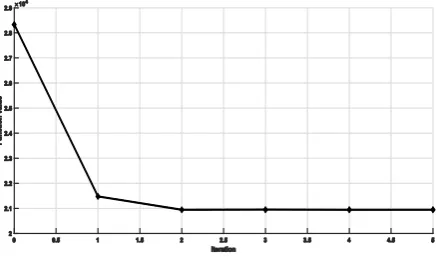
[image:4.595.56.286.52.212.2]Figure (2) depicts the variation of the objective function with iterations. It can be observed that from iteration 0 to 1 the variation is abrupt but after the iteration 2 the variation is asymptotic.
Fig. 2 Variation of objective function with iterations
Even after achieving the goal of minimization at iteration number 2, there are further iterations to satisfy the constraints and to achieve the first order optimality criterion. The variation of number of functional evaluations per iterations are shown in the figure [3]. It can be seen that, at the convergence, the functional evaluations are maximum, which indicates the exhaustive search along the gradient for minima. The total cost obtained after optimization using ‘fmincon’ algorithm is about 13.157% higher than the cost obtained by WDO algorithm, implying the inferiority of ‘fmincon’. However, this conclusion is misleading and unfound for, as a more meticulous examination of the optimization results reveal that the value of overall heat transfer coefficient, as obtained in the present study is disproportionately superior than that obtained by WDO. The value of the ‘U’ is 20.6841 times larger than the value of ‘U”, optimized by WDO. This clearly highlights the superiority of the ‘fmincon’ algorithm over WDO.
Fig. 3 Function evaluation count
A comparison with the other two studies Moretta [4] and Bidabadi [1], reveals that the cost obtained by FMINCON is lower. Also the value of ‘U’ is thrice that of study [1] and 28.2541 % more than that of Moretta [4].
IV. CONCLUSION
Thermal design optimization of SHE is carried out using a gradient based search algorithm, “fmincon”, with the objective of minimizing the total cost. The optimized design parameter values are 107.254, 43.592, 1.5, 5 and 0.855 for pressure drop on hot side, pressure drop on cold side, overall diameter, length and width of SHE. Results reveal that the cost of SHE obtained is lesser than the ones repeated by Moretta [4], Bidabadi [1] earlier and only slightly more than the value reported by WDO algorithm [2]. But the value of overall heat transfer coefficient obtained in the present study is superior to all the above three studies.
Therefore, in future, a study with dual objective of minimum the cost and maximization of overall heat transfer coefficient can be carried out for getting better insights into design optimization.
REFERENCES
1. M. Bidabadi, A. K. Sadaghiani, and A. V. Azad, “Spiral heat exchanger optimization using genetic algorithm,” vol. 20, pp. 1445–1454, 2013. 2. O. De and E. Dos, “Spiral heat exchanger optimization using wind
driven algorithm,” SBAI, 2015.
3. A. V. Azad and M. Amidpour, “Economic optimization of shell and tube heat exchanger based on constructal theory,” Energy, vol. 36, no. 2, pp. 1087–1096, 2011.
4. Moretta, A.A. “Spiral plate heat exchangers: Sizing units for cooling non-Newtonian slurries”, ChemicalEngineering (May,2010) 5. B. Wilhelmsson and A. Laval, “Consider spiral heat exchangers for
fouling applications Consider spiral heat exchangers for fouling applications,” no. July, 2005.
6. Trom, L. “Use spiral plate exchangers for various applications”,
Hydrocarbon Processing, 74(5), pp. 73- 81
7. Cengel, Y.A. (2002) Heat Transfer: A Practical Approach. 2nd Edition, McGraw-Hill, New York.
8. M. Pico, “SHORTCUT DESIGN APPROACH FOR SPIRAL,” vol. 85, pp. 322–327, 2005.
9. J. Mičieta, V. Jiří, J. Jandačka, and R. Lenhard, “Optimization principle of operating parameters of heat exchanger by using CFD simulation,” EPJ Web Conf., vol. 114, p. 02074, 2016.
10. Kondahkar, G.E. and Kapatkat, V.N. (2012) Performance Analysis of Spiral Tube Heat Exchanger Used in Oil Extraction System. International Journal of Modern Engineering Research, 2, 930-936. 11. P. Naphon, “Thermal performance and pressure drop of the helical-coil
[image:4.595.55.274.292.422.2]International Journal of Innovative Technology and Exploring Engineering (IJITEE) ISSN: 2278-3075,Volume-8 Issue-6, April 2019
12. M. W. Egner, L. C. Burmeister, and M. Asme, “Heat Transfer for Laminar Flow in Spiral Ducts of Rectangular Cross Section,” vol. 127, no. March 2005, 2014.
13. L. C. Burmeister, “Effectiveness of a Spiral-Plate Heat Exchanger With Equal Capacitance Rates,” vol. 128, no. March 2006, pp. 295–301, 2016.
14. J. Khorshidi and S. Heidari, “Design and Construction of a Spiral Heat Exchanger,” no. April, pp. 201–208, 2016.
15. Rao, K. R. 1991. “Optimal Synthesis of Shell and Tube Heat Exchangers,” Ph.D. Thesis, Indian Institute of Science, Bangalore 16. Minton, P.E. “Designing spiral heat exchangers," Chemical
Engineering, May (4), pp. 103-112 (1970).
![Table 1 Table specifies the lower and upper bounds as specified by Moretta [4]](https://thumb-us.123doks.com/thumbv2/123dok_us/8215254.264044/3.595.40.287.589.709/table-table-specifies-lower-upper-bounds-specified-moretta.webp)