Extended Translation Models in Phrase-based Decoding
Andreas Guta, Joern Wuebker, Miguel Grac¸a, Yunsu Kim, Hermann Ney
Human Language Technology and Pattern Recognition Group RWTH Aachen University
Aachen, Germany
{surname}@cs.rwth-aachen.de
Abstract
We propose a novel extended translation model (ETM) to counteract some prob-lems in phrase-based translation: The lack of translation context when using single-word phrases and uncaptured dependen-cies beyond phrase boundaries. The ETM operates on word-level and augments the IBM models by an additional bilingual word pair and a reordering operation. Its implementation in a phrase-based decoder introduces translation and reordering de-pendencies for single-word phrases and dependencies across phrase boundaries. More, the model incorporates an explicit treatment of multiple and empty align-ments. Its integration outperforms com-petitive systems that include lexical and phrase translation models as well as hier-archical reordering models on 4 language pairs significantly by +0.7% BLEU on av-erage. Although simpler and using fewer dependencies, the ETM proves to be on par with 7-gram operation sequence mod-els (Durrani et al., 2013b).
1 Introduction
The first successful steps in Statistical Ma-chine Translation have been taken by applying word-based models in a source-channel approach (Brown et al., 1990; Brown et al., 1993). Within this framework, the language model (LM) is esti-mated on monolingualn-grams, whereas the trans-lation models IBM-1 to IBM-5 are trained on bilingual data using word alignments. The dis-advantage of word-to-word translation is over-come by phrase-based translation (PBT) (Och et al., 1999; Zens et al., 2002; Koehn et al., 2003) and log-linear model combination (Och and Ney, 2002).
0 10 20 30 40
1 2 3 4 5 6 7
relative word frequency [%]
[image:1.595.307.522.216.363.2]phrase length De-En (source) De-En (target) En-Fr (source) En-Fr (target)
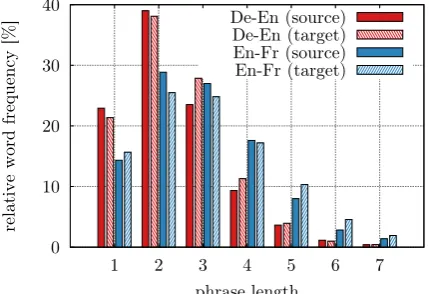
Figure 1: Relative frequency of words dependent on the length of the phrase they were decoded with
for the IWSLT dev2010German→English and
English→French corpora.
Nevertheless, phrase-based translation models have several drawbacks: (i) Single-word phrases are translated without any context. (ii) Dependen-cies beyond phrase boundaries are not modelled at all. (iii) Phrase-based translation models have dif-ficulties modelling long-distance dependencies on source words with large gaps inbetween.
The open question is how much actual
lex-ical context is included in decoding. Figure
1 depicts the relative word frequencies plotted against the length of the phrase they were trans-lated with for the IWSLT 20141German→English and English→French tasks. For English→French, more than 40% of the words are translated us-ing sus-ingle- or two-word phrases, i.e. with a lexical context of at most one word. For the German→English task, more reorderings occur and lead to less monotone alignments. Here, even 60% of all words are translated with a lexical con-text of at most one single word and over 20% are translated without any lexical context at all.
1http://www.iwslt2014.org
We address this problem by developing two variants of extended translation models (ETM), thedirect(EdTM) for the Source→Target and the inverse (EiTM) for the Target→Source direction. They operate on word-level and augment the IBM models by an additional bilingual word pair and a reordering operation. We introduce them into the log-linear framework of a PBT system. Thus, the decoding of single-word phrases can benefit from lexical and reordering context. Moreover, the ETM allows to capture dependencies across phrase boundaries and long-range source depen-dencies. It incorporates reordering information for non-monotone and multiple alignments including unaligned words.
As a first step, we implement the ETM as a count model with interpolated Kneser-Ney smoothing (Chen and Goodman, 1998) using the Viterbi alignment and apply it in phrase-based de-coding. Nevertheless, the long-term goal of this approach is to replace the phrases used in decod-ing by translation units that predict a sdecod-ingle target word, but may depend on several source words, previously translated target words and the reorder-ing context.
2 Previous Work
Various approaches have been taken to compen-sate the downside of the phrase translation model. Mari˜no et al. (2006) introduce a translation model based on n-grams of bilingual word pairs, i.e. a bilingual language model (BILM), with ann-gram decoder that requires monotone alignments. In (Niehues et al., 2011), this is further advanced by BILMs operating on non-monotone alignments within a PBT framework.
However, this differs from our approach: BILMs treat jointly aligned source words as atomic units, ignore source deletions and do not include reordering context.
The Operation Sequence Model (OSM) intro-duced in (Durrani et al., 2011; Durrani et al., 2013a) includes n-grams of both translation and reordering operations in a consistent framework. It utilizes minimal translation units (MTUs) and is applied in a corresponding OSM decoder. Ex-periments in (Durrani et al., 2013b) show that a slightly enhanced version of OSM performs best when integrated into the log-linear framework of a phrase-based decoder. Both the BILM (Stewart et al., 2014) and the OSM (Durrani et al., 2014) can
be smoothed using word clusters.
In comparison, the ETM is much simpler: Since it predicts probabilities of single words, it has a lower vocabulary size. More, it does not make use of reordering gaps, i.e. it utilizes a simpler reordering approach. The OSM uses one joint model for reorderings and translations. In con-trast, the ETM incorporates separate models to estimate the probability of words and the proba-bility of reorderings. Furthermore, the OSM has the drawback that it extracts the MTUs sentence-wise, thus one word can appear in several MTUs extracted from different sentence pairs. Since an MTUs is treated as an atomic unit, this results in a distribution of probability mass on overlapping events. The ETM overcomes this drawback by op-erating on single words.
Guta et al. (2015) propose the conversion of bilingual sentence pairs and word alignments into joint translation and reordering (JTR) sequences.
They investigate n-gram models with modified
Kneser-Ney smoothing, feed-forward and recur-rent neural networks trained on JTR sequences. In comparison to the OSM, JTR models have smaller vocabulary sizes, as they operate on words, and incorporate simpler reordering structures. Never-theless, they are shown to perform slightly better than the OSM when included into the log-linear framework of a phrase-based decoder.
Although our approach is similar, there are the following significant differences: On the one hand, the ETM estimates the probability of single words conditioned on an extended lexical and re-ordering context, whereas the JTRn-gram model predicts the probability of bilingual word pairs. On the other hand, we do not assume linear se-quences of dependencies, but propose and explicit treatment of multiply aligned words.
a hierarchical Pitman-Yor process for smoothing, but is only applied to induce word alignments. Their follow-up work (Feng et al., 2014) intro-duces a Markov-model on MTUs, similar to the OSM described above.
Finally, there has been recent research on apply-ing neural network models for extended context (Le et al., 2012; Auli et al., 2013; Hu et al., 2014; Devlin et al., 2014; Sundermeyer et al., 2014). All of these papers focus on lexical context and ignore the reordering aspect covered in our work. 3 Extended Translation Models Given a source sentence fJ
1 and its translationeI1, EiTM models theinverseprobabilityp(fJ
1|eI1)and EdTM the directprobability p(eI
1|f1J). We allow for source words to be translated to multiple target words and vice versa. The inverted alignmentbi
denotes the sequence of source positions jaligned to target positionifori=1,...,I. Its subsequence b<i j includes all source positions inbipreceding a
given source position j:
b<i j=
¯
j∈bi: ¯j< j
.
Unaligned target words are aligned to the empty source word f0, unaligned source words to the empty target word e0. b0 denotes the unaligned source positions. We introduce the fertilityφiof a
target wordei. It determines the number of source
words aligned to the target wordei:
φi=
(
0, bi={0}
|bi|, else
By analogy, we useφi<j to denote the number of source positions inb<i j. Similar to the approach in (Feng and Cohn, 2013), we generalize reorderings to the following jump classes∆φij0,j:
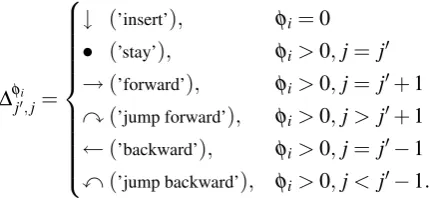
∆φij0,j=
↓ (’insert’), φi=0
• (’stay’), φi>0,j= j0
→(’forward’), φi>0,j= j0+1 y(’jump forward’), φi>0,j> j0+1
←(’backward’), φi>0,j= j0−1
[image:3.595.73.288.618.717.2]x(’jump backward’), φi>0,j< j0−1.
Figure 2 outlines the jump classes for subsequent target positions i0 and i. As shown in Figure 3,
for source positions ¯j< jwhich are aligned to the
(a) forward (b) jump forward
Figure 3: Overview of the jump classes∆¯j,j.
same target positioni, there are two possible jump classes:
∆j¯,j=
(
→(’step forward’), j= j¯+1 y(’jump forward’), j> j¯+1.
In the following, we depict the derivations of the EiTM and the EdTM. Although they operate in op-posite translation directions, both models incorpo-rate the inverted alignmentbI
1.
3.1 Extended Inverse Translation Model In order to model the inverse probabilityp(fJ
1|eI1), the unknown inverted alignment bI
1 is introduced as a hidden variable and approximated by the Viterbi alignment.
p(f1J|eI1) =
∑
bI
1
p(f1J,bI1|eI1)
umax
bI
1
p(fbI
b0,b
I
1|eI1)
=max
bI
1
p(fbI
b1,b
I
1|eI1)·p(fb0|fbb1I,b
I
1,eI1) | {z } deletion probability
The inverse probability has been decomposed into the deletion probability p(fb0|fbb1I,bI1,eI1) and the joint probability p(fbI
b1,bI1|eI1). The latter is refor-mulated using the Markov chain rule:
p(fbI
b1,b
I
1|eI1) =
I
∏
i=1p(fbi,bi|e
I
1,fbb1i−1,b
i−1 1 ).
In order to restrict the history, we assume the prob-ability of(fbi,bi)to be dependent only on the
cur-rent target word ei, its last aligned predecessor
ei0, the corresponding alignmentbi0 and the source words fbi0:
p(fbI
b1,b
I
1|eI1) =
I
∏
i=1p(fbi,bi|ei
0,ei,fbi0,bi0).
The conditional joint probability is factorized as p(fbi,bi|ei0,ei,fbi0,bi0) =
p(fbi|ei0,ei,fbi0,bi0,bi)
| {z } lexicon probability
·p(bi|ei0,ei,fb
i0,bi0)
| {z } alignment probability
(a) insert (b) stay (c) forward (d) jump forward (e) backward (f) jump backward Figure 2: Overview of the jump classes∆φij0,j.
resulting in the lexicon probability of fbi and the
alignment probability ofbi. In a nutshell, we have
decomposed the inverse probability into the fol-lowing three probabilities:
• deletion: p(fb0|fbb1I,bI1,eI1)
• lexicon: ∏I
i=1p(fbi|ei0,ei,fbi0,bi0,bi)
• alignment: ∏I
i=1p(bi|ei0,ei,fbi0,bi0)
Below, we show how to estimate these probabil-ities using the EiTM deletion, lexicon and align-ment models.
3.1.1 EiTM: Deletion Model
Due to its artificiality, e0 has no preceding target word. We condition the deletion of fb0 only one0 and assume conditional independence between the unaligned source words fb0:
p(fb0|fbb1I,b
I
1,eI1) =
∏
j∈b0
p(fj|e0).
3.1.2 EiTM: Lexicon Model
Firstly, we apply the Markov chain rule to obtain the factorized probabilities of single words fj.
p(fbi|ei0,ei,fbi0,bi0,bi) =
∏
j∈bi
p(fj|ei0,ei,fb
i0,fb<i j,bi0,bi)
Each source word fjis dependent on all
predeces-sors fb<j
i aligned to the same target wordei and
all previously aligned source words fbi0. If we modelled the probability conditioned on the sets of source words fbi0 and fb<i j, this would lead to
sparsity problems due to the arbitrary number of source words contained in the sets.
In order to avoid this, we therefore condition the probability on the individual words contained in
fbi0,fb<j
i . Without any additional information, we
assume all words fbi0,fb<i j to be equally important
for the prediction of fj. Thus, we average over the
probabilities conditioned on:
• all source words fj0 aligned to the preceding target wordei0,
• all preceding source words fj¯aligned to the current target wordei.
Moreover, we reduce the alignments (bi0,bi) to their corresponding jump classes. As a final result we obtain:
p(fj|ei0,ei,fb
i0,fb<i j,bi0,bi) =
1
φi0+φi<j
∑
j0∈b
i0
p(fj|ei,fj0,ei0,∆φij0,j)
+
∑
¯
j∈b<i j
p(fj|ei,fj¯,∆j¯,j)
.
3.1.3 EiTM: Alignment Model
In principle, we follow the same derivation as for the lexicon model above. The probability of a source position j∈bi is computed as the average
probability of a jump from a previously aligned source position, which either has to be aligned to the target predecessori0 or is a preceeding source
position aligned to the same target wordei.
p(bi|ei0,ei,fb
i0,bi0) =
∏
j∈bi
1
φi0+φi<j
∑
j0∈b
i0
p(∆φij0,j|ei,fj0,ei0)
+
∑
¯
j∈b<i j
p(∆¯j,j|ei,fj¯)
.
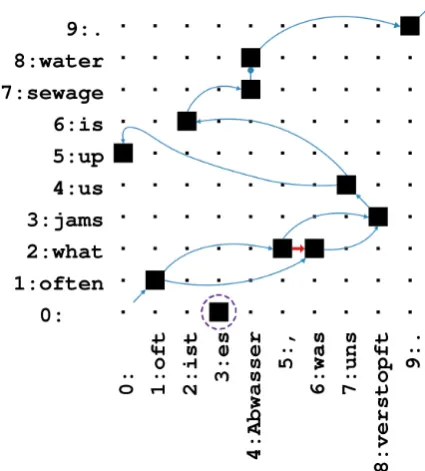
Figure 4: EiTM scoring for a sentence from the
IWSLT German→English corpus including the
word alignment.
the jump class, see Figures 2 and 3. The empty words are shown at positions j,i=0. The deletion is indicated by a violet circle. The EiTM proba-bility for the whole sentence pair is computed as follows:
p(f9
1,b91|e91) =
p(f1|e1,<s>,<s>,→)·p(→ |e1,<s>,<s>)
·p(f5|e2,f1,e1,y)·p(y|e2,f1,e1) (1)
·p(f6|e2,f1,e1,y) +2 p(f6|e2,f5,→)
·p(y|e2,f1,e1) +2 p(→ |e2,f5) (2)
·p(f8|e3,f5,e2,y) +2 p(f8|e3,f6,e2,y)
·p(y|e3,f5,e2) +2 p(y|e3,f6,e2) (3)
·p(f7|e4,f8,e3,←)·p(← |e4,f8,e3)
·p(f0|e5,f7,e4,↓)·p(↓ |e5,f7,e4) (4)
·p(f2|e6,f7,e4,x)·p(x|e6,f7,e4) (5)
·p(f4|e7,f2,e6,y)·p(y|e7,f2,e6)
·p(f4|e8,f4,e7,•)·p(•|e8,f4,e7) (6)
·p(f9|e9,f4,e8,y)·p(y|e9,f4,e8) (7)
·p(</s>|</s>,f9,e9,→)·p(→ |</s>,f9,e9)
·p(f3|e0). (8)
Lines (1), (2), (3) and (7) are dependencies in-cluded in the EiTM but not in phrase translation models due to the phrase extraction heuristics. The dependency on multiple preceding word pairs is exemplified in (2) and (3). (4) depicts the inser-tion of the target word e5 =up conditioned on the word pair(e4=us,f7=uns). Note that in (5) there is no dependency ofe6=ison its pre-decessor e5=upand the empty word f0, but on its last alignedpredecessor e4=usand the cor-responding source word f7=uns. (6) shows an example of a source word aligned to multiple tar-get words. The deletion probability of the source word f3=esis presented in (8).
3.2 Extended Direct Translation Model So far, we have introduced the EiTM, which mod-els the inverse translation probability p(fJ
1|eI1). Besides modellingp(fJ
1|eI1)using extended trans-lation models, our aim is to employ them to model thedirectprobabilityp(eI
1|f1J)as well. For a start, the direct probabilityp(eI
1|f1J)can be modelled using the EiTM: Simply put, source and target corpora have to be swapped for the training of the EiTM. By doing so, the alignment has to be inverted as well, i.e. one has to use the direct alignmentajwhich denotes the sequence of target
positionsialigned to source positionj. As a result, the EiTM modelsp(eaJ
a0,aJ1|f1J)when trained with inverted corpora and alignments.
During the decoding process, the partial hy-potheses are generated successively. Thus, for each target word ei that is hypothesized, all its
predecessors have already been translated, i.e. its last aligned predecessorei0 and the corresponding alignmentbi0 and source words fb
i0 are known.
Nevertheless, source words do not have to be translated in monotone order. In general, it cannot be guaranteed that the predecessor fj−1of the first word fjof a source phrase has been translated yet.
Therefore, the last aligned predecessor of fj and
its aligned target words are generally unknown. As a result, when applying the EiTM within phrase-based decoding for modelling the direct probabilityp(eI
1|f1J), dependencies beyond phrase
boundaries cannot be captured.
Thus, we additionally develop the EdTM which models the direct translation probability p(eI
keep-ing theinverted alignmentbI
1 instead of usingaJ1. Analogue to the EiTM, the hidden alignmentbI
1is approximated by the Viterbi alignment.
p(eI1|f1J)umax
bI
1
p(e0|fbb0I) | {z } deletion probability
·p(eI1,bI1|fbI
b0,e0)
Applying the Markov chain rule and assuming (ei,bi)to be dependent only on the aligned source
words fbi, the previously aligned target word ei0
as well as the corresponding alignmentbi0 and the source words fbi0, we obtain:
p(eI
1,bI1|fbb0I,e0) =
I
∏
i=1p(ei,bi|fbi0,fbi,ei 0,bi0).
We factorize the joint probability to obtain the lex-icon probability ofei and the alignment
probabil-ity ofbi.
p(ei,bi|fbi0,fbi,ei0,bi0) =
p(ei|fbi0,fbi,ei0,bi0,bi)
| {z } lexicon probability
·|p(bi|fbi0,{zfbi,ei0,bi0})
alignment probability
The direct probability has been decomposed into the following three probabilities.
• deletion: p(e0|fbb0I)
• lexicon: ∏I
i=1p(ei|fbi0,fbi,ei0,bi0,bi)
• alignment: ∏I
i=1p(bi|fbi0,fbi,ei0,bi0)
Next, we introduce the corresponding EdTM dele-tion, lexicon and alignment models.
3.2.1 EdTM: Deletion Model
The EdTM deletion model approximates the prob-ability of e0 conditioned on all unaligned source words fb0 and is obtained by averaging over all unaligned source words:
p(e0|fbb0I) =
∑
j∈b0
p(e0|fj)
φ0 .
3.2.2 EdTM: Lexicon Model
In contrast to the derivation of EiTM, the Markov chain rule cannot be applied at this point, since we do not model the probability of fbi, but the
prob-ability ofei conditioned on fbi. Thus, we average
over all aligned source words fbi, which results in:
p(ei|fbi0,fbi,ei0,bi0,bi) =
1
φi j∈b
∑
i1
φi0+φi<j
∑
j0∈b
i0
p(ei|fj,ei0,fj0,∆φij0,j)
+
∑
¯
j∈b<i j
p(ei|fj,f¯j,∆j¯,j)
.
3.2.3 EdTM: Alignment Model
Applying the same assumptions as for the lexicon model, the EdTM alignment model results in:
p(bi|fbi0,fbi,ei0,bi0) =
1
φi j∈b
∑
i1
φi0+φi<j
∑
j0∈b
i0
p(∆φij0,j|fj,ei0,fj0)
+
∑
¯
j∈b<i j
p(∆j¯,j|fj,fj¯)
.
3.3 Count Models and Smoothing
So far, we have introduced the ETM and shown how to include unaligned words and multiple word dependencies. However, there are various possi-bilities to train the lexicon and alignment proba-bilities derived in Subsections 3.1 and 3.2.
As a starting point, we apply relative frequen-cies obtained from bilingual training data, where the Viterbi alignment is estimated using GIZA++ (Och and Ney, 2003). In order to address data sparseness, we apply interpolated Kneser-Ney smoothing as described in (Chen and Goodman,
1998). In comparison to monolingual n-grams
used in LMs, we lack any clear order ofe, f, e0,
f0and∆, since they include bilingual and
reorder-ing information. Similar to the approach taken by Mari˜no et al. (2006), we model the probability of the bilingual word pair(e,f)given its predecessor (e0,f0,∆)which also includes the jump class. The
EdTM lexicon model for dependencies on previ-ously aligned target words is computed as
p(e|f,e0,f0,∆) = p(e,f|e0,f0,∆)
p(·,f|e0,f0,∆), (9)
where p(e,f|e0,f0,∆) is the bigram distribution
of (e,f) given its predecessor (e0,f0,∆) with
in-terpolated Kneser-Ney smoothing. The denomi-nator p(·,f|e0,f0,∆)is obtained by marginalizing
p(e,f|e0,f0,∆)over all target wordse. We follow
IWSLT IWSLT BOLT BOLT German English English French Chinese English Arabic English
Sentences 4.32M 26.05M 4.08M 0.92M
Run. Words 108M 109M 698M 810M 78M 86M 14M 16M
[image:7.595.73.529.65.142.2]Vocabulary 836K 792K 2119K 2139K 384K 817K 285K 203K
Table 1: Statistics for the bilingual training data of the IWSLT 2014 German→English, English→French and the DARPA BOLT Chinese→English, Arabic→English translation tasks.
4 Integration into Phrase-based Decoding
In this work, we apply a standard phrase-based translation system (Koehn et al., 2003). The de-coding process is implemented as a beam search for the best translation given a set of models hm(eI1,sK1,f1J). The goal of search is to maximize the log-linear feature score (Och and Ney, 2004):
ˆ
eI1ˆ=argmax
I,eI
1,sK1 (
M
∑
m=1λmhm(e
I
1,sK1,f1J) )
, (10)
where sK
1 =s1...sK is the hidden phrase align-ment. The feature weightsλmare tuned with
mini-mum error rate training (MERT) (Och, 2003). The modelshm, that are part of all baselines presented
in this work, are phrasal and lexical translation scores in both directions, an n-gram LM, a sim-ple distance-based distortion model and word and phrase penalties. All phrase pairs that are licensed by the word alignment are extracted from the train-ing corpus and their probabilities estimated as rel-ative frequencies. Moreover, the word alignment each phrase pair has been extracted from is mem-orized in the phrase table.
Our extended translation models are integrated into this framework as additional features hm.
They are trained in both directions on a bilin-gual corpus and the Viterbi alignment,
result-ing in four additional features. When
train-ing in the Target→Source direction, the align-ment direction is also swapped. Thus, EiTM and EdTM have the advantage of including context be-yond phrase boundaries only when trained in the Source→Target direction.
To include the extended translation models into the phrasal decoder, the source position aligned to the last (not inserted) target word of the pre-viously translated phrase has to be memorized in the search state of a partial hypothesis. Although this slightly affects hypothesis recombination and
therefore leads to a larger search space, in prac-tice it does not degrade the search accuracy, as experiments with relaxed pruning parameters have shown.
5 Evaluation
We perform experiments on the
large-scale IWSLT 20142 (Cettolo et al., 2014)
German→English, English→French and the
large-scale DARPA BOLT Chinese→English,
Arabic→English tasks. As mentioned in Section 4, all baseline systems include phrasal and lexical smoothing scores trained in both directions. Word alignments are trained with GIZA++, by sequentially running 5 iterations each for the IBM-1, HMM and IBM-4 alignment models.
The domain of IWSLT consists of lecture-type talks presented at TED conferences which are also available online3. The baseline systems are trained on all provided bilingual data. All
sys-tems are optimized on the dev2010 and
eval-uated on the test2010 corpus. The ETM is
trained on the TED portions of the data: 138K sen-tences for German→English and 185K sentences for English→French.
For German→English, to estimate the 4-gram LM, we additionally make use of parts of the Shuffled News, LDC English Gigaword and 109 -French-English corpora, selected by a cross-entropy difference criterion (Moore and Lewis, 2010). In total, 1.7 billion running words are taken for LM training. For English→French, we use a large general domain 5-gram LM and an in-domain 5-gram LM. Both are estimated with the KenLM toolkit (Heafield et al., 2013) using inter-polated Kneser-Ney smoothing. For the general domain LM, we first select 1
2 of the English Shuf-fled News, 14 of the French Shuffled News as well as both the English and French Gigaword corpora
by the same cross-entropy difference criterion. By concatenating this selection with all available re-maining monolingual data, we build an unpruned LM.
The BOLT tasks are evaluated on the ”discus-sion forum” domain. For Chinese→English, the baseline is trained on 4.08M general domain sen-tence pairs and the 5-gram LM on 2.9 billion run-ning words in total. The ETM is trained on an in-domain subset of 67.8K sentences and the test set contains 1844 sentences. For the Arabic→English BOLT task, we use only the in-domain data for training the baseline and the ETM. The training and test sets contain text drawn from discussion forums in Egyptian Arabic. The evaluation set contains 1510 bilingual sentence pairs.
The baseline systems for all tasks - except the Arabic→English BOLT task, where preliminary experiments showed no improvement - contain a 7-gram word cluster language model (Wuebker et al., 2013) and for comparison, we also experiment with a hierarchical reordering model (HRM) (Gal-ley and Manning, 2008). When integrated into a phrase-based decoder, Durrani et al. (2013b) have shown the OSM to outperform bilingual LMs on MTUs. Therefore, we directly compare ourselves with a 7-gram OSM implemented into our phrase-based decoder as an additional feature. The OSM is trained on the same data as the ETM for all tasks. Bilingual data statistics for all tasks are shown in Table 1. For each system setting we eval-uate three MERT runs usingmulteval(Clark et al., 2011). Results are reported in BLEU(Papineni et al., 2001) and TER (Snover et al., 2006). The optimization criterion for all experiments is BLEU.
5.1 Model parameters
To measure the complexity of the extended trans-lation models in comparison to the phrase-based translation model, we count the number of param-eters to be trained for each.
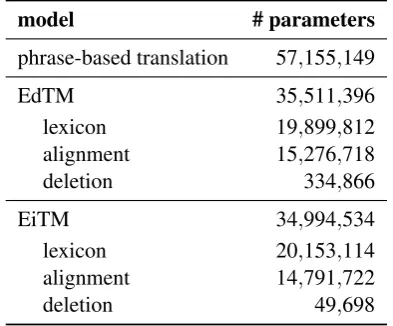
Table 2 illustrates the phrase-table and ETM count table entries for the BOLT Arabic→English translation task, where both the phrase-based base-line and the ETM are trained on the same bilin-gual data consisting of 0.92M bilinbilin-gual sentence pairs. Here, we only show the numbers for the Source→Target direction, as the numbers for the Target→Source direction are similar. The EdTM and EiTM each have roughly 35M parameters to be trained, i.e. there are approximately 70M
pa-model # parameters
phrase-based translation 57,155,149
EdTM 35,511,396
lexicon 19,899,812
alignment 15,276,718
deletion 334,866
EiTM 34,994,534
lexicon 20,153,114
alignment 14,791,722
[image:8.595.318.515.63.226.2]deletion 49,698
Table 2: The number of model parameters for the BOLT Arabic→English bilingual training data af-ter filaf-tering.
BLEU TER
Baseline + HRM 30.7 49.3 + EiTM + EdTM
Ge↔En none 31.4 48.3
none Ge↔En 31.6 48.1
Ge→En Ge→En 31.6 48.2
Ge↔En Ge↔En 31.8 48.2
Table 3: Results for the German→English IWSLT data. The systems are optimized with MERT on
thedev2010set. All results are statistically
sig-nificant with≥99% confidence.
rameters to be trained for the ETM in total. This is slightly more than the 57M parameters for the phrase translation model.
5.2 Results
In order to compare the effect of the EiTM and EdTM used in a phrase-based decoder, we have trained the baseline including the HRM as de-scribed above on the full German→English bilin-gual data of the IWSLT task and the extended translation models on the TED data. The results evaluated ontest2010are shown in Table 3.
Including the EiTM trained in both
German→English and English→German
di-rections into the phrasal decoder yields an
absolute improvement of +0.7 BLEU and -1.0
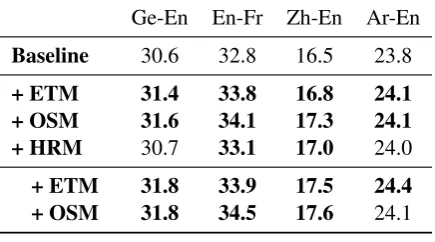
Ge-En En-Fr Zh-En Ar-En Baseline 30.6 32.8 16.5 23.8 + ETM 31.4 33.8 16.8 24.1 + OSM 31.6 34.1 17.3 24.1 + HRM 30.7 33.1 17.0 24.0 + ETM 31.8 33.9 17.5 24.4 + OSM 31.8 34.5 17.6 24.1
Table 4: Comparison of ETM to the HRM and OSM measured in BLEU. Statistically significant improvements with≥99% confidence are printed in boldface.
of a target word, which corresponds to the actual translation direction. Note, that both EiTM and EdTM lose the advantage of modelling dependen-cies beyond phrase boundaries when trained in the inverse direction English→German. Therefore, we have evaluated their joint performance when
trained only in German→English direction,
which is similar to the performance of EdTM trained in both directions. This can be due to the fact that even though the EiTM trained in German→English direction incorporates depen-dencies beyond phrase boundaries, the EdTM trained in English→German direction profits from the better suited direct translation probability. The full ETM, i.e. EiTM and EdTM trained in both directions, yields the best overall performance gain of +1.1 BLEUand -1.1 TERover the baseline. Moreover, we evaluate the performance of the (full) ETM compared to the HRM and a 7-gram OSM, which are all introduced as additional fea-tures into the log-linear framework of the base-line phrase-based decoder. The results are pre-sented in Table 4. The ETM performs simi-larly to the HRM for the Chinese→English and Arabic→English tasks, resulting in +0.3 BLEU over the PBT baseline. For both IWSLT tasks,
the ETM outperforms the HRM by +0.7 BLEU,
gaining +0.8 BLEUfor the German→English and +1.0 BLEUfor the German→English task over the PBT baseline. The context captured by the ETM corresponds roughly to the context captured by a 3-gram OSM. Bearing this in mind, we compare the ETM to a 7-gram OSM, which yields +0.25 BLEUmore than the ETM averaged over the four language pairs. Comparing the OSM vocabulary of 1.5M words for the Arabic→English task to the
285K words in the Arabic corpus, this results in an ETM vocabulary 5-times smaller than the OSM vocabulary.
We also compare the ETM to the OSM on top of a PBT system that also includes the HRM, which is shown in the last two lines of Table 4. The per-formance of the ETM benefits from the informa-tion introduced by the HRM, as the gain of us-ing the ETM is further increased by +0.15 BLEU on average. Overall, the ETM gains consistent and statistically significant improvements of +0.7 BLEUon average for all four language pairs over a state-of-the-art phrase-based decoder including the HRM. On the other hand, OSM seems to have a higher overlap with HRM, as the gain of OSM compared to ETM is reduced to +0.1 BLEUon av-erage. Thus, on top of the phrase-based system in-cluding the HRM, the ETM inin-cluding a bilingual word pair and the corresponding reordering jump class proves to be competitive to a 7-gram OSM.
6 Discussion
We have integrated two variants of a novel ex-tended translation model into a state-of-the-art phrase-based decoder. The ETM captures lexical and reordering context beyond phrase boundaries in both the Source→Target and Target→Source directions. Further, the model potentially captures long-range reorderings and utilizes multiple and empty alignments, allowing for target insertions and source deletions. As an initial step, we have implemented the ETM using relative frequencies with interpolated Kneser-Ney smoothing. Its con-sistent and statistically significant improvement of up to +1.1 BLEU and -1.1 TER respectively +0.7 BLEU on average has been shown for four large-scale translation tasks, outperforming com-petitive phrase-based systems that include lexical and phrase translation models and hierarchical re-ordering models.
instead of incorporating linear dependencies and models reorderings in a less complex way.
So far we have used the ETM as an additional feature in a phrase-based decoder, but we believe that the usage of such a decoder is a limitation. First, the ETM is estimated on alignments, which themselves are optimized for the IBM models. Second, decoding is performed using phrases that are extracted from the alignments using heuristics. Therefore, the potential of a phrase-based decoder is also limited by these heuristics.
Based on these facts, we believe that the ETM will show its full potential when it is also inte-grated into the training of the alignment, leading not only to a higher alignment quality, but also to a joint optimization of the alignments and the ETM. Further, directly applying the ETM within a word-based decoder utilizing an extended translation and reordering context will redundantize phrases and thus any extraction heuristics. We believe that a consistent framework where the ETM is applied in both training the alignments and decoding will significantly advance machine translation.
For the short term, we will investigate better smoothing strategies and the possibilities of using neural networks instead of count models.
Acknowledgements
This work has received funding from the Euro-pean Union’s Horizon 2020 research and innova-tion programme under grant agreement no645452 (QT21). This material is partially based upon work supported by the DARPA BOLT project un-der Contract No. HR0011- 12-C-0015. Any opin-ions, findings and conclusions or recommenda-tions expressed in this material are those of the authors and do not necessarily reflect the views of DARPA.
References
Michael Auli, Michel Galley, Chris Quirk, and Geof-frey Zweig. 2013. Joint Language and Translation Modeling with Recurrent Neural Networks. In Con-ference on Empirical Methods in Natural Language Processing, pages 1044–1054, Seattle, USA, Octo-ber.
Peter F. Brown, John Cocke, Stephan A. Della Pietra, Vincent J. Della Pietra, Fredrick Jelinek, John D. Lafferty, Robert L. Mercer, and Paul S. Rossin. 1990. A Statistical Approach to Machine Transla-tion. Computational Linguistics, 16(2):79–85, June.
Peter F. Brown, Stephan A. Della Pietra, Vincent J. Della Pietra, and Robert L. Mercer. 1993. The Mathematics of Statistical Machine Translation: Pa-rameter Estimation. Computational Linguistics, 19(2):263–311, June.
Mauro Cettolo, Jan Niehues, Sebastian St¨uker, Luisa Bentivogli, and Marcello Federico. 2014. Report on the 11th iwslt evaluation campaign, iwslt 2014. In
International Workshop on Spoken Language Trans-lation, pages 2–11, Lake Tahoe, CA, USA, Decem-ber.
Stanley F. Chen and Joshuo Goodman. 1998. An Empirical Study of Smoothing Techniques for Lan-guage Modeling. Technical Report TR-10-98, Com-puter Science Group, Harvard University, Cam-bridge, MA, August.
Jonathan H. Clark, Chris Dyer, Alon Lavie, and Noah A. Smith. 2011. Better hypothesis test-ing for statistical machine translation: Controlltest-ing for optimizer instability. In 49th Annual Meet-ing of the Association for Computational LMeet-inguis- Linguis-tics:shortpapers, pages 176–181, Portland, Oregon, June.
Yonggang Deng and William Byrne. 2005. Hmm word and phrase alignment for statistical machine transla-tion. InProceedings of Human Language Technol-ogy Conference and Conference on Empirical Meth-ods in Natural Language Processing, pages 169– 176, Vancouver, British Columbia, Canada, October. Association for Computational Linguistics.
Jacob Devlin, Rabih Zbib, Zhongqiang Huang, Thomas Lamar, Richard Schwartz, and John Makhoul. 2014. Fast and Robust Neural Network Joint Models for Statistical Machine Translation. In 52nd Annual Meeting of the Association for Computational Lin-guistics, pages 1370–1380, Baltimore, MD, USA, June.
Nadir Durrani, Helmut Schmid, and Alexander Fraser. 2011. A joint sequence translation model with in-tegrated reordering. InProceedings of the 49th An-nual Meeting of the Association for Computational Linguistics: Human Language Technologies, pages 1045–1054, Portland, Oregon, USA, June. Associa-tion for ComputaAssocia-tional Linguistics.
Nadir Durrani, Alexander Fraser, and Helmut Schmid. 2013a. Model with minimal translation units, but decode with phrases. In Proceedings of the 2013 Conference of the North American Chapter of the Association for Computational Linguistics: Human Language Technologies, pages 1–11, Atlanta, Geor-gia, June. Association for Computational Linguis-tics.
Linguistics (Volume 2: Short Papers), pages 399– 405, Sofia, Bulgaria, August. Association for Com-putational Linguistics.
Nadir Durrani, Philipp Koehn, Helmut Schmid, and Alexander Fraser. 2014. Investigating the useful-ness of generalized word representations in smt. In
COLING, Dublin, Ireland, aug.
Yang Feng and Trevor Cohn. 2013. A markov model of machine translation using non-parametric bayesian inference. In51st Annual Meeting of the Association for Computational Linguistics, pages 333–342, Sofia, Bulgaria, August.
Minwei Feng, Jan-Thorsten Peter, and Hermann Ney. 2013. Advancements in reordering models for sta-tistical machine translation. In Annual Meeting of the Assoc. for Computational Linguistics, pages 322–332, Sofia, Bulgaria, August.
Yang Feng, Trevor Cohn, and Xinkai Du. 2014. Fac-tored markov translation with robust modeling. In
Proceedings of the Eighteenth Conference on Com-putational Natural Language Learning, pages 151– 159, Ann Arbor, Michigan, June. Association for Computational Linguistics.
Michel Galley and Christopher D. Manning. 2008. A simple and effective hierarchical phrase reorder-ing model. In Proceedings of the Conference on Empirical Methods in Natural Language Process-ing, EMNLP ’08, pages 848–856, Stroudsburg, PA, USA. Association for Computational Linguistics.
Andreas Guta, Tamer Alkhouli, Jan-Thorsten Peter, Jo-ern Wuebker, and Hermann Ney. 2015. A com-parison between count and neural network models based on joint translation and reordering sequences. InProceedings of the 2015 Conference on Empirical Methods in Natural Language Processing, Lisboa, Portugal, September. Association for Computational Linguistics. to appear.
Kenneth Heafield, Ivan Pouzyrevsky, Jonathan H. Clark, and Philipp Koehn. 2013. Scalable modi-fied Kneser-Ney language model estimation. In Pro-ceedings of the 51st Annual Meeting of the Associa-tion for ComputaAssocia-tional Linguistics, pages 690–696, Sofia, Bulgaria, August.
Yuening Hu, Michael Auli, Qin Gao, and Jianfeng Gao. 2014. Minimum translation modeling with recur-rent neural networks. In Proceedings of the 14th Conference of the European Chapter of the Associ-ation for ComputAssoci-ational Linguistics, pages 20–29, Gothenburg, Sweden, April. Association for Com-putational Linguistics.
P. Koehn, F. J. Och, and D. Marcu. 2003. Statisti-cal Phrase-Based Translation. InProceedings of the 2003 Meeting of the North American chapter of the Association for Computational Linguistics (NAACL-03), pages 127–133, Edmonton, Alberta.
Hai Son Le, Alexandre Allauzen, and Franc¸ois Yvon. 2012. Continuous Space Translation Models with Neural Networks. InConference of the North Amer-ican Chapter of the Association for Computational Linguistics: Human Language Technologies, pages 39–48, Montreal, Canada, June.
Jos´e B Mari˜no, Rafael E Banchs, Josep M Crego, Adri`a de Gispert, Patrik Lambert, Jos´e A R Fonollosa, and Marta R Costa-juss`a. 2006. N-gram-based Machine Translation. Comput. Linguist., 32(4):527–549, De-cember.
R.C. Moore and W. Lewis. 2010. Intelligent Selection of Language Model Training Data. In ACL (Short Papers), pages 220–224, Uppsala, Sweden, July. Jan Niehues, Teresa Herrmann, Stephan Vogel, and
Alex Waibel, 2011. Proceedings of the Sixth Work-shop on Statistical Machine Translation, chapter Wider Context by Using Bilingual Language Mod-els in Machine Translation, pages 198–206. Associ-ation for ComputAssoci-ational Linguistics.
Franz J. Och and Hermann Ney. 2002. Discriminative Training and Maximum Entropy Models for Statis-tical Machine Translation. InProc. of the 40th An-nual Meeting of the Association for Computational Linguistics (ACL), pages 295–302, Philadelphia, PA, July.
Franz J. Och and Hermann Ney. 2003. A System-atic Comparison of Various Statistical Alignment Models. Computational Linguistics, 29(1):19–51, March.
Franz Josef Och and Hermann Ney. 2004. The Align-ment Template Approach to Statistical Machine Translation. Computational Linguistics, 30(4):417– 449, December.
Franz J. Och, Christoph Tillmann, and Hermann Ney. 1999. Improved Alignment Models for Statistical Machine Translation. InProc. Joint SIGDAT Conf. on Empirical Methods in Natural Language Pro-cessing and Very Large Corpora, pages 20–28, Uni-versity of Maryland, College Park, MD, June. Franz Josef Och. 2003. Minimum Error Rate Training
in Statistical Machine Translation. In Proc. of the 41th Annual Meeting of the Association for Compu-tational Linguistics (ACL), pages 160–167, Sapporo, Japan, July.
Kishore Papineni, Salim Roukos, Todd Ward, and Wei-Jing Zhu. 2001. Bleu: a Method for Automatic Evaluation of Machine Translation. IBM Research Report RC22176 (W0109-022), IBM Research Di-vision, Thomas J. Watson Research Center, P.O. Box 218, Yorktown Heights, NY 10598, September. Matthew Snover, Bonnie Dorr, Richard Schwartz,
pages 223–231, Cambridge, Massachusetts, USA, August.
Darelene Stewart, Roland Kuhn, Eric Joanis, and George Foster. 2014. Coarse split and lump bilin-gual languagemodels for richer source information in smt. InAMTA, Vancouver, BC, Canada, oct. Martin Sundermeyer, Tamer Alkhouli, Joern Wuebker,
and Hermann Ney. 2014. Translation modeling with bidirectional recurrent neural networks. In
Conference on Empirical Methods in Natural Lan-guage Processing, pages 14–25, Doha, Qatar, Octo-ber.
Joern Wuebker, Stephan Peitz, Felix Rietig, and Her-mann Ney. 2013. Improving statistical machine translation with word class models. InConference on Empirical Methods in Natural Language Pro-cessing, pages 1377–1381, Seattle, USA, October. Richard Zens, Franz Josef Och, and Hermann Ney.
2002. Phrase-Based Statistical Machine Transla-tion. In25th German Conf. on Artificial Intelligence (KI2002), pages 18–32, Aachen, Germany, Septem-ber. Springer Verlag.