JOURNAL OFVIROLOGY,Apr.1968,p.298-307 Copyright ©1968 AmericanSociety forMicrobiology
Vol. 2,No. 4 PrintedinU.S.A.
Replication of T4rII Bacteriophage
in
Escherichia coli K-12
(X)
ICLARENCE S. BULLER2 AND L. ASTRACHAN
Department ofMicrobiology, Case Western Reserve UniversitySchool of Medicine, Cleveland, Ohio 44106 Received for publication 9January1968
The defect ofT4rIIreplication in EscherichiacoliK-12(X) canbephenotypically
reversedby various supplementstothegrowthmedium.Arginine, lysine, spermidine,
and a number of diamines allowed varying levels ofrII replication. The best
re-version was obtained with 0.4 M sucrose in 0.002 to 0.005 MCa++. Monovalent
cations severely inhibited reversion. A cell surface site of polyamine action is
consistent with the fact that spermidineinhibits phageghost-inducedcelllysis and
withthefindingthatsufficientpolyamine isavailablewithin thecellstoallow
nor-malpatterns ofneutralization ofphage deoxyribonucleic acid, asdetected by the
polyamine content ofprogeny phage. Intheabsence of effective supplements,
rII-infected cells swelled and lostrefractility.The data indicate thataleakycellenvelop
is involved. No difference inmucopeptides ofuninfected K-12(X) andK-12was de-tected and, because the mucopeptide in r+ infected cellswasfound to be at least
partially hydrolyzed midway through the lytic cycle, it didnotappearthat therIl
defect concernedmucopeptide synthesis.The pattern of cellphospholipid synthesis
changes after phage infection, but no difference was detected between r+ and rII
with regard to biosynthesis of phosphatidylethanolamine and
phosphatidyl-glycerol.
When a population of rapidly lysing T4 bac-teriophage mutants are selected by plaque
mor-phologyon EscherichiacolistrainB,each indivi-dual mutant mapsin one of three separate gene
loci.Mutantsat oneof theseloci,therII mutants,
are readily distinguished because they cannot
replicate on a host
carrying
lambda prophage[E. coliK-12(X)] and yetthey multiplyaswellas
wild type if the host (E. coli
K-12)
is notlyso-genized with lambda. Thus, the wild-type rII gene product is required for lysis inhibition in
strain B, is essential for
replication
in K-12 (X),and is entirely
dispensable
in E. coli K-12 (6).The gene product and its function remain
un-known,but itsidentityhas beensoughtby
exami-nationof the varied biochemicalconsequences of
infection and by study of growth medium
addi-tions which in some way can substitute for rll
function and allow
replication
in E. coli K (X).Garen (11) demonstrated that the addition of
highconcentrationsof Mg++tothemedium (0.03
to0.08M Mg++) couldovercometherIIdefect in
IA preliminary account of this work was
pre-sented atthe 1965 Annual Meeting of the American
Society for Microbiology (Bacteriol. Proc., p. 102,
1965).
2Present address: Department of Microbiology,
University of Kansas, Lawrence, Kan. 66045.
K-12 (X). By various criteria-deoxyribonucleic acid
(DNA)
synthesis,protein synthesis, respira-tion, and ultraviolet resistance-itappeared that the reactions of phage development proceednormally in the absenceofMg++for the first 10
minof infectionbutthereafterare blockedunless Mg++ is added to the medium. Other cations,
suchasspermine, spermidine, anda homologous
seriesofmethylenediaminesfrom putrescine (C4)
and cadaverine (C5) to octamethylene diamine,
canalsophenotypicallycorrectthe rlldefect(2,8) if addedbeforethe 10th minof infection(2).The
different cationsvariedtremendouslyin
effective-ness,bothascomparedtoeachother andas
com-pared fromonelaboratorytoanother.Inthedata
wepresent,acomparison ofeffectivecompounds
indicates that the polyamines' function is not
specific and is related to cationic properties. Although the rII defect may be corrected as
lateas10minafterinfection,adifference between
mutantandwild-typeinfection can be detected at
3 min. Phosphorylation of acid-soluble
nucleo-tides is significantly lower at that time, and as a
result thelevel ofadenosine triphosphate (ATP)
is decreased (27;M.Colowick, personal
communi-cation), which may in turn account for the
de-creased uptake of Mg observed at 6 min (27).
The lowered ATP levels may also have some
298
on November 11, 2019 by guest
http://jvi.asm.org/
bearing on the fact that monovalent cations strongly inhibit correction of the rII defect (27). Energy would be required to pump out the excess monovalent cations and to pump in Mg++ (27) or polyamines (30).
Even though thelowered phosphorylation rate
isobserved so early after infection, it is not clear
that this is theprimary defect. Investigation of a
number of ATP-generating systems revealed no enzymatic differences between wild type and
mutant (27). It is possible that faulty membrane
repair or synthesis permits significant leakage and thereby leads to a cascading series of defects. Supporting this view are the reports that
pu-trescine (2) andnicotinamide adenine
dinucleo-tide (27) are extensively released from rII infected
cells. We present data that indicate some swelling
and loss of refractility in these cells.
Further-more, thefact thatosmotically active compounds
such assucrose and otherpolyols (27) can correct
therII defect also pointsto apermeability
prob-lem.
In this paper, we present our data on the
effectiveness of various compoundswhich correct
the rIIdefectin K-12(X).These andother
experi-ments presented here indicate that a faulty cell
membraneisinvolvedin the rIIdefect. Wefound
that T4 phage infectionhas aprofound effect on
phospholipid biosynthesis, but nodifference was
detected between r+ and rII with regard to
bio-synthesis ofphosphatidylethanolamineand phos-phatidylglycerol. However, we do refer in the
Discussion to preliminary results which reveal
thatr+ andrll-infected cells can bedistinguished
bytheextentof
cardiolipin biosynthesis.
MATERIALS AND METHODS
Bacteria andphage. E. coli K-12 (X) wasobtained
from I. P. Crawford. It is the K-12 prototroph of
Yanofsky and Crawford (34) and has been referred
to asstrainYmel(35). E.coliK-12,itsnonlysogenic
derivative, was isolated after curing with Xi434. E.
coli B, used for titration of bacteriophage, came
originallyfrom R.Herriott.E.coliBBfrom D. Krieg
and K12W1485 from I. P. Crawford were used to
prepare high-titer stocks of bacteriophage because
bothallowlysis inhibition withT4rIIphagemutants.
Wild-type T4r+ andvariousrII mutants were
ob-tained from the Benzer collection. T4r1993 has a
long deletion in the A cistron, r638 has a complete
deletion ofthe Bcistron,andr1272hasbothcistrons deleted. The Xi434anddirections for curingwere ob-tained fromDorothyFraser. T4phage grownonBB or W1485 werepurified by differentialcentrifugation
until they met the optical criterion of more than
2.2 X 10¹² phage per optical densityunit at400m,u (14).High-titer stocks ofapproximately1013phage/ml were stored in dilutingfluid containing 0.1M NaCl,
0.001M MgCl92, and 0.0001M CaCl2 over a drop of
CHCl3. Phagewereassayedby the method described
by Adams (1). Phage ghosts were prepared and as-sayed by the method of Herriott and Barlow (15). Media. Tryptone-Na+contained 1% tryptone and 0.1 M NaCl. Tryptone-Mg contained 1% tryptone and 0.08M MgCl2. Soft and hard agar for plating phage and bacteria contained tryptone-Na+ plus 0.55 and1.2%o agar, respectively.
Miscellaneous chemicals. Putrescine, cadaverine,
spermine, and spermidine were purchased from
Nutritional Biochemicals Corp. (Cleveland, Ohio).
Hexa-, hepta-, octa-, and deca methylene diamines
camefromL. Light and Co. (Colnbrook, England).
Reversion ofrIl defect by supplements to medium.
E.coli K-12(X) was grown to 2.5 X 10⁸ to 3 X 10⁸ cells/ml in tryptone-Na. Cells were infected with a
multiplicity of 5 to 8 with T4 phage. After 5 or 6
minofshaking, anti-T4serum wasaddedfor an
ad-ditional 2 to 3 min. At 7 or 8 min after infection
(actual times and multiplicities given with data),
the cells werediluted 104-fold through 1% tryptone and then 10-fold into the final incubation mixture
containing 1% tryptone plus the supplements at the
indicated concentrations. The final mixture was aeratedfor 52minlonger, CHCl3wasadded, and the phage weretitrated on E. coli B. Thenumber of
in-fected bacteria was set equal to the difference in
viable cells before infectionand after 7 to 8 min of
infection. (Survivors ranged from 0.5 to 10% of
starting cells.) "Burst size" indicates the number of
phage perinfectedcell.
Polyamines in phage. Approximately 5 X 10¹³
to 1 X 10'4phage,purifiedasabove,werehydrolyzed
in 4 NHCl in sealed tubes at 105 to 106 C for 18 to
22 hr. The hydrolysates were evaporated to dryness
overNaOH-CaCl2 ina vacuum desiccator andwere
redissolved in water. After removal and washing of
char at the centrifuge, a sample corresponding to
3 X 10¹³to5 X 10'3phagewaschromatographed on Dowex 1-Na+ by a method to be described (L. Astrachan and J. Miller, in preparationi). Amines
were quantitated by the ninhydrin method (22).
Phospholipids ofinifected anid uninfected bacteria.
E. coli K-12(X) was grown with shaking at 37 C in
tryptone-Mg++ to 3 X 10⁸ cells/ml and then was
divided intothree portions of 310 ml each. At time minus1 min, 1 mcof32Porthophosphate wasadded
to each flask. At zero-time, the cells in two flasks
wereinfectedat amultiplicityof sixwithr+orr1993;
and the third flask remained uninfected. All flasks
were aerated continually at 37C. At 5, 10, and 20
minafter infection (6, 11, 21 min after 32p), 100-mi
sampleswere pouredover2.9ml of 11 M HC104and
stirred inanice bath. Aftercentrifugation,
resuspen-sionin coldsaline, neutralizationwith 1 MNaHCO3,
and recentrifugation, the precipitates were extracted
with chloroform-methanol, 2:1 (32). The extracts
were washed once with one-third volume of water, after which thechloroform phasewasdried in vacuo, redissolved in chloroform, filtered through glass
wool, and then chromatographed on silica gel HR
(Brinkmann Instruments, Inc., New York, N.Y.)
thin-layer plates with a solvent mixture of
CHCl3-CH3OH-water (70:25:4). All operations were
per-formed under N2 in the cold wherever possible and
on November 11, 2019 by guest
http://jvi.asm.org/
BULLER AND ASTRACHAN
with distilled, N2-flushed solvents. Phospholipid bandsweredetected by stainingwith I2 vapors and
by radioautography. Eight separate channels were
developedfor eachsample.From fourofthechannels,
the gel bands containing phosphatidylethanolamine
(PE)andphosphatidylglycerol (PG)wereindividually
transferred to Kjeldahl flasks for ashing in 11 M
HC104 and subsequent phosphorus assay (12). Gel
from the other four channelswastransferred tovials
for counting in a liquid scintillation spectrometer. Thus, the specific activities are fromaverage values offour separate determinations each of total phos-phorus and radioactivity. Preliminary experiments
showed that the amounts of silica gel used did not
interfere with either assay. Two additional minor phospholipids were also detected and were clearly
separated on the thin-layer chromatograms. These
werenotfurtherstudied,otherthan toidentifyoneof
them as phosphatidylserine. In addition, therewas
always some radioactive material at the origin, but
this couldwell have been due to the minimalwashing
of the chloroform-methanol extract. PE and
phos-phatidylserine were identified by positive ninhydrin
reaction and extensive incorporation of '4C-labeled
serine. SincePE and PG arethe majorphospholipid
classes ofE.coli (17), theywerereadilynotedbythe
intensity of12 stainand the extent of32p
incorpora-tion.Theyweredistinguishedfrom eachotherbythe
ninhydrinreagent and the relative amounts of phos-phorus in each band (17). Furthermore, our PG co-chromatographedin the abovesolventsystemand
one other solvent system (28) with an authentic
sample of phosphatidylglycerol which was kindly
provided by John Law. The observed RF values
were orthophosphate, <0.05; phosphatidyl serine, 0.24; PG, 0.35; PE, 0.47; (?) (phosphatidic acid?), 0.60.
RESULTS
Growthof T4rHIonK(X) inpresenceo
.^permi-dine, diamines,and basic amino acids. Spermidine
and putrescine are normally foLnd in T4
coli-phage (3, 4) and in bacteria (5, 10, 13, 31). In
bacteriophage,these basiccompoundsappeartobe
involvedinneutralizationof thephosphategroups
of thephageDNA. Inbacteria, polyamineshave
beenimplicatedin the stabilizationoffragilecells
(18, 19) and ofprotoplasts (20, 23). Spermidine
and other polyamines have also been shown to
stabilize ribosomal complexes (9, 36). Since
spermidine in some systems behaves similarlyto
Mg++, it occurredtoanumberofinvestigatorsto
determinewhether thispolyaminecouldsubstitute
for Mg++ instimulatingthegrowthofrIIphages
in L. coli K-12 (X) (2, 8). In our experiments,
spermidine was foundto be effectiveat an
opti-mal concentration of0.03to0.05 M.Theyields of
rII progeny at these concentrations were usually
5to30phageperinfectedcell,representinga
100-to 600-fold increase over the control. These
results were obtained with mutants of eitherthe
A or B cistron and with r1272, an
rII
mutant inwhich both cistrons are completely deleted.
In anattempt todeterminewhether spermidine
or
Mg++
satisfiesspecificrequirements,anumberof other basic compounds were tested for their
ability to stimulate rII replication in K-12 (X).
These supplements were all compared at a
con-centration of 0.03
M,
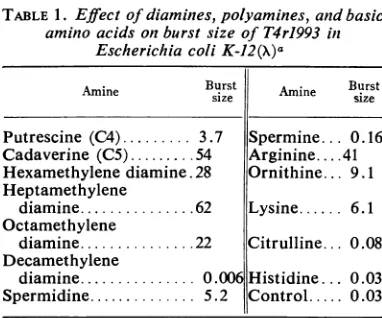
which may not be optimalfor each one. Theresultsof one such experiment arepresentedin Table 1. In thehomologousseries
of methylene diamines, heptamethylene diamine
and cadaverine were most effective, whereas
decamethylene diamine was inhibitory.
Qualita-tively similar results werereported by Brock (8),
butshereported lower phage yields, presumably,
as we shall see later, because of the presence
of NaClinthe medium.Recently,thestimulatory
properties of putrescineandspermidinehave also
been recorded (2).
Several of the basic amino acids were also
tested. Of these, arginine was the most effective
supplement, allowinginthis experimentthe
pro-duction of41progenyphageparticlesperinfected cell. From one experiment to another, the burst
size with any of the effective compounds varied
as much as recorded above for spermidine, but
qualitatively the compounds were always
effica-cious. Nostimulationof
rII
growth was observedwith nonbasicamino acids. The action ofarginine, ornithine, andlysine is of interest, because they,
incontrast tothe other effectivecompounds,offer
noapparent osmotic advantage over monovalent
cations for the neutralization of fixed anions.
This isrelevant to the site of action of the
effec-tivecompounds andsuggeststhat it is not merely
neutralizationof DNA.
Phage content of putrescine and
speimidine.
Amesand Ames (2)reported that putrescine leaks
out ofacell infected with rII phage and that the
TABLE 1. Effectofdiamines, polyamines, and basic
amino acidsonburst size of
T4rJ993
inEscherichia coliK-12(X)a
Amine Burstsize Amine Burstsize
Putrescine (C4)... 3.7 Spermine... 0.16 Cadaverine (C5)...54 Arginine....41 Hexamethylene diamine .28 Ornithine ... 9.1 Heptamethylene
diamine... 62 Lysine... 6.1
Octamethylene
diamine... 22 Citrulline... 0.08
Decamethylene
diamine... 0.006Histidine... 0.03
Spermidine... 5.2 Control. 0.03 aMultiplicity of infection = 7. Dilution and additionof0.03 M amine at 8 minafter infection.
3(00
J. VIROL.on November 11, 2019 by guest
http://jvi.asm.org/
[image:3.485.252.443.461.620.2]leakage isnotinhibited by
Mg++.
If the effective compounds function by replacing putrescine intheneutralization of DNA, their presence would
result in a lesser amount ofputrescine packaged
withintheprogenyphage.Totestthispossibility,
T4r+ and rII phagewere grownintryptone-Mg++
medium within K-12 (X) orK-12 bacteria. After
purification by differential centrifugation, the
phagewerehydrolyzed with acid, and the
hydroly-satewaschromatographed onDowex-1 columns.
The data of Table 2show thatmutant and
wild-typephagehavesimilarpolyaminecontents which
donotvarywhether the host is K-12orK-12 (X), or whether the mutation is in the A cistron
(rl993) or B cistron (r638). Comparison of the
last two lines ofTable 2further reveals that the
presence of Mg++ in the medium does not alter
phage polyamine content. It is apparent that
mutant phagegrown either in K-12 (X) or inthe
permissive host K-12 have sufficient polyamine
available toallowanormal pattern of DNA
neu-tralization andincorporationintoprogenyphage.
The datastronglysuggestthat theinabilityofrII
togrowinK-12(X) under standard conditions is
not due to a lethally insufficient availability of
polyamines.
Admittedly,thedata donotsayanythingabout
polyamine concentrations under nonpermissive
conditions. This leaves the possibilitythat Mg++
mayrelieveapolyamine shortage by substitution
elsewhere in the cell. An argument against this
possibility is indicated by the stability of
poly-amine content in the presence or absence of
Mg++,
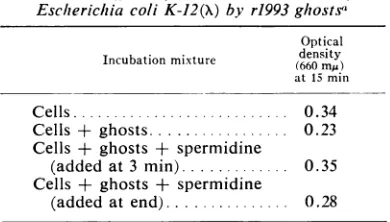
and withinmutant or wild-type phage.Inhibition ofghost-induced lysis by spermnidine. Since the stimulatory effect of polyamines does
[image:4.485.252.447.73.184.2]not appeartobe relatedtoDNA neutralization,
TABLE 2. Piutrescine andspermidine in T4
bacteriophage
Sample
Phage Host AMedium
r1993 K-12
Tryptone-Mg++
r638 K-12
Tryptone-Mg++
rl993 K-12(X)
Tryptone-Mg++
r+ K-12
Tryptone-Mg++
r+ K-12(X)
Tryptone-Mg++
r+ K-12(X)Tryptone-Na
Amtper1013
phage(pmoles)
u
E~~~~~
0.970.36, 3.0 2.7
1.120.37 3 .3 3.0
1.09'0.37 3.3 2.9
1.170.41 3.6 2.9
1.20 0.35 3.4 3.5
[image:4.485.51.244.449.639.2]1.260.381 3.6 3.3
TABLE 3. Effect ofspermidine
onI
lysis ofEscherichia coli K-12(X) by
rJ993
ghostsaOptical Incubation mixture (660densitympA)
at15min
Cells... 0.34 Cells + ghosts... 0.23
Cells + ghosts + spermidine
(addedat 3 min)... 0.35
Cells + ghosts + spermidine
(addedat end)... 0.28
Final concentrations in incubation mixtures
were 3 X 10⁸ cells/ml, 1.6 X 10⁹ ghosts/ml, 0.16
M NaCl, 0.05 M spermidine, and 1% tryptone. Total volume 4 ml. Mixtures were mechanically shaken at 37 C for 15min and absorbancy was read at that time.
other structures known to bind cationic
com-pounds were considered. It has been suggested
that, in this system, Mg++ may prevent cellular
leakage of essential components (11). To decide
whether a similar function can be ascribed to
spermidine, wemeasured itseffect oncell lysis by
phage ghosts. In Table 3, comparison of lines 2
and 4showsthat spermidine,which hasnoeffect
on the absorbancy of untreated cells, increases
the absorbancy of ghost-treated cells. This
phenomenon dims but does not obscure the
demonstration that spermidine inhibits
ghost-induced cell lysis, behavior consistent with the
idea that the effective siteofpolyamine action is
at thecellenvelope.
Replication of
T4rIi
in presence of sucrose:effect of monovalent and divalent cations. To
determine whetherthecellenvelopeisrelevant to
therII defect, weattemptedto measurethe
effect
of amine supplements oninfected protoplasts. In
the course of theseexperiments, which were
un-successful because of excessive fragility of
rII-infected cells, certain controls revealed that
sucrose alonewould allow growth ofrII in K-12
(X). Table 4 shows that theoptimalsucrose
con-centration forrII growthwas0.4M,atwhich
con-centration average burst sizes in different
experi-ments rangedfrom 5 to 35 with a mode around
10. The averageyield ofr+ wasalsoincreasedby
sucrose, but at a lower optimalconcentration of
0.3 M. It appears from the inhibition of r+ by
sucroseat aconcentration of0.4Mthat anoptimal
concentrationfor rIIinvolves a balance between
stimulation of
rII
growth andinhibition ofhost-cell metabolism.Athigher concentrations, growth
of both phages was severely restricted. Control
experiments showedthat the loweredyieldswere
not caused by phage death with high sucrose
concentrations.
on November 11, 2019 by guest
http://jvi.asm.org/
BULLER AND ASTRACHAN
TABLE4. Effect of sucrose on growth of r+ and r1993 in Escherichia coli K-12 (X)a
Burstsize Sucrose concn
r1993 r+
0 0.075 187
0.3 3.6 253
0.4 7.6 140
0.5 7.4 52
0.6 1.2 11
0.7 0.1 0.9
Multiplicity of infection:
r1993
= 12,r+ =6.8.Dilution andadditionof sucroseat 8min.
In our experiments, which partially overlap
two other reports (8, 27), we attained rII phage
yields intermediate between the results in the
other two reports. Themajor factor contributing
tothedifferentyieldswasprobablythe amountof
monovalent cation in the incubation mixture.
Whenitis considered that 1% tryptone contains
approximately 0.01 M Na+, the shape of the
curvein Fig. 1relatingrIIyieldin sucrosetosalt
concentration suggests that the yields would be
considerablyaugmented in the absence ofinherent monovalent cation. Sekiguchi (27) reported near
wild-type
yields
of rII in sucrose, but theseyields were obtained in a medium containing
only0.2% tryptone andconsequently significantly
lesssalt.This mayalso account for thesurprising factthatSekiguchi found0.15Msucrose tobeso
effective.With respecttospermidine,theinherent
Na+isofnoconsequence, but ifspermidine were
addedtothe usualmedium, which contains 0.05
to0.1 MNaCl for phageadsorption, veryfewrII
progenywould be formed. Theeffect ofMg++is
alsogreatly inhibitedby monovalentcations (11).
Although phenotypic reversion of the rII
defect was achieved with sucrose, the phage
yields inourexperiments didnotapproach
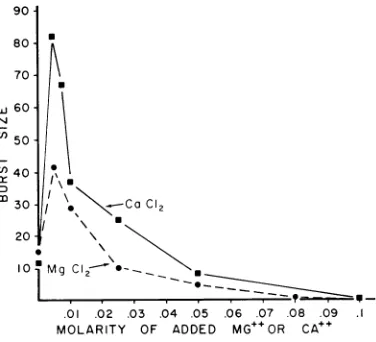
wild-type values. Since low concentrations of Ca++
added to sucrose are known to stabilize
osmot-ically fragile organelles (16), we assessed this
effect in the rll system. Figure2showsthatCa++
or Mg++, at concentrations too low to be of much effect by themselves, greatly augmented
the burst size in the presence of sucrose. The
yields ofrII phage, in sucrose media containing
an optimal 0.002 to 0.005 M
Ca++,
varied from80to130phage perinfected cell and were always
higher than those attained with
Mg++.
On theother hand, when Ca++ or Mg++ ions were
present at concentrations (0.05 to 0.08 M) at
which they produced maximal rll yields in the
absence of sucrose, the yields were sharply
reduced. Inanexperiment in which infected cells
were lysed with chloroform at various times
after infection, it appeared that sucrose plus
0.003 M Ca++ had two antagonistic effects. The
mixture slowed the rate of phage synthesis but
1.0u ,-9.
.4
n
.7-
.65-D
.5-.i .3
llJ
.2
.1
-0
\-SPERMMIDINEF
-.-SUCROSE
U-.061 .02 .03 .04 .05 .06 .07 .08 .09 .1
MOLARITY OF ADDED NA+ OR K+ FIG. 1. Effect of monovalent cations on sucrose-or spermidine-stimulated rnI growth in Escherichia
coli K-12 (X). Sucrose:r1993 multiplicity of infection
= 5. Varyingconcentrations ofKCIin 0.5Msucrose.
Dilution intofinalmixtureat8minafter infection. On
ordinate, 1.0 equals a burst size of11. Spermidine:
r1272multiplicityofinfection = 7.3. Varying
concen-trations ofNaCI in 0.03Mspermidine. Dilution at 7
min; 1.0 = burstsizeof32.
90a 80a 70-ii 60
N lI
50
ar
40
-,\
10;20M\mg
.01 .02 .03 .04 .05 .06 .07 .08 .09 .I
MOLARITY OF ADDED MG++OR CA++
FIG. 2. Burst size in 0.5M sucrose of T4rJ993
grown in Escherichia coli K-12 (X). Effect of Ca++
and Mg++. Forboth experiments, multiplicity of
in-fection = 8and dilution intofinalincubation mixture
was at 7minafter infection.
302 J. VIROL.
u
r,
u
u
a
a
u
I
on November 11, 2019 by guest
http://jvi.asm.org/
[image:5.485.48.241.68.203.2] [image:5.485.253.442.128.322.2] [image:5.485.255.443.421.592.2]delayed lysis of both r+ and rll-infected cells so that increased yields were eventually obtained.
The sucrose-Ca++ mixture thus appears to
functionbypreservingtheintegrityof theinfected
cells.
Swelling and absorbancy changes of infected
cells. Two other lines of evidence indicate that
the rll defect involves a
leaky,
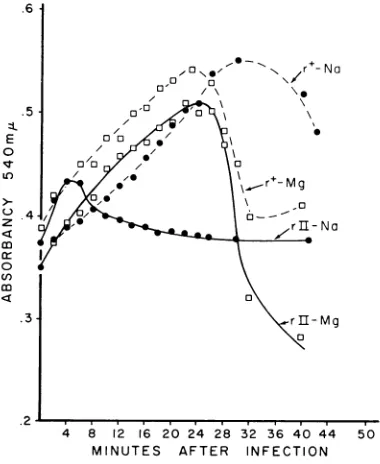
defective cellenvelope. Figure3shows how
absorbancy changes
with time after infection with r+ or r1993.Cells,
infected with rll in the presence ofMg++orwith
r+in the presence or absenceof
Mg++,
followedthe same pattern of increasing absorbancy until
thetimeoflysis. Therll-infected cells in the
ab-sence of Mg++ followed the pattern for only 4
min,afterwhich timeagradual declineoccurred.
A decrease in absorbancy has been used as an
indication ofmitochondrial
swelling
(25);
in thepresentexperiments, suchadecrease isconsidered
toindicatethatthecellsswellandlose
refractility.
A more direct indication ofswellingis
provided
in Fig. 4, where it can be seen that rll-infected
cells swell more thanr+-infected cells. Forthese
experiments,densecellsuspensions of
centrifuged
log-phase cells were infectedwith T4r+ or r1993
atmultiplicities greater than 12. Throughout the
.6
,o,~ s,r+-Na
r]-4-,
en \
0
0
4 8 12 16 20 24 28 32 36 40 44 50 MINUTES AFTER INFECTION
FiG. 3. Absorbancy changes ofK-12 (X) with time
after infectionwithT4r+orT4r1993:effectofmedium.
Cellsat2.5 X 108 in tryptone-Na- ortryptone-Mg++
were infected with T4r+or T4r1993 at a multiplicity
of6. Infectedcultures wereaeratedat37C, and
sam-ples wereremovedat 2-minintervals. Absorbancy was
read at 540 myi in cuvettes thermostatted at 30 C.
Lii E 20
J
0 >
15-z
Lii 10
c-)
Lii u- 5-z z o Lii lii 0.
a
~~~/
0 0r
2 4 6 8 10 12 14 16 18 20 22 24
MINUTES AFTER INFECTION
FIG. 4. Volumechanges upon infection ofK-12 (X)
withr+ orr1993phage. Cells,grown to3X 108/mlin
tryptone-Na+, were harvested, washed, and
resus-pended in the same medium at 4 X 10¹⁰ cells/ml.
A 1-ml amount ofsuspension in a 25-ml Erlenmeyer
flask wasinfectedwithr+ orr1993at multiplicities of 13.5. Infected cells were shaken vigorously at 37 C.
At2-minintervals,sampleswere withdrawninto
hema-tocritcapillaries, sealed with plasticene, and heldinan
ice bath until the end of the experimenzt. Capillaries
werecentrifuged, and the volume of packed cells was
measuredas apercentage of the totalsample volume.
courseofinfection, sampleswerecentrifugedand
thevolumeofpacked cellswas measured. It was
necessary to shake the infected cells vigorously
to prevent too early lysis. When the cells were
infected with
multiplicities
lower than 10, noswellingwasobserved.This mayindicate that the
observed differencesathighermultiplicities repre-sent some lysis from without. It is nevertheless
significant that r+-infected cells were better able
to withstand such lysis than were cells infected
withrII. In someexperiments,thecell volume of
r+-infected cells also increased, but always less than a parallel culture infected with rII. When
Na+ was replaced by Mg++, the volumesof
rll-infectedcells were,asexpected, thesame asthose
ofwild type.
Cell-envelope components.Al thedatapresented
thusfarwarrant
investigation
ofthe cellenvelope
as a possible site ofthe rII defect. More in thenature ofeliminatinga possibility, we examined
thehost-cell mucopeptides becausetheyare
gen-erallyconsideredtoplayanimportantrole in the
structuralintegrityof the cell. Since the rlldefect
is innocuous inE.coliK-12,themucopeptides of
this organism (uninfected) were extracted,
purified, andcomparedwith those ofE.coli K-12
(X) (21). The reason for this comparison is that
K-12 doesnotneed therIIproduct wheninfected
on November 11, 2019 by guest
http://jvi.asm.org/
[image:6.485.248.440.68.235.2] [image:6.485.45.235.346.578.2]BULLER AND ASTRACHAN
because it must differ in some way from K-12
(X). Whatever the difference, it was not detected
inacid hydrolysates of mucopeptides from thetwo
organisms whichcontained nearly identical molar
ratios of alanine, glutamic acid, lysine,
diaminopimelic acid, muramic acid, and
hexose-amine. Attempts were made toextendthis
com-parison to mucopeptides of K-12 (X) infected
with r+ and rII, but these experiments were
abandoned when it was found that the
muco-peptides ofr+-infected cells had already suffered
some hydrolysis at 10 to 12 min after infection.
(The mucopeptides were solubilized during a
formic acid extraction step, which does not
solubilize intact mucopeptides.) Since
muco-peptide is hydrolyzed early in wild-type phage
infection, itis probablynotthe specific structure
that differentiatesbetween mutant and wildtype
in the maintenance of cell integrity. This was
perhaps predictable because the rll-infected cells
do not swell excessively nor lyse but appear to
havea permeability defect whichwould be more
reasonablyassociated with the cell membrane.
Phospholipids, found in high concentrations
in the cell membrane, are also known to bind
polyamines. We examined the biosynthesis of
phospholipids ofK-12 (X) after infection withr+
and rII and in uninfected bacteria. Log-phase
cells of E. coli K-12 (X) intryptone-Mg++ were
exposed to 32P-labeled orthophosphate. One
minute later, twoofthree samples were infected
with wild-type or mutant phage. At the times
indicated in Table 5, samples were taken for
phospholipid extraction, and the phospholipids
were subsequently separated by thin-layer
chro-matography. Thematerialintheseparated bands
was analyzed for radioactivity and total
phos-phorus. The results presented in Table 5 reveal
that infection with T4 phage causes a marked
inhibition ofPEsynthesisandaslightstimulation
of PG synthesis. However, nodifferencewas
ob-served between r+- and rll-infected cells. Similar
results have been reported recently in
experi-ments with E. coli B (M. H. Furrow and L. I.
Pizer, Bacteriol. Proc., p. 26, 1967).
Inlaterexperiments, we found that 20to25%C/=
ofthephosphorusin the PGband is in the form
of cardiolipin (diphosphatidylglycerol). This
could introduce a great error in the specific
ac-tivities recordedfor PG if32Pwere incorporated
exclusively into either PG or cardiolipin. From
preliminary measurements of the distribution of
radioactivity between PG and cardiolipin, we
could calculate that the recorded PG specific
activities are 10%' too high for the rll-infected
cells and approximately 10%I too low for the other two. This does not change the conclusion
that T4infectionhas slight effect onPG
biosyn-thesis,whereas itmarkedly inhibits PEsynthesis.
DISCUSSION
Duringinfection ofahost cell, a hole is made
inthe cellenvelopetoallow penetrationby phage
DNA.Puck andLee(24) haveshownthat leakage
of cellular substances occurs inT-eveninfections
but eventually stops. With T4rII infection of E.
coli K-12, (X) however, loss of putrescine (2),
[image:7.485.55.451.437.577.2]nicotinamide adeninedinucleotide,and ATP (27)
TABLE 5. Intcorporationt of32p i/itophospholipids ofuninflitedan1dr+- antdrII-inifected
Escheric/ia coli K-12(X) 't
Uninfected r+-infected rll-infected
Min
Mp
afterafe I'}lospho-iPopho-
Cotunts
Counts Counts32p lipid
'Counts/min
Atofp permin CountsC'minper Counts Amt of permi.i
(X105) Amt perpmole (X 1O5) Amtof perAmole mi p pier,emolepmitoles u,ioltes inoloes
6 PG 0.21b 0.1 lb 1.9 0.37b 0. 9lb 1.9 0.64 0.38 1.7
11 PG 1.06 0.38 2.8 1.51 0.32 4.7 1.61 0.34 4.7
21 PG 2.43 0.48 5.1 2.97 0.44 6.8 2.56 0.40 6.4
6 PE 0.30b 0.47b 0.64 0.41b 0.58b 0.7 0.53 1.03 0.5
11 PE 1.80 1.15 1.6 0.94 0.91 1.0 1.02 0.91 1.1
21 PE 4.65 1.14 4.1 1.53 1.02 1.5 1.62 1.01 1.6
aPhospholipidswereextractedfrom2.7 X 1010bacteria(viableassayjust before32Paddition and in-fection with phage) after various durationsof 3pincorporation. Thephospholipids were separatedby thin-layerchromatography beforeassayof totalPandradioactivityin the PG and PE. Theamountsof
PE and PG perbacterial cell mayappeartobe ratherhigh. This isprobably relatedtothe factthat the
cells were grown intryptone-Mg++,inwhichmedium thecellsaremuchlargerthannormal.
b We lost partof thelipidextracts from the6-min r+-infectedand uninfectedsamples. Thisdoes not
affectthespecificactivitydatapresented.
304 J. VIROL.
on November 11, 2019 by guest
http://jvi.asm.org/
continue. The cell is fragile, low in ATP, unable
totolerate monovalent cations, and incapable of
producing progeny phage. Some of these faults are reversed sufficiently toallowphage
synthesis
when any of a number of chemicalsareaddedto
the medium. The rII block can be partially
relieved by arginine, spermidine, and certain
diamines. These substances, like Mg++, operate in a diversity of biochemical systems and,
there-fore, donotallow apreciselocalization of where
or howtheyactto overcometherIIdefect.
How-ever,they are not needed torelievea deficiency
of polyamines within the cell, since sufficient
putrescine and spermidine are available for
normal neutralization of DNA and
packaging
into progeny phage. The fact that spermidine
inhibits ghost lysis suggests that the polyamine action is not localized in the cell interior. The
efficacious action of sucrose, which does not
cross the
permeability
barrier ofthecell,
points
to anosmotic
problem
andthereby
afaulty
cellenvelopeassociated with therIIdefect. This
inter-pretationis furthersupported
by
thefinding
thatrII-infected cells lose
refractility
and swell.Infact,
all
of
thedatapresented
hereareconsistentwiththe idea that the
rII
defect is somehowasso-ciated with altered permeability. Nearly all the
effective additives have, in one system or
an-other, been shown to stabilize
fragile
cells orprotoplasts. Furthermore, cations which affect rII
multiplication
have direct effects on theplasmamembrane. Exposure ofamoebaetoNa+
causes
swelling
and lowered electrical resistanceof the
plasma
membrane,
coincident within-creased
permeability
(7).
The addition of Ca++or sucrose hasthereverse effect.
Thus,
an agentwhich increases
permeability
inhibits rIImulti-plication, and agents with the reverse effect are
stimulatory.
Finally,
another indicationthat therII product is involved with the cell
envelop
is thephenomenon oflysis
inhibition in E. coliB. This phenomenon occurs when the cell is firstinfected withr+ phage and then reinfected with
either mutant or
wild-type phage.
Since thesecond infection is not
specific
and also since it can occur so late that thesuperinfecting
phage
DNA cannot provide progeny genes, action at
the surface is
indicated,
presumably
with aproduct whose nature is determined
by
rI, rII,and rIIIgenes.
There seems little doubt that in someway the
rll defect inE. coli K-12
(X)
results inafaulty
cell envelope. But theunansweredquestions
arewhy is the
envelope
defectiveandhowdoeswild-type rII product maintain it. We have
presented
evidence that
phospholipid
synthesis
is alteredafter phage
infection,
as indicatedby
thede-creased synthesis of PEand increased
specific
activity in the PG band. It was disappointing, if not surprising, tofind no difference in
phospho-lipid synthesis between r+- and
rhl-infected
bac-teria. It is clear that phage infection has a
pro-found effect on phospholipid metabolism, and
this would appear to be an appropriate area of
study for detecting a defect in cell-membrane
synthesis. Ofcourse, even if the rll defect were
concerned with some aspect of membrane bio-synthesis, the study of 32p incorporation into PE and PG could only be a crude start at delineating
the nature of the defect. The answer could as
wellcome from a study ofminor phospholipids,
the proteins(s) of cell membrane, or the lipid
componentsofthephospholipids. Recent results
in this laboratory (M. Aghdashi and L.
Astrachan, unpublished data) reveal that rII may
be distinguished from r+ by the fact that rII infection causes a much greater stimulation of
32p incorporation into cardiolipin. This phenom-enon was not detected in the presently reported
experiments because the thin-layer solvent
system we used does not separate PG from
cardiolipin. Theeffect oncardiolipin synthesis is
detected after separation by column
chromatog-raphy ofthelipids (26, 29) or of the deacylated
backbones (33). Even though a difference
be-tween r+- and
rhl-infected
cells can be observed,this does notnecessarily point directly to the rll
defect. The difference could occur if the specific
defect were inadequate synthesis of ATP or
some other essential substrate, with the
conse-quence that a reaction involved in membrane
synthesis does not occur. For the time, the best
that can be said is that achemicalphenomenon,
of
possible
interestin thesynthesisof membranephospholipids, has been detected in association
with the rII defect. It is interesting that ATP
formation and cardiolipin synthesis are both
associated with the
rII defect,
because ATPfor-mation is so often associated with membranous
structures. The identification of which
phenom-enon is causative
(if,
indeed, eitherone is) mustawait identification ofaparticularenzyme activity
present in thewildtype andabsentin the mutant.
Ourefforts willbedirectedto thecharacterization
of the
phospholipid
difference and, if successful, tothestudy ofitsmetabolism.ACKNOWLEDGMENTS
Thisinvestigationwassupported by Public Health
Service researchgrant 5 ROI AI-04884from the Na-tional Institute of Allergy and Infectious Diseases and by Public Health Service Research Career
De-velopment Award 5-K3-GM-4673 to L. Astrachan.
The technical assistance ofJoan Miller is
grate-fullyacknowledged.
on November 11, 2019 by guest
http://jvi.asm.org/
BULLER AND ASTRACHAN
LITERATURE CITED
1. ADAMS, M. H. 1959.Bacteriophages. Interscience,
New York.
2. AMES, C. F., AND B. N. AMES. 1965. The
multi-plication ofT4rII phage in E. coli K12(X) in
the presence of polyamines.Biochem. Biophys.
Res. Commun. 18:639-647.
3. AMES, B. N., AND D. T. DUBIN. 1960. Therole of
polyamines in the neutralization of
bacterio-phage deoxyribonucleic acid. J. Biol. Chem.
235:769-775.
4. AMES, B. N., D. T. DUBIN,ANDS. M.ROSENTHAL.
1958. Presence of polyamines in certain
bac-terial viruses. Science 127:814-815.
5. BACHRACH, U., AND 1. COHEN. 1961. Spermidine
in thebacterialcell.J. Gen.Microbiol. 26:1-9.
6. BENZER,S. 1955.Finestructureofagenetic region
in bacteriophage. Proc. Natl. Acad. Sci. U.S.
41:344-354.
7. BRANDT, P. W., AND A. R. FREEMAN. 1967.
Plasma membrane: substructural changes
cor-related with electrical resistance and
pino-cytosis. Science 155:582-585.
8. BROCK, M.L.1965. The effectsof polyamineson thereplicationof T4rII mutants inEseherichia coli K12(X). Virology 26:221-227.
9. COHEN, S. S., ANDJ. LICHTENSTEIN. 1960.
Poly-amines and ribosome structure. J. Biol. Chem.
235:2112-2116.
10. DUBIN, D. T., AND S. M. ROSENTHAL. 1960.
The acetylation of polyamines in Escherichia
coli. J. Biol. Chem. 235:776-782.
11. GAREN, A. 1961. Physiological effects of rII mutations in bacteriophage T4. Virology 14:151-163.
12. GRISWOLD, B. L., F. L. HUMOLLER, AND A. R.
MCINTYRE. 1951. Inorganic phosphates and
phosphate esters in tissue extracts. Anal. Chem. 23:192-194.
13. HERBST, E. J., R. H. WEAVER,ANDD.L.KEISTER. 1958. Thegramreaction and cellcomposition: diamines and polyamines. Arch. Biochem. Biophys. 75:171-177.
14. HERRIOTT, R. M., AND J. W. BARLOW. 1952. Preparation, purification and properties of
E. coli virus T2. J. Gen. Physiol. 36:17-28.
15. HERRIOTr, R. M., AND J. W. BARLOW. 1957. Theproteincoats or"ghosts" ofcoliphageT2.
1. Preparation, assayahd somechemical
prop-erties.J.Gen. Physiol.40:809-825.
16. JOHNSTON,F. B.,G. SErrERFIELD, ANDH.STERN.
1959. The isolation of nucleoli from
ungermi-nated pea embryo. J. Biophys. Biochem. Cytol. 6:53-56.
17. KANFER, J., AND E. P. KENNEDY. 1963. Metabo-lism and function of bacterial lipids. I.
Me-tabolism of phospholipids in Escherichia coli
B. J. Biol. Chem.238:2919-2922.
18. MAGER, J. 1955. Influence of osmotic pressure
on the polyamine requirements of Neisseria
perflava and Pasteurella tularensis for growth
in defined media. Nature 176:933-934.
19. MAGER, J. 1959. Spermine as a protective agent
against osmotic lysis. Nature 183:1827-1828.
20. MAGER, J. 1959. The stabilizing effect of
sper-mine anid related polyasper-mines on bacterial
protoplasts. Biochim. Biophys. Acta
36:529-531.
21. MANDELSTAM, J. 1962. Preparation and
prop-erties of the mucopeptides of cell walls of
gram-negative bacteria. Biochem. J. 84:294-299.
22. MOORE, S., AND W. H. STEIN. 1948. Photometric
ninhydrin method for use in the chroma-tography of amino acids. J. Biol. Chem. 176: 367-388.
23. PUCK,C. W. 1960. Thestabilizing effect of
sper-mine and related amines onmitochondria and protoplasts. Biochem.Biophys. Res.Commun. 2:117-120.
24. PUCK, T. T., AND H. H. LEE. 1954. Mechanism
of cell wall penetration by viruses. I. An
in-crease in host cell permeability induced by
bacteriophage infection. J.Exptl.Med. 99:481-494.
25. RECKNAGEL, R. O., AND S. MALAMED. 1958.
The osmotic nature ofmitochondrial swelling
producedby carbontetrachloride andinorganic
phosphate. J. Biol. Chem. 232:705-713.
26. ROUSER, G., C. GALLI, E. LIEBER, M. L. BLANK,
XND 0. S. PRIVETr. 1964. Analytical
frac-tionation of complex lipid mixtures: DEAE
cellulose column chromatography combined
with quantitative thin layer chromatography.
J. Am. Oil Chemists Soc. 41:836-840.
27. SEKIGUCHI,M. 1966. Studiesonthephysiological
defect in rIl mutants of bacteriophage T4.
J.Mol. Biol.16:503-522.
28. SKIPSKI, V. P., M. BARCLAY, E. S. REICHMAN,
AND J. J. GOOD. 1967. Separation of acidic
phospholipids by one-dimensional thin-layer
chromatography. Biochim. Biophys. Acta
137:80-89.
29. STANOCEV, N. Z., Y-Y. CHANG, AND E. P.
KEN-NEDY. 1967. Biosynthesis of cardiolipin in
Eseherichia coli. J. Biol.Chem. 242:3018-3019. 30. TABOR, C. W., AND H. TABOR. 1966. Transport
systems for 1,4-diaminobutane, spermidine,
andspermine inEscherichiacoli. J.Biol. Chem.
241:3714-3723.
31. TABOR,H.,C. W.TABOR, AND S. M.ROSENTHAL.
1961.Thebiochemistryofpolyamines:
spermi-dine and spermine. Ann. Rev. Biochem. 30:
579-604.
32. VORBECK, M. L., AND G. V. MARINETrI. 1965.
Separation ofglycosyl diglycerides from
phos-phates using silicic acid column chroma-tography. J.LipidRes.6:3-6.
33. WELLS,M.A.,ANDJ.C.DITrMER. 1966. A
micro-analytical technique for the quantitative
de-termination of twenty-four classes of brain
lipids. Biochemistry5:3405-3418.
306 J. VIROL.
on November 11, 2019 by guest
http://jvi.asm.org/
34. YANOFSKY, C., AND I. P. CRAWFORD. 1959. The
effectsofdeletions, point mutations, reversions
and suppressor mutations on the two compo-nents of the tryptophan synthetase of Escherichia coli. Proc. Natl. Acad. Sci. U.S.
45:1016-1026.
35. YANOFSKY, C., AND J. ITO. 1966. Nonsense
codons and polarity in the tryptophanoperon.
J.Mol. Biol. 21:313-334.
36. ZILLIG, W., W. KRONE, AND M. ALBERS. 1959. Untersuchungen zurBiosynthese der proteine.
III. Beitragzurkenntnis derzusammensetzung
und struktur der ribosomen. Z. Physiol. Chem.
317:131-143.