General Studies Programm (GSP) Activity
Laser-Plasma-Accelerator’s Potential
to Radically Transform Space
Radiation Testing
by
Strathclyde
University of
Laser-Plasma-Accelerator’s Potential to Radically
Transform Space Radiation Testing
ESA General Studies Programme (GSP) Activity
Contract No. GSP-SOW-10-xx116 // RFQ 3-13258/11/NL/AF
Final Report
B. Hidding
1,2,4, O. Karger
2, T. Königstein
3,
G. Pretzler
3, J.B. Rosenzweig
41 Scottish Center for the Application of Plasma Accelerators, University of Strathclyde, Physics Department, Glasgow G4 0NG
2 Institut Für Experimentalphysik, Universität Hamburg, 22607 Hamburg 3Institute of Laser and Plasma Physics, Heinrich-Heine-University Düsseldorf, 40225
Düsseldorf
4 Department of Physics and Astronomy, University of California, Los Angeles
Hamburg, Germany
Contents
1 Executive Summary 1
2 Introduction 4
3 Proof-of-Concept experiments with laser-plasma-produced space
radi-ation 6
4 Summary, Outlook and Roadmap 15
5 Acknowledgements 19
List of Figures
1 ICUIL world map of ultrahigh intensity laser systems. . . 5 2 Setup inside the irradiation chamber. The indident laser system is
strongly focused on an Aluminum foil target, where the radiation is produced. Focus diagnostic microscope objective, image plate (IP) stack and permanent magnet based spectrometers in forward and backward direction are shown next to the target foil position-ing system. . . 7 3 Electron flux according to AE8max at the important orbital
dis-tances of GPS, Galileo (both around medium Earth orbits (MEO)) and at geosynchronous orbit (GEO). Fitting exponential particle distributions leads to temperatures in the range ofTeff ≈0.4−0.62
MeV (from [1]). . . 8 4 First laboratory based reproduction of space radiation (as present
at GPS satellite level) with laser-plasma-generated bunches in the present project.) . . . 9 5 Left: Set of optocouplers on mounting foil. Right: Radiography
image on image plate resulting from irradiation. . . 10 6 DUT degradation after irradiation: Optocoupler CTR degradation
after irradiation with laser-plasma-produced radiation belt flux. . . 11 7 Reduction of exponential-energy electron flux due to energy-dependent
velocities and divergence. In a), the flux of a beam withTeff =0.35 MeV,Q=100 nC and a divergence ofθ =25◦through a DUT area
of 1 cm2 is calculated at distances 0.1 cm, 1 cm, and 10 cm behind
target (note the logarithmic scaling). Next, the influence of the divergence is visualized by plotting the flux through 1 cm2 after
a distance 1 cm (b) and 10 cm (c) for the beam with parameters as in a), but for a hypothetical divergence of θ = 0◦ and θ = 25◦
(from [1]). . . 12 8 Spectral flux in Jupiter’s radiation belt. a) Flux at a distance of 5RJ
and 9 RJ, b) Overlaying three exponential spectra can reproduce
with high accuracy the flux expected at 9RJ (from [1]. . . 14
9 Fluence after 1000 seconds produced with laser systems of differ-ent repetition rate when compared to linacs. . . 16 10 Roadmap for the development of laser-plasma-accelerator based
1
Executive Summary
Laser-plasma-accelerators are relatively new accelerator devices which are char-acterized by being very compact, which is the result of the giant electric accel-erating fields present in strongly focused, high-power ultrashort laser pulses. Peak intensities of modern laser systems can reach 1022W/cm2 or more, which is many orders of magnitude larger than the complete sunlight incident on Earth, if it were collected and focused at the same time onto an area of a tip of a pencil. Such intensities make such laser systems attractive for many applications, as ex-otic as inertial confinement fusion and producing ultrashort electron beams with GeV-scale energies or advanced light sources such as free-electron lasers, or those based on inverse Compton scattering and betatron radiation. The woldwide booming community in this fields works towards these applications which have highly stringent demands on beam quality, as an alternative to well-established accelerators based on radiofrequency cavity based accelerators such as linacs (for electrons) and cyclotrons (for protons and ions). Breakthroughs were achieved in 2004, when for the first time instead of spectrally very broadband and rather divergent particle beams, pencil-like electron beams with quasi-monoenergetic electron bunch distribution were generated. Beam quality in terms of narrow en-ergy spread and larger energies (beyond the GeV barrier) improves continuously and rapidly, fueled by progress in terms of understanding and by ever increasing laser power and technology readiness. In contrast to such highest-quality beams which are needed for example for free-electron-lasers, space radiation which harms electronics and living systems outside Earth’s protective magnetic fields, is always very broadband. In fact, conventional accelerators always automati-cally produce very narrowband particle beams, which are unnatural. It has been proposed (and patented) for the first time in 2009 to use compact laser-plasma-accelerators to produce broadband radiation such as present in space and to use this for radiation hardness tests. Such broadband radiation is the inherent regime of laser-plasma-accelerators. The difficulty of laser-plasma-accelerators to produce monoenergetic beams is turned into a noted advantage here. Since producing broadband radiation is possible since many years with laser-plasma-accelerators, this application is one which has been ”left behind” for many years now due to the community seeking to produce more monoenergetic beams such as with conventional accelerators.
candi-date as a benchmark for other radiation sources, which produce monoenergetic beams based on which also the use of degraders cannot reproduce space ra-diation which is characterized by a decreasing (often exponentially decreasing) spectral flux towards higher particle energies. Spectral flux shaping by tuning the laser-plasma-interaction parameters has been demonstrated, for example to reproduce the electron flux incident on satellites on GPS orbits according to the AE8 model. Sophisticated diagnostics, readily available from the laser-plasma-community as well as the traditional accelerator laser-plasma-community, which are increas-ingly merging (again), have been used to characterize and monitor the flux. State-of-the-art radiation hardness testing techniques have been adapted to the laser-plasma radiation source environment, test devices have been exposed to laser-plasma-generated space radiation and it was shown that the performance of these electronic devices was degraded. With the exception of doing radiation tests directly in space, these irradiation campaigns may have been the most re-alistic space radiation tests to be carried out in the laboratory here on Earth to date. The approach of reproducing space radiation flux directly in the lab has hitherto not been accessible, which is why approximative techniques employing monoenergetic beams had to be used. This clearly demonstrated the applicabil-ity of laser-plasma-accelerators for space radiation reproduction, and is currently triggering large interest in the laser-plasma-community. Other advantages of laser-plasma-accelerators are that they can produce electrons, protons and ions alike – even at the same time – as well as enormous peak flux, which may allow for exploration of nonlinear response of electronics and biological systems.
in laser technology quickly converts prototype, cutting edge laser technology to commercially available off-the-shelf products. Highest power (hundreds of TW or even PW) laser systems are also characterized by relatively low repetition rate (typically, 10 Hz or less), but there is much movement on this front, too, and kHz systems are already available. Generally speaking, the higher the obtainable particle energies, the lower the repetition rate. This further supports the advised strategy to start the establishment of laser-plasma-accelerators in the space radi-ation field with reproduction of broadband, lower energy electrons and protons. In this regime, the laser shot repetition rate can be very high, currently up to hundreds of kHz, which increases the average flux. It is estimated that with such systems, for example satellite-relevant fluence can be produced within ir-radiation times which are orders of magnitude shorter than at large facilities. The development of high power thin-disk and fiber lasers and optical paramet-ric amplification (OPA) technology deserves special attention. Such lasers do not only allow for highest repetition rates, but also for an especially compact setup, best cost-effectiveness and a very high wall-plug power efficiency. Such compact devices with ever increasing powers, repetition rates and therefore obtainable ra-diation flux levels may end up in the future as compact rara-diation sources without proliferation issues available on site at chip and electronic manufacturers, and in the air- and spacecraft community.
2
Introduction
Radiation in space is one of the major threats to manned and unmanned mis-sions. With an ever increasing number and complexity of space missions, and at the same time increasing demands on the performance of electronics onboard space vessels, this fundamental problem is continuing to grow more and more important. European Space Agency and space entities all over the world are constantly developing and using various strategies and countermeasures in or-der to respond to this threat. For testing of electronics one would generally want to reproduce the actual spectral environment in space as accurately as possible in order to get the most meaningful test results. Furthermore one wants to have radiation facilities which are easily accessible. However, state-of-the-art acceler-ators are based on radiofrequency cavity acceleration and cyclotrons, where the accelerating fields are limited to electric fields of the order of tens of MeV. This results in acceleration distances of tens of meters or more, and thus requires large devices. These facilities are therefore stationary and limited in number due to rather large maintenance costs. Meanwhile, the demand for accessible beamtime is rising.
Laser-plasma-accelerators can be very compact, ”table-top” devices because the electric fields are as high as tens or even hundreds of gigavolts-per-meter. This is three or four orders of magnitude higher than with conventional accel-erators, so that in turn comparable particle energies can be reached in mm oder cm-scale distances. In the broadest sense, the concept of collective, plasma-based acceleration was originally proposed at a conference of the accelerator commu-nity at CERN [2–4]. However, means to purposefully manipulate plasma in order to achieve the desired acceleration were not available at that time. The de-velopment of the laser, and the chirped pulse amplification technique in 1985 [5] were important milestones which allowed to generate laser pulses with focused intensities where not only gases or other targets such as droplets or solids are almost immediately ionized by the ultrahigh electric fields, but also the result-ing plasma electrons are rapidly movresult-ing in the oscillatresult-ing laser field. This leads to various process by which electrons can be accelerated in various directions. While protons and ions cannot be accelerated directly in today’s available laser intensities due their larger mass (but they will be with next-generation lasers!), they are efficiently accelerated as a secondary effect: the plasma electrons, being accelerated in various preferential directions by the laser pulse, produce quasi-stationary fields which on the timescale of the plasma protons and ions live long enough to accelerate the protons and ions to high energies.
clear that laser-plasma-accelerators are indeed an effective means to accelerate electrons [6] and protons, but this remained initially disjunct from the main-stream accelerator field. Laser-plasma-acceleration then took off on its triumphal course, and now can look back to various milestones in the last decade. One of these was the generation of quasi-monoenergetic electrons in 2004, achieved at three research centres in the UK, US and France [7–10]. This breakthrough made it to the cover of Nature with the headline ”Dream Beams”. Another was the
first generation of non-thermal protons in 2006 [?, 11, 12]. Today, main research
directions are light sources [13, 14], which need highest quality electron beams to convert the electron beam into photon pulses such as in a free-electron-laser, another is the generation of protons and ions and the study of warm dense mat-ter and fusion. Many other applications exist, for which even intensities beyond 1025W/cm2 are needed and where particle physics can be explored, such as
quantum effects as exotic as breaking Schwinger limit [15].
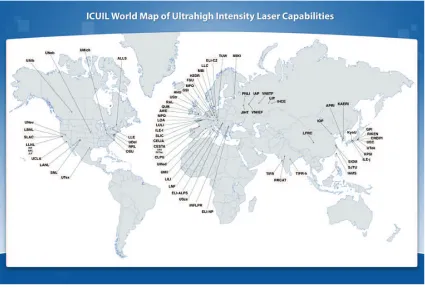
[image:12.595.86.511.475.764.2]The quest for ever higher laser powers and intensities is reflected by networks such as the International Committee on Ultra-High Intensity Lasers ICUIL. The ICUIL worl map of ultrahigh intensity lasers is depicted in figure 1. What is especially remarkable about this in the context of the present report are two things: first, that measured by the laser intensity and power levels of the systems of the map today, this map would have been practically empty just a few years ago. This shows vividly how rapid the progress in laser system capabilities is. Second, it indicates that Europe is leading the field as regards the number
of facilities. What is not seen on the map is that there are a huge number of laser systems which are mostly smaller than the laser systems on the map, but are well capable to accelerate particles via laser-plasma-acceleration. More and more laser systems are commissioned practically every week. This is also due to the fact that even PW-class laser systems for particle acceleration are today commercially available.
Many applications pursued by the laser-plasma-community demand for the highest electron beam quality (such as for Free-Electron Lasers [13, 14]) or pro-ton beam quality (such as for propro-ton cancer therapy [16–18]) in terms of diver-gence and monochromacity. The application of using laser-produced particles for the reproduction of space radiation and to test the radiation hardness of electronics [1, 19–21], in contrast, can work with broadband and strongly di-vergent electron and proton beams. This is a dramatic advantage, because the production of broadband and divergent beams is the inherent regime of laser-plasma-accelerators. In fact, it is much harder to produce monoenergetic beams with laser-plasma-accelerators than broadband ones. Moreover, the radiation in space is also not monoenergetic, but broadband! It is therefore in principle an obvious idea to introduce laser-plasma-accelerators to the field of space radia-tion reproducradia-tion and electronics testing. This was proposed in 2010/2011 [21], and in the context of the present study, design considerations for this applica-tion have been published in 2012 [1], and proof-of-concept experiments have been carried through recently in the context of this and a related project [22], which will be summarized in the next section.
3
Proof-of-Concept experiments with
laser-plasma-produced space radiation
The 150+ TW Ti:Sapphire laser system Arcturus [23] at the Institute for Laser and Plasma Physics at Heinrich-Heine-University Düsseldorf was used to irradiate thin aluminum target foils. Here, the laser pulse with an energy of E ≈ 1.2 J
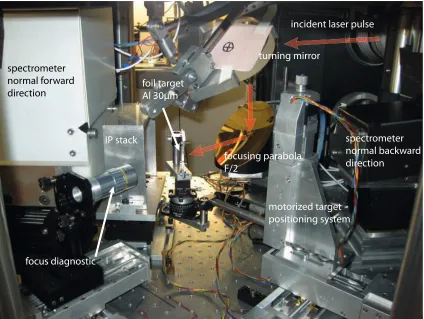
in a duration of 23 fs is incident on the Al foil at intensities of the order of a few 1019W/cm2, generates a plasma and leads to the production of broadband electron and proton bunches into various emission directions. The whole process takes place in an evacuated target chamber and is depicted in figure 2.
The compressed laser pulse is incident from the right hand side and then is send to the 90◦ focusing parabola. The F/2 parabola then focuses the laser beam
focusing parabola F/2
incident laser pulse
turning mirror
foil target Al 30µm
motorized target positioning system
spectrometer normal backward direction
spectrometer normal forward direction
IP stack
[image:14.595.87.511.65.384.2]focus diagnostic
Figure 2: Setup inside the irradiation chamber. The indident laser system is strongly focused on an Aluminum foil target, where the radiation is produced. Focus diagnostic microscope objective, image plate (IP) stack and permanent magnet based spectrometers in forward and backward direction are shown next to the target foil positioning system.
axis, the stack has a central hole where electrons (and protons) could pass and enter a magnetic spectrometer for further energy measurement. The magnetic spectrometer is a more accurate and can be monitored online, while the IP stack has the advantage of covering a large area and thus large parts of the emitted flux.
In the experimental proof-of-concept campaigns of [22], it was focused on the production of so called ’killer’ electrons in the van Allen belts [24–26]. In the radiation belts of Earth, these electrons have spectral flux which decreases fol-lowing a power-law or exponential distribution, where the number of electrons
N per MeV decreases according to
N ∝exp
Ekin kBT
=exp
Ekin Teff
(1) wherekB is Boltzmann’s constant, T is the electron temperature in Kelvin, and
Teff =kBT is the so called effective electron temperature in eV.
ex-0 1 2 3 4 5 6 7 10 100 1000 1E4 1E5 1E6 1E7 f l u x / e l e ct r o n s / cm ² s
energy / MeV
[image:15.595.144.455.61.290.2]GPS, L=3.17 GPS fit, T=0.62 MeV Galileo, L=3.65 Galileo fit, T=0.52 MeV GEO, L=6.65 GEO fit, T=0.4 MeV
Figure 3: Electron flux according to AE8max at the important orbital distances of
GPS, Galileo (both around medium Earth orbits (MEO)) and at geosynchronous orbit (GEO). Fitting exponential particle distributions leads to temperatures in the range ofTeff ≈0.4−0.62 MeV (from [1]).
ample, the electron flux at L = 3.17 (GPS), L = 3.65 (Galileo), and L = 6.65 (GEO) are plotted based on NASA’s van Allen belt AE8maxmodel [27] for
spec-tral flux during solar maximum activity. By fitting an exponential decay func-tion, effective temperaturesTeff ≈0.4−0.62 MeV can be deduced.
Reproduction of ”killer” radiation belt electrons is an excellent showcase for laser-plasma-produced electron beams, since in the laser-plasma-community the concept of exponential spectral flux and effective temperatures is also well known. Engineering scaling laws have been developed which predict the elec-tron temperature of elecelec-tron beams generated during laser-solid interaction in dependence of the focused laser intensity. The scaling of Wilks [28] predicts
Teff, Wilks = (
q
1+I[W/cm2]λ[¯m]2/(1.37×1018)−1)m0c2. (2)
while another scaling for slightly different laser-plasma-parameters was devel-oped by Beg [29]. It differs from Wilks’ scaling in that it predicts higher tem-peratures for intensities lower than≈2.8×10¹⁸W/cm2and lower temperatures
than Wilks for higher intensities. Explicitly, it is
Teff, Beg =0.1(I17λ2)1/3MeV (3)
where I17 gives the intensity in multiples of 1017W/cm2. A new analytical ap-proach to the electron temperature scaling was made recently by Kluge et al. [30] which fits the experimental and numerical data in the range of a0 ≈ 5 as good
These steering laws and the sophisticated diagnostics, consisting of imag-ing plates, beam viewers and the like, were used to optimize the electron beam output and to approximate the spectral flux predicted by the AE8max model as
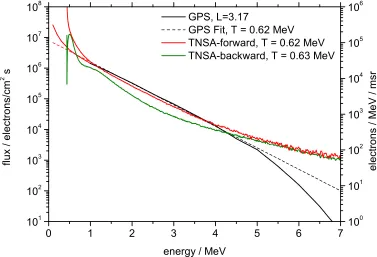
good as possible. For example, figure 4 shows the spectral flux expected on GPS orbit at L ≈ 3.17 (black solid line), an exponential fit (black dashed line) and
optimized measured spectra in the target normal forward (red) and backward (green) direction. The left y-axis gives the electron flux per square centimeter,
the right y-axis the electrons per MeV per msr. It is seen that there is an
excel-lent agreement between the real flux in space and the lab radiation, especially in the important medium energy range. The lower energy range<1 MeV is not
exactly known since it is not very well measurable (this holds for both the situ-ation in space as well as in the lab due to the spectrometer cutoff), neither is it particularly relevant (notable expection: surface charging) because low energies are more easily blocked. The mismatch in the higher electron energy range is also of secondary concern, because (note the logarithmic scaling) the number of electrons is much less here in any case.
0 1 2 3 4 5 6 7 10 1 10 2 10 3 10 4 10 5 10 6 10 7 10 8 f l u x / e l e ct r o n s/ cm 2 s
energy / MeV GPS, L=3.17
GPS Fit, T = 0.62 MeV TNSA-forward, T = 0.62 MeV TNSA-backward, T = 0.63 MeV
[image:16.595.109.486.356.613.2]10 0 10 1 10 2 10 3 10 4 10 5 10 6 e l e ct r o n s / M e V / m sr
and a magnetic spectrometer. The right hand side of figure 5 shows the result-ing radiography image on the electron sensitive image plates. The level of detail resolved by this diagnostics (e.g., one can see clearly the different pins and the inside of the spectrometer) indicates the accuracy of measurements.
Figure 5: Left: Set of optocouplers on mounting foil. Right: Radiography image on image plate resulting from irradiation.
The optocouplers were tested before and after irradiation at ESTEC using state-of-the-art test procedures and devices. A clear irradiation damage is shown in figure 6 for the optocoupler model Vishay SFH6345, for which the current transfer ratio CTR was measured for input currents of If = 100 ¯A and If =
1 mA, respectively, before and after irradiation. In figure 6, the CTR of not ir-radiated (but otherwise treated and stored in the same conditions as the other optocouplers) reference optocouplers (DUT’s # 30-60) is displayed and encir-cled with a blue dashed oval. As is clearly seen, the CTR of the not irradiated optocouplers is unchanged. In this campaign, there was one group of optocou-plers (tagged with ”1” and ”2” in figure 6, respectively) which was exposed to 3.2×10⁶e−/cm2 in the target normal forward and backward direction,
respec-tively, in one irradiation block and then in combination with a second irradiation block with in total 4.6×10⁷e−/cm2. After exposure to 3.2×10⁶e−/cm2the
op-tocouplers were again taken from Düsseldorf to Noordwijk to ESTEC, and the CTR was determined again. No significant degradation of CTR was observed. Even after the next irradiation block in Düsseldorf, when the fluence was in-creased to 4.6×10⁷e−/cm2, hardly a degradation of CTR performance could be
measured at ESTEC. In contrast, optocouplers from group 3 and 4, which were exposed to a far higher fluence, namely at maximum 2.1×10⁹e−/cm2, show a
significant (a thorough error anaylsis was performed) and cumulative deterio-ration after each irradiation block. The maximum CTR degradation was > 3%.
present campaign. It was shown that using accurately reproduced space radia-tion in the laboratory with laser-plasma-accelerators, testing is possible making use of adapted standard testing techniques and that significant radiation dam-age can be exerted on DUTs with these laser-produced radiation belt electrons.
0 10 20 30 40 50 0.96
0.97 0.98 0.99 1.00 1.01
2
2 1
1
3
Vishay SFH6345 CTR ratio I
f
= 100 µA CTR-ratio I
f
= 1 mA
C
T
R
r
a
t
i
o
DUT # 4
[image:18.595.89.511.141.455.2]4 3
Figure 6: DUT degradation after irradiation: Optocoupler CTR degradation after irradiation with laser-plasma-produced radiation belt flux.
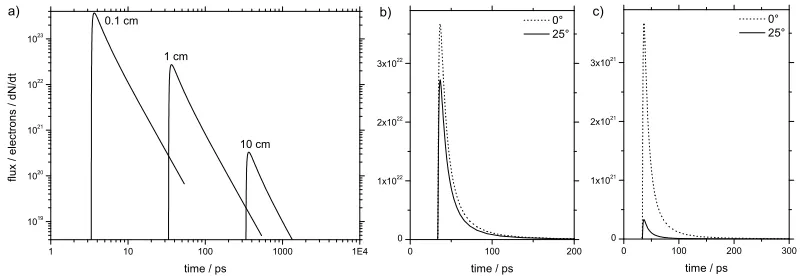
There is one difference between radiation belt flux and LPA-generated flux. Radiation belt flux is quasi-continuous, whereas LPA-generated electron flux is initially pulsed, since it is generated during the laser pulse interaction with plasma electrons. At the source, the duration of the individual electron beams is equal to the laser pulse duration. However, since we have exponential energy distribution, the time of flight of the electrons to the target is massively different for particles with different energies up to ≈ 1 MeV, which leads to a dramatic
thinning out and a reduction of peak flux. As an example, figure 7 a) shows the reduction of flux of a LPA-generated beam with Teff = 0.35 MeV, Q = 100 nC and a divergence ofθ =25◦ through a DUT area of 1 cm2 after distances of 0.1
cm, 1 cm, and 10 cm. This shows that the peak flux is reduced by more than two orders of magnitude, while the beam is stretched out in time. In figure 7 b) and c), the influence of the finite divergence is illustrated by plotting the flux through the 1 cm2 test area after 1 cm (b) and 10 cm (c) if zero divergence (dashed line) and if 25◦ divergence (solid line) are assumed. Here, in a distance of 1 cm from
0 100 200 300 0 1x10 21 2x10 21 3x10 21 c)
time / ps 0° 25°
0 100 200
0 1x10 22 2x10 22 3x10 22 b)
time / ps 0° 25°
1 10 100 1000 1E4
10 19 10 20 10 21 10 22 10 23 10 cm 1 cm 0.1 cm f l u x / e l e ct r o n s / d N / d t
[image:19.595.97.502.65.203.2]time / ps a)
Figure 7: Reduction of exponential-energy electron flux due to energy-dependent velocities and divergence. In a), the flux of a beam with Teff = 0.35 MeV, Q = 100 nC and a divergence of θ = 25◦ through a DUT area of 1 cm2
is calculated at distances 0.1 cm, 1 cm, and 10 cm behind target (note the loga-rithmic scaling). Next, the influence of the divergence is visualized by plotting the flux through 1 cm2 after a distance 1 cm (b) and 10 cm (c) for the beam with parameters as in a), but for a hypothetical divergence of θ = 0◦ and θ = 25◦
(from [1]).
on axis which will hit the DUT surface is much smaller as well as the peak flux will be lower.
Relativistic electrons are present in the radiation belts of all five strongly magnetized planets of our solar system, namely Earth, Jupiter, Saturn, Uranus and Neptune [31]. Mainly because the Jovian magnetic field is the strongest planetary field, and Jupiter’s rotation is the fastest of all planets, electrons reach highest peak flux and energies in its orbits. Jupiter is currently in the focus of mission planning both for ESA as well as for NASA, for example because of the possibility of life on Jovian moons. The extreme electron flux environment around Jupiter is a major challenge in the context of these missions. According to current models, which were developed after the first measurements of the Pioneer and Voyager probes [32–37], the maximum electron energies in Jovian radiation belts can amount up to 100 MeV, maybe more, at flux levels which can be much higher than in Earth’s radiation belts. In figure 8 a), as an example the expected spectral flux is given for two distances around Jupiter, namely at 5 and 9 RJ, respectively. It can be seen that the flux at 5 RJ could be approximated by
an exponential energy distribution. Although the flux at 9RJ cannot be directly
described by a single exponential function, it can be approximated by overlaying various different exponential spectra, as is shown in figure 8 b). Here, three different exponential spectra with temperatures ofTeff = 0.5, 6 and 32 MeV are used to approximate the actual expected electron flux.
the extreme electron flux on specific Jovian missions by laser-plasma-interaction is a unique possibility to test space electronics which are chosen for these mis-sions in an unprecedentedly realistic environment. This will potentially increase dramatically the predictability and confidence level in mission component re-liability, and could reduce the cost for the missions as aimed at for the next decade.
As a side note, the reader from the laser-plasma acceleration community might find it intriguing to follow us with the idea that the natural accelera-tion processes which are responsible for electron acceleraaccelera-tion at Jupiter [36] are surprisingly similar in many ways to how laser-plasma acceleration works. In fact, in a first step volcanic activities on Jupiter’s moon Io ejects gaseous matter into the magnetosphere – the LPA analogue would be a gas jet nozzle. Next, sunlight and secondary electrons ionizes this ejected matter (LPA analogue: the laser pulse). Finally, plasma waves (so called ”whistler-mode chorus waves”) are excited, which, under proper resonance and dephasing conditions (”gyro-resonance” [36]), can accelerate the electrons to relativistic energies. Future activities are currently in preparation which aim at reproducing outer planets electron environment with laser-plasma-accelerators.
The use of LPAs therefore promises much more realistic testing for these sce-narios, and the development of advanced testing procedures, whereby for exam-ple for reproduction of the especially harsh Jovian radiation belt electron flux, various beams with varying temperature can be overlayed to approximate the actual spectrum in space. This is similar to advanced treatment plans in particle beam cancer therapy, where different types of particle beams are used to pro-duce the best effect. Due to the initially pulsed nature of LPA-generated electron beams, extremely high peak fluxes can be produced which enable campaigns to determine linear radiation effect thresholds and to increase the understanding of radiation effects, whereby the peak flux can be tuned by varying the distance of sample to target due to the exponential energy and connected particle velocity distribution.
In the proof-of-concept experiments, the focus was put on accurate character-ization, monitoring and optimization of the electron flux. The focus was not on application of maximized fluence, which is in principle straightforward, how-ever. In the campaigns carried through in the context of the present project, a number of factors limit the averaged flux and the total fluence:
1. the time needed to break the vacuum to retrieve image plates, to insert new image plates and to evacuate the chamber (approx. 1 hour per irradiation block)
0 10 20 30 40 50 60 70 80 90 100 10 4 10 5 10 6 10 7 10 8 b) i n t e g r a l f l u x / cm 2 / s
energy / MeV
flux at 9 Rj T = 32 MeV T = 0.5 MeV T = 6 MeV
flux
0 10 20 30 40 50 60 70 80 90 100 10 4 10 5 10 6 10 7 10 8 i n t e g r a l f l u x / cm 2 / s
energy / MeV
spectral flux at 5 Rj spectral flux at 9 Rj
[image:21.595.92.508.65.220.2]a)
Figure 8: Spectral flux in Jupiter’s radiation belt. a) Flux at a distance of 5RJ and
9 RJ, b) Overlaying three exponential spectra can reproduce with high accuracy
the flux expected at 9RJ (from [1].
3. the time needed to bring the target foil into the Raleigh length of the strongly focused laser pulse (hour-scale)
4. the limited number of shots applicable on one target foil, and the time needed to introduce a new target foil (tens to hundred of shots per foil) 5. the pump performance needed to keep the chamber evacuated during
shots
6. the repetition rate of the laser system (currently 10 Hz)
All of these limitations can be overcome already with today’s state-ofthe-art technique. This means that the number of shots per time interval, and therefore the averaged flux, can be relatively straightforwardly increased by many orders of magnitude. First, the vacuum does not need to be broken for image plate change because one can relie on the cross-salibrated lanex response for online monitoring, which is thorough enough. Image plates inside the chamber can still be used but need to be more heavily shielded and can then nevertheless provide useful fluence information once the irradiation has ended. Then, the image plate readout process time is consequently also not relevant anymore. Next, positioning of the target foil is much easier when a softer focusing is used. While currently, the Ralyleigh length zR = πw20
λ = 30µm due to the very
for space radiation reproduction in the context of the present project (M. Quast et al. at University of Hamburg). An alternative to this if laser-solid-interaction is chosen as underlying acceleration mechanism would be droplet targets, such as described in [42], for example. If laser-underdense interaction is chosen as acceleration mechanism, then a steady-state gas cell with differential pumping would solve the problem of repetition rate. Also, reduced debris as with droplets [42] and underdense targets would subtantially decrease the requirements put on the vacuum system and the pumps. Finally, as regards repetition rate, already today kHz system with many mJ of laserr energy and pulse durations <100 fs
are commercially available. The rapid advance in laser technology has already even produced 100 kHz-level laser systems based on OPA, fibre lasers [43] and thin disk lasers. This trend, and furthermore a much better wall plug efficiency with fiber lasers etc. will continue for the foreseeable future.
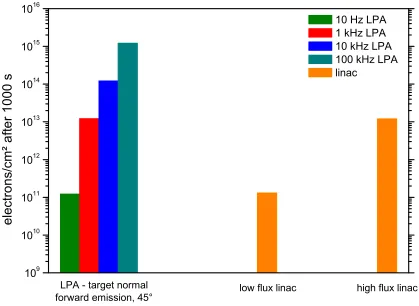
It is therefore reasonable to estimate the irradiation time needed with laser-plasma-systems for elevated repetition rates of 10 Hz and belong, which would be seen by future projects, and based on the flux per shot seen in the proof-of-concept experiments. Figure 9 shows that the fluence obtainable per unit time may be dramatically increased with laser-plasma-accelerators when compared to linacs, one assuming a flux of ≈ 1.3×10⁸e−/cm2 (the low flux linac), and one
assuming a flux of ≈ 1.2×10¹⁰ e−/cm2 (the high flux linac). It shall be noted
that due to the large divergence of laser-plasma-accelerators and the samll source size there is always also the possibility to combine multiple laser systems, e.g. 10 laser systems with 10 Hz repetition rate each, where the laser foci are located close (e.g. on an area of 1 square centimeter or so) such that in a few cm distance the emission cones of these 10 laser systems ovrlap and effectively the flux on the DUT’s is increased by an order of magnitude.
4
Summary, Outlook and Roadmap
10 9 10 10 10 11 10 12 10 13 10 14 10 15 10 16
high flux linac low flux linac
LPA - target norm al forward em ission, 45°
e l e ct r o n s/ cm ² a f t e r 1 0 0 0 s
[image:23.595.89.508.66.372.2]10 Hz LPA 1 kHz LPA 10 kHz LPA 100 kHz LPA linac
Figure 9: Fluence after 1000 seconds produced with laser systems of different repetition rate when compared to linacs.
the exact reproduction of space radiation not only with Earth radaition belt elec-trons, but also with the higher energy electron flux in the radiation belts of other planets such as Saturn and Jupiter, which may be a crucial capability for future missions.
This scientific trajectory is being paralleled by ongoing technological progress as regards laser technology, where something like a ”Moore’s Law” exists. To-day’s laser systems are already capable to produce 10 Hz repetition rate shots, which are then incident on the electronic test devices in a quasi-continuous flux form due to the broadband spectra and the connected time-of-flight differences which smear out the initially pulsed radiation. There are also laser systems with kHz repetition rate already available which could also be used for space radia-tion reproducradia-tion, thereby increasing the flux accordingly. Laser systems with hundreds of kHz and based on even more compact and efficient technology such as diode-pumped fiber and thin disk lasers do already exist as prototypes and will hit the market in the next years. These systems will further increase the usability and efficiency for space radiation reproduction. They are table-top and can be put even on mobile chassis; this actually was possible already nearly a decade ago, see [44].
belt flux and to increase the proton and ion energies and flux. The latter could be done in collaboration with large research projects such as the LIBRA consor-tium or the A-SAIL programme (Advanced Strategies for Accelerating Ions with Lasers) in the UK (2013-2019, 5M£); a recent review can be found in [45].
The computational capabilities to model the generation and expansion of plasma based radiation with particle in cell codes shall be substantially ex-panded to accompany and optimize future experimential R&D.
The communication between the space radiation testing community and the laser-plasma-accelerator community should be fostered. The space radiation testing comunity holds annual and bi-annual meetings at the Nuclear and Space Radiation Effects Conference (NSREC) [46] and the conference on Radiation Ef-fects on Components and Systems (RADECS) [47]. The laser-plasma-acceleration community does also have various meetings, such as the Advanced Accelera-tor Concepts (AAC) conference, the Laser and Plasma AcceleraAccelera-tor Workshop (LPAW), and is well established as an own research field at overarching acceler-ator and physics conferences such as the International Particle Acceleracceler-ator Con-ference (IPAC) and at the European Physical Society (EPS) conCon-ference. It should be considered whether it can be managed to have mutual contributions of both communities at these or other conferences, or even satellite meetings or special topics at these conferences. In the context of the present project, the idea of using laser-plasma-accelerators and first results on space radiation reproduction and testing have already been presented at NSREC and RADECS, where they have triggered broad and intense interest.
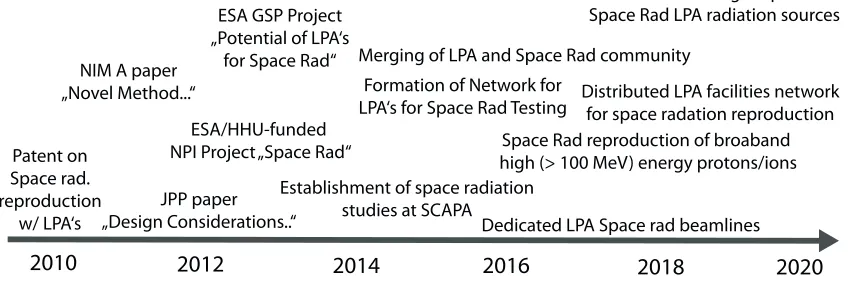
2010 2012 2014 2016 2018 2020 Patent on
Space rad. reproduction
w/ LPA‘s
NIM A paper „Novel Method...“
JPP paper „Design Considerations..“
ESA/HHU-funded NPI Project „Space Rad“
ESA GSP Project „Potential of LPA‘s
for Space Rad“
Establishment of space radiation studies at SCAPA
Formation of Network for LPA‘s for Space Rad Testing
Merging of LPA and Space Rad community
Dedicated LPA Space rad beamlines Commercial high rep rate Space Rad LPA radiation sources
Space Rad reproduction of broaband high (> 100 MeV) energy protons/ions
Distributed LPA facilities network for space radation reproduction
Figure 10: Roadmap for the development of laser-plasma-accelerator based space radiation reproduction and testing.
[image:25.595.88.520.74.220.2]5
Acknowledgements
Support from the following organizations and scientists is gratefully acknowl-edged: European Space Agency and Heinrich-Heine-University Düsseldorf for funding of this Networking Partnership Initiative; BH thanks Forschungsfo-erderungsfonds Heinrich-Heine-University for additional research group fund-ing; RadiaBeam Technologies, Santa Monica, USA, and UCLA for R&D con-tributions and patenting support; Toma Toncian, Monica Toncian, and Oswald Willi for an excellent Arcturus laser performance and technical support dur-ing various space radiation beam time campaigns; proton irradiation and image plate testing at UCL, Belgium; A. Costantino, E. Daly, V. Ferlet-Cavrois, S. Her-nandez, and G. Santin at ESTEC/ESA; R. D. Harris, P. Adell, H. Schoene, S. McClure, L.Z. Scheick, and J. Insoo at Jet Propulsion Laboratory/NASA; com-putational support from A. Karmakar at Leibniz Computing Center Munich, and computational resources at NERSC Berkeley, HLRN, and JUROPA. In the context of this work, one PhD thesis (T. Königstein, 2013), one master thesis (O. Karger, 2013) and three peer-reviewed Journal publications (a) Bernhard Hid-ding, Thomas Koenigstein, Oswald Willi, James B. Rosenzweig, Kazuhisa Naka-jima, and Georg Pretzler. Laser-plasma-accelerators–a novel, versatile tool for space radiation studies. Nuclear Instruments and Methods in Physics Research Section A: Accelerators, Spectrometers, Detectors and Associated Equipment, 636(1):31 – 40, 2011, b) T. Koenigstein, O. Karger, G. Pretzler, J. B. Rosezweig, and B. Hidding. Design considerations for the use of laser-plasma accelerators for advanced space radiation studies. Journal of Plasma Physics, 78:383–391, 8 2012) have already been published, others are in preparation. The concept has been patented (B. Hidding, T. Königstein, O. Willi, G. Pretzler. Method for testing the radiation hardnessof electronic devices with particle and pho-ton beams generated by laser-plasma-interaction.German Patent AZ 10 2010 010 716.6, March 2010. Filed on March 8, 2011 as extended United States patent in collaboration with RadiaBeam Technologies, Santa Monica, Method for testing electronic components, Serial No. 13/042,738). This report is partially based on the above mentioned publications and theses and includes text and figures from those references.
References
[1] T. Koenigstein, O. Karger, G. Pretzler, J. B. Rosezweig, and B. Hidding. Design considerations for the use of laser-plasma accelerators for advanced space radiation studies. Journal of Plasma Physics, 78:383–391, 8 2012.
[3] G.I. Budker. Proceedings of cern symposium on high-energy physics. vol-ume 1, page 68, Geneva, 1956. AIP.
[4] Ya. B. Fainberg. Proceedings of cern symposium on high-energy physics. volume 1, page 84, Geneva, 1956. AIP.
[5] Donna Strickland and Gerard Mourou. Compression of amplified chirped optical pulses. Optics Communications, 56(3):219–221, 1985.
[6] V. Malka, S. Fritzler, E. Lefebvre, M. M. Aleonard, F. Burgy, J. P. Chambaret, J. F. Chemin, K. Krushelnick, G. Malka, S. P. D. Mangles, Z. Najmudin, M. Pittman, J. P. Rousseau, J. N. Scheurer, B. Walton, and A. E. Dangor. Electron acceleration by a wake field forced by an intense ultrashort laser pulse. Science, 298(5598):1596–1600, 2002.
[7] T. Katsouleas. Accelerator physics: Electrons hang ten on laser wake. Na-ture, 431(7008):515–516, 2004.
[8] S. P. D. Mangles, C. D. Murphy, Z. Najmudin, A. G. R. Thomas, J. L. Collier, A. E. Dangor, E. J. Divall, P. S. Foster, J. G. Gallacher, C. J. Hooker, D. A. Jaroszynski, A. J. Langley, W. B. Mori, P. A. Norreys, F. S. Tsung, R. Viskup, B. R. Walton, and K. Krushelnick. Monoenergetic beams of relativistic electrons from intense laser-plasma interactions. Nature, 431(7008):535–538, 2004.
[9] C. G. R. Geddes, C. Toth, J. van Tilborg, E. Esarey, C. B. Schroeder, D. Bruh-wilder, C. Nieter, J. Cary, and W. P. Leemans. High-quality electron beams from a laser wakefield accelerator using plasma-channel guiding. Nature, 431(7008):538–541, 2004.
[10] J. Faure, Y. Glinec, A. Pukhov, S. Kiselev, S. Gordienko, E. Lefebvre, J. P. Rousseau, F. Burgy, and V. Malka. A laser-plasma accelerator producing monoenergetic electron beams. Nature, 431(7008):541–544, 2004.
[11] H. Schwoerer, S. Pfotenhauer, O. Jaeckel, K.-U. Amthor, B. Liesfeld, W. Ziegler, R. Sauerbrey, K. W. D. Ledingham, and T. Esirkepov. Laser-plasma acceleration of quasi-monoenergetic protons from microstructured targets. Nature, 439(7075):445–448, January 2006.
[12] B. M. Hegelich, B. J. Albright, J. Cobble, K. Flippo, S. Letzring, M. Paffett, H. Ruhl, J. Schreiber, R. K. Schulze, and J. C. Fernández. Laser acceleration of quasi-monoenergetic mev ion beams. Nature, 439(7075):441–444, January 2006.
Wiggins, and D. A. Jaroszynski. A compact synchrotron radiation source driven by a laser-plasma wakefield accelerator. Nat Phys, 4(2):130–133, 2008.
[14] Matthias Fuchs, Raphael Weingartner, Antonia Popp, Zsuzsanna Major, Stefan Becker, Jens Osterhoff, Isabella Cortrie, Benno Zeitler, Rainer Hor-lein, George D. Tsakiris, Ulrich Schramm, Tom P. Rowlands-Rees, Simon M. Hooker, Dietrich Habs, Ferenc Krausz, Stefan Karsch, and Florian Gruner. Laser-driven soft-x-ray undulator source. Nat Phys, 5(11):826–829, 2009. [15] M. Buchanan. Thesis: Past the schwinger limit. Nature Physics, 2:721, 2006.
[16] C. Greco and S. Wolden. Current status of radiotherapy with protons and light ion beams. Cancer, 109:1227–1238, 2007.
[17] Marco Durante and Jay S. Loeffler. Charged particles in radiation oncology.
Nat Rev Clin Oncol, 7(1):37–43, 2010.
[18] K. Zeil, J. Metzkes, T. Kluge, M. Bussmann, T.E. Cowan, S.D. Kraft, R. Sauer-brey, and U. Schramm. Direct observation of prompt pre-thermal laser ion sheath acceleration. Nat Comm, 3:874, 2012.
[19] B. Hidding, T. Königstein, O. Willi, and Pretzler G. Methods for testing the radiation hardness of electronic devices with particle and photon beams generated by laser-plasma-interaction. german patent az 10 2010 010 716.6. 2010.
[20] Santa Monica RadiaBeam Technologies. Method for testing electronic com-ponents. extended united states patent serial no. 13/042,738. 2011.
[21] Bernhard Hidding, Thomas Koenigstein, Oswald Willi, James B. Rosen-zweig, Kazuhisa Nakajima, and Georg Pretzler. Laser-plasma-accelerators– a novel, versatile tool for space radiation studies. Nuclear Instruments and Methods in Physics Research Section A: Accelerators, Spectrometers, Detectors and Associated Equipment, 636(1):31 – 40, 2011.
[22] B. Hidding, O. Karger, T. Koenigstein, G. Pretzler, and J.B. Rosenzweig.
Study of Space Radiation Effects
with Laser-Plasma-Accelerators. Heinrich-Heine-University Duesseldorf and
European Space Agency NPI Acivitiy 4000102854, 2014.
solid targets with a 100 tw laser pulse. Plasma Physics and Controlled Fusion,
51(12):124049, 2009.
[24] Richard B. Horne, Richard M. Thorne, Yuri Y. Shprits, Nigel P. Meredith, Sarah A. Glauert, Andy J. Smith, Shrikanth G. Kanekal, Daniel N. Baker, Mark J. Engebretson, Jennifer L. Posch, Maria Spasojevic, Umran S. Inan, Jolene S. Pickett, and Pierrette M. E. Decreau. Wave acceleration of electrons in the van allen radiation belts. Nature, 437(7056):227–230, 2005.
[25] Richard Bertram Horne. Plasma astrophysics: Acceleration of killer elec-trons. Nat Phys, 3(9):590–591, 2007.
[26] Yue Chen, Geoffrey D. Reeves, and Reiner H. W. Friedel. The energization of relativistic electrons in the outer van allen radiation belt. Nat Phys, 3(9):614–
617, 2007.
[27] http://modelweb.gsfc.nasa.gov/models/trap.html.
[28] S. C. Wilks, W. L. Kruer, M. Tabak, and A. B. Langdon. Absorption of ultra-intense laser pulses. Phys. Rev. Lett., 69(9):1383–1386, Aug 1992.
[29] F. N. Beg, A. R. Bell, A. E. Dangor, C. N. Danson, A. P. Fews, M. E. Glin-sky, B. A. Hammel, P. Lee, P. A. Norreys, and M. Tatarakis. A study of picosecond laser–solid interactions up to 10[sup 19] w cm[sup - 2]. Physics of Plasmas, 4(2):447–457, 1997.
[30] T. Kluge, T. Cowan, A. Debus, U. Schramm, K. Zeil, and M. Bussmann. Electron temperature scaling in laser interaction with solids.Phys. Rev. Lett.,
107:205003, Nov 2011.
[31] B.H. Mauk and N.J. Fox. Electron radiation belts of the solar system. Journal of Geophysical Research, 115(A12220), 2010.
[32] N. Divine and H. B. Garrett. Charged particle distributions in jupiter’s magnetosphere. Journal of Geophysical Research, 88:6889–6903, 1983.
[33] R. Walker Fillius and Carl E. McIlwain. Radiation belts of jupiter. 183(4122):314–315, 1974.
[35] Henry B. Garrett, Steven M. Levin, Scott J. Bolton, Robin W. Evans, and Bidushi Bhattacharya. A revised model of jupiter’s inner electron belts: Updating the divine radiation model. Geophys. Res. Lett., 32(4):L04104–,
2005.
[36] Richard B. Horne, Richard M. Thorne, Sarah A. Glauert, J. Douglas Meni-etti, Yuri Y. Shprits, and Donald A. Gurnett. Gyro-resonant electron accel-eration at jupiter. Nat Phys, 4(4):301–304, 2008.
[37] X. Tao, R.M. Thorne, R.B. Horne, B. Ni, J.D. Menietti, Y.Y. Shprits, and D.A. Gurnett. Importance of plasma injection events for energization of relativis-tic electrons in the jovian magnetosphere. Journal of Geophysical Research A: Space Physics, 116(1), 2011.
[38] J.B. Rosenzweig, A. Valloni, D. Alesini, G. Andonian, N. Bernard, L. Fail-lace, L. Ficcadenti, A. Fukusawa, B. Hidding, M. Migliorati, A. Mostacci, P. Musumeci, B. O’Shea, L. Palumbo, B. Spataro, and A. Yakub. Design and applications of an x-band hybrid photoinjector. Nuclear Instruments and Methods in Physics Research Section A: Accelerators, Spectrometers, Detectors and Associated Equipment, (0):–, 2011.
[39] E. Fill, J. Bayerl, and R. Tommasini. A novel tape target for use with repeti-tively pulsed lasers. Review of Scientific Instruments, 73(5):2190–2192, 2002.
[40] T. Plettner, R. L. Byer, E. Colby, B. Cowan, C. M. S. Sears, J. E. Spencer, and R. H. Siemann. Proof-of-principle experiment for laser-driven acceleration of relativistic electrons in a semi-infinite vacuum. Phys. Rev. ST Accel. Beams, 8:121301, Dec 2005.
[41] T. Sokollik, S. Shiraishi, J. Osterhoff, E. Evans, A.J. Gonsalves, K. Nakamura, J. van Tilborg, C. Lin, C. Toth, and W. Leemans. Tape-drive based plasma mirror. AIP Conference Proceedings, 1299(1):233, 2010.
[42] L. Rymell and H.M. Hertz. Droplet target for low-debris laser-plasma soft x-ray generation. Optics Communications, pages 105–110, 1993.
[43] C. Jauregui, J. Limpert, and A. Tuennermann. High-power fibre lasers.
Nature Photonics, 7:861–867, 2013. [44] http://www.teramobile.org/.
[45] Andrea Macchi, Marco Borghesi, and Matteo Passoni. Ion acceleration by superintense laser-plasma interaction. Rev. Mod. Phys., 85:751–793, May 2013.
![Figure 3: Electron flux according to AE8maxorbit (GEO). Fitting exponential particle distributions leads to temperatures inthe range ofGPS, Galileo (both around medium Earth orbits (MEO)) and at geosynchronous at the important orbital distances of Teff ≈ 0.4 − 0.62 MeV (from [1]).](https://thumb-us.123doks.com/thumbv2/123dok_us/1637293.117077/15.595.144.455.61.290/electron-according-exponential-distributions-temperatures-geosynchronous-important-distances.webp)


![Figure 8: Spectral flux in Jupiter’s radiation belt. a) Flux at a distance of 5 Rthe flux expected at 9J and9 RJ, b) Overlaying three exponential spectra can reproduce with high accuracy RJ (from [1].](https://thumb-us.123doks.com/thumbv2/123dok_us/1637293.117077/21.595.92.508.65.220/spectral-jupiter-radiation-expected-overlaying-exponential-reproduce-accuracy.webp)