Electric Vehicles:
Electric Vehicles:
charged with potential
© The Royal Academy of Engineering
ISBN 1-903496-56-X
May 2010 Published by
The Royal Academy of Engineering 3 Carlton House Terrace
London SW1Y 5DG
Tel: 020 7766 0600 Fax: 020 7930 1549 www.raeng.org.uk
Registered Charity Number: 293074
Contents
Executive Summary 3
1 Introduction 6
2 Background 9
3 Scope of the report 11
3.1 Technical risks 11
3.2 Non-technical risks 11
4 The environment for the car in 2050 13
4.1 The car as an integral part of society 13
4.2 Changes in society 13
4.3 Innovations leading to a low-carbon transport system 14
4.4 Affordability 15
5 Climate change and CO2 emissions 16
5.1 The commitment 16
5.2 Legal targets and incentives 16
5.3 Emissions from UK transport 16
5.4 Can EVs reduce transport CO2 emissions? 17
5.5 Energy scenarios 19
5.6 Alternatives to EVs as a route to reduced emissions 20 5.7 Competing policies
6 The challenges of establishing an EV industry 22
6.1 Manufacturers’ plans 22
6.2 Production facilities 22
7 Storage technology 23
7.1 Recent battery developments 23
7.2 Comparative battery performance 24
7.3 Availability of battery materials 24
7.4 Optimum battery size 25
7.5 Safety risk 26
7.6 Options for battery charging during the day 27
8 En-route charging 28
8.1 Fast charge stations 28
8.2 Battery exchange stations 28
8.3 Recharging at destination 29
8.4 Plug-in hybrid electric vehicles (PHEVs) 29
9 Charging at home and away 31
9.1 On-street parking 31
9.2 Charging at work 31
10 Interface with electricity grid 32
10.1 Generation capacity 32
10.2 The national transmission network 34
10.3 Local distribution networks 34
11 The ‘smarter grid’ 37
11.1 Why is a smarter grid important to EVs? 37
11.2 Smart meters and smarter grids 38
11.3 UK plans for smart meters 38
11.4 Introducing smart meters 39
11.5 A smarter grid 39
11.6 EVs as embedded generation? 40
11.7 Systems Engineering 41
12 A strategy for the electrification of road transport 42
12.1 The scenarios 42
12.2 Battery capacity 42
12.3 Barriers to EV use 43
13 Resourcing the dream 45
14 The international dimension 46
15 Conclusions and recommendations 47
Notes and references 49
Appendix A – Steering committee 51
Executive Summary
Executive Summary
Electric vehicles hold the promise, if widely adopted, of drastically reducing carbon emissions from surface transport and could, therefore, form a major plank in the UK’s efforts to meet the binding emissions reduction targets enshrined in the 2008 Climate Change Act.
Most credible energy scenarios for the UK based on the earlier CO2 emissions reduction targets of 60% compared to 1990 levels strategically allocated all emissions savings to other sectors of the UK economy, allowing the majority of road transport to be powered by fossil fuels. The revision of the emission reduction targets to 80% means that this is no longer an option and we now need radical changes in the way we power and use transport. Any likely future UK energy system will almost certainly involve the electrification of a significant proportion of the transport system. The most likely scenario for the development of electric vehicles is probably a mixture of Plug in Hybrid Electric Vehicles (PHEVs) and pure Electric Vehicles (EVs) on the roads.
Infrastructure, billing and ownership challenges
The automotive manufacturing industry appears to be very ready to take on the challenge of developing mass market electric vehicles but there are a number of prerequisites to truly mass market penetration. These include the development of an infrastructure for charging, functional standards for billing, a compelling consumer proposition and, potentially, new models of ownership for personal transport vehicles. Although these advances will come in time as the electric vehicle proposition develops, the market could be stimulated by the early adoption of standards, ranging from agreement on plugs and connectors through to protocols for billing both at home and en route. However, the major challenge is the provision of a charging infrastructure for EVs, which, in the UK, would require the active collaboration of national and local governments, car park operators, electricity distribution companies, bank card issuers, and many businesses not usually concerned with transport energy supply. The active collaboration of all these diverse parties will need to be carefully coordinated and it is not currently clear which body this coordinating role will fall to.
The present financial case for EVs is heavily dependent on the penalties for carbon emissions and the subsidies implicit in the lack of road fuel taxation on electricity. It is unlikely that these policies could be sustained were EVs to become as popular as diesel powered cars today. A crucial aspect of providing a stable framework for the development of EVs and PHEVs, will be for Government to indicate how it intends to replace fuel duty in the medium term.
Carbon saving
While EVs may hold a CO2 emissions advantage over internal combustion engine vehicles, their limited range and relatively long recharging times will mean that the convenience of refuelling at petrol stations will favour internal combustion engine vehicles or PHEVs for some considerable time. In order to close this gap, research and development in battery charging cycles and fast charging needs to be funded.
Managing the electricity supply system for EVs
EVs and PHEVs can only be as ‘green’ as the electricity used to charge their batteries. Recent results from EV trials show a typical carbon dioxide emissions rating to be around 100g/km, when the car is charged from a typical power supply in the UK. Given that a brand new Volkswagen Polo turbo diesel injection has an emissions rating of 91g/km, it is difficult to see how electric vehicles fed from today's UK electricity generation supply are significantly better than petrol or diesel vehicles. To have a major effect, the introduction of electric vehicles must be accompanied by an almost total decarbonisation of the electricity supply.
The current contribution of renewable and low-carbon generation to the UK's energy supply is one of the lowest in Europe. If the UK is to meet its renewable targets, and ensure a 'greener' power supply to electric cars, a range of new low-carbon energy sources will be needed, including new nuclear power stations, wind farms and tidal barrages. Creating this new energy system will require a massive change programme and robust leadership by Government.
The challenge for those supplying energy to a fleet of electric vehicles is to match their varying charging needs to a fluctuating and unpredictable power supply, but not all renewable energy or embedded generation is readily controllable. In terms of annual energy consumption, the additional power requirements caused by a mass take-up of electric vehicles is manageable, but supplying sufficient low-carbon power at times of peak demand will be more difficult.
One solution is an 'intelligent' electricity network or 'smart grid'. In July 2009, the Department of Energy and Climate Change (DECC) outlined its proposal for a smarter grid that would “enable more dynamic real-time flows of information on the [electricity] network... [and] help deliver electricity more efficiently and reliably.” An intelligent network could alleviate load issues from recharging batteries – a local smart grid could match generation to electricity use and manage loading on a street by street basis. Bringing together the energy and IT companies necessary to develop this will be a major feat of project engineering. However, the future overall grid architecture and network functionality for such a smart grid is yet to be worked through and what is being discussed bears little resemblance to the needs of a fleet of electric vehicles making up a very significant proportion of UK road vehicles. Without an optimised smart grid in place, the environmental case for electric car development becomes
questionable.
Major growth in popularity of EVs would place significant strains on the electricity grid and distribution systems. Early adopters could be accommodated with little impact but, as the numbers increased, there could be a real possibility of local distribution networks being overwhelmed. Significant changes in the timing and size of electricity demand peaks could mean that more carbon-intensive
generators lower down the merit order would have to be brought on-line to meet demand at times when carbon intensity would normally be expected to be low. The introduction of smart meters operating within a smart grid would alleviate this effect to some extent, but not entirely. Currently, plans to introduce smart meters to every household by 2020 do not include the functionality required to manage EV charging, potentially rendering the first generation of smart meters obsolescent as the EV market grew.
Recommendations
Executive Summary
emissions from transport. Technical development is proceeding, driven by an industry that sees their potential as the future of personal transport. However, their success will rely on a number of infrastructural improvements and early agreement on standards and protocols. Development of the technologies ahead of these decisions could reduce public acceptance of EVs, if different charging solutions are being offered, and ultimately require increased future investment in infrastructure to accommodate multiple standards.
1. Government needs to outline its long-term policy direction for EVs in order to provide the right incentives for early adopters as well as providing a stable policy environment for the EV market to develop over time. This policy needs to extend into strategies for the timely investment in the required
infrastructure, the ownership of that infrastructure and the timescales over which it must be implemented so as not to delay the development of EVs and PHEVs as mass market solutions. Government also needs to map out
intentions for the funding of road networks in the medium term as tax revenues from conventional road fuels reduces.
2. The introduction of electric vehicles on a large scale can only have a beneficial effect on CO2 emissions if low carbon energy, universal broadband provision and smart grids can be delivered. There is an opportunity to integrate these policy areas and adopt a fully systems-based approach to ensure that that all work together and the critical links between them are explicitly recognised.
3. The automotive industry, with the support of other interested parties, including UK and European governments, must proactively develop international standards for charging EVs and billing protocols.
4. The Government, Ofgem and the UK electricity industry must develop protocols to integrate the long term needs of EV charging into current plans to roll out smart meters and smart grid technologies country wide. Not doing so will risk either stifling growth in the EV market or being faced with early obsolescence of the first generation of domestic smart meters.
1 Introduction
Until the end of the 20th century, petrol and diesel were the undisputed fuels for road transport. In the past 10 years, it has been recognised that the continued use of fossil fuels is unsustainable – partly because of the resulting CO2 emissions but also because the long-term availability of affordable fuel is uncertain. The Climate Change Act 2008 sets national limits for emissions that would be unachievable with the anticipated levels of road traffic supplied by conventional fuels and the EU targets for average vehicle emissions require a radical downsizing of cars and their engines, a severe reduction in number of kilometres driven or a change in their energy supply.
At one time it was hoped that biofuels would solve both the issues of emissions and fuel availability without the need for significant changes to car technology. However, the 2008 Gallagher Review1showed that the sustainable limits on biofuel production are well below the levels needed to fuel the UK’s transport system. Since then, electric vehicles, supplied by low carbon and renewably generated electricity, have appeared to be the preferred policy option to ensure long-term sustainable mobility. However, it seems likely that road transport of the future will be fuelled by a matrix of electricity, biofuels, synthetic fuels and possibly hydrogen (the last most probably for captive fleets of larger vehicles, such as buses).
This study has investigated the implications of the large-scale adoption of electric cars in Britain. To make a significant difference to CO2 emissions, electric drive systems would have to replace internal combustion engines in a large proportion of ’family cars‘ and ’company cars‘ and could not be restricted to low-mileage niche markets.
While the report is primarily about cars, most of what is written applies to small vans derived from production cars and some of the discussion is also relevant to Transit-size vehicles. However, the report has not attempted to cover HGVs and long-distance freight transport which present a different set of challenges.
Present battery technology allows EVs a range of around 100 miles. Over the coming decade, other battery technologies will become available which could increase the range of an EV to several hundred miles. However, because of the trade-off between battery cost and additional range, only a minority of car users is likely to want the maximum range that is technically feasible. For others, a rechargeable “plug-in hybrid” (PHEV) would be more attractive and is likely to become the technology of choice for major market sectors.
A small EV with a range of 100 miles could be recharged in a few hours from a normal domestic socket. To recharge a high-performance, long-range EV would require a more powerful electricity supply. The widespread adoption of EVs would be manageable in terms of their effect on the 132kV electricity grid; but the same is not true for the local distribution network. The increased loading, particularly in affluent housing areas where high-performance vehicles might be more
prevalent, could require wholesale replacement of cables in the streets or a local ‘smart grid‘ to manage loading on a street-by-street basis by enabling electronic communication between consumers and electricity suppliers so that load and generation can be scheduled in as efficient a manner as possible.
1 Introduction
managed by the local authority, an electricity distribution company or some other body is far from clear but they represent a massive investment in
infrastructure with a large behavioural impact. Changes to planning guidance to encourage off-street parking with charging points could make a major difference in some areas.
EV charging sockets are starting to be seen in car parks and at the kerbside in city centres. While there is only a low number of EVs in use, the effects on the electricity system are negligible. However, if EVs achieve a sufficient level of market penetration to make a real difference to national CO2 emissions, the charging loads at locations such as out-of-town shopping centres, sports stadia, exhibition venues or multi-storey car parks could dominate the local electricity network. The extent to which charging at destination is needed will depend on the balance between short- and long-range EVs and PHEVs in the car fleet. Because charging at destination could take place at times of peak electricity demand, the additional energy would be unlikely to be supplied by renewable generation, which in turn would reduce the CO2 benefits of the change to EVs.
Creating a pervasive network of public charging points would be a major but necessary investment if EVs are to achieve acceptability in mainstream market segments. However, the widespread adoption of PHEVs, rather than EVs would allow the low carbon market to develop without being tied to such a major infrastructure investment.
For EVs to achieve their maximum potential in reducing CO2 emissions, they would require to be charged at times when the carbon intensity of electricity generation on the grid is low. Full integration of the UK’s transport strategy with the smart metering strategy will be essential. However, merely arranging for EV chargers to switch on when a particular price signal is transmitted from a central facility risks overloading local electrical connections. To manage this would require a disaggregated smart grid with intelligence at the level of the 11kV/415V substation to balance local loads and carbon intensity together for an optimal solution. This bears little resemblance to what is currently being discussed and there is a narrow window of opportunity to ensure that the architecture of the smart grid takes proper account of the future needs of EVs.
Users of petrol and diesel cars pay for the road infrastructure through road fund tax and fuel duty: EVs are exempt from both. While this is a valuable subsidy to accelerate the introduction of the new technology, by the time significant penetration of EVs has occurred, government will need to find alternative means of funding road infrastructure. As it would be impractical to differentiate between electricity used for EVs and for other uses, large-scale adoption of EVs is likely to accelerate the need for a comprehensive system of road pricing or another mechanism for pay-as-you-drive taxation.
The motor industry is a truly international business and car owners expect to be able to drive from one country to another without costly technical or
administrative problems arising. Although Britain has a large automotive sector, it is mainly concerned with manufacturing components, such as engines, rather than design and manufacture of complete vehicles. The widespread introduction of EVs will require close international cooperation in setting standards, including for charging interfaces, safety requirements and payment mechanisms.
issues that need to be addressed if electric cars are to fulfil the expectation that they will maintain personal mobility in the face of diminishing and evermore expensive oil supplies and will contribute to the necessary limitation of CO2 emissions.
2 Background
2 Background
Electric vehicles have been on the roads for more than 150 years. In the 1830s, Robert Anderson, a Scot, developed an early electrically powered cart; in 1899, Belgian Camille Jenatzy set a land speed record of more than 100 kph in an electric car,La Jamais Contente. By 1897, the Electric Carriage and Wagon Company of Philadelphia had built a fleet of New York City taxis. The years 1899 and 1900 were the high point of electric cars in America, as they outsold all other types.2In 1910 in London there were some 6,000 electric cars and 4,000
commercial vehicles registered.3
In the early 1900s, electric vehicles had many advantages over their competitors. They did not have the vibration, smell or noise associated with petrol cars and, because the driver did not need the strength to swing a starting handle or the dexterity to operate a non-synchromesh gearbox, they were much easier to drive.
In the 1860s, oil was discovered in North-Western Pennsylvania. During the second half of the century, production increased from a few tens of (whisky) barrels a month to thousands of barrels a day. The consequent reduction in the price of oil and improvements in the internal combustion engine meant that the dominance of electric vehicles was short-lived. By the middle of the 20th century, petrol cars were dominant and electric vehicles had been relegated to specialist uses, such as industrial trucks and milk floats.
In the 1970s, events in the Middle East triggered a five-fold increase in the price of crude oil and a renewed interest in electric vehicles on both sides of the Atlantic, particularly for commuter cars or light commercial vehicles.
[image:11.595.20.205.115.440.2]During the 1980s, the price of oil fell back to its earlier level (in real terms) and the financial incentive for electric vehicles fell with it. In the 20 years following 1975 North Sea oil production (from the UK and Norway) grew from nothing to six million barrels a day, which eliminated most geopolitical strategic reasons for the UK seeking an alternative to oil based road transport fuels.
Figure 1 : Early electric car (Science Museum/SSPL) Figure 2 : 1970s electric vans –
[image:11.595.222.548.296.546.2]In the last five years, there have been two dramatic changes in the prospects for electric vehicles – the ‘push’ from new technology and the ‘pull’ of new demand.
The changes in technology centre round the battery. Up to the 1980s, there was really no choice – lead acid was the only sufficiently developed technology. The batteries were heavy; for long life cells, as used in milk float and industrial batteries, the tubular plate construction was almost universal which resulted in a specific energy of no more than 30kWh/tonne. In the last 30 years, there has been a revolution in battery technologies, led by the mobile phone and laptop market, which has made possible specific energy of 200kWh/tonne or more coupled with high cycle lives. New developments are expected to increase this by a further factor. A second breakthrough has been in the design of drive systems: for the first 100 years of EVs, the only choice was the dc motor, originally with very simple contactor control and, from the 1970s, with semiconductor control. Now
software-controlled three-phase drives allow cheaper and more reliable AC motors to be used and high performance rare earth magnets have made smaller motors possible, increasing the flexibility of vehicle layout.
[image:12.595.224.540.484.695.2]Apart from the push from new technology, there has also been the pull of the need to move away from oil-based transport fuels. Type the phrase ‘global warming’ into an internet search engine and it produces some 26 million results. In Britain, transport (including refuelling international carriers) is responsible for almost one third of CO2 emissions, which have increased steadily over the past half century and show no indication of a permanent downturn. Because of the huge numbers of cars on the road, their use of oil and emissions dominate the statistics and finding an alternative to petrol and diesel to power the private car has become the key part of the drive to reduce transport emissions. There is also the strategic importance of ‘peak oil’. Whether or not one accepts the predictions of an imminent physical shortage, there is little doubt that oil is a finite resource and, as the most accessible reserves are exhausted, prices will continue to rise.
Figure 3 : Crude oil prices 0
20 40 60 80 100 120 140 160
Jan-88 Jan-90 Jan-92 Jan-94 Jan-96 Jan-98 Jan-00 Jan-02 Jan-04 Jan-06 Jan-08 Jan-10 Jan-12
Pr
ic
e
3 Scope of the report
3 Scope of the report
There are several current trials and studies on EVs financed by the EU or various UK bodies, many of which are planned to run for several years. The Academy’s intention in commissioning this report is not to duplicate these but to contribute to public policy by focusing on those areas that could affect the overall strategic feasibility of the large-scale introduction of EVs.
To date, many trials and plans for limited EV introductions have involved small numbers of vehicles operating in restricted geographical areas. This is to be expected as it would not be appropriate to introduce a new technology requiring substantial infrastructure investment into a wide area where the infrastructure is too diffuse. To have a measurable effect on the UK’s drive to reduce carbon emissions, EVs would have to achieve at least 30% penetration4by passenger-km; and, to meet the 2050 emissions target would require more than 60% penetration by passenger-km, even assuming the most favourable electrical generation mix.
In 2009, there were 32 million cars registered in the UK, more than double the number registered 30 years before. The total is increasing every year, with over 70 per cent of British households having regular use of a car. Over recent years, the number of households with the use of one car has remained stable at about 45 per cent, but the proportion with the use of two or more has risen to 28 per cent, almost doubling from 1981 to 2000. A few million small electric vehicles kept as second cars for shopping and the school run would have negligible effect on overall transport emissions; we therefore concentrate on vehicles likely to be used by the general population, not on vehicles from specialist suppliers destined for a niche market.
This report is about passenger cars and, by inference, car-derived vans. There will be many more applications of electric and hybrid technology – one of the most suitable applications for hybrids could be for refuse disposal lorries. The
manufacture of light commercial vehicles with electric drive is already established and a longer report would have included more information from this sector. However, to cover all possible applications would constitute a major study in its own right. This report should therefore be seen as a snapshot of some of the issues, not a comprehensive and definitive study of the field.
Many bodies and individual researchers have been consulted in the preparation of this report: a list can be found at Appendix B. We have spoken to some of the largest international vehicle manufacturers, as well as niche suppliers, electricity grid operators and electricity retailers, local authorities, battery manufacturers as well as many academics and independent consultants.
3.1 Technical risks
In terms of technical risk and development potential, the drive system technology of EVs is low risk and is reasonably efficient (better than 90%) and the vehicle structure can use much the same technology as for one with an internal combustion engine. There are some technical risks in establishing a viable EV production infrastructure, discussed later in this report, but these are not the most important factors restricting the growth of the industry. The larger risks are upstream of these and include the energy supply and storage infrastructure which are discussed in subsequent sections.
for users without off-road parking and charging; the electrical distribution infrastructure to provide power to millions of charging points; and the ‘smart grid’ necessary to ensure that the energy demand of a fleet of EVs occurs at a time of day that matches the daily availability of low-carbon electricity.
3.2 Non-technical risks
To date, the EV has been considered either as a low-mileage commuter car or one fulfilling the same duty as a petrol or diesel-powered vehicle. Evidence suggests that the former would make inadequate impact on emissions and the latter is impractical at a reasonable cost due to the size of battery needed to achieve the required range.
At present, a customer purchasing a petrol or diesel car can select a vehicle of a size to meet their needs, with 4 or 5 stars in the Euro NCAP crash resistance rating, air conditioning, a range of accessories, capable of driving at the speed limit on every road in the land and effectively with an infinite range, with short, simple refuelling stops. Refuelling an EV, however it is achieved, is likely to be a more complex and lengthy procedure than for an petrol or diesel vehicle and be required more often.
The challenge to EV acceptance will be seen when the various subsidies which support electric vehicle growth are removed. At present, fuel duty raises more than £20 billion each year and it is unlikely that any administration will tolerate a significant loss in that revenue. It may, therefore, be necessary to find ways of taxing the energy used by electric vehicles. Similarly the Government scheme to fund 25 per cent of the new cost of EVs is scheduled to finish in 2014. In London, EVs are excused the Congestion Charge but that scheme has high running costs and it will be difficult to justify the exemption if such schemes become
commonplace or EV numbers increase significantly. Once these subsidies are reduced, a consumer will choose between an internal combustion engine vehicle and an EV on their merits and unsubsidised price. There is a limited range of scenarios under which an EV would be fully competitive and only a committed group of potential customers would be prepared to purchase an EV that costs significantly more to own and operate than a competing internal combustion vehicle.
4 The environment for the car in 2050
4 The environment for the car in 2050
4.1 The car as an integral part of society
The growth of 20th century society went hand in hand with the development of the automobile.5Cars are iconic and aspirational in a way that most other energy-consuming goods are not and are central to much contemporary (and
particularly youth) culture. In Britain, 6.4 million people do not tune in to TV programmes called Top Domestic Appliancesor Top Condensing Boilersin the way they do for Top Gear.6
Cars have determined the development of cities and the relationship between town and country. Ribbon development of the 1930s and many communities of the post-war era owed their existence to the car and the evolution of the car was shaped by the communities in which they were used – sometimes conflicting with the dreams of their purchasers. Cars are also integral to the industrial development of countries. Cities like Detroit developed because of the car industry and much of Germany’s industrial strength is based on its successful car companies.
4.2 Changes in society
Over the past 40 years, there have been major changes in society. In 1970, most school leavers looked forward to a working life in similar factories, dockyards, mills or offices to those in which their parents worked. Computers were owned only by the most progressive companies and were housed in special rooms, tended by their acolytes; copying a letter to someone involved an extra sheet of carbon paper. Britain was still a manufacturing nation and the word globalisationcould not be found in the dictionary.7
The next 40 years promise even more dramatic changes. The need to reduce CO2 emissions to mitigate global warming is coupled with peak oil – when rate of production peaks, which is expected sometime in the next 40 years, if it has not already done so. In the same period, world population is likely to increase from the present 6½ billion to more than 9 billion8, which would exert increased pressure on land, water and food supplies, even without desertification, sea level rise and the increase in extreme weather events likely to be caused by climate change. Professor John Beddington, the government’s Chief Scientific Advisor, has warned that aperfect stormof food shortages, scarce water and insufficient energy resources, due to come to a head in 2030, threatens to unleash public unrest, cross-border conflicts and mass migration as people flee from the worst-affected regions.9
Society in 2010 is very different from that in 1970 and society in 2050 could be quite unrecognisable compared with today. Some official studies assume a continuum, as was exemplified in the Stern Review which discussed the (small) detriment to growth caused by climate change mitigation.10
“For example, if mitigation costs 1% of world GDP by 2100, relative to the hypothetical 'no climate change' baseline, this is equivalent to the average growth rate of annual GDP over the period dropping from
2.5% to 2.49%. GDP in 2100 would still be approximately 940% higher than today, as opposed to 950% higher if there were no climate-change to tackle.”
4.3 Innovations leading to a low-carbon transport system
The innovation challenge of bringing about the growth of electric vehicles involves maintaining the benefits of personal mobility without the downsides. Innovation can be non-linear, systemic and unpredictable and should not be considered solely in its technological, economic, social or political dimensions but across all of them. The level of innovation necessary for the widespread adoption of EVs requires a degree of as yet unprecedented synchronisation between technology, economics, politics and social factors.
The key question then for the widespread adoption of EVs is how such synchronisation can be made to happen across what can be an extraordinary array of agents involved in co-ordinated innovation? Probably the most important first step is to establish coherent visions of how society might develop and how the concept of the car can develop in parallel with the new views of society.
The implications of peak oil, increasing world population, changes in agricultural productivity resulting from climate change and the continued need to improve the sustainability of economic development point to EVs existing in a world very different to that at the end of the 20th Century. Thinking in terms of system developments rather than what individuals may or may not choose to do, leads us to consider three possible scenarios for the develoment of EV markets in the UK by 2050. This is not to say that these are the only scenarios, there is a range: at one extreme, a widespread decline in the number of personal vehicles, resulting from consumers being less willing to finance capital purchases through debt coupled with rapidly increasing energy prices and long queues at those petrol stations still open. At the other extreme, one can hypothesise the successful development of more sustainable and carbon efficient generations of biofuels allowing a secure, environmentally sustainable and affordable fuel for cars similar to those today.
4.3.1 Market scenario 1: competition
In this scenario, there is development of EVs by mainstream car companies which are sold and mostly used just like petrol vehicles. They are expected to cover long distances and so they are large vehicles with heavy batteries. Because of the intermittently rising cost of oil, EVs make a significant dent in the market through developing as mainly family cars (using charging points in private and workplace garages). They are something of a luxury with their quietness, greenness and immunity to petrol shortages. They are attractive to sectors of the middle class while petrol- and diesel-based cars continue as the mainstream owned vehicle.
4.3.2 Market scenario 2: complementarity
4 The environment for the car in 2050
4.3.3 Market scenario 3: substitution
EVs develop alongside many developments – deprivatisation (where shared car ownership or car clubs replace individual ownership), smart cards, virtual communications, non-metal bodies, some autonomous driverless vehicles, road redesign, smaller vehicles, smooth interchanges with mass transit and so on. This develops into a fully fledged EV system seen as smarter, quicker, more reliable and more fun. When introduced, it comes to replace petrol driven cars. These then come to appear as ‘so 20th century’: noisy, smelly, dangerous, and unreliable because oil supplies are intermittent. A tipping point occurs and many new uses for these deprivatised, smart, small vehicles develop. Major companies develop as leasers of huge numbers of such vehicles drawing on the commercial models first developed in El Bicing in Barcelona/Paris.12Garages convert into battery
replacement centres.
Substitution happens first in relatively small, maybe island societies which are prosperous, with strong ‘states’ and with strong environmentally-oriented ‘civil societies’ which themselves initiate and experiment with emerging components of these systems (such as Singapore, Hong Kong, Denmark and Iceland). Some development will take place through disruptive innovation13and is associated with new models of social and economic progress that target far more than economic GDP.
These patterns for the development of EVs provide an underlying framework for the discussion of technological and strategic issues in subsequent sections of this report.
4.4 Affordability
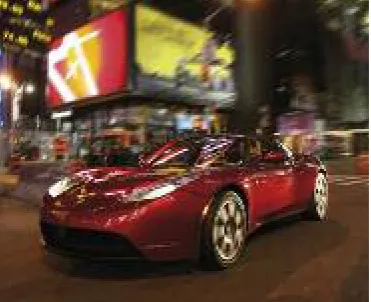
The above market scenarios indicate routes by which EVs might take a larger slice of the British transport market. However, for any of these make a significant impact on emissions, it will be necessary for the technology to be affordable. There will always be potential purchasers for a high-status ‘green’ car, such as the $130,000 Lotus-Tesla Roadster (figure 4), capable of 125 mph and less than 4 seconds from 0 to 60 mph.
JLR’s development of a Limo-Greenhybrid that will achieve 180km/h and emissions of less than 120g/km, while maintaining the ambience of a traditional Jaguar, will appeal to a niche market sector but will make a negligible dent in overall UK emissions.
At the other end of the scale, there will be a market for affordable city cars, such as the Smart Move (Figure 5) used for commuting and urban living. However, these will be used for low mileages and will not make a major difference to national emissions.
[image:17.595.20.206.367.518.2]To make a significant difference to emissions, electric vehicles will have to appeal to the mainstream family car and company car sectors, which means they will have to compete economically with petrol and diesel models. The oil industry recognises that “the era of easy oil is over and, in future, oil will be dirtier, deeper and far more challenging.”14However the overall cost of motoring using conventional fuels, which has been falling in real terms for several decades, is unlikely to see a steep increase and EVs will have to compete with vehicles having capital and running costs broadly similar to those seen today.
Figure 4 : Tesla Roadster
[image:17.595.20.205.547.704.2]5 Climate change and CO2 emissions
There is now little doubt that global warming is happening, that it is largely caused by CO2 emissions from human activity, that the effects on some
communities will be devastating and that a substantial cut in future emissions will be necessary to limit the damage.15EU policy has recognised the problem and has made ambitious commitments to reduce all greenhouse gas emissions, but it is not clear how these commitments will be fulfilled.
5.1 The commitment
The Kyoto Protocol, agreed in December 1997, aimed for a reduction in the ‘aggregate anthropogenic carbon dioxide equivalent16emissions of the greenhouse gases’ by at least 5 per cent by 2012, compared with 1990 levels; some European countries committed to greater reductions. In 2007, the International Panel on Climate Change (IPCC) reported that an 80% cut was needed from developed countries and European politicians have committed to achieve this by 2050.
This cut has been mandated in the UK by the Climate Change Act 2008 which places a legal duty on governments to meet steadily reducing targets for greenhouse gas emissions. At present, transport represents a third of total CO2 emissions in the UK and, over the last decade, has increased faster than any other sector. Although, as yet, there are no formal targets for apportioning these reductions between sectors – other than for major emitters such as power stations – it is evident that an overall reduction of 80% will not be achieved unless there are significant reductions in emissions from transport.
5.2 Legal targets and incentives
The EU’s New Car CO2 Regulation17establishes a long-term framework for action by industry to develop lower emitting vehicles. In the UK, the Regulation is expected to reduce CO2 emissions by 7 million tonnes of CO2 a year in 2020. It is hoped that it will also stimulate innovation across all segments of car production. The targets for CO2 emissions from cars are 130g/km driven from 2012, with full compliance by 2015, and 95g/km by 2020. When the regulation comes into force, manufacturers will have to ensure that the average emissions of vehicles sold will be below the target or pay the fine of €95/g per vehicle for exceeding this target.
At present, electric vehicles are deemed to be ‘zero emission’, irrespective of the carbon intensity of electricity generation. There are short term incentives and, for the first few years, selling one EV counts as equivalent to three zero-emission vehicles when calculating fleet averages. Producing EVs (even at a loss) could thus be attractive to manufacturers of larger or high-performance vehicles that could not readily meet the standards. These subsidies are likely to encourage the production of smaller vehicles, fitting into Scenario 2 (described on page 14), where the production of electric commuter cars runs in parallel with a vibrant internal combustion engine sector.
5.3 Emissions from UK transport
5 Climate change and CO2 emissions
Figure 6 : Emissions from UK transport sector
If we project forward the trend until 2050, we can see that, with business as usual, emissions from the transport sector could be roughly double those in 2010. More importantly, an 80% reduction in comparison with 1990 is equivalent to a reduction of 92% compared with an extrapolation of this trend.
Figure 7 : Extrapolation of transport emissions trend
5.4 Can EVs reduce transport CO2 emissions?
A car comparison website lists the CO2 emissions for all of the UK's major new cars. The average CO2 emissions rating is 173g/km (grams of carbon dioxide per kilometre driven), the lowest being 89g/km and the highest 500g/km.18The 2020 target for average emissions is 130g/km. It is expected that this figure will be reduced progressively and some experts are talking about a long-term target of around 80g/km for 4-seat internal combustion engine vehicles.
Results from electric vehicle trials show that EVs equivalent to a small petrol or diesel four-seat car use around 0.2kWh/km in normal city traffic. CO2 emissions from power stations vary from year to year and also over the daily cycle as the carbon intensity of generation changes: in 2009 it was 544g/kWh. Thus the emissions related to an EV are about 100g/km. Trials on a small fleet of four two-seat Smart Movevehicles have shown average CO2 emissions of 81.4g/km using electricity of the same carbon intensity.19
0 100 200 300 400 500
1980 1990 2000 2010 2020 2030 2040 2050 2060
M
illi
on
t
on
ne
s
CO
2
80% 92%
0 100 200 300
1950 1960 1970 1980 1990 2000 2010
M
illi
on
t
on
s CO
[image:19.595.221.485.374.529.2]On this basis, it is difficult to see how EVs fed from the present UK electricity generation mix are significantly better in terms of carbon emissions than petrol or diesel vehicles.20To have a major effect commensurate with the 2050 target, the introduction of EVs would need to be accompanied by almost total
‘decarbonisation’ of the electricity supply. Under these conditions, they could provide the ideal solution of personal mobility without the environmental disadvantages.
The challenge of this should not be underestimated. In November 2009, in their joint response to the Department of Energy and Climate Change consultation on
Delivering Secure Low Carbon Electricity, The Royal Academy of Engineering, the Institution of Engineering and Technology, The Energy Institute, The Institution of Chemical Engineers, The Institution of Civil Engineers and The Institution of Mechanical Engineers stressed the challenge of achieving government targets and set out the following key messages:
•
The challenges to 2020, and onwards to 2050, are of an extraordinary scale and complexity, way outside ‘business as usual’.•
We are of the view that the barriers are surmountable but the approach to the task must be bold, realistic, sustained and underpinned by determination from government.•
The scale of the technology challenges, the requirement for active consumer engagement, and the requirement for close interaction between sectors that today operate largely independently, mean that an honest assessment of downside risks is warranted.•
The approach adopted should have inbuilt flexibility for contingency out-turns and close government progress monitoring so that early action can be taken if the key deliverables are not being achieved on time.Decarbonising the electricity supply system, to allow EVs to offer much lower emissions than internal combustion engine vehicles, is possible but will be very difficult. The additional generating capacity needed to provide energy for these vehicles will also add to the challenge of decarbonising the electricity supply. This challenge – building 1,000 offshore wind turbines per year, a one hundredfold increase in the rate of installing solar PV generation, harnessing wave and tidal energy and the deployment of many new nuclear power stations – is considered by many to be improbable without greater government intervention in the electricity supply industry.21
5.5 Energy scenarios
5 Climate change and CO2 emissions
Figure 8 : Sankey chart – reduced demand: fossil fuels prioritised for heating
Figure 9 : Sankey chart – reduced demand: fossil fuels prioritised for transport
It can be seen that, even in figure 9 where fossil fuels are prioritised for transport, about one third of transport energy is provided by grid electricity. A small fraction of this use represents electric trains but even this scenario will need electrification of road passenger transport, bearing in mind that electrification of road freight is intrinsically more difficult.
In figure 8, where fossil fuels are prioritised for heating, transport is almost entirely electrified. In this case, almost all cars would have to be powered by electricity and all long-distance road freight moved to electric trains.
In practice, neither scenario is likely. Assuming the commitment to an 80% reduction is taken seriously, the outcome is likely to be somewhere between these two where there is not an outright ban on gas boilers but emissions from both the production of low grade heat and transport are cut dramatically by technologies like heat pumps and electric vehicles.
5.6 Alternatives to EVs as a route to reduced emissions
[image:21.652.222.526.322.502.2]combustion engine capable of making a dramatic improvement in fuel consumption.
Organisations developing advanced engines are confident that it will be possible for a small internal combustion engine car to achieve CO2 emissions of around 80g/km in the near future. This could be achieved by techniques such as intelligent turbo- or super-charging, low energy electric steering assistance, variable valve timing, charge stratification and switching off the engine when no power is required.
There are other options for reducing emissions from cars. Biodiesel and ethanol fuels are like-for-like (and, in the developed world, affordable) replacements for diesel and petrol. The limitations on their use will be not on their viability as fuels but on their impact on food availability and the environment, as outlined in the Gallagher report.23
DME (dimethyl ether, CH3OCH3), a readily liquefied gas, can be made from lignocellulosic biomass (such as agricultural residues or wood processing wastes) that are not in competition with food production, coal or hydrocarbons. It has been promoted as a lower-emissions alternative to conventional fuels and it is very clean, in terms of local pollution, easily meeting EURO5 emissions standards. However, the extent to which it is low carbondepends on what materials and energy went into making it.
Hydrogen has been trialled in London and is seen as a possible contender, particularly for larger vehicles such as buses. Although the energy transport and storage problems are different from those associated with EVs, the fundamental problem of providing low-carbon energy is much the same. The option of electrolysis and a fuel cell as a means of transmitting electrical energy from renewable sources, such as wind power, is generally a less efficient process than a battery.
If the objective of policy is to encourage the take-up of vehicles powered from freely available renewable energy by maximising their range and flexibility, then DME or hydrogen would be a logical option for all transport applications. But if, as seems more likely, we will be living in a world where supplies of renewable energy cannot satisfy more than a small fraction of the potential end uses, the greater efficiency of EVs will change the balance of many applications.
In the absence of a readily available, environmentally benign and affordable fuel, a range of transport energy supplies could be developed – synthetic diesel, hydrogen and biofuels as well as electric power. For the passenger car market, this would be a variant of complimentary described in market development scenario 2, in which the EVs are developed alongside advanced combustion technologies giving a wide range of alternative vehicle types for different applications.24
5.7 Competing policies
While considering how EVs might contribute to a reduction in CO2, it is important not to forget the forces ranged against a reduction in mobility, and hence emissions. The website of the EU Directorate General for Energy and Transport quotes the founding principles of the Community:
5 Climate change and CO2 emissions
In other words, EU policy is to increase the movement of people and goods – which inevitably leads to an increase in CO2 emissions.
It would be convenient if managing transport emissions could be considered in isolation from other policies, such as competition, immigration, education, employment or economic growth. All these strongly influence the amount of travel undertaken and thus emissions. For example, a policy of best value procurementthat requires a local authority to invite competitive bids for all services, rather than operating a direct works department, is likely to result in contractors from neighbouring areas driving many kilometres to undertake jobs. Education policies that result in children being driven past a local comprehensive to a specialist college or faith school have a similar effect. It will be a challenge for government to reconcile these different policies.
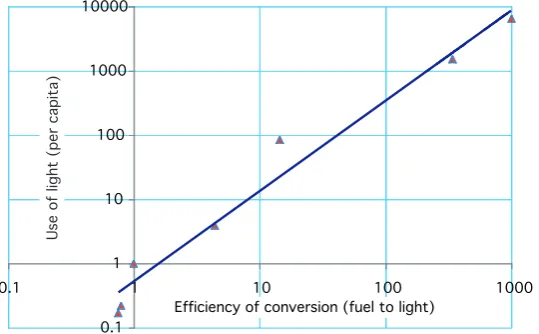
[image:23.595.224.494.405.572.2]It would also be convenient if a reduction in CO2 emissions from transport had no effect on the amount of travel undertaken; unfortunately the inverse is often true. The Khazzoom-Brookes (K-B) postulate argues that ‘if energy prices do not change, cost effective energy efficiency improvements will inevitably increase economy-wide energy consumption above what it would be without those improvements.’ In other words, the greater the efficiency of a process, the greater the use of energy. This has been demonstrated in a recent UKERC publication25 that quoted a study on the use of artificial light from 1700 to 2000 AD. As the efficiency improved over 300 years by a factor of 1000, the amount of light used per capita increased by a factor of more than 10,000.
Figure 10 : Artificial light used 1700 - 2000
This suggests that, if CO2 emissions per kilometre are reduced by a factor of five by 2050, the cost of energy should rise by the same factor – unlikely to be a popular policy.
0.1 1 10 100 1000 10000
0.1 1 10 100 1000
Efficiency of conversion (fuel to light)
Us
e
of
li
gh
t
(p
er
c
ap
ita
6 The challenges of establishing an EV industry
6.1 Manufacturers’ plans
As discussed in section 1, the technical development of EVs is not currently the main impediment to the widespread adoption of EVs – but that is not to say that all problems have been solved.
Many large vehicle manufacturers are developing EVs: Ford has a programme with Scottish and Southern Energy to develop an electric Focus; Citroën has developed the C1 electric (figure 12); Mitsubishi is also developing a range of EVs (figure 11). Toyota has a major programme of electric and hybrid vehicles; TATA (the owners of Jaguar Land-Rover), Peugeot and Renault are introducing prototype fleets of electric cars. However, with the exception of a few expensive vehicles, almost all are designed for limited mileage urban use such as the school run, commuting and shopping.
In addition to these smaller family cars, there are many specialist commuter cars, such as the G-Wiz (figure 13).
Present expectations in European countries for introducing electric vehicles by 2020 range from 40,000 cars in Sweden to 2,000,000 in France. But for EVs and plug-in hybrids to make a significant difference to energy use and CO2 emissions, total market penetration will have to be measured not in tens or even hundreds or thousands of vehicles, but in many millions.
The message from manufacturers would appear to be that it is technically possible to manufacture millions of EVs but, with the cost of current battery technology, they do not see the market developing much beyond the second car in environmentally conscious and affluent households – as in market
development scenario 2 outlined in section 4.
6.2 Production facilities
Most of the EVs available in the UK are still made in small numbers and there will be challenges to building up production volumes. Although cell production is automated, assembling cells into a battery and integrating that with the battery management system is a major task that is not yet automated. New factories, of the scale of the £200m battery plant announced by Nissan in Sunderland, will be needed to mass-produce motors and power semi conductor assemblies.
Several researchers have commented on fundamental problems over supplies of rare earth materials for the magnets needed for high-performance motors. However, if these are not available, there are fallback solutions made of common materials – iron and aluminium – that would reduce performance or efficiency by only a few per cent. Similar issues have been raised over the supply of lithium for batteries. Although lithium is the currently preferred material for battery
[image:24.595.21.208.116.266.2]chemistry, the next section of this report will show that it is not the only option that can produce a viable battery.
[image:24.595.21.206.299.451.2]Figure 11 : Mitsubishi I MiEV
Figure 12 : Citroën C1 Electric
[image:24.595.20.206.488.639.2]7 Storage technology
7 Storage technology
7.1 Recent battery developments
Over the last 20 years, a wide variety of battery types has been developed that could be used in EVs. Much of this development has been driven by the needs of laptop computers, mobile phones and cordless power tools. Current EV and PHEV battery types are most commonly grouped around lithium-ion (Li-ion) based products with various additional cathode additives to improve attributes such as energy density, power density and safety. Other alternatives such as nickel metal hydride and sodium nickel chloride are already commercially available, with lithium-air, lithium-sulphur, zinc-air and bi-polar lead-acid providing cheaper long-term solutions.
As an example of this variety, Modec, a company in the West Midlands making electrically-powered light commercial vehicles with a practical range of 160km, has used sodium nickel chloride batteries (ZEBRA batteries) which operate at 300°C using molten sodium chloroaluminate (NaAlCl4) as the electrolyte. The ZEBRA battery has a specific energy of around 90Wh/kg and specific power of 150W/kg. Modec’s recent production has used lithium iron phosphate (LiFePO4) batteries, which achieve an energy density of around 90Wh/kg. For the near future, Modec are considering lithium sulphide batteries. These have the benefits of being low-cost, biodegradable and abuse tolerant and are expected to produce 500Wh/kg.
At the smaller end of the scale, theSmart Movecars involved in the trials in the North East also used sodium nickel chloride batteries, but with a capacity of 15kWh, although future vehicles are planned to use other chemistry.
TATA, the parent company of Jaguar Land Rover, has developed a range of small four-seat cars with a performance, in urban situations, equivalent to a petrol vehicle. They use Li-ion batteries which have a capacity of 26kWh and mass of 160kg, a specific energy density of 165kWh/tonne, including local support structure and connections.
The Tesla Roadster, a sports car designed by Lotus and produced by the American firm Tesla Motors, uses lithium-ion cells with lithium cobalt oxide (LiCo) chemistry, similar to laptop batteries. The 185kW output gives 0–60 mph time of 3.9 seconds. The 375V, 53kWh battery pack has a specific energy of 120kWh/tonne and can be recharged, using a 70A 240V supply, in 3½ hours.
Much of the expertise in using modern batteries is in the charge and heat management of the complete battery pack. Most high-performance Li-ion batteries have an active cooling system, Tesla’s being active whenever the battery is charged, not just when in use. Cells are discharged in groups to ensure that they share the total load and to avoid excessive heat build-up in some areas of the pack. In some current applications, up to 50% of the energy storage device costs, and up to 35% of the total energy storage systems mass is due to packing, mechanical and electrical protection, voltage and temperature management and ancillary cooling equipment.
7.2 Comparative battery performance
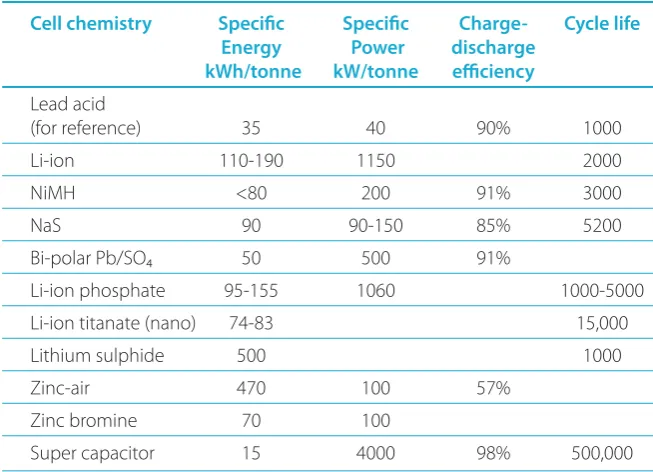
Table 126below lists some battery types that are under development for electric vehicles:
Cell chemistry Specific Specific Charge- Cycle life
Energy Power discharge
kWh/tonne kW/tonne efficiency
Lead acid
(for reference) 35 40 90% 1000
Li-ion 110-190 1150 2000
NiMH <80 200 91% 3000
NaS 90 90-150 85% 5200
Bi-polar Pb/SO4 50 500 91%
Li-ion phosphate 95-155 1060 1000-5000
Li-ion titanate (nano) 74-83 15,000
Lithium sulphide 500 1000
Zinc-air 470 100 57%
Zinc bromine 70 100
Super capacitor 15 4000 98% 500,000
Table 1 : Options for battery chemistry
7.3 Availability of battery materials
Table 1 (above) demonstrates the wide variety of batteries being developed for possible use in EVs. Many are based on lithium and there has been some concern over the long-term availability of this material. Data from the 2009 US Geological Survey27and Meridian International Research28provide the figures in the following table:
2008 Production Reserves Reserve base
tonnes t x 1000 t x 1000
Argentina 3,200 1,000 2,000
Australia 6,900 170 220
Bolivia NA 2,700 5,400
Brazil 180 190 910
Canada 710 180 360
Chile 12,000 3,000 3,000
China 3,500 540 2,700
Portugal 570 NA NA
United States (2005 data) 1,700 38 410
Zimbabwe 300 23 27
[image:26.595.221.548.536.745.2]Total c. 30,000 c. 7,000 c. 15,000
7 Storage technology
Worldwide lithium resources are estimated as some 15 million tonnes. In addition there is an estimated 230 billion tons of lithium in seawater, but the concentration is low (0.1-0.2 ppm). If the mass of lithium metal in an EV battery is 10% of the total pack, then the total lithium requirement of a whole vehicle is about 15kg. The reserve base thus represents sufficient lithium for a billion EV batteries, meaning that lithium shortages do not appear imminent.
The diversity of possible battery chemistries suggests that a shortage of battery materials is unlikely to put a brake on EV development in the UK in the
foreseeable future.
7.4 Optimum battery size
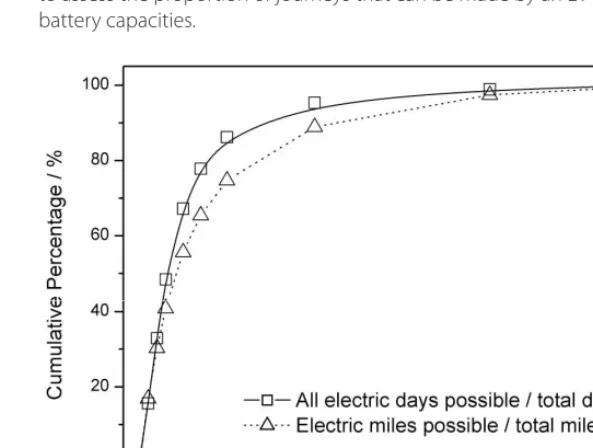
Researchers at Imperial College29have used data from the National Travel survey
[image:27.652.223.520.305.529.2]to assess the proportion of journeys that can be made by an EV with different battery capacities.
Figure 14 : Proportion of trips possible from batteries of different capacities
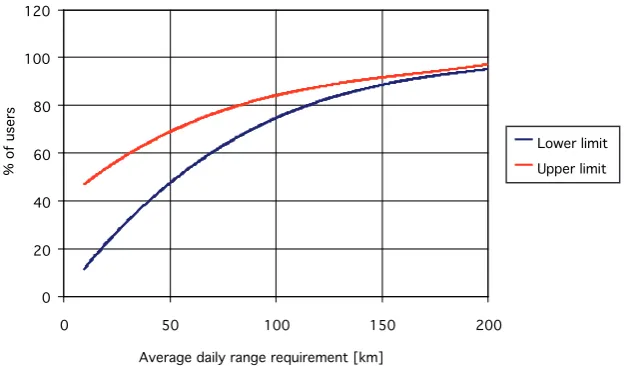
Thirty years ago a similar study was undertaken by David Bayliss (Imperial College)
of traffic in London.30This calculated the percentage of users who would be
satisfied by vehicles with a particular range using two different criteria. With energy use of 200Wh/km (typical of small EVs in city use) the upper curve implies a battery capacity of 20kWh would satisfy 86% of daily journeys, a figure very similar to the Imperial College figures.
Figure 15 : Average daily range requirement for personal vehicles
These studies suggest that, with a battery capacity of around 20kWh, on nine out of 10 days, the vehicle could be operated entirely by electric power. To increase this to 19 out of 20 days would require a further 20kWh, adding perhaps £10,000 to the battery cost and 100kg to the battery weight.
The conundrum is that satisfying nine out of 10 of daily journeys may sound positive but the other side of the coin is that, roughly once a week, the average EV user would want to undertake a trip for which a 20kWh EV would not be suitable. The extra cost (potentially up to £10,000) of a battery sized to enable owners to reduce the number of trips they cannot undertake from once a week to once a fortnight would probably not be seen as good value for money. In either case, drivers would be reticent to run their vehicles to the limit of the theoretical range to avoid the risk of being stranded with a flat battery. With the battery chemistries and costs presently foreseeable, electric vehicles are unlikely be economically attractive other than for predictable low-mileage uses, such as the second car in a multi-car household.
There are three possible solutions to this problem – one would involve changing the ownership model so more vehicles are leased or shared and a user could select either an EV or an internal combustion engine car depending on the plans for that day – if they are known sufficiently well in advance. The alternatives are rapid recharging and/or battery exchange schemes, discussed in section 8, or the adoption of plug-in hybrid electric vehicles (PHEVs) that would allow most daily mileage to be electric but with the back-up of a small engine for longer trips. Figure 14 suggests that, with a battery capacity as low as 10kWh, the average driver would use the hybrid engine only once a week. And, because the cost of a small internal combustion engine drivetrain is less than a 10kWh battery, a PHEV with a 10kW battery is expected to cost less than an EV with a 20kWh battery.
7.5 Safety risk
Although storing energy in a battery is intrinsically less risky than as a highly inflammable liquid, there are certain failure modes that have been identified, such as an internal short circuit causing a fire or a failure of the charging system resulting in the emission of explosive gases. A number of new safety issues need to be considered such as how visually impaired people can recognise the approach of a vehicle not producing engine noise or how emergency services should tackle a crashed EV.
0 20 40 60 80 100 120
0 50 100 150 200
Average daily range requirement [km]
%
o
f u
se
rs
7 Storage technology
7.6 Options for battery charging during the day
If the option of installing a very large battery has disadvantages, there are two alternative possibilities – either changing the ownership model so drivers have the use of a hybrid or internal combustion engine car on those days it is necessary to make a longer trip or finding some means of recharging the EV battery at points on the journey. Four possibilities have been described for the latter option:
•
Fast charge stations, equivalent to petrol/diesel outlets.•
Battery exchange stations, where a discharged battery can be swapped for a fresh one.•
Series hybridisation where a small diesel/petrol engine or fuel cell provides the average energy needed for the trip.•
Recharging at the destination and perhaps intermediate destinations.8 En-route charging
8.1 Fast charge stations
There are three possible impediments to fast charge stations: the ability of the battery to absorb charge in a short time, the ability of the local supply system to cope with the high instantaneous loads and the difficulty of ensuring an efficient and “user-friendly” connection between the grid and the battery.
The Li-ion battery has a maximum charge rate of 1C – meaning that it takes an hour to charge the battery, even in optimum conditions. ion phosphate and Li-ion titanate batteries can be charged at much higher rates; however cell
interconnections and cell heating then become the limiting factors. If a 500V 25 kWh battery could be recharged in three minutes at a rate of 20C, the current into the cells would be (25,000/500) x 20 = 1000A. To carry 1000A, even for a short time, requires heavy electrical conductors both within the cells and between cells. Another consideration is that of the Butler-Volmer equation, which relates the current to the overpotential (the additional voltage required in charging a battery, which is not recovered on discharge, to force the chemical reactions inside). It suggests that a higher current would require the application of a higher overpotential (leading to higher losses), which in turn would affect the
charge/discharge efficiency, thus the CO2 per kilometre performance would be worse.
A typical suburban filling station has a dozen pumps to deliver fuel. If converted to fast recharge points for EV batteries, of the rating discussed above, the load could be 5MW. Bearing in mind the peaky” nature of the load and the likely harmonic content, such a facility would probably need to be fed at 11kV from the HV supply, the level usually reserved for large commercial or industrial premises.
The third difficult area is the interface between the power supply and the battery. To avoid carrying around heavy charging equipment, most fast chargers carry out the isolation and rectification processes ’on shore‘, rather than on the vehicle. This raises the need for international standardisation of the charging interface – not only the heavy duty power connectors but also the control signals to ensure the battery is charged at the appropriate rate for the appropriate time. Charging a traction battery can be a hazardous operation and the charging regime has to be tailored to the battery and its condition. This is several orders of magnitude more complicated than standardising petrol and diesel nozzles in filling stations.
8.2 Battery exchange stations
Several proposals have been made for battery exchange stations. The principle is straightforward – a vehicle is positioned over a pit with a servo controlled lift, the battery is dropped down to below road level, replaced by another fully charged battery and conveyed to an adjoining warehouse to be recharged. In practice, the engineering would be more complicated as the system would have to cope with different sizes of battery for different vehicle types. The capital expenditure on facilities to give good coverage, even limited to main roads and motorways, would be considerable and it is highly unlikely that a battery exchange infrastructure could be available nationwide.
8 En-route charging
more during its lifetime and a five year old EV battery will have a very different residual value from a new battery.
If by 2050 there are 30 million electric vehicles in the UK and an EV battery has come down in cost to £5,000, the first cost of the batteries in use would be £150 billion. Allowing for other batteries in the supply, charging and recycling chain and the total asset value could be £200 billion. Battery leasing has been suggested as a way to allow regular battery swapping but the scale of the operation (roughly 100 times greater than the asset value of the UK railway rolling stock leasing business) would be challenging to implement, particularly on a Europe-wide scale.
8.3 Recharging at destination
Some local authorities are experimenting with city recharging stations where a motorist driving an EV can recharge in a parking bay. It is technically feasible that this scheme, which so far has covered only a few dozen charging points, could be extended to cover larger car parks and out-of-town venues. However, there is no obvious source of funding for such infrastructure. Present costs of installing a charging point are estimated at £5,000, including a card reader and data connection. Installation of a few dozen stations might be funded by a local authority to promote electric vehicles; but meeting the cost of providing the thousands that could be needed in, say, Manchester’s 50 car parks and multitude of on-street parking spaces would be a major issue.
The widespread adoption of charging at the destination would make it difficult to ensure that the electrical load was taken at a time to fit with the availability of surplus low-carbon electricity. Fans parking in Manchester United’s 5000-vehicle capacity car parks during an evening football match might put their cars on charge at 17:00 and expect them to be recharged by 20:00 – the peak load period for the grid.
8.4 Plug-in hybrid electric vehicles (PHEVs)
Figure 17 (below) shows, in simplified form, two main types of hybrid vehicles. On the left is the battery vehicle. Energy comes from the charging socket, is stored in the battery and can be transmitted by the controller to the motor and thus to the wheels. During braking, energy is taken from the wheels through the motor and back into the battery.
The centre diagram is a series hybrid. It is basically an electric vehicle but with an on-board supply of electricity from a small internal combustion engine,
sometimes referred to as a range extender. Under normal day-to-day running, the engine is not used but it can be started during a long journey to maintain the battery state of charge.
[image:31.595.26.196.114.358.2]The right-hand diagram shows a parallel hybrid. In this case the engine can drive the wheels directly via a mixing gearbox of some sort. In parallel hybrids, the electric drive system is often sized to be adequate only for low speed running and the engine is started whenever the car speed exceeds a certain value. A parallel hybrid can have a charging socket or, like the current models of the Toyota Prius, could take all its energy from the petrol and recharge the electric drive system from braking or via the mechanical drive system, when the full power of the petrol engine is not needed.