
Rochester Institute of Technology
RIT Scholar Works
Theses
Thesis/Dissertation Collections
2006
Dynamic Analysis of Hollow Tapered Isotropic and
Composite Shafts Using Finite Element
Techniques
Lindsay LaRocca Parslow
Follow this and additional works at:
http://scholarworks.rit.edu/theses
This Thesis is brought to you for free and open access by the Thesis/Dissertation Collections at RIT Scholar Works. It has been accepted for inclusion
in Theses by an authorized administrator of RIT Scholar Works. For more information, please contact
Recommended Citation
Dynamic Analysis of Hollow Tapered Isotropic and
Composite Shafts Using Finite Element Techniques
by
Lindsay LaRocca Parslow
Thesis submi
tted t
o
th
e faculty of
Rochester
Instit
ute of Technology
in
partial
fulfillm
ent of the requirements
for the
degree o
f
Masters of Science
m
Mechanical Engineering
ApPROV
ED
:
Dr
.
Hany
Ghoneim
, Thes
is
Ad
visor
Dr. Stephen Boedo
Dr.
Elizabeth DeBart
olo
Dr. Edward Hensel
J
anua
ry 2006
Rochester
,
New York
Permission Granted
Dynamic Analysis
of
Hollow Tapered Isotropic
and
Composite
Shafts
Using
Finite Element Techniques
I
, Lindsay LaRocca Parslow, hereby grant permission to the Wallace Library of the Rochester
Institute of Technology to reproduce my thesis in whole
or
in part. Any reproduction will not be
for
commercial use
or profit.
Date:
Signature of Author:
Lindsay LaRocca Parslow
Dynamic
Analysis
of
Hollow
Tapered
Isotropic
and
Composite Shafts
Using
Finite
Element Techniques
Lindsay
LaRocca
Parslow,
M.S.
Rochester Institute
of
Technology,
2006
Advisor: Dr.
Hany
Ghoneim
Abstract
Finite
element
techniques
were
used
to
analyze
the
dynamic
characteristics
of
hollow
tapered
isotropic
and
composite
shafts.
Mathematical
models
of
hollow
tapered
isotropic
and composite
shafts were
developed,
which
were
then
discretized using
Galerkin's
Method
to
produce
standard
vibration
equations.
The
solutions
to
the
standard vibration equations were coded
into
two
com
puter
programs,
which
can
be
used
to
calculate
the
torsional
dynamic
characteristics of an
isotropic
rotor
system,
and
the
coupled axial-torsional
dynamic
characteristics of a
composite
shaft.
Several
examples
using
each computer program
are
presented,
illustrating
their
ability
to
predict
natural
Acknowledgments
This
work
has been
sponsored
by
Dr.
Stephen
Edney
and
Rolls-Royce Corporation.
Special
thanks
to
Mr.
Edney
for his
outstanding
support and consistent encouragement
throughout
this
project.
Without
him,
this
work would not
have been
possible.
I
would
like
to thank
Dr.
Hany Ghoneim,
my
inspiring
professor and
advisor,
who
has
always
encouraged me
to
never
stop
learning
and
to
continue
to
pursue
my
academic
interests.
Special
thanks to
Dr.
Stephen Boedo
and
Dr. Elizabeth DeBartolo
for
serving
on
my thesis
committee
and
always
supporting my
academic goals.
Thank
you
also
to
Dr.
Edward Hensel Jr.
for
his
tremendous
support of
my
academic path and
this
project.
I
am
extremely
grateful
for
the
love
and support of
my
family
and
friends. Thank
you
to
my
parents,
James
and
Wendy LaRocca,
for
allowing
me
to
pursue
my
education
at
Rochester
Institute
of
Technology,
and
for
their
unconditional
love
throughout the
years.
I especially
want
to thank
my
husband,
Shawn
Parslow,
for his
love, friendship,
and
support
and
for
giving my
life
a
much
needed
balance
these
last
five
years.
Contents
Abstract
iv
Acknowledgments
v
List
of
Tables
x
List
of
Figures
xi
Nomenclature
xiii
Chapter
1
Introduction
1
1.1
Background
2
1.2
Statement
of
Work
4
Chapter
2
Isotropic
Material
Formulation
5
2.1
Mathematical
Model
5
2.1.1
Equation
of
Motion
5
2.2
Finite Element Formulation
7
2.2.1
Mesh
Generation
and
Function
Approximation
7
2.2.2
Derivation
of
Shape Functions
7
2.2.3
Element Stiffness
and
Mass Matrices
10
2.2.4
Formulation
of
System
Equation
of
Motion
12
2.2.4.1
Free
Vibration
Solution
12
2.2.4.2
Forced
Vibration
Solution
12
2.3.1
Uniform
Free-
Free
Shaft
16
2.3.2
Tapered Shaft
19
2.3.2.1
FETORS
19
2.3.2.2
Torsional
Analysis
Program-Holzer's
Method
21
2.3.2.3
ANSYS
22
2.3.2.4
Results
and
Discussion
22
2.3.2.5
Fixed-Fixed
and
Free-Free
Case
29
2.3.3
Forced Response: Comparison
of
FETORS
with
Published
Work
35
2.3.3.1
Discussion
and
Results
37
2.3.4
Forced Response: Comparison
of
FETORS
with
Exact
Closed Form
Solution
43
2.3.4.1
Results
44
2.3.5
Discussion
45
Chapter
3
Composite
Material Formulation
46
3.1
Mathematical
Model
46
3.1.1
Equations
of
Motion
46
3.1.1.1
Force-Displacement
Relationship
47
3.2
Finite Element
Formulation
54
3.2.1
Mesh
Generation
and
Function
Approximation
54
3.2.2
Element Stiffness
and
Mass Matrices
55
3.3
Finite Element Solution
and
Computer Program Incorporation
57
3.4
Composite Shaft Examples
58
3.4.1
Effect
of
Taper
Angle
on
Dynamic
Characteristics
60
3.4.2
Effect
of
Fiber
Angle Orientation
on
Dynamic
Characteristics
65
3.4.3
Effect
of
Taper Angle
and
Fiber
Orientation
on
Dynamic Characteristics
. .69
3.4.4
Discussion
72
Chapter
4
Conclusions
74
Bibliography
76
A.l
Element Stiffness
Matrix
78
A.2
Element Mass
Matrix
80
Appendix B
Composite Matrix
Coefficients
81
B.l
Matrix
Coefficients,
Qij
81
B.2
Matrix
Coefficients,
Q%3
82
B.3
Matrix
Coefficients,
Qtj
83
Appendix C
Computer Programs
84
C.l
FETORS
in
FORTRAN
84
C.l.l
Input
File
for
Uniform
Free-
Free
Shaft
Example: 5 Elements
104
C.l. 2
Input File
for Tapered
Fixed-
Free Shaft
Example: 5 Elements
104
C.l.
3
Boedo's Closed
Form
Solution
105
C.
1.3.1
Fixed-Free Case
107
C.l.3.2
Free-Free
Case
108
C.l.3.3
Fixed-Fixed Case
108
C.l.
4
Input File
for
Forced
Response
Example:
Comparison
to
Published Example
108
C.l. 5
Input
File for Forced Response
Example:
Comparison
to
Closed
Form
SolutionllO
C.2
Composite
Program
M-Files
in
Matlab
Ill
C.2.1
Main
M-File,
"compositeprogram.m"Ill
C.2. 2
Local Matrices
M-File,
"localmatrices.m"List
of
Tables
2.1
Tapered
Fixed-
Free Shaft: Fundamental Torsional
Natural
Frequency
23
2.2
Tapered
Fixed-
Free Shaft:
Second
Torsional Natural
Frequency
23
2.3
Tapered Fixed-Free
Shaft: First Ten Torsional Natural
Frequencies
26
2.4
Tapered
Fixed-
Free Shaft:
First
Ten
Torsional
Natural
Frequency
Errors
9
2.5
Tapered
Fixed-Fixed Shaft: First Ten Torsional Natural
Frequencies
29
2.6
Tapered
Fixed-Fixed Shaft: First Ten Torsional Natural
Frequency
Errors
30
2.7
Tapered Free-Free Shaft:
First
Ten
Torsional
Natural
Frequencies
32
2.8
Tapered Free-Free
Shaft: First Ten Torsional Natural
Frequency
Errors
33
2.9
Parameters for
Torsional Model
(Published)
36
2.10
Double Speed
Torsional
Excitation
(Published Case
[8])
36
2.11
Single Speed
Torsional Excitation
(FETORS
and
TWIST2)
39
2.12
Parameters for Torsional Model
(Closed
Form)
44
3.1
Material Properties
of
Composite Shaft Examples
59
3.2
Shaft
Geometry
for
Study
of
Effect
of
Taper
Angle
60
3.3
Shaft
Geometry
for
Study
of
Effect
of
Fiber
Angle Orientation
65
List
of
Figures
2.1
Differential Element
of
an
Isotropic
Material
Shaft
6
2.2
Tapered Element
8
2.3
Uniform Shaft: Torsional
Natural
Frequencies,
%
Error
Vs.
Closed
Form
Solution
.18
2.4
Tapered Shaft:
Fundamental Torsional Natural
Frequency, %
Error Vs.
Closed Form
Solution
24
2.5
Tapered
Shaft:
Second
Torsional Natural
Frequency,
%
Error Vs.
Closed
Form
Solution
25
2.6
Tapered Fixed-Free Shaft:
%
Error Vs.
Boedo's Closed Form Solution
28
2.7
Tapered Fixed-Fixed Shaft:
%
Error Vs. Boedo's
Closed
Form
Solution
31
2.8
Tapered Free-Free
Shaft:
%
Error Vs. Boedo's
Closed
Form
Solution
34
2.9
Torsional Model
for Forced
Response Example: Published
35
2.10
Published [8]:
Torsional
Response
at
Node 1
37
2.11
Published [8]:
Torsional
Response
at
Node
2
38
2.12
Published
[8]:
Torsional
Response
at
Node
4
38
2.13 FETORS:
Torsional Response
at
Node
1
40
2.14 FETORS:
Torsional Response
at
Node
2
40
2.15
FETORS: Torsional Response
at
Node
4
41
2.16
TWIST2:
Torsional Response
at
Node
1
41
2.17
TWIST2:
Torsional
Response
at
Node 2
42
2.18 TWIST2: Torsional Response
at
Node
4
.42
2.19
Torsional Model
for
Forced
Response
Example:
Closed
Form
Solution
44
2.20 Torsional Response
at
Nodes 1
and
2
45
3.2
Coordinate
System
of
a
Composite
Material
48
3.3
General Shaft
Geometry
58
3.4
Effect
of
Taper
Angle
on
Fundamental Torsional Natural
Frequency
(6
=0. L
3")
61
3.5
Effect
of
Taper
Angle
on
Fundamental
Axial
Natural
Frequency
(0
=0. L
=3")
. .62
3.6
Effect
of
Taper
Angle
on
Fundamental
Torsional Natural
Frequency
(6
=0,
L
=6")
63
3.7
Effect
of
Taper
Angle
on
Fundamental Axial
Natural
Frequency
(0
=0. L
=6")
. .64
3.8
Effect
of
Fiber
Angle
on
Axial
and
Torsional Fundamental Natural
Frequency
(0.
L
=3")
66
3.9
Effect
of
Fiber
Angle
on
Axial
and
Torsional Fundamental Natural
Frequency (6,
L
=60")
67
3.10
Effect
of
Fiber
Angle
on
Axial
and
Torsional Fundamental Natural
Frequency
(0.
L
=12")
68
3.11
Effect
of
Taper
Angle
and
Fiber Orientation
on
Fundamental Torsional Natural
Fre
quency
70
Nomenclature
A
cross-sectional area
Cc
critical
damping
C
cross-sectional
torsional
constant
DL
diameter
at
left
end
Dr
diameter
at
right
end
E
Young's Modulus
f
ithnatural
frequency
G
shear
modulus
of
elasticity
I
mass
inertia
Ip(x)
polar
moment
of
inertia
[I]
identity
matrix
J
polar
moment
of
inertia
K
torsional
stiffness
[Al
stiffness matrix
/
element
length
L
shaft
length
m
elemental
mass
[M]
mass matrix
[Q]
reduced
stiffness matrix
reduced
stiffness matrix
reduced
stiffness matrix
Ti
inner
radius
r0
outer
radius
R
residual
Ri(x)
inner
radius
Rjl
inner
radius at
left
end
Rir
inner
radius
at right end
Ro(x)
outer radius
Rol
outer radius at
left
end
Ron
outer radius at right
end
[R]Q
academic-engineering
strain
transformation
matrix
[R]e
academic-engineering
strain
transformation
matrix
t
time
T
kinetic
energy
T
torsional
moment
[T]
transformation
matrix
[T]e
transformation
matrix
u
axial
displacement
V
strain
energy
V
elemental volume
x
axial
location
Greek
e
engineering
strain
e
academic
strain
(f>
angle of
twist,
torsional
displacement
</>
approximate angle of
twist
(pi
ith
eigenvector
7xj/
shear
strain
A,
itheigenvalue
p
elemental mass
density
v
Poisson's
ratio
0
hoop
direction
0/
fiber
orientation
p
density
ax
normal stress
rxy
shear stress
Lun
natural
frequency
ip
shape
function
Ci
ithmodal
damping
ratio
Subscripts &; Superscripts
e
denotes
element
s
denotes
system
12
local
material coordinates
i
meridian coordinates
/
differential
with respect
to
x
Chapter
1
Introduction
Tapered
or conical shaft
sections
are
design
features
often
incorporated into
the
rotors
of a
variety
of
turbomachinery.
It
is important
to
be
able
to accurately
predict
the
dynamic
characteristics of a
rotating
system so
that
proper care can
be
taken to
avoid resonance.
Operating
a rotor
at
resonance
can
lead
to
reduced
life
of
components
and, occasionally,
catastrophic
failure
of
the turbo
machine.
Several
methods exist
for
calculating
the
torsional
natural
frequencies
of
rotating
systems which are
primarily
based
on
a
lumped
parameter approach.
While
these
methods produce acceptable
results,
they
often
require
approximations
for
simplification
purposes
to
discretize
the
rotor
system.
An
alterative,
and perhaps
better
approach,
is
to
use a
continuously
distributed
model
that
comprises
a
more
implicit
representation of
the
rotor's
geometry.
A finite
element model
is
ideally
suited
for
this
since
it
can
be
used
to
accurately
model complex
geometries,
such as
hollow
tapered
shaft sections.
Furthermore,
composite
materials
are
becoming
increasingly
utilized
in
modern
turbomachinery
due
to their
many
advantages such as
specific
strength and
stiffness,
corrosion
resistance,
and
lightweight
property, to
name a
few.
Consequently,
an
improved
method of
accurately predicting
the
axial and
torsional
natural
frequencies
of
hollow
tapered
shafts
made of
this
anisotropic material
is
essential.
Contained herein
are
dynamics
formulations
for
predicting
the
natural
frequencies
and mode
predicting the torsional
vibration of an
isotropic hollow
tapered
shaft
is
presented
first,
followed
by
a
method
for
analyzing
the
coupled axial-torsional vibration of a
composite
hollow
tapered
shaft.
In
both
instances,
a
mathematical model was constructed and
then
discretized
using
Galerkin's Finite
Element Method
to
produce
the
characteristic vibration
equation,
[M]X
+
[C]X+[K]X
=F
(1.1)
where
[M], [C],
and
[A']
are
the mass,
damping,
and stiffness
matrices,
respectively.
F is
the
forcing
vector,
and
A",
X,
and
X
are
the
acceleration,
velocity,
and
displacement
vectors.
The
eigenvalue
problem of each
finite
element
formulation
was
incorporated into
two
different
computer programs.
The
isotropic hollow
tapered
shaft
formulation
was
evaluated
in
a
FORTRAN
computer
program
capable
of
analyzing
a
drive
train system,
and
the
composite
material
shaft
formulation
was evaluated
in
a
Matlab
program.
1.1
Background
Extending
the
work of
S.L.
Edney,
C.H.J.
Fox,
and
E.J.
Williams
[13],
and
L.M.
Greenhill,
W.B.
Bickford,
and
H.D.
Nelson
[16],
two
unique
torsional
finite
element
models
were
developed for
a
hollow
tapered
shaft.
The
first
model
is
for
calculating
the torsional
dynamic
characteristics
of an
isotropic hollow
tapered shaft,
while
the
second
model
is
for
calculating
the
axial-torsional
dynamic
characteristics
of a
composite
hollow
tapered
shaft.
The
isotropic
finite
element model was
incorporated
into
a
FORTRAN
computer program
that
can
predict
the
free
and
forced
response of
multiple or geared rotor systems.
The
program.
FETORS
[14],
is intended
to
replace
the
current
lumped
parameter
model
used
by
Rolls-Royce
Corporation,
Torsional Analysis
Program
(TAP)
[15].
FETORS is
of great
benefit
to
Rolls-Royce
since
it
will allow
more
accurate
torsional
dynamic
analyses
of real rotor systems
to
be
conducted.
The
lumped
parameter
approach,
TAP,
used
by
Rolls-Royce
to
conduct
torsional
con-nected
together
by
mass-less elastic shaft elements
that
behave
as
torsional
springs.
This
approach
can yield
somewhat
crude
results
due
to the
simplifications
required
with
a
lumped
parameter model
to
represent
a
real
rotor system.
FETORS
is
based
on a continuous
mass and stiffness
representation
that
implicitly
idealizes
a
rotor's geometry.
The
work of
Edney
et al
[13]
included
translational
and rotational
inertia,
shear
deformation,
gyroscopic
moment,
axial
torque,
viscous and
hysteretic
material
damping
and mass
eccentricity
for
a
tapered
beam. Greenhill
et al
[16]
included
the
effects of
rotatory
inertia,
gyroscopic
moment,
axial
load,
internal
damping,
and
shear
deformation for
a
linearly
tapered
conical cross-section element.
Both
of
these works,
however,
were
limited
to
analyzing
the
lateral
dynamic
characteristics of a
rotor
system.
The
work
presented
here
adapts
the
lateral
finite
element
formulations derived
in
[13]
and
[16]
to
a
torsional
model.
This
new
tapered torsional
finite
element
formulation
was
then
incorporated into
a
FORTRAN
computer program
that
can
be
used
to
perform critical speed
analyses,
or
calculations
of
torsional
natural
frequencies
and
mode
shapes,
and
steady
state
forced
response
analyses
[8]
of a system comprised of
isotropic
material rotors.
Moreover,
composite materials are
becoming
increasingly
used
in
industry
due
to their
high
strength
and
light
weight
properties.
Although
composite
shafts
are not
yet
widely
used
for
the
main
shafting in
today's
turbomachinery,
it is only
a
matter of
time
before
they
will
be
used,
even
if
on
a
limited basis.
Kim,
Argento,
and
Scott
[17]
mainly
studied
the
bending
response
of a
composite
tapered
shaft.
They
found
that
by
tapering
a composite
shaft with an angle of
approximately
15to
20,
all
natural
frequencies
and stiffness
can
be
significantly increased
over a
uniform
shaft
of
the
same volume
and
composite
material.
Consequently,
the
second
part
of
this
work presents a
formulation
for
calculating
the
coupled
axial-torsional
dynamic
characteristics
for
a
hollow
tapered
1.2
Statement
of
Work
The
objective
of
this
work
was
to
develop
a
finite
element
based
computer
program
for
conducting
torsional
rotordynamics
analyses
on
hollow
tapered isotropic
material
rotor
systems,
and
axial-torsional
dynamics
analyses
on
composite
hollow
tapered
shafts
using Matlab.
The
procedure
for
the
isotropic
material
formulation
was
as
follows.
First,
a mathematical
model
of
a
hollow
tapered
shaft
was
developed.
Next,
the
mathematical
model
was
discretized
using
the
finite
element
method
to
obtain
the
standard
vibration
equation,
Equation 1.1.
The
free
and
forced
response
solutions
to the
standard vibration equation were
then
incorporated into
a
FORTRAN
based
computer program capable of
analyzing both
single and multi-shaft rotor systems.
This
program
for
conducting
torsional
critical
speed
and
forced
response
calculations
of general
multi-shaft
rotor
systems
was
then
verified
against
an exact
closed-form
solution
of
a
cylindrical
shaft
of
traditional
metallic
material.
The
purpose
of
this
work was
to
demonstrate
the
capability
of
the
computer program
to
accurately
predict
the torsional
vibration
characteristics of a
traditional
metal shaft
rotating
system.
Several
example cases are
presented,
demonstrating
the
accuracy
and
usefulness
of
the FORTRAN
program
compared
to
the
current
lumped
parameter
approach
for
torsional
analysis used
by
Rolls-Royce.
A
similar
procedure
for
the
composite
material
formulation
was
followed.
A
mathemati
cal
model
of
the
coupled
axial-torsional vibration of
a
hollow
tapered
shaft
was
developed,
then
discretized using
the
finite
element
method
to
obtain
the
standard vibration
equation, Equation
1.1.
The
eigenvalue
solution
to the
characteristic
vibration equation was
then
incorporated
into
a
computer
program,
Matlab,
capable
of
analyzing
a single shaft.
The
results of
the
finite
element
program
were
then
compared
against
a commercial
finite
element
software
package,
ANSYS.
Several
Chapter
2
Isotropic Material
Formulation
2.1
Mathematical Model
A
mathematical
model can
be
used
to
analyze
the torsional
vibration
of an
isotropic
shaft.
In
this
section, the
dynamic
equilibrium method
is
used
to
develop
the
equation of motion.
An
alternate
approach
for
developing
the
equation of
motion, the
Energy
Method,
is
given
in
Appendix A.
2.1.1
Equation
of
Motion
Taking
the
dynamic
equilibrium of
the
differential
element,
Figure
2.1,
yields
the
equation
of motion:
dT
&=*"
<2-1)
where
T
is
the
torque,
p is
the
density,
J
is the
polar moment of
inertia,
and
4> is
the
angle of
twist.
T
'*
T+
(cT/5X)dx
p-p-Figure
2.1:
Differential Element
of an
Isotropic
Material
Shaft
relationship.
T
=2tt
rx6r-dr
'? 91
where
rTe
is
the
shear stress
in
global
coordinates,
and
r,
and
r0
are
the
inner
and outer radii of
the
cross sectional area.
The
stress can
be
related
to the
strain
by
the
following
relationship,
Txe
=G^x6
(2-3)
where
G
is
the
shear
modulus,
and
";xg
is
the
strain.
The
strain
can
be
expressed
in
terms
of
displacement
using
the
following
relationship,
do
1x6
~rdi
(2.4)
where r
is
the
radius of
the
element.
Substituting
Equations 2.2,
2.3,
and
2.4 into Equation 2.1
yields
the
equation of
motion,
l(GJS)
=<*
<2-5>
The
equation of
motion,
Equation 2.5.
paired
with
the
appropriate
boundary
conditions
constitutes
2.2
Finite
Element
Formulation
The
mathematical
model
can
be discretized
using the
finite
element
method.
This
consists
of
approximating
the solution, then
applying
Galerkin 's
method
to
the
approximation
to
minimize
the
residual.
Next,
the
global
equation will emerge
as a
result
of
the
standard
assembly
method
[18].
The
global
standard
vibration equation can
then
be
solved.
2.2.1
Mesh Generation
and
Function
Approximation
The
shaft
can
be divided
up into
elements,
with nodes on
the
left
and right
sides of
the
element.
The
solution, (j)(x,t),
or
torsional
displacement,
of
the
shaft
can
be
approximated
by
a piecewise
linear
polynomial,
</>(x,t)
=Y,4>e(x,t)
(2.6)
where
4>e(x,t)
='i>i(x)<S>i(t)
(2.7)
i=i
so
that
<Pe(x,
t)
=Mx)$i(t)
+
Mx)Mt)
(2-8)
where
4>eis
the
approximated elemental
torsional
displacement,
ip is
the
shape
function,
and
<f>is
the
nodal
torsional
displacement.
2.2.2
Derivation
of
Shape Functions
Consider
the
typical tapered
element,
or
the "torsional
element,"of
the tapered
shaft
depicted
in
Figure
2.2,
where
the
xaxis
is
the
element's
rotation axis.
Figure
2.2:
Tapered Element
displacements,
$i(t)
and
&2(t),
and
the
linear
shape
function
forms,
ip\(x)
and
fafa)-
In
matrix
form,
Equation
2.7
can
be
written as
where
~tf(x,t)
={i>{x)}{<5>{t)y
{i>(x)}
={
^(x)
V>2(x) }
m)r
Mt)
(2.9)
(2.10)
(2.11)
It
is important
to
note
that
the
first
derivatives
of
the
shape
functions
must
be
finite
within
an
element,
and
the
displacements
must
be
continuous
across
the
element
boundary
[10].
The
displacement
profile
is
assumed
to
be
linear
over
each
element; the
elemental angular
rotation can
be
expressed as
4>e(xf)=c1x +
c2
(2.12)
where
c-y
and
c2
are constants.
In
matrix
form,
Equation 2.12 is
4>e(x,t)
X
1
Cl
C2
Based
on
the
approximated
polynomial
form
of
the
angular
rotation,
Equation
2.12,
the
angular
displacements
at
the two
nodes
or endpoints of
the
element
can
be
written
as
Mt)
ci(0)
+ c2
Ci(l) +
c2
Therefore,
Mt)
Mt)
o
1
i
l
Cl
Co
(2.14)
(2.15)
The
constants,
c\
and
c2,
can
be determined
by
solving
the
following
equation
-i-i
which
yields
Cl
c2
Cl
C2
0
1
I
1
1
I
1
I
1
0
Mt)
Mt)
Mt)
Mt)
(2.16)
(2.17)
By
substituting Equation 2.17 into
2.13,
the
angular rotation
becomes
4>(x,t)
=j
x
1
or,
after
simplifying,
1
I
1
I
1
0
Mt)
Mt)
<t>(x,t)
=\
(l-f)
f
Mt)
Mt)
By
equating
Equations
2.9
and
2.19,
the
shape
functions for
the
torsional
element are
x
Mx)
=i
/
ifo(x)
X
1
when
assuming
the
angular
displacements
vary
linearly
along the
element.
(2.18)
(2.19)
(2.20)
2.2.3
Element Stiffness
and
Mass Matrices
The dynamic
equilibrium
equation.
2.1,
can
be
rearranged
to
be
f-pJo
=0
(2.22)
Equation
2.22
can
be
approximated
using
the
assumption
of
Equation 2.7.
and
the
residual.
R.
can
be
determined
T-pJo
=R
(2.23)
The
residual
can
be
minimized
by
multiplying it
by
the
shape
function,
integrating
over
the
length
of
the
shaft, and
setting
the
integrand
to
zero.
f
v1(x)Rdx
=0
(2.24)
Jo
'where
j
=1.2.
The
shape
functions,
V\
and i2.
are
given as
i'i(x)
=l-y
(2.25)
v:(-r)
=j
.(2.26)
Equation 2.23
can
be
substituted
into
the
residual.
R.
of
Equation 2.24. After
integrating by
parts.
the
differential
equation
to
solve
is
--ii
o
JQ
(x)fdx
+
jT
Vj
(x)
pJodx
=[Vj
(x)
f]
where
j
=1.2.
The
local
stiffness
and
mass matrices.
[A']
and
[M\
respectively,
can
be
extracted
from
the
differential
equation of motion.
The
elements of
the
stiffness matrix are
the
coefficients
of
the two
equations
for
the two
degrees
of
freedom
of each element.
$x.
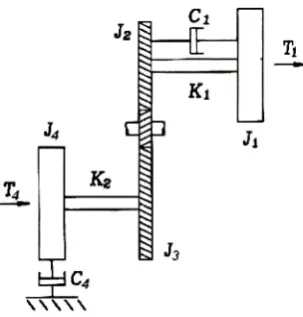
and
<f>2-
For
example.
[K]_+[M]_
=E
(2.28)
where
_ =
and
=
-T
T
(2.30)
The
stiffness
matrix
is
and
the
mass matrix
is
[K}
=M
An
A12
Kn
A22
Mi
l-h-2
M12
A/22
(2.31)
(2.32)
The
elements
of
the
stiffness
and mass matrices are
listed below.
An
=/
%\GJ\i\dx
Jo
K12
A'22
ijj-.GJ'i-o
dx
/
VoGJv'-i
Jo
dx
where
Mi
=/
4>ipJi>i
dx
Jo
M2
=/
i'\pJv->dx
Jo
M22
=/
fopJfo
dx
Jo
J
=U^-y)
and
r0
and
r,
are
functions
of
x, the
distance along
the
length
of
the
shaft.
2.2.4
Formulation
of
System
Equation
of
Motion
2.2.4.1
Free
Vibration
Solution
To find
the
system's
free
undamped
vibration, the
following
differential
equation
of motion must
be
solved,
[M]s
0
+
[K]s8
=0
(2.34)
where
[M]sand
[K]sare
the
mass
and
stiffness matrices of
the system,
respectively.
For
a
linear
system,
0
=0oelut(2.35)
where
0q
is
the
amplitude of
the
response.
Differentiating
Equation 2.35
twice
with
respect
to time
and
substituting into Equation 2.34
yields
(-u;2
[A/]s+
[A]s)
0o
=0
(2.36)
The
natural
frequencies
of
the system, u>i,
can
be
expressed
by
solving
the
following
equation
for
det
(-a;,2
[M]a+
[A]s)
=0
(2.37)
The
eigenvalues,
A,,
are
the
roots of
the system,
given
by
^
=a;2
(2.38)
and
the eigenvectors,
fa,
are
the
displacement
vectors,
or
mode
shapes,
resulting
from
the
back
substitution
of
eigenvalues,
Aj.
2.2.4.2
Forced Vibration
Solution
can
be
represented
by
a vector.
m
=[{fa},{fa},...,Un}\
(2.39)
The
orthonormal
modes,
or
the
weighted
normal
modes,
can
be determined
by dividing
the
normal
modes
by
the
square root
of
the
generalized
mass, Mu. The
generalized masses are
the
coefficients
of
the
identity
matrix,
so
that
mT[M}[}
=[Mu}[I]
(2.40)
Therefore,
the
orthonormal
modal matrix elements
can
be
written
as
The orthogonality
relationships
are
[20]
:
and
where
[A]
Yi
%sJ[Mu
[*r
[Af]
[*]
=[I]
wr
[A]
[*]
=[A]
Ai
0
0
0
0
A2
0
0
0
0
A3
0
0
0
0
Ar
(2.41)
(2.42)
(2.43)
(2.44)
In
matrix
form,
the
system equation of motion
for
the
continuous system
is
[Af]
{<?}
+
[C]
{0}
+
[A] {0}
={T}
(2.45)
where
the
[M], [C],
and
[A]
are
the mass,
damping,
and stiffness
matrices, respectively,
and
{T}
is
the
complex
torsional
forcing
vector.
The
system
damping
matrix,
[C],
from Equation
2.45,
can
be determined
by
decomposing
it
into
a
linear
combination
of
the
mass and stiffness
matrices
[18]:
[C]
=a[M}+/3
[A]
where a and
j3
are coefficients
for frictional
damping
and structural
damping,
respectively.This
is
known
as
proportional
damping.
The
physical
coordinate,
0,
can
be
transformed
to
"modal"coordinate, q,
using
the
following
equation
[8]
{0}
=[*]
{q}
(2.47)
Substituting
Equation
2.47 into 2.45
yields
[Af]
[*]
{q}
+
[C]
[$]
{q}
+
[A]
[*]
{q}
={T}
(2.48)
To
use
the
orthogonality
relationships,
Equations
2.42
and
2.43,
Equation 2.48 is
pre-multiplied
by
~-\T
-~iT
$
to
give
[*]
'[M]
[$]
{q}
+
[C]
[*]
{q}
+
[A]
[$]
{9}
=[$]'J'{T}
The
employment
of
equations
2.42,
2.43,
and
2.46 in 2.49
yields
[f] {?}
+
[a
[f]
+ /?
[A]] {q}
+
[A] {9}
=[*]'
{T}
~lT
(2.49)
(2.50)
The
above
equation resembles
the
differential
equation of motion
for
forced
damped
vibration
in
terms
of
C,
the
damping
ratio,
and
ujn, the
natural
frequency
[20]
x
+ 2C^'x
+
^'2.r =F(t)
m
(2.51)
Therefore,
by
forcing
Equation 2.50
to
fit 2.51,
the
damping
coefficient
can
be
simplified
to
(a+^n;23)=2^m
(2.52)
The
system
damping
matrix
can
then
be
written with
the
diagonal
elements
being 2Qu)ni
[8]
[C]
0
0
0
2(>2
0
0
0
(2.53)
where
Ci
is
the
modal
damping
ratio
for
the
ith
normal mode.
where
c
is the
damping
constant,
and
cc
is
critical
damping
[18]
cc
=2rrtaJni
(2.55)
If
lQ}
=mT{T}
(2.56)
then
Equation 2.50 becomes
q,(t)
+
2c,-,--;ni.fc(*)
+
WnMt)
=Qi(t)
(2.57)
after
substituting
Equations
2.52
and
2.56. When
the
modal
damping
ratio
is
less
than
1,
according
to
Rao
[18],
the
solution
to the
above
equation can
be
expressed as
qx
(t)
=A
+
B +
C
(2.58)
where
A
=e'^"'*
l
cosu;,7,-f
cosydlt
+
-\ =sin^f
>
qt
(0)
(2.59)
i-C
B
=\
e-*'*"*smudit
}
qx
(0)
(2.60)
C
=/
Ql(T)e-Q-,"At-T)
sinu:di
(t
-t) dr
(2.61)
\jJdi
Jo
and
"'d,
=u.'ni-v/l-Ci
(2.62)
This
solution must
be
transformed
back
to
physical
coordinates
using
Equation
2.47.
2.3
Computer
Incorporation
and
Numerical Examples
Section 2.2
was
coded
into
a
FORTRAN
computer
program
called
FETORS.
Gauss-Legendre
Algorithm
was used
to
evaluate
the
eigenvalue solution.
FETORS
requires an
input
file
that
con
tains
the
torsional
system's
geometry,
as
well
as
any
other
necessary information
such
as
damping,
couplings,
external
torques,
and
lumped
external
inertias.
FETORS
is
capable of
evaluating
mul
tiple
rotor systems connected
by
couplings,
geared
rotor
systems
with
different
speeds,
and rotor
systems
with
different
material properties.
A
listing
of
the
FETORS
computer program
is
provided
in
Appendix C.l.
The
accurac)^of
the
finite
element
torsional
formulation
embedded
in
FETORS
is demon
strated
by
using
the
program
to
determine
the torsional
natural
frequencies
and
mode shapes of
a
uniform
cylindrical shaft
and
a
tapered
shaft.
In
the
case
of
the
uniform
cylinder,
the
results
given
by
FETORS
are
compared
to
a
known
exact solution.
For
the tapered shaft, the
results
are
compared
with other
methods,
such as a stepped-cylinder model and
TAP.
Convergence
curves
for
the
first
two modes,
which
show
how many
elements
are
required
for
the
new
model
to
produce
accurate
results,
are
given
for
each
example
case.
Also,
two
additional
examples
are
presented
illustrating
the
forced
response analysis capabilities
of
the
computer program.
2.3.1
Uniform Free-Free
Shaft
A
uniform
(cylindrical)
free-
free
shaft was modelled
using
the
finite
element
formulation,
as a
series
of
"tapered
having
equal
left
and right end outer
diameters.
The
uniform
shaft
geometry is
as
follows:
L=
100 in.
D
=10 in.
The
calculated natural
frequencies
and
mode
shapes of
the
uniform
free-free
shaft
determined
The
exact natural
frequency
of
a
uniform
free-free
shaft
in hertz
(Hz)
is
given
by
1
fi
=(cGy
(263)
2irl
\
plp
J
where
A,
is the transcendental equation,
I
is
the
element
length,
C
is
the torsional
constant of
the
cross
section,
G
is
the
shear
modulus, p is
the
mass
density
of
the element,
and
Ip
is
the
polar
second
area moment of
area about
the
axis of
torsion,
as
given
below.
/
=1,2,3...
A,
=in
tvR4
C
G
h
2
E
2(1
+
!/)
vrA4
where
R
is
the
radius of
the
shaft.
The
exact mode
shape
is
given
by
the
expression
x\
fnrx\
l)
=
cos
vt)
{2M)
where
i
=1, 2,
3
. ..,
x
is
the
axial position
along
the element,
and
I
is
the
element
length.
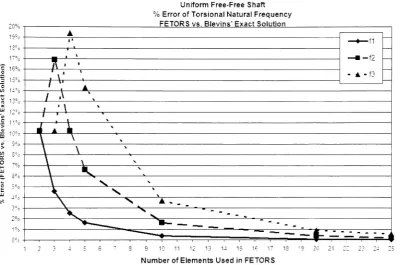
Figure 2.3
compares
the
first
three torsional
natural
frequencies,
as a
function
of
the
number
of
elements,
from FETORS
with
Blevins'
[6]
exact
solution.
FETORS
was run seven
times,
each
with
a
different
number of elements
representing the
100 inch
long
shaft.
The
results show
that
approximately ten
elements
are needed
to
predict
the
first
natural
frequency
within
1%
of
the
exact
[image:32.530.228.311.181.308.2]20%
1?%
13%
17%
16%
11%
10%
3%
3%
Uniform Free-Free Shaft
% Error
ofTorsional Natural
Frequency
FETORS
vs.Blevins'Exact
Solution
?
J
-
A
-f3
,v
1
\'
1
*
/
A
\
/
'\
4
*\
\
\
\
v\
v_
\
<
x\
s.
V\
s.
\
x
A
'
-V.
.-.
>
_
*- " "
-_
1 1 1 1 1 1 1 ,--4'f
v
v
0
1
2
9
10
11 1213
1i15
16 1718
Number
ofElements Used in FETORS
[image:33.530.48.449.193.458.2]19
20
212.3.2
Tapered
Shaft
A
tapered
fixed-free
shaft
was
modelled
using
six
different
methods,
three
of which
were
in FE
TORS. The
three
different
modelling
methods
used
in FETORS
were
the
presented
finite
element
formulation,
and
two
stepped-cylinder models
based
on
different diameters
to
represent
a
tapered
element as
an equivalent uniform straight element.
The
other
modelling
methods were
TAP
[15]
and
ANSYS [1]. All
methods
were
compared
against
the
closed
form
solution
for
a
tapered
fixed-free
shaft,
or
truncated cone,
derived
by
H.D.
Conway
[11].
The
solid
metallic
tapered
shaft
had
the
following
material properties and
geometry,
which
equated
to
a
taper
angle of
11.31.
The
larger
diameter
end was
fixed,
while
the
other
end was
free.
E
=29.5 Mpsi
u=
0.32
p
=0.283
lb/in3L
=20 in.
DL
=4 in.
DR
=12 in.
2.3.2.1
FETORS
Three different
modelling
approaches
were
used
in
the
FORTRAN
program,
FETORS:
the ta
pered
finite
element
formulation,
and
two
stepped
cylinder
models
each with
a
different
method
of
determining
the
uniform
diameter
to
represent
the
tapered
element.
The
tapered geometry
was modelled
directly
using
the
new
finite
element
formulation,
with
increasing
number
of elements.
Stepped-Cylinder Model
-Geometric Average
Diameter:
This
approach models
a
tapered
shaft
using
multiple numbers of uniform
cylindrical
beam
elements
in
series,
otherwise
known
as stepped-cylinder or stepped-shaft modelling.
The
geometric
average
of
the
elemental
left
and
right
end
diameters
was
taken to
be
the
equivalent
diameter
of
the
uniform section
representing
the tapered
element:
DL
+
Dr
, .Dequiv
=5
(2-65)
Although
simple, this
approximation approach will yield error
in
the
mass
inertia
and stiffness of
the
stepped-cylinder
representation.
This
error
clearly
reduces with
increased
number of
elements
used
to
model
the tapered
shaft.
Stepped-Cylinder
Model
-Weighted
Average
Diameter:
As
opposed
to the
geometric
average
diameter
model
described
above, this
approach
uses a
weighted average
diameter
to
represent
the
tapered
element
as a uniform
cylindrical,
or
straight,
element.
This
was achieved
by
forcing
the
uniform element
used
to
represent
the tapered
geometry
to
have
the
same mass
inertia
as
the tapered
element.
The
mass
inertia
of
a
tapered truncated cone,
or
frustum,
can
be
expressed as
'
m.D
(x)2I
where
f-
mV{x
,
L
r-*(Z66>
m
=pV
(2.61
7T
V
=J
-D(x)2dx(2.68)
and
n(r\
=Dr
4-(n-r>r)
D(x)
=DL
+
{DR
By
substituting Equation 2.68
into
2.66,
the
mass
inertia
of
the tapered
element
can
be
expressed
as
g/>M
(2.70)
The
mass
inertia
of
-anequivalent
uniform cylinder
is
t _
Pn \X>equiv)
>
t.-y
j-i\32
By
equating
the
mass
inertias
for
the
tapered
and
uniform
elements,
Equations 2.70
and
2.71,
the
diameter
of
the
equivalent uniform cylinder
is
V'equiv
fV
+
dl3dr
+
dl2dr2+
dldr3+
fV)
(2.72)
Although
this
approach
yields
an
equivalent
mass
inertia,
the
elemental
stiffness
is
only
approximated.
2.3.2.2
Torsional
Analysis Program-Holzer's Method
The
same
tapered
free-free
shaft
was
modelled
in
TAP,
Torsional
Analysis Program
[15].
This
method
is based
on a
distributed
point mass representation of
the
rotor's
inertial
-componentscon
nected
together
by
mass-less
elastic shaft
elements
that
behave
as
torsional
springs.
This
program
calculates
the torsional
natural
frequencies
and
modes
shapes
from
user-supplied mass
inertias
and
torsional
stiffnesses used
to
represent
the
rotor system.
In
this method,
the
mass
inertia
of
one
element
is
split
so
that
one
half
of
it is
distributed
on
the
left
end of
the torsional
spring
and one
half
is
on
the
right end.
Since
the
shaft
is
tapered,
the
mass
inertia
is
not constant
for
all elements.
The
mass
inertia
for
a
tapered
element
is
f'
mD
(x)2-f
Jo
dx
where
m
=pV
(2.74)
and
V
(x)
and
D
(x)
are given
by
Equations
2.68
and
2.69.
Identical
to
the
weighted
average
diameter
case of
the
stepped-cylinder
model, the
equivalent
diameter
used
to
represent
the
tapered
element
as a uniform straight element
is
^equiv
fV
+
DL3DR
+
DL2DR2+
DLDR3+
fV'
(2.75)
which
is
also
Equation
2.72.
Blevins
[6]
states
that the torsional
stiffness of
a
tapered
beam
can
be
calculated
by
K
=^L
r^g
32
l
[Dr/Dl
+
(DR/DL)2+
(DR/DLf
2.3.2.3
ANSYS
The
tapered
shaft was modelled
twice
in
ANSYS
8.1
[1].
First,
three-dimensional tapered
elements
(Beam44)
were
used
to
model
the
fixed-free
shaft
using different
mesh
densities:
5, 10, 20, 25,
and
50
elements.
The
second
model
consisted
of
9720 20-noded
solid
brick
elements
(Solid95),
which
contained over
40,000
nodes.
It
must
be
noted
that
a
sensitivity study
was
conducted
on
the
density
of
the
mesh within
the
ANSYS-Solid95
model,
and
it
was
illustrated
that the
fundamental
and second
torsional
natural
frequencies
were
not affected when
the
number of
elements
used
in
the
model
were
increased.
This demonstrates
the
preciseness
of
this
model.
2.3.2.4
Results
and
Discussion
The first
and second
torsional
natural
frequencies
were
determined
using
each of
the
six
methods
solution
yields
a
fundamental
torsional
natural
frequency
of
2944.97
Hz,
and
a second
torsional
natural
frequency
of
5052.77 Hz.
The
ANSYS-Solid95
model
produced
corresponding
results
of
2978.2
and
5473.1
Hz.
Table
2.1:
Tapered
Fixed-
Free
Shaft: Fundamental Torsional
Natural
Frequency
NumberofElements
Modelling
Method 2 3 4 5 10 20 25 50Tapered Formulation 3.062.67 3,039.50 3.031.50 3.021.,00 3.017.83 3.01550 3.015.33 3.015.00 WeightedAvg. Diameter 2.513.83 2.778.17 - 2.927.83 2.993.83 3.010.50 3.012.17 3.014.17 Geometric Avg. Diameter 2.560.33 2.813.83 - 2.944.50 2.997.67 3.010.50 3.012.17 3.014.17 TAP 1.839.75 2,423.79 2.665.98 2.786.44 2.957.32 3.002.23 3.007.71 3.019.62
ANSYS-Solid95 2.978.2
ANSYS-Beam44
|
]
|
2.513.40|
2,758.90|
2.885.70|
2.911.40|
2.963.10Table
2.2:
Tapered Fixed-Free Shaft:
Second
Torsional Natural
Frequency
NumberofElements
Modelling
Method 2 3 4 5 10 20 25 50Tapered Formulation 6.248.17 6.006 17 5.833.00 5.735.33 5.591.00 5.552.67 5.548.00 5.541.83 WeightedAvg. Diameter 4,377.17 5.104.50 - 5.443.17
5.521.83 5.537.83 5.538.50 5.539.50
Geometric Avg. Diameter 4,322.50 5,104.50
-5.458.50 5.529.33 5.537.83 5,538.50 5.539.50 TAP 2.626.75 3,707.61 4.415.41 4.794.31 5.345.97 5,494.29 5,512.25 5.539.82
ANSYS-Solid95 5.473.1
ANSYS-Beam44
|
|
4.643.00|
5.025.80|
5.267.40|
5.319.30|
5.427.30The
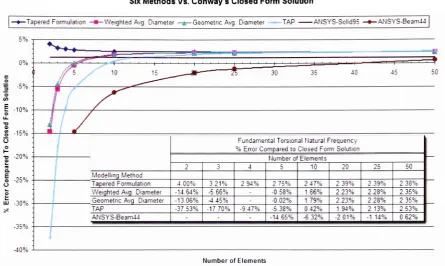
natural
frequencies
were compared
to
Conway's
closed
form
solution,
and
the
correspond
ing
errors are presented
in
Figures
2.4
and
2.5.
Note
that the
results
from
the
ANSYS-Solid95
model
are plotted
as
a single
line for
reference.
It
was
found
that the two
stepped-cylinder
models,
Weighted Average Diameter
and
Geo
metric
Average
Diameter,
yield
remarkably
similar results.
Nevertheless,
these
results
demonstrate
the
level
of
inaccuracy
introduced
with
a
stepped-cylinder
approximation
to modelling
a
tapered
shaft.
Moreover,
the
FETORS
tapered
element model
monotonically
converges
to the
closed
form
solution
from
above, consistently overestimating the
solution.
This
is
a
desirable
characteristic
since



![Table 2.10: Double Speed Torsional Excitation (Published Case [8])](https://thumb-us.123doks.com/thumbv2/123dok_us/120572.11606/51.530.174.346.159.314/table-double-speed-torsional-excitation-published-case.webp)
![Figure 2.10: Published [8]: Torsional Response at Node 1](https://thumb-us.123doks.com/thumbv2/123dok_us/120572.11606/52.530.108.406.166.397/figure-published-torsional-response-at-node.webp)
