COMMUNITIES SCIENCE
RESEARCH AND DEVELOPMENT
'
MONITOR
MONITOR - SAST ACTIVITY
STRATEGIC ANALYSIS IN SCIENCE AND TECHNOLOGY
THE NEEDS AND POSSIBILITIES FOR COOPERA
T
ION BETWEEN
SELECTED ADVANCED DEVELOPING COUNTRIES AND THE
COMMUNITY IN THE FIELD OF SCIENCE AND
T
ECHNOLOGY
(Sast Project N° 1)
COUNTRY REPORT ON THE PEOPLE
'
S REPUBLIC OF CHINA
by
Kurt Hoffman and Dr. Geoff Oldham Sussex Research Associates Ltd
March 1991
It:
* *
*
*
*
*
*
"' • It:*
STRATEGIC ANALYSIS IN SCIENCE AND TECHNOLOGY
THE NEEDS AND POSSIBILITIES FOR COOPERATION BETWEEN
SELECTED ADVANCED DEVELOPING COUNTRIES AND THE
COMMUNITY IN THE FIELD OF SCIENCE AND TECHNOLOGY
(Sast Project N° 1)
COUNTRY REPORT ON THE PEOPLE'S REPUBLIC OF CHINA
by
Kurt Hoffman, Sussex Research Associates Ltd
Directorate-General
Telecommunications, Information Industries and Innovation
l-2920 LUXEMBOURG
LEGAL NOTICE
Neither the Commission of the European Communities nor any person acting on behalf of the Commission is responsible for the use which might be made of the following
information
Catalogue number : CD-NA-14 146-EN-C
This report has been prepared for the Strategic Analysis in Science and Technology Unit (SASTJ of the Directorate-General for Science, Research and Development of the Commission of the European Communities. SAST activities are part of the MONITOR Programme which aims to identify new directions and priorities for Community research and technological development (RTDJ policy and to help show more clearly the relationship between RTD policy and other Community policies.
For questions already identified as of interest for the development of Community policy, SAST projects provide an investigation of the perspectives opened up by science and technology. SAST projects thus serve as an input to the process of policy formulation. In the case of the SAST project to which this report contributes, "The needs and possibilities for cooperation between selected advanced developing countries and the Community in the field of science and technology", the context of policy questions includes the evolving economic relations between the Community and these countries, the interest to the Community of promoting international cooperation in science and technology with various types of countries, and the Community's role in European science and technology.
This report is one of a set of country studies carried out for the project. The set comprises the Republic of Korea, Thailand, other ASEAN countries, the People's Republic of China, India, Brazil and Mexico. An overall strategic review will also be available in 1992.
It should be borne in mind in reading the country studies that the fieldwork on which they are based was carried out almost entirely in the country concerned. The points of view of European industrialists/researchers/policy makers were not explicitly sought for this part of the project. (They will be sought as part of the work for the overall strategic review.)
Pages
INTRODUCTION AND READERS' GUIDE . . .
i-iiEXECUTIVE SUMMARY . . .
i - iiiPART I : STRATEGIC REVIEW
I. 1. THE MAIN ElEMENTS OF REFORM AND ITS
ECONOMIC CONSEQUENCES . . . 3
I. 1.1 . Initial wave of reform leads to major improvements in all aspects of economic performance . . . 3
1.2. INCREASING ECONOMIC DIFFICULTIES lEADS TO STAllED REFORMS, AUSTERITY AND RETRENCHMENT . . . 5
1.2. 1. Economic austerity and slowing of the reform process . . . 5
1.3. THE "OPEN DOOR" AND POLICIES TOWARD FOREIGN INVESTMENT . . . 7
1.3. 1 . Contradictory signals and economic difficulties . . . 8
1.3.2. Despite policy contradictions, the door is still open . . . 9
1.4. THE REFORM OF CHINA'S S&T SYSTEM . . . 11
1.4. 1. Specifics of the market-driven reform of the S& T system . . . 11
1.5. SYSTEMIC PROBLEMS EMERGE AMIDST RESOUNDING SUCCESS . . . 13
1.5.1. The explosive growth of technology markets . . . 14
1.5.2. The rise of scientific enterprises and minban science firms . . . 14
1.6. CHINA'S CENTER-PROPEllED DRIVE TO ESTABLISH NATIONAl HIGH TECHNOLOGY RESEARCH AND PRODUCTION CAPABILITIES 1.6.1. The national high technology development plan for research, 17 training and production . . . 1 7 1.6.2. The TORCH programme for the stimulation of high technology industries . . . 1 8 1.6.3. Strengthening long term basic research capabilities . . . 20
1.6.4. The National Key Lab programme . . . 20
1.7. PROPOSALS FOR EXPANDED S&T COllABORATION WITH CHINA . . . 22
I. 7. 1 . Considerably increased bargaining power for Europe and the Community . . . 23
I. 7 .4. Confusion over the meaning of mutually beneficial
S& T collaboration . . . 24
INDUSTRY RELATED /NIT/A TIVES . . . 25
I. 7 .5. Opportunities for foreign enterprises . . . 25
I. 7. 6. Two possibilities for pursuing innovative forms of collaboration . . . 26
I. 7. 7. The provision of support to European high tech firms interested in investing in China . . . 27
COLLABORATIVE PROJECTS LINKED TO BASIC RESEARCH . . . 27
I. 7 .8. Joint research with national key labs . . . 27
APPLIED SCIENCE-RELATED /NIT/A TIVES . . . 27
I. 7 .9. Establishment of EC supported applied research institute to support joint research into environmental and agricultural problems . . . 27
I. 7. 1 0. Demonstration projects oriented towards systemic solutions of the survival problems of closed or isolated communities . . . 28
NEAR-MARKET COLLABORATIVE ACTIVITIES . . . 28
I. 7. 11 . Joint R&D projects leading to commercialisation and production 28 I. 7 .12. Joint venture training institutes . . . 29
I. 7 .13. Exploiting the opportunities for collaboration offered by the 863 and TORCH programmes . . . 29
PART II : DECISION BASE
II. 1. THE MAIN ELEMENTS OF REFORM AND ITS ECONOMIC CONSEQUENCES . . . 33II. 1. 1. The main elements of reform . . . 33
11.1.2. The coastal development strategy . . . 34
11.2. FAVOURABLE ECONOMIC IMPACTS OF THE REFORM PROCESS . . . 36
11.2.1. General performance of the economy . . . 36
11.3. OVERALL EXCELLENT TRADE PERFORMANCE . . . 38
11.3.1. Major problems lie ahead . . . 42
11.3.2. Exports represent a bright future . . . 42
11.3.3. Trade patterns by country . . . 43
52
11.5.1.
Economic austerity . . .53
11.6. KEY POLICY INSTITUTIONS IN CHINA'S S& T SYSTEM . . . 55
11.6.1.
Other key activities of the SSTC . . .56
11.6.2.
The Chinese Academy of Sciences (CAS) . . .57
11.6.3.
The National Natural Science Founidation of China . . .59
II. 7. SIZE AND STRUCTURE OF THE S& T LABOUR FORCE . . .
62
II.
7.1.
Structural problems in the distribution of S& T manpower . . .62
11.7.2.
Addressing the problem of labour mobility . . .63
II.
7 .3.
The higher education system . . .63
11.8. THE SCALE AND SCOPE OF CHINA'S R&D SYSTEM . . .
65
11.8.1.
China's core R&D capabilities . . .66
11.8.2.
R&D capacities in the higher education sector . . .67
11.8.3.
Research institutes under ministries . . .68
11.8.4.
Research institutes under provincial control . . .68
11.8.5.
Research capacities in the defense sector . . .69
11.8.6.
Internationally recognized scientific capabilities of limited practical value . . . 7011.9. GROWING EXPENDITURE ON S&T . . .
72
11.9.1.
Financial system reforms . . .73
11.10.CHINA'S INTERNATIONAL RELATIONS IN S&T: AN AREA OFSTRATEGICIMPORTANCE . . .
74
11.11.THE DEVELOPMENT OF CHINA'S HIGH TECH CAPABILITIES . . .
75
ANNEXES
Annex 1 Annex 2 Annex 3 Annex 4 Annex 5 Major affiliated companies of the Chinese Academy of Sciences . . . .83
Proprity research areas and projects for China's 863 high technology development programme . . . 85
Projects identified as suitable for international collaboration under the TORCH programme . . .
87
National key laboratories . . .
89
SSTC major departments and functional offices . . .
93
Charting the most appropriate path towards greater future collaboration in science and technology between China and the European Commission at the present moment is a task fraught with difficulties and uncertainties. The events of June 1989, their impact on China's international relations, and the resulting uncertainty about the country's stability and the future direction of policy are the most obvious complicating factors in this equation.
China entered the last year of the 1980s having accomplished a great deal through its much heralded reform process. Though the problems of reform were growing daily more difficult, the country had behind it ten years of solid economic growth and largely positive social change. This had been accompanied and heavily influenced by unprecedented levels of interaction with the world economy due to the Open Door policy. A series of sweeping reforms to the S& T system, also involving extensive international contact and exchange, had generated significant gains. More importantly, the S&T system exhibited a huge potential for making an even greater contribution to China's modernization drive in the future as well as marking out China as a force to be reckoned with in international S& T.
However, the situation following June 1989 when the government used military force to suppress the pro-democracy movement has thrown open to question the durability of these achievements and the future possibilities for continued change and reform. Opinions are widely divided between those who fear a permanent retreat from reform is underway and those who believe that reform has been slowed but not reversed and that after some time forward movement will become much more visible.
We tend toward the latter view and feel reasonably optimistic about the future prospects for renewed reform in the medium term. Two reasons for ta.king this position are of direct relevance to our concerns. Firstly, the current leadership has continued to stress the need to further develop China's S& T capabilities through increased domestic investment and enhanced international contact; while secondly, it has likewise emphasized the continuation of the favourable conditions governing foreign investment and international technology transfer.
These aspects of current Chinese thinking relate directly to the explicit interests of the SAST project. China, of course is a very large and a very poor country. In many respects it fulfils all the criteria to qualify as a developing country and therefore deserves to be treated as such in terms of the provision of aid and technical assistance on developmental and humanitarian grounds.
There are however other dimensions to China that must also be acknowledged. The country possesses formidable S& T capabilities and resources, it enjoys significant cost advantages in a number of sectors, it oversees a potentially vast market and, most importantly, it is fully prepared and capable of exploiting vigorously its domestic and
international pos1t1on to its own advantage. These characteristics make China an appropriate country with which to pursue S& T and industrial collaboration according to the criteria of mutual benefit.
This is the perspective adopted by this report. We have not set out to identify areas or fields where China needs technical assistance or aid-oriented development support for S& T. China's needs in this area are very great. China is the largest aid recipient for many agencies and countries including the EC, UNDP and the U.S. It was not our brief to focus on this aspect of EC relations with China. Rather, we explored, through our interviews and subsequent analysis, issues relating to S& T collaboration between the EC and China based on the concept of mutual benefit.
With this focus in mind, Part I of this report contains a strategic review of the key issues impinging upon the prospects for S&T collaboration with China. We begin in Sections 1 - 3 by setting the context for assessing the prospects for S& T collaboration with China by first reviewing briefly China's economic performance, the success and failures of its reform programme, and the current status of China's policy toward foreign investment. Sections 4 and 5 review key aspects of S& T reform and its effects while Section 6 discusses China's current initiatives to develop its high technology R&D capabilities. Section 7 presents proposals for the pursuit of greater S& T collaborative linkages between the Community and China.
Part II contains the "decision base" for this case study and consists of 11 sections containing background information and analysis of China's economy and its S& T system. Sections 1 - 5 cover various aspects of the recent performance of the economy and the economic reforms programme and its impacts. The remaining sections focus on various aspects of the S& T system with Section 6 describing the S& T policy institutions and policy-making process, Sections 7 and 8 on the S&T labour force and the R&D system. Section 9 reviews available information on S& T expenditure, Section 1 0 assesses China's international S& T relations and Section 11 focuses specifically on the development of China's high technology capabilities. Five annexes provide additional information.
1 . During the 1980s, China undertook an ambitious programme of reform that generated considerable economic benefits and gained acceptance of the country into the international community of nations. However, the events of June 1989 caused severe damage to China's international relations that are only just beginning to be repaired. And though it is unlikely the government will soon adopt a more relaxed political posture, there are good reasons to believe that forward movement of the reform process will resume in the medium term.
2. By any measure, China's economic accomplishments during the period of reform in the 1980s were impressive. During 1981-1987, real GNP grew annually by 9.8 per cent (reaching $329 billion in 1988) while real industrial output grew by 12.8 per cent a year over that period. Total trade rose from $44.2 billion in 1980 to $113.9 billion in 1989 (of which the Community accounted for 8.5 per cent) while exports increased at an annual rate of 16.8 per cent from $9.8 billion to $39.4 billion, bringing the country to 16th place in the world league of exporters (up from 32nd in 1979).
3. Foreign investment rose substantially as well due to the attractions of an expanding domestic economy, a more hospitable investment climate and the country's potential as a low cost exporter of labour-intensive products. For the 1980-88 period, real new foreign investment totalled $15 to $18 billion (of which Europe accounted for 3.4 per cent) spread across 22,000 joint ventures and wholly foreign owned subsidiaries. Moreover, through foreign investment and its own arms-length purchases, China absorbed $27 billion worth of imported technology between 1980 and 1989, with much of this coming from Japan and the U.S.
4. Partly because of the success of the reform programme and partly because the reform process didn't go far enough, China began to experience growing economic difficulties by the mid-1 980s. These included high inflation, rising indebtedness, s-erious raw material shortages, major transport bottlenecks and the increasingly high costs of maintaining an unreformed and still massively inefficient state-run industrial sector. A severe austerity programme was imposed in 1989 (and is still in force) to tackle some of these problems. Inflation has been brought under control but many of the other worries will continue to bedevil the economy for some time to come. In 1990, China spent more money subsidising prices and bailing out inefficient state firms than the total budget for defence, education, science and public health.
5. Despite the current economic difficulties, the government has indicated clearly that it remains committed to achieving further progress in two areas that are of direct interest. The first involves improving the climate for foreign investment so as to attract greater inward flows of foreign capital and technology in the future. This has become necessary because of the damage done to investor confidence and to China's standing with the international financial community by the events of June
1989. A variety of long awaited measures have now been introduced including the passage of important new laws giving protection to intellectual property rights and software and easing the operational climate for foreign firms. These are positive steps and more changes are expected - though there are still grounds for keeping up the pressure for further improvement.
6. The strengthening of the government's public commitment to the "Open Door" policy could create genuine opportunties for European enterprises who understand how to do business with the Chinese. The prospects are particularly bright for firms operating in high technology sectors, for those able to put together technology-intensive projects in mainstream manufacturing sectors and for those able to guarantee that a majority of output will be exported. The opportunity is also there for the Community to play a more active role in promoting an expansion of European involvement in technology-intensive projects in China. Particular attention could be paid to developing joint ventures with the new forms of "scientific enterprise" that the government is promoting.
7. Beyond this, there is acknowledgement that China's reliance on Japan and the US as its main sources of industrial technology has to be moderated. Japanese reluctance to transfer technology was a particular source of irritation. There could be considerable trading advantages on offer for European firms prepared to undertake projects involving the effective transfer of technology. Again there is a role here for the Community to play.
8. Second, the leadership has continued to stress the need to further develop China's S& T capabilities through increased domestic investment in R, D & D and enhanced contact with the internationalS& T community. This commitment has been a staple feature of China's development policy since the mid 1980's as the leadership became convinced that success of the modernization programme was critically dependent upon China's ability to assimilate, generate and diffuse science and technology much more effectively than it had in the past.
9. Beginning in 1985, a pervasive reform of the S& T system was initiated in order to better link R&D to production and in general to make the whole system more market-oriented. This is no small matter since the Chinese S& T system involves approximately 8700 R&D institutions ( 1044 of which are directly under state control and form the core of the R&D network), over 600 universities and some 9.66 million S&T personnel, 800,000 of which are directly engaged in R&D. Despite the size of the task, significant gains were achieved by the reform that both highlighted the huge potential of S& T in China as well as marking out the country as a force to be reckoned with in international S& T.
10. The most important dimension of the recent emphasis given to S& T development by the government has been the vigourous campaign to develop and strengthen China's high technology capabilities via targeted R&D projects and applied technology development, the launching of new institutional innovations, and the acquisition of knowledge through international collaboration.
11 . The activities undertaken have begun to create the necessasry starting conditions for rapid high tech development in China. If these R&D efforts are pursued in the 1990s with the same energy that accompanied their launch prior to June 1989, these could translate into a broad range of opportunities for collaboration in R&D and technology commercialization with China. Chinese officials interviewed felt
that these high tech programmes could serve as an ideal base for EC S& T collaborative initiatives.
12. Our judgement is that it is a propitious moment for the Community to explore further the development of a wide array of S& T and industrial collaborations with China. The benefits to Europe could be considerable and would derive from China's substantial pockets of world class R&D, its large S& T manpower base, ultimately enormous domestic market, and the potential for serving as a platform for the regional and global export of technology- and labour-intensive products. From a strict commercial perspective, however, it has to be acknowledged that benefits to Europe would only begin to flow strongly in the medium term.
13. The Community now enjoys a potential position of relative strength vis a vis China. The country's bargaining power remains weakened by the events of June 1989. The leadership recognizes that it continues to require good access to foreign knowhow and invesstment funds and sees Europe as a valuable counter to the Japanese and Americans as a source of technology transfer. It also believeS that international collaboration in S& T is an important tool for developing its own domestic capabilities.
14. There were clear and strong expressions of interest on the part of the Chinese S& T leadership in the pursuit of further discussions with the Community to develop S& T collaborative initiatives. However some problems will need to be confronted directly if this opportunity is taken up. Chinese S& T officials will push strongly for being allowed to participate in the Framework Programme. Some will also find it difficult to operate under conditions of "mutual benefit" since they are accustomed to working in a dependent aid-dominated relationship with the international S& T ' community. The Chinese are also tough negotiators. None of these issues should present insurmountable obstacles.
I. 1. - THE MAIN ELEMENTS OF REFORM AND ITS ECONOMIC
CONSEQUENCES
1.2. - INCREASING ECONOMIC DIFFICULTIES LEADS TO STALLED
REFORMS, AUSTERITY AND RETRENCHMENT
1.3. -THE "OPEN DOOR" AND POUCIES TOWARD FOREIGN
INVESTMENT
1.4.-
THE REFORM OF CHINA
1S.-S&T -SYSTEM
1.5. - SYSTEMIC PROBLEMS EMERGE AMIDST RESOUNDING SUCCESS
1.6- CHINA'S CENTER-PROPELLED DRIVE TO ESTABLISH NATIONAL
l:fiGH TECHNOLOGY RESEARCH AND PRODUCTION CAPABILITIES
1.1. THE MAIN ELEMENTS OF REFORM AND ITS ECONOMIC
CONSEQUENCES
China embarked on a process of far-reaching economic and institutional reform in 1978 that aimed to double 1980 gross output by 1990; double it again by the year 2000; and finally to reach the per capita income levels of moderately developed economies by the middle of the next century. The reforms involved the phased introduction of fundamental changes on previous practice in four interlinked areas affecting every facet of Chinese economic activity.
Firstly, through the introduction of the "responsibility system" in the productive sectors, workers, managers and enterprises were given greater autonomy and offered incentives to increase output, improve quality and lower costs. Second, attempts were made to reform the price and wage system in order to give the market a greater role in determining the prices of commodities, products and wages in both the agricultural and industrial sectors.
The third component of the reform programme was the widely heralded "Open Door" policy which involved an unprecedented opening up of the economy to foreign investment, technology transfer and international trade. Finally, the fourth area of reform involved a fundamental restructuring of the country's science and technology system. This was necessary because the long term success of the modernization programme was seen as critically dependent upon China's ability to assimilate, generate and diffuse science and technology much more effectively than it had in the past.
1.1.1. INITIAL WAVE OF REFORM LEADS TO MAJOR IMPROVEMENTS
IN ALL ASPECTS OF ECONOMIC PERFORMANCE
During the 1 980s, the implementation of China's reform programme resulted in considerable economic gain for the country as a whole. For example, during 1981-1987, real GNP achieved an annual growth rate of 9.8 per cent, underpinned by annual increases in real gross industrial and agricultural output averaging 12.8 per cent and 7.2 per cent respectively, and a 9.5 per cent annual growth in real national income. By the late 1980s, rural reforms had created nearly 1 9 million township enterprises, whose dynamic growth powered the expansion of the whole economy and whose output in 1 987 exceeded that of agriculture itself.
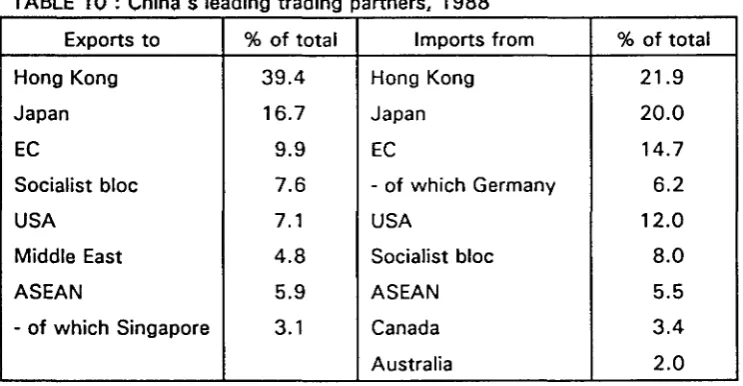
Trade performance was similarly impressive. Total trade grew from $44.2 billion in 1980 to $113.9 billion in 1989 while exports increased at an annual rate of 16.8 per cent from $9.8 billion to $39.4 billion. By 1989, Hong Kong was China's major trading partner with 21 .2 per cent of two way trade followed by Japan with 12.7 per cent, the EC with 8.5 per cent and the USA with 6. 7 per cent.
Levels of foreign investment rose significantly as well as foreign firms were attracted by the (reform-driven) expansion of the domestic economy, a more hospitable investment climate and the country's potential as a low cost exporter of labour-intensive products. For the 1980-88 period, real new foreign investment totalled $15 to $18 billion ( $2.4 billion in 1988) and was bound up in the activities of some 12,000 joint equity ventures, 8000
JOint production operations and 1 500 wholly foreign owned subsidiaries. 1
As in trade, Hong Kong is China's leading investment partner accounting for 70.8 per cent of all approved projects involving foreign partners between 1978 and 1988 followed by the U.S. with 8.5 per cent ($2.4 billion) Japan with 4.7 per cent ($1.3 billion) and the EC with 3.9 per cent ($987 million).
1
An equally s1zeable inflow of Imported technology (embodied and disembodied) accompan1ed th1s mward flow of foreign investment funds Over the 1980-89 period, the government claims an expenditure for imported technology of $27 billion spread across 27,000 contracts.
1.2. INCREASING ECONOMIC DIFFICULTIES LEADS TO STALLED
REFORMS, AUSTERITY AND RETRENCHMENT
Despite these successes, some very serious problems emerged during the implementation of the reforms, particularly in the post-1985 period, that eventually led to the present economic and political crisis. Simply put, the reform process floundered on the inability (and often unwillingness) of the economy, bureaucracy, enterprises and individuals to cope with the enormous pressures for radical change that were placed upon them by the leadership.
These problems became visible at both the macro and micro level. At the macro level, the most serious was undoubtedly the emergence of an unprecedentedly high rate of inflation that went from virtually zero in 1978 to an average of 10.3 per cent by 1985 and growing sharply to more than 20 per cent in 1988 and close to 30 per cent in 1989 before the imposition of draconian credit restrictions which should at least halve it by the end of 1990. Moreover, the unbridled demand for consumption goods and decentralization of control over imports stemming from the reforms resulted in a ballooning of the country's foreign trade deficit to $14.19 billion in 1985.
At the micro level, rural reform, after some early successes, ran into severe problems. On the one hand the pace of reform was deemed to be too slow while at the same time the rapid growth of township enterprises through the mid-1 980s had placed the economy under enormous inflationary pressures. In the urban areas, apart from some successes linked to the establishment of high tech industries, it proved far more difficult than expected to implement even the most basic reforms among the vast majority of state-run productive enterprises.
Inevitably, reform of the price and incentive structure proved the most problematic with the consequence that the prices of most industrial products in 1 988 still do not reflect their true scarcity value, while many state-run industries remained hopelessly inefficient. As a result, serious shortages of raw materials developed, major transport bottle-necks emerged and huge stockpiles of unsaleable, poor quality goods piled up through the latter half of 1987 and all through 1988.
1.2.1.
ECONOMIC AUSTERITY AND SLOWING OF THE REFORM
PROCESS
By mid 1988, it was clear that the problems faced by the Chinese economy were so widespread and fundamental that they could no longer be passed off as purely transitional. A political struggle ensued within the government between those advocating the hastening and deepening of the reform process as the only way to maintain forward progress and those calling for a return to centralization and strict control in order to reduce inflation and bring the economy back into line.
The net outcome of that phase of the struggle was that a strict austerity drive was instituted in early 1989 involving severe credit restraints, an abrupt slow-down in capital investment, and a sharp cutback on imports. While this austerity programme had some impact on the economic front, it exacerbated existing political tensions particularly in the
cities. This unsustainable situation was ultimately resolved by the government's use of force in Tiananmen Square in June 1989.
Since then the economy has continued to struggle both with the restraining effects of the austerity programme and the continued imbalances caused by the earlier reforms and deep-rooted structural weakness. The availability of credit at all levels continues to be sharply reduced - with particularly severe (and intended) effects on the performance of the rural enterprise sector; in the urban sector state-run producers are being favoured over private and semi-autonomous firms in terms of access to investment funds, inputs, foreign exchange, etc.; the government is now relying more heavily on central planning to direct the economy; and, perhaps most importantly the pace of price reform appears to have been slowed sharply- at least for the time being.
It is virtually impossible to judge at this stage how long the current period of retrenchment will persist in China. Certainly, the struggle between different factions within the government leadership continues. Some argue that these conditions will remain for some time; others are more optimistic. However, there are two areas where it is clear that the Chinese government is committed to pushing forward and will not be reversing the reform process in a major way - the Open Door policy with regard to foreign investment and the strengthening of the country's S& T capacity. Both of these elements are critical to our interest in this strategic review because of the direct link and possibilities thus generated for mutually beneficial collaboration. We discuss direct foreign investment first in the next section and then move on to S& T issues.
1.3. THE "OPEN DOOR" AND POLICIES TOWARD FOREIGN INVESTMENT
The one area of policy where Chinese leaders avow there has been little change is in respect to the Open Door towards foreign investment and trade. Since June 1989 they have been constantly at pains to insist that nothing has changed and that the door is still open. The leadership feels the need to reiterate the openness of the Chinese economy to foreign investment for two obvious reasons.
First, given China's relative technological backwardness even after 1 0 years of reform, further pursuit of the modernization/rapid growth strategy will still rely heavily on access to foreign investment, technology and aid. The promised improvements in living standards (on which the regime's continued legitimacy now depends more than ever) simply cannot be delivered without massive inward flows of foreign capital and technology - particularly given the straitened circumstances of the current austerity programme .. Second, and more importantly in the short run, the authorities have to make clear to the international finance community, that China is still a safe haven for foreign capital so that it can reach an accommodation on its debt repayment problem in the next year or two.
As documented in Part 2, between January 1987 and June 1989, there had been a boom in foreign investment. By June 1989 the number of contracts signed grew by 400 per cent and their unit value by 67 per cent over the totals accumulated from 1979-86. In the first half of 1989, foreign investment was up by nearly 50 per cent. A major reason for this boom was that after 5 or so very difficult years, foreign firms had finally begun to have trust and confidence in the stability of the Open Door policy.
This confidence and trust, particularly that of Western and Japanese businessmen, was severely shaken by the shock of Tiananmen. This damage was reflected in a downturn of at least 25 per cent in the level of new commitments over the last six months of 1 989. Moreover there is some evidence that these uncertainties have continued to restrain new investment activity during that year as it is reported that in the first six months of 1990, the foreign exchange value of negotiated foreign investments had in fact dropped by nearly 32 per cent. 2
It is interesting to note that unlike their Western and Japanese counterparts, Taiwanese and Hong Kong entrepreneurs carried on investing in China with the value and number of Taiwanese funded projects doubling in the first six months of 1990. These investment actions are, however, of only marginal interest to the leadership since they primarily involved low tech projects not much in favour with Beijing. They were far more concerned by the apparent downturn in investment activity on the part of U.S., Japanese and European firms
2 There has also been a sharp falloff in foreign investment in capital intensive and high technology projects
in Guangdong Province which encompasses many of China's most favoured economic zones and currently accounts for 43 per cent of all foreign investment. By the end of March, 1990, new investment projects were down by 20 per cent from a year earlier. Shanghai City reported an even more precipitous decline in new investment projects over the same period.
1.3.1. CONTRADICTORY SIGNALS AND ECONOMIC DIFFICULTIES
In response to these difficulties the government has been taking steps and sending out signals designed to restore confidence. One response has been the more rapid approval of export-oriented projects already in the pipeline. Others involved buying up unsold inventory from highly visible joint ventures (a practice now stopped) and continued insistence that the special economic zones, Open Cities and the open province of Hainan Island would still offer preferential terms for foreign investment. A new policy announced in January 1990 and related to these special zones was the first time authorization that land in these areas can be leased to foreign firms.
Also related, the government has, in recent months, launched what in effect amounts to a new development strategy focussing on the eastern part of the country in the Pudong area that will be heavily dependent on attracting in new foreign investment. 3 The original
"coastal development strategy" is discussed in Part 2.
Most importantly, a major new piece of legislation relating to joint ventures was passed in April 1990 which gave guarantees against expropriation and eliminated any requirement that joint ventures be limited to a fixed time period. This was a surprise development because the government had previously been adamantly opposed to such measures.
Of a surprise has been the even more recent (September 1990) decision by the State Council to implement the long awaited Copyright Law which for the first time grants protection for intellectual works published in foreign countries if there is a reciprocal agreement in that country of if the country is a member of an international intellectual property convention or institution of which China is a member. Protection is granted to all forms of work and is extended for 50 years after the death of the original inventor.4 Further legislation relating to the protection of software is expected soon.
The passage of these two measures, along with the promised legislation on software significantly improves the foreign investment climate in China and goes some way towards meeting the demands of the West and Japan for further reform in the critical areas of foreign investment and intellectual property rights. These moves along with the others mentioned above allowing land leasing to foreigners are indicative both of the degree of
3
• The Pudong New Development Zone is in the eastern part of China, includes an area of 350 kms with one
m1llion inhabitants and covers Shanghai and a large portion of the Yangtze R1ver regions. There 1s a three-phase plan stretching 20 years into the next century with the first infrastructure phase taking place over the next ten years and costing $1.7 billion. A whole set of new policies more favourable to foreign investment than those currently in place anywhere in China are being formulated. The intended proJects will cover export processing activities, petro-chemicals and energy and pollution-free high tech industries with most expected to be established by means of foreign investment. Pilkington's, the U.K. glass producer has already established a float glass joint venture there. See for example Elizabeth Chang, "The East is Ready", Far Eastern Economic Rev1ew, 31st May 1990.
•. Additional provisions of the law cover the distribution of control over royalties which has been another sticking point in Ch~na's relations with other countries on this issue. These are now in hne w1th the requirements demanded by the U.S., Europe and Japan.
difficulty the government was having in attracting new foreign investment post-Tiananmen and of its earnest intention to overcome these problems.6
These are significant measures designed, as indicated above, to demonstrate to the outside world (particularly foreign banks and aid agencies) that it is still possible for foreign enterprises to do business in China. However, the leadership's efforts to create a positive impression by these moves are tending to be undermined somewhat by the downstream actions of officials and agencies less visible to foreign observers. 6
Moreover there is still considerable suspicion that new legislation mentioned above will not actually have very much impact in practice. 7 Compounding these difficulties, foreign firms are, of course, also subject to the chill winds of the generalized downturn in domestic demand and the inadequacies of an overstretched infrastructure.
1.3.2. DESPITE POliCY CONTRADICTIONS, THE DOOR IS STILL OPEN
Many foreign firms have until recently been adopting a wait and see position with regards to their future investment plans in China. There are however signs of an upturn in interest and activity on the part of foreign firms. One of the most recent examples of this was the November 1990 announcement by VW that it intends to significantly expand its involvement in the domestic production of motor vehicles - with the aim of producing 1 50,000 cars per year by 1996.8 From the Chinese perspective this is undoubtedly encouraging and they have gone to considerable lengths to publicize these successes.
However, with the possible exception of a rise in new investment "commitments" in Guangdong and Guangzhou province, there is clearly no evidence yet to suggest a
For a recent review of the current situation with regard to related areas such as technology transfer contracts see the comprehensive discussion in Arthur Wolff, "Technology Transfer to the People's Republic of China", International Journal of Technology Management, Vol 4., Nos 4-5, 1989.
6
• For example, despite being eased on specific projects, bureaucratic obstacles to new investments and
expansion plans have in fact increased substantially in recent months. Foreign firms are also being deliberately squeezed on the credit side and being pressured to increase their capital contribution. See Richard Brechert, "The End of Investment's Wonder Years," China Business Review, January-February 1990.
Moreover, a variety of show-case joint ventures in the motor vehicle and consumer goods sectors were operating at least through the end of 1989 at well below capacity because of shrinking demand and a clamp-down on government spending while the infrastructure in certain foreign investment zones is severely constrained at precisely the time the government is cutting back on investment.
7
• These suspicions have lead to a recent rise in tensions between the US and China over the trade issue. The
US trade deficit with China in 1990 was $10.4 billion, up from $6.2 billion in 1989 and third largest after Japan and Taiwan. There is a remote possibility that the Congress will revoke China's "most favoured nation" trade status as a result of its displeasure over slow progress by the Chinese over intellectual property issues and irritation over charges that China is engaged in "dumping" in garments and other sectors. At the very least, action may well be taken under Section 301 of the Omnibus Trade Bill of 1988 if conditions do not improve.
8
• Earlier in 1990, Courtaulds announced a $4 million joint venture to produce paints (the first such U.K. investment since June 1 989), while in mid- 1 990, there was a renewed commitment from Philips of Holland to continue pushing forward with its sizeable programme of manufacturing investment - $200 million in nine manufacturing and assembly joint ventures in consumer electronics. Perhaps just as significant is a recent announcement by a major Japanese chain of clothing stores to establish a chain of menswear stores in China with the first opening mid-1991.
sustained return to the pre-June 1989 investment boom. Industrialists continue to insist that what they do vis a vis new investment will be very much affected by government policy. This message is being sent loudly and clearly to the leadership by the foreign investment community and by Japanese and Western governments.
Evidence from our research suggests that while there is still much that is contradictory in that policy - particularly as it is implemented at lower levels -the leadership is sincere about maintaining an open stance towards foreign investment. However, they do have a clear preference for the type of foreign investment they wish to welcome into the country. Recent decisions and policy statements make it clear that high technology investment projects involving the development and production of new and technologically advanced products, technologies or applications will continue to be given very favourable consideration.
Likewise foreign investments in some capital- and technology-intensive infrastructure projects such as nuclear power or telecommunications - will be treated favourably though many of these infrastructure projects will also revert back to a development financing format. Moreover it was made clear to us that China is keen to counterbalance its overwhelming S& T and industrial dependence on Japan and the US by further developing links with Europe.
Projects with foreign involvement that are deemed of national importance will now largely be handled by the centre rather than by provincial authorities. Local officials will ultimately retain a measure of decisionmaking power but will be "encouraged" to only enter into projects that address the key aims of the new investment policy which emphasizes movement into higher value-added export industries, the pursuit of essential import substitution and quick foreign currency generation and require minimal investment from central funds.
These indications of current attitudes of the leadership toward foreign investment and the differential ability and interest of different foreign governments and enterprises to exploit current conditions raise issues of considerable strategic importance both for the Community and more particularly for European enterprises either already present or contemplatil')g entry into China. They are addressed in the final section of Part 1.
1.4. THE REFORM OF CHINA'S S&T SYSTEM
Though always considered important, the development and strengthening of the S& T system in China began in 1979 to be accorded a central role in the country's modernization strategy. Technological change and hence the capacity of the country's R&D system to generate innovations were identified as the main mechanisms for improving economic performance and maintaining economic growth. Indeed, in the early 1980s, the emphasis given by the leadership to the critical importance of S& T in China's new growth-oriented development strategy was so great that at times it was taken to the point of naivete. This concern with enhancing the state of China's S&T capabilities was greatly intensified by the leadership's fast growing awareness, and fear, of the implications of the developments in new technologies.
The emphasis given to S& T in the Sixth Five-Year Plan demonstrated this high-level commitment. 16.8 per cent of state expenditures were allocated to science, technology and education - appreciably more than the 11 per cent allocated during the previous plan. Thirty-eight fields of technology and 114 key R&D programmes were singled out for special attention and investment. 9 A special fund of 130 billion yuan was allocated for the technical transformation of China's 400,000 enterprises
Even more significant, the leadership recognized that even with greater resource allocation, China's highly centralized and rigidly controlled S& T system simply could not cope with the new demands being placed upon it. Fundamental institutional and organizational change was required. The leadership convened a powerful ad hoc group of the most senior officials, chaired by Zhao Ziyang, who were given the task of planning the reform and modernization of the S&T system.
This group, known as the Leading Group in Science and Technology, developed and launched in 1 985 a programme of far-reaching S& T reform on a nationwide basis that in many respects was more revolutionary than that attempted in the economic sphere. 10 Certainly it was pushed through with a speed and boldness that was simply not achieved elsewhere in the economy - and in the process created new institutions and new nodal points of dynamic S& T capabilities that greatly enhanced the attractiveness of China as a potential partner in mutually beneficial S& T collaboration with the EC and Member States.
1.4.1.
SPECIFICS OF THE MARKET-DRIVEN REFORM OF THE S& T
SYSTEM
The basic objective of the reform programme was to link the performance and output of the R&D system much more tightly to the needs of the production sector. This was by far
9
• These programmes were encompassed within the Sixth Five Year Plan for Key R&D projects and involved
1450 specific projects involving some 5000 institutions and more than 100,000 S& T personnel.
10
• The Leading Group was disbanded in 1988 after its mission of designing and launching the S& T reform programme was deemed completed. Prime responsibility for S&T management was passed back to SSTC who worked closely with the SEC (State Economic Commission) and the SPC (State Planning Commission) to undertake further planning and to implement reforms. See Part 2 for a full discussion.
the greatest weakness of the old system and manifested in a variety of ways. 11
It was felt the best way to achieve this was to give the market a greater role in determining what kind of R&D should be carried out by the research institutes while at the same time reducing the level of state subsidy for operating expenses of R&D institutes. The creation of a system of paid contracts (between R&D units and user enterprises) along with fundamental changes in way central financial resources for R&D were allocated were the two keys to the reform of the S& T system.
Under the paid contract system, enterprises negotiate a contract with an R&D unit to carry out specific R&D work (or the provision of technical consultancy services) at an agreed price or else they could sell technology that they had already developed. In this way the institute could increase its outside earnings and become less dependent on the state while also orienting its research efforts to producing innovations actually needed by the economy. Such an approach may seem straightforward enough to western observers but in the Chinese context it was truly revolutionary.
Co-incident with these moves, the government also set up a mechanism to chann~l the funding and direction of basic research through one centralized body as well instituting a new system of funding for applied R&D whereby R&D institutions would compete for central government resources and the awarding of major R&D projects on the basis of competitive tenders and bids.
In parallel with these central reforms in the linking of R&D to production and the state funding of R&D, a large number of institutional innovations and other changes to established practice were introduced. Among the most significant were:
the establishment of technology "markets" that encouraged R&D institutions to market their wares to user agencies and enterprises in order to stimulate production-oriented R&D and increase the rate and spread of diffusion of innovation;
the strengthening of enterprise capabilities to articulate demands for innovations supplied by the S& T system and enhancing their abilities to absorb new technology. This strategy is linked to the economic reforms of state productive enterprises and to policies promoting the technological transformation of existing industries;
the reorganizing of the training and career development procedures of scientific and technical personnel working in the state-supported S& T system thereby allowing the movement of personnel between institutions and tying promotion to merit and performance;
the organizational and financial reform of the Chinese Academy of Sciences (and its associated institutes) and the research activities of the higher education system in order to give them greater autonomy, encourage them to forge links with the production sector and the local community and generate greater initiative on the part of research personnel;
the creation of a wide variety of new research and scientific production institutions and organizations set up both to meet the specific R&D needs of specific sectors as well as to integrate scientific research and production. These institutions which take a variety of forms survive financially by meeting market demands for their work and are thus able to operate more or less independently from centralized control.
11
• See the discussion 1n Tony Sa1ch, China's Sc1ence Policy in the 1 980s, Manchester Umvers1ty Press, 1989.
1.5. SYSTEMIC PROBLEMS EMERGE AMIDST RESOUNDING SUCCESS
Virtually every one of the substantive S& T reforms undertaken in the 1 985-1989 period constituted a major and fundamental change on established practice. Consequently, they were inevitably bound to come up against a diverse array of difficulties and obstacles. This is particularly the case if one takes into account the size and complexity of the Chinese S& T system. 12
Some were internal to the S& T system and centered on the reluctance of certain institutions and administrative personnel to relinquish their privileged positions. Other more serious problems arose because the slowness of the wider price and economic reforms, meant that many productive enterprises still did not find it in their interest to seek out technological advantages from the S& T system.
These sorts of demand determined difficulties were such that by mid-1988, there was widespread consensus that though the S& T reform programme had been successful, further real progress was dependent upon the rejuvenation of the process of economic reform. Needless to say matters have been considerably more complicated by the events of the June 1989 and the visible role in the pro-democracy movement played by leading members of the S& T elite. It remains to be seen how the current retrenchment will affect the future role accorded to the S&T system. Certainly, most of the evidence provided to us suggests that the government is still fully committed to the S& T reform process.
What we want to draw attention to here is the fact that despite the problems mentioned above, the rate and extent of the changes in the structure and performance of the S& T system that actually did occur in the 1985-1989 period is remarkable. For example, a new venture capital initiative 13 was launched to support start-up S& T enterprises and the SSTC
embarked on a major programme of developing a variety of high technology zones, science parks and technology "incubator" units. Below we review only two aspects of these developments in detail - the growth of technology markets and the development of civilian S& T enterprises while the development of high technology zones is discussed in the next section.
12
• In 1987, the number of all R&D institutions affiliated with government departments at different levels stood at around 9000, of which 5568 were above the county level and administered centrally. By the end of 1988, China had a manpower stock of 9.66 million people in these categories, up from 7.35 million in 1984. Of these 800.000 are scientists and engineers directly engaged in scientific research and technology development. By the end of 1 987. there were 1063 full-time institutions of higher education and there were 1 .959 million students enroled in this sector of which 106,185 were graduate and post·graduate students. See analysis in Part 2.
13
• The China Venture Investment Corporation was launched in September 1985 to provide support for new
technology development and production in existing and new enterprises. Through 1988, it had supported a total of 255 projects on a total investment of 730 million yuan. Few of these investments have actually been true venture style investments and most involved heavy purchases of equipment. More important is that prior to June 1989, the experience of CVIC had prompted the emergence of 2 or 3 other fledgling venture enterprises- though the future status of these experiments in venture financing at the current time is not clear.
1.5.1. THE EXPLOSIVE GROWTH OF TECHNOLOGY MARKETS
The development and growth of technology markets is a good proxy for evaluating the response of R&D units and enterprises to the paid contract system. In late 1984, the State Council gave approval to concept of treating technology as a commodity, thus allowing state R&D units and others to market their technology to industrial users.
Although informal exchanges had occurred before this approval, afterwards the scale of exchange increased rapidly so that by 1 986 there were 11 00 technology exchange centres and 3000 technical service and consulting organizations at prefectural and city level nationwide compared to just 146 exchange centres a year earlier. Beginning from a value of technology transactions of only 50 million yuan in 1983, ($1 0 million) the first year of the technology market experiment, total technology market transactions leapt to 720 million yuan in 1984, 3.20 billion yuan in 1985 and over 4.5 billion yuan (nearly $1 billion) - based on over 150,000 separate transactions in 1988 and equivalent to more than 40 per cent of China's total R&D expenditures in that year. 14
-Three other aspects of the Chinese technology markets are worth noting. First, the concept has been introduced in a highly flexible manner. Relationships between R&D units and enterprises have included joint development efforts, long-term co-operation, joint bidding, multiple players - including foreign firms - as well as a variety of payment formats such as royalties, flat fees, etc.
Second, numerous institutional innovations were developed in order to provide the structures to allow the markets to operate. These ranged from the passage of patent and technology contract legislation (which also had significant positive implications for the international flow of technology to China) to the setting up by 1988 of nearly 10,000 service groups and agencies dedicated to facilitating technology transactions. Third, there is every reason to believe that the authorities will continue to allow these technqology markets and related service organizations to continue to operate once conditions settle down.
1.5.2. THE RISE OF SCIENTIFIC ENTERPRISES AND MINBAN SCIENCE
FIRMS
Another set of related developments that occurred in the wake of the S& T reforms relates to the emergence of a large number of new technology-intensive research and production enterprises operating both within the state sector and outside of it. Again, the initial reforms stimulated the emergence of these enterprises in 1 984/85 and the State Council formally encouraging their further development in 1 987. These new civilian S& T enterprises encompass a variety of actors and operational formats engaging in a range of technology- intensive commercial activities. 16
,. For further details see R.Conroy, "Reforms to the Science and Technology System at Provincial and Municipal Level, • Mimeo, OECD, Paris, 1989.
15
• The actors mvolved include individuals, collectives, state-run R&D institutes, universities, and state
agencies like the CAS and the operational format introduced include individual ownership, share companies, conglomerates, and JOint ventures. Their actiVIties range from integrated units carrying out R&D, production and trade in high and med1um technology areas, R&D agencies carrying out contract research, university-based groups
The Chinese Academy of Science (CAS) played a leading role in launching some of the more notable scientific enterprises when from 1 987 onwards it began to facilitate the creation of enterprises run and staffed by some of the best of its personnel. By 1989 some 400 such companies had been launched with revenues of $241 million and employing well over 10,000 individuals.
More than 1 5 of these companies are run by the central staff of the Academy and are operating in key areas of strategic importance; some are run by CAS affiliated institutes and, most significantly from our perspective, others are joint ventures formed in co-operation with foreign firms and oriented toward exports of technology-intensive products.16 CAS has also been setting up services agencies to support this growing network of high tech ventures. It has linked up with U.S. and Hong Kong investors to create a finance company; it has established a consulting agency which acts as a matchmaker to assist CAS companies in linking with foreign or domestic partners; and it has formed a corporation to promote the export of CAS technology. These latter two agencies respond to specific requests for assistance from CAS companies and also facilitate the efforts of foreign firms who approach CAS (or SSTC or MOFERT) to identify potential Chinese partners. Annex 1 gives further details of the major-affiliated companies of the CAS - all of whom either have or are seeking further international collaboration.
Other similar companies have been spun off from universities, from research institutes under industrial ministries and even from S& T associations.17 All feature some form of concrete link to state institutions, as well as a high tech production and product base, and an emphasis on R&D and innovation.
In parallel with the emergence of these state-linked S& T firms, many scientists decided to separate completely from the state system in order to set up a wide variety of new technology-intensive companies. These minban (non-governmental) science firms,
numbered between 10,000 and 15,000 in 1988 and employed more than 400,000 staff. Although they represent only a small fraction of total output, some reached prominent positions in certain segments requiring high technology applications and marketing flexibility such as electronics and new materials - though most are not R&D intensive.
Many minban have struggled to overcome financial and political constraints to survive and now exist only on paper. However others were much more successful and a few such as the Stone Corporation known as China's IBM (with sales in 1988 of nearly 900 million yuan
carrying out teaching, research and production on a contract basis and various kinds of consulting enterprises.
16
• Hong Kong firms have been the most active (one has joined with the Institute of Zoology to produce
pesticides) but others are getting into the act. A Japanese company is involved in a joint venture with CAS to produce infra-red filters, a U.S. firm is co-operating with another CAS enterprise, Kejian, to produce phased array sector medical scanning products involving joint research in Massachucetts and production in the Shekou Special Economic Zone. The quality and cost combination of the product is superior to anything on the market and Japanese have been forced to cut prices to compete; the same CAS company is involved in the production of nuclear magnetic resonators -the U.S firm supplies the electronics, Kejian provides the magnetics, while software and systems engineering is done jointly.
11
• By 1988, 283 institutions of higher learning had set up 571 S&T complexes encompassing over 1200
enterprises featuring links between production and research. Local S& T associations linked to CAST (the Chinese Association for Science and Technology) have also, since the mid-1980s, been organizing individuals and groups to provide consultancy services to small and medium enterprises. By 1987, local S& T associations had been involved in 53,000 consultancy proJects involving 516,000 association members.
($70 million) based on imported and home design computers and printers became quite influential in policy circles prior to Tiananmen Square.
In the Chinese context, these ambitious, scientist-led entrepreneurial initiatives constituted a truly dramatic break from past institutional practice and in terms of the social role of individual scientists. While it was never likely that the whole of the state S& T system would go down this route, minban science firms and scientific enterprises do offer an alternative vision of what can be achieved within the system that is heartening and encouraging both to the science community and to the progressive wing of the leadership.
From our perspective, these enterprises could occupy a key position as a focal point for innovative collaborative projects with the Commission. The evidence available to us suggests that while the survival of these enterprises in their pre-June 1989 form may be in doubt (particularly the minban firms), there will still be room for them to operate once the situation becomes more stable. Certainly, evidence generated by our interviews with senior SSTC officials indicated that the further development and creation of these forms would continue to be encouraged. The options open to the Community regarding possible collaboration with these enterprises are explored in Section 7.